'Not Tonight 2' launches on Steam February 11th

You won’t have to wait long to see how the creators of Not Tonight tackle American politics. PanicBarn and No More Heroes have revealed their “political dark comedy” title Not Tonight 2 will be available on Steam February 11th, with a console version coming later in 2022. A final PC beta launches January 28th. As teased early on, the game continues that Papers, Please-style focus on checking IDs as a bouncer while throwing in minigames — and, of course, addressing US political issues head-on.

The game centers around Kevin, Malik and Mari as they travel across an ‘alternative’ US to save their friend Eduardo from deportation. As with the first Not Tonight, the sequel doesn’t pull punches – it examines climate change denial, anti-immigration policies, American religious views and the pitfalls of capitalism. While there are certainly silly parts (such as serving poutine in a Canada-controlled Montana), the aim is as much to make you think about sensitive issues as it is having fun.

The series is, in some ways, a criticism of the games industry’s aversion to politics. Heavyweights like Ubisoft will claim their games aren’t political even when that’s clearly not true, and others will simply steer clear of politics altogether. PanicBarn’s game effectively challenges developers to embrace political commentary — that is, to risk alienating some customers in the name of making a statement.

eBay Will Now Authenticate Trading Cards Worth $750 or More

Online marketplace eBay is once again expanding its authentication service, this time to include support for authenticating valuable trading cards. From a report: The service will now be able to authenticate cards worth at least $750 from collectible card games, as well as sports and other non-sports cards, the company said. By the middle of this year, this service will grow to include graded, autograph and patch cards sold for $250 and higher, as well. These additions broaden eBay’s ability to assure its customers of the authenticity of high-value items, including the sneakers, watches and handbags the company is already able to authenticate. Like other verticals where authentication is available, eBay saw the value in adding support for trading cards due to the volume of activity in the category on its site. The company said the trading cards category is growing “significantly faster” than its total marketplace, and the category saw $2 billion in transactions in the first half of 2021. Thatâ(TM)s equal to all of the trading card transactions that took place in 2020, for comparison.

Read more of this story at Slashdot.


Source: Slashdot – eBay Will Now Authenticate Trading Cards Worth 0 or More

Nvidia's Blockbuster Takeover of Arm Is Reportedly On the Brink of Collapse

The biggest semiconductor acquisition in history is apparently on the brink of collapse. Nvidia is reportedly preparing to declare defeat in its attempted $40 billion purchase of Arm from SoftBank, according to a Bloomberg report.

Read more…


Source: Gizmodo – Nvidia’s Blockbuster Takeover of Arm Is Reportedly On the Brink of Collapse

Substack is testing a native video player

Substack is expanding into video with a native player. The feature is currently in private beta, so only a limited number of creators can upload videos directly to a post for now. The newsletter service plans to open up the option to everyone in the coming weeks.

Creators can share videos publicly or only with paid subscribers. Videos will be playable on web versions of posts and they’ll appear as clickable images in emails. Substack notes that creators have full ownership of their videos, as with their mailing list and everything else they share on the platform.

Among those who are testing the feature are legendary musician Patti Smith and chef Andrew Zimmern. They highlight the fact that creators will be able to share things like musical performances and step-by-step guided recipes with subscribers without having to rely on third-party services like YouTube or Vimeo. Others might share makeup tutorials, workouts or career advice.

This is the latest in a line of additions to Substack creators’ tool chests. The platform introduced a podcast hosting option in 2019 and it expanded to comics last year.

Substack isn’t the only membership platform of its ilk with its own video player. Patreon said in November it was building one too. On the flip side, Facebook and Twitter have made a push into newsletters over the last year amid Substack’s rise to prominence and the battle to attract and keep creators on their platforms.


Source: Engadget – Substack is testing a native video player

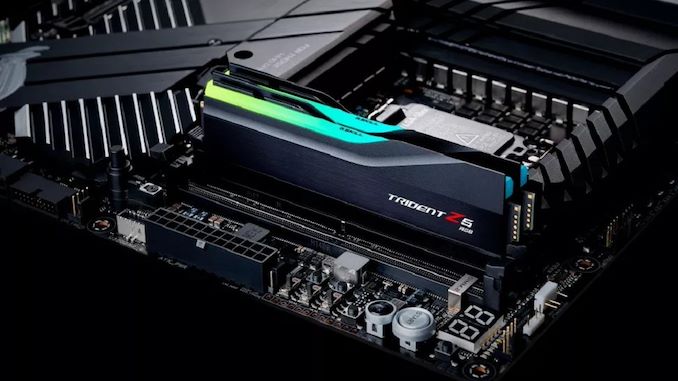
G.Skill Blitzes DDR5 World Record With Trident Z5 at DDR5-8888

For users buying a memory kit of DDR5, if they want to adhere to Intel specifications, will buy a DDR5-4800 kit. Though through XMP, there are other faster kits available – we’ve even tested G.Skill’s DDR5-6000 kit in our memory scaling article. But going above and beyond that, there’s overclocking.


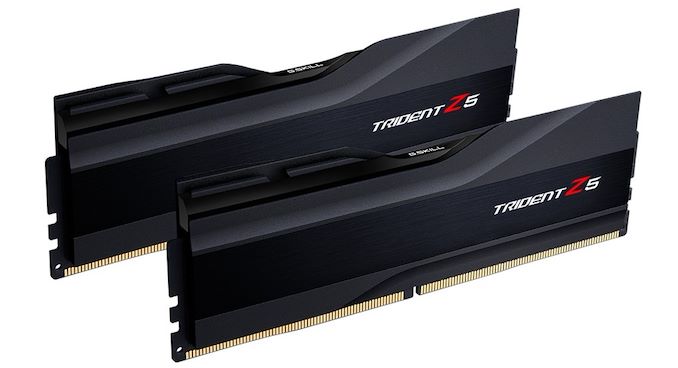
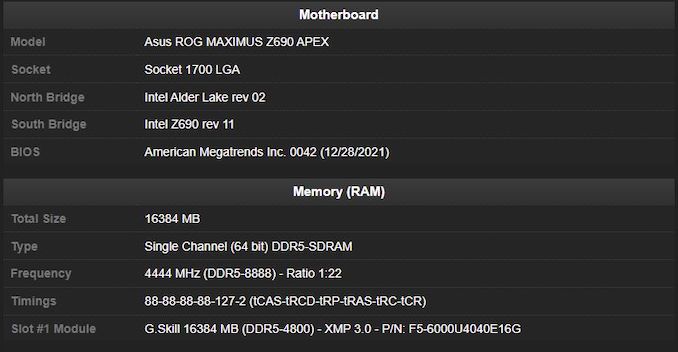
Back in November 2021, extreme overclocker ‘Hocayu‘ managed to achieve DDR5-8704 using G.Skill’s Trident Z5 DDR5-6000 memory. As always with these records, they are made to be broken, and fellow Hong-Kong native lupin_no_musume has managed to surpass this with an impressive DDR5-8888, also using G.Skill Trident Z5 memory, with an ASUS’s ROG Maximus Z690 Apex motherboard, Intel’s Core i9-12900K processor, and some liquid nitrogen.


Without trying to sound controversial, indeed, extreme overclocking isn’t as popular as it once was. That isn’t to say it doesn’t have a purpose – using sub-ambient cooling methods such as liquid nitrogen, dry ice, and even liquid helium can boost frequencies on processors and graphics cards well beyond what’s achievable with standard cooling. Doing this not only shows the potential of hardware, but it also gives companies ‘bragging rights’ as being the proud owners of overclocking world records. Car companies boast about the best Nürburgring record for a variety of categories, or tuning their mainstream offerings, in a similar fashion.


G.Skill Trident Z5 DDR5-6000 (2 x 16 GB) memory kit. 


This not only pushes the boundaries of what DDR5 memory is capable of, but it’s also an impressive feat given DDR5 is relatively nascent. For reference, going from DDR5-6000 to DDR5-8888 represents an overclock of around 48% over the XMP profile and a crazy 85% overclock over the JEDEC specification of DDR5-4800. It should be worth noting that this is an all out data rate record regardless of latency, which in this case was increased to 88 over the standard 40, for stability. Going back to the car analogy, this would be akin to speed records on the drag strip, rather than on the oval.


Screenshot from G.Skill Trident Z5 DDR5-8888 CPU-Z validation (link)


While speeds of DDR5-8888 are not attainable in the form of purchasable memory kits for Alder Lake, G.Skill did unveil a retail kit that tops out at DDR5-7000. We also reported back in November 2021 that S.K. Hynix was planning for DDR5-8400 at 1.1 volts, but that’s actually part of the entended JEDEC specifications for when processors get verfied at that speed.


Source: G.Skill


Related Reading


Source: AnandTech – G.Skill Blitzes DDR5 World Record With Trident Z5 at DDR5-8888

Rare and Beautiful Snow Blankets the Mediterranean Coast

It’s a winter wonderland in parts of the Mediterranean—a rare sight in a region of the world known for its azure seas and beautiful beaches. A major snowstorm blanketed parts of Greece and Turkey this weekend, causing havoc in an area not accustomed to winter weather.

Read more…


Source: Gizmodo – Rare and Beautiful Snow Blankets the Mediterranean Coast

This App Makes Your Cheap Mouse Work Better Than Trackpad Gestures

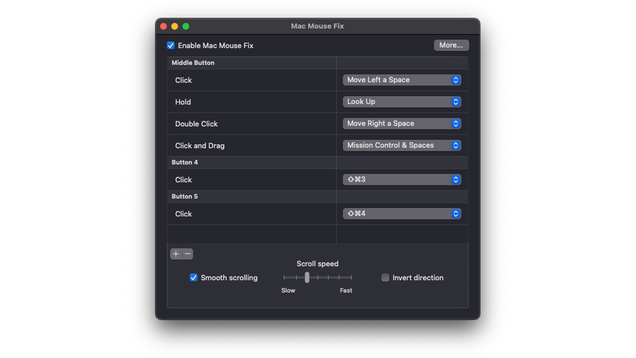
On one hand, using a cheap Bluetooth mouse with your Mac is better than moving the cursor with your finger. On the other hand, though, you miss out on some of macOS’ trackpad gestures—including the three-finger drag to switch to different workspaces. But there’s a free app called Mac Mouse Fix that adds trackpad…

Read more…


Source: LifeHacker – This App Makes Your Cheap Mouse Work Better Than Trackpad Gestures

Google Flushes Controversial FLoC In Favor Of Topics API To Replace Third-Party Cookies

Google Flushes Controversial FLoC In Favor Of Topics API To Replace Third-Party Cookies
After more than a year of testing, Google is abandoning plans to replace support for third-party tracking cookies with the “Federated Learning of Cohorts,” otherwise known as FLoC, basically an algorithm that sorts people into groups with others who have similar browsing habits. Google isn’t embracing third-party cookies, though. Instead,

Source: Hot Hardware – Google Flushes Controversial FLoC In Favor Of Topics API To Replace Third-Party Cookies

Astrophysicists Calculate A Staggering 40 Quintillion Stellar Black Holes Permeate The Universe

Astrophysicists Calculate A Staggering 40 Quintillion Stellar Black Holes Permeate The Universe
A team of astrophysicists have developed a method of estimating the number of stellar-mass black holes, and that number is massive. They estimate that while these black holes only make up 1% of all normal matter, there are an astounding 40,000,000,000,000,000,000 (40 quintillion) of them.

Teams at NASA continue to align the mirrors of the

Source: Hot Hardware – Astrophysicists Calculate A Staggering 40 Quintillion Stellar Black Holes Permeate The Universe

Skyrocketing Data Breaches Hit All-Time High In 2021 As Ransomware Attacks Doubled

Skyrocketing Data Breaches Hit All-Time High In 2021 As Ransomware Attacks Doubled
It felt like we were constantly reading about data compromises last year. Unfortunately, this statement is not far from the truth. According to the Identity Theft Resource Center (ITRC), there were 1,862 data compromises in 2021. The overall number of data compromises was up by 63% from 2020 and the number of ransomware attacks doubled last

Source: Hot Hardware – Skyrocketing Data Breaches Hit All-Time High In 2021 As Ransomware Attacks Doubled

Gizmodo's Degrees of the Future

In the 1950s, a visionary college student might have pursued a degree in computer science, and helped create our modern digital world. In the 1990s, that same student might have studied biotechnology, and developed genetic engineering techniques that are solving today’s health crises. But what and where should a…

Read more…


Source: Gizmodo – Gizmodo’s Degrees of the Future

Nvidia ready to abandon Arm acquisition, report says

Read 9 remaining paragraphs | Comments


Source: Ars Technica – Nvidia ready to abandon Arm acquisition, report says

Indonesia Regulator Says Financial Firms Banned From Facilitating Crypto Sales

Indonesia’s Financial Services Authority (OJK) on Tuesday warned that financial firms are not allowed to offer and facilitate sales of crypto assets amid a boom in crypto trading in Southeast Asia’s largest economy. From a report: “OJK has strictly prohibited financial service institutions from using, marketing, and/or facilitating crypto asset trading,” the regulator said in a statement posted on Instagram. It warned that the value of crypto assets often fluctuates and that people buying into the digital assets should fully understand the risks. “Please beware of allegations of Ponzi scheme scams in crypto investments,” it added, without elaborating. The warning follows similar concerns by the central banks of Thailand and Singapore.

Read more of this story at Slashdot.


Source: Slashdot – Indonesia Regulator Says Financial Firms Banned From Facilitating Crypto Sales

Lucasfilm and EA Announce New Star Wars Games, Including More Jedi: Fallen Order

In the last year Lucasfilm has announced its intent to bring Star Wars to a broader range of gaming developers, ahead of a decade-long exclusivity deal with EA Games that ends in 2023. But just because Lucasfilm has altered the deal doesn’t mean it’s not working with the developer on more Star Wars adventures.

Read more…


Source: Gizmodo – Lucasfilm and EA Announce New Star Wars Games, Including More Jedi: Fallen Order

8 Ways to Appear Offline on Social Media so You Can Lurk in Peace

If you don’t want to be overwhelmed by the pressure of replying to every message the second you see it, it’s best to just hide or disable your online status so people won’t see you or know when you were last online. You can appear offline in most popular social media and messaging apps, including WhatsApp, Facebook,…

Read more…


Source: LifeHacker – 8 Ways to Appear Offline on Social Media so You Can Lurk in Peace

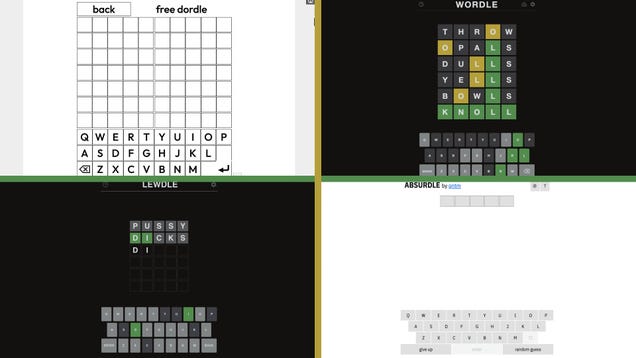
There Are Many Wordle Clones And Variants And That’s Good, Actually

Wordle, the browser-based word-guessing game that has overtaken Twitter, is very good. It is so good, in fact, that it has spawned over half a dozen different variants (and some rip-offs) made by fans of the original. These range from the antagonistic Absurdle to the extremely difficult, two-word Dordle. Wordle is not…

Read more…


Source: Kotaku – There Are Many Wordle Clones And Variants And That’s Good, Actually

Amazon buys rights to popular true-crime podcast 'My Favorite Murder'

Amazon is once again racing to buy the rights to major podcasts and the networks that share them. According to Bloomberg, Amazon is buying exclusive distribution and ad rights for the popular true crime series “My Favorite Murder” and other podcasts from Exactly Right Media. Amazon Music and Wondery will offer episodes a week before they’re available anywhere else, and Amazon will have sole rights to sell ads. The paid Wondery+ service will offer shows ad-free.

The company didn’t reveal the terms of the deal. When Amazon bought the celebrity SmartLess podcast, it paid $80 million for a three-year deal that also included one-week exclusives.

The arrangement comes as Amazon races to compete with Spotify and other tech giants snapping up major podcasts. While the “My Favorite Murder” deal isn’t a full exclusive, the goal is the same: Amazon wants to spur use of its services, and ideally add some paying customers. Whatever the company spends now might be worthwhile if it persuades you to switch apps and bring in years of ad or subscription money.


Source: Engadget – Amazon buys rights to popular true-crime podcast ‘My Favorite Murder’

Vulkan 1.3 Specification Released: Fighting Fragmentation with Profiles

Khronos this morning is taking the wraps off of Vulkan 1.3, the newest iteration of the group’s open and cross-platform API for graphics programming.


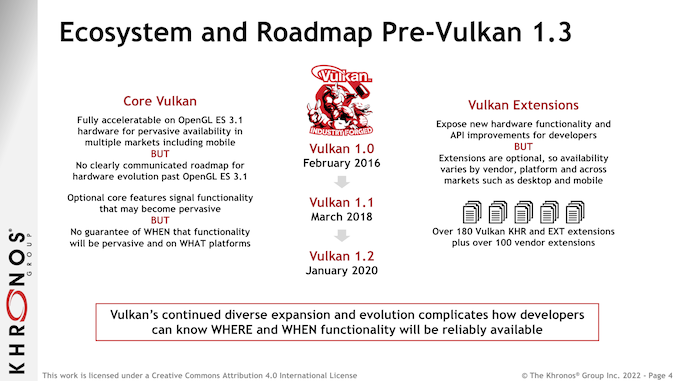
Vulkan 1.3 follows Khronos’s usual 2 year release cadence for the API, and it comes at a critical juncture for the API and its future development. Vulkan has been a full and official specification since 2016, turning 6 years old this year. This has given the API plenty of time to mature and have its kinks worked out, as well as to be adopted by software and hardware developers alike. But it also means that with the core aspects of the API having been hammered out, where to go next has become less obvious/harmonious. And with the API in use for everything from smartphones to high-end PCs, Vulkan is beginning to fragment at points thanks to the wide range of capabilities in devices.


As a result, for Vulkan 1.3, Khronos and its consortium members are taking aim at the future of the API, particularly from a development standpoint. Vulkan is still in a healthy place now, but in order to keep it that way, Khronos needs to ensure that Vulkan has room to grow with new features and functionality, but all without leaving behind a bunch of perfectly good hardware in the process. Thankfully, this isn’t a new problem for the consortium – it’s something virtually every standard faces if it lives long enough to become widely used – so Khronos is hitting the ground running with some further refinements to Vulkan.


Vulkan 1.3 Core


But before we get into Khronos’s fragmentation-fighting efforts, let’s first talk about what’s coming to the Vulkan 1.3 core specification. The core spec covers all of the features a Vulkan implementation is required to support, from the most basic smartphone to the most powerful workstation. As a result it has a somewhat narrow scope in terms of graphical features, but as the name says on the tin, it’s the common core of the API.


As with previous versions of the spec, Khronos is targeting this to work on existing Vulkan-compliant hardware. Specifically, Vulkan 1.3 is designed to work on OpenGL ES 3.1 hardware, meaning that of the new features being rolled into the core spec, none of them can be beyond what ES 3.1 hardware can do.


Consequently, Vulkan 1.3’s core spec isn’t focused on adding new graphical features or the like. By design, graphical feature additions are handled by extensions. Instead, the 1.3 core spec additions are largely a quality-of-life update for Vulkan developers, with a focus on adding features that simplify some aspect of the rendering process or add more control over it.
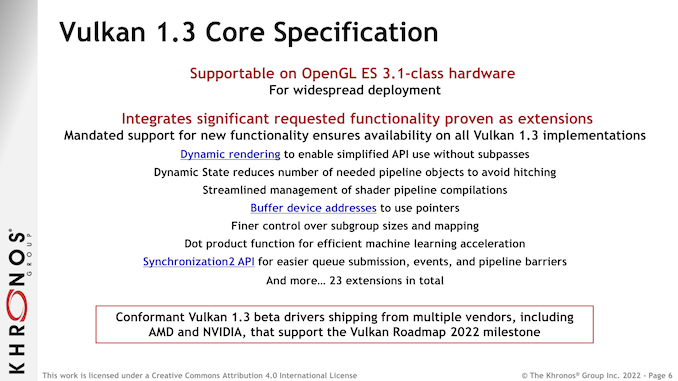


Altogether, Khronos is moving 23 existing extensions into the Vulkan 1.3 core spec. Most of these extensions are very much inside-baseball fodder for graphics programmers, but there are a couple of highlights. These include the integer dot product function, which is already widely used for machine learning inference on GPUs, as well as support for dynamic rendering. These functions already exist as extensions – so many developers can and are already using them – but by moving them into the core spec, they are now required for all Vulkan 1.3 implementations, opening them up to a wider array of developers.


But arguably the single most important addition coming to Vulkan isn’t an extension being promoted into the core specification. Rather, it’s entirely new functionality entirely, in the form of feature profiles.


Vulkan Profiles: Simplifying Feature Sets and Roadmaps


Up until now, Vulkan has not offered a concept of feature levels or other organizational grouping for additional feature sets. Beyond the core specification, everything in Vulkan is optional, all 280+ extensions. Meaning that for developers who are building applications that tap into features that go beyond the core spec – which has quickly become almost everything not written for a smartphone – there hasn’t been good guidance available on what extensions are supported on what platforms, or even what extensions are meant to go together.


The freedom to easily add extensions to Vulkan is one of the standard’s greatest strengths, but it’s also a liability if it’s not done in an organized fashion. And with the core spec essentially locked at the ES 3.1 level for the time being, this means that the number of possible and optional extensions has continued to bloom over the last 6 years.


So in an effort to bring order to the potential chaos, as well as to create a framework for planning future updates, Khronos is adding profiles to the Vulkan standard.


Profiles, in a nutshell, are a precisely defined lists of supported features and formats. Profiles don’t define any new API calls (that’s done by creating new extensions outright), so they are very simple conceptually. But, absent any kind of way to define feature sets, they are very important going forward for Vulkan.
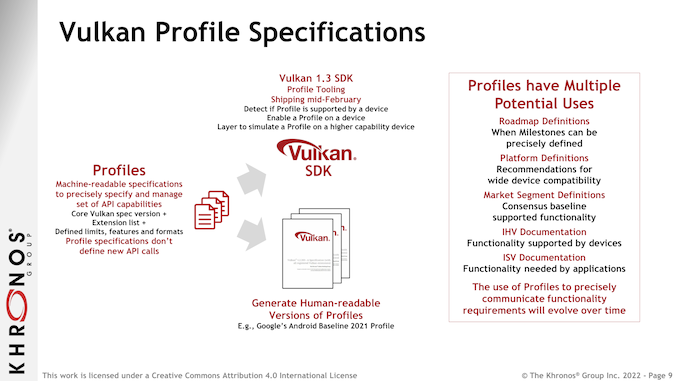


The power of profiles is that they allow for 280+ extensions to be organized into a much smaller number of overlapping profiles. Rather than needing to check to see if a specific PC video card supports a given extension, for example, a developer can just code against a (theoretical) “Modern Windows PC” profile, which in turn would contain all of the extensions commonly supported by current-generation PCs. Or alternatively, a mobile developer could stick to an Android-friendly profile, and quickly see what features they can use that will be supported by most devices.


At a high level, profiles are the solution to the widening gap between baseline ES 3.1 hardware, and what current and future hardware can do. Rather than risk fragmenting the Vulkan specification itself (and thus ending up with an OpenGL vs. OpenGL ES redux), profiles allow Vulkan to remain whole while giving various classes and generations of hardware their own common feature sets.


In line with the open and laissez faire nature of the Khronos consortium, profiles are not centrally controlled and can be defined by anyone, be it hardware devs, software devs, potato enthusiasts, or even Khronos itself. Similarly, whether a hardware/platform vendor wants to support a given profile is up to them; if they do, then they will need to make sure they expose the required extensions and formats. So this won’t be as neat and tidy as, say, Direct3D feature levels, but it will still be functional while offering the flexibility the sometimes loose consortium needs.


That said, Khronos’s expectation that we should only see a limited number of widely used profiles, many of which they’ll be involved with in some fashion. So 280 extensions should not become 280 profiles, at least as long as the hardware vendors can find some common ground across their respective platforms.


Finally, on a technical level, it’s worth noting that profiles aren’t just a loose list of features, but they do have technical requirements. Specifically, profiles are built as JSON lists, which along with providing a means to check profile compatibility, also open the door to things like generating human-readable versions of profiles. It’s a small distinction, but it will help developers quickly implement profile support in a generic fashion, relying on the specific JSON lists to guide their programs the rest of the way.


Profiles are also not limited to being built upon Vulkan 1.3. Despite being introduced at the same time as 1.3, they are actually a super-feature of sorts that can work with previous Vulkan versions, as all of the heavy lifting is being done at the application and SDK level. So it will be possible to have a profile that only calls for a Vulkan 1.0 implementation, for example.


Google’s Android Baseline 2021 Profile


The first profile out the door, in turn, comes from Google. The Android author is defining a Vulkan profile for their market that, at a high level, will help to better define and standardize what feature are available on most Android devices.


Interestingly, Google’s profile is built upon Vulkan 1.0, and not a newer version of Vulkan. From what we’re told, there are features in the Vulkan 1.1 core specification that are still not widely supported by mobile devices (even with the ES 3.1 hardware compatibility goal), and as a result, any kind of common progression with Vulkan on Android has become stalled. So since Google can’t get Vulkan 1.1/1.2/1.3 more widely supported across Android devices, the company is doing the next best thing and using a profile to define a bunch of common post-1.0 extensions that are supported by the current crop of devices.


The net result of this is the Android Baseline 2021 Profile. By establishing a baseline profile for the ecosystem, Google is aiming to not only make newer functionality more accessible to developers, but to simplify graphics programming in the process. Essentially, the Baseline 2021 Profile is a fix for existing fragmentation within the Android ecosystem by establishing a reasonable set of commonly supported features and formats.
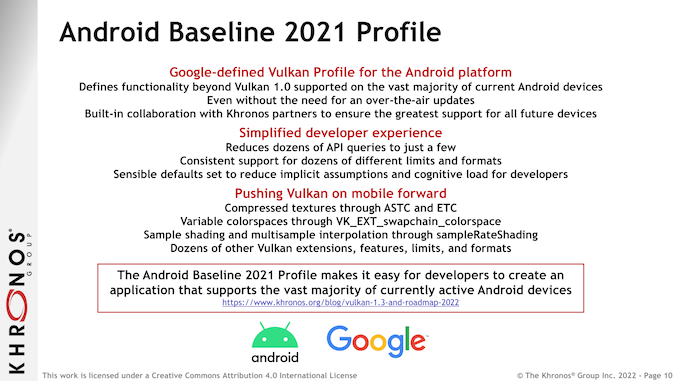


Of particular note, Google’s profile calls for support for both ETC and ASTC texture compression formats. As well, sample shading and multi-sample interpolation are on the list as well. Given that this is a baseline specification, there aren’t any high-concept next-generation features contained within the profile. But over time, that will change. Google has already indicated that they will be developing a 2022 profile for later this year, and will continue to keep adding further baseline profiles as the situation warrants.


Finally, Google’s use of profiles is also a solid example of taking advantage of the application-centric nature of profiles. According to Google, developers will be able to use profiles on the “vast majority” of Android devices without the need for over-the-air updates for those devices. Since profiles are handled at the application/SDK level, all the device itself needs to present are the necessary Vulkan extensions, which in accordance with a baseline specification are already present and supported in the bulk of Android devices.


Vulkan Roadmap 2022: Making Next-Generation Features Common Features


Last but certainly not least, the other big development to stem from the addition of profiles is a renewed path forward for developing and adopting new features for next-generation hardware. As mentioned previously, Vulkan has until now lacked a way to define feature sets for more advanced (non-core) features, which profiles are finally resolving. As a result, Khronos and the hardware vendors finally have the tools they need to establish baselines for not just low-end hardware, but high-end hardware as well.


In other words, profiles will provide the means to finally create some common standards that incorporate next-generation hardware and the latest programming features.


Because of Vulkan core’s ES 3.1 hardware requirements, there is a significant number of advanced features that have remained optional extensions. This includes everything from ray tracing and sample rate shading to more basic features like anisotropic filtering, multiple processor scheduling, and bindless resources (descriptor indexing). To be sure, these are all features that developers have had access to for years as extensions, but lacking profiles, there has been no assurance for developers that a given feature is going to be in all the platforms they want to target.


To that end, Khronos and its members have developed the Vulkan Roadmap 2022, which is both a roadmap of features they want to become common, as well as a matching profile to go with the roadmap. Conceptually, the Vulkan Roadmap 2022 feature set can be thought of as the inverse of Google’s baseline profile; instead of basing a profile around low-end devices, Roadmap 2022 excises low-end devices entirely in order to focus on common features found in newer hardware.
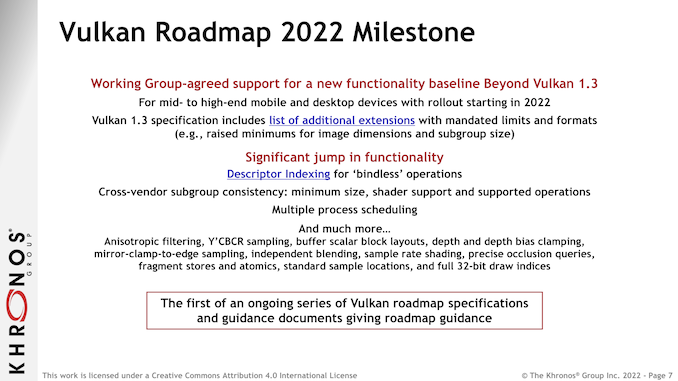


Roadmap 2022 is being based around features found in mid-end and high-end devices, mobile and PC alike. So while it significantly raises the bar in terms of features supported, it’s still not leaving mobile devices behind entirely – nor would it necessarily be ideal to do so. In practice, this means that Roadmap 2022 is slated to become the common Vulkan feature set for mid-end and better devices across the hardware spectrum.


Meanwhile, adoption of Roadmap 2022 should come very quickly since it’s based around features and formats already supported in existing hardware. AMD and NVIDIA have already committed to enabling support for the necessary features in their Vulkan 1.3 drivers, which are out today in beta and should reach maturity in a couple of months. In fact, the biggest hold-up to using profiles is Khronos itself – the Vulkan SDK won’t get profile support until next month.
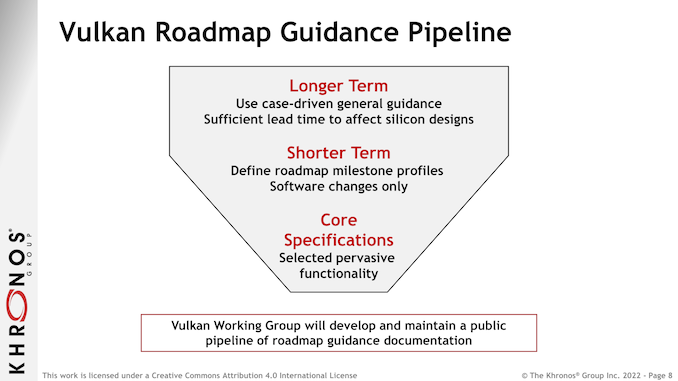


Finally, according to Khronos Roadmap 2022 is just the start of the roadmapping process for the group. After getting caught-up with current-generation hardware with this year’s profile, the group will be developing longer-term roadmaps for Vulkan profiles. Specifically, the group wants to get far enough ahead of the process that profiles are being planned out years in advance, when the next-generation of hardware is still under development. This would enable Khronos to have a compete pipeline of profiles in the works, giving hardware and software developers a roadmap for the next couple of years of Vulkan features.


Ultimately, having a roadmap will serve to help keep the development of advanced features for Vulkan on-track. Freed from having to support the oldest of hardware, the Vulkan group members will be able to focus on developing and implementing new features, knowing exactly when support is expected/planned/desired to arrive. Up until now the planning process has been weighed down by the lack of a timeline for making new features a requirement (de jure or otherwise), so having a formal process to standardize advanced features will go a long way towards speeding up and simplifying that process.


Source: AnandTech – Vulkan 1.3 Specification Released: Fighting Fragmentation with Profiles

Lenovo Halo Gaming Phone Tipped With A Snapdragon 8 Gen 1 Plus And 144Hz OLED

Lenovo Halo Gaming Phone Tipped With A Snapdragon 8 Gen 1 Plus And 144Hz OLED
There’s been a blurring of the lines between what constitutes a gaming phone versus a premium flagship. One thing most people would agree on, though, is that gaming phone needs a top-notch processor and a high-end display with a fast refresh rate. It looks like Lenovo’s upcoming Halo handset under its Legion banner will deliver both.

According

Source: Hot Hardware – Lenovo Halo Gaming Phone Tipped With A Snapdragon 8 Gen 1 Plus And 144Hz OLED