Should I Send My Resume as a PDF or Word Document?

If you haven’t been out testing the waters of the job market for a long time, dusting off your resume may feel like unearthing a relic from centuries past. But once you have it ready, you might be wondering about the best potential format for dispersing it among all the employers who may want to hire you.

Read more…


Source: LifeHacker – Should I Send My Resume as a PDF or Word Document?

Verizon's latest prepaid service offers mmWave 5G for $75 per month

You can now access Verizon’s 5G Ultra Wideband service with a prepaid plan. The company has launched Verizon Prepaid Unlimited, a $75 per month option that includes access to its mmWave network. If you need a refresher, Verizon effectively offers two…

Source: Engadget – Verizon’s latest prepaid service offers mmWave 5G for per month

New RISC-V hardware designs from 5G startup EdgeQ

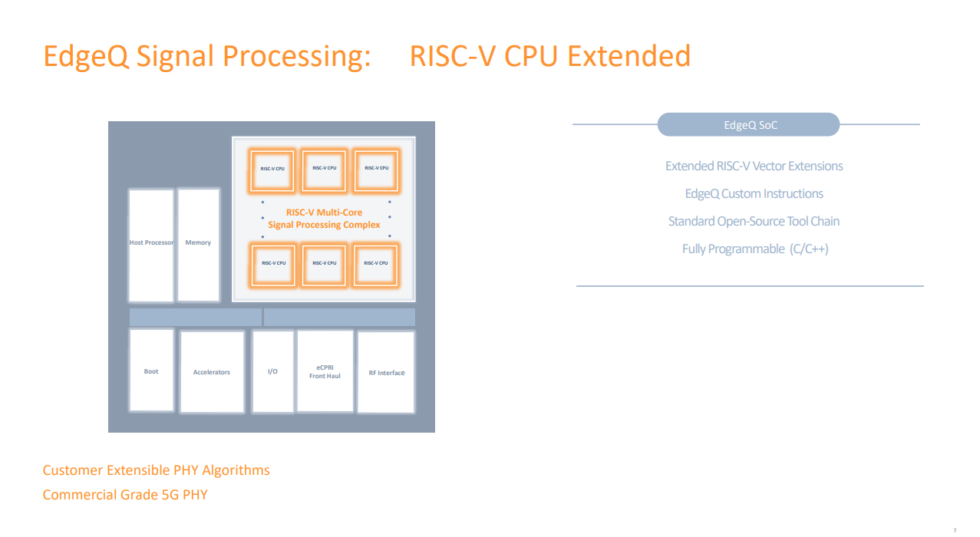
Today, 5G cellular startup EdgeQ is announcing the addition of two new members to its advisory board—former Qualcomm CEO Paul Jacobs, and former Qualcomm CTO Matt Grob. Their mission is to cut the Total Cost of Ownership (TCO) of 5G cellular base stations in half by leveraging and extending open hardware RISC-V designs.

Traditionally, Radio Access Network (RAN) devices have tended to be closed design and deeply proprietary—much like consumer Wi-Fi and network hardware, they depend on closed-design ASICs with vendor-provided drivers and firmware. Such closed stacks generally cannot be upgraded to accommodate new protocols and use cases—for example, a Radio Unit or Distributed Unit designed for 4G networks must typically be replaced in its entirety in order to service 5G devices.

By contrast, vendors can implement their own OpenRAN solutions, which generally implement fewer functions in hardware, and more in software running on traditional operating systems such as Linux. But implementing such an O-RAN properly requires very deep protocol expertise to get right, and it tends to be extremely power-hungry and expensive to maintain once finished.

Read 5 remaining paragraphs | Comments


Source: Ars Technica – New RISC-V hardware designs from 5G startup EdgeQ

AMD Ryzen 9 5980HS Cezanne Review: Ryzen 5000 Mobile Tested

Since AMD’s introduction of its newest Zen 3 core for desktop users, the implementation for notebooks and mobile users has been eagerly awaited. In a single generation, on the same manufacturing process, AMD extracted +19% more performance per clock (we verified), so for any system that is power limited, extra performance is often very well received. AMD announced its new Ryzen 5000 Mobile processor family at the start of the year, with processors from 15W to 45W+ in the pipeline, and the first mobile systems coming to market in February. AMD sent us a peak example of Ryzen 5000 Mobile for today’s review, the 35W Ryzen 9 5980HS, as contained in the ASUS ROG Flow X13.


Source: AnandTech – AMD Ryzen 9 5980HS Cezanne Review: Ryzen 5000 Mobile Tested

Intel Iris Xe Video Cards Now Shipping To OEMs: DG1 Lands In Desktops

Following plans first unveiled last year during the launch of their DG1 GPU, Intel sends word this morning that the first Iris Xe video cards have finally begun shipping to OEMs. Based on the DG1 discrete GPU that’s already being used in Intel’s Iris Xe MAX laptop accelerators, the Iris Xe family of video cards are their desktop counterpart, implementing the GPU on a traditional video card. Overall, with specifications almost identical to Xe MAX, Intel is similarly positioning these cards for the entry-level market, where they are being released as an OEM-only part.


As a quick refresher, the DG1 GPU is based on the same Xe-LP graphics architecture as Tiger Lake’s integrated GPU. In fact, in broad terms the DG1 can be thought of as a nearly 1-to-1 discrete version of that iGPU, containing the same 96 EUs and 128-bit LPDDR4X memory interface as Tiger Lake itself. Consequently, while DG1 is a big first step for Intel – marking the launch of their first discrete GPU of the modern era – the company is planning very modestly for this generation of parts.


Intel Desktop GPU Specification Comparison
  Iris Xe

dGPU
Tiger Lake

iGPU
Ice Lake

iGPU
Kaby Lake

iGPU
ALUs 640

(80 EUs)
768

(96 EUs)
512

(64 EUs)
192

(24 EUs)
Texture Units 40 48 32 12
ROPs 24? 24 16 8
Peak Clock 1650MHz? 1350MHz 1100MHz 1150MHz
Throughput (FP32) 2.11 TFLOPs 2.1 TFLOPs 1.13 TFLOPs 0.44 TFLOPs
Geometry Rate

(Prim/Clock)
2 2 1 1
Memory Clock LPDDR4X-4266? LPDDR4X-4266 LPDDR4X-3733 DDR4-2133
Memory Bus Width 128-bit 128-bit

(IMC)
128-bit

(IMC)
128-bit

(IMC)
VRAM 4GB Shared Shared Shared
TDP ~25W? Shared Shared Shared
Manufacturing Process Intel 10nm SuperFin Intel 10nm SuperFin Intel 10nm Intel 14nm+
Architecture Xe-LP Xe-LP Gen11 Gen9.5
GPU DG1 Tiger Lake

Integrated
Ice Lake Integrated Kaby Lake Integrated
Launch Date 01/2021 09/2020 09/2019 01//2017


The first DG1 GPUs were shipped in the fall as part of Intel’s Iris Xe MAX graphics solution for laptops. At the time, Intel also indicated that a desktop card for OEMs would also be coming in 2021, and now, right on schedule, those desktop cards have begun shipping out.


Overall, Intel is taking a very OEM-centric approach to their DG1 products, and that goes for both laptops and the desktops. Even the desktop Iris Xe cards won’t be sold as retail – as entry-level cards, they are unlikely to fly off of shelves – and instead are only being sold to OEMs for use in pre-built systems. And even then, the cards were co-designed with ecosystem partners – of particular note, ASUS – rather than Intel building and shipping out their own video cards. So by desktop video card standards, Intel is being somewhat hands-off at the moment.


In a curious twist, the desktop cards will have slightly lower specifications than the laptop parts. While I’m still waiting to hear what the TDPs and final clockspeeds will be, Intel’s announcement confirms that the Iris Xe cards will only ship with 80 of 96 EUs enabled, rather than being fully-enabled in the case of the laptop parts. Given that this is an entry-level part, any further drop in performance isn’t doing the part any favors, but at the same time it was never going to be a speed-demon to begin with. At any rate, given that no chip has perfect yields, we now know where salvaged DG1 chips are going.


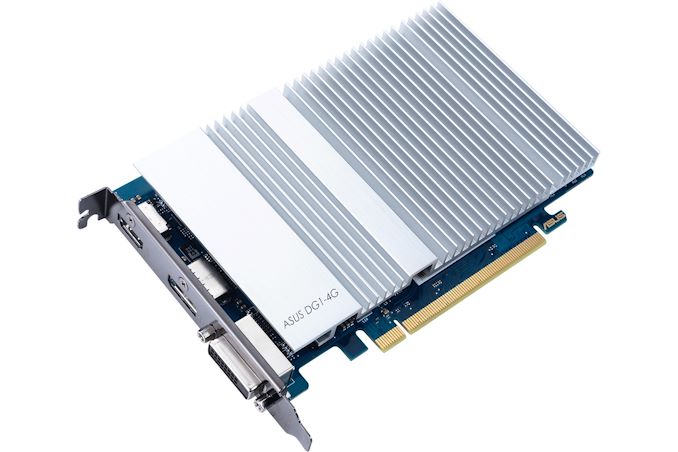
Meanwhile, like their laptop counterparts, the Iris Xe desktop cards will ship with 4GB of LPDDR4X memory. Intel has also confirmed that the cards will ship with up to three display outputs, with ASUS’s card using a mix of HDMI, DisplayPort, and even a DL-DVI-D port.
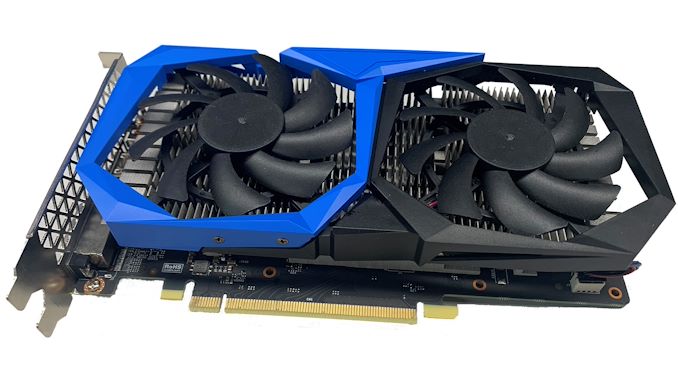


Colorful’s DG1 Card


As for Intel’s target market, the company is targeting what they’re calling the “high-volume, value-desktop market.” Notably, unlike the Iris Xe MAX launch, Intel’s (admittedly brief) news release doesn’t spend much time focusing on the cards as a secondary accelerator, and instead are promoting these as a superior solution over existing graphics options. Given the focus on things like AV1 decoding, HDR support, and deep learning inference performance, I’m assuming that these will primarily be showing up in Atom (Gemini Lake Refresh) systems. Though it may also show up in low-end Comet Lake Celeron and Pentium systems, where vendors are looking to add a few more display ports and take advantage of the additional hardware accelerator blocks for things like video encoding, similar to how Intel positioned Iris Xe MAX for laptops.


Finally, given the OEM-centric nature of today’s launch, Intel isn’t publishing any specific availability dates for their Iris Xe video cards. But we expect that they’ll begin showing up in short order.


Source: AnandTech – Intel Iris Xe Video Cards Now Shipping To OEMs: DG1 Lands In Desktops

Amazon's Alexa Can Now Act On Its Own 'Hunches'

An anonymous reader quotes a report from The Verge: Amazon is enabling a new feature today that allows Alexa to proactively complete tasks around the house, such as turning off lights, based on your habits and frequent requests. Alexa has been able to sense these habits and ask about them since 2018 — the company calls them “hunches” — but before this update, Alexa would ask permission before acting on something like lowering the thermostat before you went to bed. If the new proactive hunches are enabled, though, Alexa will skip asking for permission for a task and just do it.

While proactive hunches seem like they could make Alexa a lot more useful, having granular controls over what Alexa can automatically act on will be important. An Amazon support article seems to suggest you can select what types of hunches Alexa can complete on its own, but we’ve reached out to Amazon for more information on how much you can customize proactive hunches. In addition, Amazon is rolling out its Guard Plus security subscription service. “The service can alert you if Alexa picks up on certain types of sounds in your home and offers access to human agents who can call emergency services on your behalf, similar to ADT,” reports The Verge. It’ll cost $4.99 per month.

The company is also rolling out an energy dashboard via the Alexa app that can monitor and estimate how much power compatible devices connected to Alexa use if their manufacturers support it.

Read more of this story at Slashdot.


Source: Slashdot – Amazon’s Alexa Can Now Act On Its Own ‘Hunches’

With Linux 5.12 Set To Boot On The Nintendo 64, The N64 Controller Driver Is Now Queued

A few days ago we wrote about Linux 5.12 to see support for the Nintendo 64 more than two decades after that MIPS-based video game console first shipped. While the practicality of Linux on the Nintendo 64 is particularly limited given only 4~8MB of RAM and the MIPS64 NEC VR4300 clocked under 100MHz, it’s going upstream and now the N64 controller driver is also queued for this next kernel cycle…

Source: Phoronix – With Linux 5.12 Set To Boot On The Nintendo 64, The N64 Controller Driver Is Now Queued

An automated Telegram bot is selling Facebook account phone numbers

Access to a database reportedly containing 500 million users’ private information is being sold on a cybercrime forum. Motherboard reports that the database, which hosts data pulled from Facebook more than two years ago, contains people’s phone numbe…

Source: Engadget – An automated Telegram bot is selling Facebook account phone numbers

The Morning After: Apple's new fitness feature is a guided walk with Dolly Parton

How are those mid-pandemic, new-year-new-you fitness goals going? My diet is still atrocious, but I’m grinding out my workouts. We’ve got two stories today that take different approaches to coaxing us all into being a little more active.  Through th…

Source: Engadget – The Morning After: Apple’s new fitness feature is a guided walk with Dolly Parton

Samsung's Galaxy S21 Ultra features a new low-power OLED display

When Samsung launched the Galaxy S21 Ultra, it talked about how the device’s screen supports refresh rates of 120Hz at both full HD and Quad HD resolutions. What it didn’t say until now, however, is that the S21 Ultra serves as the debut device for t…

Source: Engadget – Samsung’s Galaxy S21 Ultra features a new low-power OLED display

Samsung's Galaxy Watch 3 ECG tracking comes to 31 more countries

Samsung has announced that it’s expanding the ECG and blood pressure tracking features in its latest Galaxy Watch models to the UK and Europe, along with Chile, Indonesia and the UAE for 31 new countries in total. So far, the function has only been a…

Source: Engadget – Samsung’s Galaxy Watch 3 ECG tracking comes to 31 more countries

Baby panda won't let go of zookeeper

clingy-baby-panda.jpg

This is a video of six-month-old baby giant panda Fu Bao being super clingy with a zookeeper in South Korea.

Fu Bao, the first Chinese giant panda born in South Korea, made her official public debut on January 4, according to the zoo.The baby panda’s parents, seven-year-old female Ai Bao and eight-year-old male Le Bao, arrived in 2016 from China’s Sichuan province, the home of giant pandas, as part of China’s “panda diplomacy”.

The original video posted by Everland zoo last month has over 4 million views, though I suspect it’s fake, because how could anybody ever walk away from this cutie pie! I just wanna squish her and cuddle her and never leave her ever. At the end the zookeeper just walks away and leaves her all alone and nobody could ever be that cruel so obviously there’s some deepfake shenanigans going on here.

Keep going for the full adorable video.

Source: Geekologie – Baby panda won’t let go of zookeeper

Linux Says Farewell To Intel's Smartphone Attempts With Clearing Out Moorestown / Medfield

Not only are some old ARM platforms and some obsolete, obscure CPU architectures on the chopping block for some spring cleaning in the Linux kernel, but the Intel Moorestown and Medfield “Mobile Internet Device” platforms are being phased out from the Linux kernel this spring as well…

Source: Phoronix – Linux Says Farewell To Intel’s Smartphone Attempts With Clearing Out Moorestown / Medfield

Fedora's Chromium maintainer suggests switching to Firefox as Google yanks features in favour of Chrome

‘They’re not closing a security hole, they’re just requiring that everyone use Chrome’Fedora’s maintainer for the open-source Chromium browser package is recommending users consider switching to Firefox following Google’s decision to remove functionality and make it exclusive to its proprietary Chrome browser.…

Source: LXer – Fedora’s Chromium maintainer suggests switching to Firefox as Google yanks features in favour of Chrome

Europe created more energy from renewables than fossil fuels last year

Europe is slowly reducing its dependancy on fossil fuels. A report co-published by Ember and Agora Energiewende, two think tanks focused on clean energy, has revealed that the continent generated more electricity from renewables than fossil fuels in…

Source: Engadget – Europe created more energy from renewables than fossil fuels last year