Driven by a surge in demand for artificial intelligence, Taiwanese chip maker TSMC plans to invest nearly T$90 billion ($2.87 billion) in an advanced packaging facility in northern Taiwan, the company said on Tuesday. From a report: “To meet market needs, TSMC is planning to establish an advanced packaging fab in the Tongluo Science Park,” the company said in a statement. CEO C.C. Wei said last week that TSMC is unable to fulfil customer demand driven by the AI boom and plans to roughly double its capacity for advanced packaging – which involves placing multiple chips into a single device, lowering the added cost of more powerful computing. For advanced packaging, especially TSMC’s chip on wafer on substrate (CoWoS), capacity is “very tight,” Wei said after the company reported a 23% fall in second-quarter profit. “We are increasing our capacity as quickly as possible. We expect this tightening will be released next year, probably towards the end of next year.”
Back-to-school time is fast approaching, which means the struggle to get out the door (on time) is, once again, also upon us. As any veteran parent knows, successfully leaving the housein the morning really starts the night before. Packing up lunches, stuffing homework into backpacks, and having shoes ready and…
If you were feeling nostalgic for old-school Max Payne, the perpetually grimacing star of Remedy’s iconic third-person shooter of the same name, take heart. There’s now a mod for Max Payne 3 that brings back the character’s unforgettable OG face—based on Remedy Creative Director Sam Lake—squint and all.
For more than 25 years, a technology used for critical data and voice radio communications around the world has been shrouded in secrecy to prevent anyone from closely scrutinizing its security properties for vulnerabilities. But now it’s finally getting a public airing thanks to a small group of researchers in the Netherlands who got their hands on its viscera and found serious flaws, including a deliberate backdoor.
The backdoor, known for years by vendors that sold the technology but not necessarily by customers, exists in an encryption algorithm baked into radios sold for commercial use in critical infrastructure. It’s used to transmit encrypted data and commands in pipelines, railways, the electric grid, mass transit, and freight trains. It would allow someone to snoop on communications to learn how a system works, then potentially send commands to the radios that could trigger blackouts, halt gas pipeline flows, or reroute trains.
Linux security is anything but stagnant. It’s no secret that cybercriminals are exploiting the growing popularity of the OS and the high-value servers and devices it powers worldwide with new and evolving attacks such as malware and rootkits. Despite the reputation Linux has earned of being an exceptionally secure and stable OS , Linux malware is on the rise, and the number of new Linux malware variants reached a record high in the first half of 2022 , as researchers discovered nearly 1.7 million samples during this period.
DJI is one of the most innovative gadget companies out there, constantly trying new things with its drones like a triple-camera setup on the Mavic 3 Pro. With the launch of the mid-sized Air 3 camera drone, the company has introduced a new trick called dual primary cameras. That means the telephoto camera has the same specs as the main camera, rather than being relegated to lesser quality like it was on the Mavic 3. That opens up new possibilities for pilots, giving them two ways to create cinematic shots.
It also has numerous improvements over the Air 2 and Air 2S. It uses DJI’s new O4 transmission system that greatly increases range, while bringing the Waypoint feature to Air drones for the first time. It also has much improved battery life and is considerably quieter. Otherwise, it matches the Mavic 3 Pro feature for feature, with obstacle detection all around, focus tracking, Hyperlapse and more.
Some buyers might see the 1/1.3-inch sensors as a downgrade compared to the 1-inch sensor on the Air 2S, however. How does it stack up against that model, and how does it fit in with the Mavic 3 Pro and Mini 3 Pro models? I took it flying in France’s Loire valley with my drone pilot friend to find out.
Design and performance
With a dual-camera module up front and similar design, the Air 3 (no more Mavic in the name) looks more like the Mavic 3 than the Air 2 and Air 2S. It has the same frog-like design, and folds up exactly like the Mavic 3, collapsing into a compact size for travel. The body has omnidirectional sensors all around for obstacle detection. For storage, it comes with the usual microSD storage slot and has 8GB internally that’s really for emergency use only. It’s also considerably heavier than the Air 2S, tipping the scales at 720 grams compared to 595.
At the same time, it has borrowed some aerodynamic tricks from the Mini 3 Pro, particularly the larger propellers that reduce noise down to 81 decibels — making it near-inaudible when flying at over 100 feet or so. The body is also more aerodynamic, giving it better range in forward flight and the ability to handle stronger winds than past models.
Much of the extra weight comes from the new 4,241 mAh batteries that weigh 267 grams more than an entire Mini 3 Pro. They have nearly the capacity of the Mavic 3 Pro’s batteries, greatly boosting the Air 3’s range to 46 minutes, up from 34 minutes on the Air 2S.
In real-world use, we saw flight times of around 35 minutes before the return-to-home warning went off, depending on flying style and winds. That generally allowed us to fly for a full day with three charged batteries. DJI also introduced a new charging feature with the updated battery hub, letting you transfer power from two weaker batteries to the most charged at the touch of a button. Doing so allows for longer flights if you’re in a location with no charging available. The one drawback of the higher-capacity batteries is that charging speeds are relatively slow.
Steve Dent for Engadget
Another key feature is the next-gen O4 video transmission system that boosts range from 15 to 20 km (9.3 to 12.4 miles). Drone range can be a big problem in Europe, because laws significantly reduce transmission power compared to the US. To help compensate for that, DJI added a new 5.1GHz frequency in Europe that appears to have a large impact on range and transmission dropouts in tricky terrain, from what we saw in our tests in France.
In terms of maneuverability and speed, the Air 3 offers a good compromise between stability of the Mavic 3 Pro and the agility of the Mini 3 Pro. The latter makes it great for following fast-moving subjects like mountain bikers and vehicles, but it’s also steady in stiff breezes. At the same time, if a subject is moving through trees, obstacle avoidance with APAS 5.0 is outstanding, with less risk of crashing than the Mini 3 Pro thanks to the extra sensors — particularly from the side and rear.
All of DJI’s tentpole features like Active Track, Master Shots, Quickshots and Timelapse are available on the Air 3 and work on both cameras. Active Track, used to lock onto and follow subjects, works about the same on both cameras. As with DJI’s other drones, it’s generally reliable, but if you’re chasing a mountain biker through the trees, it can lag a bit and the tracking can switch off without warning.
Steve Dent for Engadget
Quickshots features like Dronie and Rocket are more interesting with the addition of the tele camera that can add extra intimacy and drama. The obstacle detection is handy there as well. Because the drone flies automatically once you hit “go,” it’s easy to misjudge boundaries, so it’s good to know it’ll abort if it gets too close to something.
On top of those flight modes, DJI has brought the Mavic 3’s Waypoint flight mode over to the Air series for the first time. It lets you plan flight and camera moves in advance, letting you repeat a flight precisely for multiple takes, Timelapse videos and more. It requires some time to learn and set up, but it delivers consistent results. It also opens up creative possibilities, like doing a Timelapse during the day and at night, then seamlessly blending them together.
Along with the Air 3, DJI has introduced the new RC-2, DJI’s third screen controller after the RC and the RC Pro. It’s a good compromise between the two, as it’s significantly cheaper than the $1,200 RC Pro. At the same time, it has a brighter screen, more substantial feel and more precise controls than the RC. It’s available either separately or in a bundle with the Air 3 Fly More kit. DJI also announced another new controller, the RC-N2, effectively a refresh of the RC-N1, with the main benefit being the new O4 transmission system.
Cameras
The big idea with the Air 3 is that the quality of the two cameras is the same. As such, it comes with a 1/1.3-inch 24mm (35mm equivalent) f/1.7 main and 70mm f/2.8 telephoto camera. Those focal lengths match the two primary cameras on the Mavic 3 Pro, with the sensor size being the same as the Mini 3 Pro and the tele camera on the Mavic 3 Pro.
The 70mm lens is particularly good for action or hero shots, adding excitement and a more natural perspective. With a perfect portrait focal length, it’s great for people shots at weddings, for example. It also lets you stay a greater distance from subjects for safety or other reasons, while compressing the space between them. As usual, the main wide camera can be used for establishing, overhead, follow and other shots. And with identical sensors, it’s easy to match footage from the two cameras while editing.
The sensors have dual native ISO support for improved light sensitivity, and deliver 4K 60p in HDR or 4K at up to 100 fps with slo-mo only playback. 1080p can be shot at 200 fps with slo-mo playback as well. The camera module can be tilted down 90 degrees and up 60, and it’s the first Air series drone supporting 2.7K vertical 9:16 video.
Both cameras support 10-bit 4:2:0 D-Log M and HLG HDR for improved dynamic range and reduced banding, something that can be an issue when shooting skies. DJI’s regular D-Log mode, which offers even more dynamic range, is not available on the Air 3, though. It also lacks a variable aperture found on the Mavic 3, so the optional ND filter kit (available in the Fly More combo) is desirable for sunny day flying to allow for lower shutter speeds and thus smoother video.
With the same 1/1.3-inch dual native ISO sensor and resolution as the Mini 3 Pro, image quality is similar — but there are some improvements on the Air 3. D-Log M offers better dynamic range, particularly in challenging contrasty shooting conditions. It also offers mildly better low-light capability, with less noise in shadows for nighttime cityscapes, for example.
The Air 3 delivers as good or even better video and photo quality than the larger sensor on the Air 2S, likely because the size difference is slight and the Air 3 has higher resolution. That said, it’ll be interesting to see if DJI releases an Air 3S, possibly with a larger sensor.
Wrap-up
Steve Dent for Engadget
DJI has another winner with the Air 3 thanks to the dual cameras. By elevating the tele to the same importance as the main camera, it opens up new cinematic shooting options. It should prove popular with event and wedding pros who are willing to pay a few hundred dollars more than the Mini 3 Pro. In return, they get additional creative options, plus a more stable and secure camera drone.
Image quality might not be good enough for some pros when compared to the $2,200 Mavic 3 Pro, But at $1,100, it’s considerably cheaper, more maneuverable, and offers the same features (including Waypoints) and level of obstacle protection. At the same time, it has a leg up on the Mini 3 Pro in terms of image quality thanks to the D-Log M option.
At $1,100 with the non-screen RC-N2 controller, the Air 3 is $330 more than the DJI Mini 3 Pro with the same controller. That goes up to $1,550 with the RC 2 Fly More kit, compared to $1,253 for the Mini 3 Pro in a similar kit. At those prices, its main competition is Autel’s similarly priced 6K EVO Lite+ and the Mini 3 Pro itself. In any case, it’s a great new option for drone buyers who might like the idea of two primary cameras and can’t quite afford a Mavic 3 Pro.
This article originally appeared on Engadget at https://www.engadget.com/dji-air-3-review-a-high-quality-zoom-adds-new-creative-options-130020261.html?src=rss
Crucial’s X6 and X8 Portable SSDs have been attractive budget options for the mainstream consumers looking to purchase high-capacity direct-attached storage drives. The company has been delivering some industry-firsts in these drives. However, these drives use QLC and are not particularly attractive for power users (such as content creators) who require writing vast amounts of data as quickly as possible.
Over the last few quarters, the company has been actively trying to introduce high-performance flash products in the client market. As an example, Crucial’s T700 Gen 5 internal SSD is the only M.2 SSD available in retail to reach the 14 GBps mark. The company is introducing two new products in the PSSD category today – the USB 3.2 Gen 2 X9 Pro, and the USB 3.2 Gen 2×2 X10 Pro. These 1 GBps and 2 GBps-class drives come with a Type-C port and a Type-C to Type-C cable (Type-A adapter sold separately). The performance specifications of these two products indicate suitability for power users – for the first time, the company is quoting write speeds for their PSSDs in the marketing material.
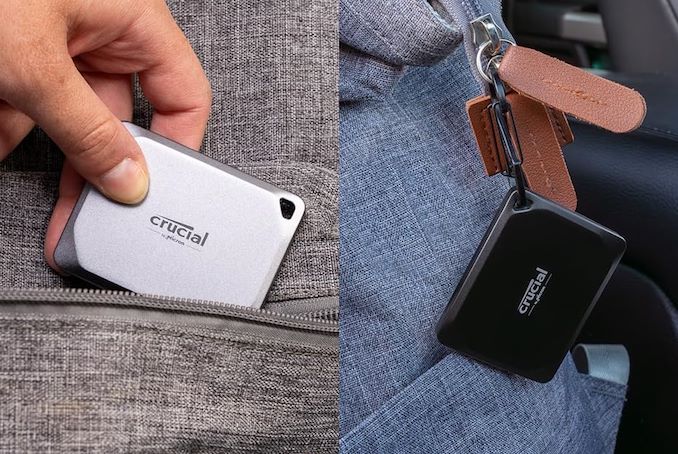
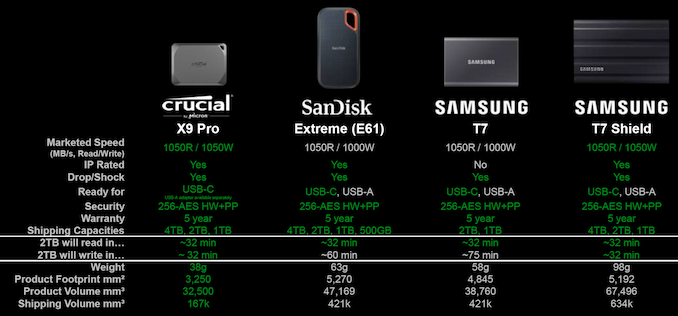
The X9 Pro is a 38g 65mm x 50mm USB 3.2 Gen 2 PSSD made of anodized aluminum. It includes a lanyard hole (with the LED near the hole, rather than near the Type-C port) and a rubberized soft-touch base for protection against bumps. The sides are slightly recessed for better traction during handling. It is IP55 rated, and drop-proof up to 7.5′. The PSSD supports hardware encryption (Windows BitLocker-compatible, but Crucial’s own software to set passwords will become available later this year). The company claims speeds of up to 1050 MBps reads and 1050 MBps writes, with a minimum of 970 MBps for a whole drive fill using sequential writes.
Micron’s Competitive Positioning of the X9 Pro (Vendor Claims)
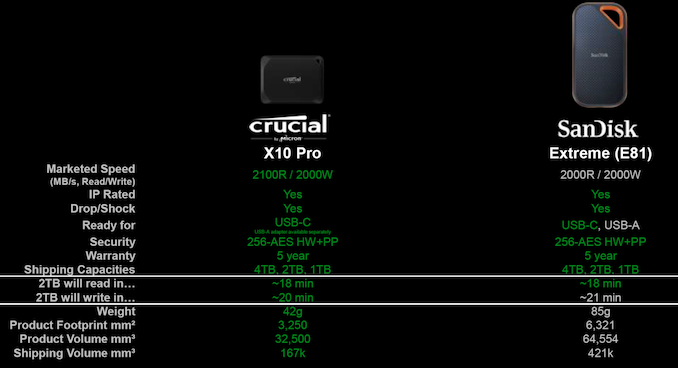
The X10 Pro is a 42g 65mm x 50mm USB 3.2 Gen 2×2 PSSD, with a very similar industrial design to the X9 Pro (retaining almost all of the features). The extra weight is contributed by some internal changes for a better thermal solution. Read speeds of up to 2100 MBps and write speeds of up to 2000 MBps are claimed, though there is no minimum sequential write speed guaranteed.
Micron’s Competitive Positioning of the X10 Pro (Vendor Claims)
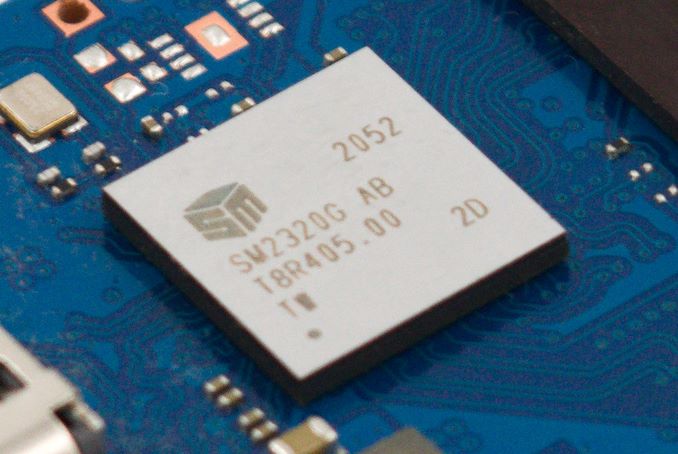
The X9 Pro and X10 Pro both utilize the Silicon Motion SM2320 native UFD controller. We had previewed its performance (and that of the Kingston XS2000 based on it) using Micron’s 96L 3D TLC NAND. More recently, the Transcend ESD310C was evaluated with the same controller and Kioxia’s BiCS5 112L 3D TLC NAND. Micron is able to claim much better long-term performance consistency compared to these products because of the use of their 176L 3D TLC NAND. The form-factor and size do point to the possibility of thermal throttling, which is possibly the reason for Crucial not claiming any minimum sustained write speeds for the 20 Gbps product. We will get to know further during the course of our hands-on evaluation.
Seagate was one of the first vendors to bundle a free month of Adobe Creative Cloud and Mylio Photos with select direct-attached storage drives. Micron is adopting the same value additions for the X9 Pro and X10 Pro, and also including a copy of Acronis True Image for Crucial for free.
Pricing varies from $80 for the 1 TB version of the X9 Pro to $290 for the 4 TB version of the X10 Pro, and the drives are available for purchase today. The flash industry is currently in a bust cycle, and pricing is quite low. While that is not great news for the manufacturers, it is good news for consumers. The introduction of the X9 Pro and X10 Pro at attractive price points finally brings some competition to the SanDisk Extreme / Samsung T7 Shield in the 1 GBps category and the SanDisk Extreme PRO v2 in the 2 GBps category. While the SanDisk offerings with a bridge-based design will probably perform better for a wider variety of workloads, the Micron offerings are bound to have an advantage in terms of physical footprint and power consumption.
As if airfare wasn’t costly enough on its own, these days you usually need to factor in at least $35 for dreaded checked bag fees. And that’s just one-way, so needless to say, the costs of checking your bags adds up quick.
Enlarge/ Lee Pace as the latest incarnation of Brother Day, one of a trio of ruling Cleons in Apple TV’s Foundation. (credit: Apple TV+)
We’re now two episodes into the second season of Foundation, Apple TV’s epic sci-fi series adapted—or remixed, per showrunner David Goyer—from the seminal series of stories by Isaac Asimov, and it’s shaping up to be even better than its first. Goyer took great pains in S1 to carefully set up his expansive fictional world, and the scope has only broadened in the second season.
Goyer describes the new season as more emotional and romantic, with a bit more humor—or at least moments of levity—and faster paced now that the main characters and their key relationships have been well established. “Now it’s a bit like jazz,” he said. “We can riff on our creation and start to move the chess pieces around and create alliances or unusual pairings that didn’t exist last season. Audiences have a certain expectation of how things are going to unfold, and part of the fun is subverting those expectations.” The narrative is also more linear, with fewer time jumps forward and back—just the occasional traditional flashback.
(Major spoilers for S1 below. Some minor spoilers for S2 but no major reveals.)
For processors supporting CPU performance boosting with higher performance states available beyond the base states, Linux allows toggling the boosting on a per-CPU basis. However, a new patch proposed this week would allow per-policy performance boosting where capable…
Sony can no longer claim its popular WF-1000XM4 wireless earbuds offer the best active noise cancellation (ANC) around. Why is that? Simply put, they’ve been usurped by its newest flagship offering, the WF-1000XM5, and according to Sony, “[active] noise cancellation does not get any better” than it does with its latest iteration of the WF-1000X
Quests are now available to everyone with a Quest — a Meta Quest VR headset, that is. Meta is rolling out quests and rewards to every user on Horizon Worlds, its virtual reality live-interactive experience. Meta started testing quests over the spring with a game called Giant Paddle Mini Golf and added two more: Arena Clash and Bad Roommates. Rewards include things like new clothing options for your avatar.
Meta clearly designed many of the quests (and rewards) to encourage users to interact more with their avatar — an area of its business that has seen billions of dollars lost. Main quests include “try on a clothing avatar reward you’ve earned” and “open your backpack and change your emote” — not exactly a Frodo traveling to Mordor-level quest, but some could be engaging. Quests are available in the Worlds Menu, each stating how much of a reward you’ll receive for completing it. Meta claims it will add more as time goes on.
Meta Horizon Worlds’ update also includes a new quick actions menu that can pause your gameplay and lets you mute, follow or block people you encounter. While Meta fixed some bugs, anytime you discover one, you can now report them by clicking the home button four times in a row or holding down AB/XY.
This article originally appeared on Engadget at https://www.engadget.com/meta-adds-quests-to-horizon-worlds-to-keep-users-returning-to-the-metaverse-123100954.html?src=rss
If you’re reading this, we don’t have to tell you parenting is a roller coaster of emotion. One moment you’re frustrated trying to get your kids ready for school, and the next, you’re laughing over something cute or funny your kid said. But some parents wear their emotions on their sleeve too much, randomly crying…
In the second quarter of 2023, Spotify saw its million monthly active users (MAU) climb to 551 million after welcoming 36 million new listeners. That represents a 27 percent increase in MAUs and is an all-time high for the streaming giant, which has just published its earnings report. While not all new users signed up for a Premium account, Spotify also had a record-breaking second quarter when it comes to Premium subscriber numbers. It welcomed 10 million paying users — 3 million larger than guidance — and grew its subscriber base by 17 percent year over year. That’s not an all-time high, but it’s also apparently the best Q2 Spotify has ever had in that regard.
Despite the massive influx of new users, Spotify still lost a significant amount of money. Its total revenue for the period is $3.5 billion (€3.2 billion), 11 percent larger than last year’s. However, it also posted an adjusted operating loss of $123.7 million (€112 million). Spotify blamed those losses on the shutdown of its podcast shows, as well as on excess real estate and severance for employees laid off due to company restructuring. If you’ll recall, the audio streaming giant recently made big changes to its podcast strategy and axed several original productions.
According to The Wall Street Journal, Spotify previously told investors that it would be raising prices in order to turn a profit. Indeed, the company just added $1 on top of the old subscription rate, meaning users in the US now have to pay at least $11 a month. Spotify also plans to implement price hikes across markets, including the UK, Canada, Australia, New Zealand and Hong Kong. The company anticipates a slowdown in premium subscription signups due to its higher prices for the third quarter of the year. From having 10 million new paying users in the second quarter, it expects to add 4 million Premium subscribers in Q3. Even so, it believes the price increases will “have a minimal impact on total revenue” and is still expecting to earn $3.65 billion (€3.3 billion) this quarter.
This article originally appeared on Engadget at https://www.engadget.com/spotify-grew-far-more-than-expected-but-is-still-losing-money-121553523.html?src=rss
A wide range of processors based on AMD’s Zen 2 architecture, including consumer Ryzen chips (desktop and mobile) and EPYC server silicon, are vulnerable to a newly discovered exploit that could allow an attacker to steal sensitive data. That includes user passwords, encryption keys, and other information that you don’t want to fall into the
TSMC on Tuesday announced plans to construct a new advanced chip packaging facility in Tongluo Science Park. The company intends to spend around $2.87 billion on the fab that will employ some 1,500 people when it becomes operational several years from now.
“To meet market needs, TSMC is planning to establish an advanced packaging fab in the Tongluo Science Park,” a statement by TSMC reads. “TSMC expects to invest nearly NT$90 billion for the project, and create 1,500 job opportunities. The Science Park Administration has officially agreed to TSMC’s application to lease land at the Tongluo Science Park, and is arranging for a lease briefing.”
The chip packing site itself is not expected to come online for several years. TSMC has yet to even begin ground preparations, and while the company isn’t announcing a formal date for project completion, local Taiwanese media has been reporting that the fab will come online some time in 2027.
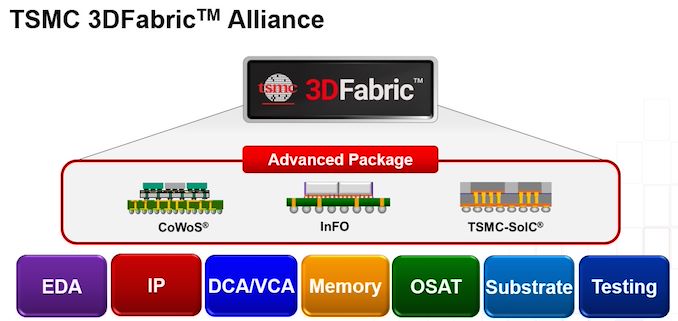
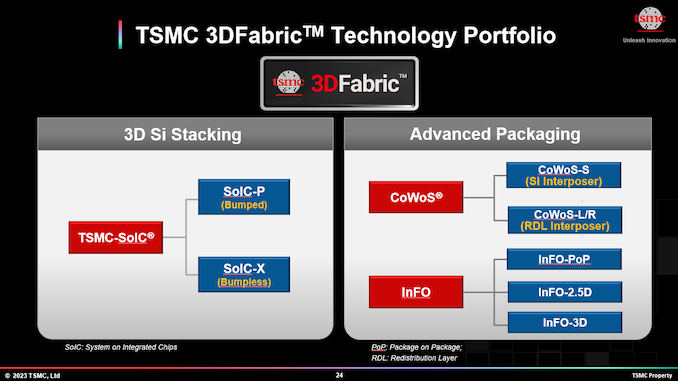
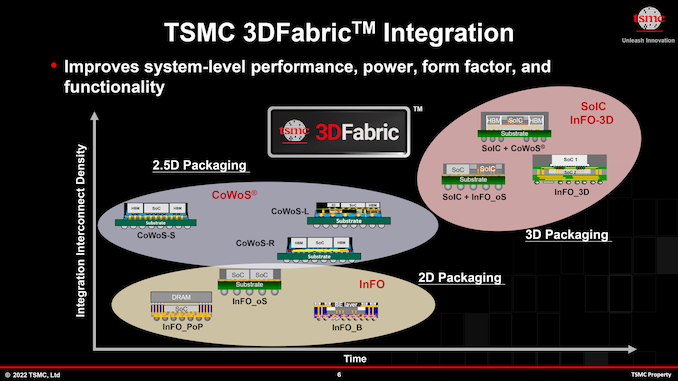
Otherwise, the nearly $2.9 billion price tag implies that this will be yet another significant capital expansion project for TSMC – rivaling what would have been the cost of a wafer lithography fab a decade ago. Given TSMC’s product roadmaps as well as projections for the growing need for advanced packaging types in the coming years, the new chip packaging plant will likely be a comprehensive facility offering 3DFabric integration of front-end to back-end processes, as well as testing services.
It is likely that the new Tongluo fab will be akin TSMC’s recently opened Advanced Backend Fab 6 that is designed to support TSMC-SoIC (System on Integrated Chips) process technology, which includes such frontend 3D stacking techniques as chip-on-wafer (CoW) and wafer-on-wafer (WoW) as well as such backend packaging technologies like integrated fan-out (InFO) and chip-on-wafer-on-substrate (CoWoS).
TSMC’s InFO and CoWoS packaging technologies are currently used for chips like Apple’s M2 Ultra, AMD’s Instinct MI300, and NVIDIA’s A100 and H100 GPUs. Demand for the latter is booming these days and TSMC admitted just last week that the company barely has enough CoWoS capacity to meet it. As things stand, the company is working hard to double its CoWoS capacity by the end of 2024.
“But for the back end, the advanced packaging side, especially for the CoWoS, we do have some very tight capacity to — very hard to fulfill 100% of what customers needed,” said C.C. Wei, chief executive of TSMC, at the company’s earnings call last week. “So we are working with customers for the short term to help them to fulfill the demand, but we are increasing our capacity as quickly as possible. And we expect these tightness somewhat be released in next year, probably towards the end of next year. […] I will not give you the exact number [in terms of processed wafers capacity], but CoWoS [capacity will be doubled in 2024 vs. 2023].
TSMC’s Advanced Backend Fab 6 can process about one million 300-mm wafers per year, as well as handle over 10 million hours of testing per year. Production capacity of the upcoming packaging fab is unknown, though it is reasonable to expect TSMC to make it even bigger as importance of advanced packaging is growing.
Welcome to “How I Became,” a new Lifehacker series where I ask real people about how they really got their jobs. This week I had the pleasure of chatting with Devon Lara Lucas, freelance board game content developer. I met Lucas in 2016 when I was an intern at Hasbro; I was learning the ropes on the Monopoly team,…
As part of AMD’s recent Linux graphics driver development approach of enabling new GPU support gradually on a IP block-by-block basis rather than big monolithic patch series marked by colorful fishy codenames, it’s worked out well for getting new hardware support rolling into the kernel early and without revealing any combined details on yet-to-be-released graphics processors. This week has seen some new IP block patches surface…
Governing bodies worldwide have taken steps in recent years to boost local chip manufacturing, such as tax incentives and funding. For instance, the European Union just approved the Chips Act, regulations meant to improve its member states’ semiconductor production capacity. First announced in February 2022, the Chips Act aims to use €43 billion ($47.5 billion) in investments to increase the EU’s cut of microchip production to 20 percent in 2030 — it currently sits at about 10 percent. The Council of the European Union also hopes it will “attract investment, promote research and innovation and prepare Europe for any future chip supply crisis.” The semiconductor industry is projected to be worth $1 trillion by 2030, led by smartphones, servers, data centers, and storage applications.
In approving the Chips Act, the EU might remove some of its reliance on foreign entities, like China, to produce semiconductors. “With the Chips Act, Europe will be a frontrunner in the world semiconductors race,” Héctor Gómez Hernández, Spanish Minister for Industry, Trade and Tourism, said about the development. “We can already see it in action: new production plants, new investments, new research projects. And in the long run, this will also contribute to the renaissance of our industry and the reduction of our foreign dependencies.”
The EU’s final approval of the Chips Act follows President Biden signing the CHIPS and Science Act into law in 2022. It made $52 billion in funding and tax credits available to the United States’ semiconductor industry, with $39 billion of it set aside for semiconductor manufacturing initiatives — applications for funding first opened in Spring 2023.
This article originally appeared on Engadget at https://www.engadget.com/the-eu-chips-act-just-received-its-final-approval-114524113.html?src=rss