Another Retraction Imminent for Controversial Physicist

A prominent journal has decided to retract a paper by Ranga Dias, a physicist at the University of Rochester in New York who has made controversial claims about discovering room-temperature superconductors — materials that would not require any cooling to conduct electricity with zero resistance. From a report: The forthcoming retraction, of a paper published by Physical Review Letters (PRL) in 20211, is significant because the Nature news team has learnt that it is the result of an investigation that found apparent data fabrication. PRL’s decision follows allegations that Dias plagiarized substantial portions of his PhD thesis and a separate retraction of one of Dias’s papers on room-temperature superconductivity by Nature last September.

After receiving an e-mail last year expressing concern about possible data fabrication in Dias’s PRL paper — a study, not about room-temperature superconductivity, but about the electrical properties of manganese disulfide (MnS2) — the journal commissioned an investigation by four independent referees. Nature’s news team has obtained documents about the investigation, including e-mails and three reports of its outcome, from sources who have asked to remain anonymous. “The findings back up the allegations of data fabrication/falsification convincingly,” PRL’s editors wrote in an e-mail obtained by Nature.

Read more of this story at Slashdot.


Source: Slashdot – Another Retraction Imminent for Controversial Physicist

Mold 2.0 High Speed Linker Released: Moves From AGPL To MIT License

Mold 2.0 is out today as a major update to this high performance linker developed by Rui Ueyama. Mold has consistently shown to outperform GNU’s Gold and LLVM’s LLD linkers while today is making another shift with it now turning to MIT licensing…

Source: Phoronix – Mold 2.0 High Speed Linker Released: Moves From AGPL To MIT License

This Refurbished 24-Inch Acer Monitor Is $130 Right Now

This 24″Acer monitor with an anti-glare coating is on sale for $129.99 right now (reg. $163). It’s a 1080p LCD monitor with a grade “B” refurbished rating, meaning it only has minor superficial scuffs or scratches, but none that affect its performance. This monitor has a 60Hz refresh rate with 1920×1080 resolution.

Read more…


Source: LifeHacker – This Refurbished 24-Inch Acer Monitor Is 0 Right Now

Assassin’s Creed Publisher Axes Sequel To BotW-Like That Was Pretty Good

The 2020 action-adventure game Immortals Fenyx Rising won’t be getting a sequel after all. Drawing clear inspiration from The Legend of Zelda: Breath of the Wild, the game seemed like the start of a fresh new franchise for Ubisoft, a company that’s struggled to ship new original hits. But a sequel has now been…

Read more…


Source: Kotaku – Assassin’s Creed Publisher Axes Sequel To BotW-Like That Was Pretty Good

Summer Samsung Unpacked 2023: Everything announced at the event

This year’s summer edition of Samsung Unpacked was busy, to put it mildly. The company not only introduced its latest wave of foldable phones, but major updates to its smartwatch and tablet lineups. But don’t worry if that’s a lot to take in — here’s everything Samsung introduced at its event.

Watch the highlights of Galaxy Unpacked summer 2023 

If 7AM Eastern was too early for you to watch live, don’t worry. We’ve cut down Samsung’s summer Unpacked presentation to a more reasonable nine minutes. You can watch the highlights of the keynote here, including all the major product introductions. 

Galaxy Z Flip 5 and Galaxy Z Fold 5

Samsung Galaxy Z Flip 5
Photo by Sam Rutherford/Engadget

In a slight twist, the highlight of the foldable phones this year was the “entry” clamshell device, the Galaxy Z Flip 5. The new model has a much larger 3.4-inch external display than its predecessor, letting you reply to messages, use Wallet and otherwise handle tasks that previously required opening the phone. A new hinge design also eliminates the gap when the handset is closed. You can also expect a speedier custom Snapdragon 8 Gen 2 chip and double the storage. It starts at $999, and is available for pre-order through Samsung and Amazon ahead of its August 11th release. 

The Galaxy Z Fold 5, meanwhile, is an iterative (if still welcome) update. The book-style foldable delivers a thinner, gapless design with a brighter primary display, the Snapdragon 8 Gen 2 and improved multitasking abilities. It ships August 11th starting at $1,799, and you can pre-order it now through Samsung and Amazon.

Galaxy Watch 6

Samsung Galaxy Watch 6 and Galaxy Watch 6 Classic
Photo by Sam Rutherford/Engadget

The biggest update at summer Unpacked was arguably for Samsung’s smallest computing device. The company unveiled a Galaxy Watch 6 family that makes some much-requested improvements to the Wear OS timepieces. Most notably, the rotating bezel is back — buy a Galaxy Watch 6 Classic and you can scroll through apps and widgets with a tactile feel. Both watches offer larger, brighter displays, upgraded processors, larger batteries and a “one-click” strap swapping system.

The Galaxy Watch 6 line arrives August 11th. You can pre-order through Samsung and Amazon starting at $300 for the base model and $400 for the Classic.

Galaxy Tab S9

Samsung Galaxy Tab S9 Ultra
Photo by Mat Smith/Engadget

Samsung catered to fans of high-end Android tablets at unpacked by introducing the Galaxy Tab S9 range. While the design hasn’t changed much (mainly slimmer bezels), it’s still a significant upgrade with dynamic refresh rate AMOLED screens, the custom Snapdragon 8 Gen 2 chip, more powerful speakers and even IP68 water and dust resistance for both the tablet and included S Pen.

The series goes on sale August 11th, with pre-orders open at Samsung and Amazon. The 11-inch Galaxy Tab S9 starts at $800, while the 12.4-inch Tab S9+ begins at $1,000. The enormous 14.6-inch Tab S9 Ultra costs at least $1,200.

This article originally appeared on Engadget at https://www.engadget.com/summer-samsung-unpacked-2023-everything-announced-at-the-event-134721886.html?src=rss

Source: Engadget – Summer Samsung Unpacked 2023: Everything announced at the event

Your Training 'Week' Doesn’t Have to Be Seven Days Long

How many days are in your training week? If you’re like most of us, seven. But this is because we are tools, creatures of habit, small-minded folks who cannot conceive of a schedule that is approximately seven days without being exactly seven days.

Read more…


Source: LifeHacker – Your Training ‘Week’ Doesn’t Have to Be Seven Days Long

Major AI companies form group to research, keep control of AI

Read 11 remaining paragraphs | Comments


Source: Ars Technica – Major AI companies form group to research, keep control of AI

Meta, Microsoft and Amazon Team Up on Maps Project To Crack Apple-Google Duopoly

Google and Apple dominate the market for online maps, charging mobile app developers for access to their mapping services. The other mega-cap tech companies are joining together to help create another option. From a report: A group formed by Meta, Microsoft and Amazon Web Services, along with TomTom, is releasing data that could enable companies to build their own maps, without having to rely on Google or Apple. The Overture Maps Foundation, which was established late last year, captured 59 million “points of interest,” such as restaurants, landmarks, streets and regional borders. The data has been cleaned and formatted so it can be used for free as the base layer for a new map application.

Meta and Microsoft collected and donated the data to Overture, according to Marc Prioleau, executive director of the OMF. Data on places is often difficult to collect and license, and building map data requires lots of time and staff to gather and clean it, he told CNBC in an interview. “We have some companies that, if they wanted to invest to build the map data, they could,” Prioleau said. Rather than spending that kind of money, he said, companies were asking, “Can we just get collaboration around the open base map?” Overture is aiming to establish a baseline for maps data so that companies can use it to build and operate their own maps.

Read more of this story at Slashdot.


Source: Slashdot – Meta, Microsoft and Amazon Team Up on Maps Project To Crack Apple-Google Duopoly

How we host Ars Technica in the cloud, part two: The software

Welcome aboard the orbital HQ, readers!

Enlarge / Welcome aboard the orbital HQ, readers! (credit: Aurich Lawson | Getty Images)

Welcome back to our series on how Ars Technica is hosted and run! Last week, in part one, we cracked open the (virtual) doors to peek inside the Ars (virtual) data center. We talked about our Amazon Web Services setup, which is primarily built around ECS containers being spun up as needed to handle web traffic, and we walked through the ways that all of our hosting services hook together and function as a whole.

This week, we shift our focus to a different layer in the stack—the applications we run on those services and how they work in the cloud. Those applications, after all, are what you come to the site for; you’re not here to marvel at a smoothly functioning infrastructure but rather to actually read the site. (I mean, I’m guessing that’s why you come here. It’s either that or everyone is showing up hoping I’m going to pour ketchup on myself and launch myself down a Slip-‘N-Slide, but that was a one-time thing I did a long time ago when I was young and needed the money.)

How traditional WordPress hosting works

Although I am, at best, a casual sysadmin, having hung up my pro spurs a decade and change ago, I do have some relevant practical experience hosting WordPress. I’m currently the volunteer admin for a half-dozen WordPress sites, including Houston-area weather forecast destination Space City Weather (along with its Spanish-language counterpart Tiempo Ciudad Espacial), the Atlantic hurricane-focused blog The Eyewall, my personal blog, and a few other odds and ends.

Read 55 remaining paragraphs | Comments


Source: Ars Technica – How we host Ars Technica in the cloud, part two: The software

Bumble spins its BFF friend-finding feature off into a standalone app

Seven years after Bumble launched Bumble BFF, the company is finally giving users their own app for making friends. Bumble has announced the release of Bumble For Friends, an app dedicated solely to finding friends in your area. The company started testing the app earlier this year in the United Kingdom and select regions of Asia, Mashable reported

Bumble For Friends will function almost exactly like Bumble BFF (which makes up 15 percent of Bumble’s monthly active users, a Bumble spokesperson told TechCrunch). However, there will be no need to download a dating app — something coupled-up users will likely be happy about. Like a dating app, though, you create a profile with a mix of photos, information about yourself and responses to prompts. It can include things like if you drink, your political affiliation, your relationship status and why you’re looking to make friends. Your Bumble For Friends profile will also have space to share some of your interests, like dogs or dancing — one of the things Bumble uses to help match you with potential friends.

There is one new feature on Bumble For Friends: the option to create a group chat. Basically, if you think any of your matches would also get along, you can add two or more of them to a group chat. To use this option, go into the conversations tab and pick a Bumble-suggested activity or add your own. You can also just give the group chat a name (which you can edit later on) if you don’t want to pick what to do. From there, you can invite matches and get talking. Invitees will receive a notification about the chat showing them your chosen title or the potential activity.

Bumble For Friends is free to download on Apple’s App Store or the Google Play Store. You can create a new account or log into your existing one and have your profile and matches transferred over. At that point, your Bumble BFF account will disappear from the original app, but you can still use Date or Bizz modes. Bumble doesn’t seem to be forcing anyone to switch to the new app, so you can still keep all your accounts in one place if you prefer.

This article originally appeared on Engadget at https://www.engadget.com/bumble-spins-its-bff-friend-finding-feature-off-into-a-standalone-app-130040779.html?src=rss

Source: Engadget – Bumble spins its BFF friend-finding feature off into a standalone app

The man behind the USB-C iPhone rebuilt the AirPods Pro case to make it repairable

Robotics engineer Ken Pillonel, known for creating a makeshift USB-C iPhone and AirPods, has revealed his next project. The modding wunderkind has deconstructed Apple’s AirPods Pro case and built a custom repairable version. Pillonel is sharing the design for free, allowing enterprising self-repair enthusiasts with a knack for engineering to make their own.

Pillonel has already tackled the AirPods Pro with a custom replaceable printed circuit board (PCB). However, his new project attempts to dissect the earbuds’ entire case, offering a complete blueprint for others to do the same — with 3D-printed sections and a few (cheap) afterparty parts. “Most gadgets are designed without repairability in mind, unlike the durable technology of the past that seemed built to last,” Pillonel wrote, noting that iFixit gave the second-gen AirPods Pro a dismal zero repairability score. “It is troubling to see design choices like non-replaceable batteries, glued-in components, and a lack of transparency in public information leading to the rise of ‘fast electronics.’”

In response, the engineer took on this latest project “to demonstrate how one of the most popular gadgets today — Apple’s AirPods Pro — could have been easily made repairable with minimal effort.” His stated goal is to inspire consumers and multi-billion-dollar corporations (ahem, Apple) to treat technology less like a locked-down disposable commodity and more like something one can tinker with, learn from and — with the right skills — repair themselves. Of course, a central component is using screws and nuts instead of adhesives to create a makeshift case you can crack open and fix down the road.

Engineer Ken Pillonel working with a 3D printer. He is to the right / front of the printer, looking inside of it.
Ken Pillonel / Exploring the Simulation

Pillonel says this was one of his most challenging custom projects yet, as he had to create precise scans of the case’s every component. As he explains in the video below from his YouTube channel, some of the case’s parts proved especially difficult with complex curves that a simple caliper and basic 2D scans couldn’t quite nail down. He even detailed his quest for finding the right spring-loaded contact pins to charge the buds and an affordable 3D scanner to capture some of the more oddly shaped parts. I recommend a quick watch to anyone curious about sustainability and the nuts and bolts behind iconic consumer tech gadgets. (Remember that such tinkering will void your warranty, and you should probably only give it a shot if you’re experienced with electronics repairs.)

“I am thrilled to make these repairable designs available to the public at no cost, encouraging individuals and manufacturers alike to prioritize repairability in their product development,” Pillonel wrote today. “Together, we can work towards a circular economy that not only minimizes electronic waste but also fosters a culture of conscious consumption and responsible tech innovation.” You can peruse Pillonel’s designs and storefront for replacement parts on his website.

This article originally appeared on Engadget at https://www.engadget.com/the-man-behind-the-usb-c-iphone-rebuilt-the-airpods-pro-case-to-make-it-repairable-130008565.html?src=rss

Source: Engadget – The man behind the USB-C iPhone rebuilt the AirPods Pro case to make it repairable

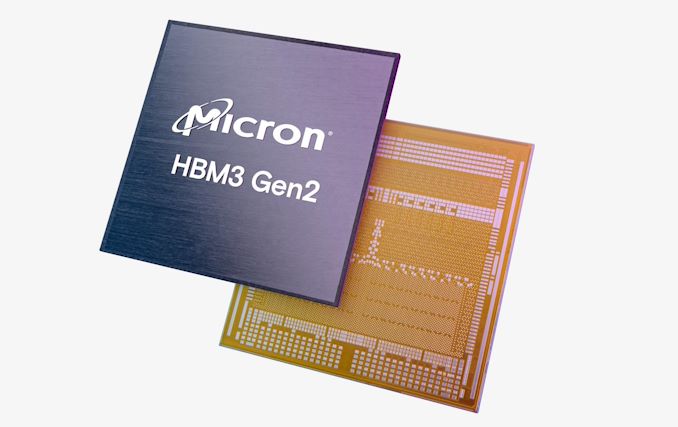
Micron Unveils HBM3 Gen2 Memory: 1.2 TB/sec Memory Stacks For HPC and AI Processors

Micron today is introducing its first HBM3 memory products, becoming the latest of the major memory manufacturers to start building the high bandwidth memory that’s widely used in server-grade GPUs and other high-end processors. Aiming to make up for lost time against its Korean rivals, Micron intends to essentially skip “vanilla” HBM3 and move straight on to even higher bandwidth versions of the memory they’re dubbing “HBM3 Gen2”, developing 24 GB stacks that run at over 9 GigaTransfers-per-second. These new HBM3 memory stacks from Micron will target primarily AI and HPC datacenter, with mass production kicking off for Micron in early 2024.


Micron’s 24 GB HBM3 Gen2 modules are based on stacking eight 24Gbit memory dies made using the company’s 1β (1-beta) fabrication process. Notably, Micron is the first of the memory vendors to announce plans to build HBM3 memory with these higher-density dies, while SK hynix offers their own 24 GB stacks, the company is using a 12-Hi configuration of 16Gbit dies. So Micron is on track to be the first vendor to offer 24 GB HBM3 modules in the more typical 8-Hi configuration. And Micron is not going to stop at 8-Hi 24Gbit-based HBM3 Gen2 modules, either, with the company saying that they plan to introduce even higher capacity class-leading 36 GB 12-Hi HBM3 Gen2 stacks next year.


Besides taking the lead in density, Micron is also looking to take a lead in speed. The company expects its HBM3 Gen2 parts to hit date rates as high as 9.2 GT/second, 44% higher than the top speed grade of the base HBM3 specification, and 15% faster than the 8 GT/second target for SK hynix’s rival HBM3E memory. The increased data transfer rate enables each 24 GB memory module to offer peak bandwidth of 1.2 TB/sec per stack.


Micron says that 24GB HBM3 Gen2 stacks will enable 4096-bit HBM3 memory subsystems with a bandwidth of 4.8 TB/s and 6096-bit HBM3 memory subsystems with a bandwidth of 7.2 TB/s. To put the numbers into context, Nvidia’s H100 SXM features a peak memory bandwidth of 3.35 TB/s.


HBM Memory Comparison
  “HBM3 Gen2” HBM3 HBM2E HBM2
Max Capacity 24 GB 24 GB 16 GB 8 GB
Max Bandwidth Per Pin 9.2 GT/s 6.4 GT/s 3.6 GT/s 2.0 GT/s
Number of DRAM ICs per Stack 8 12 8 8
Effective Bus Width 1024-bit
Voltage 1.1 V? 1.1 V 1.2 V 1.2 V
Bandwidth per Stack 1.2 TB/s 819.2 GB/s 460.8 GB/s 256 GB/s


High frequencies aside, Micron’s HBM3 Gen2 stacks are otherwise drop-in compatible with current HBM3-compliant applications (e.g., compute GPUs, CPUs, FPGAs, accelerators). So device manufacturers will finally have the option of tapping Micron as an HBM3 memory supplier as well, pending the usual qualification checks.


Under the hood, Micron’s goal to jump into an immediate performance leadership position within the HBM3 market means that they need to one-up their competition from a technical level. Among other changes and innovations to accomplish that, the company increased the number of through-silicon vias (TSVs) by two times compared to shipping HBM3 products. In addition, Micron shrunk the distance between DRAM devices in its HBM3 Gen2 stacks. These two changes to packaging reduced thermal impendence of these memory modules and made it easier to cool them down. Yet, the increased number of TSVs can bring other advantages too.



Given that Micron uses 24 Gb memory devices (rather than 16 Gb memory devices) for its HBM3 Gen2 stacks, it is inevitable that it had to increase the number of TSVs to ensure proper connectivity. Yet, doubling the number of TSVs in an HBM stack can enhance overall bandwidth (and shrink latency), power efficiency, and scalability by facilitating more parallel data transfers. It also improves reliability by mitigating the impact of single TSV failures through data rerouting. However, these benefits come with challenges such as increased manufacturing complexity and increased potential for higher defect rates (already an ongoing concern for HBM), which can translate to higher costs.
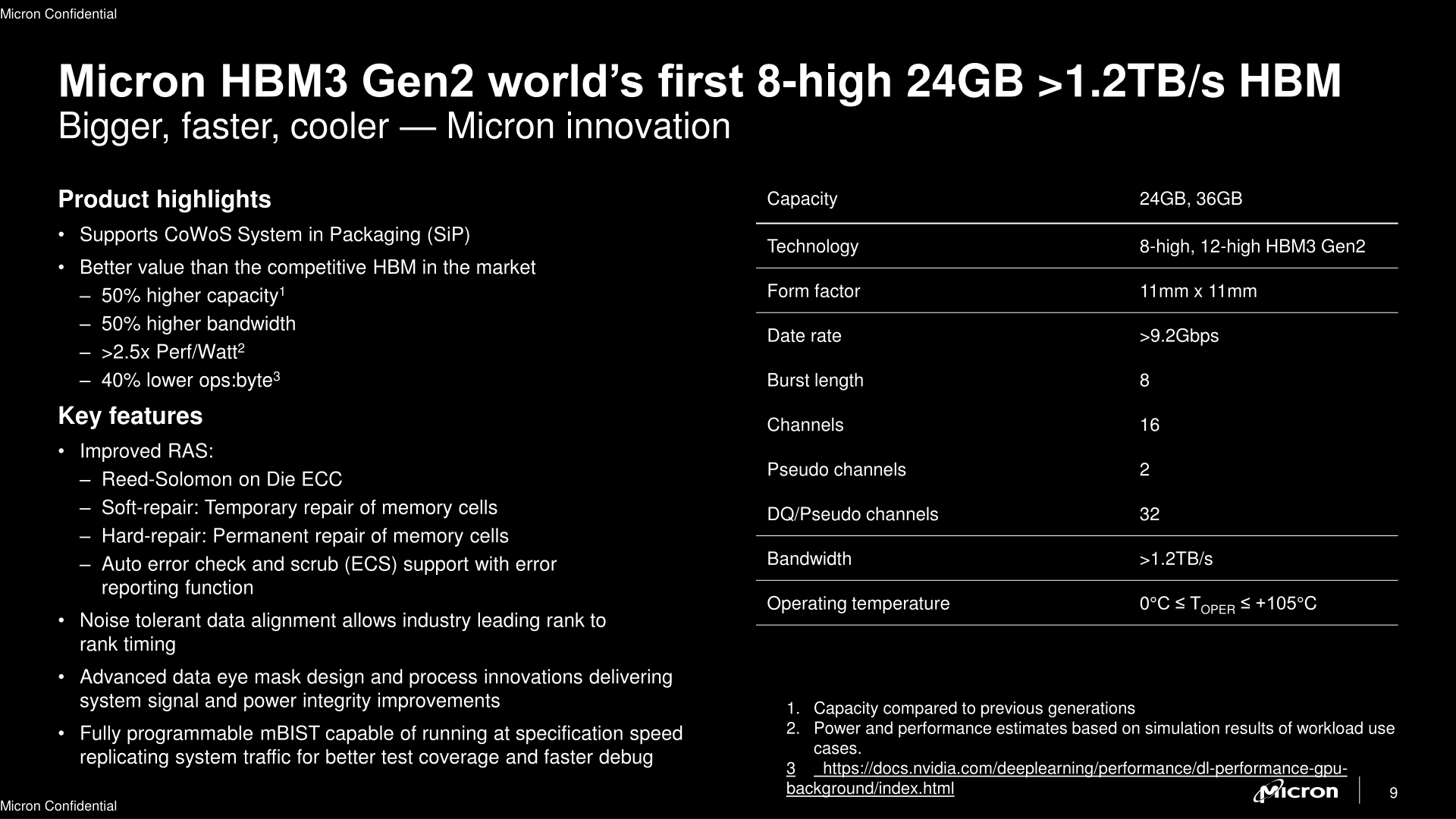


Just like other HBM3 memory modules, Micron’s HBM3 Gen2 stacks feature Reed-Solomon on-die ECC, soft repair of memory cells, hard-repair of memory cells as well as auto error check and scrub support.


Micron says it will mass produce its 24 GB HBM3 modules starting in Q1 2024, and will start sampling its 12-Hi 36GB HBM3 stacks around this time as well. The latter will enter high volume production in the second half of 2024.


To date, the JEDEC has yet to approve a post-6.4GT/second HBM3 standard. So Micron’s HBM3 Gen2 memory, as well as SK hynix’s rival HBM3E memory, are both off-roadmap standards for the moment. Given the interest in higher bandwidth HBM memory and the need for standardization, we’d be surprised if the group didn’t eventually release an updated version of the HBM3 standard that Micron’s devices will conform to. Though as the group tends to shy away from naming battles (“HBM2E” was never a canonical product name for faster HBM2, despite its wide use), it’s anyone’s guess how this latest kerfuffle over naming will play out.


Beyond their forthcoming HBM3 Gen2 products, Micron is also making it known that the company already working on HBMNext (HBM4?) memory. That iteration of HBM will provide 1.5 TB/s – 2+ TB/s of bandwidth per stack with capacities ranging from 36 GB to 64 GB.



Source: AnandTech – Micron Unveils HBM3 Gen2 Memory: 1.2 TB/sec Memory Stacks For HPC and AI Processors

Make Waffled SPAM Pops for a Debauched Start to the Day

Waffle makers and SPAM are a powerful duo. The ridged plates press into the processed meat, creating crispy browned peaks and valleys that grab onto sauce and don’t let go. I’ve been waffling naked, unadorned SPAM for years, but we’re leveling up with waffled SPAM pops (now with actual waffle batter).

Read more…


Source: LifeHacker – Make Waffled SPAM Pops for a Debauched Start to the Day

Linux Group Shares Its First Open Dataset for Creating Real Google Maps Alternatives

If you’re not Google (or, to a much lesser extent, Apple), map apps are damned hard to make. Last year, several major heavy hitters in tech, including the likes of Meta, Microsoft, TomTom, and Amazon, decided to lay down their arms and meet under a flag of parlay held aloft by the Linux Foundation to make mapping just…

Read more…


Source: Gizmodo – Linux Group Shares Its First Open Dataset for Creating Real Google Maps Alternatives

Unprecedented Meteorite Believed to Have Originated From Earth

Five years ago, a partially crusted, dark red meteorite crashed in the Sahara desert and was sold in Morocco. Meteorites, almost exclusively, are of extraterrestrial origin, but this chunk seemed weirdly familiar, leading scientists to believe that it originated from the same planet where it ended up thousands of…

Read more…


Source: Gizmodo – Unprecedented Meteorite Believed to Have Originated From Earth