The Webb telescope has completed the third stage in aligning its mirrors, a crucial process for getting state-of-the-art imagery out of this $10 billion space telescope. The feat comes right on time as the telescope heads into the second month of its three-month alignment period.
The American Council of the Blind, National Disability Rights Network, National Federation of the Blind and more than 170 other disability organizations signed a letter published today, calling for the Department of Justice to finalize rules for online accessibility. According to the letter, the rulemaking process began in 2010 “under Titles II and III of the ADA” but was withdrawn in 2017. Last year, US representative Ted Budd (R-NC) led the re-introduction of a bill proposing an Online Accessibility Act, which was initially introduced in October 2020.
In today’s letter, addressed to assistant attorney general Kristen Clarke, the signees urged “the Department of Justice to maintain this rulemaking process as a priority and finalize a rule by the end of the current administration.” It states that while the DoJ has held that the Americans with Disabilities Act (ADA) includes websites and other technologies critical to accessing a business’ services, it has “failed to define when and how they should be accessible.”
Efforts to come up with these rules have ebbed and flowed. The letter noted that “In 2018, the Department reconfirmed its position that the ADA applies to the internet but never completed rulemakings that were begun in 2010 under Titles II and III of the ADA and withdrawn in 2017.”
The result is an online world where people with disabilities struggle to get their needs met. According to WebAIM (Web Accessibility In Mind), about 97 percent of the 1 million pages evaluated had WCAG 2 (Web Content Accessibility Guidelines) failures. These issues ranged from using low contrast text and missing form input labels to empty buttons and missing alt text for images.
zlikovec via Getty Images
“The absence of digital accessibility regulations in the intervening time period has resulted in persistent exclusion of people with disabilities from digital spaces covered by the ADA,” the letter notes. It also highlights issues like “persistent barriers in telehealth accessibility,” particularly for deaf users. While there haven’t been quantitative studies on intersectional disabilities and how they relate to online accessibility, the letter states “anecdotal reports suggest that the vast majority of DeafBlind people are completely unable to utilize telehealth as it currently exists.”
An American Foundation for the Blind study that’s cited in the letter found that almost 60 percent of educators surveyed in Fall 2020 reported “their blind and low vision students could not access one or more of the digital learning tools they were expected to use in class.”
As the world increasingly lives and conducts business online, it’s crucial that the digital world is accessible by design. The letter points out that “These findings are neither exhaustive of all website-related issues nor comprehensive of the entire disability community.” There’s a lot of work and research still to be done.
“The disability community is large and diverse, facing access issues that continue to grow and evolve with the ever-changing landscape of websites and applications.” Having a set of rules in place will help enable clearer communication and implementation of the tools that will make websites (and apps) accessible to all.
Facebook is “restricting access” to two Russian state media outlets across the entire European Union, a move that will prevent the publishers from sharing content to millions of people in the countries. Meta’s President of Global Affairs, Nick Clegg, announced the block of RT and Sputnik, saying that it was in response to “a number” of government requests from within the EU.
“Given the exceptional nature of the current situation, we will be restricting access to RT and Sputnik across the EU at this time,” Clegg said. The change comes after the European Commission enacted its own ban on the outlets, and after Facebook had already blocked access to ads and other monetization features. The social network had also blocked the publications’ ability to post content inside of Ukraine.
Clegg didn’t elaborate on whether “restricting access” referred simply to these accounts’ ability to post and share inside of these countries, or if the accounts would be completely inaccessible in the EU. We’ve asked Facebook for more details.
We have received requests from a number of Governments and the EU to take further steps in relation to Russian state controlled media. Given the exceptional nature of the current situation, we will be restricting access to RT and Sputnik across the EU at this time.
The move comes as Russian State media outlets, some of which have vast social media followings, find their reach increasingly limited. Facebook and other platforms have taken more aggressive measures to tamp down the influence of Russia-backed publications in recent days as there has been a sharp rise in disinformation. Twitter announced Monday that it would label tweets from Russian state media accounts, and would try to curb their influence on the platform. YouTube has also blocked the outlets’ ability to monetize their channels.
Members of the Conti ransomware gang are now being attacked by one of their own. An insider from the gang has leaked a massive cache of internal chats after its leaders took an aggressive pro-Russian stance on their public site.
In any other large franchise, each TV show getting its own new costumes and designs is just a perfectly normal thing. In Star Trek, it’s created a canonical tapestry that paints the picture of Starfleet’s uniform design department going mad with power in a post-money utopia society that lets them radically overhaul…
Forza Horizon 5is about to become more accessible for deaf and hard-of-hearing individuals. On March 1st, Microsoft will update the title to add support for both American and British Sign Language. Enabling the feature adds a picture-in-picture display of an ASL or BSL interpreter during cutscenes. By visiting the game’s accessibility menu, you can adjust the position of the display and decide whether to add a colored background.
Forza Horizon 5, like many other games,includes support for subtitles, but as Microsoft’s Athima Chansanchai points out, the two features serve different purposes. While subtitles are helpful to many, it turns out they’re not that useful to people who primarily depend on signing to understand a conversation. For those individuals, reading subtitles can be fatiguing since ASL and BSL feature a different structure to English. They also can’t convey tone and emotion in the same way a skilled interpreter can.
Outside of that accessibility addition, Forza Horizon 5’s Series 5 update includes bug fixes for issues related to the game’s photo mode, livery editor and more. Developer Playground Games has also added five new cars and a new festival playlist for players to check out.
Qualcomm is using Mobile World Congress to show off some new technology that should improve 5G connectivity and wireless audio. From a report:The Snapdragon X70 5G modem-RF system attempts to improve your phone’s 5G connection with the help of an AI processor. This helps it maximize 5G signal for better coverage — particularly important for mmWave signals, which are short-range compared to the broader coverage of low and mid-band frequencies. Qualcomm says this improvement is limited to situations like stadiums and city blocks, and that it doesn’t address one of mmWave’s key weaknesses: the signal’s inability to travel from outdoors to indoors. But where there’s no mmWave signal, the new AI processor should boost sub-6GHz coverage and speeds, too. The new audio features, wrapped up in a platform called Snapdragon Sound, include a feature teased last year: wireless earbud support for 16-bit “CD-quality” lossless audio over Bluetooth.
Early humans suffered frequent head injuries but often lived long enough for those injuries to heal. That’s the result of a study that analyzed twenty 350,000-year-old skulls from a cave in Spain. The study also found that recovery wasn’t inevitable—several of the individuals in the cave apparently died from violent blows to the head.
Welcome to the Pit of Bones
About 350,000 years ago, deep in a cave network in what is now northern Spain, the remains of at least 29 people somehow ended up at the bottom of a 13-meter-deep shaft. Paleoanthropologists have unearthed thousands of broken pieces of bone, which add up to the partial skeletons of at least 29 members of a hominin species called Homo heidelbergensis, which may have been a common ancestor of our species and Neanderthals.
The pit, called Sima de los Huesos, contains a mix of ages and genders. Paleoanthropologists are still debating whether the pit was a burial site or just a place where bones washed in with floodwaters.
Nikon’s staunch devotion to DSLRs meant the company is now trying to play catch up to Sony, Canon, and even Fujifilm when it comes to the ever-growing mirrorless camera market. The Nikon Z9, revealed last year, wasn’t quite the runaway hit the company needed, but a potential new feature could change the market share…
More known for its custom water cooling components, Bitspower has released its first-ever air-based CPU cooler, the Phantom. Designed for the entry-level market, the Phantom includes a single 120 mm RGB enabled cooling fan and supports Intel’s latest LGA1700 desktop socket and AMD’s AM4 socket.
With a height of 158 mm, the Phantom is compatible with most desktop cases. It is constructed of aluminum, with four copper heat pipes attaching the large aluminum fin stack to the cold plate. To aid in heat dissipation, it uses a single 120 mm cooling fan which includes RGB for users looking to add a bit of flair to their system. The cooling fan included has a maximum speed of 1800 RPM, which Bitspower claims the fan has an airflow rating of 80 CFM, and it operates with a maximum volume of 34 dBA.
The Bitspower Phantom CPU Cooler is installed onto a mini-ITX motherboard.
Despite the official listing on the Bitspower website not providing much information on specification and capability, I reached out to Bitspower CEO Vincent Yu and confirmed what the webpage leaves out. This includes the official dimensions of the Bitspower Phantom CPU cooler, which has a relatively small footprint of 116 x 51 x 158 mn. Vincent Yu also confirmed that the Bitspower Phantom could dissipate heat from most desktop processors, with a rated TDP of 200 W.
The Bitspower Phantom air cooler is available directly from its website for 1450 TWD. Still, Bitspower has confirmed to me that it will be available in other regions soon with an expected MSRP of $55.
Key Russian websites and state online portals have been taken offline by attacks claimed by the Ukrainian cyber police force, which now openly engages in cyber-warfare. From a report: As the announcement of the law enforcement agency’s site details, specialists from the force have teamed with volunteers to attack the web resources of Russia and Belarus. The three countries are currently involved in an ongoing and large-scale armed forces conflict that includes a cyber frontline, which manifested even before the invasion. The Ukrainian cyber police have announced having targeted the websites of the Investigative Committee of the Russian Federation, the FSB (Federal Security Service), and the Sberbank, Russia’s state-owned bank.
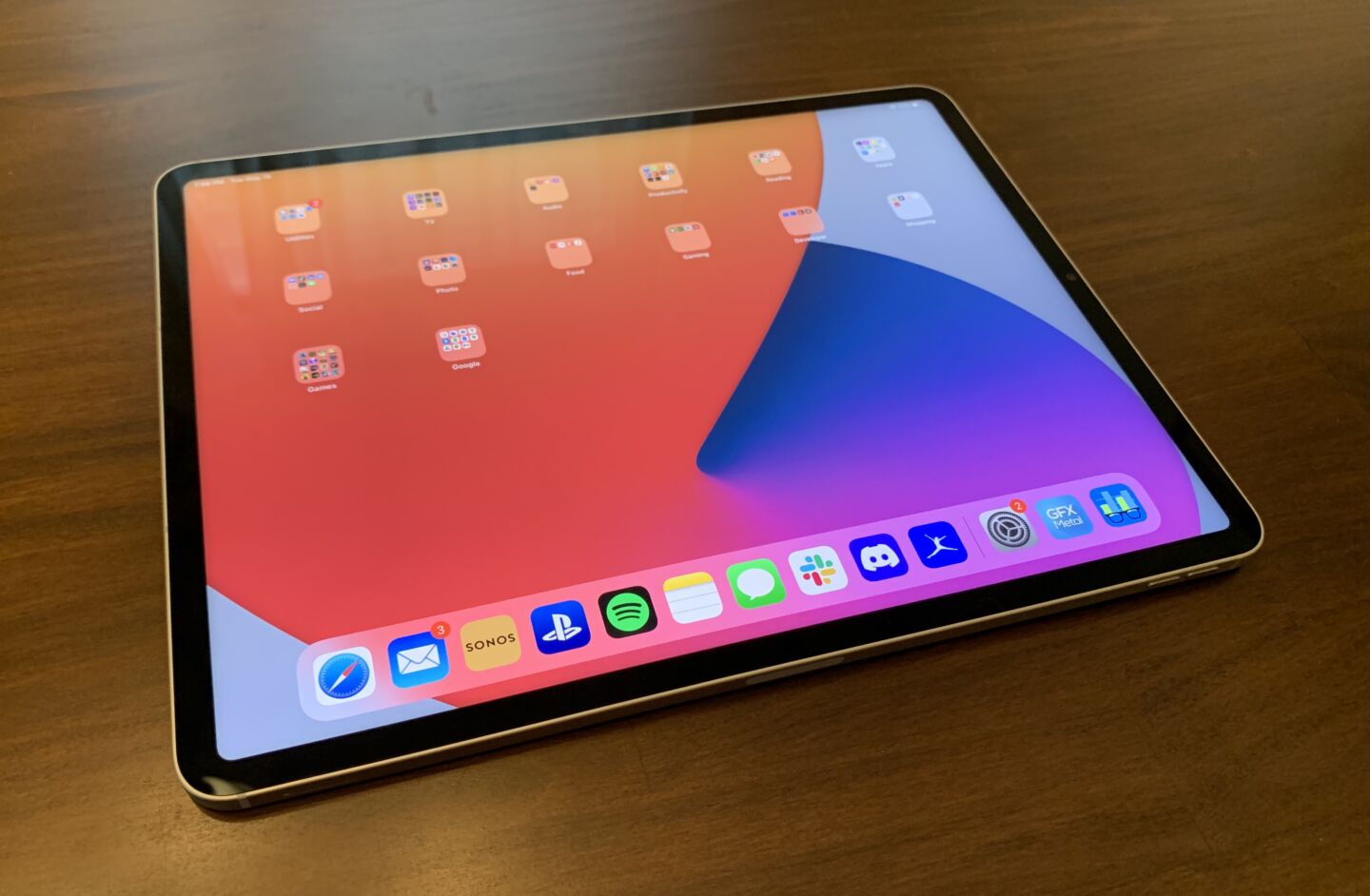
Enlarge/ Apple’s 2021 iPad—sans futuristic folding capability, of course. (credit: Samuel Axon)
Two different sources are now saying Apple plans to introduce a foldable iPad and MacBook hybrid product, though the release date for such a device would likely be a few years away.
The rumors first began to swirl when DSCC analyst Ross Young published a report claiming that Apple has been discussing a 20-inch foldable computing device with suppliers.
The device could be used in multiple ways. When it’s folded into a laptop-like shape, the hybrid’s bottom half could be used as a keyboard. When it’s unfolded, the device could be treated like a large tablet computer. Further, the hybrid could be used with an external keyboard to work as a portable monitor and all-in-one computer.
Cyberpunk 2077, patch 1.5, PlayStation 5, ray-tracing mode. [credit: CD Projekt Red
]
While video game consoles have finally reached the age of ray tracing, performing those graphical calculations in real time can still be tough on consumer-level hardware. A PS5 game like Gran Turismo 7, for instance, can only handle ray-traced visuals in replays thanks to the processing requirements.
With a newly filed patent, though, Sony engineer Mark Cerny lays out a method that could significantly speed up the ray-tracing process by offloading certain calculations from the GPU to specially designed ray-tracing unit (RTU) hardware. The outlines of the new ray-tracing process are laid out in a patent application titled “System and method for accelerated ray tracing with asynchronous operation and ray transformation.” The application was published in the European Union last week after being filed last August.
In Cerny’s method, the RTU hardware is specially designed to efficiently traverse so-called acceleration structures in a 3D environment, going through a stack of bounding volumes to identify points where a virtual light ray intersects with an object. Those intersections are then sent to a shader program running on the GPU, which determines whether the object is opaque (a “hit” for the ray-tracing algorithm) or transparent (i.e., the intersection can be ignored).
By and large, anime protagonists have inspiring backstories and an iconically infectious resolve. As it turns out, so do many of the actors whose vocal talents help bring these characters to life. While anime originates in Japan, the medium’s relatable and heroic characters, particularly in the shounen genre, have…
Input devices can have an enormous impact on your user experience, especially as they relate to games. For retro games in particular, which were often designed with joysticks in mind, playing with any other type of input device isn’t quite the same. Thankfully, using a Raspberry Pi Pico and some inexpensive parts, you can build your own joystick
I think it’s safe to say, if you’ve lived in America for any length of time, you’ve probably eaten ice cream. From sundaes and apple pie accompaniments, to root beer floats and the almighty summer cone, its popularity is legion. According to a study conducted by Yahoo Food, ice cream is America’s favorite dessert. (It…
What’s a term for the midpoint between avidly viewing for entertainment, and hate-watching? That’s where I am with Saturday Night Live, as it meanders its way through these peculiar years. But this weekend’s episode was just outright funny, in a way I can’t remember the show being in years. And especially when the…
An anonymous reader shares a report: Lenovo has dumped a whole bunch of new ThinkPads into the world, and there’s some exciting stuff in there. We’re getting a brand-new ThinkPad X13s powered by Snapdragon chips, a fifth-generation ThinkPad X1 Extreme with a WQXGA 165Hz screen option, and new additions to the P-series and T-series as well. The news I’m personally most excited about is the screen shape. A few months ago, Lenovo told me that much of its portfolio would be moving to the 16:10 aspect ratio this year. They appear to be keeping their word. Across the board, the new models are 16:10 — taller and roomier than they were in their 16:9 eras. Some news that’s a bit more… intriguing is the all-new ThinkPad X13s, which is the first laptop to feature the Snapdragon 8cx Gen 3 compute platform. Qualcomm made some lofty claims about this platform upon its release, including “60 percent greater performance per watt” over competing x86 platforms and “multi-day battery life.” The ThinkPad X13s will run an Arm version of Windows 11, with its x64 app emulation support. The P-series models and Intel T-series models will all be here in April, with prices ranging from $1,399 to $1,419.