
The long time Phoronix reader, with an excellent long-term memory, may remember an odd article from back in August 2017 on buying a passively cooled computer. It tells the tale of the consumer who decided to buy a rather niche, fanless, therefore passively cooled computer.
Source: Phoronix – Building A Silent Linux Desktop For 2022 With The Streacom DB4
Monthly Archives: January 2022
Announcing Gizmodo’s Degrees of the Future
In the 1950s, a visionary college student might have pursued a degree in computer science, and helped create our modern digital world. In the 1990s, that same student might have studied biotechnology, and developed genetic engineering techniques that are solving today’s health crises.
Source: Gizmodo – Announcing Gizmodo’s Degrees of the Future
Antimicrobial Resistance Now a Leading Cause of Death Worldwide, Study Finds
An anonymous reader quotes a report from The Guardian: Antimicrobial resistance poses a significant threat to humanity, health leaders have warned, as a study reveals it has become a leading cause of death worldwide and is killing about 3,500 people every day. More than 1.2 million — and potentially millions more — died in 2019 as a direct result of antibiotic-resistant bacterial infections, according to the most comprehensive estimate to date of the global impact of antimicrobial resistance (AMR). The stark analysis covering more than 200 countries and territories was published in the Lancet. It says AMR is killing more people than HIV/Aids or malaria. Many hundreds of thousands of deaths are occurring due to common, previously treatable infections, the study says, because bacteria that cause them have become resistant to treatment.
The new Global Research on Antimicrobial Resistance (Gram) report estimates deaths linked to 23 pathogens and 88 pathogen-drug combinations across 204 countries and territories in 2019. Statistical modeling was used to produce estimates of the impact of AMR in all locations — including those with no data — using more than 470m individual records obtained from systematic literature reviews, hospital systems, surveillance systems, and other data sources. The analysis shows AMR was directly responsible for an estimated 1.27 million deaths worldwide, and associated with an estimated 4.95 million deaths, in 2019. HIV/Aids and malaria have been estimated to have caused 860,000 and 640,000 deaths, respectively, in 2019. While AMR poses a threat to people of all ages, young children were found to be at particularly high risk, with one in five deaths attributable to AMR occurring in children under the age of five. Some of the actions policymakers can take, as mentioned in the report, include “optimizing the use of existing antibiotics, taking greater action to monitor and control infections, and providing more funding to develop new antibiotics and treatments.”


Read more of this story at Slashdot.
Source: Slashdot – Antimicrobial Resistance Now a Leading Cause of Death Worldwide, Study Finds
The Original Author of NGINX Has Chosen to Step Back from the Company
Igor Sysoev, the author of the most popular web server in the world, left the company to work on personal projects and spend more time with family and friends.
Source: LXer – The Original Author of NGINX Has Chosen to Step Back from the Company
Amazon one-day sale knocks up to 40 percent off Anker chargers and accessories
You can grab a bunch of Anker accessories from Amazon for up to 40 percent off just for today only. One of the products on sale is the Anker Nano II 30W GAN charger, which is currently listed for its all-time low of $25, down $9 from its usual retail price of $34. The adapter works with the latest iPhones, Samsung Galaxy phones S8 and later, iPads, the Apple Watch, AirPods cases and even the 2020 MacBook Air. It’s much smaller than an original MacBook adapter even though it works with the laptop, because it uses GAN II technology that gives it an efficient way to disperse heat. The technology enables small chargers to operate at faster speeds without overheating.
Buy Anker Nano II 30W GaN II Compact Charger at Amazon – $25
The Anker 2-in-1 wireless charging stand for the iPhones 12 and 13 is also currently on sale for $34, down $16 from its original price of $50. This magnetic stand can securely prop up an iPhone — vertically or horizontally — while charging it and the AirPods or other earbuds you place on its base. It works with MagSafe cases for the iPhone 13, as well.
Buy Anker PowerWave Magnetic 2-in-1 wireless charging stand at Amazon – $34
Another Anker item on sale worth mentioning is its power strip that comes with three outlets, two USB-A ports and one USB-C port. The USB-C port is capable of delivering 30W high-speed charging speeds, while the two USB-A ports can deliver 12W charging. The sale knocks off $14 from the power strip’s usual retail price of $40, so you can get it within the day for $26 only.
Buy Anker USB C Power Strip at Amazon – $26
Follow @EngadgetDeals on Twitter for the latest tech deals and buying advice.
All products recommended by Engadget are selected by our editorial team, independent of our parent company. Some of our stories include affiliate links. If you buy something through one of these links, we may earn an affiliate commission.
Source: Engadget – Amazon one-day sale knocks up to 40 percent off Anker chargers and accessories
Keychron K14 review: The rare Mac-ready wireless mechanical keyboard

Enlarge / Keychron K14 with no backlight (top) and an RGB backlight (bottom). (credit: Scharon Harding)

A common complaint about mechanical keyboards is that they’re too expensive. Options are limited further for budget-minded buyers if they want a wireless device, especially if they’re looking for a Mac-specific board. But the market has come a long way, and you can now pick up mechanical keyboards, including cable-free options, for under $100. And not only can you buy a wireless mechanical keyboard that works with Apple computers, but in the case of the Keychron K14, you can get one that comes with a Mac layout out of the box (don’t worry, Windows keycaps are also included).
The K14 is a 70 percent wireless mechanical keyboard, meaning that it ditches the numpad (but not the navigation keys) and forgoes a dedicated function row. The result is a compact clacker with an option for white or RGB lighting and hot-swappable switches to get the exact typing feel you want.
The K14 even throws in some wireless luxuries, like the ability to pair the board with up to three Bluetooth devices and toggle between them, plus USB-C charging and the option to use the keyboard with a cable. At $59–$99, the K14 is a good candidate for someone seeking a budget- to mid-priced wireless keyboard with mechanical switches, and it’s even better for those who want Apple-ready legends. For keyboard enthusiasts seeking the finest craftsmanship from sight to sound, though, some of the K14’s features fall short.
Read 45 remaining paragraphs | Comments
Source: Ars Technica – Keychron K14 review: The rare Mac-ready wireless mechanical keyboard
The Morning After: Apple closes education discount loophole
Apple has finally closed a loophole in the US that allowed most buyers to claim education pricing, even if they weren’t actually a student or a teacher. First noted on Reddit, the US Apple Store now requires buyers to verify their status via UNiDAYS to be able to purchase MacBooks, iPads and other devices from its education portal. The change appears to have happened over the past few days.
I’m based in the UK, where Apple has long required proof through the UNiDAYS platform to nab that often substantial discount on some of the company’s priciest devices. For legitimate students and teachers, you’ll have to click through to the UNiDAYS’ partner page for Apple first and sign in before you get to those discounts. Not that anyone can go too crazy: shoppers are limited to one desktop, one Mac mini, one laptop, two iPads and two accessories per year. Still, that’s a lot of Macs.
— Mat Smith
Anemia could make space travel to Mars a challenge
In space, your body destroys more blood cells than it makes.
NASA
A new study has found that “space anemia” caused by weightlessness in space is not a temporary issue as once thought, the CBC has reported. “As long as you are in space, you are destroying more blood cells than you are making,” said the University of Ottawa’s Guy Trudel, who led a 14-astronaut study carried out by the Canadian Space Agency (CSA).
The researchers said anemia could even be an issue for space tourism. The study also noted that “current exercise and nutritional countermeasures of modern space travel did not prevent hemolysis and post-flight anemia” in the astronauts tested.
Tesla driver in fatal California crash first to face felony charges involving Autopilot
Autopilot was apparently engaged at the time of the crash.
A Tesla owner is facing the first felony charges filed against someone using a partially automated driving system in the US. The defendant, Kevin George Aziz Riad, was driving a Model S when he crashed into a Honda Civic at a California intersection in 2019. It ended up killing the Civic’s two passengers. The National Highway Traffic Safety Administration (NHTSA) recently confirmed the vehicle’s Autopilot mode was switched on at the time of the crash. The NHTSA formally opened a probe into Tesla’s driver assistance system in August last year following a string of 17 people killed in 11 crashes involving parked first responder vehicles.
AT&T and Verizon finally switch on their C-Band 5G networks
Verizon expects to hit over 1,700 cities this month, but AT&T’s rollout is more limited.
After a six-week delay — and no availability near many airports for the time being — people in some areas of the US will have access to C-Band services starting today.
AT&T is taking a relatively cautious approach to its rollout, with its C-Band 5G services going live in “limited parts” of eight metro areas, including Detroit and Chicago. Folks in three regions in Florida also use AT&T’s C-Band network. Verizon (Engadget’s former parent company) says 100 million more people will gain access to its 5G Ultra Wideband network this month.
Google is discontinuing its old free G Suite tier on July 1st
Affected users will need to move to a paid Workspace plan.
First, it was Google Apps, then G Suite and now it’s Workspace. During all those name changes, Google offered new subscription plans while doing away with older ones. It now plans to sunset a tier that had survived the suite’s most recent rebranding.
In an email spotted by 9to5Google, the company told Workspace administrators it won’t offer G Suite legacy free edition as of July 1st, 2022. This doesn’t necessarily mean you have to start paying for GDocs. If you’re using Gmail, Docs, Sheets and the rest through a free Google account, you won’t be affected by the move. Google will continue to offer free Workspace plans to nonprofits and schools that qualify for its Fundamentals tier.
Airstream’s concept electric camping trailer propels itself
The eStream helps tow itself.
Airstream
According to Autoblog, Airstream’s Thor brand has revealed an eStream concept self-propelling camper. The dual-motor trailer not only reduces the burden on the towing vehicle but can be remote-controlled from your phone to help you hitch up, reverse or simply move camp site. You can even use the motors to shift the weight distribution, so you might not need a special hitch.
Limited beta brings Google Play Games to Windows
Play some big-name Android titles on your PC.
You can now play Google Play Games on Windows — if you live in the right country. Google has launched registration-based beta access to “popular” Play Games titles on Windows PCs in Hong Kong, South Korea and Taiwan. Google said it would offer details of later betas and expansions “soon.” It previously committed to a generic 2022 rollout.
The Backbone One made cloud gaming on the iPhone feel natural
It’s an expensive controller, though.
Engadget
Whether it’s Xbox Cloud gaming, Stadia, PlayStation Remote Play or just a very severe addiction to Apple Arcade, gamepads are a better way to play many games on your smartphone. Normally that means using some kind of smartphone clip, but there are several options now that snap directly to your phone. The $100 Backbone One is a single-piece controller that extends to fit your iPhone and plugs directly into it.
The biggest news stories you might have missed
Amazon gives its ‘Lord of the Rings’ series a redundant name
Microsoft’s Xbox Elite Wireless Series 2 controller is $40 off again
I tried Silk’s dairy-inspired Nextmilk and wasn’t fooled
Apple’s WeWork drama ‘WeCrashed’ premieres March 18th
President Biden signs memo to help improve military cybersecurity
iRobot’s Roomba 694 is back down to a record low of $179
GM aims to use hydrogen fuel cells for mobile power generators
Source: Engadget – The Morning After: Apple closes education discount loophole
Crypto.com Finally Acknowledges $34 Million Stolen by Hackers

Trading platform Crypto.com lost about $34 million worth of cryptocurrency in a hack on Monday, according to a new blog post by the company published overnight. The company had previously declined to say much about the hack, which forced users to stop withdrawals for most of the day, and only reassured customers they…
Source: Gizmodo – Crypto.com Finally Acknowledges Million Stolen by Hackers
Intel's Unaccepted Memory Support Updated For Substantially Faster Booting Of TDX VMs
Way back in August Intel posted a set of Linux kernel patches for supporting “unaccepted memory” by the Linux kernel in preparation for next-generation Xeon processors and speeding up the boot time for guest virtual machines making use of Intel’s Trust Domain Extensions (TDX) security feature. Unaccepted memory support hasn’t yet made it to the mainline kernel but now a second iteration of the patches have been posted…
Source: Phoronix – Intel’s Unaccepted Memory Support Updated For Substantially Faster Booting Of TDX VMs
How to Do a Git Hard Reset – Walkthrough
A tutorial on how to use the git reset –hard command to reset a git branch back to an earlier commit
Source: LXer – How to Do a Git Hard Reset – Walkthrough
Intel’s Next Gen Bitcoin ASIC called BZM2: Built on 7nm, 137 GigaHash/sec at 2.5 W
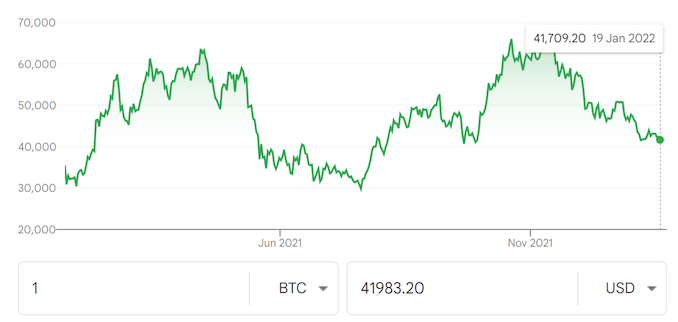
It has been noted in the media that at the upcoming ISSCC conference at the end of February, Intel is set to give a talk entitled ‘Bonanza Mine: An Ultra-Low Voltage Energy Efficient Bitcoin Mining ASIC’. It already has a lot of attention, as it confirms the fact that Intel is working towards blockchain-enabling hardware. Through a number of channels, we’ve been able to acquire more details about this chip ahead of the conference.
Source: AnandTech – Intel’s Next Gen Bitcoin ASIC called BZM2: Built on 7nm, 137 GigaHash/sec at 2.5 W
A Look Inside Nintendo’s Old Kyoto Headquarters

If you’re a Nintendo fan, you’ve probably seen countless photos of the exterior of Nintendo’s old Kyoto headquarters. But have you seen inside?
Source: Kotaku – A Look Inside Nintendo’s Old Kyoto Headquarters
Why Every Employer Should Have Workers Compensation Insurance In Colorado

As an employer, it is your job to do all that you can to protect your employees at all times. Every business is only as good as the employees that it hires and every business owner would attest to the fact that without their employees, the business would not be successful at all. It seems only fair then to reward your employees with the necessary injury care program that they so rightly deserve. It is a requirement to make sure that an employer purchased insurance for their employees and that they contact a workers compensation insurance carrier to get it done. If you are a larger employer however you may be allowed to self insure and companies that are quite small with only three or four employees are exempt from this type of insurance.
When you have a business and a worker is injured, you need required insurance in Colorado which will pay the medical and disability benefits to the affected employee. It is important to remember that as the owner of a business and if workers’ compensation coverage is optional in your particular state then you are still liable for any workplace injuries that might occur. It makes sense then to take out the necessary insurance so that you don’t always have to be paying out of your own pocket. You could have a really bad year for workplace injuries and this could force you to close your business and this would be a great shame. For those of you who are pondering whether or not to get workers’ compensation coverage, then maybe the following benefits of doing so can help you to make a more informed decision.
1. It helps to lower business costs
You can’t just take the chance that an injury will not occur while an employee is doing their job. You may be very stringent in your rules and you may have many health and safety procedures in place and you are to be commended for that. However, realistically an accident will happen, and depending on the extent of the injuries, if you don’t have an insurance policy in place then you will be paying out of your own pocket and you could be running into many hundreds of thousands of dollars for medical expenses and prescriptions. It just doesn’t make sense to take a chance when you could have full coverage for a much lower payment.
2. Employees are covered
Finding employees nowadays is incredibly difficult and so you need to offer them something that other employers are not. If an employee knows that you offer workers compensation coverage then they are more likely to make an application for a job with your company. You need to remember that when an employee gets hurt at work, it works out to be very expensive for them as their salary will be reduced and their personal life will be affected as well. They might even be forced to file a lawsuit in order to be able to pay the bills and so you should never put your employee in this position in the first place.
These are two of the benefits of getting workers comp insurance and there are numerous more. It is your responsibility as an employer to do everything that you can to protect your employees and of course, it is the right thing to do.
Written by Callum Jackson
Source: TG Daily – Why Every Employer Should Have Workers Compensation Insurance In Colorado
Crypto.com loses $34 million in hack that affected 483 accounts
In an interview with Bloomberg TV, Crypto.com’s Chief Executive Kris Marszalek has admitted that 400 customer accounts were compromised by hackers. He said his team detected unauthorized transactions made from the accounts, but that they’d fixed the issue immediately and fully reimbursed the affected users. Now, the company has published a report revealing details from its post mortem. Apparently, 483 accounts were affected and the unauthorized withdrawals totaled 4,836.26 ETH, 443.93 BTC and approximately $66,200 in other currencies. Based on current exchange rates, that’s $15.3 million of ETH and $18.7 million of ETC for a total of $34 million in losses.
JUST IN: CEO @cryptocom’s Kris Marszalek discusses the site’s recent hack with @BloombergTV’s @emilychangtv. “Customer funds were never at risk.” #TheYearAheadpic.twitter.com/YlCtGO60t5
— Bloomberg Live (@BloombergLive) January 19, 2022
Before the company revealed the scope of the hack in terms of lost funds, blockchain security analytics company PeckShield Inc. said Crypto.com may have lost cryptocurrency worth $15 million. At least 4,600 of the coins lost were Ethereum, and half of them are reportedly being washed — a process that obfuscates a coin’s transaction trail. Meanwhile, Bitcoin research firm OXT Research said the company’s loss might be worth up to $33 million.
The report explained that the company’s risk monitoring systems detected unauthorized activity a few days ago, wherein transactions were being approved without two-factor authentication for a small number of accounts. As a result, the cryptocurrency exchange paused withdrawals on the evening of January 16th. Indeed, people in the comments on its Twitter announcement revealed that they had funds stolen even if they had 2FA enabled.
In another tweet posted on January 17th, Marszalek said that “no customer funds were lost,” the company’s infrastructure was down 14 hours and that his team strengthened its security in response to what happened. The report expounded on that last part, revealing that Crypto.com revoked all customer 2FA tokens and implemented additional security measures that required all account users to re-log-in. The company said the move is necessary, because it migrated to a completely new 2FA infrastructure. However, it intends to eventually move away from 2FA and to true Multi-Factor Authentication (MFA).
Crypto.com has also introduced an additional security measure that requires users to wait 24 hours before they can withdraw to a newly registered whitelisted address. Finally, the company is launching the Worldwide Account Protection Program (WAPP) on February 1st for users who want additional protection for their funds.
WAPP can restore up to $250,000 of a participating user’s money in case a third-party gains access to their account. That said, to qualify for the program, users must enable multi-faction authentication on all transaction types and not be using a jailbroken device. To be able to recoup their funds under the program, they must’ve set up an anti-phishing code at least 21 days before an unauthorized transaction, file a police report and provide Crypto.com a copy, as well as complete a questionnaire to support forensic investigation.
Source: Engadget – Crypto.com loses million in hack that affected 483 accounts
CIA Says Havana Syndrome Isn't Caused by Russia or Other Foreign Adversary: Report

Havana Syndrome, the name for a variety of illnesses reported by U.S. spies and diplomats working overseas, isn’t caused by Russia or any other foreign adversary, according to an interim report by the Central Intelligence Agency covered by multiple news agencies late Wednesday. But people who insist Havana Syndrome is…
Source: Gizmodo – CIA Says Havana Syndrome Isn’t Caused by Russia or Other Foreign Adversary: Report
AMD SMCA Updates Land In Linux 5.17 For Future CPUs
Last week I noted about EDAC changes in Linux 5.17 for future AMD CPUs. The “Error Detection and Correction” work included AMD adding RDDR5 / LRDDR5 support to their driver and new CPU model IDs that appear to be for Zen 4. Also working on next-gen AMD processor support in Linux 5.17 are recent SMCA changes…
Source: Phoronix – AMD SMCA Updates Land In Linux 5.17 For Future CPUs
The AI4K12 project: Big ideas for AI education
What is AI thinking? What concepts should we introduce to young people related to AI, including machine learning (ML), and data science? Should we teach with a glass-box or an opaque-box approach? These are the questions we’ve been grappling with since we started our online research seminar series on AI education at the Raspberry Pi Foundation, co-hosted with The Alan Turing Institute.
-

Dave Touretzky -

Fred G. Martin
Over the past few months, we’d already heard from researchers from the UK, Germany, and Finland. This month we virtually travelled to the USA, to hear from Prof. Dave Touretzky (Carnegie Mellon University) and Prof. Fred G. Martin (University of Massachusetts Lowell), who have pioneered the influential AI4K12 project together with their colleagues Deborah Seehorn and Christina Gardner-McLure.
The AI4K12 project
The AI4K12 project focuses on teaching AI in K-12 in the US. The AI4K12 team have aligned their vision for AI education to the CSTA standards for computer science education. These Standards, published in 2017, describe what should be taught in US schools across the discipline of computer science, but they say very little about AI. This was the stimulus for starting the AI4K12 initiative in 2018. A number of members of the AI4K12 working group are practitioners in the classroom who’ve made a huge contribution in taking this project from ideas into the classroom.
The project has a number of goals. One is to develop a curated resource directory for K-12 teachers, and another to create a community of K-12 resource developers. On the AI4K12.org website, you can find links to many resources and sign up for their mailing list. I’ve been subscribed to this list for a while now, and fascinating discussions and resources have been shared.
Five Big Ideas of AI4K12
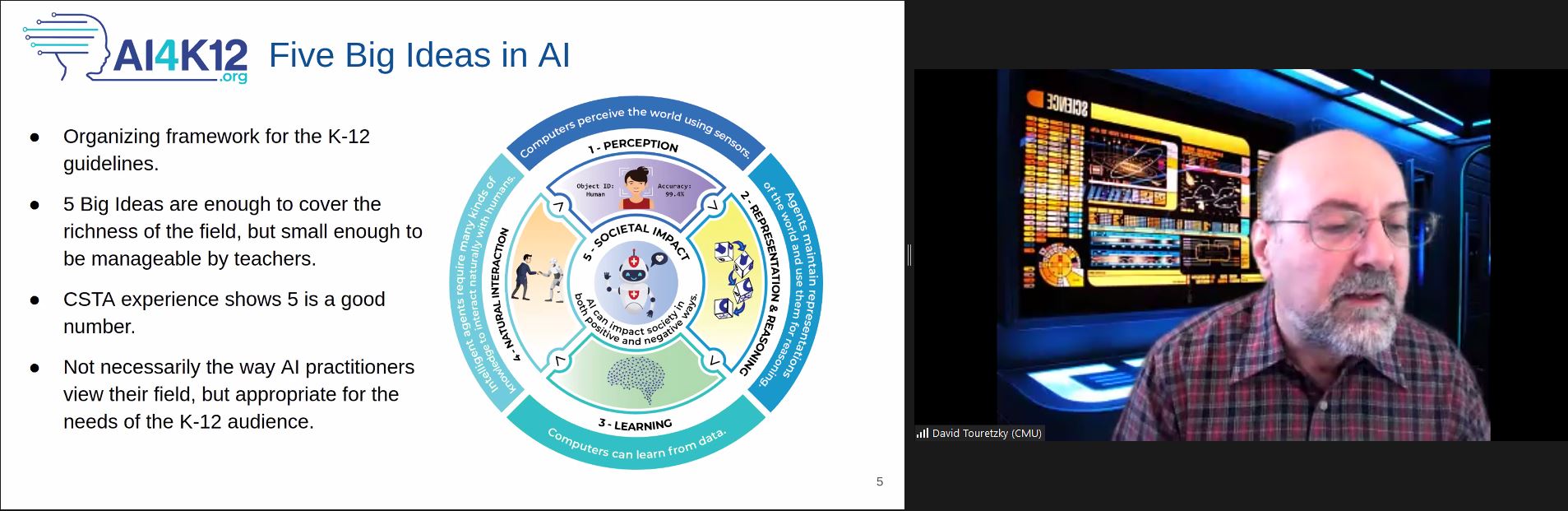
If you’ve heard of AI4K12 before, it’s probably because of the Five Big Ideas the team has set out to encompass the AI field from the perspective of school-aged children. These ideas are:
- Perception — the idea that computers perceive the world through sensing
- Representation and reasoning — the idea that agents maintain representations of the world and use them for reasoning
- Learning — the idea that computers can learn from data
- Natural interaction — the idea that intelligent agents require many types of knowledge to interact naturally with humans
- Societal impact — the idea that artificial intelligence can impact society in both positive and negative ways
Sometimes we hear concerns that resources being developed to teach AI concepts to young people are narrowly focused on machine learning, particularly supervised learning for classification. It’s clear from the AI4K12 Five Big Ideas that the team’s definition of the AI field encompasses much more than one area of ML. Despite being developed for a US audience, I believe the description laid out in these five ideas is immensely useful to all educators, researchers, and policymakers around the world who are interested in AI education.

During the seminar, Dave and Fred shared some great practical examples. Fred explained how the big ideas translate into learning outcomes at each of the four age groups (ages 5–8, 9–11, 12–14, 15–18). You can find out more about their examples in their presentation slides or the seminar recording (see below).
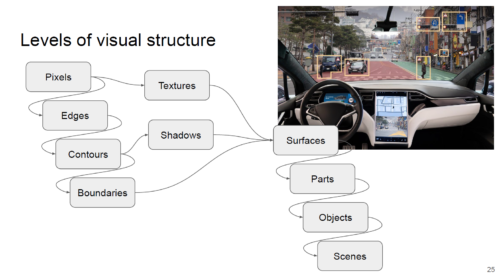
I was struck by how much the AI4K12 team has thought about progression — what you learn when, and in which sequence — which we do really need to understand well before we can start to teach AI in any formal way. For example, looking at how we might teach visual perception to young people, children might start when very young by using a tool such as Teachable Machine to understand that they can teach a computer to recognise what they want it to see, then move on to building an application using Scratch plugins or Calypso, and then to learning the different levels of visual structure and understanding the abstraction pipeline — the hierarchy of increasingly abstract things. Talking about visual perception, Fred used the example of self-driving cars and how they represent images.
AI education with an age-appropriate, glass-box approach
Dave and Fred support teaching AI to children using a glass-box approach. By ‘glass-box approach’ we mean that we should give students information about how AI systems work, and show the inner workings, so to speak. The opposite would be a ‘opaque-box approach’, by which we mean showing students an AI system’s inputs and the outputs only to demonstrate what AI is capable of, without trying to teach any technical detail.
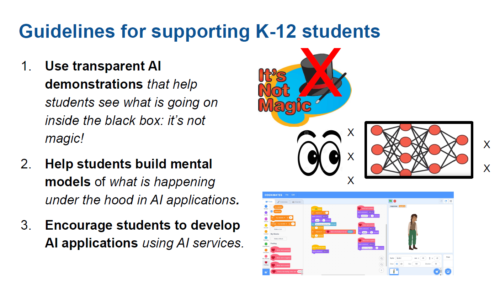
Our speakers are keen for learners to understand, at an age-appropriate level, what is going on “inside” an AI system, not just what the system can do. They believe it’s important for young people to build mental models of how AI systems work, and that when the young people get older, they should be able to use their increasing knowledge and skills to develop their own AI applications. This aligns with the views of some of our previous seminar speakers, including Finnish researchers Matti Tedre and Henriikka Vartiainen, who presented at our seminar series in November.
What is AI thinking?
Dave addressed the question of what AI thinking looks like in school. His approach was to start with computational thinking (he used the example of the Barefoot project’s description of computational thinking as a starting point) and describe AI thinking as an extension that includes the following skills:
- Perception
- Reasoning
- Representation
- Machine learning
- Language understanding
- Autonomous robots
Dave described AI thinking as furthering the ideas of abstraction and algorithmic thinking commonly associated with computational thinking, stating that in the case of AI, computation actually is thinking. My own view is that to fully define AI thinking, we need to dig a bit deeper into, for example, what is involved in developing an understanding of perception and representation.

Thinking back to Matti Tedre and Henriikka Vartainen’s description of CT 2.0, which focuses only on the ‘Learning’ aspect of the AI4K12 Five Big Ideas, and on the distinct ways of thinking underlying data-driven programming and traditional programming, we can see some differences between how the two groups of researchers describe the thinking skills young people need in order to understand and develop AI systems. Tedre and Vartainen are working on a more finely granular description of ML thinking, which has the potential to impact the way we teach ML in school.
There is also another description of AI thinking. Back in 2020, Juan David Rodríguez García presented his system LearningML at one of our seminars. Juan David drew on a paper by Brummelen, Shen, and Patton, who extended Brennan and Resnick’s CT framework of concepts, practices, and perspectives, to include concepts such as classification, prediction, and generation, together with practices such as training, validating, and testing.
What I take from this is that there is much still to research and discuss in this area! It’s a real privilege to be able to hear from experts in the field and compare and contrast different standpoints and views.
Resources for AI education
The AI4K12 project has already made a massive contribution to the field of AI education, and we were delighted to hear that Dave, Fred, and their colleagues have just been awarded the AAAI/EAAI Outstanding Educator Award for 2022 for AI4K12.org. An amazing achievement! Particularly useful about this website is that it links to many resources, and that the Five Big Ideas give a framework for these resources.
Through our seminars series, we are developing our own list of AI education resources shared by seminar speakers or attendees, or developed by us. Please do take a look.
Join our next seminar
Through these seminars, we’re learning a lot about AI education and what it might look like in school, and we’re having great discussions during the Q&A section.
On Tues 1 February at 17:00–18:30 GMT, we’ll hear from Tara Chklovski, who will talk about AI education in the context of the Sustainable Development Goals. To participate, click the button below to sign up, and we will send you information about joining. I really hope you’ll be there for this seminar!
The schedule of our upcoming seminars is online. You can also (re)visit past seminars and recordings on the blog.
The post The AI4K12 project: Big ideas for AI education appeared first on Raspberry Pi.
Source: Raspberry Pi – The AI4K12 project: Big ideas for AI education
Linux 5.17 Making It Easier To Build A Kernel With All The Shiny Debug Features
Over the years the Linux kernel has picked up many different sanitizers, memory leak detectors, and other features for helping to diagnose and address deficiencies in the kernel. However, all of these debugging-optimized features aren’t centrally located that can make it difficult for system administrators and developers to spot these numerous features when configuring a kernel build manually. Now with Linux 5.17 that is changing…
Source: Phoronix – Linux 5.17 Making It Easier To Build A Kernel With All The Shiny Debug Features
Earthbound Getting An Excellent Casio G-Shock In Japan

Casio has released a slew of limited and special edition watches over the years. As a proud owner of the Japanese-made GW5000-I JF, which sports a stainless steel case back, I’m a big fan of Casio and G-Shock. I also, like Earthbound (aka Mother), so when I heard the two were joining forces, you can bet their collab…
Source: Kotaku – Earthbound Getting An Excellent Casio G-Shock In Japan
Amazon is opening its first physical clothing store
Amazon is opening its first-ever Amazon Style physical clothing store with the promise of a high-tech shopping experience, confirming a rumor from last year. It will offer brands consumers “know and love,” according to Amazon, and an app will let you choose an item, size and color and send it directly to a fitting room or pickup counter. The first store is coming to The Americana at Brand in Los Angeles sometime “later this year,” the company said.
Amazon said it will offer “hundreds of brands” chosen by fashion creators and “feedback provided by millions of customers shopping on Amazon.com.” It didn’t specify which, but its online store currently carries products from designers like Oscar de la Renta, Altuzarra and La Perla. However, many luxury and high-end brands have resisted listing goods online with Amazon.
The stores will offer double the number of styles of traditional stores, while not forcing customers to search manually for the right size or color. Instead, if you see a clothing item you like, you can scan its QR code using the Amazon Shopping App to see sizes, colors, customer ratings and other details. You can then send it to the fitting room or directly to the pickup counter if you don’t need to try it on. As you might expect, it also uses an AI-powered algorithm to recommend more products based on what you’ve already picked.
You can open the fitting room door using the app, with all the items you’ve picked inside. Each one offers a touchscreen that lets you continue shopping and request new items to try on without having to leave. They’ll then arrive in “minutes” thanks to tech that Amazon also uses in its fulfillment centers.
You can feel free to buy items online that you found in the store, with the same prices in both places. Items can be returned in store, and any item you’ve scanned will be saved in the shopping app so you can revisit it later.
Amazon has already opened a number of Fresh grocery stores, along with book stores and even a hair salon. It didn’t say if it would use its cashierless “Just Walk Out” tech found in Fresh and Whole Foods, but it will use the Amazon One palm recognition service for checkout.
Source: Engadget – Amazon is opening its first physical clothing store