
According to a report this morning from Bloomberg, NVIDIA is communicating to their partners that they face the real possibility their deal to acquire Arm will not come to pass…
Source: Phoronix – NVIDIA Reportedly Close To Admitting Defeat In Arm Acquisition
Monthly Archives: January 2022
Neil Young Wants Music Pulled From Spotify Over Joe Rogan's Misinformation: Report

Neil Young wants all his music pulled from streaming service Spotify as quickly as possible, according to an open letter the veteran rock musician posted to his website that’s since been deleted. What’s the problem? Young doesn’t like the misinformation about vaccines being peddled by Joe Rogan, the podcast host who…
Source: Gizmodo – Neil Young Wants Music Pulled From Spotify Over Joe Rogan’s Misinformation: Report
GNOME 42 Lands DRM Privacy Screen Support
Now that Linux 5.17 has prepared DRM privacy screen support, the GNOME 42 is ready with its user-space side support for making use of this new standardized interface…
Source: Phoronix – GNOME 42 Lands DRM Privacy Screen Support
NXP Continues Work On Linux Driver Bring-Up Of "Amphion" Video Encoder/Decoder
NXP engineers continue persevering for bringing up a mainline-suitable, open-source kernel driver for their Amphion video encoder/decoder hardware. Out today is their 15th revision to the Amphion driver patches…
Source: Phoronix – NXP Continues Work On Linux Driver Bring-Up Of “Amphion” Video Encoder/Decoder
Linux Foundation Launches Open Source Software Development, Linux, and Git Certification
The Linux Foundation has released three new training courses on the edX platform: Open Source Software Development: Linux for Developers (LFD107x), Linux Tools for Software Development (LFD108x), and Git for Distributed Software Development (LFD109x). The three courses can be taken individually or combined to earn a Professional Certificate in Open Source Software Development, Linux, and Git. ZDNet reports: The first class, Open Source Software Development: Linux for Developers (LFD107x) explores the key concepts of developing open-source software and how to work productively in Linux. You don’t need to know Linux before starting this class, as it’s an introduction to Linux designed for developers. In it, you’ll learn how to install Linux and programs, how to use desktop environments, text editors, important commands and utilities, command shells and scripts, filesystems, and compilers. For this class, the Foundation recommends you use a computer installed with a current Linux distribution. I’d go further and recommend you use one with one of the professional Linux distributions. In particular, you should focus on one of the three main enterprise Linux families: Red Hat Enterprise Linux (RHEL), SUSE Linux Enterprise Server (SLES), and Ubuntu. There are hundreds of other distros, but these are the ones that matter to companies looking for Linux developers.
The next course, Linux Tools for Software Development (LFD108x) examines the tools necessary to do everyday work in Linux development environments and beyond. It is designed for developers with experience working on any operating system who want to understand the basics of open-source development. Upon completion, participants will be familiar with essential shell tools, so they can work comfortably and productively in Linux environments. In addition, I recommend you come to this class with a working knowledge of the C programming language.
Finally, Git for Distributed Software Development (LFD109x) provides a thorough introduction to Git. Git is Linux Torvalds’ other great accomplishment. This source control system was first used by the Linux kernel community to enable developers from around the world to operate efficiently. In addition, thanks to such sites as GitHub and GitLab, Git has become the lingua franca of all software development. Everyone uses Git today. With this class, you’ll learn to use Git to create new repositories or clone existing ones, commit new changes, review revision histories, examine differences with older versions, work with different branches, merge repositories, and work with a distributed development team. Whether or not you end up programming in Linux, knowing how to use Git is essential for the modern programmer. As ZDNet’s Steven Vaughan-Nichols notes, you can take the three courses through edX in audit mode for no cost. However, you’ll need to earn the professional certificate so employers will know you’re capable of open-source programming.
“To do this, you must enroll in the program, complete all three courses, and pay a verified certificate fee of $149 per course.”


Read more of this story at Slashdot.
Source: Slashdot – Linux Foundation Launches Open Source Software Development, Linux, and Git Certification
Creating better online multiple choice questions
In this blog post we explore good practices around creating online computing questions, specifically multiple choice questions (MCQs). Multiple choice questions are a popular way to help teachers and learners work out the next steps in learning, and to assess learning in examinations. As a case study, we look at some data related to learner responses to computing questions on the Oak National Academy platform.

The case study illustrates the many things MCQ authors have to think about while designing questions, and that there is much more research needed to understand how to get an MCQ “just right”.
Uses of multiple choice questions
Online auto-marked MCQs are now being integrated into classroom activities, set as homework, and used in self-led learning at home. Software products involving MCQs, such as Kahoot and Socratic, are easy to use for many, and have become popular in some learning contexts. MCQ may have become more prevalent due to increased online teaching and the availability of whole curricula through platforms such as the Oak National Academy.

An international group of researchers from China, Spain, Singapore, and the UK recently looked into the reasons why MCQ-based testing might improve learning. Chunliang Yang and his co-authors concluded that there are three main ways that MCQ tests help learners learn:
- They provide learners with additional exposure to learning content
- They provide learners with content in the same format that they will be later assessed in
- They motivate learners, e.g. to prompt them to commit more effort to learn in general
What does the research say about creating multiple choice questions?
In recent research reviewing the use of MCQs, Andrew Butler from Washington University in St Louis looked at the effectiveness of MCQs in relation to learning, rather than assessment. Andrew gives the following advice for educators creating MCQs for learning:
- Think about the thinking processes the learner will use when answering the question, and make sure the processes are productive for their learning
- Don’t make the question super easy or too difficult, but make it challenging — the difficulty needs to be “just right”
- Keep the phrasing of the question simple
- Ensure that all answers are plausible; providing three or four answers is usually a good idea
- Be aware that if learners pick the wrong answer, this can reinforce the wrong thinking
- Provide corrective feedback to learners who pick the wrong answer
What I find particularly interesting about Andrew’s advice is the need to make the difficulty of the MCQ “just right” for learners. But what does “just right” look like in practice? More research is needed to work this out.
The anatomy of a multiple choice question
When talking about MCQs, there are technical terms to describe question features, e.g.:
- Incorrect answers are called distractors (or lures)
- A distractor is defined as plausible if it’s an answer a layperson would see as a reasonable answer
- Plausible distractors are called working distractors
Here at the Foundation, we created MCQs for the Oak National Academy when we adapted our Teach Computing Curriculum classroom materials into video lessons and accompanying home learning content to support learners and teachers during school closures. Data about what questions are attempted on the Oak platform, and what answer options are chosen, is stored securely by Oak National Academy. The Oak team kindly provided us with four months of anonymous data related to responses to the MCQs in the ‘GCSE Computer Science – Data representations’ unit.
Over this period of four months, learners on the platform made more than 29,000 question attempts on the thirty-five questions across the nine lessons that make up this data representation unit. Here is a breakdown of the questions by topic area:
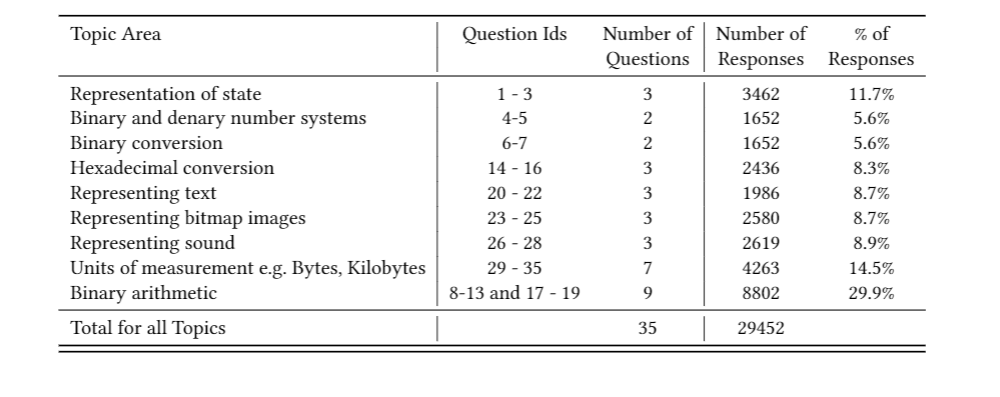
As shown in the table, more questions relate to binary arithmetic than to any other topic area. This was a specific design decision, as it is well-known that learners need lots of practice of the processes involved in answering binary arithmetic questions.
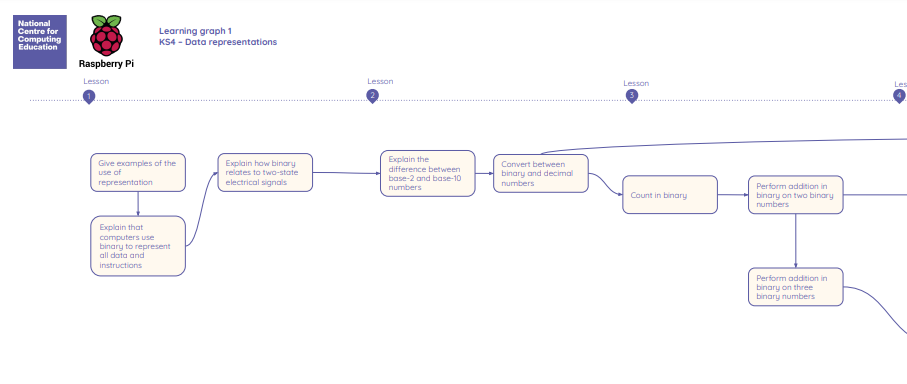
Let’s look at an example question from the binary arithmetic topic area, with one correct answer and two distractors. The learning objective being addressed with this question is ‘Perform addition in binary on two binary numbers’.

As shown in the table below, in four months, 1170 attempts were made to answer the example question. 65% of the attempts were correct responses, and 35% were not, with 21% of responses being distractor b, and 14% distractor c. These distractors appear to be working distractors, as they were chosen by more than 5% of learners, which has been suggested as a rule-of-thumb threshold that distractors have to clear to be classed as working.
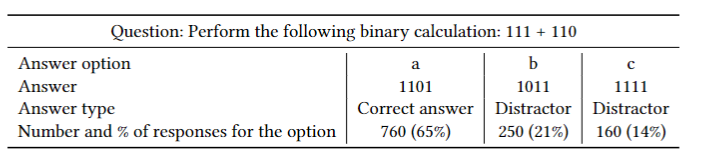
However, because of the lack of research into MCQs, we cannot say for certain that this question is “just right” — it may be too hard. We need to do further research to find this out.
Creating multiple choice questions is not easy
The process of creating good MCQs is not an easy task, because question authors need to think about many things, including:
- What learning objectives are to be addressed
- What plausible distractors can be used
- What level of difficulty is right for learners
- What type of thinking the questions are encouraging, and how this is useful for learners
In order for MCQs to be useful for learners and teachers, much more research is needed in this area to show how to reliably produce MCQs that are “just right” and encourage productive thinking processes. We are very much looking forward to looking at this topic in our research work.
To find out more about the computing education research we are doing, you can browse our website, take part in our monthly seminars, and read our publications.
The post Creating better online multiple choice questions appeared first on Raspberry Pi.
Source: Raspberry Pi – Creating better online multiple choice questions
They see us Cinnamon Rolling, they're rating: GeckoLinux incorporates kernel 5.16 with familiar installation experience
Most distros haven’t got to 5.15 yet, but openSUSE’s downstream project GeckoLinux boasts 5.16 of the Linux kernel and the latest Cinnamon desktop environment.
Source: LXer – They see us Cinnamon Rolling, they’re rating: GeckoLinux incorporates kernel 5.16 with familiar installation experience
Valve Rolling Out Dynamic Cloud Sync For Moving Between The Steam Deck & PC
Ahead of the Linux-based Steam Deck hopefully shipping around the end of February, Valve announced a new Steamworks feature called Dynamic Cloud Sync…
Source: Phoronix – Valve Rolling Out Dynamic Cloud Sync For Moving Between The Steam Deck & PC
Samsung built a fingerprint security chip for payment cards, employee IDs and more
Samsung has revealed what it calls the “industry’s first” all-in-one fingerprint security chip (IC) for payment cards. The S3B512C chip reads biometric information via a fingerprint sensor, stores and authenticates data with a tamper-proof secure element (SE) and analyzes it with a secure processor. While primarily designed for payment cards, it could also be used for “student or employee identification, membership or building access,” the company said.
Samsung
Mainly, though, the new chip could make it easier for banks and others to make biometric payment cards. The solution performs in line with Mastercard’s latest security specifications for payment cards, while also conforming to international security standards (CC EAL 6+) for “protecting high-value assets against significant risks,” according to Samsung.
Last year, Samsung announced that it was collaborating with Mastercard on a biometric scanning payment card with a built-in fingerprint reader. It said at the time that the tech would “adopt a new security chipset from Samsung’s LSI business” rather than using Mastercard’s tech, so the new S3B512C chipset appears to be what it was referring to.
The chip could also allow for “faster and safer interactions when making purchases,” Samsung notes. It removes the need for a PIN code and even uses anti-spoofing technology to block fraudulent methods like artificial fingerprints.
It seems absurd that in 2022, people are still swiping cards and signing for purchases. Given Samsung’s manufacturing chops and influence, however, the chip has the potential to make biometric payment cards more mainstream. Samsung didn’t mention any launch customers or other details.
Source: Engadget – Samsung built a fingerprint security chip for payment cards, employee IDs and more
DXVK 1.9.4 Enables Performance Optimizations and DLSS Support for God of War
DXVK developer Philip Rebohle announced today the release of DXVK 1.9.4 as the fourth maintenance update to the latest DXVK 1.9 stable series of this open-source Vulkan-based implementation of D3D9, D3D10, and D3D11 for Linux/Wine.
Source: LXer – DXVK 1.9.4 Enables Performance Optimizations and DLSS Support for God of War
What is conversation intelligence and why your sales team should use it

Conversation intelligence has become a well-known buzzword today, and that is for good reason. The post-pandemic has shifted many businesses into the digital world making most interactions in an organization via video conference software, such as zoom, google meet, skype, etc… By implementing conversation intelligence into your sales process, you’re able to enhance the meeting’s outcome and improve the productivity of your team.
Implementing a conversation intelligence software can help your team close more deals. Attention is the only tool that empowers your sales reps during their meetings through state-of-the-art artificial intelligence. Attention gathers insightful analytics during the calls and provides real-time feedback to your sales reps. The sales reps are able to identify their goals and measure their process, thus, increasing the productivity of the team. Attention is a modern tool that can aid in training your sales reps and ramp up coaching time turning junior reps into top-performing sellers.
What is Conversation Intelligence?
Conversation Intelligence (CI) is a software that captures and analyzes speech or text from a sales agent and prospect through Artificial Intelligence and Natural Language Processing (NLP). The software is then able to deliver a data-driven response. The data collected can then be used by sales teams to win more deals and increase their productivity.
With an increase in digital meetings, conversation intelligence has become crucial for a business’s sales process. Implementing this software to your practices will aid in making sense of the data, provide real-time feedback, and be able to ramp up the coaching of your reps.
What can conversation intelligence do for your business?
Using the conversational data collected, teams can filter through the important analytics and be able to interact with their customers in a genuine way. There are many benefits of adding a conversation intelligence software into your sales process. As a manager, you will be able to ramp up the team’s sales training and coaching because getting your new hires and junior reps to perform their best shouldn’t take months. The data collected through sales meetings are analyzed and scored, allowing sales reps to be empowered and improve their productivity. Conversation Intelligence improves the sales process so that the team will be able to focus on closing more deals.
Applying a conversation intelligence tool to your sales process can also optimize your sales conversion. Attention provides real-time feedback that sales reps can use during their call to connect with their prospects. Being able to have battlecards during your calls will set your team for success. Battlecards help sales reps focus on what’s important during their calls. Sales Battlecards will have information such as facts about clients, selling tactics, and data on market research.
Conversational intelligence can ramp up training, optimize your sales conversion, and create genuine relationships between your sales reps and prospects.
Who should use conversation intelligence?
There is a misconception of who should use conversation intelligence. Many companies think that it benefits only large organizations. However, this is far from the truth. Conversation Intelligence tracks calls and provides insightful data to help optimize your conversation with prospects. This is a very powerful tool that any business will be able to benefit from.
Some of the positions in an organization who will benefit from a conversation intelligence software are:
- CRO
- Sales leads
- Sales reps
- Customer service/ success
- Marketing teams
The conversational data collected can help each team member understand their audience and their pain point. This will help each team find ways to better help them and improve their selling and marketing tactics.
How to drive growth with conversation intelligence?
Think of conversation intelligence as the magic wand that helps connect your sales team with their prospects. Conversation Intelligence will make your sales team more effective. A great salesperson will be able to close a deal and keep their prospects happy through the whole process, even when they become customers of your business. Conversation intelligence can provide real-time feedback to your salesperson allowing them to have the tools to carry an authentic conversation with their prospects. This will help close more deals and keep your clients happy.
Implementing a conversation intelligence software can also help provide superior support for your management. As your team grows, it quickly becomes nearly unrealistic for a manager to shadow every rep’s calls. Using a conversational AI platform will analyze and monitor the data collected through their meetings. This data can be used for coaching and training to improve junior reps into high-performing reps and close more deals.
Implementing software that will work for your sales team
The convenience and efficiency of implementing a conversation intelligence makes it easy to streamline your sales process and provide your potential clients with the best overall experience.
If you are looking for a solution that can help improve the efficiency and productivity across teams and departments in your organization, give Attention a try! Attention uses state-of-the-art artificial intelligence to analyze and generate metrics such as questions asked, speak share, positive feedback, engagement, and overall performance. This data can then be used to ramp up training and turn your junior reps into top sellers. Attention integrates with your Zoom calls and delivers real-time guidance to aid your sales reps during their calls.
Source: TG Daily – What is conversation intelligence and why your sales team should use it
Twitter's experimental 'Flock' feature will let you share tweets with your closest friends
Twitter is still working on a feature that will give you a way to blast tweets that can only be seen by the friends you choose. In July last year, the social network revealed that it’s considering letting you designate “trusted friends” so some tweets would only be visible to them. Now, developer and reverse engineer Alessandro Paluzzi has unearthed evidence that the feature is currently in development and that Twitter now calls it “Flock.”
It might be called differently if it gets a wider release, though — the company told The Verge that “Flock” is just a placeholder name. Based on the explanation that Paluzzi found, its current iteration will let you add up to 150 users to your list, and they’ll be the only ones who can see and respond to tweets you send to the group. Any tweet you send to your Flock will be come with a notice telling your audience that they can see it because you’ve added them to the group. You can edit the group anytime, though, and Twitter says it won’t notify anyone you remove.
#Twitter continues to work on Twitter Flock by adding an explanation of how it works 👀
ℹ️ You can choose up to 150 people to include in your Twitter Flock 👥
ℹ️ People won’t be notified if you remove them from the list 🔕 pic.twitter.com/xtGcDiHgxS— Alessandro Paluzzi (@alex193a) January 21, 2022
When the company first revealed that it’s considering adding a trusted friends feature, it also presented another concept that would allow you to take on different personas within the same account. It’s unclear if that version of the feature is no longer in development. Twitter is also testing a feature called Communities that gives you a dedicated space for groups of people with the same interests. Flock, however, was designed with your real friends in mind, similar to Instagram’s Close Friends for Stories. In its statement sent to The Verge, Twitter said it’s “always working on new ways to help people engage in healthy conversations, and [it’s] currently exploring ways to let people share more privately.”
Source: Engadget – Twitter’s experimental ‘Flock’ feature will let you share tweets with your closest friends
7 strategies for success when contributing to open source
Many people aspire to become contributors to open source projects. With a little effort, anyone can. This article shares how I got started with open source contributions and how doing so helped me land a job in an open source organization.
Source: LXer – 7 strategies for success when contributing to open source
Framework Laptop Now Enjoys Open-Source EC Firmware
While just one part of the overall equation for a system with open-source firmware, the Framework Laptop has joined the ranks of the Linux-focused laptops these days being backed by open-source firmware for its embedded controller (EC)…
Source: Phoronix – Framework Laptop Now Enjoys Open-Source EC Firmware
Desktop-deprived Linus Torvalds releases first release candidate of ‘not huge’ kernel 5.17
The first release candidate for version 5.17 of the Linux kernel has rolled off the production line – despite fears that working from a laptop might complicate matters.
Source: LXer – Desktop-deprived Linus Torvalds releases first release candidate of ‘not huge’ kernel 5.17
Space Force Just Launched Satellites Capable of 'Inspecting' Enemy Satellites
An anonymous reader quotes a report from The Drive: Space Force launched two additional satellites today as part of its push for greater Space Domain Awareness, or SDA, in geosynchronous orbit some 22,000 miles away from Earth. The two satellites are part of the Geosynchronous Space Situational Awareness Program, or GSSAP, and will allow Space Force to not only locate and identify objects in this distant orbit, but also maneuver close to them in order to inspect them or assess their capabilities. The launch comes as Space Force leadership continues to sound the alarm about the risks posed to U.S. satellites in orbit.
The Northrop Grumman-built GSSAP-5 and GSSAP-6 were launched today at Cape Canaveral Space Force Station in Florida atop a United Launch Alliance (ULA) Atlas V 511 rocket. The first two GSSAP satellites were launched in 2014, with the second two following in 2016. Space Force has not released any details about how these two new GSSAP satellites might differ from the previous four, which were designed to operate near the belt of other geosynchronous satellites and maneuver close to them to conduct surveillance. A spokesperson for Space Systems Command stated this week that the new GGSAP satellites “will provide improved SDA data to the National Space Defense Center and other national users to enhance our ability to navigate freely and safely within the GEO belt.”
GSSAP-5 and GSSAP-6 were originally scheduled to be launched in 2020, and it is not known why the launch was delayed almost two years. The GSSAP program was originally highly classified and was only revealed to the public in 2014. While the exact capabilities of the satellites are not public, it’s known that they are able to capture close-up images of other satellites in geosynchronous orbit. Former Commander of Air Force Space Command Gen. William Shelton (Ret.) told Aviation Week in 2014 that the satellites are designed to drift in and out of the geosynchronous belt collecting intelligence on specific targets. The Air Force has previously used one of the satellites for Remote Proximity Operations (RPO), maneuvering close enough to inspect another Department of Defense satellite operated by the Navy that was experiencing a malfunction. The former head of Air Force Space Command, General John Hyten (Ret.), has previously said the satellites are capable of capturing some “truly eye-watering” imagery.


Read more of this story at Slashdot.
Source: Slashdot – Space Force Just Launched Satellites Capable of ‘Inspecting’ Enemy Satellites
Git hooks: How to automate actions in your Git repo
Protect your Git repository from mistakes, automate manual processes, gather data about Git activity, and much more with Git hooks.
Source: LXer – Git hooks: How to automate actions in your Git repo
Raven's New 'Organizational Change' Conveniently Breaks Up Union Members

It was only a few days ago that 34 quality assurance testers at Raven, one of the studios working exclusively on the Call Of Duty series, formed the first ever union among Activision Blizzard employees. Today, management has responded to their success with some changes.
Source: Kotaku – Raven’s New ‘Organizational Change’ Conveniently Breaks Up Union Members
How to Create Sudo User on Linux (RHEL | Rocky Linux | AlmaLinux)
Sudo user is the regular user in Linux which has admin or root privileges to perform administrative tasks. Learn how to create a sudo user on Linux here.
The post How to Create Sudo User on Linux (RHEL | Rocky Linux | AlmaLinux) appeared first on Linux Today.
Source: Linux Today – How to Create Sudo User on Linux (RHEL | Rocky Linux | AlmaLinux)
Amazon allegedly retaliates against worker at its Bessemer facility
Isaiah Thomas is a 20-year-old Amazon worker at the company’s Bessemer, Alabama facility, BHM1. He is also a vocal supporter of unionizing the warehouse. In a conference with press Monday evening, he described what he believed were surveillance and retaliation by his employer, solely because of his support for collective bargaining efforts. The Retail, Wholesale and Department Store Union (RWDSU), which has been working to represent employees at BHM1, has filed two unfair labor practice complaints with the National Labor Relations Board over the incident.
In a screenshot provided by the union, a letter addressed only from “BHM1 Management” to Isaiah claims the worker was “soliciting in working areas, during working associate times.” The letter concedes that these activities “may have occurred during your break time” but nonetheless contends that Isaiah was “in violation” of the company’s solicitation policy.
RWDSU, however, believes this action was itself in violation of “the settlement agreement the employer recently executed with the NLRB.” That agreement, which was reported late last month, pertained to several instances of Amazon impeding union activity. The union filed a separate ULP, alleging that the company or its agents “created the impression Mr. Thomas was under surveillance.” Amazon has been known to hold captive audience meetings meant to discourage union interest, and after one such meeting at BHM1 wherein Isaiah allegedly questioned a “labor relations manager,” RWDSU states in its ULP that “Mr. Thomas observed the employer’s agents circling his work area for no other purpose than to watch him work” and later assigned him to a different area where he could be “more easily observed.”
While RWDSU have described the letter as a “reprimand” in an email to Engadget, it’s unclear if it represents a formal write-up. We’ve reached out for comment from Amazon.
The news comes two days after the NLRB ruled Amazon had illegally fired another pro-union worker at its Staten Island facility. If that case doesn’t go to settlement, the Board plans to issue a formal complaint against the company.
BHM1 famously became the first large Amazon facility on US soil to hold a union vote. While the vote swung heavily in favor of the cloud-and-ecommerce giant, it was challenged on procedural grounds by RWDSU. The NLRB found merit to the challenge, ruling that Amazon had, in fact, illegally interfered with the unionization vote. Ultimately the Board determined a new vote should be held. It’s scheduled to take place on February 4th (though the ballot count will not begin until the end of March.)
Amazon is, beyond is preference for a non-unionized workforce, well known for its rate of employee attrition. Seemingly, the speed at which it churns through workers would disadvantage efforts to build a cohesive bargaining unit at BHM1. According to RWDSU, the current voter list at the facility it 6,143 people, just over half of which were present for the previous vote, which took place almost exactly one year ago.
Source: Engadget – Amazon allegedly retaliates against worker at its Bessemer facility