Verizon Opens Its Blazing Fast 5G Ultra-Wideband MmWave Network To Prepaid Customers

Verizon Opens Its Blazing Fast 5G Ultra-Wideband MmWave Network To Prepaid Customers
Verizon is expanding access to its greater 5G network to its customers that prefer prepaid accounts. Verizon previously provided access to both its 5G Nationwide (sub-6GHz) and 5G Ultra-Wideband (mmWave) to its postpaid customers, however, only the former was available to prepaid accounts.

With this week’s announcement, prepaid accounts

Source: Hot Hardware – Verizon Opens Its Blazing Fast 5G Ultra-Wideband MmWave Network To Prepaid Customers

AT&T's public safety network knows which floor first responders are on

AT&T’s FirstNet public safety network just received some upgrades that could make all the difference in certain emergencies. Most notably, the platform now includes vertical GPS support, or Z-Axis in AT&T-speak. It’s now possible to pinpoint…

Source: Engadget – AT&T’s public safety network knows which floor first responders are on

What to Consider Before Buying Your Kid a Fitness Tracker

The pandemic has forced us all to slow down in a myriad of ways. Our schedules are not as packed as they once were, and our legs have not had to carry us from here to there and back again with the frequency of yore. I personally feel myself sinking into hibernation mode; I am most likely to be found huddled under a…

Read more…


Source: LifeHacker – What to Consider Before Buying Your Kid a Fitness Tracker

Average US iPhone Price Hits a Record $873

Spurred by big demand for top-of-the-line iPhones, the average selling price in the U.S. hit $873 last quarter, up from $809 a year ago, according to a report from Chicago-based Consumer Intelligence Research Partners. From a report: Apple still makes a huge chunk of its revenue and profits from iPhone sales, though services are an increasing source of both as well. “For the full quarter, the new iPhone 12 models, and in particular the most expensive ones, garnered a significant share of sales,” said CIRP partner and co-founder Josh Lowitz.

Read more of this story at Slashdot.


Source: Slashdot – Average US iPhone Price Hits a Record 3

NVIDIA GeForce RTX 3080 Laptop Performance: What To Expect

NVIDIA GeForce RTX 3080 Laptop Performance: What To Expect
NVIDIA unveiled its Ampere-based RTX 30 series mobile GPUs at a special GeForce Event, during this year’s virtual CES 2021 festivities. A wide range of notebook design wins were also showed off at various events, spanning a variety of form factors. With the GeForce RTX 30 series, NVIDIA is targeting high-performance gaming notebooks in form…

Source: Hot Hardware – NVIDIA GeForce RTX 3080 Laptop Performance: What To Expect

Formlabs launches its first SLS 3D printer for in-house prototyping

Today, Formlabs is introducing a new Selective Laser Sintering (SLS) 3D printer for prototypers and engineers. The Fuse 1 uses the company’s first Nylon powder to make SLS printing more affordable and accessible for businesses. It’s an industrial pri…

Source: Engadget – Formlabs launches its first SLS 3D printer for in-house prototyping

Sony Launches Xperia PRO 5G … for $2499

Last year in February Sony had launched the Xperia 1 II, as well as teasing a sibling device called the Xperia PRO. This latter variant of the phone was meant to be a professional variant of the Xperia 1 II, in a more rugged form-factor, as well as integrating a HDMI input port.


Today, almost a whole year later, Sony is ready to finally to launch the Xperia PRO 5G, with availability starting today at a staggering price tag of $2499.


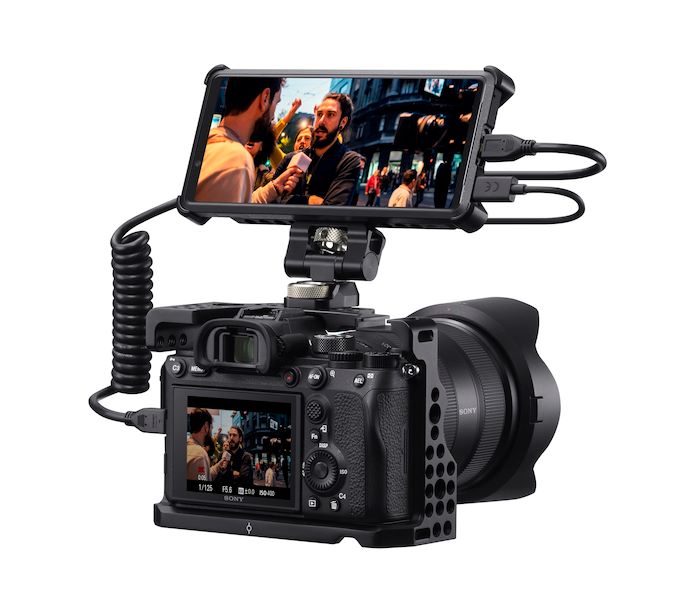
The peculiarity about the Xperia PRO 5G are two key features: a HDMI input port alongside the usual USB-C port, as well as additional mmWave 5G connectivity in the form of four antennas, more than the usual two or three we find in other consumer models.


Sony is trying to position the Xperia PRO as a professional accessory for broadcast video, where the phone directly attaches to your camera feed via HDMI and is able to directly upload to the internet. It’s a very niche use-case, however Sony is trying to replace several discrete devices in one: The Xperia PRO can serve simultaneously as a high-quality monitor, and actually outperform most other dedicated camera monitors out there thanks to its 6.5” 3840 x 1644 HDR OLED screen, as well as serving as a cellular video streamer, a kind of device that usually alone goes for $1000 to $1500.


Furthermore, Sony is doing a lot of fanfare about the phone’s 4 mmWave antennas and how it’ll be able to achieve much better, stable, and uniform reception compared to other devices in the market which employ only 2 or 3 antennas. The caveat here is of course that this will only ever get used when under actual mmWave coverage, which is still a very limited number of locations in the US. Of course, the phone will fall back to sub-6GHz 5G and LTE whenever there’s no mmWave coverage.


So, while the $2499 price tag might sound absolutely outrageous at first, it’s not much more expensive than other discrete solutions such as a dedicated monitor as well as competing, feature poorer cellular streaming devices. Where I do think Sony dropped the ball here is in terms of software features: the Xperia PRO lacks more commonly found features in dedicated monitors such as wave forms or vector scopes, and also lacks any kind of camera control or status features, even with Sony’s own line-up of cameras. For the device being now launched almost a whole year after its initial announcement, that’s extremely disappointing. During the Q&A briefing, it seems that Sony is aware of these features missing, but offered no concrete answers on whether they’ll continue to evolve the product from a software standpoint.


The Xperia PRO is otherwise feature identical to an Xperia 1 II – including the Snapdragon 865 SoC, the triple-camera setup, screen, and battery size, though DRAM and storage are upped to 12GB and 512GB. Furthermore, Sony says that the Xperia PRO is only launching in the US for $2499, with no current plans for availability in other markets.


Related Reading:


Source: AnandTech – Sony Launches Xperia PRO 5G … for 99

Could One More Ghostbusters Icon Be Joining Afterlife?

Richard Kelly still wants to get his Rod Serling biopic off the ground—and a sequel to Donnie Darko. Gaten Matarazzo teases big scares for the next season of Stranger Things. Plus, Jeff Nichols talks about his Alien Nation reboot, and what’s to come on Nancy Drew and Charmed. Spoilers, away!

Read more…


Source: Gizmodo – Could One More Ghostbusters Icon Be Joining Afterlife?

I Fell in Love With the Asus ROG Flow X13, and Then It Broke My Heart

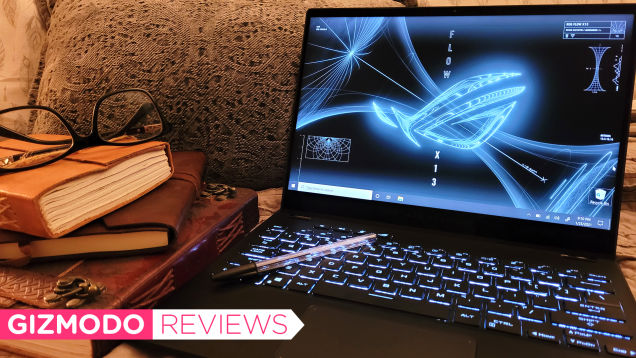
I never heard of a 2-in-1 gaming laptop prior to CES 2021. Did one even exist? Convertible laptops and gaming laptops are two incredibly different things with unique thermal and performance needs—not to mention they are designed for two different consumer bases. But it looks like we’ve finally shrunken GPUs small…

Read more…


Source: Gizmodo – I Fell in Love With the Asus ROG Flow X13, and Then It Broke My Heart

AMD's Latest Mobile CPU Is Really Freaking Fast

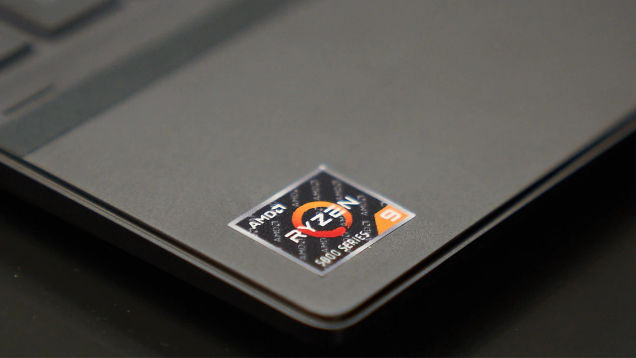
Just when I was starting to eye the new MacBook Pro for its incredibly fast processing speeds, AMD just pulled me back to the Windows side with its Ryzen 9 5980HS. Like its latest desktop processors, AMD took advantage of its Zen 3 architecture and brought the same impressive performance to its newest H-series mobile…

Read more…


Source: Gizmodo – AMD’s Latest Mobile CPU Is Really Freaking Fast

Lego Vidiyo Lets Kids Make Augmented Reality Music Videos With Minifigs

Harnessing the power of augmented reality and featuring songs from Universal Music Group artists, Lego Vidiyo lets kids and adults with too much time on their hands put together colorful music videos filled with special effects and dancing toy llamas.

Read more…


Source: Kotaku – Lego Vidiyo Lets Kids Make Augmented Reality Music Videos With Minifigs

Eat One Half of Your Everything Bagel Over the Other

There are two types of bagel eaters—those who eat their bagels one half at a time, and those who eat them as a sandwich, even if cream cheese is the only filling. If you are a member of the second group (like my boyfriend), the following tiny-but-smart hack is not for you. But if you are a member of the first group…

Read more…


Source: LifeHacker – Eat One Half of Your Everything Bagel Over the Other

AMD Ryzen 5000 Mobile Explored: The Future Of Zen 3 Laptops

AMD Ryzen 5000 Mobile Explored: The Future Of Zen 3 Laptops
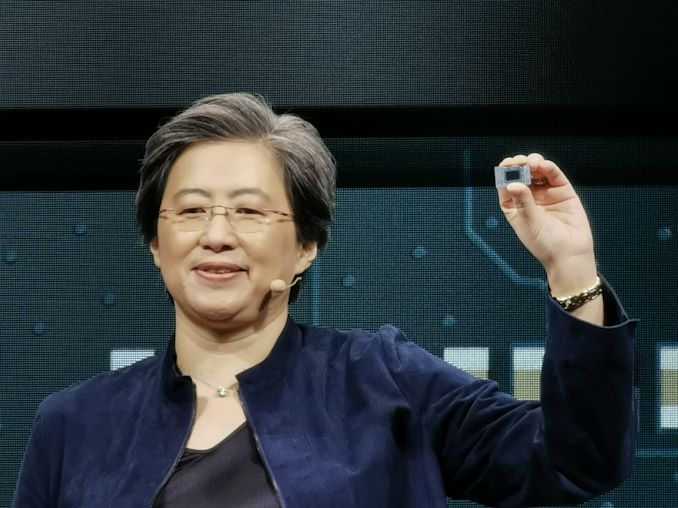
During her CES2021 keynote address, AMD CEO Dr. Lisa Su, along with a handful of partners, revealed the AMD Ryzen 5000 series mobile processors. At that event, the overall line-up and a few details were disclosed, and over the course of CES many design wins were announced by multiple OEMs as well. Shortly thereafter though, AMD hosted an additional…

Source: Hot Hardware – AMD Ryzen 5000 Mobile Explored: The Future Of Zen 3 Laptops

AMD's Ryzen 5000 Lucienne: Not Simply Rebranded Ryzen 4000 Renoir

AMD came in for some harsh criticism when it announced that its new Ryzen 5000 Mobile U-series processors would not all be using its latest core design. At the product announcement, we were told that some of the U-series processors would be based on the previous Zen 2 generation, and this was mainly for partners to take advantage of the new naming scheme but also reuse designs with the same ballpark performance. A number of tech enthusiasts (including myself, I have to say) scoffed at this as it made the whole system complex. It’s still complex, but we’ve come to understand that these latest Zen 2 based mobile processors also include a whole raft of updates that make them a better version of what they are.


To simplify things I’m going to call these products by their AMD codenames. The older Zen 2 processors are called Renoir, and the newer Zen 2 processors are called Lucienne. Here is a list of the new Ryzen 5000 U-Series, with Lucienne listed in yellow.
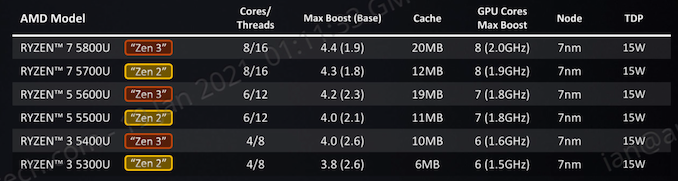


Renoir, for all intents and purposes, was a very successful product for AMD. Placed in the Ryzen 4000 Mobile series, it became the bedrock of AMD’s mobile portfolio and has been installed in around 100 design wins since it came to market. Lucienne on the other hand is a minor player in the latest Ryzen 5000 Mobile series. It doesn’t have the updates that the new Zen 3 cores have, but we have since learned that on the power side of things, rather than being a copy of Renoir, it is almost certainly Renoir Plus.


What Lucienne brings to the table over Renoir comes in discrete categories.


Memory Controller


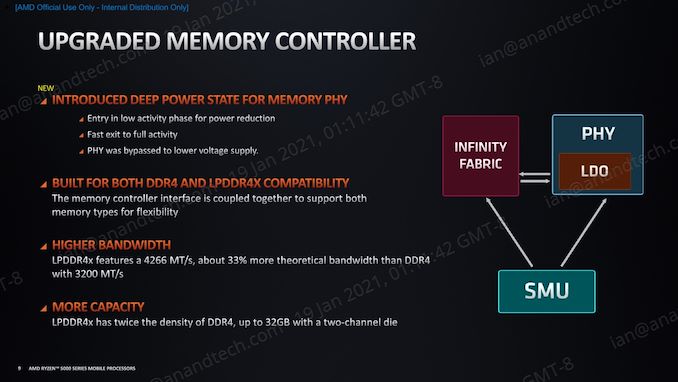
The memory controller in Lucienne is now able to decouple its voltage from the cores and enter a lower power state when not in use or for low bandwidth reasons. This ultimately saves power, and AMD has enabled it to bypass particular voltage indicators to help it stay in the low voltage state. Aside from the cores and the graphics, the other two consumers of power inside a mobile processor is the internal communications and the external communications, of which the memory controller falls under the latter. AMD has also put into place a system by which the memory controller can wake to a full bandwidth state faster than before, enabling better responsivity from those deep sleep states.


On top of this, the memory controller can now support double the capacity of memory from Renoir: up to 64 GB of DDR4-3200, or up to 32 GB of LPDDR4X-4267. Using DDR4 means the system can have more peak memory, as well as being user adjustable, however LPDDR4X trades those in for faster bandwidth overall (68.4 GB/s vs 51.2 GB/s).


Per-Core Voltage Control


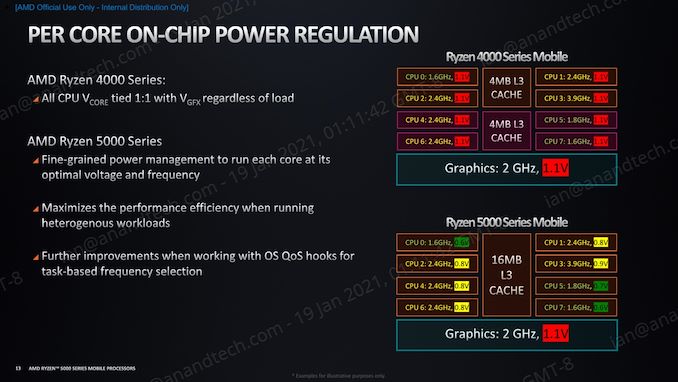
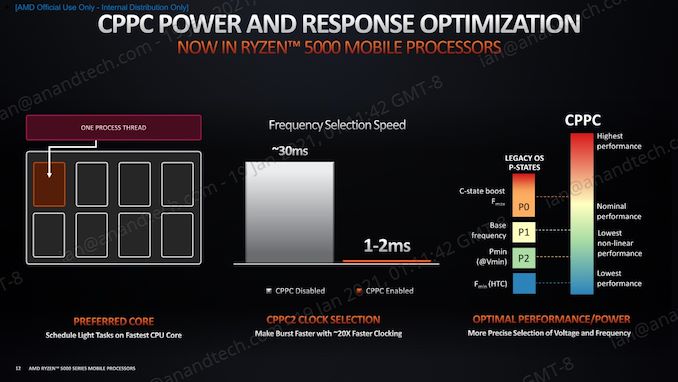
In similar circumstances to the memory controller, having voltage control of each individual core in a mobile processor is one angle to both maximize performance when needed and minimize power loss when idle. In Renoir, all of the cores can adjust their frequency, but they all had to run at the same voltage. Lucienne changes that such that each core can adjust its voltage independently, enabling a finer grained power management and a more optimal power-efficient system. There are also additional hooks that operating systems can use if it knows high performance cores are needed in advance.


Preferred Core


When we speak about turbo, historically it has been assumed that any core can reach the highest single core turbo frequency, and that the workload is sometimes shifted between cores to help with thermal management. When a system uses a preferred core however, it means that a system could be optimized for that specific core, and more performance extracted. AMD introduced its Preferred Core technology on the desktop two generations ago, and now it comes to the mobile processors. One core out of the eight on Lucienne silicon will be designated the best core, and through an OS driver (default in Windows) all workloads will be placed on that core preferentially.


Frequency Ramp


One of the features that tie all of this together is how quickly a core can move from idle to peak performance and back again. If a system takes too long to ramp up to speed, or ramp back down, then responsiveness and power is lost. A typical modern system is expected to ramp up from idle to peak frequency within two frames at 60 Hz, or 32 milliseconds, however the latest systems from AMD and Intel have done it much faster, often within 16 ms. AMD’s enhanced clock gating technology is now enabling Lucienne to reduce that down to 1-2 milliseconds. This means that a system could easily ramp up and down between each keystroke on a keyboard, supplying immediate responsiveness to a user while keeping the total power use down. In the 16-32 millisecond regime, typing on a keyboard may have meant a core being active almost continuously, however making this change faster affords a lot of power savings through these transitions.


Continuous Performance Levels


The legacy way for an operating system to command performance is through performance states, or P-states. In this instance the OS would request a specific level of power and performance from the processor based on its detected workload, and the processor would respond. This was originally implemented during a time when turbo was first coming to modern processors, and workload analysis was better done through the operating system. Now we can do this level of monitoring on the processor directly, and through an OS driver (already part of Windows), with system support that level of frequency control can be passed back down to the processor. The processor also gets an effective continuous distribution of performance, rather than discrete P-states.


While Renoir had P-states, Lucienne gets the benefit of CPU-level performance requests.


Faster Integrated Graphics


With the additional power control elsewhere on the core, how the power delivery works to the integrated graphics was also adjusted to allow for better regulation and ultimately a lower minimum voltage. Through firmware AMD has enabled a frequency sensitive prediction model that allows the GPU to adjust its voltage and frequency based on its dynamic energy management. Coupled with the better regulation and the power budget balancing done between CPU, interconnect, DRAM, and the GPU, more power budget is available for the GPU. For Lucienne, this means +150 MHz on the peak IGP speeds compared to Renoir.
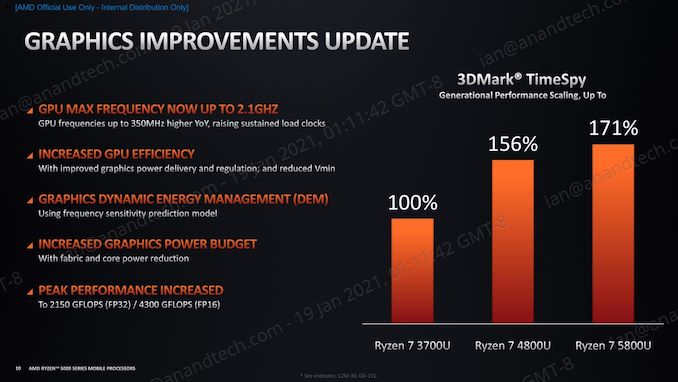


Slide shows Cezanne numbers, but applies to Lucienne as well


But I thought Lucienne Silicon was the same as Renoir Silicon?


This is the big question. We asked AMD if Lucienne was the same stepping of Renoir, and the answer was not exactly committal in one direction or the other. The simple answer is yes, however AMD wants to make clear that substantial changes were made to firmware and manufacturing that means that despite the transistor layout being identical, there are features of Lucienne that would never have worked in Renoir without the changes that have been made.


So while yes it is the same silicon layout and floorplan, some of these features weren’t possible in Renoir. AMD built in these features perhaps knowing that they couldn’t be enabled in Renoir, but sufficient changes and improvements at the manufacturing stage and firmware stage were made such that these features were enabled in Lucienne. More often than not these ideas often have very strict time windows to implement, and even if they are designed in the hardware, there is a strict cut-off point by which time if it doesn’t work as intended, it doesn’t get enabled. Obviously the best result is to have everything work on time, but building CPUs is harder than we realize.


Sometimes I wonder how we ever get these rocks powered by lightning to work in the first place.


Source: AnandTech – AMD’s Ryzen 5000 Lucienne: Not Simply Rebranded Ryzen 4000 Renoir

How Apple's Spatial Audio Works—and How It's Different From True Surround Sound

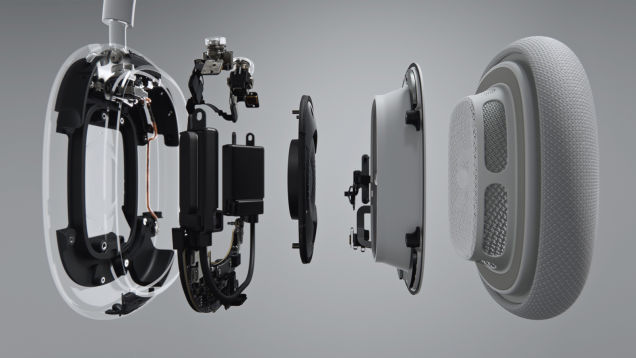
Smartphone audio is getting a little more advanced with two new features: Apple’s Spatial Audio for AirPods Pro and AirPods Max, which was pushed out with iOS 14, and Samsung’s 360 Audio feature, available on the Samsung Galaxy Buds Pro, which works similarly to Spatial Audio but under a different name.

Read more…


Source: Gizmodo – How Apple’s Spatial Audio Works—and How It’s Different From True Surround Sound