Twitter Gave a Gold Checkmark to a Fake, Foul-Mouthed Disney Account

Twitter owner Elon Musk has tried foisting checkmarks upon celebrity accounts in a bid to popularize his paid-for verification scheme. In this way, Musk and Twitter may have been going a little too fast with its push for Twitter Blue subscriptions, and it may have pissed off the indomitable House of Mouse in the…

Read more…


Source: Gizmodo – Twitter Gave a Gold Checkmark to a Fake, Foul-Mouthed Disney Account

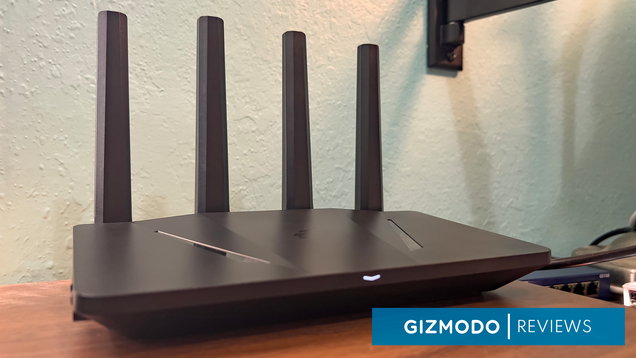
The ExpressVPN Aircove Is a Serviceable Router That Hides Web Traffic For Your Whole Home

So it’s not like I’m always out here talking about Virtual Private Networks; I’m not a YouTube ad read. But the few times I bring them up in polite company, the conversation screeches to a halt as I slowly realize that nobody knows what I’m talking about. Thankfully, that’s changing as VPNs become more of a known…

Read more…


Source: Gizmodo – The ExpressVPN Aircove Is a Serviceable Router That Hides Web Traffic For Your Whole Home

Why Clothing Subscription Boxes Are Basically Pointless

One struggle shared by just about every adult is buying clothes. It comes in different forms. Some folks are very fashion-forward but struggle with their clothing budget; others developed a personal style during four inebriated years of high school and have no clue how to actually dress as an adult. But whatever your…

Read more…


Source: LifeHacker – Why Clothing Subscription Boxes Are Basically Pointless

3Dfx Voodoo 1 & 2 Glide Linux Driver Retired, Other X.Org Code Officially Retired

In clearing up the state of various X.Org packages that have been effectively unmaintained for years, an attempt is being made to better communicate the status of some “retired” X.Org packages that Linux distributions should work towards removing as they are no longer being maintained…

Source: Phoronix – 3Dfx Voodoo 1 & 2 Glide Linux Driver Retired, Other X.Org Code Officially Retired

If You Haven't Had a Cheese Fries Omelette, Have You Even Lived?

While I cook up “whole” foods and balanced meals even, nothing can keep me from participating in snack culture–including, but not limited to, fast food, salted gummy candy, and the entire world of frozen potatoes. It turns out you can actually wrap your snack potatoes in eggs (a whole food, no less) and make it a…

Read more…


Source: LifeHacker – If You Haven’t Had a Cheese Fries Omelette, Have You Even Lived?

MSI Addresses CPU Voltages on AM5 Motherboards for Ryzen 7000X3D Processors

In response to recent reports of AMD’s Ryzen 7000X3D processors being damaged, MSI has announced a wave of firmware updates to address potential issues. The highlight of MSI’s new wave of BIOS versions for its AM5 motherboards is that the company is further locking down the voltage controls for X3D chips, removing support for positive offset voltages. Going forward, it will only be possible to use negative offset voltages on X3D chips, ensuring that the sensitive V-Cache-equipped X3D chips can’t be overvolted and put at risk of damage.


Over the last couple of days, there has been concern across various social media platforms, such as Reddit, about reports of AMD’s Ryzen 7000X3D processors spontaneously ‘burning out.’ Multiple users have posted issues where their Ryzen 7000X3D processors with 3D V-Cache have been dying – and curiously, all when using ASUS motherboards.


Perhaps one of the most recognizable images over the last few days has been via a Reddit post by Speedrookie. In the image above, the user uploaded a photo that shows his AMD Ryzen 7800X3D and ASUS ROG Strix X670E-E Gaming motherboard with very noticeable scorch marks within the CPU socket itself, as well as a very large bulging on the CPU contact pads.


Image credit: Speedrookie/Reddit


There is little concrete information about where the issue lies – whether it’s even a systemic issue, or just a statistical fluke – but it would seem that MSI considers it an important enough matter to take immediate action via new firmware versions for its AM5 motherboards, including those with X670E, X670E, B650, and A620 chipsets.


Announced via a post on Reddit, the company is releasing new BIOSes for all of its AM5 platform motherboards. The new firmware from MSI specifically targets overvolting Ryzen 7000X3D CPUs or restricting the ability to do this. The new firmware from MSI essentially locks down any options or settings related to voltage adjustment. This includes blocking positive voltage offsets, as well as direct voltage adjustment. Consequently, with the new BIOSes it’s only possible to use offering negative offset voltage settings on X3D chips


These updates don’t just impact the firmware itself, but MSI has also restricted overvolting through its MSI Center application. So, much like their firmware, MSI Center won’t allow users to add any additional CPU VCore to the processor when used on any the Ryzen 7000X3D processors such as the Ryzen 9 7950X3D and the Ryzen 7 7800X3D which we’ve both reviewed recently.


MSI AM5 Motherboard New BIOS Versions (as of 04/24)
AnandTech BIOS Version

(Click to Download)
Price at Amazon

($)
MEG X670E Godlike E7D68AMS.151 $1284
MEG X670 Ace E7D69AMS.181 $700
MPG X670E Carbon WIFI E7D70AMS.171 $361
MAG X670E Tomahawk WIFI E7E12AMS.131 $310
Pro X670-P WIFI Coming Soon $264
 
MPG B650 Carbon WIFI E7D74AMS.151 $300
MPG B650 Edge WIFI E7E10AMS.161 $260
MPG B650I Edge WIFI E7D73AMS.131 $311
MAG B650 Tomahawk WIFI E7D75AMS.161 $219
MAG B650M Mortar WIFI Coming Soon  
Pro B650-P WIFI E7D78AMS.151 $200
Pro B650M-A WIFI E7D77AMS.181 $180
Pro B650M-A E7D77AMS.181
 
Pro A620M-E E7E28AMS.121 $108


Aside from the MSI Pro X670-P WIFI and MAG B650M Mortar WIFI motherboards, the rest of MSI’s line-up has new firmware available for users to install and flash over the current BIOS version. MSI states that the remaining two boards will soon have a new firmware version. It should also be noted that on the official product pages for each motherboard and its corresponding BIOS version, these new BIOSes are listed as ‘Beta’.


Meanwhile, for users still looking to squeeze a bit more out of their X3D processors, MSI is directing users to utilize the Enhanced Mode Boost option within the firmware, which essentially optimizes the Precision Boost Overdrive (PBO) settings without making manual voltage adjustments.


As the situation develops, we expect to hear more from other vendors and users expressing issues. In the meantime, if you use an MSI AM5 motherboard with a Ryzen 7000X3D processor, these new BIOSes likely warrant a good look and a quick installation.


Source: AnandTech – MSI Addresses CPU Voltages on AM5 Motherboards for Ryzen 7000X3D Processors

All the Ways Airbnb Hosts Deceive You

Short-term rental platforms are here to stay—and when you think of short-term renting, you think of Airbnb. But there are a growing number of reasons to avoid Airbnb like the plague. Aside from rising prices and poor customer service, Airbnb has been accused of destroying neighborhoods and not respecting your privacy…

Read more…


Source: LifeHacker – All the Ways Airbnb Hosts Deceive You

The Universe sucks: The mysterious Great Attractor that’s pulling us in

Read 37 remaining paragraphs | Comments


Source: Ars Technica – The Universe sucks: The mysterious Great Attractor that’s pulling us in

How China Censored Research About Covid-19

Long-time Slashdot reader schwit1 spotted this story in today’s New York Times. (Also re-published in the Seattle Times.) In early 2020 a team of U.S. and Chinese scientists “released critical data” on the speedy spread and lethality of the coronavirus, remembers Times, “cited in health warnings around the world… Within days, though, the researchers quietly withdrew the paper, which was replaced online by a message telling scientists not to cite it…

“What is now clear is that the study was not removed because of faulty research. Instead, it was withdrawn at the direction of Chinese health officials amid a crackdown on science.”

It’s not the only retraction. The Times also points out a paper published on March 9 of 2020 relying on patient samples from mid-December of 2019, which “added to evidence that the virus was spreading widely before the Chinese government took action.” Two months later the journal that published an update that “said that the Wuhan samples were not collected in December after all, but weeks later, in January… After Jesse Bloom of the Fred Hutchinson Cancer Center in Seattle tweeted about the discrepancy, the journal’s editors posted a third version of the paper, adding yet another timeline. This revision says the samples were collected between Dec. 30 and Jan. 1.”

Beijing’s stranglehold on information goes far deeper than even many pandemic researchers are aware of. Its censorship campaign has targeted international journals and scientific databases, shaking the foundations of shared scientific knowledge, a New York Times investigation found. Under pressure from their government, Chinese scientists have withheld data, withdrawn genetic sequences from public databases and altered crucial details in journal submissions. Western journal editors enabled those efforts by agreeing to those edits or withdrawing papers for murky reasons, a review by The Times of over a dozen retracted papers found.

This scientific censorship has not universally succeeded: The original version of the February 2020 paper, for example, can still be found online with some digging. But the campaign starved doctors and policymakers of critical information about the virus at the moment the world needed it most. It bred mistrust of science in Europe and the United States, as health officials cited papers from China that were then retracted. The crackdown continues to breed misinformation today and has hindered efforts to determine the origins of the virus.
The article notes an international team’s discovery last month of genetic sequence data collected in January of 2020 at Wuhan market, “withheld from foreign experts for three years — a delay that global health officials called ‘inexcusable.'”
The sequences showed that raccoon dogs, a fox-like animal, had deposited genetic signatures in the same place that genetic material from the virus was left, a finding consistent with a scenario in which the virus spread to people from illegally traded market animals… Soon after the group alerted Chinese researchers to their findings, the genetic sequences temporarily disappeared from a global database. “It’s just pathetic that we’re in this stage where we’re having cloak-and-dagger conversations about deleted data,” said Edward Holmes, a University of Sydney biologist who was part of the group that analyzed the sequences containing raccoon dog DNA.

The Times cites retracted coronavirus papers flagged by Retraction Watch, which tracks withdrawn research. Amid tighting government censorship in 2020, Chinese researchers began asking journals to retract their work, the Times reports, and “a review of more than a dozen retracted papers from China shows a pattern of revising or suppressing research on early cases, conditions for medical workers and how widely the virus had spread — topics that could make the government look bad.”

Journals are typically slow to retract papers, even when they are shown to be fraudulent or unethical. But in China, the calculus is different, said Ivan Oransky, a founder of Retraction Watch. Journals that want to sell subscriptions in China or publish Chinese research often bend to the government’s demands. “Scientific publishers have really gone out of their way to placate the censorship requests,” he said…

The journal retractions continued, and for unusual reasons. One group of authors noted that “our data is not perfect enough.” Another warned that its paper “cannot be used as the basis for the origin and evolution of SARS-CoV-2.” A third said its findings were “incomplete and not ready for publication.” Several scientists promised in retraction notices to update their findings but never did.

Read more of this story at Slashdot.


Source: Slashdot – How China Censored Research About Covid-19

The Morning After: Apple’s mixed-reality headset may have MagSafe-style ports and external power supply

As Apple’s WWDC approaches, the rumor frequency for the company’s VR/AR headset is gathering pace. ​​Bloomberg’s Mark Gurman says the device, rumored to be named Reality Pro or Reality One, will have two ports: a USB-C interface for data transfers and a “new proprietary charging connector.” Judging by Gurman’s description, the latter is reminiscent of Apple’s recently reintroduced MagSafe power port. As for the power supply, it’s about the size of an iPhone, similar to Apple’s own MagSafe Battery Pack for iPhones. The component can reportedly power the wearable for up to two hours on a single charge, but you’ll be able to buy extra packs, given how quickly the headset may drain them.

It doesn’t sound particularly elegant, but there are reasons for it. At the start of 2023, Gurman first hinted at an external power supply. He reported Apple was concerned about the device overheating, while also chasing a lighter, more comfortable headset.

– Mat Smith

The Morning After isn’t just a newsletter – it’s also a daily podcast. Get our daily audio briefings, Monday through Friday, by subscribing right here.

The biggest stories you might have missed

Hitting the Books: We’d likely have to liquidate Jupiter to build a Dyson Sphere around the Sun

Recommended Reading: The websites that make ChatGPT and other AI sound smart

Google gives Bard the ability to generate and debug code

I love Quella’s gorgeous retro cafe racer e-bikes

Chromebooks’ short lifespans are creating ‘piles of electronic waste’

Leaked Pixel Fold video shows an internal display with chunky bezels

It looks a lot like the Galaxy Z Fold 4.

TMA
Kuba Wojciechowski

Days after CNBC reported Google’s plans for a foldable Pixel phone at I/O 2023, an alleged video of the device is circulating online. On late Friday evening, leaker and developer Kuba Wojciechowski shared what he says is a clip of the Pixel Fold. Unfortunately, the video doesn’t show any features that definitively identify the foldable as a Pixel device, but if this is the real thing, be prepared for some noticeable borders to the device’s internal screen. The Pixel Fold will reportedly cost around $1,700 when it arrives later this year. According to CNBC, the device will have a book-like design, with a 5.8-inch external screen and a 7.6-inch folding display. It’s also said to sport the “most durable hinge” of any foldable to date and a battery that can last up to 72 hours in Extreme Battery Saver mode.

Continue reading.

Twitter adds blue checks to accounts of dead celebrities

Tapping the icon says the deceased individuals are “subscribed” to Twitter Blue.

Twitter has begun handing out blue ticks to celebrity users and accounts with more than one million followers. Among the users who received the verification but say they did not pay for the service include author Neil Gaiman, actor Ron Perlman, the Massachusetts Institute of Technology and Twitter comic dril. Also, accounts that once belonged to Chadwick Boseman, Kobe Bryant and Anthony Bourdain, celebrities who died long before Musk’s takeover of Twitter, were also reverified over the weekend. On Friday, Musk claimed he was “personally” paying the Twitter Blue subscription for a few celebrities, including LeBron James and Stephen King.

Continue reading.

You can’t share Xbox clips directly to Twitter anymore

The change is likely down to Twitter’s decision to charge for API access.

Microsoft said it had to switch off the option to upload Xbox screenshots and clips directly to Twitter from Xbox consoles as well as the Game Bar on Windows. There are other options, but they’re a little more inconvenient. You can use the Xbox mobile app to download console captures and share them to Twitter.

When asked for comment, Xbox declined to shed more light on the reason for the change. It seems likely that Microsoft dropped the built-in sharing option due to Twitter’s decision to charge at least $42,000 per month for enterprise access to its APIs. That move is breaking functionality for all kinds of organizations, including disaster response services. This week, Microsoft said it would soon remove Twitter integration from its social media management tool for advertisers.

Continue reading.

This article originally appeared on Engadget at https://www.engadget.com/the-morning-after-apple-mixed-reality-headset-rumors-111549504.html?src=rss

Source: Engadget – The Morning After: Apple’s mixed-reality headset may have MagSafe-style ports and external power supply

Improved AMD Color Management Being Worked On For The Steam Deck

Open-source Linux graphics driver engineer Melissa Wen with Igalia, Joshua Ashton with Valve, and Harry Wentland with AMD have been working on kernel mode-setting (KMS) color pipeline enhancements for SteamOS and in particular for enhancing the Steam Deck…

Source: Phoronix – Improved AMD Color Management Being Worked On For The Steam Deck

Kdenlive 23.04 Open-Source Video Editor Released With Nested Timelines

Kdenlive remains one of the best available fully open-source non-linear video editing solutions available. With today’s release of Kdenlive 23.04 they continue enhancing its feature set and improving the UI/UX for those editing videos on the Linux desktop…

Source: Phoronix – Kdenlive 23.04 Open-Source Video Editor Released With Nested Timelines

Linux 6.4 Kernel Graphics Drivers Include More Meteor Lake Code, Rockchip 4K, QAIC

With Linux 6.3 released that marks the opening of the two-week Linux 6.4 merge window. David Airlie sent in the Direct Rendering Manager (DRM) subsystem updates already for Linux 6.4 with the assortment of kernel graphics/display driver updates…

Source: Phoronix – Linux 6.4 Kernel Graphics Drivers Include More Meteor Lake Code, Rockchip 4K, QAIC

Anker Soundcore noise-canceling headphones are up to 36 percent off right now

Anker is best known for its chargers and power banks, but its Soundcore brand offers some surprisingly good value wireless headphones. If you’ve been looking for a pair with noise cancellation and want to pay less than a $100, it has several models currently on sale at or near all-time lows. Those include the Soundcore Life Q30 model on sale for just $56 (30 percent off), the Soundcore Space Q45 priced at $100 for a $50 discount and the Space A40 wireless noise-cancelling earphones, down to $64 or 36 percent off the regular price. 

Both the Soundcore Life Q30 and Soundcore Space Q45 headphones offer a comfortable fit thanks to the ample padding. They deliver superb battery life of up to 40-50 hours, can connect two devices at once and come with a 3.5mm cable for wired listening (though only the Space Q45 lets you use ANC when wired). The ANC can’t of course, beat high-end headphones like the Sony WH-1000XM5 or Bose QuietComfort 45, but it does a great job of reducing lower-end rumble from jet planes, trains, etc.

For the extra money, The Space Q45 it has an adaptive ANC mode that can automatically adjust the headphone’s ANC strength based on your surroundings. The Life Q30, on the other hand, just offers three preset ANC levels. For Android users, the Space Q45 also supports the higher-quality LDAC audio codec. Both let you tune the audio using Anker’s companion app, which offers a graphic EQ tool and a few alternative sound profile presets.

Meanwhile, the Soundcore Space A40 earbuds can reduce noise by up to 98 percent, according to Anker. They have a one-touch transparency mode, adaptive noise cancellation and wireless high-res audio. A feature called Hear ID Sound is designed to analyze how you hear music to create a sound profile tuned for your ears. You’ll get up to 10 hours of playtime on a single charge, with the charging case providing another 40 hours of playback. Charging for 10 minutes could get you up to four hours of playtime. Soundcore promises “pumping bass” along with “rich middle and crisp trebles” thanks to the 10mm drivers. 

Follow @EngadgetDeals on Twitter and subscribe to the Engadget Deals newsletter for the latest tech deals and buying advice.

This article originally appeared on Engadget at https://www.engadget.com/anker-soundcore-noise-canceling-headphones-are-up-to-36-percent-off-right-now-080952280.html?src=rss

Source: Engadget – Anker Soundcore noise-canceling headphones are up to 36 percent off right now

Amazon's Vow to Stop Squeezing Its Sellers Was Fake, Says California's Lawsuit

An anonymous reader shared this recent report from Bloomberg:

Amazon continued blocking sellers from offering lower prices on rival sites, despite assuring antitrust enforcers it ended its policy that artificially inflated prices for consumers, according to newly unsealed filings in California’s antitrust lawsuit against the e-commerce giant.

The Seattle-based company planned to expand penalties on sellers who presented lower prices outside Amazon, even after it claimed in 2019 that it stopped punishing third-party merchants who posted better deals on Walmart, Target, eBay, and, in some instances, their own websites, according to previously redacted portions of the suit that were made public.

The newly unsealed filings include an internal document in which Amazon states point-blank that despite “the recent removal of the price parity clause in our Business Solutions Agreement… our expectations and policies have not changed.”

“Many of the complaint’s allegations are inaccurate,” an Amazon spokesperson told Bloomberg. “We look forward to presenting the facts to the court.”

California Attorney General Rob Bonta is seeking a court order blocking Amazon from continuing to engage in what he alleged is anticompetitive behavior, as well as compensation for consumers in the most populous U.S. state. A similar suit filed by Washington, D.C., was dismissed in 2021…

The 2022 suit came three years after Bloomberg reported that the company’s policies were forcing sellers to charge more on competing sites like Walmart because Amazon would bury their products in search results if they offered lower prices elsewhere…

California’s probe into Amazon’s practices also highlighted concerns that ads on the platform are unhelpful for customers.

Amazon advertising revenue grew 19% in the fourth quarter, to $11.6 billion. The fast-growing revenue source helps prop up Amazon’s otherwise low-margin online retail business that carries the high expense of operating warehouses around the country and delivering orders to shoppers’ homes.

California’s attorney general issued an official statement arguing that Amazon “has orchestrated the substantial market power it now enjoys through agreements at the retail and wholesale level that prevent effective price competition in the online retail marketplace.” And it includes this fierce denunciation attributed directly to attorney general Bonta:

“As California families struggle to make ends meet, we’re in court to stop Amazon from engaging in anticompetitive practices that keep prices artificially high and stifle competition. There is no shortage of evidence showing that the ‘Everything store’ is costing consumers more for just about everything. Amazon coerces merchants into agreements that keep prices artificially high, knowing full well that they can’t afford to say no. With other e-commerce platforms unable to compete on price, consumers turn to Amazon as a one-stop shop for all their purchases. This perpetuates Amazon’s market dominance, allowing the company to make increasingly untenable demands on its merchants and costing consumers more at checkout across California. We won’t stand by while Amazon uses coercive contracting practices to dominate the market at the expense of California consumers, small business owners, and the economy.”

Read more of this story at Slashdot.


Source: Slashdot – Amazon’s Vow to Stop Squeezing Its Sellers Was Fake, Says California’s Lawsuit

Amazon's Vow to Stop Squeezing Its Seller Was Fake, Says California's Lawsuit

An anonymous reader shared this recent report from Bloomberg:

Amazon continued blocking sellers from offering lower prices on rival sites, despite assuring antitrust enforcers it ended its policy that artificially inflated prices for consumers, according to newly unsealed filings in California’s antitrust lawsuit against the e-commerce giant.

The Seattle-based company planned to expand penalties on sellers who presented lower prices outside Amazon, even after it claimed in 2019 that it stopped punishing third-party merchants who posted better deals on Walmart, Target, eBay, and, in some instances, their own websites, according to previously redacted portions of the suit that were made public.

The newly unsealed filings include an internal document in which Amazon states point-blank that despite “the recent removal of the price parity clause in our Business Solutions Agreement… our expectations and policies have not changed.”

“Many of the complaint’s allegations are inaccurate,” an Amazon spokesperson told Bloomberg. “We look forward to presenting the facts to the court.”

California Attorney General Rob Bonta is seeking a court order blocking Amazon from continuing to engage in what he alleged is anticompetitive behavior, as well as compensation for consumers in the most populous U.S. state. A similar suit filed by Washington, D.C., was dismissed in 2021…

The 2022 suit came three years after Bloomberg reported that the company’s policies were forcing sellers to charge more on competing sites like Walmart because Amazon would bury their products in search results if they offered lower prices elsewhere…

California’s probe into Amazon’s practices also highlighted concerns that ads on the platform are unhelpful for customers.

Amazon advertising revenue grew 19% in the fourth quarter, to $11.6 billion. The fast-growing revenue source helps prop up Amazon’s otherwise low-margin online retail business that carries the high expense of operating warehouses around the country and delivering orders to shoppers’ homes.

California’s attorney general issued an official statement arguing that Amazon “has orchestrated the substantial market power it now enjoys through agreements at the retail and wholesale level that prevent effective price competition in the online retail marketplace.” And it includes this fierce denunciation attributed directly to attorney general Bonta:

“As California families struggle to make ends meet, we’re in court to stop Amazon from engaging in anticompetitive practices that keep prices artificially high and stifle competition. There is no shortage of evidence showing that the ‘Everything store’ is costing consumers more for just about everything. Amazon coerces merchants into agreements that keep prices artificially high, knowing full well that they can’t afford to say no. With other e-commerce platforms unable to compete on price, consumers turn to Amazon as a one-stop shop for all their purchases. This perpetuates Amazon’s market dominance, allowing the company to make increasingly untenable demands on its merchants and costing consumers more at checkout across California. We won’t stand by while Amazon uses coercive contracting practices to dominate the market at the expense of California consumers, small business owners, and the economy.”

Read more of this story at Slashdot.


Source: Slashdot – Amazon’s Vow to Stop Squeezing Its Seller Was Fake, Says California’s Lawsuit

Chromebooks' short lifespans are creating 'piles of electronic waste'

Chromebooks have always been a popular option for schools due to the relatively cheap prices, but they exploded in popularity during the Covid pandemic as kids did their schoolwork from home. However, they may not be such a good deal after all, according to a new report called Chromebook Churn from the US Public Interest Research Group (PIRG). They found that many Chromebooks purchased just three years ago are already breaking, creating electronic waste and costing taxpayers money. 

Chromebooks in schools typically see rough use, and repairability is a key issue, due to a lack of parts and expensive repairs. For instance, 14 out of 29 keyboard replacements for Acer Chromebooks were found to be out of stock, and 10 of the 29 cost $90 each — nearly half the price of some models. “These high costs may make schools reconsider Chromebooks as a cost-saving strategy,” the report states. In another instance, HP only stocked power cords and AC adapters for one model, but no other parts.

The devices also have built in “death dates,” the report reads, after which software updates end. “Once laptops have ‘expired,’ they don’t receive updates and can’t access secure websites.” Google does provide eight years of software updates for Chromebooks, but that’s only from the date of release. Since many schools buy Chromebooks released several years before, support can expire in half that time. 

Chromebooks aren’t built to last. Professional repair techs tell me they’re often forced to chuck good Chromebook hardware with years of life left due to aggressive software expiration dates.

“Chromebooks aren’t built to last. Professional repair techs tell me they’re often forced to chuck good Chromebook hardware with years of life left due to aggressive software expiration dates,” iFixit’s director of sustainability Elizabeth Chamberlain told PIRG. Those expiration dates also make it a challenge for schools to resell their devices. PCs and Macs may have a higher purchase price, but they can easily be resold after a couple of years and can get updates for longer periods of time.

The organization said that doubling the lifespan of the Chromebooks sold in 2020 (some 31.8 million) “could cut emissions by 4.6 million tons of CO2e, equivalent to taking 900,000 cars off the road for a year. To do that, they recommend that Google eliminate update expirations and that its manufacturing partners production a 10 percent overstock of replacement parts, and that those parts be more standardized across models. They also say that consumers should be allowed to install alternative operating systems like Linux.

In a statement to Ars Technica, Google said: “Regular Chromebook software updates add new features and improve device security every four weeks, allowing us to continuously iterate on the software experience while ensuring that older devices continue to function in a secure and reliable manner until their hardware limitations make it extremely difficult to provide updates.” 

It added that it’s “always working with our device manufacturing partners to increasingly build devices across segments with post-consumer recycled and certified materials that are more repairable, and over time use manufacturing processes that reduce emissions.”

Google needs to do better, though, according to the group. “The least we can do for students who rely on their laptops is ensure these devices are durable and repairable—not part of a constant churn,” said PIRG’s Lucas Rockett Gutterman. “With more tech in our lives and classrooms, if Google wants to be a trusted source for tens of millions of students, they need to make laptops that families and school districts can count on.”

This article originally appeared on Engadget at https://www.engadget.com/chromebooks-short-lifespans-are-creating-piles-of-electronic-waste-063314306.html?src=rss

Source: Engadget – Chromebooks’ short lifespans are creating ‘piles of electronic waste’