Miyamoto Says Negative Reviews Of Mario Movie Helped It Grow

The Super Mario Bros. Movie is a bona fide hit. In its first five days in theaters, the new animated film brought in over $375 million globally. And despite a lot of negative and meh reviews from critics, it’s expected to cross a billion dollars at the box office soon. In fact, according to Shigeru Miyamoto—Mario’s…

Read more…


Source: Kotaku – Miyamoto Says Negative Reviews Of Mario Movie Helped It Grow

Bannon-Linked GoFundMe Scammer Sentenced to 4-1/2 Years for Trump Border Wall Scheme

A U.S. Air Force veteran was sentenced to four and a half years in prison on Wednesday for carrying out a fraudulent GoFundMe scheme claiming he was raising money to fund former President Donald Trump’s border wall. Brian Kolfage, who previously worked as an associate to Trump’s former advisor and White House…

Read more…


Source: Gizmodo – Bannon-Linked GoFundMe Scammer Sentenced to 4-1/2 Years for Trump Border Wall Scheme

Inmates Are Using VR To Learn Real-World Skills

Corrections systems are using simulators to provide incarcerated individuals with more lifelike instruction. But is it working? From a report: Atorrus Rainer, 41, is standing in the center of a stuffy room wearing a virtual-reality headset. Every so often, he extends his arm, using the VR controller to pick up garbage bags, a toothbrush, and toilet paper during a simulated trip to the supermarket. The self-checkout station overwhelms him: those didn’t exist in 2001, when Rainer, then a teenager, was sentenced to more than 100 years in prison. His first experience with one is this virtual interaction taking place inside Fremont Correctional Facility, a medium-security prison about two hours south of Denver. Rainer is practicing in the hopes of stepping into a real store in the near future through an initiative launched in Colorado in 2017 in response to US Supreme Court rulings that deemed juvenile life without parole sentences unconstitutional. People who meet certain requirements — for example, if they were under 21 when they committed felony crimes and have been incarcerated for a minimum of 20 to 30 years — can apply to work through the three-year Juveniles and Young Adults Convicted as Adults Program (JYACAP) in an effort to earn early parole.

The premise of JYACAP is that learning the basic skills they missed the chance to acquire while incarcerated will provide these juvenile lifers with their best chances for success upon release. That’s a formidable challenge. Because of safety concerns, they have had limited access to the internet. Though they’re now adults, many have never used, or even seen, a smartphone or a laptop. Or had a credit card. “We had to figure out a way of giving them these opportunities in a restricted environment,” says Melissa Smith, interim director of prisons for the Colorado Department of Corrections. Though its use is not yet widespread, a handful of state corrections departments, from Ohio to New Mexico, have turned to virtual reality as an answer. The goals vary from helping reduce aggressive behavior to facilitating empathy with victims to, as in Colorado’s case, reducing recidivism. Though the state’s prison budget sits close to $1 billion, Colorado has one of the worst return-to-prison rates in the country, at around 50%. Nationally, as many as two-thirds of the 600,000 people released from state and federal prisons each year will be rearrested within three years.

Read more of this story at Slashdot.


Source: Slashdot – Inmates Are Using VR To Learn Real-World Skills

Zelda: Tears of the Kingdom: 11 Exciting New Things We Just Learned

We are now a couple of weeks away from The Legend of Zelda: Tears of the Kingdom’s release, Nintendo’s long-awaited follow-up to its seminal adventure, Breath of the Wild. While the Japanese company has showcased its final trailer for Link’s upcoming romp, it’s certainly not done marketing the Switch exclusive.…

Read more…


Source: Kotaku – Zelda: Tears of the Kingdom: 11 Exciting New Things We Just Learned

TSMC Details 3nm Evolution: N3E On Schedule, N3P and N3X To Deliver 5% Performance Gains

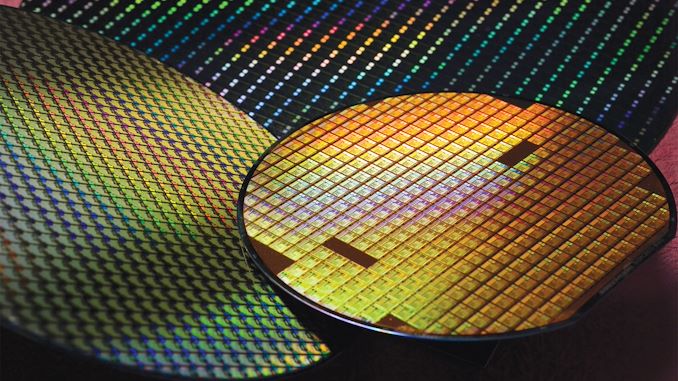
Alongside some new announcements for their 2nm process node plans, TSMC has also released a progress and roadmap update for their N3 family process technologies at today’s 2023 North American Technology Symposium. TSMC’s final generation of FinFET-based process nodes, the N3 family is expected to remain around in some shape or form for many years to come as the densest node available for customers who don’t need a more cutting-edge GAAFET-based process.


TSMC’s big roadmap updates on the N3 front were with N3P and its high performance variant, N3X. As revealed today by TSMC, N3P will be an optical shrink of N3E, offering enhanced performance, reduced power consumption, and increased transistor density compared to N3E, all while maintaining compatibility with N3E’s design rules. Meanwhile, N3X will wed extreme performance with 3nm-class densities, offering higher clockspeeds for high performance CPUs and other processors.


N3E: 3nm for Everyone Is on Schedule


As a quick refresher, TSMC’s N3 (3nm-class) family of process technologies is comprised of several variants, including baseline N3 (aka N3B), relaxed N3E with reduced costs, N3P with enhanced performance and chip density, and N3X with higher voltage tolerances. Last year the company also talked about N3S with maximized transistor density, but this year the company remains tight lipped about this node and it is not mentioned anywhere in its slides.
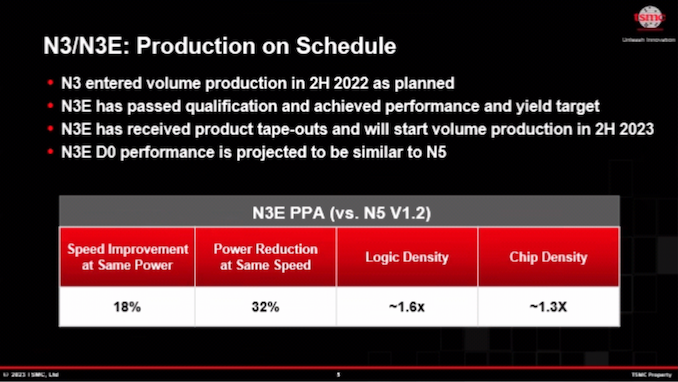


TSMC’s vanilla N3 node features up to 25 EUV layers, with TSMC using EUV double-patterning on some of them to make for higher logic and SRAM transistor density than N5. EUV steps are expensive in general, and EUV double patterning drives those costs up further, which is why this fabrication process is only expected to be used by a handful of customers who are not as concerned about the high outlay required.


Advertised PPA Improvements of New Process Technologies

Data announced during conference calls, events, press briefings and press releases
  TSMC
N3

vs

N5
N3E

vs

N5
Power -25-30% -32%
Performance +10-15% +18%
Logic Area


Reduction* %


Logic Density*
0.58x


-42%


1.7x
0.625x


-37.5%


1.6x
SRAM Cell Size 0.0199µm² (-5% vs N5) 0.021µm² (same as N5)
Volume

Manufacturing
Late 2022 H2 2023


The majority of TSMC’s clients interested in a 3nm-class process are expected to use the relaxed N3E node, which according to TSMC is on schedule and achieving their performance targets. N3E uses up to 19 EUV layers and does not rely on EUV double patterning at all, reducing its complexity and costs. The trade-off is that N3E offers lower logic density than N3, and it has the same SRAM cell size as TSMC’s N5 node, making it somewhat less attractive to those customers who are driving for density/area gains. Overall, N3E promises a wider process window and better yields, which are two crucial metrics in chip fabrication.


“N3E will be better than N3 in terms of yield, process complexity, which directly translating into [wider] process window,” said Kevin Zhang, Vice President of Business Development at TSMC. 


N3P: Higher Performance, Higher Transistor Density


Following N3E, TSMC will continue to optimize the N3 family’s transistor density with N3P, which will build on N3E by offering improved transistor characteristics. The refined process node will allow chip designers to either increase performance by 5% at the same leakage or reduce power by 5% ~ 10% at the same clocks. The new node will also increase transistor density by 4% for a ‘mixed’ chip design, which TSMC defines as a chip consisting of 50% logic, 30% SRAM, and 20% analog circuits.


As part of their discussion on N3P, TSMC stressed that the density improvement was achieved by adjusting the optical performance of its scanners. So it is likely that TSMC will be able to shrink all types of chip structures here, which will make N3P an attractive node for SRAM-intensive designs.


“N3P is a performance boost, it has a 5% higher performance, at least a 5% higher than N3E,” explained Zhang. It also has the 2% optical shrink, which bring transistor density to 1.04x.”


Advertised PPA Improvements of New Process Technologies

Data announced during conference calls, events, press briefings and press releases
  TSMC
N3

vs

N5
N3E

vs

N5
N3P

vs

N4E
N3X

vs

N3P
Power -25-30% -32% -5% ~ 10% higher
Performance +10-15% +18% +5% +5%

Fmax @ 1.2V
Chip Density ? ?    
SRAM Cell Size 0.0199µm² (-5% vs N5) 0.021µm² (same as N5) ? ?
Volume

Manufacturing
Late 2022 H2 2023 H2 2024 2025


Since N3P is an optical shrink of N3E, it will preserve N3E’s design rules, enabling chip designers to quickly reuse N3E IP on the new node. Consequently, N3P is also projected to be one of TSMC’s most popular N3 nodes, so expect IP design houses like Cadence and Synopsys to offer a variety of IP for this process technology, reaping the benefits of forward compatibility with existing N3E in the process. TSMC says that N3P will be production ready in the second half of 2024.


N3X: Maximum Performance and Density


Finally, for developers of high-performance computing applications like CPUs and GPUs, TSMC has for the past few generations been offering its X family of high voltage, performance-focused nodes. As disclosed at last year’s event, the N3 family will be getting its own X variant with the aptly named N3X node.


Compared to N3E, N3X is projected to offer at least 5% higher clockspeeds compared to N3P. This is being accomplished by making the node more tolerant of higher voltages, allowing chip designers to crank up the clockspeeds in exchange for higher overall leakage.
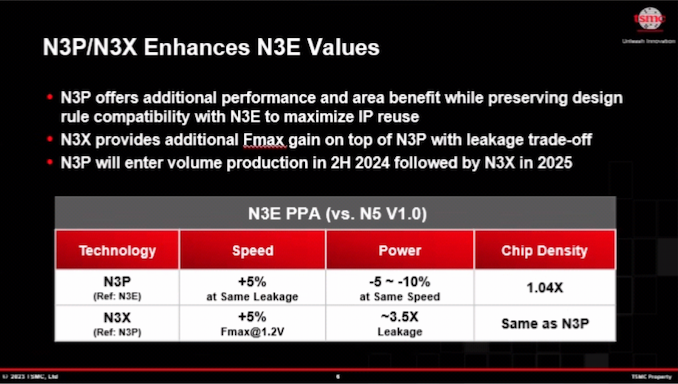


TSMC claims that N3X will support voltages of (at least) 1.2v, which is a fairly extreme voltage for a 3nm-class fabrication process. The leakage cost, in turn, is significant, with TSMC projecting a whopping 250% increase in power leakage over the more balanced N3P node. This underscores why N3X is really only usable for HPC-class processors, and that chip designers will need to take extra care to keep their most powerful (and power-hungry) chips in check.


As for transistor density, N3X will offer the same density as N3P. TSMC has not commented on whether it will also maintain design rule compatibility with N3P and N3E, so it will be interesting to see what ends up happening there.


The final N3 family node in TSMC’s current roadmap, the company says that that N3X will be production ready in 2025.


Source: AnandTech – TSMC Details 3nm Evolution: N3E On Schedule, N3P and N3X To Deliver 5% Performance Gains


Kenneth Branagh's Next Agatha Christie Adaptation Shares a Freaky First Teaser

The mustache is back for another mystery—this time, a supernatural one!—in Kenneth Branagh’s next Agatha Christie adaptation, A Haunting in Venice, once again starring the director as the gifted detective. The movie is based on Christie’s novel Hallowe’en Party and has just shared its first teaser trailer:

Read more…


Source: Gizmodo – Kenneth Branagh’s Next Agatha Christie Adaptation Shares a Freaky First Teaser

Star Wars Jedi: Survivor review: An immense sequel that aims high and hits

En garde.

Enlarge / En garde. (credit: Respawn)

2019’s Star Wars Jedi: Fallen Order was one of the rare Star Wars games to capture the thrills and the spirit of adventure that come with being a Jedi exploring the galaxy. With AAA production flair, the game blended a very ’90s Star Wars expanded universe setup with the scale of a modern action-adventure game to great effect. The sequel Star Wars Jedi: Survivor significantly ups its predecessor’s scale, continuing Cal Kestis’ story while expanding the suite of Jedi powers and worlds to explore.

In many ways, Star Wars Jedi: Survivor is the best of both worlds for classic and modern Star Wars. By blending the focus on a traditional galaxy-hopping adventure with the sprawling scope of a AAA adventure game, the follow-up to Fallen Order succeeds in offering a compelling and dense universe to explore. Although this sequel has some rough edges that can dull its main story, Star Wars Jedi: Survivor is a confident sequel that shows off the best of what a Star Wars game can aspire to be.

A Jedi knight story

As the second story of a Star Wars trilogy, Survivor keeps with the franchise’s tradition of taking the characters and plot into darker territory. Picking up five years after the end of Fallen Order, Cal Kestis is now a full-fledged rebel and Jedi knight who has become one of the galaxy’s most wanted. After a botched mission on Coruscant, Cal escapes to the frontier planet Koboh, leading to a new adventure where he unearths lost artifacts from the early days of the Jedi Order, builds new alliances, and reunites with old friends as he continues his fight against the Empire.

Read 23 remaining paragraphs | Comments


Source: Ars Technica – Star Wars Jedi: Survivor review: An immense sequel that aims high and hits

Meta Begins to Dig Itself Out of ‘Year of Efficiency' Hole

Meta has had a lot to prove about its future ambitions. First it was all about the “metaverse,” but now it’s AI. Before, the company could sit back and let the ad revenue roll in, until regulators, along with Amazon and Apple, said it couldn’t. Fortunately for Meta and its CEO Mark Zuckerberg, the company managed to…

Read more…


Source: Gizmodo – Meta Begins to Dig Itself Out of ‘Year of Efficiency’ Hole

This OLED screen can fill with liquid to form tactile buttons

Swiping and tapping on flat screens is something we’ve learned to deal with in smartphones, tablets and other touchscreen gizmos, but it doesn’t come close to the ease of typing on a hardware keyboard or playing a game with a physical controller. To that end, researchers Craig Shultz and Chris Harrison with the Future Interfaces Group (FIG) at Carnegie Mellon University have created a display that can protrude screen areas in different configurations. It’s a concept we’ve seen before, but this version is thinner, lighter and more versatile.

FIG’s “Flat Panel Haptics” tech can be stacked under an OLED panel to create the protrusions: imagine screen sections that can be inflated and deflated with fluid on demand. This could add a new tactile dimension for things like pop-up media controls, keyboards and virtual gamepads you can find without fumbling around on the screen. As Gizmodonotes, haptic feedback like Apple’s Taptic Engine produces natural-feeling vibrations but doesn’t help you find onscreen elements by touch alone. For activities like typing and playing games that require rapid-fire response time, a screen with pop-up elements could make things much less frustrating.

The Embedded Electroosmotic Pumps (EEOPs) are arrays of fluid pumps on a thin actuation layer built into a touchscreen device, like a smartphone or car display. When an onscreen element requires a pop-up button, fluid fills a section of the EEOP layer, and the OLED panel on top bends to take that shape. The result is a “button” that sticks out from the flat surface by as much as 1.5 mm, enough to feel the difference. When the software dismisses it, it recedes back into the flat display. The research team says filling each area takes about one second, and they feel solid to touch.

Closeup of a finger touching an inflated space bar on a protruding onscreen keyboard on a smartphone.
Future Interfaces Group at Carnegie Mellon

If the concept sounds familiar (and you’ve been following consumer tech long enough), this tech may remind you of Tactus’ rising touchscreen keyboard, which ultimately shipped as a bulky iPad mini case. FIG’s prototype can take on more dynamic shapes and sizes, and the research team says their version’s thinness sets it apart from similar attempts. “The main advantage of this approach is that the entire mechanical system exists in a compact and thin form factor,” FIG said in its narration for a demo video. “Our device stack-ups are under 5mm in thickness while still offering 5mm of displacement. Additionally, they are self-contained, powered only by a pair of electrical cables and control electronics. They’re also lightweight (under 40 grams for this device), and they are capable of enough force to withstand user interaction.”

The researchers see this as a tactile equivalent to the way pixels work on displays. “Much like LCD pixels, which modulate light from a common backlight, EEOPs draw from a common fluid reservoir and selectively modulate hydraulic pressure in and out of haptic cells.”

The pop-up buttons in their current form have a limited scope of shapes and sizes, reducing their versatility. But if they can eventually apply the same principle to a layer with more / smaller pop-up buttons (essentially “higher resolution” if we’re extending the “pixels” metaphor), it could open new doors for user interaction, including easier onscreen typing, gaming, in-car controls and even accessibility features like onscreen braille.

This article originally appeared on Engadget at https://www.engadget.com/this-oled-screen-can-fill-with-liquid-to-form-tactile-buttons-204829553.html?src=rss

Source: Engadget – This OLED screen can fill with liquid to form tactile buttons

'High Risk of Biological Hazard' In Sudan After Fighters Seize Biolab, WHO Says

The World Health Organization (WHO) said there’s a “high risk of biological hazard” in Khartoum, the capitol of Sudan, after a biolab containing deadly pathogens was seized by fighters. From a report: There’s a war in Sudan right now as two rival generals struggle for power. After a week of fighting, one of the factions has seized the National Public Health Laboratory which contains samples of measles, cholera, polio, and other diseases. Now, lab workers are unable to return to the facility and secure the hazardous materials. “This is the main concern: no accessibility to the lab technicians to go to the lab and safely contain the biological material and substances available,” Nima Saeed Abid, the WHO’s representative in Sudan, told reporters on Tuesday.

According to the lab’s website, it contains “reference laboratories related to the control of some diseases such as polio, measles, tuberculosis, malaria and AIDS.” The lab is engaged in various aspects of studying and controlling diseases, including identifying pathogens, testing for them, and sending samples to international labs. The work is aimed at preventing and identifying possible epidemics, and the lab works with the WHO. The fighting in Sudan has already killed 459 people and injured 4,072, and the release of a deadly pathogen would lead to more suffering. The fighting is between generals Abdel Fattah Burhan and Mohammed Hamdan Dagalo. Burhan is the head of the country’s military and Dagalo is the leader of a paramilitary group called the Rapid Support Forces. The RSF got its start as a Janjaweed militia, an Arab fighting group that operated in Darfur.

Read more of this story at Slashdot.


Source: Slashdot – ‘High Risk of Biological Hazard’ In Sudan After Fighters Seize Biolab, WHO Says

Virgin Galactic Completes Final Glide Flight and Readies for Rocket-Powered Spaceflight

Virgin Galactic appears to be one step closer to resuming its space tourism services. The company announced today a successful suborbital test of the VSS Unity spaceplane and hopes to begin rocket-powered spaceflight tests in the coming months.

Read more…


Source: Gizmodo – Virgin Galactic Completes Final Glide Flight and Readies for Rocket-Powered Spaceflight

Brazil Court Suspends Telegram

Brazilian court has ordered the nationwide suspension of the Telegram messaging app due to its parent company’s failure to provide data on neo-Nazis operating on the platform, imposing a daily fine of approximately $198,000 until compliance is met. The action was taken as part of an investigation into neo-Nazi activity on social networks.

Agence France-Presse first reported the news.

Read more of this story at Slashdot.


Source: Slashdot – Brazil Court Suspends Telegram

Apple's iMessages Are Finally Coming to Windows 11

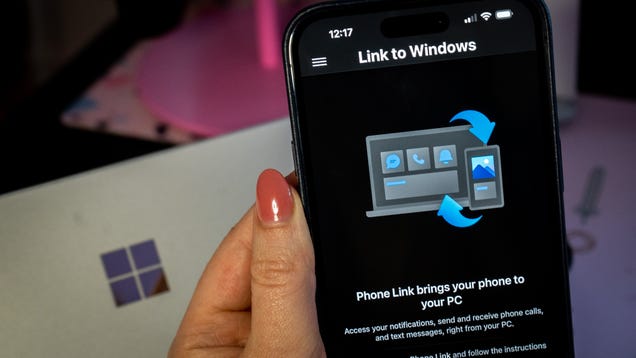
For iPhone users stuck between Apple and Microsoft’s worlds, there’s good news that will help make jumping from one to the other a little easier. Microsoft has announced that it will roll out support for iMessages through the Phone Link app starting today. The update is available for Windows 11 users and allows you to…

Read more…


Source: Gizmodo – Apple’s iMessages Are Finally Coming to Windows 11

Elizabeth Holmes gets bail extension one day before prison term start


Former Theranos CEO Elizabeth Holmes, alongside her partner Billy Evans, leaves a hearing at the Robert E. Peckham US Courthouse on March 17 in San Jose, California.

Enlarge / Former Theranos CEO Elizabeth Holmes, alongside her partner Billy Evans, leaves a hearing at the Robert E. Peckham US Courthouse on March 17 in San Jose, California. (credit: Getty | Philip Pacheco)

Theranos founder Elizabeth Holmes just got a little more freedom—a delay of her 11-year prison sentence, which was previously scheduled to start Thursday, April 27.

In an unsurprising legal move, Holmes filed a last-ditch motion with the US Court of Appeals for the 9th Circuit, challenging a lower court’s denial of bail as she appeals her conviction. Her motion in the appeals court triggered an automatic freeze of the bail denial until the appeals court issues a ruling.

On April 10, US District Judge Edward Davila denied her request to remain free as she pursued an appeal of her conviction. Davila ruled that her arguments for appealing the conviction did not raise a “substantial question of law or fact” and was unlikely to succeed. Thus, she was ordered to begin her prison term as scheduled.

Read 3 remaining paragraphs | Comments


Source: Ars Technica – Elizabeth Holmes gets bail extension one day before prison term start

How Star Wars: Visions Volume 2 Embraces Global Storytelling

After the acclaimed debut of Star Wars: Visions volume one in 2021, a new collection of animated shorts is about to drop on Disney+. io9 recently spoke to Lucasfilm’s executive producers on the series—James Waugh, Jacqui Lopez, and Josh Rimes—about putting together the upcoming anthology

Read more…


Source: Gizmodo – How Star Wars: Visions Volume 2 Embraces Global Storytelling

NASA Power Hack Extends 45-Year Voyager 2 Mission Even Longer

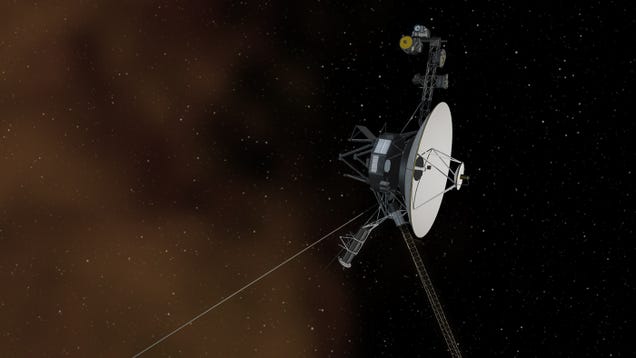
At 12 billion miles (20 billion kilometers) from Earth, Voyager 2 is so far that it takes more than 22 minutes for NASA’s signals to reach the probe. With its power gradually diminishing, mission planners thought they might have to shut down one of its five scientific instruments next year, but a newly implemented…

Read more…


Source: Gizmodo – NASA Power Hack Extends 45-Year Voyager 2 Mission Even Longer

Chaos Ensues After The ‘LeBron James Of Incels’ Gets Laid

We’re only four months into the calendar year and the incel community, an insular corner of the internet composed of dudes who lack romantic and sexual relationships “despite trying,” has lost one of its strongest soldiers because…well…he’s finally done the deed.

Read more…


Source: Kotaku – Chaos Ensues After The ‘LeBron James Of Incels’ Gets Laid