Just about one year ago Arturia launched the first entry in its Augmented series of hybrid instruments, Augmented Strings. Since then it’s grown to include Augmented Voices and Grand Piano. Now the family is getting bigger still with Augmented Brass.
Just like the other installments Augmented Brass combines samples of its namesake — brass instruments — with advanced synth engines and effects to create something wholly new. The core concept isn’t terribly different from what Output has with its Analog series, but the results generally hew closer to the real world instruments that inspired them.
From a surface level, not much has changed. There are some minor workflow and visualization tweaks, but you still get the same main interface with a large morph knob in the middle that generally lets you dial in the balance of organic and synthetic sounds you’re looking for. Around that are seven macro knobs for tweaking the timbre, dialing in effects levels, and adding delay and reverb.
Arturia
There is also the advanced tab for those that what to dig in deep on the sound design. Here still, the UI is clean, easy to navigate and unintimidating. But there is a lot of power to be found under the hood. Here you can freely choose your four different layers of synths and samples, customize your filter selection and the effects, and even add complex modulation. If you do dive into the advanced tab, don’t overlook that modulation section where you’ll find two LFOs, two function generators, two random generators and you can customize things like aftertouch and velocity effects.
If you never bother to mess with the advanced options, you’ll still have a pretty large palette to work with. Augmented Brass comes with hundreds of presets that cover everything from ’80s slasher film scores, to early aughts hip hop horns, to sci-fi dirges. If you’ve read any of my reviews in the past, it should come as no surprise that I was immediately drawn to the nostalgic warbles of the Muted Tape Orchestra preset. But I loved the Full Brass Orchestra patch which was clearly made for scoring endless Game of Thrones spinoffs.
Arturia’s been pretty busy recently, having also just launched Rev LX-24, a plugin that aims to recreate the revered (and insanely expensive) Lexicon 224 Digital Reverb. Like most of the company’s plugins, the LX-24 visually tries to hew pretty close to the hardware it’s based on. That means a few sliders and buttons, and not much more in the default interface. But, as usual, there’s an advanced tab here that allows you to add modulation, ducking and generally make use of the amenities you’ve come to expect from modern music software. Of course, the LX-24 is still based on a late ’70s digital reverb, so expect crust, grime and maybe some gated snares.
Augmented Brass is available now at an introductory price for existing Arturia customers, but will go up to the regular price of $99 on May 11th. REV LX-24 is also available now for $99, though chances are it will make its way into the next version of Arturia’s FX Collection.
This article originally appeared on Engadget at https://www.engadget.com/arturias-augmented-brass-plugin-is-built-for-synthwave-and-sci-fi-scores-150043349.html?src=rss
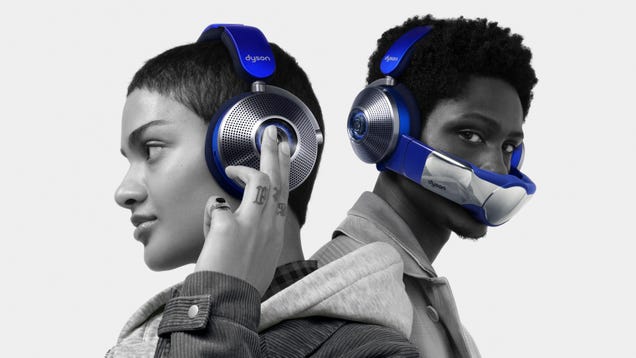
If you hate breathing in pollutants and don’t mind being stared at, then your time might have come: The Dyson Zone headphones are finally available to buy in the US. They mark the company’s first foray into wearable technology and it’s certainly making a statement with them. The headphones include a sizeable (but detachable) visor that stretches across your mouth to provide cleaner air.
The visor’s ectrostatic filter is designed to remove up to 99 percent of pollutants like nitrogen dioxide and ozone. It works in tandem with the ear cups — as they draw in air, it gets filtered. Then two purified streams of air flow into your mouth and nose — so, be prepared to feel that air if you use it. You can change the speed with a button on the left ear cup. The filter lasts for up to 12 months and, notably, it doesn’t protect against COVID-19. A mask can be worn with it, but the product alone is not designed to block the virus.
The Dyson Zone headphones last up to 50 hours with “isolation” or “transparency” noise cancelling options. You can control this and the airflow speed through the MyDyson app. It will also let you know how much nitrogen dioxide is in the air.
When we tested the Dyson Zone headphones, they were surprisingly comfortable — though it did take some time to figure out how to snap the visor in properly. The breeze of the air felt nice, almost like a personal air conditioning. The visor merited some stares when on a quick walk outside, so it could be more lowkey to use on an airplane.
The headphones come with one filter, a USB-C charging cable and a visor cleaning brush and sleeve. They can be bought in satin silver and ultra blue or prussian blue and ultra blue. These two colorways have a ‘Quarter Turn’ hard case to keep them safe.
They’re available on Dyson Direct in prussian blue and bright copper. This model comes with two filters, explorer case, in-flight adaptor kit and soft pouch. These unique headphones don’t come cheap, though, starting at $949, they might merit trying them for yourself before going all in.
This article originally appeared on Engadget at https://www.engadget.com/dysons-949-air-purifying-zone-headset-is-now-available-in-the-us-150040191.html?src=rss
Deconstructeam creates games that feel like a new kind of noir, each one draped in pixelated shadows and filled with philosophical innuendo, short and slow-burning. The studio is known for Gods Will Be Watching and The Red Strings Club, two narrative titles that play with concepts of morality and manipulation in harsh futuristic environments. These games ask players to dictate the fates of friends, lovers and enemies, and then they provide languid scenes of rumination as the violence and betrayal unfolds. Deconstructeam’s latest project, The Cosmic Wheel Sisterhood, elevates these concepts to a grander plane.
The Cosmic Wheel Sisterhood begins with a witch who lives on an asteroid. Her name is Fortuna, and she was exiled from her coven after her prediction of doom angered the witch in charge; the game begins on year 200 of Fortuna’s 1,000-year sentence. Fed up and lonely, she summons an ancient Behemoth to help her escape the space rock and enact revenge on her former sisters. It all plays out in classic Deconstructeam style, with densely detailed, vibrant pixel art.
Deconstructeam
The Cosmic Wheel Sisterhood feels bigger than previous Deconstructeam experiences, layered with divergent gameplay styles, characters and narrative branches. A main mechanic in its first hour involves building a deck of divination cards, choosing the backgrounds, main symbols and supporting elements based on a rich grimoire of the combinations and their interpretations.
Designing the cards can be as tedious a process as you want, and I thoroughly enjoyed taking my time to create a deck that I found to be beautiful (and creepy) as well as powerful.
At its core, Cosmic Wheel is a visual novel with narrative paths dictated by the player’s choices. The immortal Behemoth, Ábramar, is Fortuna’s main companion in the demo — but our little witch is actually fairly social for someone who’s supposed to be exiled. As Fortuna rebuilds her deck with Ábramar, she reads the fates and fortunes of visitors that find her asteroid, and players are able to dictate, to an extent, what each card will reveal. These moments give Fortuna an upper hand, even in interactions with the massive god peering through her window, and they nicely supplement the standard flow of conversation.
Ábramar suggests multiple times that Fortuna’s decisions in conversations will “dramatically” affect her fate, and even in just an hour of playtime, I saw evidence of this feature. At one point, there’s an opportunity to lie to an authority figure in charge of auditing Fortuna’s sentence — the deception doesn’t fit with statements Fortuna has already made, but in games like these, often the “(lie)” option is the correct one, regardless of logical flow. That’s not the case in The Cosmic Wheel Sisterhood. The lie is immediately spotted, much like it would be in a real-life conversation with a member of a parole board.
In another instance, Fortuna is given the option to destroy her coven — but the choice is provided before we’ve met any other witches involved, when the sisterhood is a vague entity filled with faceless enemies in the player’s mind. Only after this decision, Cosmic Wheel introduces players to some of Fortuna’s former friends in a camping-trip flashback, allowing ample time for any guilt and regret to fester. The conversations these friends have, pre-asteroid and pre-coven, are amusing and authentic, and the information they provide is relevant to future tasks.
Pay attention to the details in The Cosmic Wheel Sisterhood. Lie only when you’re sure you can get away with it, listen to your companions’ stories, build a beautiful divination deck, and go ahead, seduce an immortal god of gods (that last one is less gameplay advice, more wicked encouragement). The demo comes to a close after that camping trip, with three friends watching the stars appear above a tranquil lake, laughing about life and making plans. The weight of the choices you’ve already made, more than 200 years in the future, linger in the chill air. Above it all, Ábramar waits.
Deconstructeam
The Cosmic Wheel Sisterhood is due out in 2023 for PC and Nintendo Switch, developed by Deconstructeam and published by Devolver Digital.
This article originally appeared on Engadget at https://www.engadget.com/build-tarot-decks-and-seduce-a-god-in-the-cosmic-wheel-sisterhood-150023513.html?src=rss
Initially revealed over a year ago, Dyson’s first audio product, a pair of noise-canceling headphones called the Zone that still manages to incorporate the company’s expertise with cleaning and purifying air, officially goes on sale today in the US with a price that’s as expensive as both Apple and Sony’s premium…
The food distributor Lipari Foods has issued a voluntary recall after a specific lot of Lipari Branded Ground Cumin Tubs was found to potentially have been contaminated with Salmonellaand was distributed to 16 states. Salmonellacan cause serious or fatal infections to young children, elderly people, or those with a…
When the developers of the Linux security module (LSM) subsystem find
themselves disagreeing with other kernel developers, it tends to be because
those other developers don’t think to — or don’t want to — add security
hooks to their shiny new subsystems. Sometimes, though, the addition of
new hooks by non-LSM developers can also create some friction. Andrii
Nakryiko’s posting of a pair of
BPF-related security hooks raised a couple of interesting questions,
one of which spurred a fair amount of discussion, and one that did not.
Sure, audiences are going to see a galaxy-spanning war, centuries of prophetic witch-women, and spice, but Dune 2is also going to have a storyline that the first Dune installment only hinted at; romance.
Armored Core VI Fires of Rubicon, the long-awaited next game in the FromSoftware series that most definitely isn’t a Soulslike, dropped its first gameplay trailer on April 27. The trailer comes along with an official release date: August 25 of this year.
Sony Interactive released The Last of Us Part I on Windows right around a month ago and in that time, developer Naughty Dog has issued no less than seven patches specific to the PC port. The latest one—version 1.0.4.0—addresses a bunch of issues across a variety of hardware, including AMD systems and the Steam Deck, and squeezes in some noteworthy
Every time you interact with ChatGPT, you’re actually training it to be better. It takes your conversations and uses that experience to make future conversations more useful and accurate for everyone. That’s a good thing for both ChatGPT, as well as anyone who wants to see their chats with the bot improve overtime. As…
I’ve developed an odd fascination with body-measuring technology, especially as it relates to the fashion world. Many companies are working on infrastructure that will hopefully one day let us buy clothes custom-tailored for the exact contours of our bodies. That should make people like me, who feel very under-served by the traditional fashion industry, a lot happier. It should also help to reduce the waste generated by the overproduction of clothes nobody wants to buy, which is a problem both for businesses and the planet. So, when Zozofit, makers of the Zozosuit, asked if I wanted to try its skin-tight body-measuring outfit, which has now been repurposed as a fitness tool, I agreed, albeit with my usual degree of trepidation.
The Zozosuit isn’t new, but its makers are using this year as a form of soft relaunch, with a new focus on breaking into the US. It was actually set up back in 2018 by Japanese high-end fashion retailer Zozo as a way of launching a custom-clothing line. Users bought the suit, scanned their bodies and then could order clothes that, on paper, were tailored to better suit their bodies. And while the clothes weren’t custom-made, the idea was that the outfits would be a better fit for them than the usual mass-produced stuff. But that idea, great in theory, didn’t necessarily shake out that well in practice.
Fashion Network said that the cost and complexity involved in launching the suit ate away at the company’s otherwise healthy profits. QZ reported that while people bought the suits, which were sold at a deep discount, few went on to purchase the custom threads as Zozo had planned. It got worse, as many reporters who tested the system found the clothes they had ordered, like Gizmodo’s Ryan F. Mandelbaum and theEconomist’s Charlie Wells, didn’t actually fit. A better suit with higher-resolution dots for imaging was developed, but the project was subsequently put on ice.
Since then, Zozo has tried to open up its technology to third parties, but has now pivoted the technology toward something more fitness-focused. Since it already had the tech to make a body-measuring suit, it might as well be put to good use, or so the thinking goes. A number of health and fitness professionals advocate that, for people looking to get fitter, measure their bodies instead of stepping on the scale. So it makes sense for this to be offered as an elegant alternative to wrestling with a tape measure on a weekly basis.
Buying a Zozosuit is easy enough, just give it your weight in pounds, as well as your height in feet and inches, and cough up $98 plus tax. Not long after, you’ll get a slender package which contains a skinsuit made out of polyester and spandex. It looks very much like a motion capture suit commonly used in the production of visual effects, and functionally does the same job. Coming in two parts, the app will give you guidance on how to wear it, making sure that the waistband is pulled up high and covered by the top. You’ll need to try and keep everything as flat as you can, since visible creases will prevent you from taking an accurate scan.
Zozofit
As a 5’11”, 231-pound man, I did wonder if Zozo would have a suit large enough to cater for my body shape. The website has images of much more athletically-adept models wearing its clothing and you may be concerned there’s no option for bigger-sized folks. The suit I tried on was tight, as intended, but didn’t feel restrictive, and I don’t think you should be nervous that the company can’t accommodate your needs. Other users in a similar situation have documented a similar experience, including YouTuber The Fabric Ninja, who produced a “Plus-Size Review” in 2020. That said, I don’t think I could pull this off as some form of athleisure fashion statement, for all of the reasons you can probably presume.
Inside the package is a cardboard phone stand, which you’ll need to pop out and fold into place to prop your smartphone onto. The Zozofit uses your handset’s primary camera, and so you’ll need to stand it on a table and then stand six feet or so away from it. Once activated, you’ll get voice guidance talking you through the setup and measurement process, and you’ll be asked to hold your arms slightly away from your body. The coach will then ask you to turn to every position on the clock, taking 12 images as you shuffle around in a circle. Once completed, you’ll be notified that you can pick up your phone and then wait 30 seconds-or-so for the model to process.
And you’ll get a headless 3D-mesh model of your body with various measurements labeled off the sides. These include measurements for your upper arms, chest, waist and hips, upper thigh and your calves. After you’ve pawed at your vital statistics, you’ll be invited to set some fitness goals based on those initial measurements. Interestingly, these are capped, I suspect to keep you picking smaller, more sustainable goals and avoid becoming disappointed. It measured my waist at 46.6-inches, and you can only set the goal at inch-wide increments down to 41.6-inches or up to 51.6-inches. This will change in a later update, but I appreciated the more realistic form of goal-setting it promises.
You’ll also get the app’s rough calculation of your body fat percentage, which it clocked at 35.6 percent. Not long after, I jumped on my smart scale and it registered me as having 31.6 percent, and I suspect, too, the imaging might struggle to be as accurate when you’re dealing with such big figures. I’d wager, too, that body fat percentages might not be so easily calculated by sight alone, and perhaps Zozo could look to remove those measurements which aren’t as reliable. It may also dent the PR braggadocio the company is putting out, claiming that this setup is the “world’s most accurate at-home 3D body scanner.” (It says it has compared its results to several rivals on the market, as well as professional hand-measurements.)
Zozofit / Daniel Cooper
Now, the company says that its body fat measurements use the US Navy Body Fat system, which calculates your body fat based on a series of body measurements. That method was developed to create a quick-and-dirty measurement to determine if someone was fit for service. (In the process of researching this, I learned that personnel describe it as the “rope and choke,” which isn’t relevant, but thought you’d appreciate the slang.) The company’s representatives added, to me, that it has found that curvier bodies are more likely to see less accurate results than thinner ones, and that it is working on its algorithms to improve this situation.
With any health-and-fitness technology, there’s a question of how much you can rely upon the accuracy of its measurements. Few consumer-level devices offer the same level of data quality you can get from a much more expensive clinical tool. Straight after my first scan, I ran a second, to see the sort of variation you can expect from an imaging-based measurement. The margin is fairly small, only a few tenths of an inch difference between each scan, which seems fair to me. I’d say, too, that what matters more with these sorts of tools is the trend and direction of travel, rather than obsessing over the pinpoint accuracy of each individual measurement.
And, to test that, as soon as I’d run my second scan (and changed back into normal clothes), I asked a friend to help measure me with a tailor’s tape. And there was a wider delta than I think some people might expect, especially if they’re in need of millimeter-perfect measurements. For instance, the app measured my chest at 43.4-inches, while the tape clocked it in at 44. My upper arms measured 14.5-inches, compared to 14.2 and 14.3-inches inside the app. With my waist and hips, the app said they were 44.6 and 45.3-inches, respectively, while the tape measure clocked them in at 44.5-inches and 47-inches.
Partially, I think these divergences are because computer imaging, even with help, isn’t going to hit as perfectly as a tape measure. Not to mention that the suit pulls you in a little compared to normal clothes, which are far baggier by comparison. I’m sure, too, that the garb sits less well on a larger body compared to a smaller one, where there are fewer issues with terrain. Maybe I’m grading on a curve, but it’ll depend on what exactly users want to get out of this system.
The other question, and a likely more relevant one, is if squeezing into a Zozosuit is easier and less time-consuming than using a tape measure. It’s nice to have an automated process, and to have that data tracked over time, but nothing the app does could qualify as essential. That’s a fairly neat way to sum this up – if you’re a dedicated gym-goer looking for a more elegant way to monitor your vital statistics, then you may find some value here. I’m not sure how compelling this would be, however, if you’re expecting this to be the sum total of your fitness universe.
This article originally appeared on Engadget at https://www.engadget.com/zozofits-capture-suit-takes-the-guesswork-out-of-body-measuring-140006295.html?src=rss
Cara Delevigne is joining the next American Horror Story. There’s more Batman: The Caped Crusader coming to Amazon. Plus, what’s coming on Gotham Knights and Superman & Lois. Spoilers now!
After profiling and raising an issue by Google’s Chrome OS engineers, there is a set of “request for comments” patches out today for the Intel Linux graphics driver that can provide 10~15% better performance when operating in the tuned mode…
Apple has revealed App Store metrics in Europe in response to the European Digital Services Act. From the legal compliance post: iOS App Store: 101 million
iPadOS App Store: 23 million
macOS App Store: 6 million
tvOS App Store: 1 million
watchOS App Store: under 1 million
Apple Books: under 1 million
Podcasts paid subscriptions: under 1 million
We live in a divided world, but one thing most people can agree on right now is that the cost of housing is way too high. Home prices have slipped a bit, but home prices, mortgage rates, and rents remain sky-high in a lot of places, and a lot of people—especially younger folks—are despairing of ever owning a home.…