Twitter will host 'Halo' watch parties starting March 28th

Paramount+ is kicking off its Twitter watch parties with one of the service’s more important shows. Twitter and Paramount+ are kicking off a series of watch parties for the Halo TV series that will give fans chances to discuss episodes in shared moments. The run begins today (March 25th) at 6PM Eastern with a ‘pre-show’ through the official account, with executive producer Kiki Wolfkill and stars Olive Gray and Kate Kennedy meeting online to discuss the series and offer a behind-the-scenes look.

From then on, you can expect nine regular “after-show” parties. The first takes place March 28th at 4PM Eastern, but you can expect a weekly cadence of parties starting April 1st at a similar time. The virtual festivities end on May 20th. The streams will include celebrity Halo enthusiasts, fan segments and other reasons to tune in.

Twitter and Paramount+ aren’t shy about the rationale behind the get-togethers. They’re hoping to recreate the “water cooler effect” of conventional TV, where you rush to share your opinions and speculation about an episode. This probably won’t turn Halo into a Game of Thrones-style blockbuster that has everyone talking, but it might provide a sense of community that keeps you invested. If nothing else, it shows what you can expect from future parties.


Source: Engadget – Twitter will host ‘Halo’ watch parties starting March 28th

Over a Dozen Researchers and Critics Respond To New York Times' 'Thinly-Veiled Cryptocurrency Ad'

Molly White: On March 20, 2022, the New York Times published a 14,000-word puff piece on cryptocurrencies, both online and as an entire section of the Sunday print edition. Though its author, Kevin Roose, wrote that it aimed to be a “sober, dispassionate explanation of what crypto actually is”, it was a thinly-veiled advertisement for cryptocurrency that appeared to have received little in the way of fact-checking or critical editorial scrutiny. It uncritically repeated many questionable or entirely fallacious arguments from cryptocurrency advocates, and it appears that no experts on the topic were consulted, or even anyone with a less-than-rosy view on crypto. This is grossly irresponsible. Here, a group of around fifteen cryptocurrency researchers and critics have done what the New York Times apparently won’t.

Read more of this story at Slashdot.


Source: Slashdot – Over a Dozen Researchers and Critics Respond To New York Times’ ‘Thinly-Veiled Cryptocurrency Ad’

'I Would See People Get Shot in the Face:' TikTok Ex-Moderators Sue Over On-the-Job Trauma

A small army of overworked content moderators is the public’s last line of defense against a flood of depraved and horrific content uploaded to social media. While the moderators help us normal users avoid the worst of the worst, constant exposure to humanity’s darkest impulses can wreak havoc on their mental health.…

Read more…


Source: Gizmodo – ‘I Would See People Get Shot in the Face:’ TikTok Ex-Moderators Sue Over On-the-Job Trauma

Unleash Angostura’s Star Power With a Trinidad Sour

If I had to pick one bottle of bitters to use for the rest of my life, it would undoubtedly be Angostura. Ubiquitous behind bar counters, distinctly dressed in its yellow cap and oversized paper label crowded with dizzyingly tiny script, Angostura “Aromatic” bitters are easy to identify both by look and taste. I often…

Read more…


Source: LifeHacker – Unleash Angostura’s Star Power With a Trinidad Sour

Spotify is testing a new car mode focused on voice commands

Spotify is trying out a new “Car Mode” on a handful of users, the streaming service confirmed to TechCrunch. Last year the company retired its old Car View mode, explaining that it needed to pave the way for “new innovations”. The new in-car interface, called “Car Mode” appears to be more focused on voice controls than the older version. The jury is still out on whether hands-free voice recognition actually makes driving safer (some studies suggest drivers who use voice controls are more distracted). But the new revamp does offer less visual distractions and a cleaner interface.

According to screenshots of the Android version of Spotify Car Mode posted by 9to5Google, users can use voice controls to search for artists, browse albums, play or pause, fast forward and “like” a song. The new in-car mode appears to be far less busy than the older version, with simplified “Player View” and a “Library” tab that allows you to quickly access music or podcasts you’ve recently listened to.

Tech companies like Google and Amazon have pushed automakers to build more voice recognition features in future models of cars. As TechCrunchnotes, voice controls will also be an essential feature in autonomous vehicles. Spotify is no doubt trying to stay ahead of this trend. Last month, Spotify officially launched Car Thing, an in-car player with voice controls, after an extended test period (we reviewed it here). But for those who don’t want to pay extra for a hands-free in-car listening experience, Spotify’s new mode will be a welcome option.


Source: Engadget – Spotify is testing a new car mode focused on voice commands

Sauron, Dark Lord of Mordor and Lord of the Rings Star, Dead at… Hoo Boy

Sauron, the fallen Maia, former Lieutenant of the Dark Lord Morgoth, and previous wielder of the One Ring of Power, has passed away after a brief several thousands of years of being a non-corporeal spirit bound to the tower of Barad-dûr. He was… very, very old.

Read more…


Source: Gizmodo – Sauron, Dark Lord of Mordor and Lord of the Rings Star, Dead at… Hoo Boy

US Charges Four Russian Spies for Hacking Saudi Oil Facility and US Nuclear Power Plant

The U.S. Department of Justice has announced charges against four Russian government employees for a years-long hacking campaign targeting critical infrastructure, including a U.S. nuclear power operator and a Saudi petrochemical facility. From a report: The first indictment, from June 2021, charges Evgeny Viktorovich Gladkikh, 36, a computer programmer at the Russian Ministry of Defense, and two co-conspirators, of planning to hack industrial control systems — the critical devices that keep industrial facilities operational — at global energy facilities. Gladkikh is believed to be behind the infamous Triton malware, which was used to target a petrochemical plant in Saudi Arabia in 2017. Hackers used the malware in an attempt to disable safety systems in the plant designed to prevent dangerous conditions that could lead to leaks or explosions. Triton was first linked to Russia in October 2018. Following their failed plot to blow up the Saudi plant, the hackers attempted to hack the computers of a company that managed similar critical infrastructure entities in the U.S, according to the DOJ.

Read more of this story at Slashdot.


Source: Slashdot – US Charges Four Russian Spies for Hacking Saudi Oil Facility and US Nuclear Power Plant

Google’s next smart display rumored to be a detachable tablet

The 2nd Gen Nest Hub.

Enlarge / The 2nd Gen Nest Hub. (credit: Corey Gaskin)

Google’s second-generation Nest Hub smart display is a year old, so it’s time to wonder if a new hardware release is around the corner. 9to5Google has a new rumor to consider: Google is “working on a new Nest Hub for 2022 with a dockable tablet form factor where the screen detaches from a base/speaker.” The site didn’t provide further details, but the idea would fit in Google’s recent product plan.

Since its inception, Google Assistant hardware has essentially copied Amazon’s Echo line. The original Google Home speaker released two years after the Amazon Echo. The Home Mini came out a year and a half after the Echo Dot. The Google Home Hub smart display hit the market a year after the Echo Show. Google Assistant smart clocks launched a year and a half after the Echo Spot. The lack of hardware innovation from Google isn’t a huge deal since Google is generally considered to have a better voice command system, but it’s pretty clear where Google goes shopping for a product roadmap.

And, of course, Amazon has a whole line of tablets that turn into smart displays. In 2018, the company built smart display functionality into Fire OS, Amazon’s fork of Android. Whenever you stick an Amazon tablet into one of the official docks, it automatically transitions into smart display mode. Google experimented with an “ambient mode” for Android phones a year and a half after Amazon’s launch (Google’s timing is remarkably consistent), but the feature was initially only available on specific third-party phones. Ambient mode did not make it to devices like the Pixel 6. The feature also doesn’t make much sense on phones, which generally aren’t readable from across the room. Smart displays typically are. A tablet ambient mode would have been better, but Google’s launch in 2019 was during a dead period for Android tablets.

Read 6 remaining paragraphs | Comments


Source: Ars Technica – Google’s next smart display rumored to be a detachable tablet

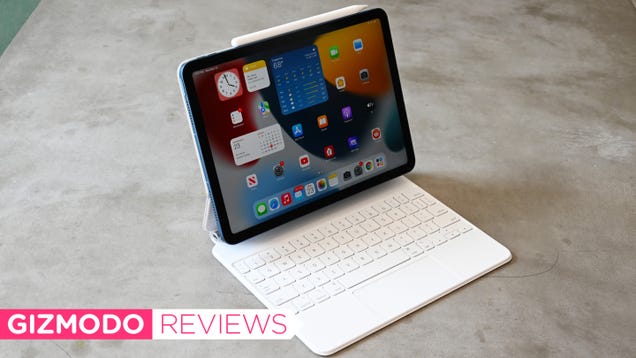
Apple's New iPad Air Is the Smart Choice

The iPad Air is one of the easiest products to recommend. Need a tablet? You should probably go with this one. That’s even more true today now that Apple has equipped the mid-range product with a more powerful engine. The supercharged M1 processor now powering this slate is a proven entity, having logged miles on the

Read more…


Source: Gizmodo – Apple’s New iPad Air Is the Smart Choice

Ukraine is selling NFTs to support its military

Ukraine’s Ministry for Digital Transformation has launched an NFT collection to help fund its military. The project was first announced in early March, but the NFT collection, called “ Meta History Museum of War,” is now live. The collection is meant to be an “NFT museum” documenting the history of Russia’s invasion of Ukraine.

The collection is currently comprised of 54 NFTs documenting the events of the first three days of the war. The illustrations were done by Ukrainian and international artists, and each one references a tweet documenting some aspect of the invasion and the world’s response to it.

“The formula of each NFT is clear and simple: each token is a real news piece from an official source and an illustration from artists, both Ukrainian and international,” Ukraine’s Ministry of Digital Transformation writes on its Meta History Museum of War website. “The NFT’s will be created in chronological order, according to the events so the true history will be saved and cherished.”

The NFT Project is the latest way Ukraine has turned to digital assets to fund its defense. The country has collected more than $100 million in cryptocurrency donations since the start of the war, and Ukrainian President Volodymyr Zelensky recently signed a bill officially legalizing the crypto industry.


Source: Engadget – Ukraine is selling NFTs to support its military

Elden Ring Bleeding Glitch Makes Some Dogs Its Most Dangerous Enemies

I previously went on and on about the wildlife in Elden Ring, explaining how its bears, wolves, and birds often pose a larger problem for me than its otherworldly bosses. But a group of bloody dogs put everything else in the game to shame.

Read more…


Source: Kotaku – Elden Ring Bleeding Glitch Makes Some Dogs Its Most Dangerous Enemies

Why 'Prolonged Grief Disorder' Has Mental Health Professionals Split

The American Psychiatric Association last week officially introduced a new diagnosable mental health condition: prolonged grief disorder. The news, while welcomed by some clinicians and researchers, has also been controversial. At the heart of the debate is the long-running question of how to define suffering, as well…

Read more…


Source: Gizmodo – Why ‘Prolonged Grief Disorder’ Has Mental Health Professionals Split

How to Actually Enjoy a Weekend With Your Kids

Weekends are a time to rest, recharge, goof off, engage in your hobbies, and have fun. Oh, unless you have kids. Then they are a time to beg them to go outside, referee sibling brawls, entertain them every moment they’re not plastered to a screen, and count the hours until they go back to school.

Read more…


Source: LifeHacker – How to Actually Enjoy a Weekend With Your Kids

Google Fiber workers successfully unionize in Kansas City

In a tally with the National Labor Relations Board (NLRB) this afternoon, Google Fiber customer service workers — jointly employed by Google parent Alphabet and staffing agency BDS Connected Solutions — voted 9 to 1 to form a union. They’ll be represented by the Alphabet Workers Union, an arm of the Communications Workers of America (AWU-CWA.)

Workers at the store, which operates out of Kansas City, Missouri, told Engadget back in January that they were feeling left out of important workplace conversations, especially around safety and staffing. Kansas City was the market where Google Fiber first launched, approximately a decade ago. Workers at this store skipped straight to petitioning the NLRB for union recognition because, for reasons unknown, the supermajority of union card-signers were seemingly ignored by Google and BDS alike. At the time Emrys Adair, a worker at this location said, “There’s been no acknowledgement, no pushback. No response at all yet.” Since then neither company responded to Engadget’s requests for comment either.

Among the ballots cast 9 were in favor while one was opposed; an additional ballot was challenged, but the number of challenged ballots was not sufficient to change the result of the election. 

“Our campaign faced many efforts to discourage us from exercising our right to a collective voice on the job. Yet it was always clear to all of us that together we can positively shape our working conditions to ensure we all have access to the quality pay, benefits and protections we have earned,” Eris Derickson, one of the retail associate at this location, told press in a statement today. “We all enjoy our work with Google Fiber and look forward to sitting at the negotiating table with BDS Connected Solution to set a new standard for our workplace to improve both worker, customer and company experience.” 

The Alphabet Workers Union sees this not only as a victory for this specific store, but part of a broader campaign to level the playing field between Alphabet’s full-time staff, and its larger and reportedly worse-compensated TVCs (temps, vendors and contractors, in Google parlance.) “Since our founding we have been committed to tackling Alphabet’s segregative, two-tiered employment system. Alphabet wants to maintain its reputation for treating its workers well but doesn’t want to pay for it. Instead, the trillion dollar corporation relies on temporary, contract and vendor workers to provide essential work for the company without the same pay, benefits or rights as full time employees,” Andrew Gainer-Dewar, a Google software engineer with AWU-CWA wrote in a statement today.

What remains next is for these Google Fiber workers to bargain their first contract, itself a herculean effort that companies have tremendous power to draw out or undermine. Thus far, the specific changes these workers hope to win in bargaining have not been disclosed by the AWU-CWA, though keeping those goals close to the chest is by no means unusual. 

Earlier this year, document discovery by the NLRB revealed the existence of an internal Google initiative called “Project Vivian.” As reported by Wired, the program was meant “to dissuade employees from unionizing after worker activism began heating up in late 2018”; and as it was put in the in documents themselves by Michael Pfyl, the company’s director of employment law, Project Vivian was intended “to engage employees more positively and convince them that unions suck.” 

“We have many contracts with both unionized and non-union suppliers, and respect their employees’ right to choose whether or not to join a union,” a Google spokesperson told Engadget. “The decision of these contractors to join the Communications Workers of America is a matter between the workers and their employer, BDS Solutions Group.”


Source: Engadget – Google Fiber workers successfully unionize in Kansas City

Exxon Weighs Taking Gas-to-Bitcoin Pilot to Four Countries

Exxon Mobil is running a pilot program using excess natural gas that would otherwise be burned off from North Dakota oil wells to power cryptocurrency-mining operations and is considering doing the same at other sites around the globe, Bloomberg News reported, citing people familiar with the matter. From the report: The oil giant has an agreement with Crusoe Energy Systems to take gas from an oil well pad in the Bakken shale basin to power mobile generators used to run Bitcoin mining servers on site, said the people, who asked to not be named because the information isn’t public. The pilot project, which launched in January 2021 and expanded in July, uses up 18 million cubic feet of gas per month that would have otherwise been burned off — or flared — because there aren’t enough pipelines. Exxon, the largest U.S. oil producer, is considering similar pilots in Alaska, the Qua Iboe Terminal in Nigeria, Argentina’s Vaca Muerta shale field, Guyana and Germany, one of the people said.

Read more of this story at Slashdot.


Source: Slashdot – Exxon Weighs Taking Gas-to-Bitcoin Pilot to Four Countries