happy monday writes: Dyson has announced its first wearable product that builds the firm’s air purification expertise into a set of Bluetooth noise cancelling headphones aimed at city dwellers wanting to avoid polluted air. Quite unlike anything the company has made before, the Dyson Zone is sure to draw quizzical looks. It is a set of large, plush headphones with a plastic mask-type contraption that connects from ear-to-ear across the wearer’s mouth and looks like something out of a sci-fi movie. It delivers purified air to the mouth and nose while simultaneously tackling noise pollution through its active noise cancelling technology. Chief engineer Jake Dyson said: “Air pollution is a global problem — it affects us everywhere we go. In our homes, at school, at work and as we travel, whether on foot, on a bike or by public or private transport. The Dyson Zone purifies the air you breathe on the move. And unlike face masks, it delivers a plume of fresh air without touching your face.”
The eyebrow-raising design has a motor, compressor fan and air purifying dual-layer filter in each ear cup. The air is drawn through the filters cleaning it of 99% of particles as small as 0.1 microns, including pollen, bacteria and dust, as well as gas pollutants such as sulphur or nitrogen dioxide. The filtered air is then pushed along the inside of a visor, which sits just in front of the mouth and nose without making contact with the skin, creating a pocket of clean air for the wearer to breathe. The headphones have sensors that detect how fast the wearer is moving, automatically adjusting the airflow between three intensity levels to ensure they deliver up to 5 litres of clean air a second, the equivalent breathing rate of a jog.
Near the end of Intel’s Arc Alchemist mobile discrete GPU reveal today, there was a ‘But wait, there’s more!’ moment, equivalent to the post-credit teasers that often accompany Marvel superhero movies. Though instead of teasing an upcoming flick, Intel shared a first look at the finished design for its upcoming Arc Alchemist graphics card.
When you run the lsblk -l or df -h command to list out the available block/storage devices, you may find the /dev/loop filesystem, especially if you are using the Snap package manager, and it’s quite common to find in Ubuntu distributions. If you are keen on knowing what loop devices are and how to mount and unmount them from the system, then this article will be enough for you because it will cover all the necessary aspects of loop devices, like how to create a loop device, loop filesystem, mounting, and unmounting steps.
Intel has only just detailed its first Arc laptop GPUs, but it’s already teasing its desktop plans. The company has offered a peek at an Arc A-series Limited Edition video card arriving sometime this summer — yes, that’s another delay. There are no specs or prices, unfortunately, but the double-height design and twin-fan cooling make clear this is aimed directly at gamers who’d normally buy AMD or NVIDIA boards.
Early Arc desktop GPUs are expected to support a raft of modern features, including hardware-accelerated ray-tracing and AI-based supersampling. Intel is already developing second-generation GPUs, nicknamed Battlemage, and expects the third-gen Celestial hardware to target the “ultra-enthusiast” camp.
It’s still too soon to say if Arc desktop models will offer truly competitive performance. This latest delay doesn’t help, though. NVIDIA is poised to deliver its first Ampere Next-based GPUs (likely the RTX 40 series) later this year, and AMD will follow suit with the Radeon RX 7000 series. Intel is aiming at a moving target, and there are no guarantees a card released this summer will hold its own against the absolute latest the competition has to offer.
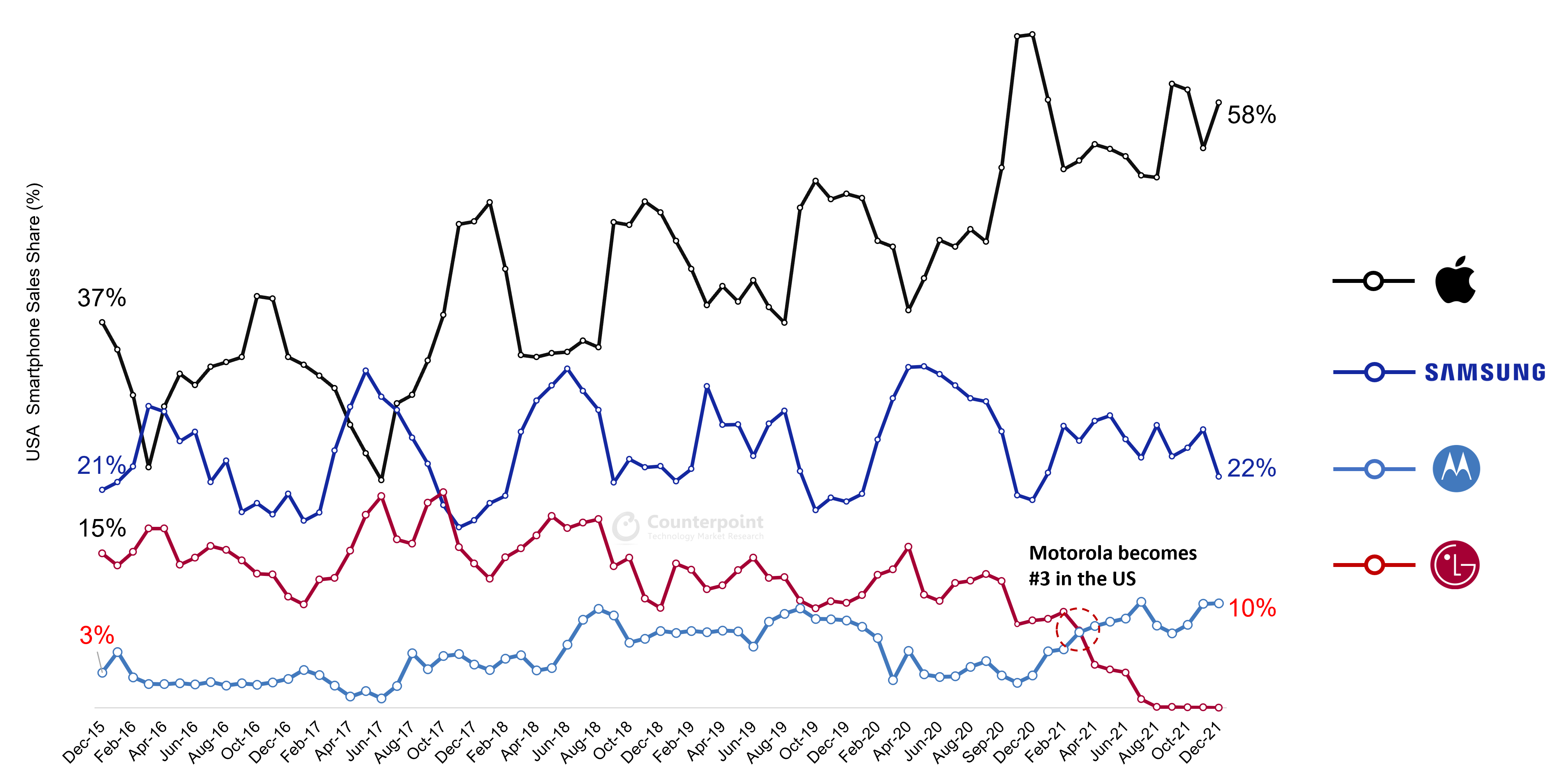
LG Electronics quit the Android world last July, and while the company never produced a flagship smartphone capable of hanging with the best in the market, LG was a prominent source of cheap smartphones, especially in the US. Thanks to a new report from Counterpoint Research, we’re now getting a look at what a US market without LG looks like, and the big winner is apparently Lenovo’s phone division, Motorola.
Counterpoint Research shows Motorola capturing the #3 spot in the US smartphone market, with 10 percent market share. Apple takes the top spot with 58 percent, and Samsung grabs a 22 percent share. It looks like LG supply cratered around September 2021.
Counterpoint says Motorola’s rise is mostly thanks to its success at the lower end of the market and its good relationship with US carriers. Research Director Jeff Fieldhack notes in the report that “Motorola has been a key OEM filling the void left by LG’s exit. The OEM has all the key characteristics major carriers look for—a full portfolio, ability to ramp volumes, and low return rates. Motorola’s sub-$300 portfolio—Moto G Stylus, Moto G Power and Moto G Pure—has driven its success in the US. Thanks to its reliability, Motorola has been a key free ‘switch’ device, a device carriers use to move subscribers from networks that are being shut off or as a device MVNOs (mobile virtual network operators) use when changing network partners.”
Traeger is one of the biggest names in backyard grilling. The company’s line of pellet grills offers WiFi connectivity and other handy features across the board starting at $900. After churning out new smart models in both 2018 and 2019, the company hasn’t debuted a new grill in about three years. Instead, it focused on redesigning its app to include recipe guidance and video tips along with an Apple Watch version and recently introduced Traeger Provisions meal (read: feast) kit service. For grilling season 2022, though, Traeger has completely redesigned its premium model, the Timberline.
And a lot of those upgrades relate to the tech. First, Traeger touts “an entirely new level of performance” thanks to a new smart combustion system. With added sensors, the grill monitors the cooking area to prevent pesky flare-ups for consistent results. The company has also swapped out the old black and white display for a full-color touchscreen unit. Not only does it offer a more modern look, but the screen can show a guided setup in addition to monitoring time and temperature. What’s more, Traeger has built in a maintenance check where the grill can self-diagnose issues and guide you to customer service or replacement parts via a unique QR code.
You won’t have to worry about the Timberline pulling cooking power for that display either. Traeger says dual controllers handle the cooking and the screen separately, and the display has its own dedicated graphics processor. The new controller automatically detects Meater’s wireless food probes and the new Timberline comes with two of those accessories (you can use up to four at a time). In case you missed it, Traeger acquired Meater last summer, so this integration was inevitable. The only caveat is you have to use the probes designed for the new Timberline grills. Previous versions from Meater aren’t the same so they won’t work here. If you prefer wired probes, you can still use those on these new models.
Traeger Grills
To help with sauces, frying, searing and other tasks, the new Timberline grills have a side burner. Sure, a lot of grills have that extra burner, but they’re not common on pellet models. More specifically, Traeger says this Timberline features the first outdoor-rated induction burner for both precision and power. It should especially be handy for fans of the reverse sear as it will heat up much faster than trying to get the entire grill up to 500 degrees Fahrenheit or higher after a quick smoke.
Plenty of grills offer lighting to help you see at night, with Weber being one of the biggest names to do so. Until now, Traeger hadn’t included built-in illumination, but the new Timberline has it. The company’s vice president of product Michael Colston explained that Traeger spent a lot of time researching where the best location for the lights should be so that smoke doesn’t interfere with visibility. Instead of putting lights inside the smoke chamber, it positioned them on the outside, so it can be activated by a lid sensor and it won’t get smoked up while lighting the entire cooking surface.
“We’ve thought about where that light needs to be placed,” he told Engadget. “It also signals to the controller that the door is open and barely keeps the smoke going.” So when the lid is up, the grill is no longer working to produce the same level of smoke as when it’s closed. It’s also not trying to recover from the drop in ambient temperature before you’re ready for it to do so.
Traeger Grills
Inside, a new grease and ash collection system sends all of the waste out of the bottom instead of rolling grease to a small pan on the side. Colston described the Timberline as “nearly self-cleaning” since a new FreeFlow firepot ejects the ash over to what Traeger calls the EZ-Clean Grease & Ash Keg. New plates channel grease to the same receptacle where gravity carries over wood pellet ash and debris. Besides putting all the waste in one spot, this new setup also means you won’t have to break out the shop vac as frequently to clean up. Colston explained he’s been using a new Timberline for months and probably could’ve gone longer without vacuuming out the inside. If the description is accurate, this will alleviate a key headache with pellet grills.
Instead of a four-post support for the new Timberline, Traeger opted for a cart stand like you typically see with gas grills. This offers more storage via a cabinet and small shelves below the pellet hopper. The company also designed what it calls the Pop-And-Lock (P.A.L.) rail system for accessories — things like an adjustable roll holder (paper towels, foil or butcher paper), tool hooks and a basket for rubs/sauces. The rails wrap around the front and sides of the grill, but not the back, so you have some room to move things as needed. Traeger relocated the pellet hopper cleanout chute to right below the hopper, so it’s accessible from the front. The cart was designed so you can easily slide in a storage container and empty pellets between cooks. So not only are you able to keep your fuel fresh, but you might also be more likely to use different types of wood instead of sticking to your go-to variety (read: buy more pellets).
The new Timberline should also offer more consistent performance in chilly weather thanks to full stainless steel insulation and a multi-level heat delivery system that wraps the cooking area in radiant warmth. Traeger says all of this creates hotter temperatures at the grates for better searing and improved overall heat regulation.
Traeger designed the new Timberline so it can be installed in an outdoor kitchen’s countertop setup. A trim kit can be purchased for a finished look and you can install the induction side burner off to the side of the grill as well. Lots of Traeger users have built outdoor setups with counters and bigger carts by removing the legs that come with the grills, so the company is catering to those folks by designing its latest model so that this process is relatively easy.
Traeger Grills
Even if you don’t want a full kitchen on your patio, the company has more accessories to add other culinary capabilities to the Timberline. With ModiFire products, you can purchase a stainless steel fish/veggie tray or a griddle for the induction cook top. The company says a two-sided griddle for use inside the grill is coming this fall alongside pizza stone and cover system that has its own sensors and cooking algorithm.
Despite all of the new stuff, some old favorites are still here. The Timberline is still powered by Traeger’s D2 platform and WiFire wireless connectivity. The company’s app still provides step-by-step guidance, video tutorials and a wealth of recipes, in addition to giving you control over every grill setting except for pressing the ignite button to get things going. And yes, you can use it to control that new side burner with the app too. The company has swapped out the WiFi antenna for a 360-degree component is says is more powerful that what was on previous models. Super Smoke mode is also back for low-and-slow cooking, but Traeger says it’s capable of even more flavor with that new firepot that can churn out more smoke.
The new Timberline and the larger Timberline XL will sit at the pinnacle of Traeger’s product lineup. Both models will be available this spring for $3,499 and $3,799, respectively. For comparison, the previous-gen Timberline 850 and 1300 are $2,100 and $2,300, so you’ll have to pay quite the premium for all of the upgrades the company has added to it’s high-end models.
Developer Guerrilla Games has rolled out a massive patch for Horizon Forbidden West, purporting to fix more than a dozen quests, plus a litany of minor hiccups. It also aims to make the game less shimmery. Those who made it through the era of puddlegateunscathed should rejoice.
While Star Wars and Marvel shows like The MandalorianandMoon Knight will always get the most attention, Disney+ has also created a great many original documentaries that you shouldn’t be sleeping on. But Disney+’s next documentary will tackle one of the most beloved people in children’s entertainment: Jim Henson.
In a Sunday post on Russian social network VK (Google translated version), Loop Hero developer Four Quarters said, “In such difficult times, we can only help everyone to raise the pirate flag (together with vpn)” to get the game. The developer then included a link to a copy of Loop Hero on a popular Russian torrent tracker to aid in that process directly.
In a follow-up post the next day (Google translated version), Four Quarters insisted that “we didn’t do anything special, there’s nothing wrong with torrents.” The company also notes that players wanting to offer the developer donations in lieu of buying the game should refrain. “The truth is that everything is fine with us, send this support to your family and friends at this difficult time,” they wrote.
About one-third of U.S. subscribers to Netflix share their login credentials with others, according to new data from Leichtman Research Group. From the report: The research firm’s online survey of 4,400 consumers confirms the company’s own conclusions in recent years. While 64% of respondents said they pay for and use Netflix only in their own household, 33% indicate some form of sharing. (The remaining 3% are households whose Netflix comes packaged via other subscriptions.) Netflix has about 74 million subscribers in the U.S. and Canada and has penetrated nearly 70% of U.S. broadband homes. With subscription growth flattening in the region of late, Netflix has recently phased in rate increases in order to continue funding its $18 billion in annual programming spending. Earlier this month, Netflix announced a test of monthly fees for password-sharing in three territories outside of the U.S. The rise of password sharing between households, a blog post explained, is âoeimpacting our ability to invest in great new TV and films for our members.â
Yesterday, Google officially released version 100 of its Chrome browser, and today it’s following suit by releasing version 100 of Chrome OS. While there weren’t a lot of big features for Chrome 100 besides a new icon, the update for Chrome OS brings a handful of changes worth noting. Probably the most significant is a redesigned app launcher experience. When you press the “everything” button (where caps lock is on most keyboards) or click the circle icon on the lower left side of the screen, the new launcher pulls up in a window on the left side of your display rather than covering all your open windows. Longtime Chrome OS users might remember that this was how the launcher behaved years ago.
Besides that visual change, Google has made it easier to organize the apps you have installed. You can choose to sort them alphabetically or by color, and new apps you add will stick to that organization scheme. From a functional perspective, Google has also improved search results that come up when you type in the launcher, automatically pulling up information for your query without having to open more details in a browser window. The search field also can look through all your open tabs if you’re trying to find a specific site you had open.
The next new feature is purely for fun — the camera app can now create GIFs. When you pop open the camera, you can choose to record a five-second video that’ll automatically be turned into a GIF. Once that’s done, you can share it to pretty much any app on your Chromebook or send it to an Android phone using the nearby share feature.
Google also improved the dictation feature on Chromebooks. Previously, you could dictate text into any text field on your device, but today Google is adding some editing features. Chrome OS now recognizes commands like “delete” to remove the last letter or “move to the next character” to adjust where your cursor is. Asking for “help” will also pull up a list of commands that you can use if you’re not sure how to accomplish a specific task with your voice.
As is usually the case with most Chrome OS updates, these aren’t exactly earth-shattering updates. But as Google now updates Chrome OS and the Chrome browser every four weeks, they’re not all going to bring big features. But there are still a few quality of life improvements worth checking out once the update hits your device — I’ve always found managing the apps in my launcher a bit cumbersome, so I’m hoping today’s update makes things a bit better.
Google plans to use artificial intelligence in more ways to make using search safer. In the coming weeks, it will roll out some updates for its AI model, MUM. The upgrades should help it detect a wider variety of personal crisis searches about sexual assault, substance abuse, domestic violence and suicide.
The company says people search for information about these topics in a broad range of ways. By employing MUM’s machine learning capabilities, Google says it can better understand the intent behind queries to recognize when someone is in need. As such, it’ll be able to provide them with more actionable, reliable information at the appropriate time.
With the help of local partners, the company plans to use the AI to improve how it handles personal crisis searches in other countries in the coming months, since MUM can translate knowledge between 75 languages. Google says it will harness the model in other ways, including to improve spam protections and enhance safety measures in countries where it doesn’t have much training data.
Other companies have been making use of multimodal AI systems similar to MUM. Meta, for instance, said it has been using AI to tackle hate speech and misinformation across its platforms in recent years. Its AI models can also obtain knowledge by analyzing videos and use that information in new products. Meanwhile, China’s Wu Dao seems to be the Swiss army knife of AI models. It can write essays, poems and couplets in traditional Chinese, analyze images to generate alt text, create almost-photorealistic images from written descriptions and much more.
In the US, the National Suicide Prevention Lifeline is 1-800-273-8255. Crisis Text Line can be reached by texting HOME to 741741 (US), 686868 (Canada), or 85258 (UK). Wikipedia maintains a list of crisis lines for people outside of those countries.
Does this article’s headline sound a bit, we, unhinged to you? Why would anyone remove their MacBook’s display? Newer MacBooks have great displays, and if you didn’t want a display on your Mac, surely you’d have bought a Mac mini or a Mac Studio, right? But while it might seem silly indeed, removing a MacBook’s…
Anno: Mutationem is an overly ambitious love letter with one too many recipients. While the game has an interesting gumbo of ideas, its story buckles under the weight of living up to the very properties it attempts to pay tribute to. Ultimately, Mutationem’s ending fails to deliver a satisfying or cohesive pursuit of…
Canada is joining the ranks of countries and states planning to ban sales of combustion engine cars. Canada has outlined an Emissions Reduction Plan that will require all new passenger car sales to be zero-emissions models by 2035. The government will gradually ramp up pressure on automakers, requiring “at least” 20 percent zero-emissions sales by 2026 and 60 percent by 2030.
Officials didn’t say whether this applied to a make’s product mix or simply the volume of cars sold. The strategy is more forgiving for the workplace — the Canadian government wanted 35 percent of total medium- and heavy-duty vehicle sales to be zero-emissions by 2035, and 100 percent of a “subset” of those machines by 2040.
The country is also offering $1.7 billion CAD (about $1.36 billion US) to extend incentives for buying electric cars and other zero-emissions vehicles. The current federal program offers up to a $5,000 CAD ($4,010 US) rebate for EVs, plug-in hybrids and hydrogen fuel cell cars that meet varying price, seat and battery requirements. Some provinces, such as British Columbia and Nova Scotia, offer their own incentives.
The broader plan is meant to reduce emissions to 40 to 45 percent below 2005 levels by 2030, and reach net zero by 2050. This includes funds to support renewable energy projects, shrink oil industry emissions and develop “nature-based climate solutions.”
Canada’s car market is small compared to the US. Passenger vehicle sales in Canada reached 1.64 million in 2021, according to estimates, versus an estimated 15 million for the country’s southern neighbor. However, the de facto ban on combustion engine cars could further motivate car brands already transitioning to EVs — that’s still a lot of potentially lost sales, particularly for a country known for its auto manufacturing plants.
Custom hardware from AMD powers the latest generation game consoles from Microsoft (Xbox Series X|S) and Sony (PlayStation 5), but not every APU designed for these systems makes the cut. What do you do with these excess chips if you’re AMD? Find ways to recycle the partially defective hardware, such as injecting them in 4700S/4800S Desktop
Enlarge/ A Deepmind Health webpage sits displayed on the screen of an Apple Inc. iPhone in this arranged photograph in London, U.K. on Monday, Nov. 26, 2018. Three years ago, artificial intelligence company DeepMind Technologies Ltd. embarked on a landmark effort to transform health care in the U.K. Now plans by owner Alphabet Inc. to wrap the partnership into its Google search engine business are tripping alarm bells about privacy. Photographer: Jason Alden/Bloomberg via Getty Images (credit: Bloomberg | Getty Images)
A former DeepMind employee has accused the artificial intelligence group’s leadership of mishandling multiple allegations of sexual misconduct and harassment, raising concerns over how grievances are dealt with at the Google-acquired company.
The female member of staff, whom we call Julia to protect her identity, claimed in December 2019 that a senior researcher at the London-based group had sexually assaulted her twice, threatened suicide, and alluded to previous instances of rape, among other concerning behavior.
DeepMind, one of the world’s most respected AI companies, employs more than 1,000 people, including renowned research scientists. It said Julia’s “allegations were investigated thoroughly, and the individual who was investigated for misconduct was dismissed without any severance payments.”
There are so many open source backup software out there, each with different features. But ever thought that you don’t want these complicated and fully-fledged solutions? Try Duplicati for simplicity.
A group of attorneys general have asked Snap and TikTok to work more closely with parental control apps and to apply more scrutiny to inappropriate content on their platforms, the latest salvo in a growing fight over child protection between governments and social media companies. From a report: Attorneys general from 43 states and territories said in a letter to executives at the two apps that they were worried the companies were “not taking appropriate steps to allow parents to protect their kids on your platforms.” Specifically, the officials said that Snap, which makes the Snapchat app, and TikTok should work more closely with third-party parental control services.
Some people have raised concerns that third-party parental controls surveil young people but do little to actually stop them from encountering harmful content. The attorneys general said in the letter, organized by the National Association of Attorneys General, that they were not endorsing a particular parental control product. They also called on the companies to tighten their own parental supervision tools and to do a better job of weeding out content that might be harmful to children. Concerns that popular social media platforms can expose children to posts that are sexualized, hurt their body image or are violent have escalated in recent years. State attorneys general are currently investigating whether Facebook, owned by Meta, and TikTok, part of the Chinese conglomerate ByteDance, have put young people in harm’s way. President Biden also called for new online privacy rules for children in his State of the Union speech earlier this month.