Majority of Ukrainian hospitals could run out of oxygen today as omicron rages: WHO

A worker is seen servicing oxygen cylinders for COVID-19 patients in Kramatorsk city hospital.

Enlarge / A worker is seen servicing oxygen cylinders for COVID-19 patients in Kramatorsk city hospital. (credit: Getty | SOPA Images)

The majority of Ukrainian hospitals could run out of life-saving medical oxygen as soon as today, putting at risk the lives of thousands of critically ill patients amid the pandemic, the World Health Organization warned Sunday.

The United Nations agency said it is looking into ways to increase supplies, which would likely require a safe-transit corridor through Poland. “It is imperative to ensure that lifesaving medical supplies—including oxygen—reach those who need them,” WHO Director-General Dr. Tedros Adhanom Ghebreyesus and WHO Regional Director for Europe Dr. Hans Kluge said in a joint statement.

Amid the Russian attack and invasion, trucks are currently unable to transport oxygen supplies from producers to hospitals across Ukraine, including the capital of Kyiv, the WHO reported. The onslaught is also hampering the production of medical oxygen in the country. Several medical oxygen generator manufacturers are running low on zeolite, a critical production component that is imported. Safe transport of zeolite into Ukraine is also needed. Drs. Tedros and Kluge also warned that patients are at risk because hospitals are facing power shortages, and ambulances transporting patients are at risk of being caught in crossfire.

Read 3 remaining paragraphs | Comments


Source: Ars Technica – Majority of Ukrainian hospitals could run out of oxygen today as omicron rages: WHO

Destiny 2: The Witch Queen Review: Hands-On With The Game's Best Expansion Yet

Destiny 2: The Witch Queen Review: Hands-On With The Game's Best Expansion Yet
The much anticipated Destiny 2: The Witch Queen expansion is here. The main question that players or potential players may have is whether the expansion lives up to all the hype. Here is our review of the Destiny 2: The Witch Queen campaign. We do not reveal any major plot points but there are some light spoliers ahead. 

The Witch Queen

Source: Hot Hardware – Destiny 2: The Witch Queen Review: Hands-On With The Game’s Best Expansion Yet

Ukraine raises over $13 million in crypto to help fight Russian invasion

Ukraine isn’t just relying on foreign government aid to finance its defense against the Russian invasion. According to Reuters, Elliptic reports the Ukranian government has raised over $13 million ($13.6 million as of this writing) in cryptocurrency from more than 18,000 contributors after it launched a crowdfunding effort on February 26th to bolster its fight. The country has raised a total of $20.9 million since the invasion began, but got its biggest lift when it published wallet addresses for Bitcoin, Ethereum and Tether on Saturday.

The nation’s digital transformation ministry told Reuters it would use the crypto to “destroy as much [sic] Russian soldiers as possible.” Unofficial efforts like Come Back Alive and Support Ukranian Sovereignty have also raised cryptocurrency to support the Ukraine military and local charities.

The actions come as cryptocurrency exchanges have partially clamped down on Russia. Finbold and Reuters note Binance has already restricted crypto accounts affected by sanctions against Russia, while Kraken is warning Russians their accounts might be frozen if there’s a “legal requirement” to do so. Both exchanges have ruled out blanket bans for all Russian users despite Ukranian Vice Prime Minister Mykhalio Fedorov calling on major exchanges to “sabotage ordinary users” in addition to addresses linked to Russian and Belarusian politicians.

The cryptocurrency donations are tiny compared to the conventional aid Ukraine has received so far. The US government alone contributed $350 million in military support this past weekend. The amount is still significant, though, and it’s a novel concept — a country is directly requesting crypto to fuel its military and defend its existence.


Source: Engadget – Ukraine raises over million in crypto to help fight Russian invasion

Panasonic will start making Tesla's higher-capacity EV batteries by March 2024

Panasonic aims to start mass production of a higher-capacity battery for Tesla by March 2024. The company is building a production facility for the battery at its Wakayama Factory, where it will create two more production lines and make structural improvements.

Development is continuing on the 4,680 lithium-ion battery. It’s expected to be around twice the size of current batteries and have a fivefold increase in energy capacity. While fewer of them would be required for each car (which will reduce costs and potentially lower EV prices), the batteries could boost the range of an EV by over 15 percent.

Panasonic’s announcement lines up with previous reports suggesting it could start making the battery next year. The company was said to be investing approximately 80 billion yen (around $694 million) into production equipment. It started working on the battery following a request from Tesla, though it may sell the 4,680 to other automakers.


Source: Engadget – Panasonic will start making Tesla’s higher-capacity EV batteries by March 2024

Oppo's New 150W Fast Charging Will Fully Charge Your Phone in Just 15 Minutes

Batteries still suck, which means that any and all innovations regarding capacity and charging times will always be big news. At Mobile World Congress 2022, which gets underway in Barcelona this week, Oppo will be showing off its new speedy 150W SuperVOOC charging standard which the company promises will completely…

Read more…


Source: Gizmodo – Oppo’s New 150W Fast Charging Will Fully Charge Your Phone in Just 15 Minutes

US Bets on Faster-Charging Battery in Race To Catch Energy Rivals

The U.S. is far behind its global rivals in the race for energy supremacy in a low-carbon world. To catch up, it is pinning its hopes on companies such as Ion Storage Systems, a next-generation battery company started in a University of Maryland chemistry lab with a $574,275 federal grant. WSJ: At a new factory outside of Washington, D.C., Ion Storage will be among the first companies in the U.S. to produce a new kind of faster-charging, longer-lasting battery. The company’s batteries also don’t catch fire; combustibility is a problem that has bedeviled the industry’s batteries for years. The U.S. government and private investors have poured cash into battery startups hoping to catch up to the Chinese, Japanese and South Korean companies that dominate battery manufacturing. The goal is to leapfrog their rivals with better technology.

There is an urgency for U.S. battery makers to get products to market because big customers such as auto makers are lining up long-term suppliers. If there are no U.S. options, the buyers will go abroad. “This is our last chance to get it right” in the U.S., said Ricky Hanna, Ion Storage’s chief executive and the former executive director of battery operations at Apple. […] The company is one of several startups focusing on solid-state lithium-ion batteries. These batteries differ from most lithium-ion batteries today because the electrolyte that conducts a charge between cathode and anode is solid, rather than a flammable liquid. That allows faster charging, less risk of fire and longer battery life. Ion Storage scientists demonstrate their batteries’ durability by cutting them open with scissors or putting them before an open flame.

Read more of this story at Slashdot.


Source: Slashdot – US Bets on Faster-Charging Battery in Race To Catch Energy Rivals

Why Some Fans Might Dislike Pokémon Scarlet and Violet's New Trainer Designs

There’s a new Pokémon game, which means there are also new Trainers in addition to new starters. Whenever a new entry is announced, there’s always a split between those who think they’re great, and those who find them wanting. But with Gen 9, it feels like there are more who aren’t exactly blown away.

Read more…


Source: Kotaku – Why Some Fans Might Dislike Pokémon Scarlet and Violet’s New Trainer Designs

Kernel prepatch 5.17-rc6

The 5.17-rc6 kernel prepatch has been
released.

While things look reasonably normal, we _are_ getting pretty late
in the release, and we still have a number of known
regressions. They don’t seem all that big and scary, but some of
them were reported right after the rc1 release, so they are getting
a bit long in the tooth. I’d hate to have to delay 5.17 just
because of them, and I’m starting to be a bit worried here. I think
all the affected maintainers know who they are.


Source: LWN.net – Kernel prepatch 5.17-rc6

How to Know When It’s Time to Upgrade Your Laptop

Laptops have sure come a long way. The first computer that can be considered a true laptop was the Osborne 1, released in 1981. It weighed a spritely 25 pounds, had a 5-inch screen, and cost $1,800—about $5,567.29 in today’s money. It was an instant hit, but its sales collapsed as competitors entered the market. Just…

Read more…


Source: LifeHacker – How to Know When It’s Time to Upgrade Your Laptop

Huawei MateBook X Pro For 2022 Gets A 90Hz OLED, Better Cooling And 6 Speaker Sound System

Huawei MateBook X Pro For 2022 Gets A 90Hz OLED, Better Cooling And 6 Speaker Sound System
It’s going on four years since the last time I spent hands-on time with Huawei’s sleek and capable MateBook X Pro, and who knows if I ever will again—Huawei’s relationship with the US has only grown more tenuous since then. That’s too bad because the upgraded 2022 MateBook X Pro model unveiled at Mobile World Congress looks like another promising

Source: Hot Hardware – Huawei MateBook X Pro For 2022 Gets A 90Hz OLED, Better Cooling And 6 Speaker Sound System

OnePlus 10 Pro is headed to the US, Europe and India in March

While most OnePlus phones had been made available globally before “reaching” China, that wasn’t the case with the OnePlus 10 Pro, which has so far been China-exclusive since its early January launch. That’s about to change, as the company announced at MWC that its latest flagship phone will finally be headed to the US, Europe and India “by the end of March.”

But what’s more interesting is that OnePlus appears to have reversed its decision — at least for now — to share a unified OS with Oppo. In today’s announcement, the company confirmed that “global OnePlus devices will continue to run OxygenOS,” whereas their China counterparts will stick to ColorOS after their switch from HydrogenOS since last year’s OnePlus 9 series. In the case of the global OnePlus 10 Pro, it will launch with OxygenOS 12.1 but will soon receive the OxygenOS 13 update. No word on the model after that, though, except for the fact that it’ll launch with Oppo’s upcoming 150W SuperVOOC fast charging some time in Q2 2022.

OnePlus stressed that both OxygenOS and ColorOS already share a “clean and lightweight” unified OS codebase, with the main differentiation being the “lighter” stock Android experience on the former to cater to global users. That said, the company acknowledged that some users weren’t happy with OxygenOS 12, not to mention the OnePlus 9 rollout which was so buggy that it had to be temporarily suspended. OnePlus will have to prove itself worthy with OxygenOS 13.


Source: Engadget – OnePlus 10 Pro is headed to the US, Europe and India in March

Google disables Maps live traffic in Ukraine following Russian invasion

Google is once again modifying its services in response to the Russian invasion of Ukraine. The company has confirmed to Reuters and Vice World News that it temporarily disabled some live traffic data in Ukraine, including the general live traffic layer as well as activity info for stores and other locations. The move is meant to protect the safety of locals and follows consultation with Ukranian authorities, according to Google. The data is still available during turn-by-turn navigation sessions.

While Google didn’t outline the exact reasons for deactivating the features, it follows discoveries by Middlebury Institute professor Jeffrey Lewis and others that live traffic info reflected troop movements as civilians were stuck at roadblocks. While that could help pinpoint Russian incursions, as Lewis noticed, the Russians could potentially use the traffic info to spot Ukranian military actions or a fleeing population.

The initiative comes as other tech giants have taken a series of actions in response to the Russian invasion. Meta has restricted the Facebook accounts of Russian state media in Ukraine, while Twitter has temporarily halted ads in both Russia and Ukraine to curb the spread of misinformation. Russia has retaliated in some cases, such as limiting access to Facebook. The actions show how relatively innocuous internet services can pose serious risks during a conflict, whether it’s to distort reality or provide military intelligence.


Source: Engadget – Google disables Maps live traffic in Ukraine following Russian invasion

Bose's QuietComfort 45 headphones are back on sale for $279

Noise cancelling headphones can make all the difference if you’re tired of working in a noisy environment or want your public-transit commute to be a bit more peaceful. Bose’s QuietComfort 45 ANC headphones are some of the best out there right now, and they’re back down to their Black Friday price on Amazon. You can pick up the cans in either black or white for $279, which is $50 off their normal price.

Buy Bose QuietComfort 45 at Amazon – $279

The QuietComfort lineup has been around for a long time, and Bose essentially took the “if it ain’t broke, don’t fix it” route with the QC45. These wireless headphones look much the same as the previous version — they don’t have the slickest design, but they are super comfortable and they have handy onboard controls for playing/pausing music, adjusting volume and switching between ANC and ambient sound mode. They charge via USB-C and have an impressive 22.5-hour battery life, so you can wear them all day long without missing a beat.

The sound quality is what you’d expect from a pair of high-end Bose cans. The QC45 pump out clear and balanced audio, and the active noise cancellation is some of the best we’ve tried. Bose’s ANC was already great to begin with, but the company improved on it here with a “proprietary digital chip” that helps detect and silence more mid-range frequencies.

There are a few downsides to these cans, including their somewhat antiquated design, but more importantly, the QC45 don’t have automatic pausing. Also, their multi-device connectivity can be a bit finicky because they don’t automatically reconnect to a second device after you take a call. If those features mean a lot to you, you’ll want to consider Sony’s WH-1000XM4. But otherwise, the QC45 are excellent ANC headphones that are even better when you can get them on sale like this.

Follow @EngadgetDeals on Twitter for the latest tech deals and buying advice.


Source: Engadget – Bose’s QuietComfort 45 headphones are back on sale for 9

Apple Period-Tracking Data Powers Large New Study on Menstrual Health

A large study of women who use Apple products to track their periods might provide some insights about a common but still barely understood menstrual condition. On Monday, Harvard researchers released the latest preliminary update from their Apple Women’s Health Study. Among other things, they found that 12% of women…

Read more…


Source: Gizmodo – Apple Period-Tracking Data Powers Large New Study on Menstrual Health

Supreme Court Will Hear Biggest Climate Change Case in a Decade

In the most important environmental case in more than a decade, the Supreme Court on Monday will hear arguments in a dispute that could restrict or even eliminate the Environmental Protection Agency’s authority to control the pollution that is heating the planet. From a report: A decision by the high court, with its conservative supermajority, could shred President Biden’s plans to halve the nation’s greenhouse emissions by the end of the decade, which scientists have said is necessary to avert the most catastrophic impacts of climate change. “They could handcuff the federal government’s ability to affordably reduce greenhouse gases from power plants,” said Michael Oppenheimer, a professor of geosciences and international affairs at Princeton University. But the outcome could also have repercussions that stretch well beyond air pollution, restricting the ability of federal agencies to regulate health care, workplace safety, telecommunications, the financial sector and more.

[…] At issue is a federal regulation that broadly governs emissions from power plants. But in a curious twist, the regulation actually never took effect and does not currently exist. The legal wrangling began in 2015 when President Barack Obama announced the Clean Power Plan, his chief strategy to fight climate change. Citing its authority under the Clean Air Act, the Obama administration planned to require each state to lower carbon dioxide emissions from the electricity sector — primarily by replacing coal-fired power plants with wind, solar and other clean sources. Electricity generation is the second largest source of greenhouse gas emissions in the United States, behind transportation.

Read more of this story at Slashdot.


Source: Slashdot – Supreme Court Will Hear Biggest Climate Change Case in a Decade

Apple's latest women's health study results focus on PCOS

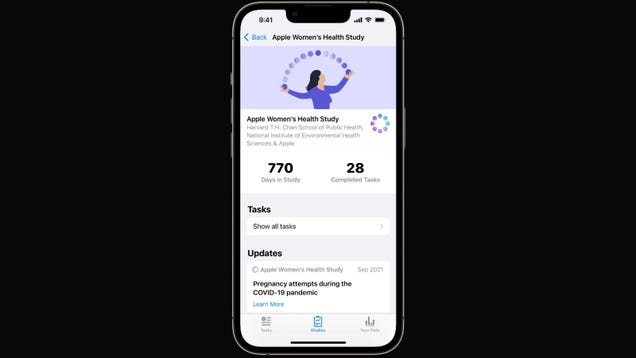
Apple continues to release findings from its ongoing Women’s Health study, and is announcing updated results today ahead of International Women’s Day (March 8th). The report, published on Harvard’s website, reveals some insights on polycystic ovary syndrome (PCOS) and cardiovascular health, based on data from more than 37,000 participants. 

Apple and Harvard found that its participants who had received PCOS diagnoses tended to be diagnosed between ages 14 and 35, with the median age being 22 years old. They were also more likely to report a family history of the syndrome and have unpredictable menstrual cycles after their first periods.

According to the report, more than 70 percent of participants without PCOS diagnoses said their menstrual cycles became regular within four years of their first period, while just 43 percent of those with PCOS experienced the same. In fact, 49 percent of participants with PCOS diagnoses never had regular menstrual cycles or only got regularity after using hormones. 

The study also looked at the health conditions related to PCOS. It reported that participants with PCOS diagnoses were four times more likely to have pre-diabetic conditions, three times more likely to have Type 2 diabetes and twice as likely to have high blood pressure and high cholesterol. It also said irregular heartbeats or arrhythmia was more common among participants with PCOS diagnoses than those without. 

A chart from Apple's Women's Health Study preliminary findings released in March 2022. The chart is titled
Apple Women’s Health Study – Harvard T.H. Chan School of Public Health.

Apple did caution that these were preliminary insights. Data was gleaned from medical history surveys completed by more than 37,000 participants enrolled from November 2019 through December 2021. Of those who completed the medical history surveys, about 30,000 also filled out reproductive history surveys and answered questions about their menstrual cycles over time. 

According to co-principal investigator Dr. Shruthi Mahalingaiah, “The Apple Women’s Health Study is one of the first studies where we can look at the connection between menstrual health, polycystic ovary syndrome, and heart health at a population level.”

Mahalingaiah also said “Despite the association between PCOS and heart-related conditions, historically, research studies about heart health have not included information about menstrual cycles,” adding that the study “is important for having a better understanding of PCOS and its health impacts, including for people with PCOS and those that might have PCOS, but do not know.”

Looking forward, Apple and Harvard want to “create a larger foundational data set on PCOS, with self-tracked variables, and its connection with heart health.”

“Our hope is that by expanding the understanding of the public health burden of PCOS, we can create research models that can be applied to further scientific understanding of other health conditions and the burden of other diseases,” Mahalingaiah said.


Source: Engadget – Apple’s latest women’s health study results focus on PCOS

The next OnePlus phone can reach full charge in 15 minutes

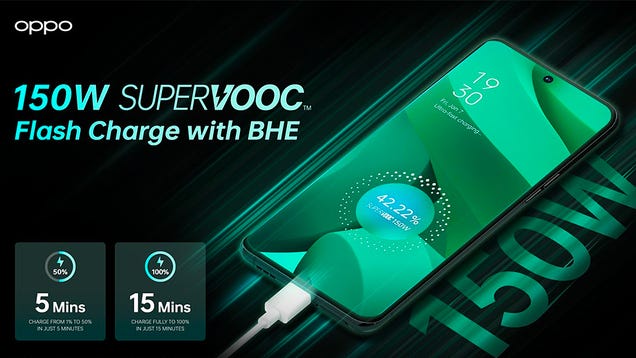
Every now and then, a phone maker comes up with a new charging speed claim. The latest company to do so is Oppo, which unveiled its 150W SuperVOOC flash charge — a leap from the 80W version on the recently launched Find X5 Pro and OnePlus 10 Pro — at MWC. This will offer a mere 15-minute charge time for a 4,500mAh dual-cell battery, but a quick five-minute charge can already get you back up to 50 percent. If you like the sound of this, you may look forward to it on the next OnePlus flagship phone, which is due in Q2 2022. At the same conference, Oppo’s sister brand Realme even announced that its upcoming GT Neo 3 will be the world’s first phone to support 150W SuperVOOC, so chances are OnePlus’ next phone will arrive after Realme’s.

Oppo’s 150W SuperVOOC is a tad faster than the current 120W offerings from the likes of Xiaomi and Vivo iQOO — ranging from 17 to 20 minutes, depending on the battery size. But it’s not just about speed. This fast charge tech is supported by Oppo’s “Battery Health Engine” (or “BHE” in short) which claims to double the battery lifespan, and this is already available on the recently launched Find X5 series. In a nutshell, “BHE” comprises of a dedicated battery management chip, smart battery health algorithm and some sort of battery healing tech — mainly by way of improving the cells’ electrolyte formula. 

Oppo 150W SuperVOOC with BHE
Oppo

According to Oppo, the industry standard for conventional flash charge is 800 charge cycles before reaching the 80-percent battery health deterioration threshold. With the “BHE” enhancements, however, the battery lifespan can be prolonged to 1,600 cycles — or as long as four years for a phone with daily recharging. The company added that “BHE” will be a standard feature for all flagships from Oppo and OnePlus (and likely Realme as well) moving forward, irregardless of their charging speeds.

It’s also worth noting that this new 150W SuperVOOC charger is almost just as compact as its 65W counterpart. The latter has been bundled with most flagship and mid-range phones from Oppo, OnePlus and Realme over the past two years.

With Oppo setting a new benchmark in terms of both charging speed and battery lifespan, it’ll be interesting to see how its competitors respond. Xiaomi had already demonstrated 200W fast charging which achieved an eight-minute charge time for a (smaller) 4,000mAh battery, but as we’ve seen on its latestflagships, it has yet to offer anything beyond 120W to its users. To stay further ahead of the game, Oppo will be showing off a “200W+” SuperVOOC demo at its MWC booth, so stay tuned for more details on this.


Source: Engadget – The next OnePlus phone can reach full charge in 15 minutes

Benchmarking The AMD EPYC Speed Boost Coming To Linux 5.18, Thanks To Scheduler/NUMA Improvement

Earlier this month I noted a Linux scheduler change queued into sched/core ahead of the Linux 5.18 cycle that is expected to help AMD EPYC processors and other select Zen processors in various workloads. The change has been in the works for several months and is about adjusting the allowed NUMA imbalance when spanning multiple LLCs. I’ve now carried out some of my own benchmarks on EPYC hardware and indeed is further ratcheting up the Linux kernel performance.

Source: Phoronix – Benchmarking The AMD EPYC Speed Boost Coming To Linux 5.18, Thanks To Scheduler/NUMA Improvement