
The US Government is attempting to speed up the integration of unmanned aerial vehicles into the national airspace system and test drone detection and tracking while waiving some limits on their use: testing of drones will now include flights over people, nighttime operations, and flights out of sight of the operator. The White House stopped short of proposing new regulations that would allow broader nationwide use of drones or any timetable for new authority.
White House adviser Michael Kratsios told reporters the “program will open the skies for delivery of life-saving medicines and commercial packages, inspections of critical infrastructure, support for emergency management operations.” Kratsios said the program would allow companies and governments to operate drones in ways that are currently restricted by the FAA “including beyond-visual-line-of-sight flights, nighttime operations, and flights over people.”
Discussion
Source: [H]ardOCP – President Launches Program to Test Expanded Drone Use
Monthly Archives: October 2017
AMD's Progress on Its 25×20 Goal: The Task Ahead

When AMD announced it was creating the new high-performance Zen core, they set a lofty goal. They wanted to produce products that offered 25x the relative efficiency (performance per watt) between 2014 and 2020. This was called the 25×20 goal, and AMD gave an update.

Starting from a baseline of Kaveri, AMD has put the Ryzen Mobile processors currently at 5.86x the performance efficiency in 3 years. That leaves another ~5x performance to get in the next three years. That’s a steep hill to climb, and it is clear that the scale of the graph above seems to be wrong, with Ryzen Mobile being half-way up the graph, rather than around 20% up the graph. If AMD is set to make that target, then they are expecting a huge jump in efficiency coming up. Is that what Navi is?
For this data, AMD also gave some insight into how they are calculating it. In the footnotes, we get the following steps:
- Overall performance efficiency is C divided by E
- Performance is a 50:50 average of CPU and GPU performance (variable ‘C’) compared to Kaveri
– CPU Performance from Cinebench 15 Multi-Threaded
– GPU Performance from 3DMark 11 P - Energy Use (variable ‘E’) defined by ETEC ‘Typical Energy Consumption from Notebooks’ as per Energy Star Program Requirements Rev 6.1 Oct-2014
- Kaveri is the Baseline where C/E = 1.00x
To calculate C, the following equation is used:

So say for example the base processor scored 100 in Cinebench and 1000 in 3DMark 11. If the upgraded processor scored 150 and 2000, the overall value of C would be 0.5 x (150/100 + 2000/1000) = 1.75.
To calculate C, we have to go to the Energy Star documents and pull out this long equation:

The PT(x) options are the power consumed in those modes multiplied by a given weighting factor in the document listed above. But it is worth noting that because it involves system level power in off/sleep/idle states, it is also subject to any efficiency improvements from the other component manufacturers as well, such as DRAM, IO, power delivery and display. Part of the goal here is performed by the vendors, not AMD.
AMD provided all the benchmark data for the CPU and GPU parts, as well as ‘overall’ values for E. These are all taken from mobile APU parts.
| AMD’s 25×20 Goal: Progress | |||||
| Cinebench R15 nT |
3DMark 11 P | Variable C | Variable E | Performance Efficiency |
|
| Raven Ridge | 719 | 4315 | 2.56 | 0.44 | 5.86x |
| Bristol Ridge | 279 | 3234 | 1.36 | 0.34 | 3.97x |
| Carrizo | 277 | 2709 | 1.23 | 0.35 | 3.51x |
| Kaveri | 232 | 2142 | 1.00 | 1.00 | 1.00x |
From the table, we can clearly see that moving from Kaveri to Carrizo was mainly about the power consumption under the Energy Star test, moving the denominator to a nice low number. Moving from Carrizo to Bristol Ridge was about GPU performance, extracting the most out of the 28nm process for frequency at the same power and some better binning. The jump to Raven Ridge/Ryzen Mobile marks a big step for Cinebench, given the new high-performance core, and a bump in 3D Mark performance.
What is interesting to note is that the variable ‘E’ has gone up from Bristol Ridge to Raven Ridge, from 0.34 to 0.44. This is despite AMD claiming a 58% power reduction in workloads like Cinebench. This will be down to how the Energy Star guidelines are set out, which in this instance do not favor how a system is applying the power (regardless of performance).
It brings up how AMD is going to achieve its 25x goal by 2020. Ryan and I discussed this at length before I wrote this segment, but there are a few interesting things to note.
Calculating E: It’s in the System
In order to calculate E, AMD relies on a good representation of the whole system, not just the processor. That includes things like memory, the display, and other components. This means that the improvements in these segments should help significantly towards that goal. One major thing that AMD could do with the next generation is swap support for DDR4 to either LPDDR3 or LPDDR4. The reason why is the low power states.
When we asked why AMD is not supporting LPDDR memory on Ryzen Mobile, the response was related to performance. If we look at almost every single Intel 15W notebook on the market, despite the processors supporting both LPDDR3 and DDR4, they all use LPDDR3 by default. If we ask the OEMs, the answer lies in the power consumption during lower power modes such as idle: LPDDR memory can achieve much, much lower power modes than standard DDR. We put this to AMD and they looked confused, saying that literally none of their OEM partners had ever brought this up in conversation as a requirement for a future platform.
Nonetheless, that value of E could take a nice tumble when AMD implement LPDDR on a future APU. I’d bet some money on that being the case.
Process Nodes Matter
Ryan also pointed out that AMD could implement a super low power SKU, something like Intel’s Core-M line that sits at 4.5W. At that low power, the value for E should be cut considerably. However, we have to think if these parts actually have a lower idle/off power than Intel’s 15W, or if it is, in fact, all in the binning. They would certainly have lower VRM losses by having fewer VRMs in play anyway. This is something AMD could pursue, assuming the performance values could be kept high.
We are also expecting AMD to implement GlobalFoundries 7nm process before 2020. That should yield a number of improvements for power, especially if AMD decides to fab a chip on a low power node.
The Future of Performance
On the C side of the equation, more is better. There are still a couple of iterations in the public roadmap for Zen from now until 2020, so the CPU performance could increase another 10-25%. Moving to 7nm could also lend itself to doubling the core count, giving a sizeable increase in the Cinebench or 3DMark score. With extra transistors and new GPU architectures (like Navi, or beyond), there is room to grow.
We did some mockup numbers to see where AMD would sit. The new 25×20 table would look like this based on three potential scenarios.
| AMD’s 25×20 Goal: Future? | |||||
| Cinebench R15 nT |
3DMark 11 P | Variable C | Variable E | Performance Efficiency |
|
| Same Power | 2000 | 18000 | 8.51 | 0.34 | 25.04x |
| Half Power | 1000 | 8000 | 4.02 | 0.16 | 25.14x |
| Low Power | 800 | 4400 | 2.75 | 0.11 | 25.01x |
| Raven Ridge | 719 | 4315 | 2.56 | 0.44 | 5.86x |
| Bristol Ridge | 279 | 3234 | 1.36 | 0.34 | 3.97x |
| Carrizo | 277 | 2709 | 1.23 | 0.35 | 3.51x |
| Kaveri | 232 | 2142 | 1.00 | 1.00 | 1.00x |
In the same power scenario (0.34E, like Bristol Ridge), AMD would have to severely increase both CPU performance by 3x and GPU performance by over 4x. An obvious way to go in that direction would be to double everything, although that is not always an easy task when it requires keeping power the same, even over several generations. A crystal ball will predict 8-core laptops, though it will be interesting to see the power, the frequencies, and the process node.
For a half-power scenario (0.16E), we took the fact that AMD is likely to increase its IPC over the next few generations by 5-15% each year. By 2020, assuming the same core count as today, this would give a Cinebench score of about 1000. In order to reach the 25x performance efficiency metric with that increase in CPU performance, the GPU would have to almost double in performance. One of the outcomes of moving to 7nm could be that AMD keeps the quad-core design but instead increases the number of compute units in the integrated GPU. Doubling the compute units, halving the power consumption, and increasing IPC by 30% is a tall order in three years, even with a node change and new architectures.
Ryan’s preferred option is the low power scenario. If AMD created a 4.5W-like processor which overall reduced the variable ‘E’ by ~75%, along with the general system improvements like LPDDR, but kept about the same performance as the 15W chips of today, then AMD could hit the 25x metric fairly comfortably. This might be considered an easier task than the others, and it will depend on how AMD is able to manage the power with such a low ceiling.
This is where I put in a poll to see what people think of where AMD will sit come 2020:
[twitter poll]
I have set the poll to last for 7 days. The results should speak for themselves.
Source: AnandTech – AMD’s Progress on Its 25×20 Goal: The Task Ahead
Nvidia GTX 1070 Ti takes fight to AMD RX Vega 56 for $450

| Specs at a glance: Nvidia GTX 1070 Ti | |
|---|---|
| CUDA CORES | 2432 |
| TEXTURE UNITS | 152 |
| ROPS | 64 |
| CORE CLOCK | 1607MHz |
| BOOST CLOCK | 1683MHz |
| MEMORY BUS WIDTH | 256-bit |
| MEMORY BANDWIDTH | 256GB/s |
| MEMORY SIZE | 8GB GDDR5 |
| Outputs | 3x DisplayPort 1.4, 1x HDMI 2.0b with support for 4K60 10/12b HEVC Decode, 1x dual-link DVI |
| Release date | November 2 |
| PRICE | Founders Edition: £419/$449/€469 |
Following weeks of leaks and rumours Nvidia has made the GTX 1070 Ti graphics card official. A Founders Edition version launches on November 2 for £419/$449/€469, with partner cards from the likes of Asus, MSI, and Zotac expected to launch shortly after.
More powerful than a GTX 1070, but less powerful than a GTX 1080, the GTX 1070 Ti is Nvidia’s response to AMD’s RX Vega 56 graphics card. Vega 56 proved a potent competitor for the GTX 1070, with better performance for around the same price. Theoretically, the GTX 1070 Ti should be a better performer than Vega 56, but with GPU prices still all over the place thanks to the Ethereum mining craze, it remains to be seen whether retailers will stick close enough to the £419 recommended price to make it a viable competitor.
Read 4 remaining paragraphs | Comments
Source: Ars Technica – Nvidia GTX 1070 Ti takes fight to AMD RX Vega 56 for 0
HP Announces ENVY x360 15 With Ryzen Mobile

As part of the launch for the new Ryzen Mobile platform from AMD, HP is today announcing a refresh of their HP ENVY x360 15-inch laptop which features the AMD Ryzen 5 2500U processor. This refresh is based off their existing AMD FX series x360. The HP ENVY x360 has been a popular platform for HP, offering a fully convertible laptop with a 360° hinge, offering traditional laptop weight balance, along with stand, tent, and tablet modes to increase the versatility.
| HP ENVY x360 Ryzen Mobile | |||||
| CPU | AMD Ryzen 5 2500U Quad-core, Eight-thread, 2.0GHz to 3.6GHz |
||||
| GPU | AMD Radeon Vega 8 Graphics 8 Radeon RX Vega CUs Up to 1100 MHz |
||||
| Display | 15.6″ 1920×1080 IPS with Touch | ||||
| Memory | Up to 8 GB DDR4 (2 DIMMs) | ||||
| Storage | Up to 512 GB SSD or 1 TB HDD | ||||
| Wireless | Intel 802.11ac w/Bluetooth 4.2 | ||||
| I/O | 1 USB-C 3.1 Gen 1 with DP 1.2 and Power 2 USB 3.0 1 HDMI Headset Jack |
||||
| Power | 65W AC Adapter 55.8 Wh Battery |
||||
| Dimensions | 14.16″x9.8″x0.77″ | ||||
| Weight | 4.75 lbs | ||||
| Starting Price | $699 | ||||
| Availability | November 2017 | ||||
But the star of the show is going to be the Ryzen Mobile processor. HP is offering the Ryzen 5 2500U option, which is four cores, eight threads, and a 2.0 GHz base frequency with 3.6 GHz boost frequency. As with Intel’s CPUs, it has a 15-Watt nominal TDP. HP has paired it with up to 8 GB of DDR4 RAM in dual-channel mode.
The GPU side is where we expect Ryzen Mobile to have an edge, thanks to the Radeon Vega graphics core. In the Ryzen 5 2500U, this means eight Radeon RX Vega CUs, with a boost frequency of up to 1100 MHz. It’ll be exciting to see what this integrated graphics core will be able to achieve with just a 15-Watt TDP.
The CPU change is clearly the big change. The rest of the laptop is similar to the existing HP ENVY x360 15-inch model. It offers up to a 512 GB SSD, or 1 TB SATA HDD, and features Intel 802.11ac wireless. The display is a 15.6-inch IPS 1920×1080 panel, featuring thin side bezels and edge-to-edge glass. The laptop features an IR webcam for Windows Hello support, and offers a full-size backlit keyboard with a number pad as well. The laptop weighs in at 4.75 lbs.

For connectivity and more, the HP ENVY x360 offers USB-C with DisplayPort and power capabilities, and HP lists the laptop as able to drive two UHD displays. HP’s partnership with Bang & Olufsen continues as well, handling the audio duties. It also features a stylus for Windows Ink.
The Ryzen Mobile powered HP ENVY x360 starts at $699, with availability in November.
Source: HP
Source: AnandTech – HP Announces ENVY x360 15 With Ryzen Mobile
AMD’s Ryzen CPU with Vega graphics threatens to blow Kaby Lake out of the water

Enlarge / Ryzen processor with Vega graphics. The blue part on the right is the GPU; the dark, complicated bit on the left is the CPU. Around the edge are memory controllers, multimedia engines, power management, and other bits and pieces. (credit: AMD)
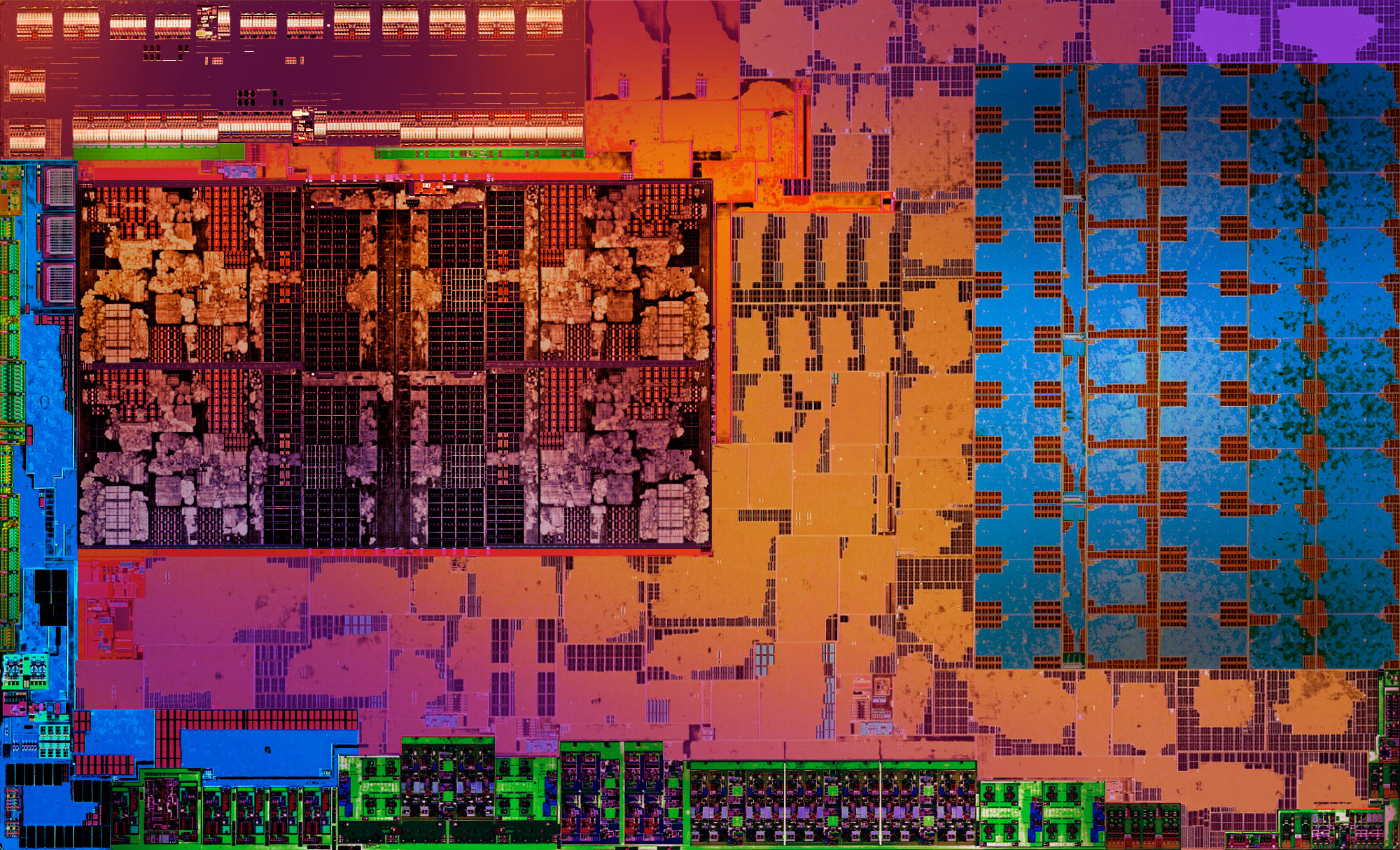
AMD announced today its first two processors to combine its new Zen CPU architecture with its Vega graphics. The new chips, aimed at lightweight mobile systems, go head to head with Intel’s U-series processors, and for the first time in many years, AMD is going to have competitive chips in the thin-and-light laptop market.
AMD’s Ryzen and Threadripper processors re-established AMD’s chips as competitive with Intel’s. While the AMD parts gave up a bit of performance to their Intel rivals, especially in single-threaded tasks—a result of the combination of slightly lower clock speeds and slightly inferior instructions-per-cycle (IPC)—they shine in multithreaded tasks, with AMD often offering many more cores and threads than Intel for the same or less money.
In the mainstream desktop space, Intel’s Coffee Lake chips have reasserted that company’s dominance; Skylake-X does the same in the high-end desktop space, too, albeit at a high price.
Read 17 remaining paragraphs | Comments
Source: Ars Technica – AMD’s Ryzen CPU with Vega graphics threatens to blow Kaby Lake out of the water
Super Mario Odyssey review: Mario’s densest, deepest adventure yet

Enlarge / “May you be as joyful as a Mario in boxer shorts and an oversized boxing glove hat” -Ancient proverb

A few weeks ago, I got dragged down a rabbit-hole discussion of what defines a “core” Mario game. One proposed definition relied on Mario trying to reach an explicit “goal point” or exit at the end of the level.
While a core Mario game could have secondary goals (like collecting red coins or one-ups) and while there might be multiple exits in a single level, getting from the start to the end has always been a defining characteristic of his adventures. Even more open 3D games like Super Mario 64, Super Mario Sunshine, and Super Mario Galaxy have retained this model to some extent, ending with a run through the level and putting Mario back to the start after he collects a star (or “shine”).
By this strict definition, Super Mario Odyssey can’t really be considered a core Mario game at all. The game’s wide-open “Kingdoms” don’t have any set end points, instead they exist more as spaces to run and jump around at your leisure. When you stumble on one of the many power moons that are Mario’s most explicit goals within these levels, the exploring continues on from that same point after a short animation. On top of that, you only need to collect a small handful of these available moons before you’re allowed to move on to the next Kingdom (and back) at your leisure.
Read 26 remaining paragraphs | Comments
Source: Ars Technica – Super Mario Odyssey review: Mario’s densest, deepest adventure yet
Google Pixelbook review: Prepared today for the possible reality of tomorrow
Chromebooks may be most popular in the classroom, but Google wants to ride that train out of schools and into the next phase of students’ lives. The Pixelbook is the manifestation of that idea, the piece of hardware that combines Google’s revamped design aesthetic and Internet-based software with the needs and wants of a younger generation.
Google stopped selling the original Chromebook Pixel, but seemingly only because the company wants to shine the spotlight on its new Chrome OS laptop. No distractions, no other (potentially) cheaper options: if you’re someone who grew up using Chrome OS in school, this $999 convertible is the one you should get if you want to continue using Chrome OS later in life.
Read 59 remaining paragraphs | Comments
Source: Ars Technica – Google Pixelbook review: Prepared today for the possible reality of tomorrow
Super Mario Odyssey: The Kotaku Review

For Mario, 3D used to mean freedom. In 1996, Super Mario 64 broke Nintendo’s mascot from the shackles of having to run in a straight line, letting the player choose their own path. But for quite some time now—no matter how 3D the graphics may have been—Mario’s adventures have reverted back to running on a straight…
Source: Gizmodo – Super Mario Odyssey: The Kotaku Review
More Rumors of a Major Battle to Come in Star Wars: The Last Jedi

Arnold Schwarzenegger teases the next Terminator movie. Pixar’s Coco casts an Agent of SHIELD. See Thor’s new team in action in a new Ragnarok featurette. Plus, tons of behind the scenes pictures from Justice League, and John Carpenter will be back in the director’s chair for a new Syfy Horror anthology. Spoilers…
Source: Gizmodo – More Rumors of a Major Battle to Come in Star Wars: The Last Jedi
The Google Pixelbook Made Me Alter My Existence

I had to change how I think because of Google’s new $1,000 Pixelbook. This gorgeous 2-in-1 is some of my favorite hardware for the price, but it’s loaded with Chrome OS, the worst operating system you could put on your computer. If you’ve grown up a power user of MacOS, Windows, or Linux, then Chrome OS feels like…
Source: Gizmodo – The Google Pixelbook Made Me Alter My Existence
Uber Faces Engineers' Lawsuit Alleging Gender, Race Bias
An anonymous reader quotes a report from Bloomberg: Uber was sued by three Latina engineers who claim the company pays women and people of color less than their peers and doesn’t promote them as frequently as males, whites and Asians. The three women from the ride-hailing company, one of whom still works there, accused Uber of violating California’s Equal Pay Act in a complaint filed Tuesday in San Francisco state court on behalf of all engineers similarly held back. The women filed the complaint under a state statute that gives employees the right to step into the shoes of the state labor secretary to bring enforcement actions. That law also may give them a way around a provision in Uber’s contracts requiring workplace disputes to go through one-on-one arbitration instead of as group actions in court. “Female employees and employees of color are systematically undervalued compared to their male and white or Asian American peers because female employees and employees of color receive, on average, lower rankings despite equal or better performance,” according to the complaint against Uber. In July, Uber said that it adjusted salaries to ensure equity in pay for women and minorities.


Read more of this story at Slashdot.
Source: Slashdot – Uber Faces Engineers’ Lawsuit Alleging Gender, Race Bias
Uber's multi-destination feature makes riding with friends easier
 Uber has launched a multiple stop feature that lets riders add up to three stops on their trip, eliminating the need to add a new address after each drop or pick-up. Open the app, hit “Where to?” and then tap the “+” symbol to add the addresses of ea…
Source: Engadget – Uber’s multi-destination feature makes riding with friends easier
Amazon discounts LG's G6 if you accept Prime ads
 Amazon didn’t have much joy selling its own phone, but has achieved plenty by selling other people’s under its Prime Exclusive Phones label. The deal is that users get a discount off the price of a mid-range handset in exchange for Amazon slinging yo…
Source: Engadget – Amazon discounts LG’s G6 if you accept Prime ads
Google Pixelbook review: A premium Chromebook that's worth the price
 When we reviewed Google’s Chromebook Pixel in 2013, we said it was a gorgeous, well-built computer that almost no one should buy. That’s also how we felt about the follow up in 2015. See, Chrome OS has been considered fine for a cheap second computer…
Source: Engadget – Google Pixelbook review: A premium Chromebook that’s worth the price
AMD stuffs Radeon Vega graphics into its Ryzen Mobile chips
 It’s been a revival year for AMD. Its Ryzen chips thrust it back into the desktop arena — so much so that it practically forced Intel to dramatically ramp up the capabilities of its upcoming eighth generation Core CPUs. And with its RX Vega video ca…
Source: Engadget – AMD stuffs Radeon Vega graphics into its Ryzen Mobile chips
'Super Mario Odyssey' is everything it needs to be and more
 “A return to form.” “A reinvention.” There are lots of clichés we fall back on when describing a fresh game in a long-running series. The truth is, Nintendo has constantly reinvented the idea of a 3D Mario game, relentlessly pushing the franch…
Source: Engadget – ‘Super Mario Odyssey’ is everything it needs to be and more
Ryzen Mobile is Launched: AMD APUs for Laptops, with Vega and Updated Zen
The final piece of AMD’s return to high-performance computing is in laptops. While Ryzen, Threadripper, and EPYC have used the 8-core Zeppelin building block for their products, the laptop side of the equation will combine the new high-performance Zen core with the latest Vega graphics in a single piece of silicon. AMD is now set to release the results of their efforts: a single silicon chip offering four Zen cores, up to 10 Vega compute units, and a unified power delivery system all in under 15W, with AMD touting +200% CPU performance and +128% GPU performance over its previous generation of laptop processors. HP, Lenovo and Acer are releasing laptops based on the Ryzen Mobile hardware today (or soon), and we expect to see more OEMs at CES in January with their offerings.
Source: AnandTech – Ryzen Mobile is Launched: AMD APUs for Laptops, with Vega and Updated Zen
The Best Boston Hacks From Our Readers

This week on Hack Your City, we asked for your best Boston tips. You gave us great guides to museums (including one that’s free if you’re named Isabella), restaurants (like a spot for “rice and a slice”), good and bad neighborhoods, how to save money on parking, and tons of favorite bars and breweries. Here are the…
Source: LifeHacker – The Best Boston Hacks From Our Readers
Three female engineers sue Uber for sex and race discrimination

Enlarge / Uber’s office in Queens, New York. (credit: Photo by Spencer Platt/Getty Images)

A new lawsuit claims Uber pays female engineers, and some engineers of color, less than male, white, and Asian-American counterparts.
The complaint (PDF) claims that Uber’s biannual “stack ranking” system is invalid, arbitrary, and forces different outcomes between employees “regardless of whether there are meaningful performance differences between individual employees within a particular peer group.”
The plaintiffs state that female employees and employees who are African-American, Latino, or American Indian get, on average, lower rankings than male, white, and Asian-American workers, “despite equal or better performance.”
Read 6 remaining paragraphs | Comments
Source: Ars Technica – Three female engineers sue Uber for sex and race discrimination
Bloodhound preps for land speed record with 200MPH test run
 It’s finally happened. Nine years after the Bloodhound project was first announced in London, the supersonic car has completed its first test runs. At a closed-off airstrip near Newquay airport, Cornwall, the monstrous vehicle roared across the tarma…
Source: Engadget – Bloodhound preps for land speed record with 200MPH test run