Also: Atlus is giving its Persona devs a raise

Also: Atlus is giving its Persona devs a raise

The process is a whole lot more involved than jailbreaking a PS4, though

Krafton is “enjoined” from firing Ted Gill as part of a new court order
When Apple takes the virtual stage in June for WWDC 2026, avid fans might expect the company to announce a number of new features for updates like iOS 27, iPadOS 27, and macOS 27. And while these updates will almost assuredly sport some key features and changes from the “OS 26” era, the best new feature might not be a feature at all. In fact, it might be the exact opposite.
In his Power On newsletter on Sunday, Bloomberg’s Mark Gurman ran through some of Apple’s thought processes with its upcoming updates, per Gurman’s sources. It seems that following the company’s big delays and stumbles in rolling out big AI features, and its Liquid Glass design overhaul, the company is in a position to focus more on iterative updates rather than sweeping changes. As such, Gurman expects “years of gradual improvements,” starting with iOS 27, which he has said since November will be a “Snow Leopard-like” release.
For those out of the loop, Mac OS X Snow Leopard is a famous OS update in Apple world. Apple announced Snow Leopard as having zero new features, as the update was intensely focused on delivering bug fixes and stability updates to Mac OS (now macOS). Snow Leopard didn’t actually ship with zero new features—there was a new QuickTime player and a fresh version of Safari—but the emphasis was really on shipping a new OS for the Mac that felt the same as before, but just worked better.
If that’s the philosophy Apple wants to carry onto iOS 27, I’m all for it. iOS 26 hasn’t been too buggy in my experience, but I keep encountering other users who swear the update has negatively impacted their iPhones. The one complaint I keep hearing is about the keyboard, which users allege is buggy beyond belief. While there are general steps you can take to make the iOS keyboard work better for you, any software bugs affected it will require Apple’s intervention—not the end user.
I would also like Apple to extend those plans to its other big updates this year, as well. The first couple of versions of macOS 26 (Tahoe) received an even poorer reception online than iOS 26, from what I’ve seen. The negative reviews kept me from updating my M1 iMac until macOS 26.3, which beta testers found to be less buggy than previous versions. Indeed, my M1 Mac can handle macOS 26.3, but it’s still a bit laggy at times. While you could chalk that up to the five-year-old chip, I’d bet Apple could optimize its OSes across the board to make the experience a bit smoother for any devices that will be compatible with any of the OS 27 updates. If Apple can make macOS Tahoe run smooth on the MacBook Neo, running a binned, two-year-old iPhone chip, I imagine my iMac could run macOS 27 with some grace.
Like Snow Leopard, Apple won’t actually have zero new features to ship with iOS 27. The biggest feature of all will be rolling out its new “AI Siri,” which despite being announced in 2024 for iOS 18, has encountered delay after delay. But Gurman says the other big iOS 27 “feature” will be support for Apple’s upcoming foldable iPhone, introducing things like split-screen apps for the first time on iOS. It’d be great if Apple extended this support to standard iPhones as well (especially the Max), but Gurman seems to think this will remain a foldable perk only.
Remember, this year marks Apple’s 50th anniversary, and the company likely has some big plans in store. But I think the best thing the company could do to celebrate is make sure that all of its devices are running optimized versions of their respective OSes. Happy Birthday, Apple!
A German court ruled that TCL misled consumers by marketing certain TVs as “QLED” when they “do not deliver the color reproduction expected from QLED TVs.” It has ordered the company to stop advertising or selling those models in Germany. TechRadar reports: The case was filed by Samsung, which claimed that TCL was running deceptive advertising, and more court cases on the same topic are coming in other countries, including the US. The lawsuits all make the same claim: that what TCL calls a QLED isn’t a QLED as it’s commonly understood, and that consumers are being mis-sold TVs as a result. The court found that TCL’s quantum dot TVs, such as the QLED870 series available in Germany, didn’t deliver the characteristics of a quantum dot LED, and that consumers were being misled as a result.
The tests were commissioned by Seoul chemicals company Hansol Chemical (which, it’s worth noting, works with Samsung, a key TCL rival, and which heavily promoted the results of these tests alongside launching the court case) and carried out by Geneva’s SGS and the UK’s Intertek. According to ET News (via Google Translate), “no indium (In) or cadmium (Cd) was detected in three TCL QD TV models. Indium and cadmium are essential materials that cannot be omitted for QD implementation… if neither is present, QD technology cannot be said to have been applied.” You can see the test results here.
TCL disputed the findings — “The QD content may vary depending on the supplier, but it definitely contains cadmium,” it responded — and published its own tests, including a test by SGS, the same firm that conducted tests for Hansol. The results contradicted Hansol Chemical’s tests, but those tests used a different methodology: where TCL’s tests focused on TCL’s quantum dot films, Hansol’s commissioned tests were on finished TCL TVs. […] Hansol Chemical has filed a complaint against TCL with the US Federal Trade Commission, alleging false advertising, and TCL is also facing class action lawsuits in several US states making the same claim. TCL isn’t alone here: Hisense has also been targeted in the US.


Read more of this story at Slashdot.


I’m sorry, but If you want to play Cryo Archive, you’ll have to finish Introducing: Sekiguchi
The past several years Imagination Tech has been investing in an upstream and open-source DRM kernel graphics driver as well as a PowerVR Vulkan driver in Mesa. Their Mesa focus has exclusively been on the PowerVR Vulkan driver with the plans all along to use the Zink generic OpenGL-on-Vulkan implementation. With next quarter’s Mesa 26.1 release, that goal is being realized with Zink now working nicely atop the PowerVR Vulkan driver for in turn achieving open-source OpenGL support on PowerVR…

The country continues snatching up gaming assets
Blizzards and heatwaves and thunderstorms, oh my!

The AR monster-catching app can’t simply stay a good thing
A round of Intel graphics driver updates were sent today to DRM-Next in staging ahead of April’s Linux 7.1 merge window. The changes in this pull aren’t too particularly exciting with a lot of code refactoring and other work, but there are preparations made for supporting UHBR DP tunnels…

It’s
OpenAI’s forthcoming “adult mode” will allow users to engage in lewd conversations with ChatGPT, but not use the chatbot to generate explicit images, audio or video. In response to reporting from The Wall Street Journal, an OpenAI spokesperson characterized the upcoming release as capable of producing smut rather than pornography.
OpenAI CEO Sam Altman first floated the idea of allowing people to use ChatGPT for erotica last October, saying the company wanted to “treat adult users like adults.” OpenAI originally planned to release adult mode at the start of 2026. Since then, the company has pushed back the feature a handful of times, with the most recent delay coming at the start of March so that OpenAI could “focus on work that is a higher priority for more users.”
Through The Journal’s reporting, we’re learning OpenAI forged ahead with work on adult mode despite reservations from its council on wellbeing and AI. The group of eight researchers and experts were reportedly unanimous in warning the company AI-generated erotica could lead to people developing an unhealthy emotional dependence on ChatGPT, and that underage users would almost certainly find ways to access the feature. According to The Journal, one council member, citing cases where people have taken their own lives after becoming attached to ChatGPT, said the company was at risk of creating a “sexy suicide coach.”
Those concerns appear to have been well-founded. At one point, the company’s age verification technology was misidentifying underage users as adults about 12 percent of the time, according to The Journal. At OpenAI’s scale, with around 100 million teens using ChatGPT every week, that error rate would have translated to millions of minors accessing erotic chats. OpenAI told The Journal its prediction algorithm performs to industry standards, adding no such system will ever be completely foolproof.
This article originally appeared on Engadget at https://www.engadget.com/ai/openais-adult-mode-reportedly-wont-generate-pornographic-audio-images-or-video-150744035.html?src=rss

XFusion’s entry into gravel suspension comes in the form of the new G.E.T. (Grand Epic Trail) 30 fork.
The all-new 700c-wheel specific fork comes with slender 30mm stanchions, a 12x100mm thru-axle, offsets of 45mm and 51mm, and travel options of 30, 40 and 50mm.
The internals are an air spring combined with XFusion’s Finecut RL2 damper. XFusion claims the Finecut RL2 is optimised for small-bump response and high speed, so it should be up to the job for chattery gravel.
The G.E.T. 30 has a claimed weight of 1,340g (uncut steerer), which is only a few grams heavier than the RockShox Rudy XPLR Ultimate (1,300g), Fox’s 32 Taper-Cast (1,320g) and Cane Creek’s lightweight Invert CS at 1,250g.

At $659, with the UK price still to be announced but expected to be around £550-£600, the G.E.T. 30 is very competitively priced for gravel suspension.
The class-leading RockShox Rudy XPLR Ultimate is priced at £779 / $799 (1,300g), while Fox’s Taper-Cast 32 is £1,000 / $949 and Cane Creek’s Invert CS is £1,199.99 / $1,199.99.
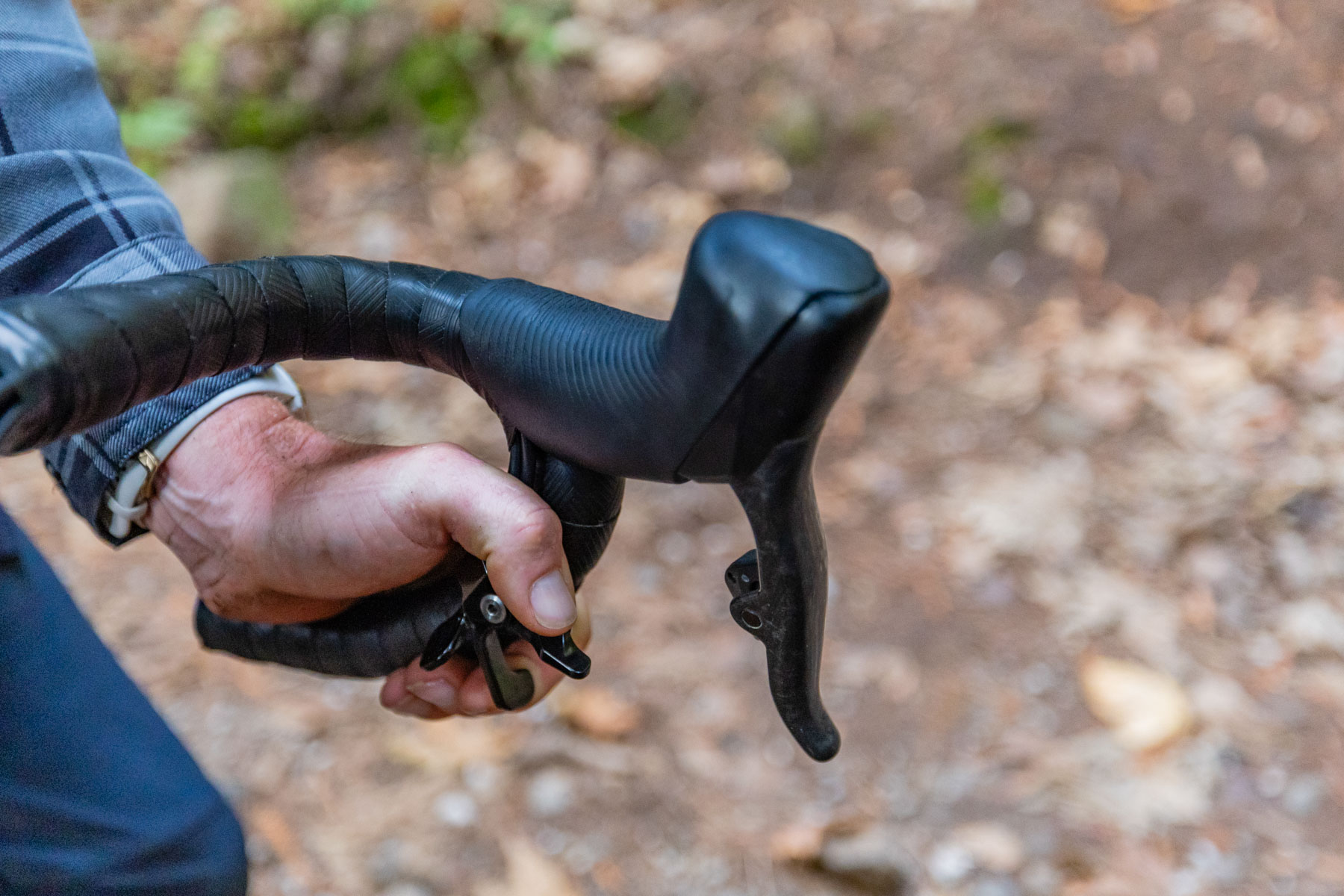
The fork offers rebound adjustment on the fly and an external lockout. The lockout is operated by the standard dial on the fork crown, or you can upgrade to a remote bar-mounted lockout.
The lockout can even be controlled with XFusion’s clever Q-Flip drop-bar specific lever. The Q-Flip features two independent levers, one to operate the fork lockout and one to activate XFusion’s gravel-specific version of its 50mm-travel, 27.2mm-diameter Manic dropper.

Gravel suspension is at something of a crossroads, with some brands opting for lightweight XC forks instead of gravel-specific options. Lee Cougan has the full-suspension Innova Super Gravel and Moots the 29er-compatible new Scrambler.
Trek is offering the Rudy XPLR Max on the new full-suspension CheckOut.
Meanwhile, brands such as Canyon, Santa Cruz, Giant and Cannondale are sticking to the lightweight, short-travel template.
It’s here where the XFusion could become a true contender: it has lots of suspension control, low weight, the clever Q-Flip controller, and a competitive retail price.
I’ve already put a request in for a test sample to see how the G.E.T. 30 shapes up against my current recommended gravel forks.
We may earn a commission from links on this page.
On Monday, Apple officially announced the AirPods Max 2. As the name implies, this is the first major update to the AirPods Max since Apple introduced the over-the-ear headphones in 2020. The company previously rolled out a minor refresh for the AirPods Max, but this only replaced the original pair’s Lightning port with USB-C, and enabled Apple to add a couple neat perks via software update. AirPods Max 2, however, come with new features out of the gate—features that Apple’s earbuds have actually had for years.
First, an answer to the question most likely on your mind: No, Apple did not change the price. These headphones are still $549, which is expensive, even for high-end over the ear headphones. Take a look at PCMag’s list of the best headphones for 2026, and you’ll see similar options from competitors like Sony and Bose reach up to $450 or $460, but none break $500—and you’ll often find huge discounts on these headphones to boot. The AirPods Max’s price tag has always made these headphones hard to recommend, even though I personally love them. That’s still the case with the AirPods Max 2.
Still, Apple is offering a lot more functionality for the same price, and seeing as $549 in 2020 is worth nearly $700 in 2025, you are getting quite a bit more for your money with the AirPods Max 2. The new headphones get Apple’s H2 chip, which Apple says improves noise cancellation by up to 1.5 times, and enables “even more natural” Transparency mode. The company says the new headphones have a new high dynamic range amplifier “for even cleaner audio,” while maintaining the sound signature from the previous generation AirPods Max. Meanwhile, Spatial Audio sounds “better than ever” with “more accurate and consistent bass response, and more natural-sounding mids and highs.” Like the USB-C AirPods Max, these headphones support 24-bit 48 kHz lossless audio when connected via a wired USB-C cable.
So, according to Apple, AirPods Max 2 sound better than AirPods Max. That’s to be expected from a new generation of headphones. In my view, however, the real upgrade here are all the “intelligent” features that AirPods Max 2 now support. For the first time, AirPods Max supports Adaptive Audio, which automatically adjusts noise cancellation and Transparency levels to match your environment. That also includes Conversation Awareness, which automatically lowers the volume and reduces background sounds when you start speaking. That way, you can hear someone clearly while having a conversation with your AirPods Max on, and when you’re done talking, your audio comes back at its previous volume.
The new AirPods also support Voice Isolation, which blocks out background noise and emphasizes your voice during calls, as well as Personalized volume, which adjusts the volume based on your past preferences. There’s “Loud Sound Reduction,” which caps the loudness of externals sounds while preserving the sounds themselves. (You could wear these to a concert and still hear everything, but protect yourself from sounds that are too loud.) You can also nod or shake your head to interact with Siri, rather than speak your commands. (If Siri asks you whether you’d like to respond to a message, you can nod to accept, or shake your head to dismiss.) You can also take advantage of Live Translation, Apple’s feature that translates conversations on the fly.
The thing is, none of these features are actually new, and with exception to some (namely Live Translation), have been available on some AirPods models for years. It’s great that Apple finally added them to the AirPods Max, but it is frustrating that the USB-C model didn’t include them for that $549 price point.
Apple says that you can pre-order AirPods Max 2 starting March 25, in midnight, starlight, orange, purple, and blue, and that the headphones will be available starting early next month. Now that these headphones are official, however, keep an eye out for discounts on the previous generation AirPods Max. Amazon tends to have good deals on AirPods Max from time to time, and now that there’s a new model, the previous ones should go down in price even more—as long as there’s availability. As of this piece, the best deals appear to be on renewed models.
An animated reboot of Firefly is in early development at 20th Television Animation with Nathan Fillion involved. The project has Joss Whedon’s blessing and will be run by writers Tara Butters and Marc Guggenheim, with early concept art already underway. According to the Hollywood Reporter, “The series would be set in the timeline between the original, 11-episode TV run in 2002 and the 2005 feature film continuation, Serenity.” You can watch Fillion announce the Firefly reboot on Instagram.
When the first episode of the original series premiered in late 2002, Slashdot reader fm6 wrote: “Firefly, Joss Whedon’s ‘anti-Trek drama’ premieres tonight, on Fox, 8 E/P. I normally despise hypespeak, but this time it’s the only language that fits: this is groundbreaking, mind-boggling, totally original. I’ve seen a bootleg of the pilot (which, unfortunately, the network is holding back) and I promise you this is the most geek-friendly SF you’ve seen in a long time. Yes, more so than Star Trek and B5, and way past Star Wars. I’ve never seen the future so skillfully, realistically, and lovingly portrayed. Here is the Official Site and a leading fan site.” “This is the single new show this season I have added a season pass for to the old Tivo,” CmdrTaco said at the time. “But I’ll probably watch it live. This looks like it could be as good as we hope.”


Read more of this story at Slashdot.

The new costumes are half-finished, seemingly melting, or just plain terrible
A coalition of Big Tech companies is working on a more comprehensive solution to combat online scams. As first reported by Axios, Google, Microsoft, LinkedIn, Meta, Amazon, OpenAI, Adobe and Match Group announced the signing of the Online Services Accord Against Scams. The new agreement is meant to put up a united industry-wide front against online fraud and scams, particularly those from sophisticated criminal networks that use multiple platforms.
According to the Axios report, the measures will include adding fraud detection tools, introducing new user security features, and requiring more robust verification for financial transactions. The agreement will also set up best practices for scam detection, prevention and reporting, while encouraging the sharing of information between companies and law enforcement. On the policy side, the coalition will call on the governments to “declare scam prevention a national priority,” according to Axios. While these measures are extensive, the report noted that they’re all voluntary since the accord doesn’t mention any penalties if the companies don’t follow through.
Many of the companies involved in the new accord already have experience in dealing with scams found on their own platforms. Earlier this month, Meta announced several new features across Facebook, Messenger and WhatsApp that would alert users about suspicious friend requests or accounts. Last year, LinkedIn introduced a new verification requirement for company recruiters or executives to address scams targeting job seekers on its platform.
This article originally appeared on Engadget at https://www.engadget.com/cybersecurity/tech-companies-are-teaming-up-to-combat-scammers-144616545.html?src=rss