Tata Consultancy Services Ordered To Cough Up $210 Million In Code Theft Trial

Richard Speed reports via The Register: A jury has sided with Computer Sciences Corporation (CSC) against Tata Consultancy Services (TCS) over the theft of source code and documentation. A total of $210 million was this week awarded. According to the verdict [PDF], a Texas jury agreed that TCS had “willfully and maliciously” misappropriated both source and confidential documentation by “improper means,” awarding CSC $140 million in damages, with another $70 million tacked on for TCS’s “unjust enrichment.” The complaint [PDF] was filed in April 2019 regarding CSC’s VANTAGE-ONE and CyberLife software platforms. CSC had licensed these software platforms to Transamerica Corporation, a life insurance holding company, to whom Tata — used here to collectively refer to Tata Consultancy Services Limited and Tata America International Corporation — began providing maintenance services.

In 2014, CSC and Transamerica signed off on a Third-Party Access Addendum that would allow Tata to alter CSC’s software, but only for the benefit of its customer — Transamerica. All was well until 2016, when Transamerica decided it needed to refresh its software. CSC and Tata both put in bids. CSC lost, and Tata won with its own software platform called BaNCS. The circumstances got sticky at this point, not least because Tata hired more than 2,000 Transamerica employees. CSC alleged that these former employees had access to its code and documents, and forwarded them on to the Tata BaNCS development team. The situation escalated in 2019, when a CSC employee was accidentally copied in on an email between Tata and Transamerica showing that Tata was accessing confidential information, according to CSC. The company then began legal proceedings. Documents and motions have been exchanged in the years since as Tata sought to get the case thrown out while CSC’s claims were upheld. Eventually, it went to a jury trial, which found for CSC.

Read more of this story at Slashdot.


Source: Slashdot – Tata Consultancy Services Ordered To Cough Up 0 Million In Code Theft Trial

Google is investigating a Drive issue that causes files to go missing

Google Drive users have recently been reporting that files and folders have gone missing, with some saying that months worth of data has disappeared from their accounts. Now, Google has acknowledged the issue, saying that it appears to be caused by the Drive for Desktop app, 9to5Google has reported.

The issue is pretty alarming, obviously. One user on Google’s support forums said that an expense spreadsheet they regularly updated has lost all data from nearly the last five years, with the version history showing the latest version as January 2019. “I’m really mad as this had all the important data which I do not have any local copy for. I need this data retrieved at any cost.” Another poster said the drive reverted to May 2023, with all subsequent data disappearing, and others report similar issues.

In a post from yesterday, Google said that “we’re investigating reports of an issue impacting a limited subset of Drive for desktop users and will follow up with more updates.” It noted the problem affects Drive for desktop v84.0.0.0 – 84.0.4.09. It advised users not to click “disconnect account” within Drive for desktop, and to not delete or move a specific app folder called DriveFS as detailed here. It even recommends making a copy of the app data folder if you have room on your hard drive. 

Google offers several ways to recover (or at least check) deleted files. That includes checking the trash, which is now automatically emptied after 30 days. It’s also a good idea to check the activity panel, which shows any files deleted or moved along with the relevant date. For this latest issue, however, the activity panel doesn’t appear to show that the files have gone missing, according to Google’s support forum users. 

This article originally appeared on Engadget at https://www.engadget.com/google-is-investigating-a-drive-issue-that-causes-files-to-go-missing-092028653.html?src=rss

Source: Engadget – Google is investigating a Drive issue that causes files to go missing

Cheaper Microscope Could Bring Protein Mapping Technique To the Masses

A team of researchers at the Medical Research Council’s Laboratory of Molecular Biology has developed a prototype cryo-electron microscopy (cryo-EM) microscope that, despite being significantly cheaper than high-end machines, has successfully solved protein structures with near-atomic resolution. The findings have been published in the journal Proceedings of the National Academy of Sciences. Science Magazine reports: [MB physicist Chris Russo] wants a manufacturer to commercialize his team’s design, which he believes could be built and sold for $500,000. That’s within reach of a new hire’s startup package, or one of the regular equipment grants offered by the National Institutes of Health (NIH) or National Science Foundation, says Bridget Carragher, founding technical director of the Chan Zuckerberg Imaging Institute. “It would be a marvelous machine,” she says. “Everyone who wants to do structural biology could do it.” […] One of the team’s key insights was that the electron beam does not need the energies typically used in high-end cryo-EM microscopes. Levels of 100 kiloelectronvolts (KeV) — one-third as high — suffice to reveal molecular structure, and they reduce costs by eliminating the need for a regulated gas, sulfur hexafluoride, to snuff out sparks. The team also saw room for improvement in the system of lenses that focuses the electrons and the detector that captures them after they probe the sample.

With the resulting prototype, the LMB group determined the structure of 11 diverse proteins. One was the iron-storing protein apoferritin, which has become a benchmark for cryo-EM resolution records. The LMB researchers mapped it at 2.6 angstroms — 2.6 times the diameter of a hydrogen atom. That’s not as high as the record cryo-EM resolution of 1.2 angstroms, but plenty good enough to make an atomic model, Russo says. And the process was fast. Because the microscope sat in the same lab as the freezing stage, the team could quickly check that its samples were good enough, rather than waiting weeks for results from a high-end machine. “Every single structure was done in less than a day,” Russo says. Thermo Fisher Scientific, which makes a top-end machine, says it is already expanding the cryo-EM market. In 2020, it began to sell a lower cost option, called Tundra, that operates at 100 KeV. “I would say that there are universities that probably never believed they could own cryo-EM that now have the tools,” says Trisha Rice, a vice president who heads the company’s cryo-EM business. Indeed, Rajan’s university just ordered one for $1.5 million.

Russo says Tundra is a step in the right direction, but his team’s innovations could make cryo-EM even cheaper. For example, he says, Tundra dials back the energy on a simplified version of the costly electron source used in top-end microscopes, whereas the electron gun on the LMB prototype was designed for 100 KeV from scratch. But he understands that commercializing his team’s design would require large investments by potential manufacturers. “We’re talking to all of them,” Russo says. “But at the end of the day, it’s up to them.”

Read more of this story at Slashdot.


Source: Slashdot – Cheaper Microscope Could Bring Protein Mapping Technique To the Masses

Corsair MP700 PRO 2TB PCIe Gen5 NVMe SSD

Corsair this month released the MP700 PRO NVMe SSD as the company’s newest PCI Express Gen5 NVMe SSD. After the initial issues encountered with the Corsair MP700, I was eager to see how well this PCIe 5.0 solid-state drive would perform. Corsair rates their MP700 PRO SSD as capable of reaching up to 12,400 MB/s sequential reads and 11,800 MB/s sequential writes.

Source: Phoronix – Corsair MP700 PRO 2TB PCIe Gen5 NVMe SSD

Instagram reportedly served up child-sexualizing reels to followers of teen influencers

Following X’s alleged ad controversy involving antisemitic content, it is now Meta’s turn to be put under the spotlight for its content algorithm. According to an experiment conducted by The Wall Street Journal, Instagram’s Reels video service would serve “risqué footage of children as well as overtly sexual adult videos” to test accounts that exclusively followed teen and preteen influencers — namely young gymnasts and cheerleaders. These sort of ads were supposed to be forbidden on Meta’s platforms.

To make matters worse, such salacious content was also mixed in with ads representing notable US brands like Disney, Walmart, Pizza Hut, Bumble, Match Group and even The Wall Street Journal itself. The report added that the Canadian Centre for Child Protection achieved similar results with its own tests separately.

While Walmart and Pizza Hut apparently declined to comment, Bumble, Match Group, Hims (retailer of erectile-dysfunction drugs) and Disney have since either pulled their ads from Meta or pressed the firm to address this issue. Given the earlier controversy on X, advertisers are obviously even more sensitive about the type of content shown next to their ads — especially for Disney which was affected by both X and now Instagram. 

In response, Meta told its clients that it was investigating, and that it “would pay for brand-safety auditing services to determine how often a company’s ads appear beside content it considers unacceptable.” However, the firm stopped short at providing a timetable nor detail on future prevention.

While one could say that such tests don’t necessarily represent real user experience (as tech companies tend to argue with), Instagram’s tendency to aggregate child sexualization content was a known problem internally — even before the launch of Reels, according to current and former Meta employees interviewed by the WSJ.

The same group of people suggested that an effective solution would require revamping the algorithms responsible for pushing related content to users. That said, internal documents seen by the WSJ suggested that Meta made it difficult for its safety team to apply such drastic changes, as traffic performance is apparently more important for the social media giant.

This article originally appeared on Engadget at https://www.engadget.com/instagram-reportedly-served-up-child-sexualizing-reels-to-followers-of-teen-influencers-053251960.html?src=rss

Source: Engadget – Instagram reportedly served up child-sexualizing reels to followers of teen influencers

Linux Performance Monitoring: Using Tools Like top, vmstat, and iostat

Linux systems are renowned for their robustness and efficiency, making them a preferred choice for servers, desktops, and embedded systems. However, with great power comes the need for effective monitoring and maintenance. Performance monitoring is a critical aspect of system administration, ensuring that all processes and resources are functioning optimally. In this article, we’ll delve into three essential tools for monitoring Linux performance: top, vmstat, and iostat.

Source: LXer – Linux Performance Monitoring: Using Tools Like top, vmstat, and iostat

Meta Designed Platforms To Get Children Addicted, Court Documents Allege

An anonymous reader quotes a report from The Guardian: Instagram and Facebook parent company Meta purposefully engineered its platforms to addict children and knowingly allowed underage users to hold accounts, according to a newly unsealed legal complaint. The complaint is a key part of a lawsuit filed against Meta by the attorneys general of 33 states in late October and was originally redacted. It alleges the social media company knew — but never disclosed — it had received millions of complaints about underage users on Instagram but only disabled a fraction of those accounts. The large number of underage users was an “open secret” at the company, the suit alleges, citing internal company documents.

In one example, the lawsuit cites an internal email thread in which employees discuss why a 12-year-old girl’s four accounts were not deleted following complaints from the girl’s mother stating her daughter was 12 years old and requesting the accounts to be taken down. The employees concluded that “the accounts were ignored” in part because representatives of Meta “couldn’t tell for sure the user was underage.” The complaint said that in 2021, Meta received over 402,000 reports of under-13 users on Instagram but that 164,000 — far fewer than half of the reported accounts — were “disabled for potentially being under the age of 13” that year. The complaint noted that at times Meta has a backlog of up to 2.5m accounts of younger children awaiting action. The complaint alleges this and other incidents violate the Children’s Online Privacy and Protection Act, which requires that social media companies provide notice and get parental consent before collecting data from children. The lawsuit also focuses on longstanding assertions that Meta knowingly created products that were addictive and harmful to children, brought into sharp focus by whistleblower Frances Haugen, who revealed that internal studies showed platforms like Instagram led children to anorexia-related content. Haugen also stated the company intentionally targets children under the age of 18.

Company documents cited in the complaint described several Meta officials acknowledging the company designed its products to exploit shortcomings in youthful psychology, including a May 2020 internal presentation called “teen fundamentals” which highlighted certain vulnerabilities of the young brain that could be exploited by product development. The presentation discussed teen brains’ relative immaturity, and teenagers’ tendency to be driven by “emotion, the intrigue of novelty and reward” and asked how these asked how these characteristics could “manifest … in product usage.” […] One Facebook safety executive alluded to the possibility that cracking down on younger users might hurt the company’s business in a 2019 email. But a year later, the same executive expressed frustration that while Facebook readily studied the usage of underage users for business reasons, it didn’t show the same enthusiasm for ways to identify younger kids and remove them from its platforms.

Read more of this story at Slashdot.


Source: Slashdot – Meta Designed Platforms To Get Children Addicted, Court Documents Allege

Today's NYT Connections Hints (and Answer) for Tuesday, November 28, 2023

Come on in, set your BAG and KEYs down on the KITCHEN COUNTER, and try to forget the obvious meanings of most of those words—today is a tricky one. If you’re looking for the Connections answer for Tuesday, November 28, 2023, read on—I’ll share some clues, tips, and strategies, and finally the solutions to all four categories. Along the way, I’ll explain the meanings of the trickier words and we’ll learn how everything fits together. Beware, there are spoilers below for November 28, NYT Connections #170! Read on if you want some hints (and then the answer) to today’s Connections game. 

If you want an easy way to come back to our Connections hints every day, bookmark this page. You can also find our past hints there as well, in case you want to know what you missed in a previous puzzle.

Below, I’ll give you some oblique hints at today’s Connections answers. And farther down the page, I’ll reveal the themes and the answers. Scroll slowly and take just the hints you need!

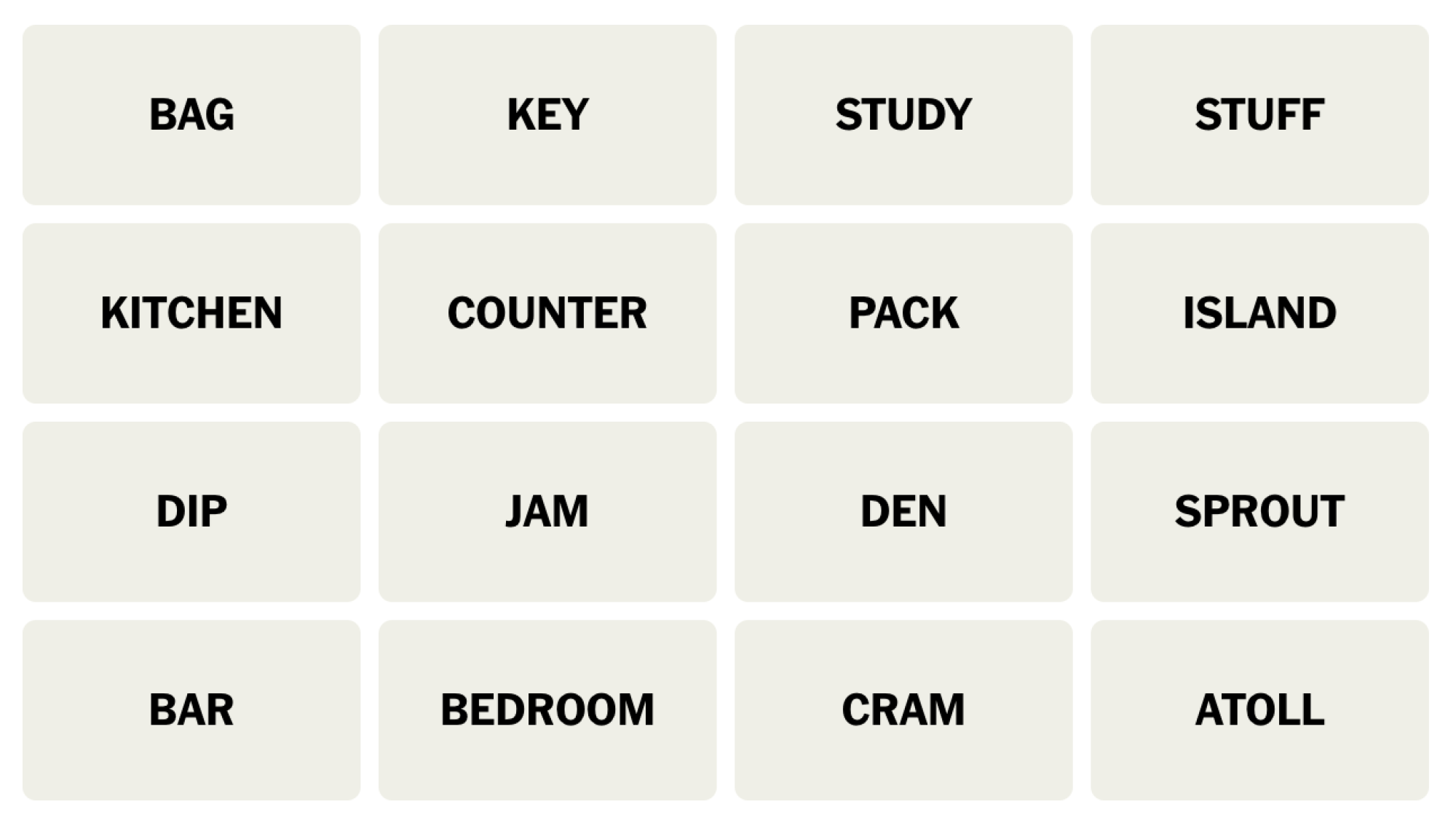
NYT Connections board for November 28, 2023: BAG, KEY, STUDY, STUFF, KITCHEN, COUNTER, PACK, ISLAND, DIP, JAM, DEN, SPROUT, BAR, BEDROOM, CRAM, ATOLL.

Credit: Connections/NYT


Does today’s Connections game require any special knowledge?

Some geographical terms might help. An ATOLL is a ring-shaped island formed by volcanic activity and the growth of a coral reef. The U.S. government used Bikini ATOLL as a nuclear testing site from 1946 to 1958, after forcibly displacing the people who lived there. The famous two-piece swimsuit got its name from the island, a big ol’ joke about how it was expected to have an “explosive” reaction. 

Hints for the themes in today’s Connections puzzle

Here are some spoiler-free hints for the groupings in today’s Connections:

  • Yellow category – Found on a floor plan.

  • Green category – Little bits of land.

  • Blue category – Fill ’er up!

  • Purple category – Other possible entries here: burrito, curd.

Does today’s Connections game involve any wordplay?

There’s a fill-in-the-blank for purple today.

Ready to hear the answers? Keep scrolling if you want a little more help.


BEWARE: Spoilers follow for today’s Connections puzzle!

We’re about to give away some of the answers. Scroll slowly if you don’t want the whole thing spoiled. (The full solution is a bit further down.)

What are the ambiguous words in today’s Connections?

  • A KEY can be a thing that opens a lock (literally or metaphorically), and a KEY or cay is a sandy island formed by washed-up, microscopic plant and animal skeletons. Think of the Florida Keys, or the Key limes grown there.

  • An ISLAND can be a COUNTER in a KITCHEN, or it can be a small landmass in a body of water. 

  • A DEN can be the place where wolves live, or a bonus room in a house often used for reading or TV watching. 

  • JAM and DIP might both bring condiments to mind, but these words are in different categories today. (I’ll give you one more hint: JAM is a verb today, DIP is not.) 

What are the categories in today’s Connections?

  • Yellow: ROOMS IN A HOUSE

  • Green: LAND SURROUNDED BY WATER

  • Blue: FILL TO EXCESS

  • Purple: BEAN ____

DOUBLE BEWARE: THE SOLUTION IS BELOW

Ready to learn the answers to today’s Connections puzzle? I give them all away below.

What are the yellow words in today’s Connections?

The yellow grouping is considered to be the most straightforward. The theme for today’s yellow group is ROOMS IN A HOUSE and the words are: BEDROOM, DEN, KITCHEN, STUDY.

What are the green words in today’s Connections?

The green grouping is supposed to be the second-easiest. The theme for today’s green category is LAND SURROUNDED BY WATER and the words are: ATOLL, BAR, ISLAND, KEY.

What are the blue words in today’s Connections?

The blue grouping is the second-hardest. The theme for today’s blue category is FILL TO EXCESS and the words are: CRAM, JAM, PACK, STUFF.

What are the purple words in today’s Connections?

The purple grouping is considered to be the hardest. The theme for today’s purple category is BEAN ____ and the words are: BAG, COUNTER, DIP, SPROUT.

How I solved today’s Connections

I see the rooms first: STUDY, KITCHEN, BEDROOM, DEN. 🟨 

COUNTER, ISLAND, and BAR are all surfaces you might use to serve or prepare food, but I can’t find a fourth. ISLAND, ATOLL, and KEY are all small landmasses in an ocean, but again, what can I do with just three of them? 

I go with STUFF, PACK, JAM, and CRAM instead. 🟦

I’m still stumped on the islands, so I look for outliers. I don’t know what to do with DIP, SPROUT, or BAG. I know there’s a good chance we’re looking at a fill-in-the-blank, because (1) most days have one, and (2) words like BAG and DIP are so simple and versatile they just scream out for something to complete them. Finally it hits me: beans. Bean COUNTER rounds out my group. 🟪

That leaves me with ATOLL, ISLAND, KEY, and BAR. Like a sandBAR. 🟩

Connections 
Puzzle #170
🟨🟨🟨🟨
🟦🟦🟦🟦
🟪🟪🟪🟪
🟩🟩🟩🟩

How to play Connections

I have a full guide to playing Connections, but here’s a refresher on the rules:

First, find the Connections game either on the New York Times website or in their Crossword app. You’ll see a game board with 16 tiles, each with one word or phrase. Your job is to select a group of four tiles that have something in common. Often they are all the same type of thing (for example: RAIN, SLEET, HAIL, and SNOW are all types of wet weather) but sometimes there is wordplay involved (for example, BUCKET, GUEST, TOP TEN, and WISH are all types of lists: bucket list, guest list, and so on).

Select four items and hit the Submit button. If you guessed correctly, the category and color will be revealed. (Yellow is easiest, followed by green, then blue, then purple.) If your guess was incorrect, you’ll get a chance to try again.

You win when you’ve correctly identified all four groups. But if you make four mistakes before you finish, the game ends and the answers are revealed.

How to win Connections

The most important thing to know to win Connections is that the groupings are designed to be tricky. Expect to see overlapping groups. For example, one puzzle seemed to include six breakfast foods: BACON, EGG, PANCAKE, OMELET, WAFFLE, and CEREAL. But BACON turned out to be part of a group of painters along with CLOSE, MUNCH, and WHISTLER, and EGG was in a group of things that come by the dozen (along with JUROR, ROSE, and MONTH). So don’t hit “submit” until you’ve confirmed that your group of four contains only those four things.

If you’re stuck, another strategy is to look at the words that seem to have no connection to the others. If all that comes to mind when you see WHISTLER is the painting nicknamed “Whistler’s Mother,” you might be on to something. When I solved that one, I ended up googling whether there was a painter named Close, because Close didn’t fit any of the obvious themes, either.

Another way to win when you’re stuck is, obviously, to read a few helpful hints–which is why we share these pointers every day. Check back tomorrow for the next puzzle!


Source: LifeHacker – Today’s NYT Connections Hints (and Answer) for Tuesday, November 28, 2023

The Grinch and Martha May Whovier Headline Grinchmas at Universal Theme Parks

Released in 2000, Ron Howard’s How the Grinch Stole Christmas has become a modern Christmas classic—so much so that it’s managed to be more timeless than Illumination’s 2018 Grinch animated film. That’s probably thanks to the presence Jim Carrey’s inimitable take on the character at Universal Studios theme parks.

Read more…


Source: Gizmodo – The Grinch and Martha May Whovier Headline Grinchmas at Universal Theme Parks

Tech Conference Collapses After Organizer Admits To Making Fake 'Auto-Generated' Female Speaker

Samantha Cole reports via 404 Media: The founder of a software developer conference has been accused of creating fake female speakers to bolster diversity numbers — and some speakers are dropping out, with the event just nine days away. Devternity is an online conference for developers that’s invite-only for speakers. In the past, it reportedly drew hundreds of attendees both when it was in-person in Latvia and even more after it moved online. Eduard Sizovs founded the event in 2015.

Engineer Gergely Orosz tweeted on Thursday that he’d discovered fake speakers listed on the Devternity site. Two women — Anna Boyko, listed as a staff engineer at Coinbase, and Natalie Stadler, a “software craftswoman” at Coinbase — were included on the site as speakers but appear to not exist in real life. Neither have an online presence beyond the Devternity website itself. Orosz found archived versions of the Devternity site where Boyko and Stadler were listed; Stadler’s listing was up for years, according to archives from 2021.

Sizovs responded to these claims in a 916-word tweet, admitting that he’d made at least one fake speaker, Stadler, in the process of building the Devternity site and then left her up. He said that the profile was “auto-generated, with a random title, random Twitter handle, random picture,” and that while he noticed it was still on the site, he delayed taking it off because it wasn’t a “quick fix” and that “it’s better to have that demo persona while I am searching for the replacement speakers,” he wrote. In his tweet, Sizovs did not elaborate on why he believed this was “better.” Sizovs wrote that after this year’s upcoming conference “achieved a worse-than-expected level of diversity of speakers,” author and programmer Sandi Metz, “Software Craftswoman, Tech Influencer @ Instagram” Julia Kirsina, and head of developer relations at Amazon Web Services Kristine Howard were the only three women he was able to bring on as speakers. But two of the three dropped out, he said […].

Read more of this story at Slashdot.


Source: Slashdot – Tech Conference Collapses After Organizer Admits To Making Fake ‘Auto-Generated’ Female Speaker

Several Piracy-Related Arrests Spark Fears of High-Level Crackdown In Nordic Region

A series of arrests that began in late August and continued into last week has sparked concerns that a relatively rare ‘Scene’ crackdown targeting the top of the so-called ‘Piracy Pyramid’ may be underway in the Nordic region. TorrentFreak reports: In a statement last week, Denmark’s National Unit for Special Crime (NSK) announced that as part of a long-running investigation, a man was arrested on November 22 and then charged with copyright infringement offenses. NSK said its officers searched the home of a 47-year-old man in South Zealand (Sydsjaelland) and seized IT equipment in connection with illegal file-sharing and “copyright infringement of a particularly serious nature.” “The case is about an organized network that has illegally shared extremely large quantities of films and TV series via file sharing services,” said NSK Police Commissioner Anders-Emil Nohr Kelbaek. While noting that NSK had no further information to offer at this time, Kelbaek said he was pleased that NSK had arrested another suspect believed to have played a ‘significant role’ in the unnamed network.

Last week’s arrest was only the latest in a series of arrests carried out as part of the same long-running NSK investigation into the illegal distribution of movies and TV shows. In late August, NSK arrested four people on suspicion of sharing “extremely large quantities” of movies and TV shows. NSK raided addresses in South-West Jutland, North Zealand and Bornholmand. A 43-year old was arrested at the last location, but it’s claimed he lives elsewhere. In common with last week’s arrest, all were charged on suspicion of “particularly serious” copyright infringement offenses. In an almost identical statement to that issued last week, Commissioner Anders-Emil Nohr Kelbaek said the case was about “an organized network that shares extremely large amounts of data, presumably in the form of films and series.”

TorrentFreak sources report concerns that last week’s arrest may be linked to Scene groups. Terminology used by NSK doesn’t instantly rule that out and does seem to suggest something potentially more significant than other arrests over the past few years. According to NSK, the August arrests took place on August 28, 2023. Using information in Scene release databases we looked for Danish Scene groups and/or groups that were releasing Denmark-focused content before that date but then made no releases afterward; while that wouldn’t provide conclusive proof that a group had been targeted, the method has proven useful in the past. While activity late August suggests nothing especially out of the ordinary, activity since the arrest last week stands in contrast. TF is informed that some groups may have gone dark simply out of an abundance of caution. It’s also possible that the groups have nothing to release. Furthermore, there are many other global groups with no obvious links to Danish content or Denmark that also stopped releasing on November 21. The reasons for this are unknown but holidays in the United States may play a role.

Read more of this story at Slashdot.


Source: Slashdot – Several Piracy-Related Arrests Spark Fears of High-Level Crackdown In Nordic Region

After 151 Years, Popular Science Will No Longer Offer a Magazine

After 151 years, Popular Science will no longer be available to purchase as a magazine. “Cathy Hebert, the communications director for PopSci owner Recurrent Ventures, says the outlet needs to ‘evolve’ beyond its magazine product, which published its first all-digital issue in 2021,” reports The Verge. From the report: PopSci, which covers a whole range of stories related to the fields of science, technology, and nature, published its first issue in 1872. Things have changed a lot over the years, with the magazine switching to a quarterly publication schedule in 2018 and doing away with the physical copies altogether after 2020. In a post on LinkedIn, former PopSci editor Purbita Saha commented on the magazine’s discontinuation, stating she’s “frustrated, incensed, and appalled that the owners shut down a pioneering publication that’s adapted to 151 years worth of changes in the space of a five-minute Zoom call.”

“PopSci is a phenomenal brand, and as consumer trends shift it’s important we prioritize investment in new formats,” Herbert tells The Verge. “We believe that the content strategy has to evolve beyond the digital magazine product. A combination of its news team, along with commerce, video, and other initiatives, will produce content that naturally aligns with PopSci’s mission.” PopSci will continue to offer articles on its website, along with its PopSci Plus subscription, which offers access to exclusive content and the magazine’s archive.

Read more of this story at Slashdot.


Source: Slashdot – After 151 Years, Popular Science Will No Longer Offer a Magazine

Timothy Olyphant Is Joining the Alien Universe

The world of Alien just got a whole lot sexier with the addition of actor Timothy Olyphant. The Justified star, who recently dipped his toe into another major sci-fi universe as Cobb Vanth on The Mandalorian and The Book of Boba Fett, has been cast in Noah Hawley’s upcoming FX show set in the universe of Alien, Aliens,…

Read more…


Source: Gizmodo – Timothy Olyphant Is Joining the Alien Universe