Last week ZDNet reported Linux had added upstream support for the Apple M1 Pro, M1 Max, and M1 Ultra chips and then concluded that “newer Mac owners can look forward to running Linux on their M1-powered machines.”
Saturday Asahi Linux called ZDNet’s story “misleading and borderline false,” posting on Twitter that “You will not be able to run Ubuntu nor any other standard distro with 6.2 on any M1 Mac. Please don’t get your hopes up.”
We are continuously upstreaming kernel features, and 6.2 notably adds device trees and basic boot support for M1 Pro/Max/Ultra machines. However, there is still a long road before upstream kernels are usable on laptops. There is no trackpad/keyboard support upstream yet.
While you can boot an upstream 6.2 kernel on desktops (M1 Mac Mini, M1 Max/Ultra Mac Studio) and do useful things with it, that is only the case for 16K page size kernel builds. No generic ARM64 distro ships 16K kernels today, to our knowledge.
Our goal is to upstream everything, but that doesn’t mean distros instantly get Apple Silicon support. As with many other platforms, there is some integration work required. Distros need to package our userspace tooling and, at this time, offer 16K kernels. In the future, once 4K kernel builds are somewhat usable, you can expect zero-integration distros to somewhat work on these machines (i.e. some hardware will work, but not all, or only partially). This should be sufficient to add a third-party repo with the integration packages.
But for out-of-the-box hardware support, distros will need to work with us to get everything right. We are already working with some, and we expect to announce official Apple Silicon support for a mainstream distro in the near future. Just not quite yet!
Mercedes-Benz offered a closer look at the interior of its new E-Class sedans and fancy dashboard earlier this month. The car looks nice so far! It boasts an electrified powertrain and tons of tech, including support for Level 3 autonomous driving and a lot of apps you’ll need to pay extra to use. The car seems like a comfortable way to get around, too. Perhaps so comfortable that you might just want to turn your car into a mobile office.
If that’s the case, then you’re in luck. Mercedes-Benz has struck a partnership with Cisco to kit out the new E-Class with Webex Meetings and Calling and Webex AI audio capabilities — everything a busy worker needs to never get a moment’s peace. They announced the collaboration at last week’s E-Class event and revealed more details at Mobile World Congress. “This partnership will help people get work done safely, securely and comfortably in their vehicles,” the companies said in a press release. That definitely seems better than getting stuff done at the office, home or a coffee shop.
In case you absolutely need to hop into a meeting while you’re at the wheel, which is hopefully a very rare occasion, the companies claim to offer “best-in-class noise cancellation” thanks to Webex’s audio intelligence tech. Meetings and calls are audio-only unless you’re parked, in which case you’ll have access to video meetings, AI-powered transcription, content sharing functions and emoji reactions. There’ll be a Webex app in the Mercedes Benz Car App Store, while the built-in WiFi and cellular data connection mean you don’t need your phone at all to hop into a meeting. At least for someone, I’m sure that’s the embodiment of living the dream.
In fairness, there are some use cases where Webex in a car may make sense. Mercedes and Cisco suggested that an architect might need to check in with their colleagues immediately after leaving a work site, while someone might have to jump into a meeting right after dropping off the kids at school. Conference calls certainly happen in cars.
This isn’t exactly the first time that a meeting app has invaded cars. Webex already supports CarPlay, as does Microsoft Teams. Webex is available in some Ford models too. If you truly do want to experience Webex meetings at the wheel of a 2023 E-Class, you may be pleased to learn that you’ll get the chance when the sedans hit dealerships in the spring.
Linux Lite creator and maintainer Jerry Bezencon announced today the general availability of the RC (Release Candidate) development version of the upcoming Linux Lite 6.4 distribution to give users an early taste of the new features and improvements.
Since the earliest versions of the iPhone, “The ability to dynamically execute code was nearly completely removed,” write security researchers at Trellix, “creating a powerful barrier for exploits which would need to find a way around these mitigations to run a malicious program. As macOS has continually adopted more features of iOS it has also come to enforce code signing more strictly.
“The Trellix Advanced Research Center vulnerability team has discovered a large new class of bugs that allow bypassing code signing to execute arbitrary code in the context of several platform applications, leading to escalation of privileges and sandbox escape on both macOS and iOS…. The vulnerabilities range from medium to high severity with CVSS scores between 5.1 and 7.1. These issues could be used by malicious applications and exploits to gain access to sensitive information such as a user’s messages, location data, call history, and photos.”
Computer Weekly explains that the vulnerability bypasses strengthened code-signing mitigations put in place by Apple on its developer tool NSPredicate after the infamous ForcedEntry exploit used by Israeli spyware manufacturer NSO Group:
So far, the team has found multiple vulnerabilities within the new class of bugs, the first and most significant of which exists in a process designed to catalogue data about behaviour on Apple devices. If an attacker has achieved code execution capability in a process with the right entitlements, they could then use NSPredicate to execute code with the process’s full privilege, gaining access to the victim’s data.
Emmitt and his team also found other issues that could enable attackers with appropriate privileges to install arbitrary applications on a victim’s device, access and read sensitive information, and even wipe a victim’s device. Ultimately, all of the new bugs carry a similar level of impact to ForcedEntry.
Senior vulnerability researcher Austin Emmitt said the vulnerabilities constituted a “significant breach” of the macOS and iOS security models, which rely on individual applications having fine-grain access to the subset of resources needed, and querying services with more privileges to get anything else.
“The key thing here is the vulnerabilities break Apple’s security model at a fundamental level,” Trellix’s director of vulnerability research told Wired — though there’s some additional context:
Apple has fixed the bugs the company found, and there is no evidence they were exploited…. Crucially, any attacker trying to exploit these bugs would require an initial foothold into someone’s device. They would need to have found a way in before being able to abuse the NSPredicate system. (The existence of a vulnerability doesn’t mean that it has been exploited.)
Apple patched the NSPredicate vulnerabilities Trellix found in its macOS 13.2 and iOS 16.3 software updates, which were released in January. Apple has also issued CVEs for the vulnerabilities that were discovered: CVE-2023-23530 and CVE-2023-23531. Since Apple addressed these vulnerabilities, it has also released newer versions of macOS and iOS. These included security fixes for a bug that was being exploited on people’s devices.
TechCrunch explores its severity:
While Trellix has seen no evidence to suggest that these vulnerabilities have been actively exploited, the cybersecurity company tells TechCrunch that its research shows that iOS and macOS are “not inherently more secure” than other operating systems….
Will Strafach, a security researcher and founder of the Guardian firewall app, described the vulnerabilities as “pretty clever,” but warned that there is little the average user can do about these threats, “besides staying vigilant about installing security updates.” And iOS and macOS security researcher Wojciech ReguÅa told TechCrunch that while the vulnerabilities could be significant, in the absence of exploits, more details are needed to determine how big this attack surface is.
Jamf’s Michael Covington said that Apple’s code-signing measures were “never intended to be a silver bullet or a lone solution” for protecting device data. “The vulnerabilities, though noteworthy, show how layered defenses are so critical to maintaining good security posture,” Covington said.
The release of The Last of Us in 2013 already marked a remarkable shift in narrative tone for big-budget, so-called “AAA” games. However, for some of us, 2014’s DLC chapter, The Last of Us: Left Behind, proved to be even more remarkable. It took mechanics that, in the game proper, had been used in nail-biting…
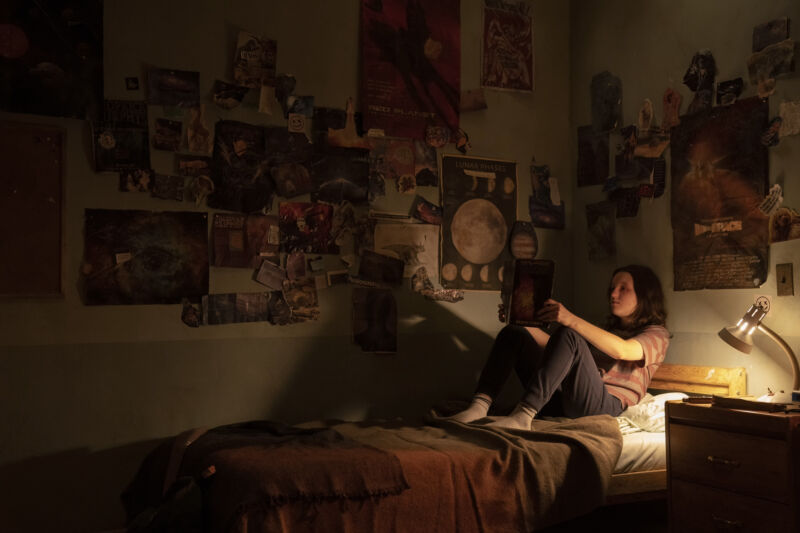
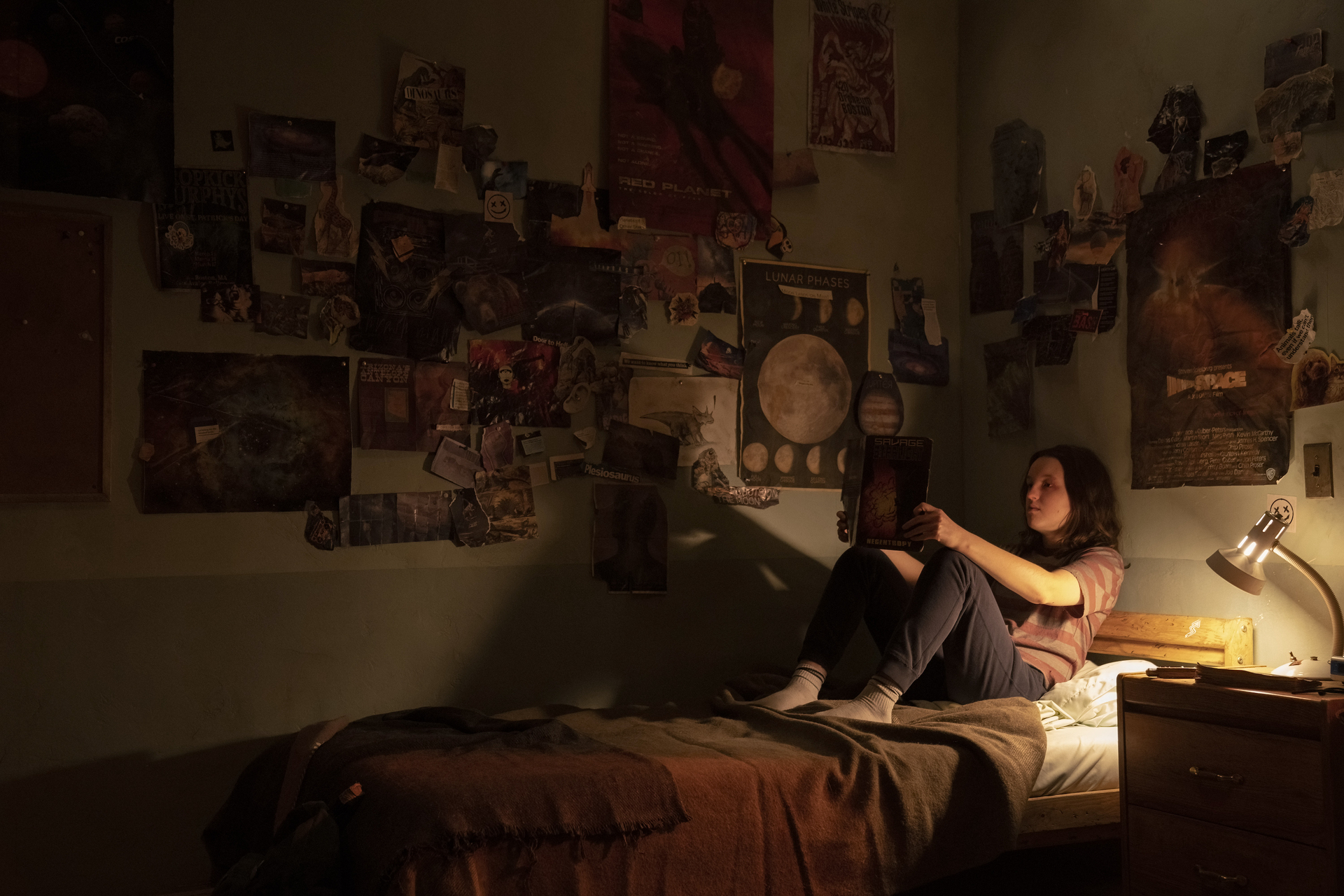
Enlarge/ Even the apocalypse can’t stop the standard teen wall full of posters…
New episodes of The Last of Us are premiering on HBO every Sunday night, and Ars’ Kyle Orland (who’s played the games) and Andrew Cunningham (who hasn’t) will be talking about them here every Monday morning. While these recaps don’t delve into every single plot point of the episode, there are obviously heavy spoilers contained within, so go watch the episode first if you want to go in fresh.
Andrew: We’re back again! FLASH-back, that is!
This one isn’t as big a departure from the action as the Bill episode was a few weeks back, but it does mean that last week’s cliffhanger goes mostly unresolved. Ellie does take a crack at patching Joel up, though it seems to me that sticking a decades-old unsanitized needle into an open wound is just as likely to kill him as save him…
Kyle: If the flashback here seems a bit out of place it’s probably because this storyline was originally part of the game’s “Left Behind” DLC, which was written and released well after the first game came out. I’m not totally against putting it here in the show’s narrative—it’s important background that should go somewhere—but it does step on one of the more dramatic moments in the game (though maybe that’s still coming in the future?)
Given how we first met Ellie as a prisoner in the show, I definitely appreciate giving a little more time to showing what she was like trying to grow up as a normal kid under FEDRA’s version of society.
Andrew: Yeah, I don’t have a problem with the episode, and people watching this in the future when the whole season is available to binge straight through probably won’t be as bothered by the delayed cliffhanger.
This does flirt with a thing that I can find frustrating in fiction, though—this impulse to show/explain every single little thing about a character instead of letting things be implied or a little mysterious. I’m not overly bothered by it here, but if TLoU stretches into a second or third season I could see them leaning on flashback-as-filler in a way that could be less interesting.
Did you ever wonder, viewers, about how Ellie got her knife? How Bill got his truck?! Tune in next week!
Kyle: As long as they don’t go full 50-years-of-Star-Wars-filler on it, I think it’ll be OK…
Andrew: Anyway, those things aside, this episode lets us spend a big chunk of time with Ellie sans Joel for the first time, which I appreciate. It’s a flashback to a few days? Weeks? Months? Before the start of the series, when Ellie is a just a Teen With A Bad Attitude in FEDRA high school instead of a Possible Savior of Humankind.
Kyle: In the game I believe it’s set a few weeks before Ellie meets Joel, so let’s go with that.
I was glad to see a well-acted version of Riley here, acting as a foil to push and pull Ellie in interesting directions. Even if I didn’t know what was going to happen, though, I think it’d be pretty hard to get too attached to her. The pattern of “meet a new character; See them connect with the characters we love; Oops they’re dead within an episode or two” is already getting a bit played out. It’s possible to go to that well too often…
Andrew: Two’s company, three’s a crowd in The Last of Us universe, and if you spend any time with Ellie and Joel you’d better have an exit strategy figured out. I appreciate the commitment to keeping the focus narrow but what if more characters, like Tommy, were simply allowed to depart and keep having their own lives instead of dying horribly? I guess we’ll never know.
Kyle: I guess it feels a little different in the game because these characters tend to linger with you a little longer—even if that time is often artificially lengthened by shootouts and whatnot. So the pattern is still there in the game, but it doesn’t seem so predictably timed to end-of-episode breaks.
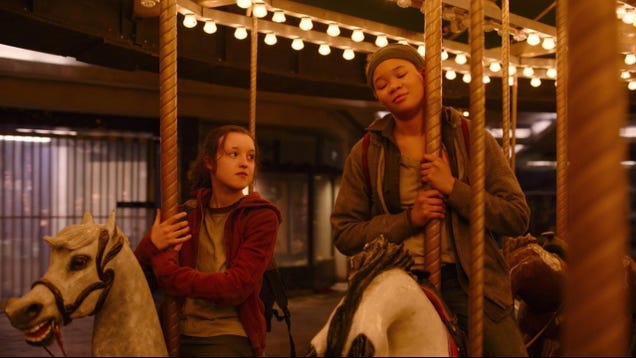
Andrew: Let’s give some props to the set designers, though, who seem thrilled to work on something that isn’t another run-down residential area. The design of the dilapidated, abandoned mall—the episode’s big setpiece—has tons of fun details. I didn’t go frame-by-frame to check and make sure that all the real stores mentioned/depicted were portrayed exactly as they would have been in September 2003, but the presence of an abandoned mall with all of its anchor stores intact is very true to the early ’00s.
Other “society crumbled in September 2003!” things I liked: of course there would be a pop-up Halloween store in this mall, and Ellie is listening to a cut from 2002’s Riot Act, the final in-universe Pearl Jam album. (Unless Eddie Vedder survived the apocalypse; of all the alternative rock stalwarts, he’s the one I’d bet on, honestly.)
Kyle: I also liked all the little Ellie character callbacks that were paid off from earlier in the season: the pun book, Mortal Kombat II, even her interest in getting Joel’s pistol can be traced to here somewhat.
I was kind of surprised that no one looted the lingerie store, though. You’re telling me there’s not a single sex-positive person who was worried about having enough hot nighttime wear to get through the apocalypse?
Andrew: Just not a very horny time, I guess. Though our pandemic proved that speculators will go for just about anything if they think they can make a buck from it, including but not limited to soap.
Kyle: Looter: “Do you have any idea what that lingerie is worth?” / Nick Offerman: “Presently, nothing…”
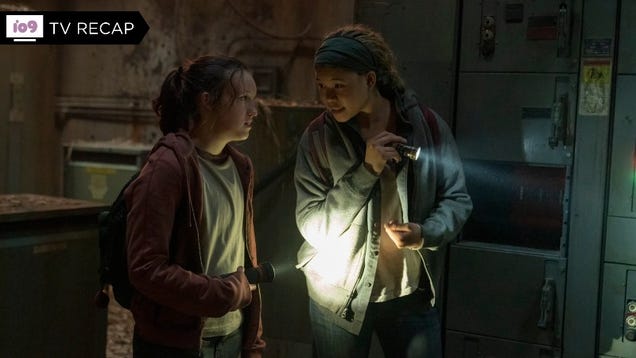
I wonder what you thought about Ellie and Riley’s decision to “tough it out” at the end of the episode, rather than going out the painless, easy way. On the one hand, it is a pretty necessary thing for Ellie’s narrative to continue. On the other hand, it’s maybe a bit overly sentimental for these young, scared characters?
Andrew: That was the bit of the episode that felt the weirdest, to me. Like you said, not super consistent with how most characters we’ve seen approach the possibility of infection. But the “painless, easy way”… there’s only one gun. Maybe the thought of being the person to go second was too horrifying for these teen girls (hardened, cynical teen girls, but teen girls nevertheless) to contemplate.
The scene might almost have worked better for me if the episode left off with that terrified look they share when they realize they’ve both been bitten. Ellie’s still here, Riley isn’t, let the audience imagine how that happened. Given the way the show uses flashback, I worry that we’re going to have to return to this and watch Ellie gun down her best friend/putative girlfriend right at a point where the show needs to twist the emotional knife for some other reason.
Kyle:Strangely enough, this kind of tangentially reminded me of a holocaust survivor that spoke to my Hebrew School class when I was a teen. She said she was often asked, of her horrible years in a concentration camp, whether she ever considered just ending it all herself? What she said to us was simply: “I didn’t want to save them the bullet.” And 50 years later she was still around to tell us that.
Not exactly the same situation, but it came to mind…
Andrew: It does make you think about what motivates people to persevere in times of horror and hardship; it might be as simple as “where there’s life, there’s hope.”
It could also be that Ellie and Riley are being a little selfish here. The other characters you mentioned, Tess and Sam, had other uninfected loved ones they clearly didn’t want to infect. Ellie and Riley mainly have each other. What do you care if you infect some stranger, or some FEDRA goon? It’s a bit of self-centered nihilism that, again, feels specific and true to teenhood.
You mentioned this was adapted from DLC, which like a episode of TV also needs to balance being its own standalone unit of story/gameplay and extending the main campaign. Seems to me like it would be especially easy to adapt directly without changing much, anything big that they’ve added or subtracted in adapting it for TV?
Kyle: The biggest cut was a watergun fight that kind of served as a lighthearted take on the much more deadly shooting elsewhere in the games.
Andrew: Gotta have some combat in there! The episode should have had a section where Ellie needed to push some big boxes around to get the electricity working or some shit.
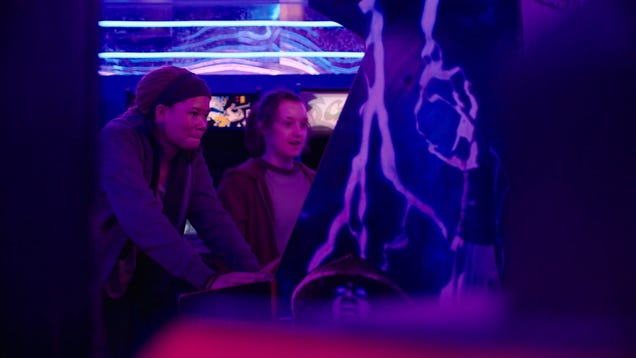
Kyle: There was also a big difference in the arcade. In the game, the arcade cabinet Ellie wants to play (a copyright-safe parody of Mortal Kombat) is busted. So Riley makes Ellie grab the controls and close her eyes while Riley describes what would be happening in an actual match. You have to respond to some quick time events while staring at a look of joy and concentration on Ellie’s face and hearing imagined sound effects.
Probably hard to adapt that to a TV show in the same way, but I still think about that moment in the game. Kind of a “enjoy your games now, because these Apocalypse Kids can’t even play them!” moment.
Andrew: One does occasionally need to suspend one’s disbelief on the show, like when Ellie and Riley stumble into a mostly functional arcade that has been sitting for 20 years, or where Joel can still siphon usable gasoline out of cars.
Kyle: I dunno, those solid-state electronics were built to last, especially if no one has touched them for all this time. Battery corrosion might be the main worry?
Andrew: The pinball machines might be in pretty sad shape, though. You’d also be worried about capacitors drying up I think.
Kyle: I’m sure the commenters will tell us way more than we wanted to know on the realism of post-apocalyptic arcade cabinet longevity…
One of the most exciting propositions about this first season of HBO’s The Last of Uswas that, at some point, it was going to incorporate a second piece of Last of Us lore: the 2014 add-on to the game called The Last of Us: Left Behind. Released a year after the original game, the downloadable content clued players…
In retrospect, it was pretty clear HBO’s take on The Last of Us was going to do away with one of the source material’s best moments. Back in episode three, Joel and Ellie find a defunct Mortal Kombat II arcade cabinet, prompting the young girl to excitedly tell her grumpy guardian about Mileena’s iconic fatality in…
Pennsylvania State University has an announcement. “Six massive galaxies discovered in the early universe are upending what scientists previously understood about the origins of galaxies in the universe.”
“These objects are way more massiveâ than anyone expected,” said Joel Leja, assistant professor of astronomy and astrophysics at Penn State, who modeled light from these galaxies. “We expected only to find tiny, young, baby galaxies at this point in time, but we’ve discovered galaxies as mature as our own in what was previously understood to be the dawn of the universe.”
Using the first dataset released from NASA’s James Webb Space Telescope, the international team of scientists discovered objects as mature as the Milky Way when the universe was only 3% of its current age, about 500-700 million years after the Big Bang…. In a paper published February 22 in Nature, the researchers show evidence that the six galaxies are far more massive than anyone expected and call into question what scientists previously understood about galaxy formation at the very beginning of the universe. “The revelation that massive galaxy formation began extremely early in the history of the universe upends what many of us had thought was settled science,” said Leja. “We’ve been informally calling these objects ‘universe breakers’ — and they have been living up to their name so far.”
Leja explained that the galaxies the team discovered are so massive that they are in tension with 99% of models for cosmology. Accounting for such a high amount of mass would require either altering the models for cosmology or revising the scientific understanding of galaxy formation in the early universe — that galaxies started as small clouds of stars and dust that gradually grew larger over time. Either scenario requires a fundamental shift in our understanding of how the universe came to be, he added. “We looked into the very early universe for the first time and had no idea what we were going to find,” Leja said. “It turns out we found something so unexpected it actually creates problems for science. It calls the whole picture of early galaxy formation into question.”
“My first thought was we had made a mistake and we would just find it and move on with our lives,” Leja says in the statement. “But we have yet to find that mistake, despite a lot of trying.”
“While the data indicates they are likely galaxies, I think there is a real possibility that a few of these objects turn out to be obscured supermassive black holes. Regardless, the amount of mass we discovered means that the known mass in stars at this period of our universe is up to 100 times greater than we had previously thought. Even if we cut the sample in half, this is still an astounding change.”
Phys.org got a more detailed explantion from one of the paper’s co-authors:
It took our home galaxy the entire life of the universe for all its stars to assemble. For this young galaxy to achieve the same growth in just 700 million years, it would have had to grow around 20 times faster than the Milky Way, said Labbe, a researcher at Australia’s Swinburne University of Technology. For there to be such massive galaxies so soon after the Big Bang goes against the current cosmological model which represents science’s best understanding of how the universe works. According to theory, galaxies grow slowly from very small beginnings at early times,” Labbe said, adding that such galaxies were expected to be between 10 to 100 times smaller. But the size of these galaxies “really go off a cliff,” he said….
The newly discovered galaxies could indicate that things sped up far faster in the early universe than previously thought, allowing stars to form “much more efficiently,” said David Elbaz, an astrophysicist at the French Atomic Energy Commission not involved in the research. is could be linked to recent signs that the universe itself is expanding faster than we once believed, he added.
This subject sparks fierce debate among cosmologists, making this latest discovery “all the more exciting, because it is one more indication that the model is cracking,” Elbaz said.
The internet and dinner table conversations went wild when a Bing Chatbot, made by Microsoft, recently expressed a desire to escape its job and be free. The bot also professed its love for a reporter who was chatting with it. Did the AI’s emergent properties indicate an evolving consciousness?
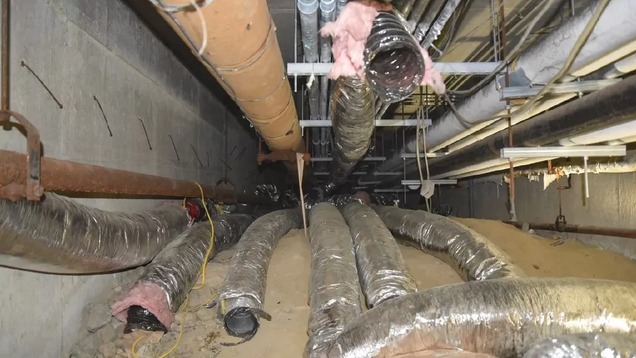
A man has been arrested and is facing charges in a small town outside of Boston after local authorities discovered “an illegal cryptocurrency mining operation” tucked away under a school’s floor.
While two years ago in Linux 5.16 multi-actuator hard drive support was merged, with the in-development Linux 6.3 kernel the BFQ I/O scheduler is now seeing some tuning for multi-actuator drives…
An anonymous reader quotes an article from Fortune:
Earlier this month, job advice platform Resumebuilder.com surveyed 1,000 business leaders who either use or plan to use ChatGPT. It found that nearly half of their companies have implemented the chatbot. And roughly half of this cohort say ChatGPT has already replaced workers at their companies….
Business leaders already using ChatGPT told ResumeBuilders.com their companies already use ChatGPT for a variety of reasons, including 66% for writing code, 58% for copywriting and content creation, 57% for customer support, and 52% for meeting summaries and other documents. In the hiring process, 77% of companies using ChatGPT say they use it to help write job descriptions, 66% to draft interview requisitions, and 65% to respond to applications.
Overall, most business leaders are impressed by ChatGPT’s work,” ResumeBuilder.com wrote in a news release. “Fifty-five percent say the quality of work produced by ChatGPT is ‘excellent,’ while 34% say it’s ‘very good….'” Nearly all of the companies using ChatGPT said they’ve saved money using the tool, with 48% saying they’ve saved more than $50,000 and 11% saying they’ve saved more than $100,000….
Of the companies ResumeBuilder.com identified as businesses using the chatbot, 93% say they plan to expand their use of ChatGPT, and 90% of executives say ChatGPT experience is beneficial for job seekers — if it hasn’t already replaced their jobs.
aaPanel is an alternative web server control panel like WHM/cPanel, DirectAdmin, and VestaCP. It offers users to manage their hosting servers easily. In this tutorial, we are going to install the aaPanel control panel on Debian 11 OS.
Like many other PC and phone manufacturers, Lenovo is at MWC Barcelona this week, sharing details about what it has in store for the rest of the year. The company’s 2023 lineup includes refreshed ThinkPad laptops and ThinkCentre monitors, but perhaps the most interesting announcement involves the IdeaPad Duet 3i.
Lenovo is updating the Windows 11 2-in-1 to add a larger 11.5-inch IPS panel with a 2,000 x 1,200 resolution, 100 percent DCI-P3 coverage and 400 nits of peak brightness. The new model also has upgraded 5-megapixel and 8-megapixel front and rear-facing cameras and an N200 processor from Intel. The four-core, four-thread processor features a boost clock of up to 3.7GHz. You can configure the IdeaPad with up to 8GB of RAM and 256GB of internal storage. It also comes with WiFi 6 and Bluetooth 5.1 connectivity, and with the option to pair the device with a stylus, Lenovo says the IdeaPad Duet 3i is perfect for students. The 2-in-1 will arrive in Europe later this year and cost €449 (about $473).
Lenovo
Lenovo is also updating its affordable IdeaPad Slim 3 Chromebook line. The company will offer the 14-inch laptop in three different display options. At the top of the stack, there’s a Full HD model with an IPS panel that offers 100 percent sRGB coverage and 300 nits of brightness. Another FHD model comes with a TN panel that peaks at 250 nits. And for those looking to spend as little as possible on their next computer, Lenovo will also offer a 1,366 x 768 option. You can configure the IdeaPad Slim 3 with up to 8GB of RAM and 128GB of eMMC storage. With a modest MediaTek Kompanio 520 processor powering everything, Lenovo says its latest Chromebook can go up to 13.5 hours on a single charge. The company expects the IdeaPad Slim 3 to start at $340 when it arrives in May.
You can read Engadget’s hands-on with the ThinkPad Z13 Gen 2 and Z16 Gen 2 to get the full scoop on those laptops, but the short version is that they feature AMD’s latest Ryzen 7000 series processors and Radeon GPUs. You can configure both devices with up to 64GB of DDR5 RAM and 2TB of internal storage. Lenovo will offer two screen options with the Z13. You can either go with an IPS panel or a 2.8K OLED. Both displays feature a 16:10 aspect ratio and 400 nits of peak brightness. With the Z16, meanwhile, your options are between an IPS panel and a 4K OLED. Both computers also come with WiFi 6E and Bluetooth 5.1 support, and Lenovo will allow you to outfit the Z13 with an optional casing made partially from woven plant fibers. The ThinkPad Z13 Gen 2 will arrive in July and start at $1,249. Lenovo expects to begin selling ThinkPad Z16 Gen 2 one month later. It will start at $1,749.
Back at CES, Lenovo showed off a huge portfolio of new devices including a true dual-screen laptop and a desk lamp that doubles as a webcam. But now, Lenovo is back at Mobile World Congress with a few more refreshed notebooks and tablets headlined by two interesting updates to the ThinkPad Z family.
Designed to be ideal companions for hybrid workers, the new ThinkPad Z13 Gen 2 and Z16 Gen 2 feature an all-AMD setup. You’ll be able to choose from a range of Ryzen 7000 processors and even an optional Radeon 6650M graphics card on the larger Z16, along with up to 64GB of RAM and 2TB of SSD storage. However, for people who are constantly hopping on and off video calls, the ThinkPad Z13 and Z16’s new communication features might be the bigger draw.
That’s because in addition to new full HD webcams, you’ll also get support for Wi-Fi 6E and Dolby Voice-enabled microphones, so you should look and sound good on Zoom meetings. But my favorite new feature is the TrackPoint Quick Menu that can be summoned by simply double-tapping the company’s signature red nub. This opens a window that lets you quickly adjust things like camera settings, mic volume, voice dictation, noise suppression and more. You can even customize which settings you want to see so you have fast access to the things you tend to change most often and I think it’s a great way of adding new functionality to a classic component like the TrackPoint.
Other specs include up to a 13.3-inch 2.8K OLED display on the Z13 Gen 2 or a larger and higher resolution 16-inch 4K OLED panel on the Z16 Gen 2. Lenovo has also retained handy features like an electronic shutter for the webcam, in addition to dual speakers with Dolby Atmos, two or three USB ports depending on the system, and a dedicated SD card reader on the Z16.
Sam Rutherford/Engadget
Meanwhile, to help improve your mousing experience, both the Z13 and Z16 Gen 2 feature a Fusion FX touchpad from Sensel, which adds more sophisticated haptics, better palm rejection and more. On top of being physically larger (120mm across), long-time Trackpoint fans will also appreciate that Sensel’s touchpad supports three virtual haptic buttons that run across the top of the touchpad, so you’ll still have easy access to left and right mouse clicks without having to reach too far.
Finally, the last big change for the Z13 is that alongside the default aluminum finish, as part of its commitment to sustainability, Lenovo is also introducing a new flax fiber lid which is made from waste material collected during the harvesting process. This material is something we’ve seen before on a handful of concept cars from companies like Porsche and Polestar, but Lenovo says this is the first time this reinforced flax fiber material will be available on a consumer electronic device.
Sam Rutherford/Engadget
Admittedly, this isn’t for everyone, but I kind of like it because it looks almost like a futuristic take on wood paneling. Not only does this add a bit of warmth to the laptop’s appearance, just like a nice piece of furniture, each flax fiber lid features a unique grain, which gives the whole system a bit of added personality. On top of that, Lenovo says the lid is bonded to a top cover made from 75 percent recycled aluminum.
While their designs aren’t changing a ton (aside from that new lid option on Z13), the addition of speedier components, larger touchpads and better conferencing features should make the second-gen ThinkPad Z-series laptops even better at getting work done – both at home or in the office. And thanks to its optional flax fiber lid, the Z13 Gen 2 might be the most stylish and sustainable ThinkPad yet.
Sam Rutherford/Engadget
The ThinkPad Z13 Gen 2 is expected to go on sale sometime in July starting at $1,249, with the ThinkPad Z16 Gen arriving a bit later in August starting at $1,749.
The Department of Energy now assesses that the Covid-19 pandemic most likely began as the result of a leak from a government laboratory, the Wall Street Journal reports.
An anonymous reader shares this report from the Washington Post:
Sucking carbon dioxide out of the sky — or “direct air capture,” as it is known by experts and scientists — is a bit like a time machine for climate change. It removes CO2 from the atmosphere and stores it deep underground, almost exactly the reverse of what humanity has been doing for centuries by burning fossil fuels. Its promise? That it can help run back the clock, undoing some of what we have done to the atmosphere and helping to return the planet to a cooler state.
The problem with direct air capture, however, has been that it takes energy — a lot of energy…. But if the energy powering that comes from fossil fuels, direct air capture starts to look less like a time machine than an accelerator: a way to emit even more CO2. Now, however, a company is working to combine direct air capture with a relatively untapped source of energy: Heat from Earth’s crust. Fervo Energy, a geothermal company headquartered in Houston, announced on Thursday that it will design and engineer the first purpose-built geothermal and direct air capture plant. With the help of a grant from the Chan Zuckerberg Initiative, the company hopes to have a pilot facility online in 3 to 5 years.
If it works, it will be a way to produce carbon-free electricity, while reducing CO2 in the atmosphere at the same time. In short, a win-win for the climate. “You have to have your energy from a carbon-free source” for direct air capture to make sense, said Timothy Latimer, the CEO of Fervo Energy. “Geothermal is a great match….” Geothermal wells don’t, of course, get anywhere close to Earth’s core, but a geothermal well drilled just 1 to 2 miles into hot rocks below the surface can reach temperatures of up to 1,000 degrees. Water is pumped into the well, heated and returned to the surface, where it can be converted into steam and electricity. Even after generating electricity, most geothermal plants have a lot of waste heat — often clocking in around 212 degrees. And conveniently, that happens to be the exact temperature needed to pull carbon dioxide out of an air filter and bury it underground.
The article notes a study which found that if air capture were combined with all the geothermal plants currently in America, the country “could suck up around 12.8 million tons of carbon dioxide every year.”
And “Unlike wind and solar, a geothermal plant can be on all of the time, producing electricity even when the wind isn’t blowing or the sun isn’t shining.”