Chipotle’s tortilla-making robot will soon help out in a restaurant you can visit. The chain has unveiled a slew of technology updates that include moving the Miso Robotics-made Chippy robot to a real restaurant. The machine will start cooking tortilla chips in a Fountain Valley, California location in October. Feedback from customers and workers will help the company decide on a national rollout.
Artificial intelligence will influence some human cooks, too. Chipotle is piloting a demand-based cooking system that uses AI to tell staff what and when to cook based on forecasts for how much they’ll need. In theory, this lightens the load for employees while making sure there’s enough freshly-cooked tacos and burritos when you show up for dinner. The pilot is underway at eight Orange County, California restaurants.
There’s also an upgrade for tech you can use. An opt-in program in the Chipotle App lets you know when your order’s ready, reminds you to scan your rewards code and can even warn if you show up at the wrong pick-up location. The experiment is in progress at 73 restaurants in Cleveland, Ohio.
The Chippy and kitchen AI projects may be well-timed. While there are concerns that AI and robotics may automate people out of jobs at restaurants like Chipotle and McDonald’s, the deployments come as retail continues to struggle with staff shortages. This theoretically frees workers to concentrate on serving customers, rather than handling drudgery behind the scenes.
Volvo has introduced a number of important safety features in its vehicles throughout the years including the first three-point seatbelt back in 1959. But now the company has developed something a bit more techy with what it’s calling the world’s first interior radar system for cars.
Set to debut on its upcoming flagship EX90 electric SUV, Volvo’s new radar system is designed to monitor both the cabin and trunk of a vehicle in order to prevent the car from being locked while anyone is still inside. The idea is to guard against situations where pets or children may be inadvertently trapped inside a car on a hot day, with the car surfacing reminders if it recognizes that there are still occupants inside when being locked. Additionally, the car’s climate control can also be set to stay on if a passenger is detected, further lowering the risk of heatstroke.
While the thought of leaving a pet or child inside a car on a hot day is unimaginable to most people, it can happen to anyone. In its press release, Volvo cited statistics from the US where more than 900 children have tragically died due to hyperthermia since 1998.
Volvo’s senior technical specialist for injury prevention Lotta Jakobsson says “No one chooses to be distracted or tired, but we know it can happen. We’re all human and distraction is a fact of life. With the help of cutting edge technology, we’ll support you when you’re not at your best and help you avoid leaving family members or pets behind by accident.”
In order to cover as much of the inside of the EX90 as possible, Volvo says it will use multiple radars positioned in the car’s overhead console, roof-mounted reading lamps and in the trunk that can detect “sub-millimeter” movements. Unfortunately, we won’t get a more detailed idea of how Volvo’s new interior radar system really works until the EX90 is officially revealed on November 9th. But given that the new feature will come standard on the company’s forthcoming EV (where allowed by regulation), we’re hoping to see similar systems become basic equipment on more cars and makes in the future.
Almost exactly a year after Nreal unveiled its Air augmented reality glasses, the company is bringing the device to the US. Nreal Air, which the company is pitching as a device for streaming shows and playing games on, is available from Amazon starting today for $379. As with Nreal’s $599 Light glasses, the Air will need to be tethered to a phone or other device. That could be a little easier if you snap up the new $59 Nreal Adaptor, an HDMI-to-Lightning dongle for iPhone.
In line with that peripheral, Nreal has upgraded the Air’s iOS and Mac compatibility. At the outset, the Air will offer screen mirroring from iOS — Nreal’s Nebula operating system doesn’t run on iPhones yet. Still, you’ll be able to watch streaming video services on a virtual 130-inch display.
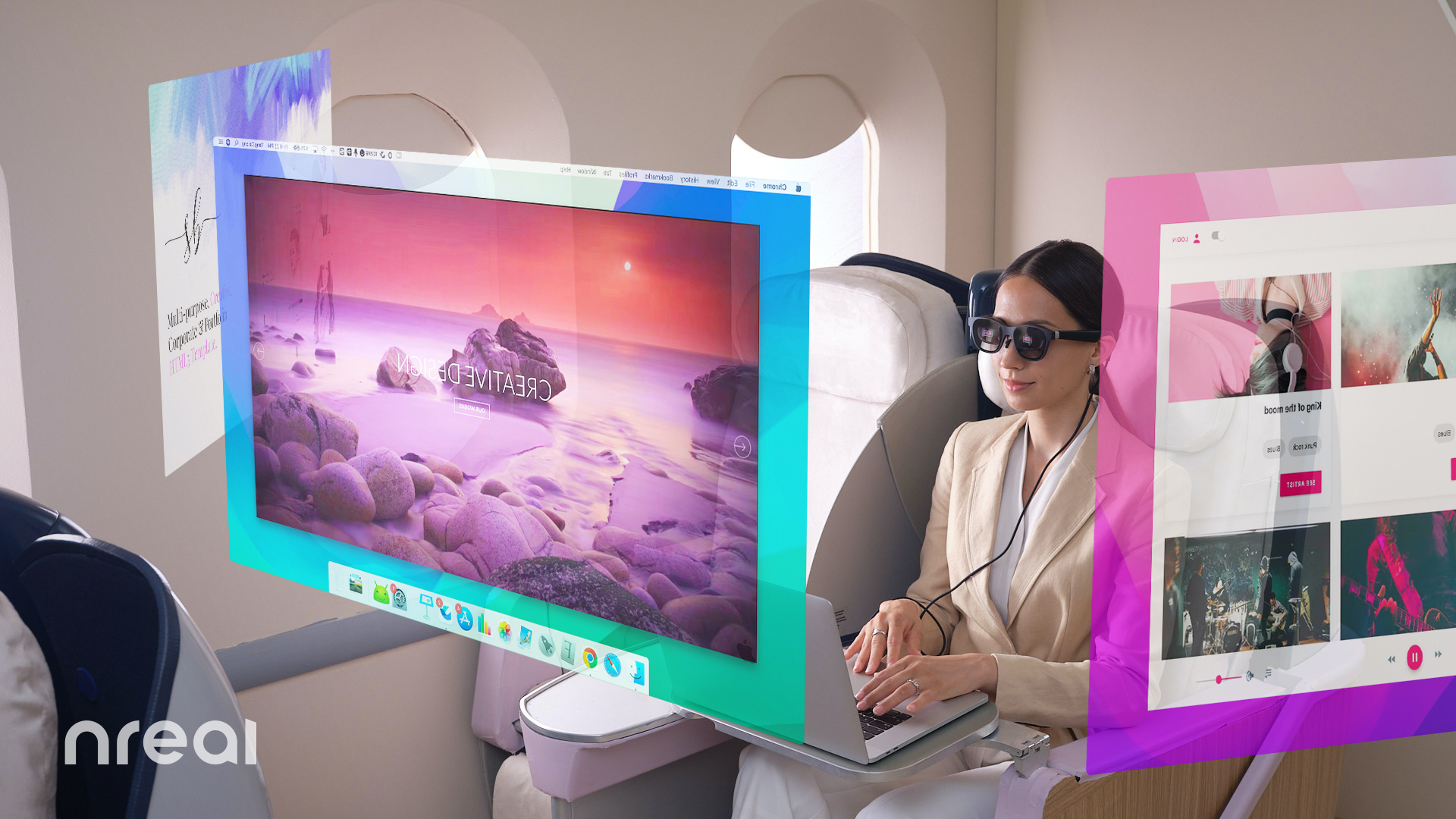
That said, a version of Nebula will be available for MacBook Pro and MacBook Air laptops, Nreal said. When you plug the Air into a Mac, a user interface called AR Desktop will open up. You’ll be able to view multiple virtual displays at the same time, which could make the Air useful if you need more screen real estate while travelling.
Nreal
The company has also redesigned Nebula. In particular, the AR Space experience, which Nreal users see when they open Nebula, now has a borderless curved wall design and animated menu icons. Users will receive recommendations for content through a new widget, which offers the option of previewing apps without having to open them. The Spatial Browser offers a horizontal mode (for multi-window web browsing) and a vertical mode for sites that demand a lot of scrolling.
In addition, Nreal is adding more casual games and a pair of new apps. The first of those is called Teleport, which will allow you to explore 3D models of real-world objects that have been scanned with phones. You’ll be able to leave photos for other users, as well as voice and text messages. Teleport will be available later this year. Meanwhile, Mirror Mode enables users to play PC and console games on a 200-inch virtual screen. Cloud gaming services such as Xbox Cloud Gaming are supported too.
Enlarge/ Nreal depicts someone using the Air glasses to extend their MacBook desktop. (credit: Nreal)
As augmented reality (AR) glasses continue to try carving a place among tech enthusiasts, we’re seeing another option hit mass availability in the US. In addition to selling the sunglass-like Nreal Air specs in America, Beijing-based company Nreal also announced today a version of its Nebula AR operating system that will work with Apple M1 and M2-powered MacBooks.
The Mac version of Nebula works with MacBook Pro and MacBook Air laptops with Apple silicon and is launching as a beta. Attaching the Air glasses to a MacBook won’t give you the same Nebula “AR Space” experience available to supported Android phones. AR Space includes a mixed-reality interface and games and other AR apps made for the glasses. Instead, Mac users will see a virtual UI that Nreal’s calling AR Desktop and projects up to three virtual displays at a time, an Nreal rep told Ars Technica. An Nreal rep wouldn’t specify when AR Space would come to MacBooks or iOS.
In a statement, Nreal co-founder Peng Jin said the company expects AR glasses to initially gain traction among consumers by serving as a display technology, so “the thinking behind Nreal Air is very focused on the aesthetics, display quality, and its connectivity with other hardware devices.”
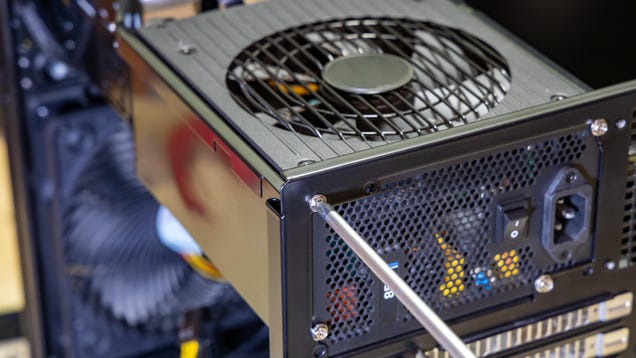
There are few things more annoying (or alarming) than your PC randomly shutting off in the middle of a game. If you’ve ruled out other solutions to the problem—like upgrading your GPU’s drivers or motherboard’s BIOS, or fixing improperly installed hardware—the most likely culprit is your PC’s power supply unit (PSU).…
An anonymous reader quotes a report from Ars Technica: The Ukrainian government on Monday warned that the Kremlin is planning to carry out “massive cyberattacks” targeting power grids and other critical infrastructure in Ukraine and in the territories of its allies. “By the cyberattacks, the enemy will try to increase the effect of missile strikes on electricity supply facilities, primarily in the eastern and southern regions of Ukraine,” an advisory warned. “The occupying command is convinced that this will slow down the offensive operations of the Ukrainian Defence Forces.”
Monday’s advisory alluded to two cyberattacks the Russian government carried out — first in 2015 and then almost exactly one year later — that deliberately left Ukrainians without power during one of the coldest months of the year. The attacks were seen as a proof-of-concept and test ground of sorts for disrupting Ukraine’s power supply. “The experience of cyberattacks on Ukraine’s energy systems in 2015 and 2016 will be used when conducting operations,” the Ukrainian government said on Monday.
It’s hard to assess the chances of a successful hacking campaign against Ukraine’s power grids. Earlier this year, Ukraine’s CERT-UA said it successfully detected a new strain of Industroyer inside the network of a regional Ukrainian energy firm. Industroyer2 reportedly was able to temporarily switch off power to nine electrical substations but was stopped before a major blackout could be triggered. […] But researchers from Mandiant and elsewhere also note that Sandworm, the name for the Kremlin-backed group behind the power grid hacks, is among the most elite hacking groups in the world. They are known for stealth, persistence, and remaining hidden inside targeted organizations for months or even years before surfacing. Besides an attack on electrical grids, Monday’s advisory also warned of other forms of disruptions the country expected Russia to ramp up. “The Kremlin also intends to increase the intensity of DDoS attacks on the critical infrastructure of Ukraine’s closest allies, primarily Poland and the Baltic states,” the advisory stated. “We don’t have any direct knowledge or data to make an assessment on Ukraine’s capability to defend its grid, but we do know that CERT-UA stopped the deployment of INDUSTROYER.V2 malware that targeted Ukraine’s electric substations earlier this year,” Chris Sistrunk, technical manager of Mandiant Industrial Control Systems Consulting, wrote in an email. “Based on that, and what we know about the Ukrainian people’s overall resolve, it’s increasingly clear that one of the reasons cyberattacks in Ukraine have been dampened is because its defenders are very aggressive and very good at confronting Russian actors.”
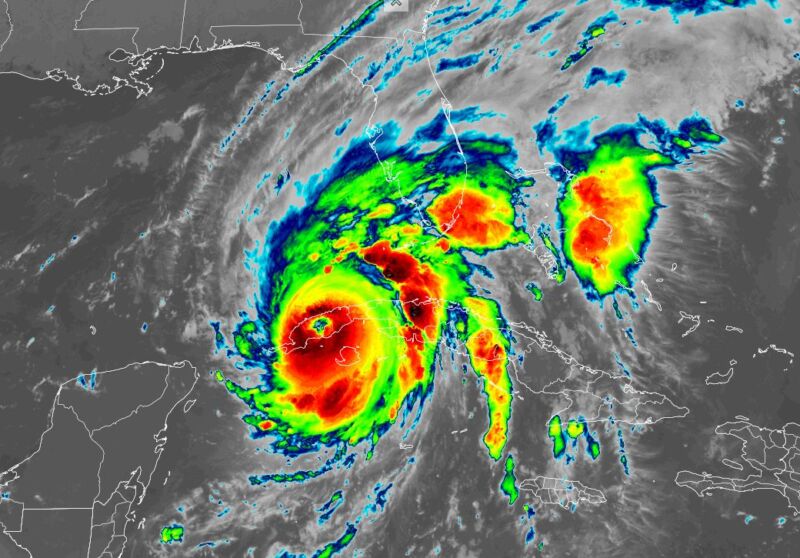
Enlarge/ As of 5:50 am ET on Tuesday, Hurricane Ian had nearly traversed the island of Cuba. (credit: NOAA)
Hurricane Ian continued to intensify on Monday night and reached sustained winds of 125 mph as its center passed across the western edge of Cuba. From there, the storm will move into the southeastern Gulf of Mexico, where very warm water and low wind shear will allow for further intensification.
The hurricane has been moving around the western edge of a high pressure system, but as Ian approaches the western coast of Florida on Wednesday it will start to run into a trough of low pressure draped across the southeastern United States. The net effect of this will cause Ian to slow down, perhaps only moving a few miles per hour for a couple of days.
All of this is a recipe for disaster for much of the Florida peninsula, but it’s difficult to say precisely where, and precisely which effects. Even though landfall is expected to occur in less than two days, there remains considerable uncertainty in where Ian will make landfall along the western Florida coast, and where it will go. This is due, in part, to the breakdown of its steering currents.
Four years after releasing the X-H1, Fujifilm has finally followed it up with not just one but two models. One of those is the highest-resolution APS-C camera to date, the 40-megapixel X-H2. The other is what we’re looking at today, the high-speed X-H2S designed for sports, wildlife shooting and more.
The biggest feature of the X-H2S is a new stacked, backside-illuminated 26.2-megapixel sensor. Its high speed allows burst shooting at up to 40 fps, faster autofocus and reduced rolling shutter. It also promises improved image quality, and comes with in-body stabilization, a high-resolution viewfinder, dual card slots and more.
These improvements and features don’t come cheap, though. At $2,500, the X-H2S is now one of the most expensive APS-C cameras out there, with the same price as comparable full-frame models like Canon’s EOS R6 and the Sony A7 IV. Is it worth paying that for a smaller sensor?
Body and handling
The X-H2S isn’t your typical Fujifilm camera. At 660 grams larger and heavier than the X-T4, though it is a touch lighter than the X-H1. It has a much bigger grip as well that imparts a feeling of stability, ideal if you’re attaching big lenses for sports or wildlife shooting.
As mentioned, the layout is more like rival mirrorless cameras from Canon and Sony than other Fuji models. Instead of dials that display shutter speed, exposure compensation and ISO like the X-T4, it has conventional front and rear dials. The only one on top is a mode selector, and at the back you have a joystick and D-Pad control. It’s got no less than 12 buttons, most of which can be reprogrammed for different functions. As with the X-H1, it has a top LCD that shows primary settings.
Since it’s designed for sports and wildlife shooting, which requires changing settings on the fly while keeping an eye on the subject, the layout makes sense. However, I know many Fujifilm fans prefer the traditional dials – though at least you can see settings on the top LCD display if shooting from the hip. The only control I didn’t care for was the record button, as it’s tiny and awkwardly positioned. The X-H2S uses the same logical menu system as the X-T4, so settings are relatively easy to find.
Also good for action photographers is the electronic viewfinder (EVF) that provides blackout-free burst shooting and higher resolution (5.76 million dots) than either the Sony A7 IV or Canon EOS R6 (3.68 million dots each). It also packs a high-resolution, fully-articulating touch display that lets you control focus, quick menu and other functions.
For I/O, you get a high-speed USB-C port with power delivery, plus WiFi and Bluetooth for camera controls or transfers. Unfortunately, Fujifilm’s camera app for live view shooting or image imports is relatively primitive (the low 1.7 Play Store rating is a clue), failing to show things like exposure and audio levels for video, or allow burst photo shooting.
Video users get both microphone and headphone ports, along with a nice full-sized HDMI jack for external recorders. To handle the extra speed and video capabilities, it has a pair of card slots, both UHS-II and high-speed CFexpress. And finally, the battery (the same kind as the X-T4 but upgraded) allows up to 720 shots on a charge and well over two hours of 4K 30p video recording.
Performance
Steve Dent/Engadget
With up to 40 fps burst shooting speeds at full resolution, the X-H2S is faster than any other APS-C camera, but there are some caveats to that. It will only hit those top speeds in release, rather than focus priority mode (meaning it takes the shot even if it’s not in focus). That means a lot of your photos will be blurry, so it’s not a realistic mode for action shooting. Dialing down to 30 fps, however, I got a lot more shots in focus and the hit rate was nearly perfect at 20 fps
Shooting with the mechanical shutter, I saw 15 fps burst speeds, very respectable and a match for Canon’s EOS R7. On top of that, the mechanical shutter is very quiet (and sweet-sounding), particularly compared to the clattery shutter on the EOS R7. In that mode or the 20 fps silent mode, I was able to capture upwards of 300 shots at a time to a fast CFexpress card – over 10 seconds of shooting. That’s right up there with sports-centric cameras like Canon’s EOS R3.
The X-H2S is Fujifilm’s first camera with bird and animal tracking, and can also follow cars, motorcycles, bikes, airplanes and trains. It worked pretty well for a first iteration, though it would lose tracking depending on the shooting angle and other factors.
Steve Dent/Engadget
Face and eye tracking, though, is the best I’ve seen on any Fujifilm camera. It tracks smoothly and tenaciously, giving you more shots in focus. It also did a good job of getting a subject’s eye and not their eyelashes or nose in focus. Overall, the autofocus on the X-H2S is much improved from before, but not quite up to Sony and Canon’s standards.
It does beat all its rivals when it comes to shooting discreetly, though. The stacked sensor’s rapid speed means it has minimal rolling shutter in silent mode, so you can confidently use it for shooting birds, wildlife, sports and other fast-moving subjects.
Promising seven stops with supported lenses, the in-body stabilization also performed well for photos, letting me get sharp shots at relatively low shutter speeds. However, it doesn’t work as well for video, as I’ll detail shortly.
Image quality
With a similar 26.2-megapixel sensor to the X-T4 (with the addition of the stacked technology), the X-H2S is among the best APS-C cameras for color rendition. Everything looks natural, whether you’re shooting landscapes, animals or people. JPEGs look good straight out of the camera, with a slightly better balance between noise and sharpening than before thanks to the tweaked color science.
Like the X-T4, it uses a dual-gain sensor, with the sweet spots at ISO 800 and 3200. High ISO performance is nearly on par with the X-T4, with noise reasonably well controlled and detailed preserved up to about ISO 6400. It does offer usable shots beyond that, but exposure needs to be correct or you’ll have excessive noise when boosting blacks.
The 14-bit RAW files offer plenty of room for adjustment, with some exceptions. Because of the dual-gain sensor, it’s better to shoot at higher ISOs than try to shoot at the base ISO 800 and then boost the blacks, as noise levels are higher. Still, you can boost blacks in high-contrast shots by several stops without any issues. It doesn’t perform quite as well as the X-T4 in this regard, likely due to the stacked technology which can raise the noise floor.
As ever, you get a range of useful JPEG film simulations like Velvia, black & white Acros and desaturated Eterna. These are well-designed and produce professional-looking results, and the original image data is preserved in the RAW file.
Video
The X-H2S is a great example of how stacked sensors improve a camera’s video capabilities. The X-H2S is now the most advanced APS-C camera for that, letting you shoot up to 6.2K 30p 3:2 video, supersampled 4K at up to 60 fps, ultra-slow-mo 120 fps 4K and 240 fps HD. Most of those modes are available in several different codecs as well. The list includes H.264 and H.265 (All-I and Long-gop), along with robust ProRes formats, including HQ, 422 and LT. And nearly all modes allow for 10-bit capture for smoother gradients and more.
It also supports Fujifilm’s F-Log and new F-Log2 formats, both in standard and Eterna cinema modes to max out dynamic range. And you can output RAW video to both Blackmagic and Atomos recorders in BRAW and ProRes RAW formats, respectively. Unfortunately, I wasn’t able to test those functions, as Fujifilm has yet to enable them.
The 6.2K 3:2 might seem an odd video mode, but it does allow for more creative cropping at the top and bottom of an image. Meanwhile, the more standard 30 fps and 60 fps 4K video is extremely sharp thanks to the downsampling. The ultra-slow-mo 120 fps 4K video is cropped so it’s not quite as sharp, but it’s much less fuzzy than I expected. And even the 1080p 240p is very usable for many projects. Keep in mind that you can’t record audio in either of those modes, however.
Steve Dent/Engadget
Dynamic range is exceptional, exceeding 13 stops when shooting F-Log2. Combined with the 10-bit capture and robust ProRes codecs, you’ll have plenty of room for creative color correction or to fix over- orunder-exposed shots. As with photos, color reproduction favors accuracy, with skin tones that aren’t quite as warm as Canon’s but still pleasant.
Rolling shutter is minimal in standard and F-Log video modes thanks to the extremely fast readout speeds. They’re a bit slower in F-Log2 mode due to the fact that it does a 14-bit readout in this mode (the other modes are 12-bit), but even then, rolling shutter is still less annoying than on rival APS-C cameras like the Canon EOS R7 or Sony A6600.
If you’re concerned about overheating, it’s really only an issue with 4K 120p video, as it’ll tend to stop after 30-60 minutes of shooting, depending on the temperature. That’s really an edge case though, and if it’s an issue for you, Fujifilm has an optional external fan you can plug in under the display.
While improved from the X-T4, video autofocus isn’t as good as those Canon and Sony models, however. It lost focus more often and could occasionally hunt. There’s no ability to touch and track random subjects, and it could be erratic with birds, animals and other preset subjects.The good news, though, is that human face and eye tracking was quite reliable.
Another downside is the in-body stabilization: If you’re just hand-holding the camera and not moving much, you do get very steady shots. But anytime you try to pan and tilt, let alone walk, it has a tendency to jolt suddenly from one position to another. So for that reason, it’s not the best vlogging camera, unless Fujifilm can mitigate the issue a bit with a future update.
Wrap-up
Steve Dent/Engadget
Despite this issue and autofocus still not quite up to par with rivals, the X-H2S is easily the most powerful APS-C camera available right now. As the only model with a stacked sensor, it easily beats all Canon, Nikon and Sony models in terms of performance and video capabilities.At $2,500, though, it’s also the most expensive mainstream APS-C camera – even more than the higher-resolution, $2,000 X-H2.
Is it worth that price? Despite all the power, that’s a tough question. For that kind of money, people might prefer a full-frame camera like the Canon EOS R6 or the Sony A7 IV. At the same time, many Fujifilm fans may be turned off by the less, well, Fujifilm-like control setup.
It’s a more versatile camera than previous Fuji models, though, and is more suited to certain things than full-frame cameras. The crop-sensor gives it better range for wildlife shooting than full-frame models and it uses smaller lenses, too. It beats both the A7 IV and EOS R6 in terms of video capability, and again, the smaller sensor makes focus less critical. Finally, I still like it as a street photography camera – despite the lack of mechanical dials, you can still see F-stop, shutter speed, ISO, etc. on the top LCD display. So if you’re a hybrid shooter that does a variety of photo and video work, the X-H2S could be the perfect camera.
Netgear has been at the forefront of the SDVoE (Software-Defined Video over Ethernet) initiative with multiple AV switches serving the growing market. The ProAV lineup of managed switches have been sold primarily in a B2B setting by the Netgear Business division. These switches are increasingly becoming part of luxury residential installations requiring an AV-over-IP solution. As part of the CEDIA Expo 2022, Netgear is announcing a new ‘Netgear Home Solutions’ push. The intention is to take the same lineup of Netgear AV products sold by Netgear Business and target it towards both commercial and residential installations.
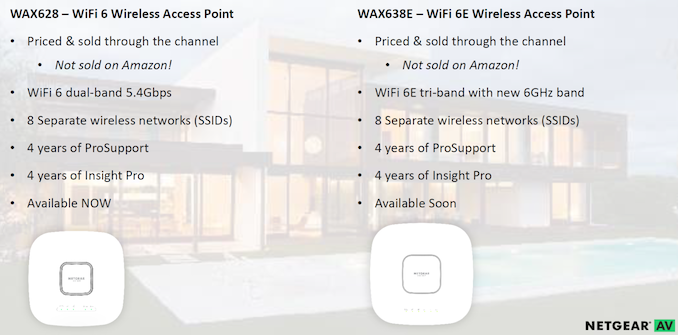
As part of this initiative, Netgear will be selling ProAV Managed Switches and ProWiFi Access Points to residential installers, along with the Pro version of Insight Remote Management and Pro Support. While the ProAV Managed Switches are already in the market, the new WAX628 and WAX638E APs are complementary to the currently existing members of the Insight Access Point Portfolio.
The WAX628 (already available for residential installers) slots in-between the dual-band AX3600 WAX620 and the tri-band AX6000 WAX630. This AX5400 dual-band solution supports 160 MHz channel bandwidth, and is accompanied by the AX7800 WAX638E which adds 6 GHz band support to the mix. The Wi-Fi 6E AP is slated to come to the market in the next few months.
Netgear is promising margin protection for installers by selling the ProAV and ProWiFi products only through the channel and not via Amazon or other e-tailers. Since these products are going to reach end-consumers through custom installers who have their own cost structures, the lack of any pricing information from Netgear is not surprising.
Netgear’s traditional consumer Wi-Fi router market has evolved rapidly over the last few years. Despite the success of Orbi (in both the consumer and SMB markets), new entrants like eero have gained significant mind and market share. In this context, Netgear has to look towards services and expand into new markets in order to maintain and build upon their technical leadership. Forays into lucrative niches like the residential installer market are not surprising.
In a perfect world, a sibling is a best friend and an ally. In the real world, sibling relationships can be incredibly complicated—and although there will always be the less-than-perfect parts, there can come a point when the flaws rise to the level of being considered toxic.
Meta has taken down a network of fake accounts from China that targeted the United States with memes and posts about “hot button” political issues ahead of the midterm elections.The company said the fake accounts were discovered before they amassed a large following or attracted meaningful engagement, but that the operation was significant due to its timing and because of the topics the accounts posted about.
The network consisted of 81 Facebook accounts, eight Facebook Pages, two Instagram accounts and a single Facebook Group. Just 20 accounts followed at least one of the Pages and the group had about 250 members, according to Meta.
The fake accounts posted in four different “clusters” of activity, Meta said, beginning with Chinese-language content “about geopolitical issues, criticizing the US.” The next cluster graduated to memes and posts in English, while subsequent clusters created Facebook Pages and hashtags that also circulated on Twitter. In addition to the US, some clusters also targeted posts to people in the Czech Republic.
During a call with reporters, Meta’s Global Threat Intelligence Lead Ben Nimmo said the people behind the accounts “made a number of mistakes” that allowed Meta to catch them more easily, such as only posting during working hours in China. At the same time, Nimmo said the network represented a “new direction for Chinese influence operations” because the accounts posed as both liberals and conservatives, advocating for both sides on issues like gun control and abortion rights.
“It’s like they were using these hot button issues to try and find an entry point into American discourse,” Nimmo said. “It is an important new direction to be aware of.” The accounts also shared memes about President Joe Biden, Florida Senator Marco Rubio, Utah Senator Mitt Romney and House Speaker Nancy Pelosi, according to Meta.
Meta also shared details about a much larger network of fake accounts from Russia, which it described as the “most complex Russian-origin operation that we’ve disrupted since the beginning of the war in Ukraine.” The company identified more than 1,600 Facebook accounts and 700 Facebook Pages associated with the effort, which drew more than 5,000 followers.
The network used the accounts to boost a series of fake websites that impersonated legitimate news outlets and European organizations. They targeted people in Germany, France, Italy, Ukraine and the United Kingdom, and posted in several languages.
“They would post original articles that criticized Ukraine and Ukrainian refugees, praised Russia and argued that Western sanctions on Russia would backfire,” Meta writes in its report. “They would then promote these articles and also original memes and YouTube videos across many internet services, including Facebook, Instagram, Telegram, Twitter, petitions websites Change[.]org and Avaaz[.]com, and even LiveJournal.”
Meta notes that “on a few occasions” the posts from these fake accounts were “amplified by Russian embassies in Europe and Asia” though it didn’t find direct links between the embassy accounts and the network. For both the Russia and China-based networks, Meta said it was unable to attribute the fake accounts to specific individuals or groups within the countries.
The takedowns come as Meta and itspeers are ramping up security and anti-misinformation efforts to prepare for the midterm elections in the fall. For Meta, that means largely using the same strategy it employed in the 2020 presidential election: a combination of highlighting authoritative information and resources, while relying on labels and third-party fact checkers to tamp down false and unverified info.
Skullcandy hasn’t offered gaming headsets for the better part of a decade, but it’s willing to give them another go — and it’s eager to catch up in some respects. The brand has introduced revamped PLYR, SLYR and SLYR Pro headsets that promise budget-friendly game audio on console, mobile and PC with a few perks. The flagship PLYR (shown above) includes Bluetooth 5.2 wireless audio, while it and the wired SLYR Pro offer Tile tracking to help you find your headset (or the device it’s connected to).
Both the PLYR and SLYR Pro (at middle) also use a hearing test to create a personalized sound profile, and offer background audio reduction whether you use the boom or integrated microphones. They can plug in through 3.5mm and USB, and an optional wireless transmitter for the PLYR promises low lag (down to 20ms) for PC- and PlayStation-based gamers. You can expect up to 24 hours of battery life in either model when you aren’t connected through USB. The base SLYR is a no-frills wired design that drops the audio processing features and USB support.
Skullcandy
As with the old headsets, Skullcandy is counting on price as the main draw. The SLYR starts the line at $60, while the SLYR Pro and PLYR are relatively affordable at $100 and $130 respectively. The caveat, as you might guess, is that the gaming headset business hasn’t been standing still. The Astro A10 offers a more flexible (and arguably more visually appealing) design for the same $60 as the SLYR, while brands like Razer and SteelSeries offer both price-competitive headsets and premium models with extras like spatial audio and RGB lighting. Your choice might come down to sale pricing and personal preferences.
As further indication of MGLRU hopefully being mainlined for Linux 6.1 as planned, the Multi-Gen LRU patches have now been moved to Andrew Morton’s mm-stable branch…
Last week I wrote about how Microsoft landed a VA-API improvement in Mesa to support faster Video Acceleration API encoding with FFmpeg. That code was initially only wired up for the Microsoft D3D12 driver within Mesa for WSL use-cases, but now AMD has taken advantage of the new capability for RadeonSI Gallium3D usage with their Radeon GPUs…
Netflix is forming its own in-house game studio and wants to go beyond relying on third-party developers to bolster its game catalog. The studio, based in Helsinki, Finland, plans to create “world-class” original games without ads or in-app purchases.
Netflix’s move into gaming has involved buying multiple developers, including the creators of Oxenfree, Night School Studio. In the last 12 months or so, the company has offered some well-regarded titles, including Into the Breach and Poinpy. But it hasn’t built a developer from scratch. Until now.
However, when it comes to original games, Netflix says we won’t see the first fruits of this internal studio for “years.” Meanwhile, UsTwo’s Desta, launching later today exclusively on Netflix, is the latest addition from the makers of Monument Valley.
The impactor vehicle was traveling at roughly 14,000 MPH when it struck.
NASA
After nearly a year in transit, NASA’s experimental Double Asteroid Redirection Test (DART) mission, which sought to answer the question: “Could you potentially shove an asteroid off its planet-killing trajectory by hitting it with a specially designed satellite?” The answer seems to be … maybe. It successfully collided with the Dimorphos asteroid. Results and data from the collision are still coming in, but NASA ground control confirms that the DART impact vehicle has intercepted the target asteroid. The vending machine-sized vehicle traveled at roughly 14,000 MPH when it crossed Dimorphos’ path nearly 68 million miles from Earth.
HBO revealed the first trailer for its highly anticipated adaptation of the hit Naughty Dog game. The clip features the leaning building from an early level and a bombastic opening outbreak sequence, as well as the unmistakable sound of a Clicker. Nightmare fuel for 2022.
It adds non-destructive editing, real-time effects and more.
Audacity is best known as a free audio app for quick edits and recording audio, but the latest update makes it more viable as a full-on production tool for your podcast ambitions. The most welcome addition is non-destructive audio capabilities that allow you to adjust effects without the changes being permanently baked into the audio file. It also supports real-time playback of effects and crossfades as you adjust them, allowing for more accurate edits. And it’s still free.
The Apple Watch Ultra is built to survive adventures outdoors, but if you push it beyond its limits, you’re going to struggle to repair it yourself. iFixit reports that the Ultra isn’t significantly more repairable than its regular counterparts. While there are external screws on the back, you might wreck a waterproofing gasket if you pry the rear open. And don’t even think of getting through the front – you might break the screen.
Samplebrain has been on Richard James’ mind for 20 years.
Aphex Twin is finally ready to offer his mutation-driven music software to the world. Samplebrain is a free “sample mashing” app that turns audio files from your computer into sample blocks you can use for projects. You can recreate a sample using tracks in your music library or craft a “303 riff” from unexpected sounds. However, you may need some technical know-how to use the app.
On Monday, Meta began rolling out a new interface on Android, iOS and on the web for switching between accounts on Facebook and Instagram. Provided you’ve added your credentials for both to the same Accounts Center, you can use the feature to switch between the two apps. Meta will also notify you every time you use an existing account to create a new one or you add an account to the Accounts Center.
Pyston as what was born at Dropbox as a speedy open-source Python implementation is out with a new update as it continues to focus on maximizing performance. Dropbox ceased work on Pyston years ago while the developers continued and since last year joined Anaconda to continue their performant Python quest…
Return to Dust, a movie that had been generating buzz in China as a sleeper hit, was unceremoniously pulled from streaming services in the country yesterday, according to multiple reports on social media. Mentioning the film on Weibo, China’s equivalent to Twitter, has even been banned. Will movie fans outside China…
Apple’s MacBook air is the thin and light notebook to own if you’re looking for the best mix of small size and performance, but the more desirable 512GB version is fairly expensive at $1,499. Fortunately, you can now grab that model Amazon for just $1,349 for a significant savings of $150 (10 percent) — the lowest price we’ve seen to date. And if you don’t need that much space, the 256GB model is also on sale
With a 96 score on our Engadget review, the MacBook Air M2 is one of the best laptops we’ve ever test. For the first time since launch, Apple changed the design from a wedge to a uniformly thin form, making it not only thinner overall but more balanced. In fact, at 11.3 millimeters and 2.7 pounds, it weighs less than an iPad Pro with its smart keyboard.
The 2,560 x 1,664 Liquid Retina screen is also slightly larger at 13.6 inches, thanks to the bezels and the webcam tucked into the screen notch up top. You also get improved speakers, a Magsafe power adapter and a pair of USB-C ports with support for charging, external monitors and data transfers up to 40Gbps. The M2 processor significantly boosts performance over the Air M1, offering performance nearly comparable to the 13-inch MacBook Pro M2. It starts rapidly, loads apps quickly and offers snappy performance across the board.
The 512GB version is more desirable not only because of the extra space, but the faster SSD performance than the base model — and the $1,349 price tag is the lowest we’ve seen yet. If that’s still not in your budget, the 256GB model is on sale at $1,099 for a savings of $100 (8 percent) — also an all-time low price.
VKD3D 1.5 was recently tagged as the newest version of this Direct3D 12 over Vulkan implementation used by Wine and originally an upstream to Valve’s VKD3D-Proton. VKD3D 1.5 has been integrated into Wine Git ahead of next week’s Wine 7.19 release…