Tension over boosters rises as FDA regulators quit and publicly blast Biden’s plan

Words and symbols adorn a large outdoor sign.

Enlarge / The Food and Drug Administration headquarters in White Oak, Maryland. (credit: Getty | Congressional Quarterly)

Two leading vaccine regulators who had previously announced their resignations from the Food and Drug Administration have now come out against the Biden administration’s plan to offer COVID-19 booster shots.

In a viewpoint article published in The Lancet on Monday, Marion Gruber, the outgoing director of the FDA’s Office of Vaccines Research and Review (OVRR), and Phil Krause, the outgoing deputy director of the OVRR, argue against the current booster plans.

“Currently available evidence does not show the need for widespread use of booster vaccination,” the pair, along with colleagues, conclude in the article. Even if there are benefits from boosters, the shots still carry risks, and any benefits “will not outweigh the benefits of providing initial protection to the unvaccinated,” they write.

Read 11 remaining paragraphs | Comments


Source: Ars Technica – Tension over boosters rises as FDA regulators quit and publicly blast Biden’s plan

Report: Facebook Has a VIP Program That Basically Allows Celebs to Avoid Moderation

For years, Facebook has operated a little known program called “XCheck,” which allows celebrities, politicians, and other members of America’s elite to elude the kinds of moderation policies that the average user is subject to, a new report from the Wall Street Journal reveals.

Read more…


Source: Gizmodo – Report: Facebook Has a VIP Program That Basically Allows Celebs to Avoid Moderation

A Horrifying New AI App Swaps Women Into Porn Videos With a Click

Karen Hao, reporting for MIT Technology Review: The website is eye-catching for its simplicity. Against a white backdrop, a giant blue button invites visitors to upload a picture of a face. Below the button, four AI-generated faces allow you to test the service. Above it, the tag line boldly proclaims the purpose: turn anyone into a porn star by using deepfake technology to swap the person’s face into an adult video. All it requires is the picture and the push of a button. MIT Technology Review has chosen not to name the service, which we will call Y, or use any direct quotes and screenshots of its contents, to avoid driving traffic to the site. It was discovered and brought to our attention by deepfake researcher Henry Ajder, who has been tracking the evolution and rise of synthetic media online.

For now, Y exists in relative obscurity, with a small user base actively giving the creator development feedback in online forums. But researchers have feared that an app like this would emerge, breaching an ethical line no other service has crossed before. From the beginning, deepfakes, or AI-generated synthetic media, have primarily been used to create pornographic representations of women, who often find this psychologically devastating. The original Reddit creator who popularized the technology face-swapped female celebrities’ faces into porn videos. To this day, the research company Sensity AI estimates, between 90% and 95% of all online deepfake videos are nonconsensual porn, and around 90% of those feature women.

Read more of this story at Slashdot.


Source: Slashdot – A Horrifying New AI App Swaps Women Into Porn Videos With a Click

IR Operators Pull Out of Yokohama

Akihabara News (Tokyo) — All three of the major Integrated Resorts (IR) firms pursuing a partnership with the Yokohama municipal government have now conceded that their bids have come to an end, as new anti-casino Mayor Takeharu Yamanaka initiated formal procedures to bring the matter to a close.

Despite a post-election appeal from the adamantly pro-IR Yokohama Chamber of Commerce & Industry to break his campaign promise and to defy the democratically expressed will of the overwhelming majority of the city’s voters, Mayor Yamanaka did not waver, making clear that he fully intended to pull the plug on the city’s IR bid.

Last Friday, Yamanaka—in his first ever appearance before the city council—formally announced his decision, noting that the city’s IR promotion office would be abolished as of October 1 and its staff reassigned.

The same day, both Genting Singapore and Sega Sammy Holdings, which had combined their efforts into a single consortium, acknowledged that the process was over.

Sega Sammy’s statement was more spare, simply noting that “we have been forced to suspend our participation in IR business in Yokohama.”

Genting Singapore revealed more emotion and even a sense of betrayal about the matter, declaring, “We are surprised and disappointed by the unexpected turn of events leading to the city’s decision to cancel the Yokohama IR bid, as the board of directors and management of the company, together with our consortium partners and supporting partners, have devoted considerable time and our best efforts to prepare and submit a compelling bid and proposed a significant investment that will benefit the city of Yokohama and its community, and at the same time make Yokohama a world-class tourism destination.”

Melco Resorts & Entertainment waited until yesterday to make its statement, but it also had the most to say.

“For the past several years, we have worked with our partners to devise a superlative, world-class IR proposal that reflects the unique characteristics and culture of Yokohama and which would put the city on the global stage of tourism,” stated Lawrence Ho, chairman and CEO of the firm, “Unfortunately, the citizens of Yokohama have decided otherwise, and the mayoral election results give a clear verdict. The new mayor, having campaigned on an anti-IR platform, has now closed the door on the process we engaged in with our partners. While we are disappointed, we are grateful for the friendships that we have formed throughout the process and express our sincere gratitude to the people and government of Yokohama, as well as our business and community partners, for their tremendous support.”

Although Melco’s major bid in Yokohama was terminated by the elections, and its small, silent bid in Nagasaki was rejected, Lawrence Ho affirmed that his company still desired to be involved in some way in the Japanese market.

“Melco has been working on the ground in Japan for over a decade. We firmly believe in the country’s long-term potential and remain committed to exploring opportunities to develop the world’s best Integrated Resort in Japan. We will be closing our Yokohama office while maintaining a representative office in Tokyo,” he stated.

Ho had indicated for several years that should his firm win a contract for a major IR in the country, that Melco would move its head offices from Macau to Japan and that he would personally take up Japanese residence.

Recent Integrated Resorts Related Articles

Casino Bribery Case Ends in Convictions

Sega Sammy Slot Series Hits Macau Casinos

Nagasaki Signs Agreement with Casinos Austria

Japan Seen Still on Track to “IR 2.0”

Wakayama Signs IR Agreement with Clairvest

Probity Accusations Abound in Japan IR Race

The post IR Operators Pull Out of Yokohama appeared first on Akihabara News.


Source: Akihabara News – IR Operators Pull Out of Yokohama

LittleBigTrouble: Sony kills multiple games’ online service without notice

Cute promotional image for Little Big Planet.

Enlarge / Almost every LittleBigPlanet release just lost its online hub. (credit: Sony)

After a year marked by targeted hacks and unexplained downtime, the online service for four of Sony’s LittleBigPlanet games—and arguably the heart of their “play.create.share” mantra—is no more. Announced in a tweet on its official Twitter account, online services across LittleBigPlanet Vita and the LittleBigPlanet trilogy for PS3 have been discontinued with no prior warning, citing issues of continued safety for its online fanbase.

For the uninitiated, the original 2008 LittleBigPlanet introduced a massively online concept of level creation and sharing. Series creators Media Molecule included incredibly robust creation tools that let fans transform the side-scrolling game into any number of incredible concepts, and that foundation grew as the series expanded from the PS3 generation to Vita and PS4.

But challenges to that creation toolbox started to spring up in November 2020 when several fans posted on Twitter that LBP.me—the series’ social site that lets players browse or queue up every available user-made level across almost every release—stopped working. Meanwhile, social features in the game’s older entries began experiencing related issues.

Read 10 remaining paragraphs | Comments


Source: Ars Technica – LittleBigTrouble: Sony kills multiple games’ online service without notice

How to Install Django Framework on Debian 11

Django is a free and open-source web development framework written in Python. It is used for developing complex and database-driven Python applications. In this tutorial, I will explain how to set up Django in Python virtual environment using the PostgreSQL database on Debian 11.

The post How to Install Django Framework on Debian 11 appeared first on Linux Today.


Source: Linux Today – How to Install Django Framework on Debian 11

Michael B. Jordan Adapting Charlie Jane Anders' Victories Greater Than Death Into an Amazon Series

While superhero characters may still be all the rage when it comes to the new series streaming platforms give the green light to, Amazon’s banking on audiences being in the mood for something a bit different for its next big adaptation.

Read more…


Source: Gizmodo – Michael B. Jordan Adapting Charlie Jane Anders’ Victories Greater Than Death Into an Amazon Series

Kubernetes YAML Generator

For those who struggle to build a Kubernetes YAML, this YAML generator provides a form-based interface with descriptions and links to the Kubernetes documentation. It has live editing, so you can view the YAML as it is edited, and handy copy and paste features to allow you to copy YAML into your own text documents.

The post Kubernetes YAML Generator appeared first on Linux Today.


Source: Linux Today – Kubernetes YAML Generator

Facebook: Some High-Profile Users 'Allowed To Break Platform's Rules'

An anonymous reader quotes a report from The Guardian: Facebook gives high-profile users special treatment, which includes immunity from its rules for some, and allowed Brazilian footballer Neymar to post nude pictures of a woman who had accused him of rape, according to a report. The XCheck or “CrossCheck” system steers reviews of posts by well-known users such as celebrities, politicians and journalists into a separate system, according to an investigation by the Wall Street Journal. Under the program, some users are “whitelisted” — not subject to enforcement action — while others are allowed to post material that violates Facebook rules, pending content reviews that often do not take place.

People are placed on the XCheck list — where they are given special scrutiny — if they meet criteria such as being “newsworthy,” “influential or popular” or “PR risky.” Names on the XCheck program included Donald Trump, US senator Elizabeth Warren and Facebook founder Mark Zuckerberg, although the report does not state whether those names were whitelisted at any point. By 2020 there were 5.8 million users on the XCheck list, the Wall Street Journal said. In one example cited by the WSJ, Brazilian football star Neymar responded to a rape accusation in 2019 by posting Facebook and Instagram videos defending himself, which included showing viewers his WhatsApp correspondence with his accuser. The WhatsApp clips included the accuser’s name and nude photos of her. Instagram and WhatsApp are owned by Facebook. Instead of immediately deleting the material, which is Facebook’s procedure for “nonconsensual intimate imagery,” moderators were blocked for more than a day from removing the video, according to the WSJ.

The WSJ investigation details the process known as “whitelisting,” where some high-profile accounts are not subject to enforcement at all. An internal review in 2019 stated that whitelists “pose numerous legal, compliance, and legitimacy risks for the company and harm to our community.” The review found favoritism to those users to be both widespread and “not publicly defensible.” “We are not actually doing what we say we do publicly,” said the confidential review. It called the company’s actions “a breach of trust” and added: “Unlike the rest of our community, these people can violate our standards without any consequences.” According to another internal document, enforcement procedures and rule-drafting were subject to interventions from members of Facebook’s public-policy team and senior executives. One 2020 memo from a Facebook data scientist added: “Facebook routinely makes exceptions for powerful actors.” The WSJ also reported that the system suffered from enforcement delays that allowed posts to stay up before they were eventually prohibited. In 2020, posts being reviewed by XCheck were viewed at least 16.4 billion times before being removed. A Facebook spokesperson said in a statement: “A lot of this internal material is outdated information stitched together to create a narrative that glosses over the most important point: Facebook itself identified the issues with cross check and has been working to address them. We’ve made investments, built a dedicated team, and have been redesigning cross check to improve how the system operates.”

Read more of this story at Slashdot.


Source: Slashdot – Facebook: Some High-Profile Users ‘Allowed To Break Platform’s Rules’

Researchers: Platforms like Facebook have played ‘major role’ in fueling polarization

Social media platforms like Facebook “have played a major role in exacerbating political polarization that can lead to such extremist violence,” according to a new report from researchers at New York University’s Stern Center for Business and Human Rights.

That may not seem like a surprising conclusion, but Facebook has long tried to downplay its role in fueling divisiveness. The company says that existing research shows that “social media is not a primary driver of harmful polarization.” But in their report, NYU’s researchers write that “research focused more narrowly on the years since 2016 suggests that widespread use of the major platforms has exacerbated partisan hatred.”

To make their case, the authors highlight numerous studies examining the links between polarization and social media. They also interviewed dozens of researchers, and at least one Facebook executive, Yann Le Cun, Facebook’s top AI scientist.

While the report is careful to point out that social media is not the “original cause” of polarization, the authors say that Facebook and others have “intensified” it. They also note that Facebook’s own attempts to reduce divisiveness, such as de-emphasizing political content in News Feed, show the company is well aware of its role. “The introspection on polarization probably would be more productive if the company’s top executives were not publicly casting doubt on whether there is any connection between social media and political divisiveness,” the report says.

“Research shows that social media is not a primary driver of harmful polarization, but we want to help find solutions to address it,” a Facebook spokesperson said in a statement. “That is why we continually and proactively detect and remove content (like hate speech) that violates our Community Standards and we work to stop the spread of misinformation. We reduce the reach of content from Pages and Groups that repeatedly violate our policies, and connect people with trusted, credible sources for information about issues such as elections, the COVID-19 pandemic and climate change.”

The report also raises the issue that these problems are difficult to address “because the companies refuse to disclose how their platforms work.” Among the researchers recommendations is that Congress force “Facebook and Google/YouTube, to share data on how algorithms rank, recommend, and remove content.” Platforms releasing the data, and independent researchers who study it, should be legally protected as part of that work, they write.

Additionally, Congress should “empower the Federal Trade Commission to draft and enforce an industry code of conduct,” and “provide research funding” for alternative business models for social media platforms. The researchers also raise several changes that Facebook and other platforms could implement directly, including adjusting their internal algorithms to further de-emphasize polarizing content, and make these changes more transparent to the public. The platforms should also “double the number of human content moderators” and make them all full employees, in order to make decisions more consistent.


Source: Engadget – Researchers: Platforms like Facebook have played ‘major role’ in fueling polarization

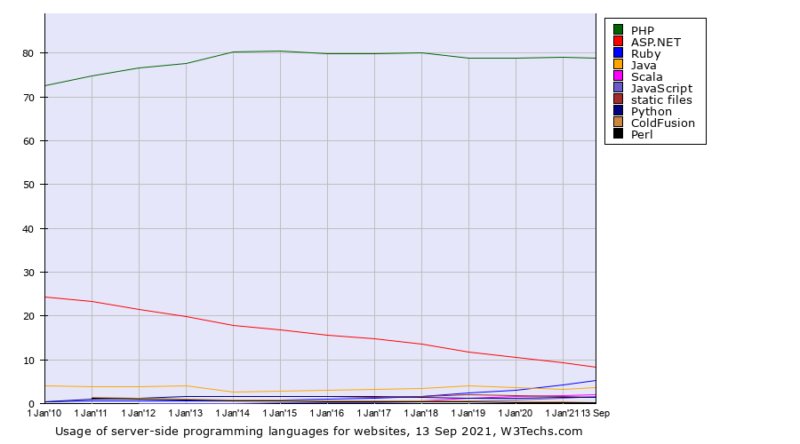
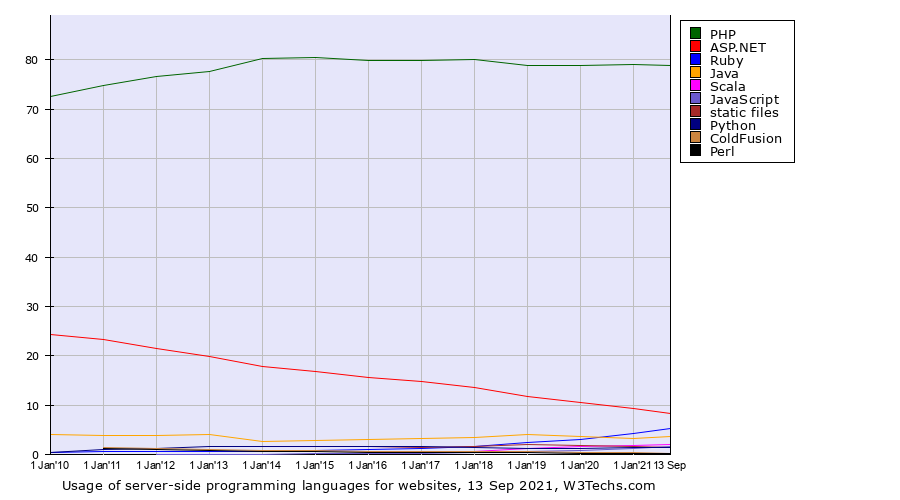
PHP maintains an enormous lead in server-side programming languages

Ruby is the only server-side web language which experienced much growth over the last decade—and the closest remaining "threat" to PHP, despite having only 6.5% the presence.

Enlarge / Ruby is the only server-side web language which experienced much growth over the last decade—and the closest remaining “threat” to PHP, despite having only 6.5% the presence. (credit: w3techs)

The venerable web programming language PHP is a source of frequent complaints and frustration, but according to a report W3Techs released today, it doesn’t seem to be going away anytime soon.

W3Techs’ web server survey looks for technologies in use by sites in Alexa’s top 10 million list; today’s report includes a year-on-year chart beginning with January 2010, running all the way through 2021. The survey only includes top sites not out of elitism, but as one part of its effort to avoid data-skewing returns from domain-parking services and spammers, which would otherwise dominate legitimate websites through sheer volume.

Within that dataset, the story told is clear. Apart from PHP—which held a 72.5 percent share in 2010 and holds a 78.9 percent share as of today—only one other server-side language ever broke a 10 percent share. That one competitor is ASP.NET, which held an impressive 24.4 percent share in 2010 but was down to 9.3 percent in January and 8.3 percent this month.

Read 3 remaining paragraphs | Comments


Source: Ars Technica – PHP maintains an enormous lead in server-side programming languages

Wow, This Quake Clone Is Smaller Than A Word Doc

Games today are massive, taking up dozens of gigabytes. Some recent bigger games, like Call of Duty Black Ops Cold War, cracked 250GB in total. That’s too big. But a new free mini-shooter out today, Q1K3, is a blast and only needs 13KB of JavaScript. It’s also part of a contest dedicated to devs making smaller games…

Read more…


Source: Kotaku – Wow, This Quake Clone Is Smaller Than A Word Doc

An xrdesktop Summer of Code

This summer, xrdesktop, the Open Source project bringing the Linux desktop to VR on Valve’s SteamVR & Monado, took part for the first time in Google Summer of Code (GSoC). Here’s a recap of what we accomplished. Both students, Remco and Manas, successfully completed their projects and submitted merge requests, implementing all the new features to xrdesktop.

The post An xrdesktop Summer of Code appeared first on Linux Today.


Source: Linux Today – An xrdesktop Summer of Code

Intuit Confirms $12 Billion Deal To Buy Mailchimp

It was teased earlier this month and now it’s confirmed: Intuit said on Monday it would buy email marketing company Mailchimp for about $12 billion in a cash-and-stock deal. Reuters reports: The deal, expected to close by the second quarter of fiscal 2022, will be financed through cash on hand and new debt of about $4.5 billion to $5.0 billion, Intuit said. The deal for Atlanta-based Mailchimp, which operates a marketing platform for small and mid-market businesses, will help Intuit expand its product base for small businesses. California-based Intuit’s products include TurboTax, a software that helps Americans file income tax returns, and QuickBooks, a cloud-based application that helps small businesses manage payments.

Read more of this story at Slashdot.


Source: Slashdot – Intuit Confirms Billion Deal To Buy Mailchimp

Sennheiser debuts CX Plus noise-cancelling earbuds for $180

By this point, Sennheiser is no stranger to true wireless earbuds. The company has several models under its belt, and the current lineup spans from basic and affordable to premium and pricey. Today, Sennheiser is introducing its latest earbuds with the CX Plus True Wireless. This newest entry offers active noise cancellation (ANC), ambient sound and the ability to customize both the on-board controls and the EQ. It also costs less than the company’s previous ANC model, the Momentum True Wireless 2

The CX Plus has a similar design to the CX and CX 400BT true wireless earbuds Sennheiser currently sells. The outer touch panel is a rounded rectangle compared to the circular exterior of the Momentum buds. On-board touch controls give you everything you need to play music, take calls and use a voice assistant without reaching for your phone. As the name implies, the CX Plus has features that aren’t on the CX True Wireless. That includes a Smart Pause feature, which is basically just automatic pausing when you remove an earbud from your ear, but Sennheiser has given it a fancy name. Smart Pause was previously reserved for the pricier Momentum True Wireless 2.

Sennheiser CX Plus True Wireless
Sennheiser

Another key addition for the CX Plus is ANC. The two preceding CX models only offer passive noise isolation. The CX Plus also offers ambient sound mode, or as Sennheiser calls it, Transparent Hearing. That feature was also not available on the CX series earbuds before now. Both active noise cancellation and Transparent Hearing were only on the Momentum True Wireless 2. The company’s Bass Boost preset from some previous models and the IPX4 splash-proof rating from the CX True Wireless both made the leap to the CX Plus. 

In terms of sound quality, Sennheiser says the CX Plus offers “audiophile technology” in “everyday” earbuds thanks to its TrueResponse transducer. The acoustic setup was built for much more expensive earphones and designed for “high-fidelity stereo sound” that offers “deep basses, natural mids and clear, detailed treble.” The company has a solid track record when it comes to sound, but we’ll still need to check those claims ourselves to make sure they hold up this time around. Sennhesier is promising up to 24 hours of total listening time: eight hours on the buds with two additional charges in the case. 

The CX Plus will be available September 28th in black and white color options for $179.95


Source: Engadget – Sennheiser debuts CX Plus noise-cancelling earbuds for 0

PeaZip 8.2 Released, Focused on Improving Command Line Usage

PeaZip 8.2 archive manager for Linux and Windows now supports a massive 225 archive formats. The new version focuses on improving user experience on Linux systems, updating installers, improving the automatic configuration of applications for “open with” actions, and displaying more system paths in the file manager. Learn more about the new release here.

The post PeaZip 8.2 Released, Focused on Improving Command Line Usage appeared first on Linux Today.


Source: Linux Today – PeaZip 8.2 Released, Focused on Improving Command Line Usage

Colin Farrell's Batman Villain Might Get His Own HBO Max Series

Audiences are still several months away from meeting our new big-screen Batman, Catwoman, Riddler, and Penguin—but one already has a spin-off in the works. Variety reports that Colin Farrell, who plays Oswald Cobblepot aka the Penguin in Matt Reeves’ upcoming The Batman, has been approached to reprise the role in a

Read more…


Source: Gizmodo – Colin Farrell’s Batman Villain Might Get His Own HBO Max Series