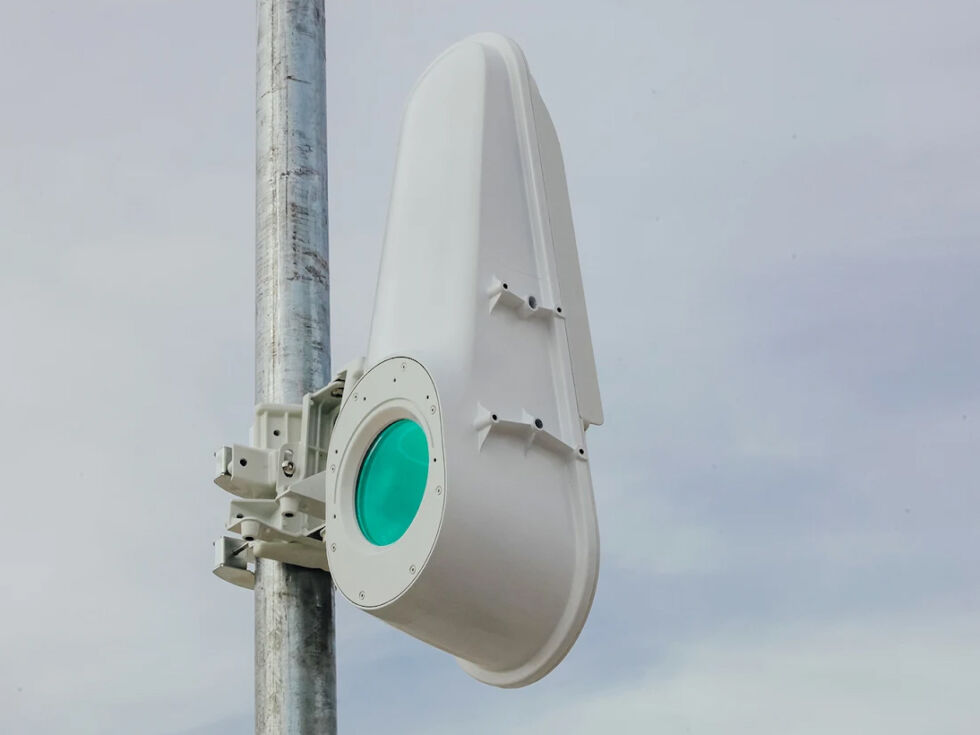
Google’s parent company, Alphabet, is still experimenting with hooking up remote towns to the Internet via frickin’ laser beams. Today, Alphabet’s moonshot “X Lab” shared an update on Project Taara, its experimental point-to-point optical communication system, often described as “fiber optics without the fiber.” The company built a working installation in Africa and has been blasting a 20Gbps link about 5 km across the Congo River to a town of millions of people, lowering the cost of Internet access for them.
The Taara laser beam is bridging the gap between Brazzaville in the Republic of the Congo and Kinshasa in the Democratic Republic of the Congo, which are on opposite sides of the Congo River. Brazzaville has decent Internet, but because nobody wanted to run a fiber line through the world’s deepest and second-fastest river, Kinshasa uses a fiber line that runs 400 km around the river, and the Internet is five times more expensive there. Alphabet’s 20Gbps commercial link has been up and running for 20 days now, and the company says it has served nearly 700TB of data in that time, with 99.9 percent uptime.
Taara was born out of the “Loon” Internet balloon project launched in 2017. Originally, Google was building flying cell towers to beam down the Internet from the sky (over RF), but for balloon-to-balloon backhaul, the company was planning communications via laser beam. Space X just started doing something similar by equipping its Starlink satellites with space lasers for optical intra-satellite communication. One benefit of Sky- and space-based laser communication is that not much can interfere with a point-to-point optical beam. Ground-based lasers have more interference to consider, since they have to deal with nearly everything: rain, fog, birds, and once, according to Alphabet’s blog post, “a curious monkey.”
Locast was ordered to shut down its online TV service forever in a permanent injunction issued yesterday by a federal judge. The order came two weeks after the judge gave major broadcast networks a big victory in their copyright case against Locast, a nonprofit organization that provided online access to broadcast TV stations.
Locast will have to win on appeal in order to stream broadcast channels again. Locast already suspended operations after the September 1 ruling that said it does not qualify for a copyright-law exemption available to nonprofits, so the permanent injunction doesn’t change the status quo.
US District Judge Louis Stanton cited a December 2019 agreement between Locast and the networks that limited the scope of the litigation and said a permanent injunction should be entered if the court determines that Locast does not qualify for the copyright-law exemption. The deal did not prohibit Locast “from applying for a stay of the permanent injunction pending appeal, nor to bar the broadcasters from opposing any such stay,” the agreement said.
Enlarge/ Pope Francis speaking to journalists as he returned to the Vatican on September 15, 2021. (credit: Vatican)
Pope Francis, well-known for his freewheeling conversations with journalists aboard the papal plane, yesterday called out COVID-19 vaccine resistance within church ranks as he flew home from Hungary and Slovakia. And he went straight to the top.
“Even in the College of Cardinals, there are a few ‘deniers’ [‘negazionisti’] and one of them, poor man, is hospitalized with the virus,” Francis told journalists on the flight, according to a translation of his Italian remarks.
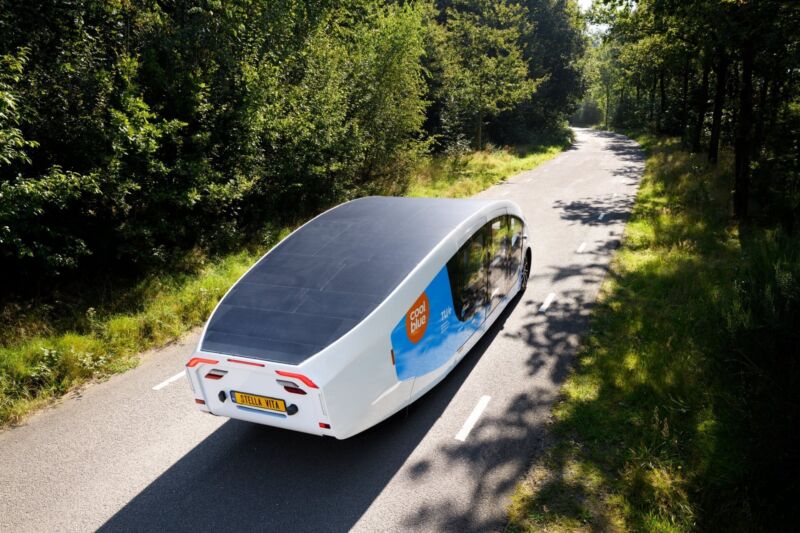
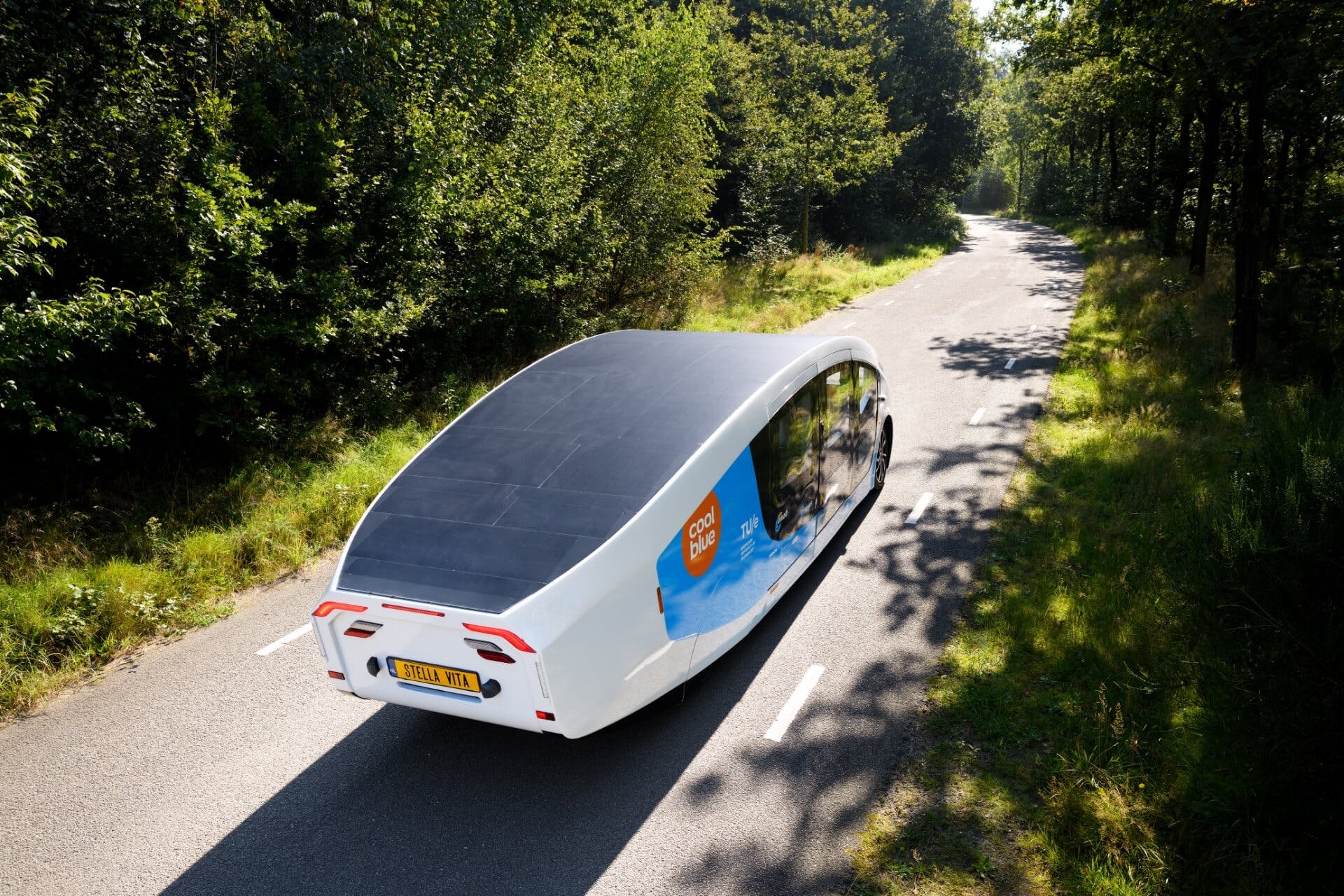
The creators of a new “self-sustaining house on wheels” are hoping their strange-looking project will help spark interest in solar vehicles. The vehicle, called the Stella Vita, was made by Eindhoven University of Technology students.
Solar Team Eindhoven’s 22 members previously created a smaller solar-powered family car called the Stella Lux. According to Tijn Ter Horst, a member of the team and a mechanical engineering student at the university, the Stella Lux was energy-positive. “She could power other electric vehicles because she had so much energy left,” Ter Horst told Ars.
After producing the Stella Lux, the team began brainstorming future projects and came up with the idea of a home-like vehicle powered entirely by the Sun. In March, the students started constructing a tear-shaped solar mobile home, and they recently completed the project.
Enlarge/ Elizabeth Holmes, founder and former CEO of blood-testing and life sciences company Theranos, leaves the courthouse with her husband Billy Evans after the first day of her fraud trial in San Jose, California, on September 8, 2021. (credit: Nick Otto / AFP)
At Theranos, lab techs would regularly omit two “outlier” data points from analysis in order to get the company’s machines to pass quality checks, whistleblower Erika Cheung told jurors yesterday at the trial of Theranos founder Elizabeth Holmes.
The process of removing outliers from an analysis isn’t necessarily unusual. But Theranos’ own lab manual did not say how outliers should be identified, so to get the company’s proprietary blood-testing devices to pass quality checks, employees could decide which results to keep, essentially “cherry-picking” data, Cheung said.
“It was very concerning in a research context because once that translates to a patient setting, it’s giving you a good indication that the system isn’t working reliably enough to feel confident and comfortable in running patient samples,” she said.
Enlarge/ A Lockheed Martin concept for a lunar lander. (credit: Lockheed Martin)
NASA is moving ahead with plans to bring competition into the development of landers for its Artemis Moon program. This week, the space agency said it had selected five US companies to conduct additional work toward refining lunar lander concepts to take astronauts down to the Moon’s surface later this decade.
The combined value of the fixed-price awards is $146 million, and the work is to be completed during the next 15 months. The winning companies are:
Blue Origin Federation of Kent, Washington, $25.6 million
Dynetics of Huntsville, Alabama, $40.8 million
Lockheed Martin of Littleton, Colorado, $35.2 million
Northrop Grumman of Dulles, Virginia, $34.8 million
SpaceX of Hawthorne, California, $9.4 million
According to NASA, each of these companies will further develop lander design concepts and evaluate the landers’ performance, design, mission assurance requirements, and more. The companies will also mitigate lunar lander risks by conducting critical component tests and advancing the maturity of key technologies.
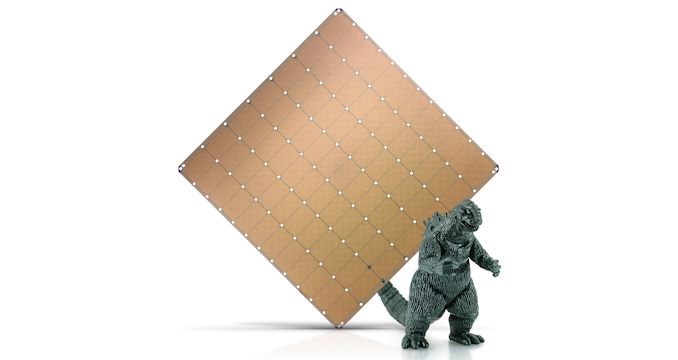
To date, most of the new AI hardware entering the market has been a ‘purchase necessary’ involvement. For any business looking to go down the route of using specialized AI hardware, they need to get hold of a test system, see how easy it is to migrate their workflow, then compute the cost/work/future of going down that route, if feasible. Most AI startups are flush with VC funding that they’re willing to put the leg work in for it, hoping to snag a big customer at some point to make that business profitable. One simple answer would be to offer the hardware in the cloud, but it takes a lot for a Cloud Service Provider (CSP) to bite and offer that hardware as an option to their customers. Today’s announcement between Cerebras and Cirrascale is that as a CSP, Cirrascale will begin to offer wafer-scale instances based on Cerebras’ WSE2.
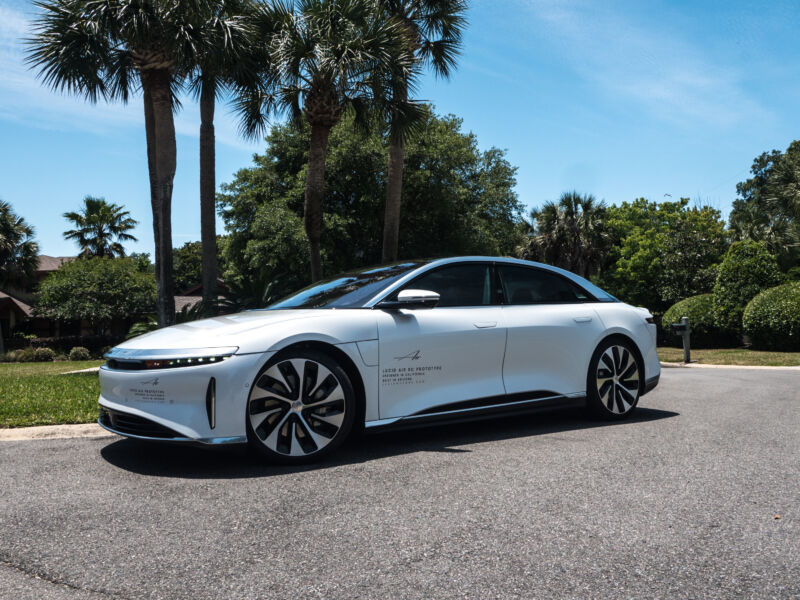
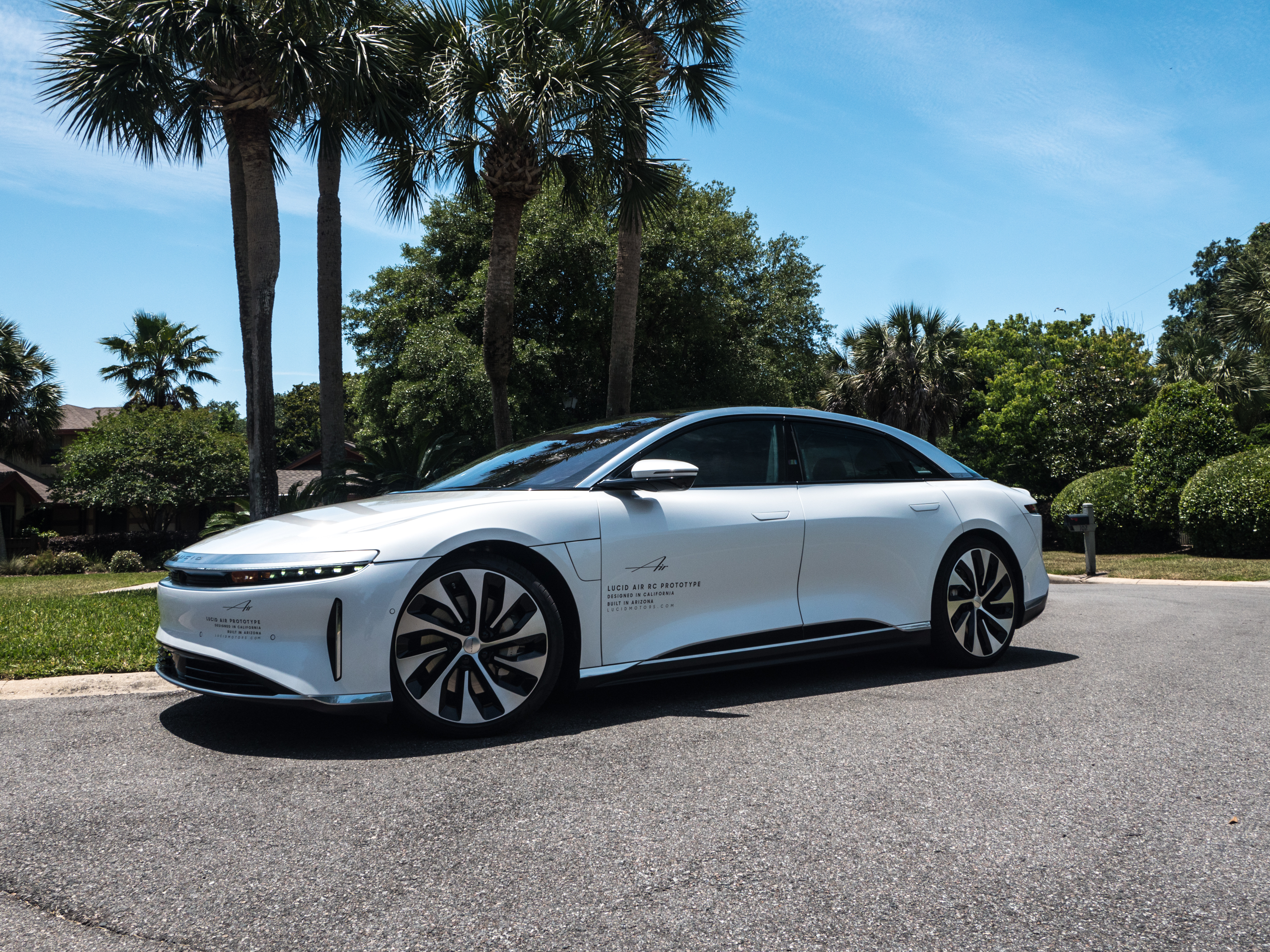
Enlarge/ The Lucid Air may look the same as the early prototype we saw in 2017, but a lot has changed. (credit: Jonathan Gitlin)
When it comes to bench-racing battery-electric vehicles, all is well and good when comparing standing-start acceleration times. But the only number anyone really cares about is how far a vehicle can go on a single charge. Rightly or wrongly, US car buyers have decided that the long charging times for a BEV (relative to refueling with liquid hydrocarbons) must be offset with enormous range. And when it comes to a long-legged BEV, there’s a new king of the hill.
On Thursday, the US Environmental Protection Agency issued its official range rating for the Lucid Air. The Air was probably going to do well here—Lucid-commissioned independent testing determined that a combination of a very low drag coefficient and a hefty 113 kWh battery pack would deliver over 517 miles (832 km) of range. But the EPA says Lucid has done even more than that: the Air Dream Edition has been rated at 520 miles (837 km) on a single charge.
“Crucially, this landmark has been achieved by Lucid’s world-leading in-house EV technology, not by simply installing an oversize battery pack,” said Peter Rawlinson, CEO and CTO of Lucid Group. “Our race-proven 900V battery and BMS technology, our miniaturized drive units, coupled with our Wunderbox technology endow Lucid Air with ultra-high efficiency, enabling it to travel more miles from less battery energy.”
The external storage market has experienced rapid growth over the last few years, particularly in the retail consumer segment. It has been fueled in part by advancements in bus-powered flash-based storage devices.
Thunderbolt SSDs are at the top in terms of both performance and price, but the last few years have seen various high-end portable SSDs with a USB interface. The USB 3.2 Gen 2×2 (20Gbps) ecosystem has been slowly gaining traction, with Kingston’s XS2000 portable SSD being the latest to join the device lineup. Based on Silicon Motion’s new SM232x family of UFD (USB flash drive) controllers, the product family offers full Gen 2×2 performance while consuming a fraction of the power needed by similar solutions currently in the market.
Silicon Motion sent across the bare reference board used inside the Kingston XS2000 to put through our rigorous direct-attached storage testing routine. Read on for our evaluation report of the SM2320XT reference design.
In the latest issue of Wireframe magazine, video game pioneer Howard Scott Warshaw reflects on the calamitous E.T. for the Atari 2600. Could it serve as a useful metaphor for real life?
When Julius Caesar ran into Brutus on the Ides of March so many years ago, it changed his life dramatically. I would say the same thing about my life when I ran into the E.T. project, though in my case, the change wasn’t quite so abrupt… or pointed. People say that my E.T. game was ahead of its time, so much so that it didn’t work for many players in its time. Fair enough. But E.T. is more than that. On many levels, that game has served as a metaphor for life, at least for my life. Let me explain, and perhaps it will sound familiar in yours as well.
There was an aura of promise and anticipation on the advent of the E.T. project – much like the prospect of graduating from college and entering the working world as a computer programming professional. This was super-exciting to me. Once I began the challenge of delivering this game, however, the bloom left the rose (no matter how many times I healed it). Similarly, on my entry into the working world, my excitement was quashed by the unsatisfying nature and demands of typical corporate computing tasks. This is analogous to the experience of E.T. players, having just unwrapped the game. They pop the cartridge in, fire it up, and venture forward with innocent exuberance… only to be crushed by a confusing and unforgiving game world. Perhaps the E.T. game was some sort of unconscious impulse on my part. Was I recreating the disappointment of my first foray into corporate life? Highly unlikely, but the therapist in me just had to ask.
In the E.T. game, I spend a lot of time wandering around and falling into pits. Sometimes I find treasure in those pits. Sometimes I’m just stuck in a pit and I need to dig my way out. That costs energy I could have used on more productive endeavours. There’s also a power-up in the game you can use to find out if there is something worth diving in for. Sadly, there’s no such power-up in life. Figuring out the difference between the treasure and the waste has always been one of my biggest questions, and it’s rarely obvious to me.
One of the treasures you find in the game is the flower. The act of healing it brings benefits and occasional delightful surprises. I was at the bottom of a ‘pit’ in my life when I found the path to becoming a psychotherapist (another act of healing). It helped me climb out and take some big steps toward winning the bigger game.
E.T. is all about the pits, at least it seems so for many who talk about it. And they do so with such derision. Many times I’ve heard the phrase, “E.T. isn’t about the pits. It is the pits!” But are pits really so bad? After all, there are situations in which being stuck in a pit can be an advantage – OK, perhaps not so much in the game. But in life, I find it’s unwise to judge where I am until I see where it takes me. There have been times where major disappointments ended up saving me from a far worse fate had I been granted my original desire. And in more concrete terms, during a hurricane or tornado, there are far worse outcomes than stumbling into a pit. Sometimes when I trip and fall, I wind up dodging a bullet.
Yes, in the game you can wind up wandering aimlessly around, feeling hopeless and without direction (somehow, they didn’t put that on the box). But ultimately, if you persevere (and read the directions), you can create a reasonably satisfying win. After finishing development of the game, there was a long period of waiting before any feedback arrived. Then it came with a vengeance. Of course, that only lasted for decades. My life after Atari seemed a bit of a wasteland for a long time too. Rays of sunlight broke through on occasion, but mostly cloudy skies persisted. Things didn’t improve until I broke free from the world in which I was stuck in order to launch the improbable life I truly wanted.
But it’s not like there were no lingering issues from my E.T. experience. It turns out that ever since the E.T. project, I have a much greater propensity to procrastinate, regularly shorting myself of dev time. I didn’t used to do that before E.T., but I’ve done it quite a bit since. I delay launching a genuine effort, then rush into things and try to do them too quickly. This results in a flurry of motion that doesn’t quite realise the potential of the original concept. More flailing and more failing. It doesn’t mean my idea was poor; it means it was unrefined and didn’t receive sufficient nourishment. On reflection, I see there are both challenges and opportunities at every turn. Pits and treasures. Which of those I emphasise as I move forward is how I construct the life I’m going to have, and I’m doing that all the time.
Pits and treasures, this is much of life. My E.T. game has mostly pits. Truth be known, people like to call them ‘pits’, but I’ve always thought of them as wells: a place to hide, to take repose and to weather out life’s storms. For me, that has been the value of having so many wells. I hope it works for you as well. Try it on. It just might fit like Caesar’s toga. And if it doesn’t, you can say what Brutus said on that fateful day: “At least I took a stab at it.”
Get your copy of Wireframe issue 55
You can read more features like this one in Wireframe issue 54, available directly from Raspberry Pi Press — we deliver worldwide.
And if you’d like a handy digital version of the magazine, you can also download issue 54 for free in PDF format.
Akihabara News (Tokyo) — On Tuesday, Clairvest Neem Ventures finally opened an office in Wakayama city, weeks after it was selected to lead the local Integrated Resort (IR) consortium.
The office is a modest affair on the second floor of a nondescript office building in the Junibancho district, walking distance from Wakayama Castle in the center of the city. It is quite distant from the Marina City location of the proposed casino resort.
The Clairvest office is quite unlike the flashy Suncity Group office that had been opened in September 2020 to showcase that Macau firm’s IR plans and to widely appeal to the public as a sort of community center. Indeed, Clairvest is asking visitors to send an email and to make advance arrangements before members of the public drop by their new office.
There are a couple of ironies here.
The first is that in an earlier stage of Japan’s IR race, Clairvest was often the first to open a small local office. This was the case in both Sasebo, Nagasaki, and Tomakomai, Hokkaido. However, they have only now opened a local office in Wakayama, the location where they actually won their bid.
The second irony is that among the IR operators that at one time sought to lead IR development in Wakayama—Suncity Group, Bloomberry Resorts, Groupe Barriere—the ultimate winner, Clairvest, was the one which made the weakest effort to build local community relations.
That was also the case for Nagasaki, where the firm that won, Casinos Austria International, was also the most silent and least engaged in public marketing activities.
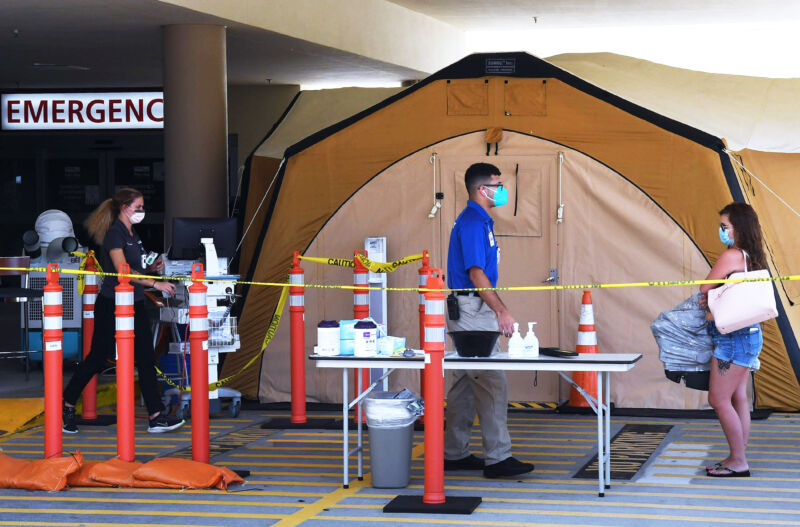
Enlarge/ PALM BAY, FLORIDA, 2021/07/29: A woman arrives at a treatment tent outside the emergency department at Palm Bay Hospital.
(credit: Getty | SOPA images)
The current surge of the COVID-19 cases driven by the hypertransmissible delta variant is straining hospitals across the US, particularly in the South. Twenty-five percent of hospital intensive care units around the country are now above 95 percent full. That percentage is up from 20 percent in July and just 10 percent in June, according to data tracking by The New York Times.
The spike in critical care follows a surge in cases and hospitalizations. Average new daily cases in the country skyrocketed from around 12,000 a day in late June to the 150,000 or so in mid-September. Hospitalizations have likewise risen, shooting up from an average of nearly 17,000 a day at the start of July to around 100,000 now. Though cases and hospitalizations are starting to plateau or decline slightly, they are still extremely high. Deaths, meanwhile, are increasing. In the past two weeks, deaths have increased 40 percent to the current average of nearly 1,900 per day.
Most of the cases and nearly all of the hospitalizations and deaths remain among the unvaccinated. Around 60,000 people in the US have died of COVID-19 since the start of July. With highly effective vaccines freely available, nearly all of the current deaths are preventable.
Google’s best image of the Pixel 6 Pro. [credit: Google
]
What in the world is going on?
Google is building the Pixel 6, and with it, the company is dumping Qualcomm and introducing its first in-house main SoC (with help from Samsung): the “Google Tensor SoC,” aka “Whitechapel.” Other than some talk about Google’s special AI sauce, there’s hasn’t been much info about the core parts of Tensor like, say, the CPU. A reasonable expectation for a company building its first SoC is that it won’t be too ambitious—we would expect Google to play within the guardrails set up by ARM, and after shipping a modest, cookie-cutter SoC, the company would learn from its first design and iterate. But a new report from XDA Developers’ Mishaal Rahman claims that even with its first design, Google isn’t afraid to blaze its own trail in SoC design.
Recall how ARM SoCs generally come with three tiers of CPU cores: a big CPU for bursty processing tasks like app-launching, medium cores for sustained performance, and small cores for background duty and low-power processing. Rahman says he has a source with a real-life Pixel 6 Pro and offers the following CPU specs: two 2.8GHz Cortex-X1 cores, two 2.25GHz Cortex-A76 cores, and four 1.8GHz Cortex-A55 cores.
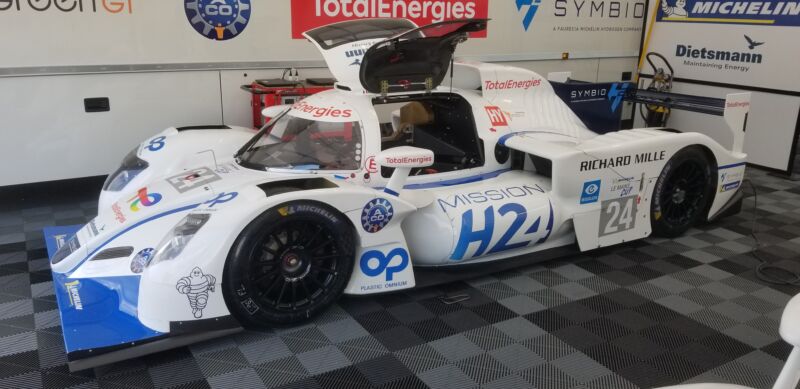
Around 400 meters from the buzz of the paddock during this year’s 24 Hours of Le Mans stood a tent with two racing cars and a mobile fueling station. Every now and then, people wearing blue T-shirts bearing the logo of “Mission H24” would walk by the cars to attend meetings in a motor home sitting next to the tent.
One of those people was François Granet of the Franco-Swiss company GreenGT. He appeared particularly thrilled because, on the eve of the start of this year’s race, the ACO (Automobile Club de l’Ouest), which organizes the 24 Hours of Le Mans, announced a new category of race cars at the Le Mans event for 2025: hydrogen-electric prototypes. The company’s forerunners were stationed in that tent.
Creating a category
GreenGT is developing the hydrogen fuel cell powertrain for these cars, which will be designed around a chassis built by Oreca and Red Bull Technologies. “In partnership with ACO, we are helping define the sporting and technical regulations for the new category,” Granet said.
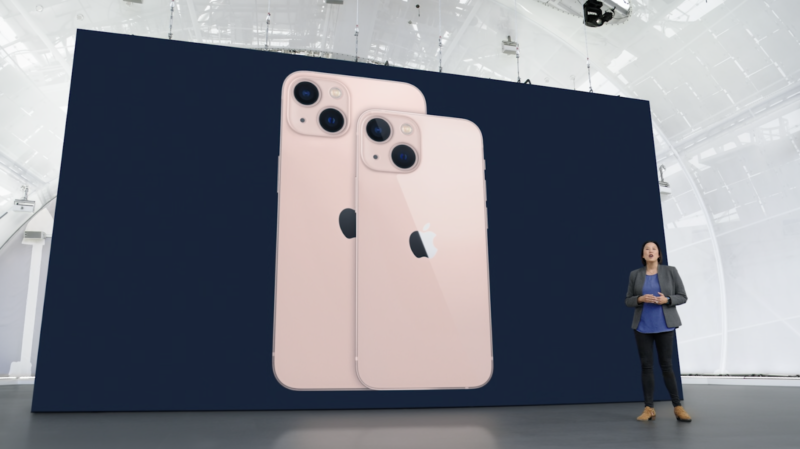
Enlarge/ The IPhone 13 and iPhone 13 mini. (credit: Apple)
Yesterday, Apple announced its new flagship iPhones: the iPhone 13, iPhone 13 mini, iPhone 13 Pro, and iPhone 13 Pro Max. But while Apple’s livestream was full of details, some things were left out.
Fortunately, we’ve learned a bit more from Apple’s updated website, including dimensions and weight, some info about specs, and the lineup of older iPhone models that will survive the culling that follows the introduction of a new flagship.
Thicker and heavier
The new iPhones are heavier than their immediate predecessors, and they’re a little thicker, too. For example, the iPhone 12 weighed 5.78 ounces, but the iPhone 13 weighs 6.14 ounces. The iPhone 12 Pro was 6.66 ounces, but the iPhone 13 Pro is 7.19 ounces. This holds up across the line. And the iPhone 13 is 0.25 mm thicker than the 12; similar thickness differences are also universal.
Enlarge/ A human collects their Walmart delivery from an autonomous delivery vehicle operated by Ford and Argo AI. (credit: Ford)
It’s easy to feel like the autonomous vehicle industry has settled into the trough of despair. The hyperbolic buzz around self-driving cars that was all the rage a few years ago has become tempered as developers discover that not only do humans drive well—which sets a high bar for their robocars—but humans also drive badly in unique ways depending upon where they are. (People drive badly in Las Vegas differently to the way they drive badly in San Francisco, and so on.)
Our streets might not be overflowing with robotaxis as we were promised circa 2017, but here and there, AV companies are beginning commercial deployments. Like Argo AI, the AV startup that’s been heavily backed by Ford, Volkswagen, and others. On Wednesday, Argo, Ford, and Walmart revealed they will be working together to roll out last-mile deliveries from the retail giant’s stores in Austin, Texas; Miami, Florida; and Washington, DC.
“Our focus on the testing and development of self-driving technology that operates in urban areas where customer demand is high really comes to life with this collaboration,” said Bryan Salesky, founder and CEO of Argo AI. “Working together with Walmart and Ford across three markets, we’re showing the potential for autonomous vehicle delivery services at scale.”
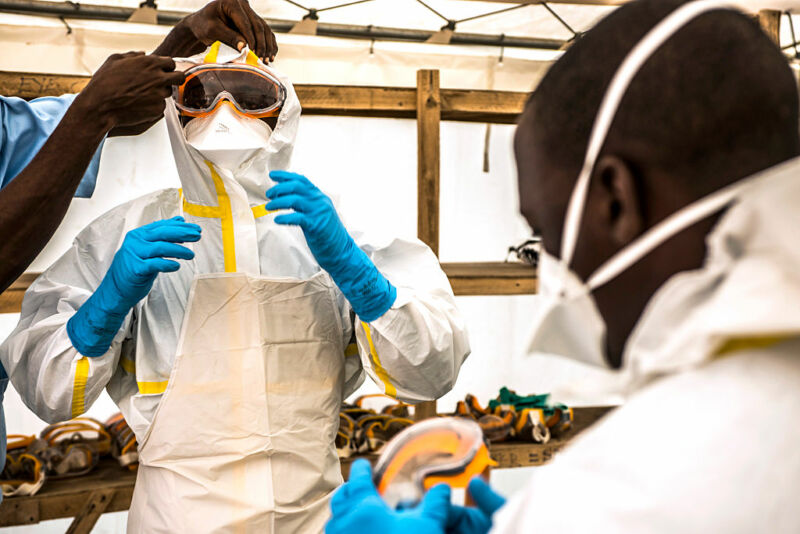
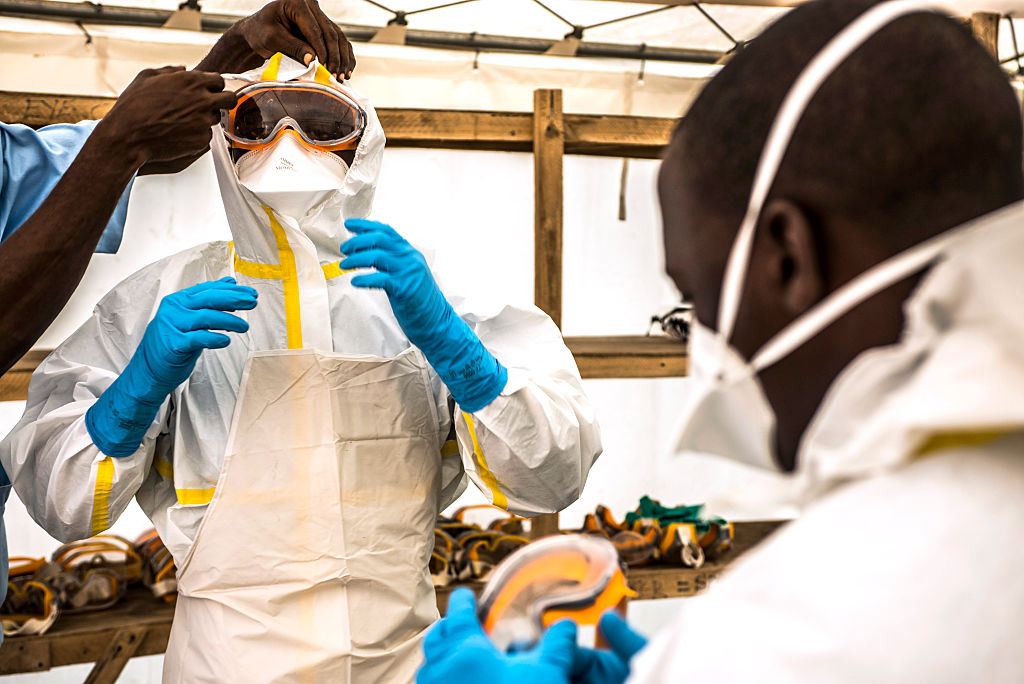
Enlarge/ Health care workers don protective equipment before working with Ebola patients. (credit: Bloomberg / Getty Images)
A large international research group released a paper today suggesting that Ebola viruses can emerge from five years of dormancy to trigger a new outbreak of infections. While this isn’t the first instance in which Ebola re-emerged from a previously infected individual, the new results extend the timeframe of risk substantially.
At present, we have little idea how and where the virus persists in the human body. But there are now tens of thousands of people who have survived previous infections, so it’s an area where more research is urgently needed.
A re-outbreak
The African nation of Guinea experienced a small Ebola outbreak that started in January of 2021 when a nurse fell ill. Due to a misdiagnosis, she was not immediately isolated, allowing the virus to spread. Fortunately, a major outbreak that occurred in the same region from 2013 to 2016 resulted in the local health authorities obtaining sophisticated diagnostic equipment, including the real-time RT-PCR machines that are used for COVID-19 testing. This ultimately allowed the authorities to determine that Ebola was the cause of her illness, identify 15 additional cases, and take measures that brought the outbreak to a halt. In all, 12 of the 16 infected died.
A federal judge yesterday declared a mistrial in the case against Backpage’s founders, ruling that US prosecutors unfairly tainted the jury by focusing too heavily on claims of child sex trafficking in a trial that involved zero charges of child sex trafficking. A new trial will be held.
“‘The government, as prosecutors, are held to a higher standard,’ said Judge Susan Brnovich from the bench as court opened for what was expected to be the eighth day of the trial. ‘Their goal is not to win at any costs, but their goal is to win by the rules,'” according to an Arizona Republic article.
The case against Backpage founders Michael Lacey and James Larkin, and five Backpage executives and managers, is in US District Court for the District of Arizona. The actual charges are for conspiracy, facilitating prostitution, and money laundering. An order confirming the declaration of mistrial was filed, but Brnovich explained her reasoning orally.
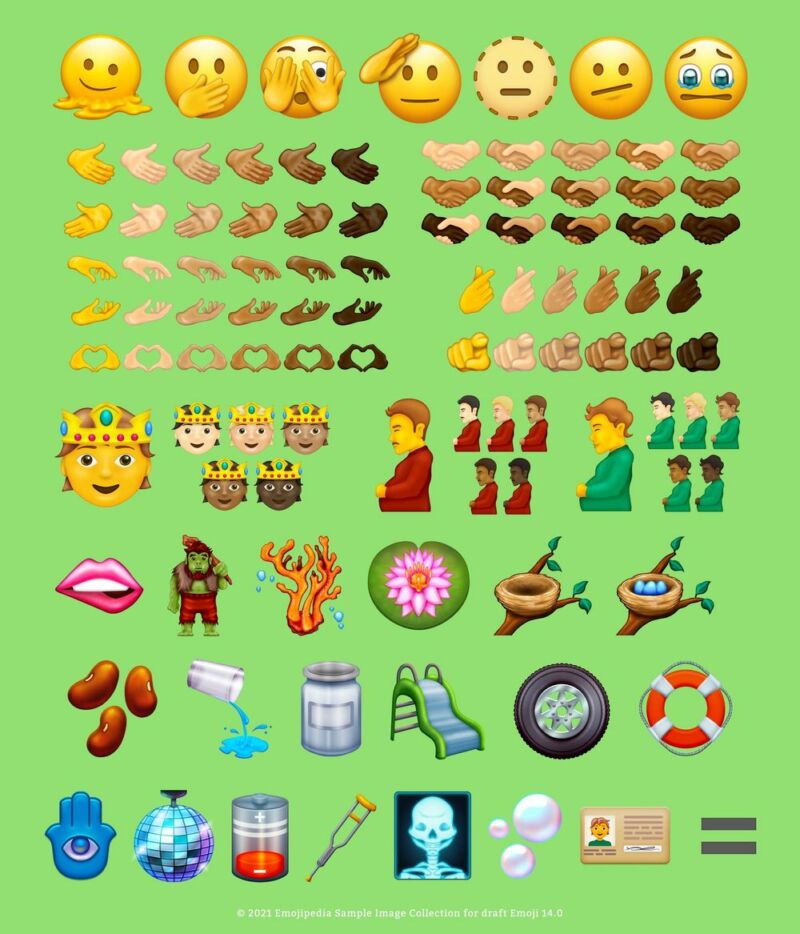
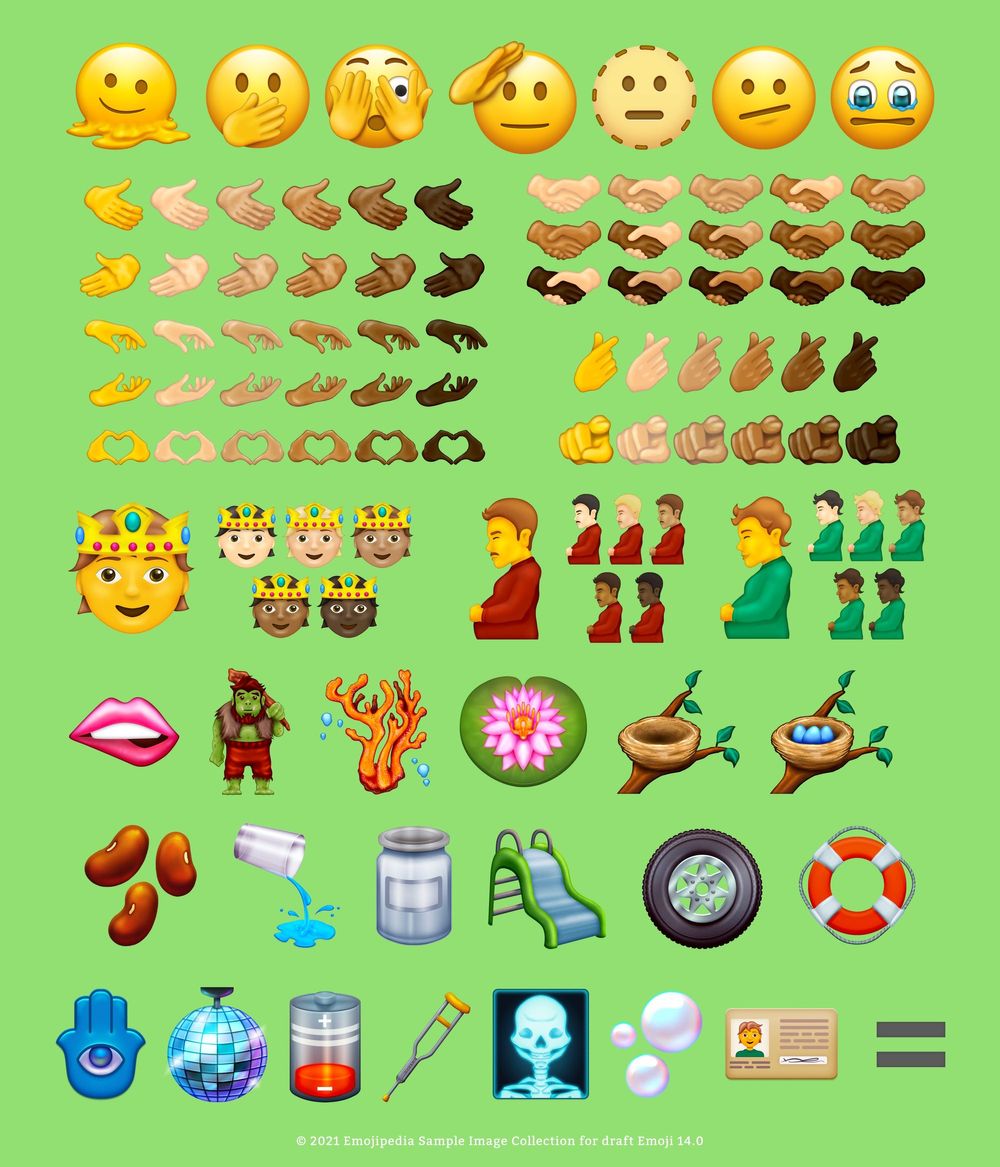
Enlarge/ This is the full slate of proposed new emoji for Unicode 14.0. (credit: Emojipedia)
The Unicode Consortium has finalized Unicode 14.0, adding a total of 838 new characters to the standard, which dictates how text and other written characters are handled in most of the world’s software. Most notably for everyday users, Unicode 14.0 includes 37 new emoji characters, including multiple hand gestures and additions like “melting face,” “biting lip,” “troll,” “beans,” “pouring liquid,” “pregnant man,” and “pregnant person.”
The “pregnant man” and “pregnant person” emoji are important for inclusivity and representation, since some transgender and non-binary people can be pregnant. The “other keywords” for both emoji suggest possible alternate uses like “bloated” and “full.” But the emoji names for both characters were specifically changed from “man/person with swollen belly” to “pregnant man/person” back in February in order to be consistent with the name and intended usage of the extant “pregnant woman” emoji.
The finalized list of emoji is the same as the draft version that circulated a few months ago. That list removed a few candidates that could reappear in a future version of the Unicode spec, including “vulture,” “crow,” “raised little finger,” “cooking pot,” “chainsaw,” and “submarine.” The Unicode Consortium is working to limit the number of new emoji added in each new version of the standard to stay “focused on what is useful” and reduce the amount of work that OS and app developers need to do to support new emoji every year.
Hacktivist collective Anonymous claims to have obtained gigabytes of data from Epik, the web host for the Texas GOP, Gab, Parler, and 8chan, among other right-wing sites. The stolen data has been released as a torrent. The hacktivist collective says that the data set, which is over 180GB in size, contains a “decade’s worth of data from the company.”
Anonymous says the data set is “all that’s needed to trace actual ownership and management of the fascist side of the Internet that has eluded researchers, activists, and, well, just about everybody.” If this information is correct, Epik’s customers’ data and identities could now fall into the hands of activists, researchers, and just about anyone curious enough to take a peek.
Decades of Epik stuff, now in a torrent near you
Epik is a domain registrar and web services provider known to serve right-wing clients, some of which have been turned down by more mainstream IT providers due to the objectionable and sometimes illicit content hosted by the clients.