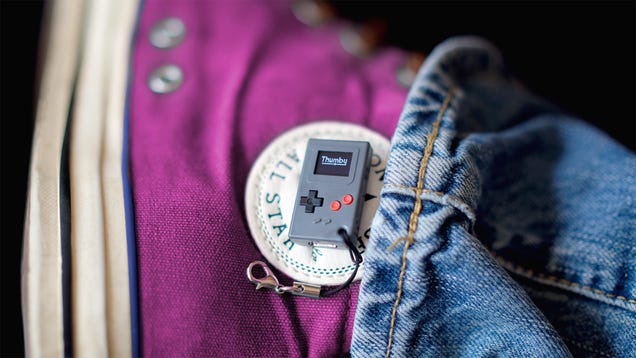
A (Playable) Game Boy For Ants

You know what my grandmother used to say? “That blasted Game Boy of yours, it’s too damn big!” She was right, the old woman was wise. And if this fictional gram were alive today maybe she’d smile upon hearing word of Thumby, a very, very small Game Boy-like device that launched a Kickstarter today. (Of course, she’d…

Read more…


Source: Kotaku – A (Playable) Game Boy For Ants

9to5Linux Weekly Roundup

Last week, we saw fewer Linux news, but a lot of goodies. NVIDIA GPU users got a new graphics driver release with support for the latest Linux 5.14 kernel series, especially now that Linux kernel 5.13 reached end of life, the Emmabuntüs Debian Edition 4 has been finally released for those who want to refurbish old computers, and Ubuntu Touch OTA-19 arrives for Ubuntu Phone users.

On top of that, gamers received a new DXVK update to run the latest Windows games, a new major Telegram Desktop release brought in new features and enhancements for a better chat experience, and the GNOME 41 desktop environment arrived with many goodies. You can enjoy these and much more in 9to5Linux’s Linux weekly roundup for September 26th, 2021, below!

The post 9to5Linux Weekly Roundup appeared first on Linux Today.


Source: Linux Today – 9to5Linux Weekly Roundup

Android advances towards its convergence with the general branch of Linux

Google has been looking for ways to make it easier to maintain Android, the operating system that governs the vast majority of active smartphones. To do this, the search giant has been working for years to adjust the Android kernel to the official Linux branch, causing third-party drivers to be installed through a mechanism called Project Treble, which was presented in 2017.

The post Android advances towards its convergence with the general branch of Linux appeared first on Linux Today.


Source: Linux Today – Android advances towards its convergence with the general branch of Linux

Linux for Starters: Your Guide to Linux, Part 18— Remote Desktop to Windows from Ubuntu

It’s not uncommon for people interested in Linux to have multiple PCs in their home. Hardware comes in different shapes and sizes. They may be notebooks, tablets, home servers, media boxes, even single-board computers like the Raspberry Pi. Some of the devices may be headless (i.e. with no monitor attached). Regardless, with multiple devices, a convenient way to access them all from a central location is with remote desktop software.

This article looks at a common activity: accessing a Windows PC desktop from your new Linux machine over a local home network.

The post Linux for Starters: Your Guide to Linux, Part 18— Remote Desktop to Windows from Ubuntu appeared first on Linux Today.


Source: Linux Today – Linux for Starters: Your Guide to Linux, Part 18— Remote Desktop to Windows from Ubuntu

Physicists may have cracked the case of “Zen” stones balanced on ice pedestals

A laboratory reproduction of the Zen stone phenomenon in a lyophilizer.

Enlarge / A laboratory reproduction of the Zen stone phenomenon in a lyophilizer. (credit: Nicolas Taberlet / Nicolas Plihon)

Visit the Small Sea of Lake Baikal in Russia during the winter and you’ll likely see an unusual phenomenon: a flat rock balanced on a thin pedestal of ice, akin to stacking Zen stones common to Japanese gardens. The phenomenon is sometimes called a Baikal Zen formation. The typical explanation for how these formations occur is that the rock catches light (and heat) from the Sun and this melts the ice underneath until just a thin pedestal remains to support it. The water under the rock refreezes at night, and it’s been suggested that wind may also be a factor.

Now, two French physicists believe they have solved the mystery of how these structures form, according to a new paper published in the Proceedings of the National Academy of Sciences—and their solution has nothing to do with the thermal conduction of the stone. Rather, they attribute the formation to a phenomenon known as sublimation, whereby snow or ice evaporates directly into vapor without passing through a water phase. Specifically, the shade provided by the stone hinders the sublimation rates of the surrounding ice in its vicinity, while the ice further away sublimates at a faster rate.

Many similar formations occur naturally in nature, such as hoodoos (tall, spindly structures that form over millions of years within sedimentary rock), mushroom rocks or rock pedestals (the base has been eroded by strong dusty winds), and glacier tables (a large stone sitting precariously on top of a narrow pedestal of ice). But the underlying mechanisms by which they form can be very different. 

Read 12 remaining paragraphs | Comments


Source: Ars Technica – Physicists may have cracked the case of “Zen” stones balanced on ice pedestals

Identical Twins Carry Genetic Modifications No One Else Has

sciencehabit shares a report from Science.org: Identical twins are living proof of how genetics shapes our looks and traits. Now, researchers have found they carry a molecular signature on their DNA that no one else has — one that becomes fixed in their cells early in development and stays with them into adulthood. This signature doesn’t seem to influence a twin’s health, but it could offer insights into how identical twinning happens. “It is a starting point” for solving “what is really an enigma,” says Jenny van Dongen, a twin genetics researcher at Free University (VU), Amsterdam. The signature could also be used to test whether a person had a “vanishing twin,” an identical twin that died in the womb.

An international team led by van Dongen and VU twin genetics researcher Dorret Boomsma looked for clues in what’s known as the epigenome. Patterns of chemical tags called methyl groups glom onto genes, turning them on or off. (Such epigenetic changes are responsible for everything from enabling Peruvians to live at high altitudes to helping the placenta develop.) Using blood and cheek cell samples, the researchers scanned the epigenomes of more than 3000 identical twins, as well as a comparable number of fraternal twins and some twins’ parents. They looked at 400,000 different places on each person’s genome. About 800 locations had differences in methylation that set identical twins apart from everyone else, the team reports today in Nature Communications. “It’s likely something established very early on that is propagated to subsequent cells,” van Dongen says.

Some of the methylated or unmethylated spots made sense, such as tags on genes involved in cell adhesion that might influence how easily a fertilized egg splits into two embryos. But changes in other locations, such as the ends of chromosomes, don’t have an obvious explanation. These regions have been associated with aging, yet identical twins’ life spans are similar to other people’s. An epigenetic test might also be useful to determine whether a person once had an identical twin that vanished in the uterus, perhaps because it didn’t have enough room or nutrients to grow. Sometimes a twin fetus appears in an ultrasound before vanishing, but other times it may be absorbed without leaving a trace. As many as 12% of pregnancies start out as multiples (including fraternal twins), according to some estimates, but only 2% of twin pairs survive. Using a separate data set, the epigenetic signature could predict whether someone was an identical twin in 70% to 80% of cases, van Dongen says. With data from a large enough group of people, the test would get even better, she says, and it could also help “predict the exact rate” of vanishing twins. That figure would be useful not only for researchers, but also “of broad interest” to twins themselves and to families who are mourning the loss of an identical twin, Boomsma says.

Read more of this story at Slashdot.


Source: Slashdot – Identical Twins Carry Genetic Modifications No One Else Has

April Fools' Copy-Paste Button For Lazy Programmers Now Actually For Sale

Stack Overflow’s copy-paste keyboard, an April Fools’ Day prank that ribbed lazy programmers, is now actually for sale. CNET reports: It’s been a joke in programming circles for years: Instead of writing your code from scratch, just head over to the Stack Overflow forums and copy the way another programmer already solved your problem. The meme is such a fixture that Stack Overflow turned it into an April Fools’ Day prank this year, saying it would limit free access to its site unless people bought The Key, a device with buttons for opening Stack Overflow, copying and pasting. Enough people said they’d actually buy one that Stack Overflow, with help from keyboard aficionado Cassidy Williams and custom keyboard maker Drop, designed one for real and began selling it for $29. A portion of the keyboard sales’ proceeds will go to Digitalundivided, a nonprofit set up to help Black and Latinx women succeed as technology entrepreneurs. Further reading: How Often Do People Actually Copy and Paste From Stack Overflow?

Read more of this story at Slashdot.


Source: Slashdot – April Fools’ Copy-Paste Button For Lazy Programmers Now Actually For Sale

Leaked Documents Show How Amazon's Astro Robot Tracks Everything You Do

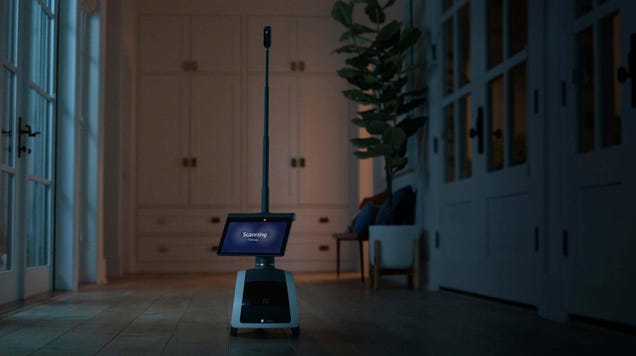
em1ly shares a report from Motherboard: Amazon’s new robot called Astro is designed to track the behavior of everyone in your home to help it perform its surveillance and helper duties, according to leaked internal development documents and video recordings of Astro software development meetings obtained by Motherboard. The system’s person recognition system is heavily flawed, according to two sources who worked on the project. The documents, which largely use Astro’s internal codename “Vesta” for the device, give extensive insight into the robot’s design, Amazon’s philosophy, how the device tracks customer behavior as well as flow charts of how it determines who a “stranger” is and whether it should take any sort of “investigation activity” against them.

The meeting document spells out the process in a much blunter way than Amazon’s cutesy marketing suggests. “[Astro] slowly and intelligently patrols the home when unfamiliar person are around, moving from scan point to scan point (the best location and pose in any given space to look around) looking and listening for unusual activity,” one of the files reads. “Vesta moves to a predetermined scan point and pose to scan any given room, looking past and over obstacles in its way. Vesta completes one complete patrol when it completes scanning all the scan point on the floorplan.” […]
Developers who worked on Astro say the versions of the robot they worked on did not work well. “Astro is terrible and will almost certainly throw itself down a flight of stairs if presented the opportunity. The person detection is unreliable at best, making the in-home security proposition laughable,” a source who worked on the project said. “The device feels fragile for something with an absurd cost. The mast has broken on several devices, locking itself in the extended or retracted position, and there’s no way to ship it to Amazon when that happens.” “They’re also pushing it as an accessibility device but with the masts breaking and the possibility that at any given moment it’ll commit suicide on a flight of stairs, it’s, at best, absurdist nonsense and marketing and, at worst, potentially dangerous for anyone who’d actually rely on it for accessibility purposes,” the source said.

Read more of this story at Slashdot.


Source: Slashdot – Leaked Documents Show How Amazon’s Astro Robot Tracks Everything You Do

No Time To Die Is the Most Emotional James Bond Film Ever

No Time to Die, the 25th James Bond movie, almost feels like 25 movies in one. So much happens in its complex story—filled with so many sprawling, varied set pieces—that by the time you get to the end, the events of the beginning feel like they happened 18 months ago. Which, if you remember, they were supposed to.…

Read more…


Source: Gizmodo – No Time To Die Is the Most Emotional James Bond Film Ever

Facebook's Effort To Attract Preteens Goes Beyond Instagram Kids, Documents Show

An anonymous reader quotes a report from The Wall Street Journal: Facebook has come under increasing fire in recent days for its effect on young users and its efforts to create products for them. Inside the company, teams of employees have for years been laying plans to attract preteens that go beyond what is publicly known, spurred by fear that Facebook could lose a new generation of users critical to its future. Internal Facebook documents reviewed by The Wall Street Journal show the company formed a team to study preteens, set a three-year goal to create more products for them and commissioned strategy papers about the long-term business opportunities presented by these potential users. In one presentation, it contemplated whether there might be a way to engage children during play dates. “Why do we care about tweens?” said one document from 2020. “They are a valuable but untapped audience.”

The Facebook documents show that competition from rivals, in particular Snap Inc.’s Snapchat and TikTok, is a motivating factor behind its work. […] Over the past five years, Facebook has made what it called “big bets” on designing products that would appeal to preteens across its services, according to a document from earlier this year. In more than a dozen studies over that period, the documents show, Facebook has tried to understand which products might resonate with children and “tweens” (ages 10 through 12), how these young people view competitors’ apps and what concerns their parents. “With the ubiquity of tablets and phones, kids are getting on the internet as young as six years old. We can’t ignore this and we have a responsibility to figure it out,” said a 2018 document labeled confidential. “Imagine a Facebook experience designed for youth.”

Earlier this year, a senior researcher at Facebook presented to colleagues a new approach to how the company should think about designing products for children. It provided a blueprint for how to introduce the company’s products to younger children. Rather than offer just two types of products — those for users 13 and older, and a messenger app for kids — Facebook should tailor its features to six age brackets, said a slide titled “where we’ve been, and where we’re going.” The age brackets included: adults, late teens ages 16 to maturity, teens ages 13 to 15, tweens ages 10 to 12, children ages 5 to 9 and young kids ages zero to four. […] “Our ultimate goal is messaging primacy with U.S. tweens, which may also lead to winning with teens,” one of the documents said. Yesterday, Facebook paused its plans to develop a version of Instagram for kids under 13 after facing pressure from lawmakers.

Read more of this story at Slashdot.


Source: Slashdot – Facebook’s Effort To Attract Preteens Goes Beyond Instagram Kids, Documents Show

Amazon’s indoor camera drone is ready to fly around your house

Amazon unloaded an entire delivery truck’s worth of products at a private event today. Here are some of the many, many smart home products that were announced.

The Amazon Smart Thermostat: Way cheaper than the competition

Lookout Nest! Amazon is stepping on Google’s turf (and its old thermostat partner, Ecobee) with the Amazon Smart Thermostat. Nest thermostats are a circle, so this thing is a square, with the usual touch controls on the front and an app (the Alexa app) for remote control and usage tracking. “Thermostat Hunches” will let Alexa control the thermostat based on your location, and of course there are Alexa voice commands. This is “made with Honeywell Home Thermostat Technology” so between Amazon’s Echo smarts and Honeywell’s thermostat experience, there is plenty of expertise here.

The device is $59.99, and for $16 more you can get a bundle with a C-Wire Power Adapter, which you might need if your existing thermostat wiring isn’t putting out enough power. That is dramatically cheaper than Nest, whose cheapest thermostat is $129.99. Amazon is also undercutting its biggest thermostat partner, Ecobee, which ships a thermostat with an entire Alexa speaker and microphone integrated into it, the $229.99 Ecobee 4. This is just a thermostat—but wow is it cheap.

Read 11 remaining paragraphs | Comments


Source: Ars Technica – Amazon’s indoor camera drone is ready to fly around your house

J-Power: 650MW in Wind Energy by FY2024

Akihabara News (Tokyo) — With several new projects under construction and renewal of old turbines, Electric Power Development (J-Power) expects to have 650 megawatts of wind energy in service by FY2024.

At present, J-Power has about 540 megawatts of wind energy operating at 23 locations around Japan. This is equivalent to more than half of the electricity generation capacity of a conventional nuclear reactor.

The wind farms tend to be rather small, with the average number of turbines at a single site averaging about twelve. Geographically, they are widely spread from Kagoshima to Hokkaido.

J-Power has two new wind farms under construction, a 42 megawatt site in Hokkaido and a 34 megawatt site in Ehime, each of which will feature ten turbines.

Moreover, there are two sites in Hokkaido with a combined generation capacity of 35 megawatts that are currently offline for renewal.

In its latest announcement, J-Power has revealed that its oldest wind farm, the twenty-year-old Nikaho Kogen Wind Farm in Akita, is also entering a renewal process. In its case, its fifteen existing aged wind turbines, which each have a capacity of 1.6 megawatts, will be replaced with six new 4.3 megawatt wind turbines supplied by Siemens Gamesa.

Recent Wind Power Related Articles

Toda Corporation Leads Nagasaki Wind Farm

Offshore Construction Begins at Akita Wind Farm

Toshiba Prepares Big Move into Wind Power

StormGeo to Support Akita Offshore Wind

Wind Power to the Rescue

The post J-Power: 650MW in Wind Energy by FY2024 appeared first on Akihabara News.


Source: Akihabara News – J-Power: 650MW in Wind Energy by FY2024

Convert your Raspberry Pi into a trading bot with Pythonic

The current popularity of cryptocurrencies also includes trading in them. Last year, I wrote an article How to automate your cryptocurrency trades with Python which covered the setup of a trading bot based on the graphical programming framework Pythonic, which I developed in my leisure. At that time, you still needed a desktop system based on x86 to run Pythonic. In the meantime, I have reconsidered the concept (web-based GUI).

Source: LXer – Convert your Raspberry Pi into a trading bot with Pythonic

Apple Watch Can Detect Arrhythmias Other Than AFib, Study Shows

According to new research published this week in American Heart Association Journal, Apple Watch can detect arrhythmias other than Atrial Fibrillation (AFib). The Apple watch irregular pulse detection algorithm was found to have a positive predictive value of 0.84 for the identification of atrial fibrillation (AFib). MyHealthyApple reports: The Apple Heart Study investigated a smartwatch-based irregular pulse notification algorithm to identify AFib. For this secondary analysis, the researchers analyzed participants who received an ambulatory ECG patch after index irregular pulse notification. Among 419,297 participants enrolled in the Apple Heart Study, 450 participant ECG patches were analyzed, with no AF on 297 ECG patches (66%). Non-AF arrhythmias (excluding supraventricular tachycardias [less than] 30 beats and pauses [less than] 3 seconds) were detected in 119 participants (40.1%) with ECG patches without AFib. 76 participants (30.5%) reported subsequent AF diagnoses. In participants with an irregular pulse notification on the Apple Watch and no AF observed on ECG patch, atrial and ventricular arrhythmias, mostly PACs and PVCs, were detected in 40% of participants.

Read more of this story at Slashdot.


Source: Slashdot – Apple Watch Can Detect Arrhythmias Other Than AFib, Study Shows