Google’s YouTube Music app for Wear OS is now live, a few months after the tech giant promised to release one for the platform. That certainly sounds like great news for users who’ve been waiting for it after Google retired Play Music for Wear OS in 2020. The bad news is, as noted by 9to5Google, it only currently works on Google’s Wear OS 3 platform. Samsung’s Galaxy Watch 4 and Galaxy Watch 4 Classic wearables, which will be available on August 27th, will be the only devices that will be running the OS in the foreseeable future.
The company killed off the Play Music app for Wear OS watches back in August 2020, weeks before it completely shut the service down in favor of YouTube Music. It quickly released a YouTube Music app for the Apple Watch, but Wear OS users have had to wait for their turn. And, based on what we know now, they may have to continue waiting, unless they’re set to get Samsung’s new smartwatches tomorrow. In comparison, Spotify’s Wear OS app works even on older smartwatches and can be used to stream and download music.
In addition to extremely limited compatibility, the app can’t actually be used to stream music. According to 9to5Google’s hands-on experience, users will only be able to download tracks on the app. Further, the phone must be plugged in to be able to download anything. For those not bothered by all those limitations and will soon have access to a Galaxy Watch 4, the app is now available on Google Play.
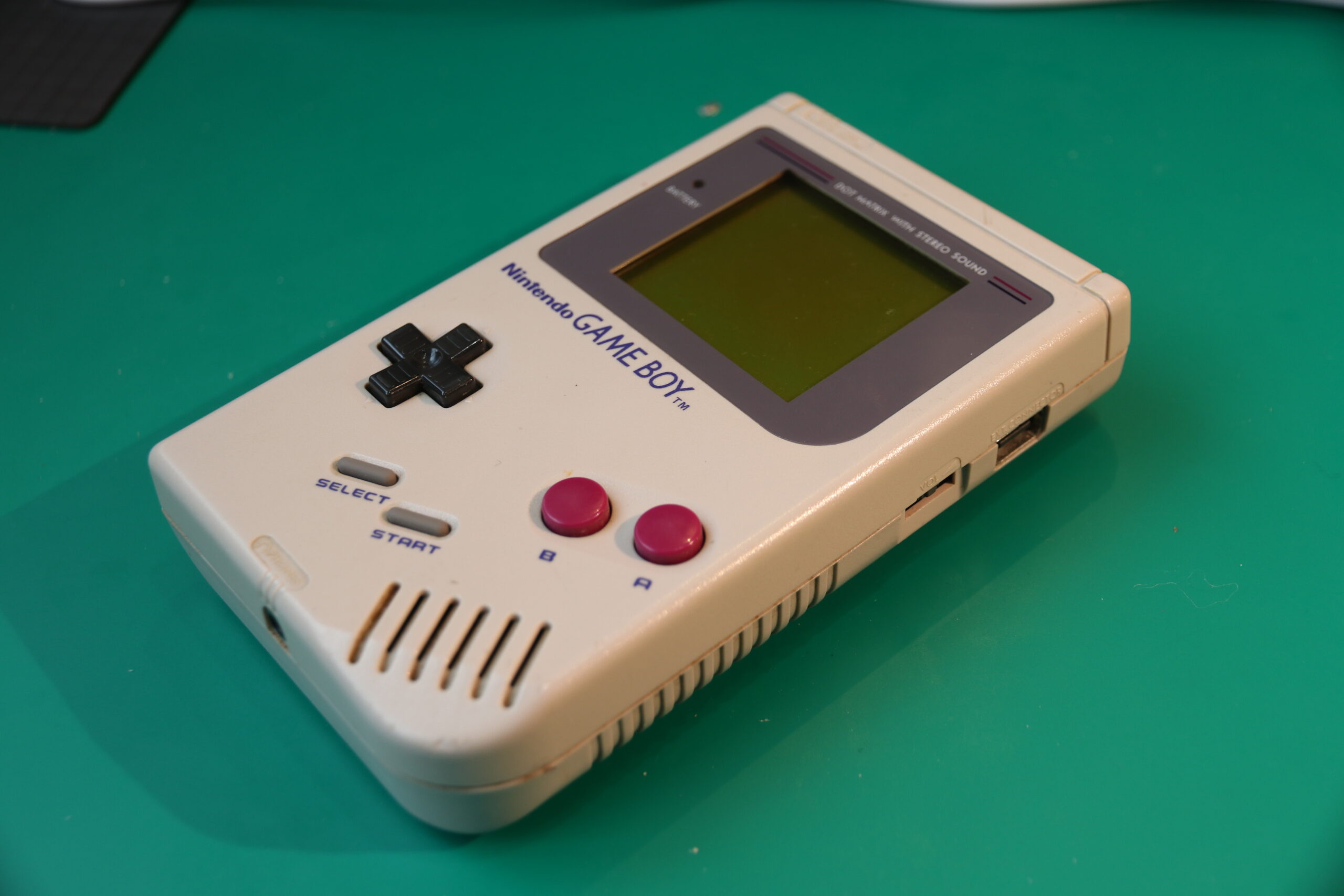
In the latest issue of The MagPi Magazine, Jeroen Domburg showcases his refurbed Nintendo Game Boy.
The Nintendo Game Boy – the iconic handheld video game console launched in 1989 – is no stranger to the pages of The MagPi. We’ve seen makers either stuff a Raspberry Pi computer into an original case or buy off-the-shelf projects, such as the superb RetroFlag GPi, and create their own from scratch. It’s great to see the device kept alive.
You can’t tell the difference between the finished DMGPlus project and the original Game Boy – all the alterations are inside
But just as we thought we’d seen it all, along came Jeroen Domburg, aka Sprite_tm. Like us, he’d seen a reasonable number of people modifying Game Boy cases to create portable RetroPie machines. “But because they wanted the thing to emulate as many consoles as possible, they usually went all-out with the modifications: high-resolution screen, Li-ion battery, HDMI and USB, multiple front buttons, shoulder buttons, the works,” he says.
“Obviously this would work really well, but it went against the original Game Boy looks. The projects could look like a weird mutation and it made me think, what if I went the other way? What if instead of sacrificing the original looks for playability, I sacrificed playability for the original looks?” Welcome then, DMGPlus: a handheld that looks familiar but has its internals replaced by something more powerful.
Pressing the right buttons
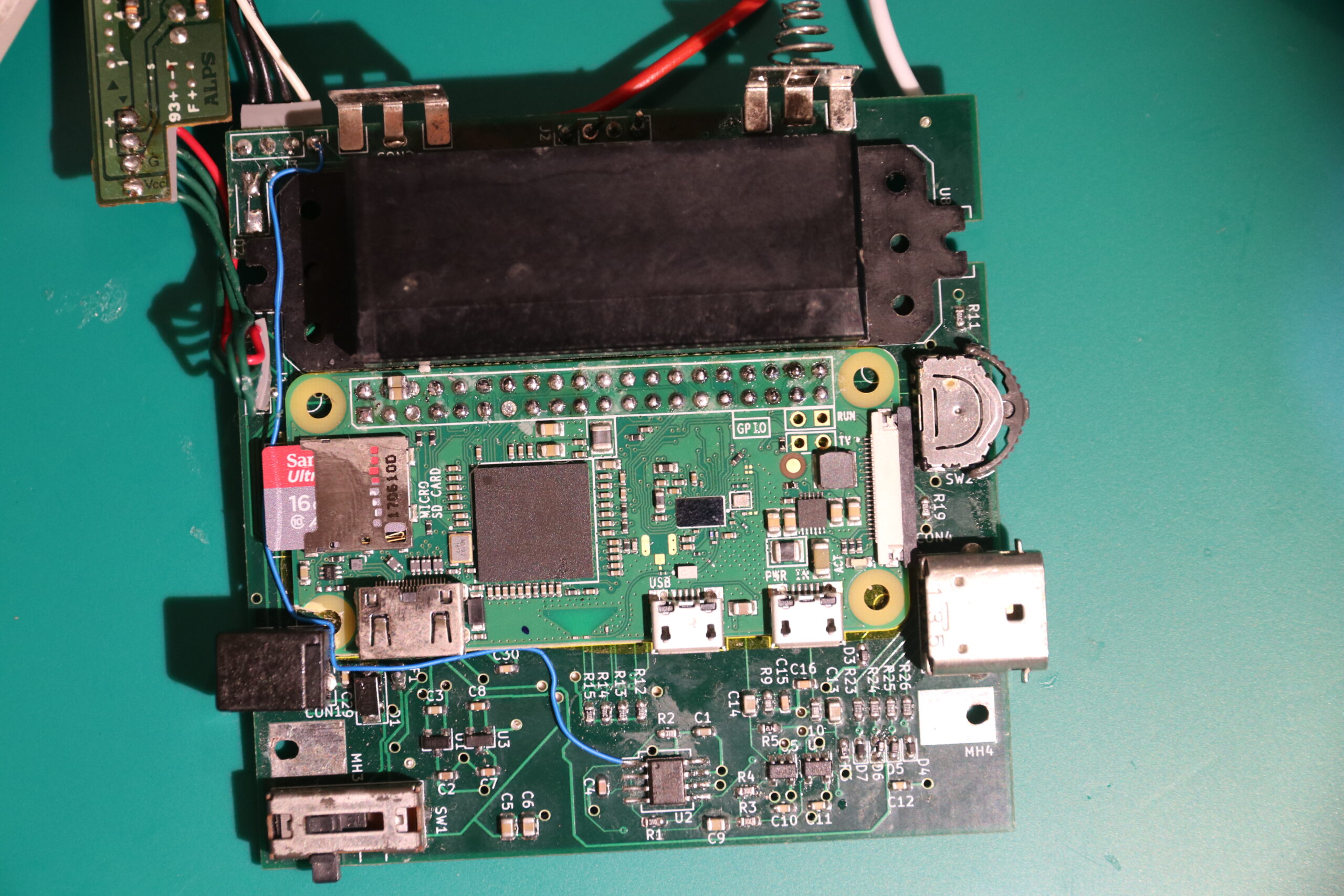
That something includes a Raspberry Pi Zero computer and a replacement motherboard containing a lower power, high performance ICE40 field-programmable gate array (FPGA). These are fixed either side of a new, printed circuit board, replacing the CPU, GPU, and memory.
The original hardware had a direct connection to the cartridge, but Raspberry Pi Zero has to communicate with the FPGA via the SPI port. To speed things up, the emulator reads an entire region from a cart
Jeroen has retained the buttons, cartridge port, speaker, and link port, with everything capable of being run from four AA batteries, just like the original. “I did change the LCD a little bit by driving it in a smart way so that it can display 16 greys instead of the original four,” he enthuses.
And the upshot of that? “It ends up substantially increasing the number of games the Game Boy can play,” he continues. “Because of emulation, all of a sudden you can have access to games that originally ran on other consoles, some of which have specs way better than the original Game Boy.”
Work hard, play hard
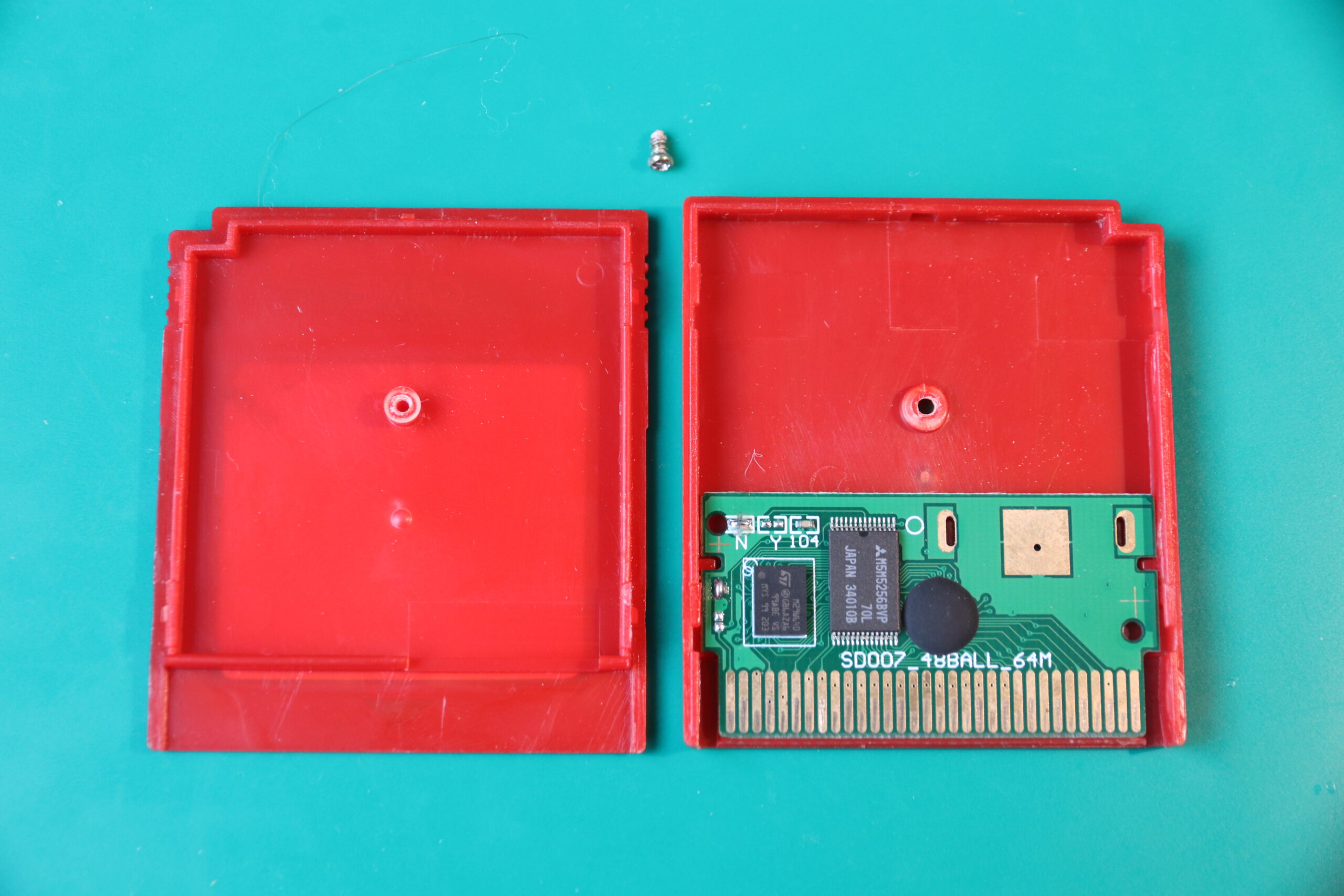
Making the build extra-special is its use of original carts, emulating the Game Boy experience so closely it’s difficult to tell if anything has changed. It uses the emulator Gnuboy and when Jeroen uses his own reproduction carts containing games not originally made for the Game Boy, Raspberry Pi Zero kicks in and runs the title natively.
This is a reproduction cart. Figuring how to program them properly was tricky because they’re used outside of their specified voltage range, even in a standard Game Boy
“Getting Raspberry Pi Zero to boot as fast as possible was tricky because it needed some rethinking of the boot process, as well as a kernel recompile to make it load within the time it took the Game Boy startup screen to finish,” Jeroen explains. “My hardware also takes a longer path: Raspberry Pi has to talk through the SPI port to the FPGA, which then needs to control the cartridge. Doing this for every byte that the game needs would be very slow, so the emulator uses caching.”
Raspberry Pi Zero seemed the perfect choice. Aside from being able to fit in the case, Jeroen said he knew he could get the video interface to do what he wanted. “Raspberry Pi has proper DPI support, outputting video over the GPIO pins so I could make the Game Boy LCD show up as just another frame buffer device,” he says. “That was important because I didn’t want to hack the video output system of every emulator or game I wanted to run it.”
The result is a stunning handheld console, but not one for the faint-hearted. “The big challenge was the need for custom hardware, custom software, custom gateware, and so on and it took a fair bit of time and effort to develop,” he says. “If you’re looking to replicate it, be prepared to put some work into tweaking and fixing things.”
Get The MagPi #109 NOW!
You can grab the brand-new issue right now from the Raspberry Pi Press store, or via our app on Android or iOS. You can also pick it up from supermarkets and newsagents. There’s also a free PDF you can download.
Mexico received 124 media workers and their family members from Afghanistan, including New York Times journalists.
They arrived at Mexico City’s international airport early on Wednesday morning, where Foreign Minister Marcelo Ebrard waited to greet them.
Mexico was able to “cut through the red tape” to take in the media workers, unlike the United States, the Times said.
Mexico and Afghanistan are considered among the most dangerous countries for journalists. At least 141 journalists have been murdered in Mexico since 2000, according to non-profit data. In July, Reuters journalist Danish Siddiqui was killed in Afghanistan after getting stuck in a Taliban-controlled area.
Journalists are often targeted for reporting on criminal gangs or corrupt officials. Journalists have been killed in Mexico and a German public broadcaster said to have killed one family member of a reporter working for Deutsche Welle.
Taliban seized power in Afghanistan last week as the U.S. and its allies withdrew troops after two decades and the Western-backed Afghan government and military collapsed.
The Taliban follow an ultra-hardline version of Sunni Islam. It has become more media-savvy since, using social media and promising to allow a free press.
TheHill
Afghan journalists who worked for The New York Times taken in by Mexico
Afghan journalists who worked for The New York Times landed in Mexico City this week after fleeing their native country due to the Taliban takeover,
Rocky Linux 8 users currently, by default, are only limited to the Firefox Internet Browser. However, many alternatives can be installed. Microsoft Edge is one alternative that has been in development for over a year and has been getting quite a lot of good reviews amongst many Linux distribution communities and maybe an alternative compared to just switching to Google Chrome.In the following tutorial, you will learn how to install Microsoft Edge on Rocky Linux 8.
It is an age of innovation at breakneck speeds and the unimaginable becoming commonplace. Technology has a foothold in society unlike ever before. Back in 1969, the Apollo 11 mission established the foundation for modern computing. Smartphones, now commonly wielded by pre-teens, are millions of times more powerful than the very computers that landed man on the moon. There is now so much capability in the palms of human hands.
Many are taking that technology and using it to facilitate big purchases. House hunting of the olden days meant tedious work – procuring newspapers from a desired location and pouring over them. It meant eyeing grainy photos and brief descriptions to try to figure out if the house was right. Now, house-hunting includes methods never before possible or likely even imagined.
“A few years ago, those in the real estate industry were a bit hesitant to fully accept technological advancement,” said Regan McGee, chairman and chief executive officer of Nobul, a platform created to facilitate the ease of real estate transactions. “There are a number of reasons as to why, but now we are seeing a catalyst in the industry prompted by the pandemic. Agents, buyers, and sellers are all recognizing that technology can prove a tremendous asset,” McGee added.
For example, real estate photography is its own unique art form, which at one time was viewed as cutting edge, but is now rather commonplace. After all, high-definition photos can allow buyers to clearly see the living space – a vital tool as realtors vie for the sale.
There are now real estate photography courses and certifications as photographers move into the niche market of photographing both staged and empty homes – finding the correct light and angles to properly represent – and sell – properties. Even the advancements of stunning photographs are being joined by drones. Graduates of drone school are now pushing the market of drone photography, particularly for real estate sales.
Virtual tours of homes allow for prospective homebuyers to place their cursors upon highlighted arrows and do complete walkthroughs of homes, without even stepping foot in them.
The sales tactic of baking cookies to make a home smell pleasant and inviting is now being replaced by high-end graphics online. The welcome mat is taking on less importance as buyers seek to welcome technology in the hunt.
Staging has been met with digital mockups as potential homebuyers can reimagine – and envision – complete transformations, including 3D room designs and virtual kitchen planners. Spatial intelligence or the ability to imagine rooms or concepts, a skill often found in interior designers and architects, is now a click away for people who want to reimage a living space.
The real estate market is now met with a level of creativity only made possible by technology. It is a new era and recent studies back up that buyers, sellers, and agents are embracing the times and using available tech.
The Real Estate in a Digital Age report compiled by REALTORS® in 2019 provides the data to support that belief.
A sign of the times: “In 1981, 22 percent of home buyers read newspaper ads to find a home and eight percent used friends as an information source. In 2018, 44 percent looked for properties online first.”
Potential buyers can now search for homes by neighborhood and location and the online aspect allows them to more efficiently and accurately compare and contrast homes that catch their interest, according to the study.
“The ability for buyers to narrow their search and to do virtual tours should prove a positive step for the entire industry – the ability to experience a home in such a way will allow them to narrow their search and should prove a timesaver for what can be a tedious process,” said McGee.
Technology is not replacing agents, as was the concern some years ago. In fact, according to the 2019 study, 87% of homebuyers are working closely with a real estate agent.
So the process begins online but is then often taken to an expert – an agent. Agent reviews, therefore, are taking on more importance and word-of-mouth recommendations remain a vital source of clients for agents.
The primary difference as discussed in the findings “is that home buyers are entering the process more educated about the market before they speak to a home seller or an agent.”
Regan McGee noted that this sort of progress is crucial to the industry.
“The entire goal of Nobul’s platform is to empower consumers in the real estate market. The more educated people are about their options and what they want, the happier they will be,” he said. “I see technology as continuing to facilitate home sales and purchases in positive ways.”
A run-through the top user-facing changes coming in GNOME 41, which is now in beta ahead of a stable release in September. There are new features, key improvements, and even a brand new app.
This article contains mild spoilers for season two, episode three of ‘Star Trek: Lower Decks.’
This week’s episode of Lower Decks, “We’ll Always Have Tom Paris,” manages to squeeze two references into its title: a season one The Next Generation installment called “We’ll Always Have Paris,” and the name of a main cast member of Star Trek: Voyager, Lieutenant Tom Eugene Paris. But aside from that clever bit of wordplay, the title also carries a deeper meaning: That as much as we’d like to forget about the more embarrassing moments of the Star Trek franchise, they still happened and they weren’t all bad. Even, and especially, Voyager.
CBS
Viewer reactions to Voyager have been rather polarized over the course of the 26 years since it premiered. Back in the ‘90s, many fans were excited to have a “real” Star Trek show again, one that took place on a ship that was constantly exploring, unlike the comparatively stationary political drama of Deep Space Nine. But clunky writing soured many people’s opinion on Voyager, and toward the end of its run the show was known more for Seven of Nine’s skintight outfits and its slate of guest stars of the week, including Jason Alexander and Dwayne “The Rock” Johnson.
After the show went off the air, the franchise stopped moving forward in its timeline, choosing to explore Starfleet’s founding in Enterprise and rebooting the entire universe completely with the 2009 Star Trek movie. While fans were thrown a bone with a brief cameo by Admiral Kathryn Janeway in the last TNG-era film, Nemesis, Voyager would essentially disappear from the Star Trek canon until the appearance of Seven of Nine in episode four of Picard.
Trae Patton
For fans of The Next Generation, Picard had its upsides: We got to see Troi and Riker as a family, and Data got a better sendoff into the afterlife. But for fans of Voyager, it was anything but positive, with the death of a supporting character and a rather grim existence for fan-favorite Seven of Nine.
Star Trek: Lower Decks rolls back the clock a little bit, as it takes place a year after the events of Nemesis, making it our first real view of the Star Trek universe’s immediate future after TNG, DS9 and Voyager. The Dominion War is over, Romulus is under a new regime and the crew of the USS Voyager are basically celebrities after seven years spent in the Delta Quadrant; Picard takes place nearly twenty years later, when the luster would have been gone.
Matt Kennedy
Here everything is just shiny and new and worthy of commemorative plates — a bit of a weird thing to exist in a post-scarcity culture, but this is a comedy series, after all. And in this week’s B-plot, Brad Boimler is looking to get one of his plates signed by a special guest to the USS Cerritos: Tom Paris. Or, as Brad refers to the former Voyager crew member, “Creator of Fairhaven, Captain Proton himself” as well as the first human to break the transwarp barrier. Straight off, that’s a reference to three of the goofiest, oddball and some say worst episodes of Star Trek: Voyager. And just in case you forgot what was so bad about the last one, Mariner asks “is he still a salamander?,” because that is a thing that happened in the episode “Threshold.”
Undeterred (and perhaps even encouraged) by the weirdness, Boimler is all hyped to meet his hero. Even after the ship’s system doesn’t recognize him and won’t let him through any doors, he takes to the Jefferies tubes to make his way to the bridge to meet Lt. Paris.
In a way, it feels like a metaphor for how the fandom feels about Star Trek: Voyager now. While everyone admits it had a lot of dumb moments, those actually made it moreendearing. The famous line “there’s coffee in that nebula” would inspire astronaut Samantha Cristoforetti to bring a replica uniform with her and wear it on a mission back in 2015:
— Samantha Cristoforetti (@AstroSamantha) April 17, 2015
And who can forget the infamous “Tuvix” episode, where crew members Tuvok and Neelix were merged into one being thanks to a transporter accident? Though the resulting individual was healthy and happy, the decision was made to force him to split back into his component persons, inspiring the recent internet rallying cry “Janeway murdered Tuvix.” Even Janeway actor Kate Mulgrew entered the debate, responding to a tweet from Congresswoman Alexandria Ocasio-Cortez. When you’ve got politicians involved it’s not really a fandom in-joke anymore.
Willing to hear the crew’s thoughts, as always. However, shouldn’t Tuvok and Neelix should have the biggest say…oh wait, they couldn’t! I stand by my decision to restore them to their lives. Rewatch and report back, AOC – and congrats on your win! 👏🏻
Maybe it’s time to give Voyager a bit more credit. It’s not as good as TNG or DS9, but it still has its fair share of fans. I remember a time when it seemed like it was constantly running on Spike TV (now the Paramount Network), as opposed to Deep Space Nine, which is seldom rerun due to its serialized nature. Last year I sat down and rewatched the entire Star Trek franchise, including Voyager, and saw quite a few episodes I had missed the first time. I found myself enjoying some of it, cringing just as often, and eventually remembering why I had stopped watching the show for a while back when it aired. In general, I feel like the show’s biggest problem was missed potential, like the way the conflict between the Starfleet and Maquis crew members was quickly smoothed over, how it underutilized many of its cast, and why on earth did Harry Kim never get promoted.
CBS
However, it’s not the job of Lower Decks to explain or redeem Voyager. Boimler and Tom Paris are only the B-plot here, with the main drive of the episode being Tendi and Mariner’s mission to pick up a package for Doctor T’Ana as well as Rutherford’s quest to find out how a certain dead officer is alive again. The episode just asks us to consider what it would be like to be a Starfleet officer and hear about all of Voyager’s adventures in the Delta Quadrant. Weird and goofy? Yes. But honestly, they’re also pretty cool.
The Government Accountability Office has revealed in a new report that 10 federal agencies are planning to expand their use of facial recognition. In a survey involving 24 federal agencies on their use of facial recognition technology, the Agriculture, Commerce, Defense, Homeland Security, Health and Human Services, Interior, Justice, State, Treasury and Veterans Affairs departments told GAO that they’re planning to use facial recognition in more areas through fiscal year 2023.
As The Washington Post notes, most agencies already use facial recognition to give their personnel access to their phones and computers. However, there’s a growing number of agencies using it to investigate crime and to track people. The Department of Agriculture apparently wants to monitor the live feeds at its facilities and scan for individuals in the watch list. Another agency wants to use it to automate identity verification for travelers at airports.
The agencies are planning this expansion despite the strengthening pushback against facial recognition systems. They’re still far from being perfectly accurate, especially when identifying women and POCs, and have led to false arrests in the past. In Detroit, their use led to the wrongful arrest of two men last year, both of whom are Black. The states of Massachusetts, Maine and Virginia banned law enforcement from using facial recognition. At the same time, several cities across the US, including Portland, Oregon, had also restricted their use. GAO’s report noted, however, that “recent advancements in facial recognition technology have increased its accuracy and its usage.”
Ten of GAO’s respondents have also revealed they’ve been involved in the research and development of facial recognition tech. For instance, they’re looking into the technology’s ability to identify individuals wearing masks and to detect image manipulation. In addition, several agencies, including the Justice Department, the Air Force and Immigration and Customs Enforcement, admitted to using Clearview AI. Clearview has been under fire for scraping people’s images from social networks over the past years without the companies’ knowledge or consent to build its database. As of last year, the system, which can identify people in real time, was reportedly in use by 600 police departments across the US, including the FBI and DHS.
NASA hopes that commercial space stations will orbit Earth once the International Space Station eventually retires, NASA Administrator Bill Nelson said today at the 36th Space Symposium. Space.com reports: The space station, which was completed in 2011, could retire as soon as 2024. However, today, Nelson revealed that he expects the orbiting lab to last to 2030 and that NASA hopes it will be replaced by commercial labs in orbit. “We expect to expand the space station as a government project all the way to 2030. And we hope it will be followed by commercial stations,” Nelson said during a “Heads of Agency” panel alongside other space leaders from around the world.
Now, while NASA hopes for commercial space stations to take over as the International Space Station nears the end of its tenure, China has already begun building its own space station. And, as NASA is prohibited from engaging in bilateral activities with China, this move by China is more competitive than collaborative. “Unfortunately, I believe we’re in a space race with China,” Nelson said during the panel. “I’m speaking on behalf of the United States, for China to be a partner. I’d like China to do with us as a military adversary, like Russia has done … I would like to try to do that. But China is very secretive, and part of the civilian space program is that you’ve got to be transparent.” Nelson pointed to Russia’s longstanding history as a collaborator alongside NASA in space, despite ongoing political divides back on Earth.
GitHub is a provider of Internet hosting for software development and version control using Git. It offers the distributed version control and source code management (SCM) functionality of Git and offers its basic services without charge. But it is not open source which puts some organisations in a difficult position to migrate where they rely on the non-Git elements of GitHub’s service offerings. Vendor lock-in is a legitimate concern.
From my past experience when I was new, Linux commands and terminals really scared me, I was worried about the commands, as to what extent I have to remember and memorize commands to get myself fully functional with Linux.
Clonezilla enables you to clone disks and partitions, storing resulting images on a backup storage device of your choice. Clonezilla Live 2.7.3 has been released based on Debian Sid. The new version adds support for mounting BitLocker device as image repository.
Going back to June of last year there has been work on Intel bringing up Advanced Matrix Extension (AMX) that will debut with next-gen Xeon “Sapphire Rapids” processors as a new programming paradigm. Over the past year they have published patches for the Linux kernel and open-source toolchains with GCC and LLVM Clang. One year later, the AMX kernel patches are up to their tenth revision but will miss out on the imminent Linux 5.15 merge window…
An anonymous reader quotes a report from Popular Mechanics, written by Laura Rider: After four long years of planning, the world’s first 3D-printed steel bridge debuted in Amsterdam last month. If it stands up to the elements, the bridge could be a blueprint for fixing our own structurally deficient infrastructure in the U.S. — and we sorely need the help. Dutch Company MX3D built the almost 40-foot-long bridge for pedestrians and cyclists to cross the city’s Oudezijds Achterburgwal canal. It relied on four robots, fit with welding torches, to 3D-print the structure. To do it, the machines laid out 10,000 pounds of steel, heated to 2,732 degrees Fahrenheit, in an intricate layering process. The result? An award-winning design, pushing the boundaries of what steel can do.
Designers first came up with the concept for the bridge in 2015, with the goal of making an exceptionally efficient structure. To do so, they had to emphasize two things: simplicity and safety. To monitor the efficiency of their design, scientists at Imperial College London engineered the bridge to be a “living laboratory.” A team of structural engineers, computer scientists, and statisticians developed a system of over one dozen embedded sensors for the bridge, which send live data to the university for further analysis of the bridge’s performance. They monitor the bridge’s movement, vibration, temperature, strain (the change in shape and size of materials under applied forces), and displacement (the amount an object shifts in a specific direction) over time. From that data, scientists built a “digital twin” — computer science parlance for an identical, virtual rendering — of the bridge that gets more accurate over time. With machine learning, they can now look for trends that might suggest modifications are in order.
For this bridge, designers utilized two methods of 3D printing — Direct Energy Deposit (DED) and Powder Bed Fusion (PBF). With DED, the printer feeds material (typically in powder or wire form) through a pen-like nozzle, and an intense heat source (typically a laser, but sometimes an electron beam) melts the metal on contact. PBF works similarly in that a laser or electron beam melts powder down to build each layer. The main advantage of PBF, though, is that it operates with much smaller (and more expensive) parts, resulting in a higher-resolution project than DED could accomplish on its own. This allows designers to take their visions a step further.
To say that Facebook’s Project Aria AR glasses were never meant for consumers would be an understatement. Facebook does not even consider them a prototype. And they are not, and may never be, available for purchase. Rather, Facebook has always described them as a way for its employees to study and test augmented reality tech.
Though Facebook’s announcement at the time made clear the company’s intentions, it was light on details about how the glasses would actually work. Now, nearly a year after the initial launch, a series of regulatory documents are giving us a belated first peek inside. In a user manual first reported by Protocol, we learn that this specific device goes by the codename Gemini EVT, with EVT being an abbreviation for “engineering valuation test.”
As you might expect, given the stated purpose of the device, there is no visual AR component. Meaning, there’s no built-in display for viewing 3D image overlays. Again, the glasses in their early form really do exist just for this small team of engineers to collect data.
Not that you can buy one but if you could, the glasses would also support prescription lenses, the manual reveals.
Additionally, the manual indicates there’s a proximity sensor on the inner temple, along with four cameras that can capture both video and still photos. Interestingly, Facebook used the same camera sensors here that it did on the Oculus Quest 2 headset, our review of which we published the same day in September last year that Facebook announced Project Aria. Given the timing, it may just be those sensors were the most readily available to Facebook.
Also inside is a Qualcomm chipset, with a modified version of Android powering the software experience. Charging happens via a USB cable, which attached magnetically to the glasses.
The user experience seems simple, as far as we can tell. There are shutter and power buttons, plus a mute switch that “toggles privacy mode on/off.” When a recording is in progress, a series of LEDs help passerby understand that the camera is on. Meanwhile, there’s a companion iOS app called Ariane that handles the basics: device setup, scanning for WiFi networks, showing the battery status and uploading what data the sensors have collected. It’s unclear, however, if there is also an Android version of the app that exists, or is in the works. Again, not that you’d be able to download it either way.
A Norwegian company has created the world’s first zero-emission, autonomous cargo ship that is expected to journey between two Norwegian towns before the end of the year. CNN reports: It’s not the first autonomous ship — an autonomous ferry launched in Finland in 2018 — but it is the first fully electric container ship, say its makers. Developed by chemical company Yara International, the Yara Birkeland was designed to reduce emissions of nitrogen oxides, which are toxic pollutants and greenhouse gases, and carbon dioxide, as well as moving freight away from roads to the sea. The shipping industry currently accounts for between 2.5% and 3% of global greenhouse gases emissions, according to the International Maritime Organization.
First conceptualized in 2017, the ship was created in partnership with technology firm Kongsberg Maritime and shipbuilder Vard. Capable of carrying 103 containers and with a top speed of 13 knots, it will use a 7 MWh battery, with “about a thousand times the capacity of one electrical car,” according to Jon Sletten, plant manager for Yara’s factory in Porsgrunn, Norway. He says it will be charged at the quayside “before sailing to container harbors along the coast and then back again, replacing 40,000 truck journeys a year.”
The cybersecurity company Red Code Labs has created an open source tool called easyWSL, which can be used to convert virtually any Docker image of a Linux distro to boot with WSL. Learn more about the new tool here.
Greg Kroah-Hartman talks to El Reg about world domination, what was, and what may be for the kernelInterview On August 25, 1991, Linus Torvalds, then a student at the University of Helsinki in Finland, sent a message to the comp.os.minix newsgroup soliciting feature suggestions for a free Unix-like operating system he was developing as a hobby.…