Alligator gar both sucks and chomps to catch its prey, new study finds

Scientists had assumed the alligator gar catches its prey simply by slamming its powerful, tooth-y jaws shut. But according to a new study posted to the pre-print site bioRxiv, the fish also creates a fast, powerful suction force to suck prey into its jaws by moving the bones in its skull and shoulder. The paper is currently undergoing peer review for the Journal of Morphology.

Alligator gar are the largest species in the gar family of freshwater fish, and they can grow as large as 10 feet and 300 pounds. They are often dubbed “living fossils” because their earliest ancestors in the fossil record date back over one hundred million years to the Early Cretaceous period. Once considered a “trash fish,” they are primarily found in the southern US (Arkansas, Louisiana, Texas) along the Gulf of Mexico.

They get their colloquial name from the fact that they share a broad snout and long teeth with the American alligator—most other gar have long slender snouts. Because of this, it was assumed that the alligator gar used a similar lateral snap of the jaw for feeding, but according to lead author Justin Lemberg of the University of Chicago, the jaws of the alligator gar have a lot more joints, and hence greater mobility, than their reptile namesakes.

Read 7 remaining paragraphs | Comments


Source: Ars Technica – Alligator gar both sucks and chomps to catch its prey, new study finds

Florida Utility To Close Two Natural Gas Plants, Build World's Largest Solar Battery System

An anonymous reader quotes a report from Electrek: Florida Power & Light has joined the race to build the world’s largest solar battery storage system, announcing plans for its massive Manatee Energy Storage Center. The utility plans to build a 409 MW/900 MWh battery, to be powered by an existing FPL solar plant in Manatee County, Florida. It will begin serving customers in 2021. FPL says the battery system will be able to power 329,000 homes for two hours. For comparison, FPL notes the battery system is equivalent to 100 million iPhone batteries, or 300 million AA batteries. The system will be used in periods of high demand. The utility company also said that it will accelerate the retirement of two natural gas facilities at a nearby power plant. “FPL says the project will save customers more than $100 million while eliminating more than 1 million tons of carbon emissions, though no cost estimates for the project were disclosed,” reports Electrek. And while the Manatee Energy Storage Center is projected to be the “world’s largest solar-powered battery storage system,” it will have some competition from Texas where there are plans to build a 495 MW battery storage system that would be paired with an equivalent 495 MW solar farm in Borden County, Texas. It too is due to come online in 2021.

Read more of this story at Slashdot.


Source: Slashdot – Florida Utility To Close Two Natural Gas Plants, Build World’s Largest Solar Battery System

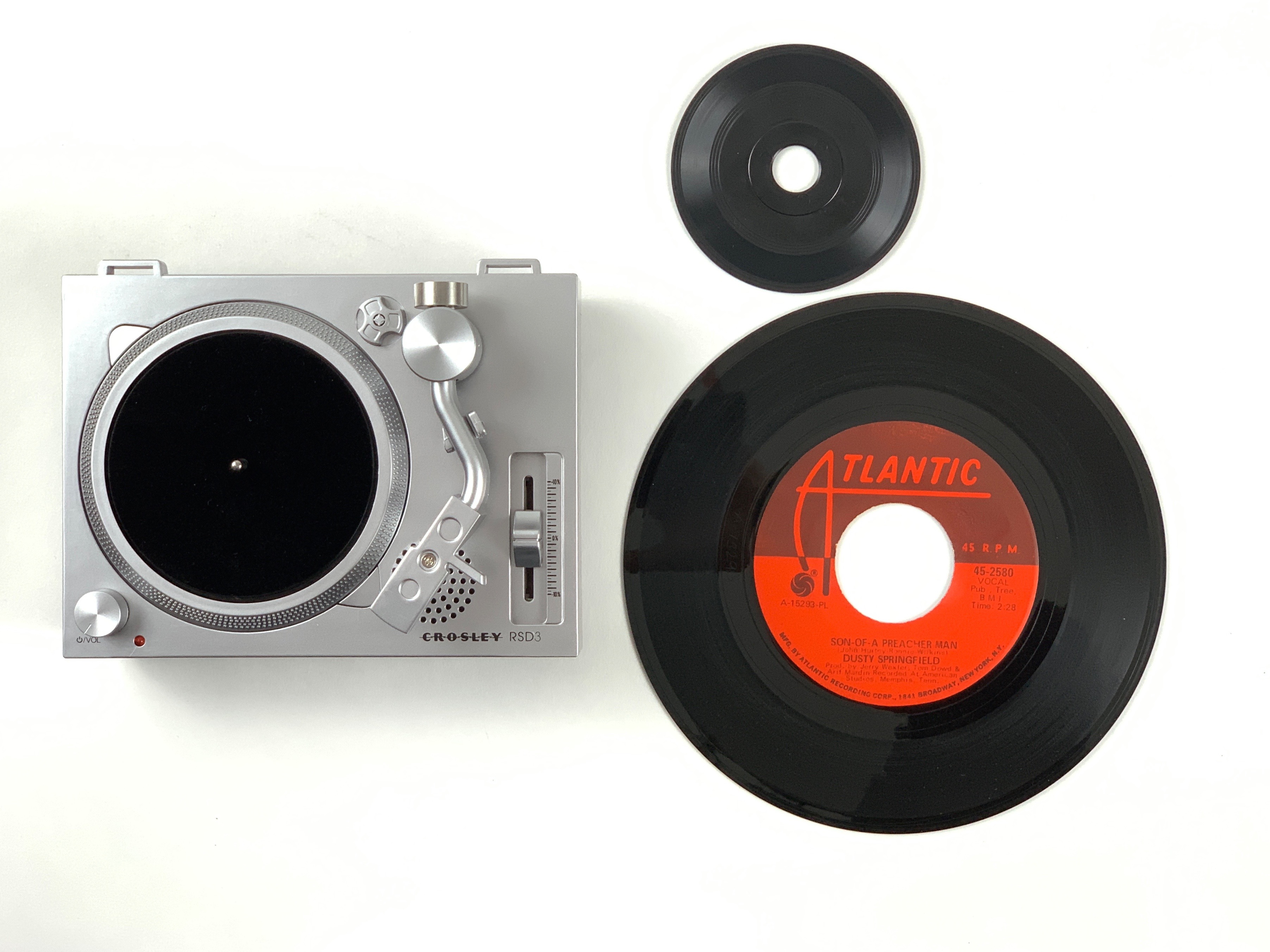
The possible, curious comeback of 3-inch vinyl records

This tiny turntable will be released, along with eight 3” singles from Epitaph Records and Third Man Records on April 13, 2019, aka Record Store Day.

Enlarge / This tiny turntable will be released, along with eight 3” singles from Epitaph Records and Third Man Records on April 13, 2019, aka Record Store Day. (credit: Chris Foresman)

History is littered with dead audio formats, from Elcaset to 8-track tapes, wire recording to “talking rubber.” Yet so far, vinyl has consistently resisted going quietly into that good night. Today, unit sales are up 800 percent from ten years ago, and companies continue to produce turntables of all shapes and sizes (they even steal CES headlines from the latest Internet-of-whatever device).

So while we may no longer want them in our automobiles, in home record players appear to be thriving whether due to an appreciation of physical media, tactile rituals, or multi sensory experiences. And on this wave of modern record appreciation, one of the most obscure vinyl formats is getting a second lease on life thanks to Record Store Day.

If you’ve heard of 3” vinyl singles at all, you have the enigmatic frontman of The White Stripes to thank for that. Jack White’s label Third Man Records imported the tiny format from Japan nearly 15 years ago for a limited series of White Stripes singles. The original player—a cheap toy from Japanese maker Bandai—was abandoned almost as quickly as it launched. Outside of a few rabid White Stripes fans or Japan-o-philes willing to part with anywhere from a few hundred to as much two-thousand dollars on eBay, few in the US have even seen one, let alone listened to it.

Read 60 remaining paragraphs | Comments


Source: Ars Technica – The possible, curious comeback of 3-inch vinyl records

The Thermal Performance Of NVIDIA's Jetson Nano $99 Developer Board

One of the exciting product launches for this month has been the introduction of the NVIDIA Jetson Nano as a $99 Arm developer board offering four Cortex-A57 cores that isn’t too special itself but packing in a 128-core Maxwell NVIDIA GPU makes this board interesting for the price. Out-of-the-box the Jetson Nano is just passively cooled by a small aluminum heatsink, but does it work any better if actively cooled to avoid any potential thermal throttling? Here are some thermal benchmarks.

Source: Phoronix – The Thermal Performance Of NVIDIA’s Jetson Nano Developer Board

Can AI be a fair judge in court? Estonia thinks so

Illustration of a toy robot using a rotary telephone.

Enlarge / An honorable Estonian future judge, presumably. (credit: Getty Images | Charles Taylor)

Government usually isn’t the place to look for innovation in IT or new technologies like artificial intelligence. But Ott Velsberg might change your mind. As Estonia’s chief data officer, the 28-year-old graduate student is overseeing the tiny Baltic nation’s push to insert artificial intelligence and machine learning into services provided to its 1.3 million citizens.

“We want the government to be as lean as possible,” says the wiry, bespectacled Velsberg, an Estonian who is writing his PhD thesis at Sweden’s Umeå University on using the Internet of Things and sensor data in government services. Estonia’s government hired Velsberg last August to run a new project to introduce AI into various ministries to streamline services offered to residents.

Deploying AI is crucial, he says. “Some people worry that if we lower the number of civil employees, the quality of service will suffer. But the AI agent will help us.” About 22 percent of Estonians work for the government; that’s about average for European countries, but higher than the 18 percent rate in the US.

Read 20 remaining paragraphs | Comments


Source: Ars Technica – Can AI be a fair judge in court? Estonia thinks so

Physicists Predict a Way To Squeeze Light From the Vacuum of Empty Space

sciencehabit shares an excerpt from Science Magazine: Talk about getting something for nothing. Physicists predict that just by shooting charged particles through an electromagnetic field, it should be possible to generate light from the empty vacuum. In principle, the effect could provide a new way to test the fundamental theory of electricity and magnetism, known as quantum electrodynamics, the most precise theory in all of science. In practice, spotting the effect would require lasers and particle accelerators far more powerful than any that exist now. Physicists have long known that energetic charged particles can radiate light when they zip through a transparent medium such as water or a gas. In the medium, light travels slower than it does in empty space, allowing a particle such as an electron or proton to potentially fly faster than light. When that happens, the particle generates an electromagnetic shockwave, just as a supersonic jet creates a shockwave in air. But whereas the jet’s shockwave creates a sonic boom, the electromagnetic shockwave creates light called Cherenkov radiation. That effect causes the water in the cores of nuclear reactors to glow blue, and it’s been used to make particle detectors.

However, it should be possible to ditch the material and produce Cherenkov light straight from the vacuum, predict Dino Jaroszynski, a physicist at the University of Strathclyde in Glasgow, U.K., and colleagues. The trick is to shoot the particles through an extremely intense electromagnetic field instead. According to quantum theory, the vacuum roils with particle-antiparticle pairs flitting in and out of existence too quickly to observe directly. The application of a strong electromagnetic field can polarize those pairs, however, pushing positive and negative particles in opposite directions. Passing photons then interact with the not-quite-there pairs so that the polarized vacuum acts a bit like a transparent medium in which light travels slightly slower than in an ordinary vacuum, Jaroszynski and colleagues calculate. Putting two and two together, an energetic charged particle passing through a sufficiently strong electromagnetic field should produce Cherenkov radiation, the team reports in a paper in press at Physical Review Letters. Others had suggested vacuum Cherenkov radiation should exist in certain situations, but the new work takes a more fundamental and all-encompassing approach, says Adam Noble, a physicist at Strathclyde.

Read more of this story at Slashdot.


Source: Slashdot – Physicists Predict a Way To Squeeze Light From the Vacuum of Empty Space

Valve freezes updates on 'Artifact' to face 'deep-rooted' issues

Last year Valve launched a Dota 2 card game spin-off that took aim Hearthstone and Gwent, but according to the team, Artifact hasn’t lived up to anyone’s expectations. In a blog post, Valve announced it’s dropping the old plan of developing a stream…

Source: Engadget – Valve freezes updates on ‘Artifact’ to face ‘deep-rooted’ issues

Tesla Hacking Report Is a Good Reminder of the Risks of Stored Data

It can be easy to forget how much personal data we share with the various technologies geared at streamlining our lives, be they voice assistants, smart home devices, or the phones we carry with us virtually everywhere. And if you own a car, that may go for your ride too.

Read more…


Source: Gizmodo – Tesla Hacking Report Is a Good Reminder of the Risks of Stored Data

Valve Reveals High-End VR Headset Called the Valve Index

After partnering with HTC to launch the Vive in 2016, Valve has moved ahead with plans to launch its own headset, called the Valve Index, in May 2019. Ars Technica reports: The news came on Friday in the form of a single teaser image, shown above, of a headset with the phrase “Valve Index” written on its front. The front of the headset is flanked by at least two sensors. This shadow-covered hardware matches the leaked headset reported by UploadVR in November of last year. That report hinted to Valve’s headset supporting a wider, 135-degree field-of-view (FOV), as opposed to the roughly 110-degree FOV of the original HTC Vive and Oculus Rift.

Valve’s dedicated website for the new device includes no other information than the above image and the date “May 2019.” It does not include any mention of the new SteamVR Knuckles controllers, which Valve has advertised pretty heavily via developer outreach since their 2016 reveal and a later series of improved prototypes in 2018. This page also doesn’t mention a series of three Valve-produced VR games that have been repeatedly advertised by Valve co-founder Gabe Newell since 2017. There’s very little information about the headset, but after cranking up the brightness and contrast of the teaser image, Ars Technica’s Sam Machkovech was able to find “a series of six dots on one of the headset’s surfaces, […] which may hint to this headset’s use of an outside tracking sensor, a la the HTC Vive’s infrared trackers.” He adds: “Even so, those two giant lenses imply that ‘inside-out’ tracking, managed entirely by the headset without any extra webcams or sensors, may also be in the cards. Additionally, we can see a giant physical slider, which is likely linked to interpupillary distance (IPD), a precise measurement needed to ensure maximum VR comfort.”

Read more of this story at Slashdot.


Source: Slashdot – Valve Reveals High-End VR Headset Called the Valve Index

Scientists Find Genetic Mutation That Makes Women Feel No Pain

An anonymous reader quotes a report from The Guardian: Doctors have identified a new mutation in a woman who is barely able to feel pain or stress after a surgeon who was baffled by her recovery from an operation referred her for genetic testing. Jo Cameron, 71, has a mutation in a previously unknown gene which scientists believe must play a major role in pain signaling, mood and memory. The discovery has boosted hopes of new treatments for chronic pain which affects millions of people globally.

In a case report published on Thursday in the British Journal of Anaesthesia, the UCL team describe how they delved into Cameron’s DNA to see what makes her so unusual. They found two notable mutations. Together, they suppress pain and anxiety, while boosting happiness and, apparently, forgetfulness and wound healing. The first mutation the scientists spotted is common in the general population. It dampens down the activity of a gene called FAAH. The gene makes an enzyme that breaks down anandamide, a chemical in the body that is central to pain sensation, mood and memory. Anandamide works in a similar way to the active ingredients of cannabis. The less it is broken down, the more its analgesic and other effects are felt.

The second mutation was a missing chunk of DNA that mystified scientists at first. Further analysis showed that the “deletion” chopped the front off a nearby, previously unknown gene the scientists named FAAH-OUT. The researchers think this new gene works like a volume control on the FAAH gene. Disable it with a mutation like Cameron has and FAAH falls silent. The upshot is that anandamide, a natural cannabinoid, builds up in the system. Cameron has twice as much anandamide as those in the general population.

Read more of this story at Slashdot.


Source: Slashdot – Scientists Find Genetic Mutation That Makes Women Feel No Pain