

Our photo of the day is the picture of contentment … and a lesson in anatomy.
Source: TreeHugger – Photo: Secrets of the squirrel tail revealed
Monthly Archives: January 2018
Microsoft's new Windows 10 Spectre patch disables Intel's 'fix'
 Intel recently admitted that its latest patch for “Spectre” was essentially worse than the bug it was supposed to fix, as it was causing computers to spontaneously reboot. Now, Microsoft has taken action by issuing an out-of-band patch for Windows 7,…
Source: Engadget – Microsoft’s new Windows 10 Spectre patch disables Intel’s ‘fix’
Normal Phones Doing Normal Dude Stuff on a Budget
I know a lot of HardOCP readers figured this out a long time ago. There is no way in hell you need pay these huge prices for the latest phone when you are just doing “regular guy stuff” with it. Cageymaru pointed me to this video that Louis Rossman has put together that is about 1 hour long. He takes his time and show some very real world usage scenarios and how those experiences change between phones. $230 Moto G vs $350 Samsung S7. Good stuff.
Discussion
Source: [H]ardOCP – Normal Phones Doing Normal Dude Stuff on a Budget
Another Day Another CryptoRube
Haha! Only $150K in Ethereum this time.
A hacker has tricked Experty ICO participants into sending Ethereum funds to the wrong wallet address. He was able to do this by sending emails with a fake pre-ICO sale announcement to Experty users who signed up for notifications.
An ICO (Initial Coin Offering) is similar to a classic IPO (Initial Public Offering), but instead of stocks in a company, buyers get tokens in an online platform. Users can keep the tokens until the issuing company decides to repurchase them, or they can sell the tokens to other users for Ethereum.
Discussion
Source: [H]ardOCP – Another Day Another CryptoRube
Solving the Automotive Bandwidth Problem: Aquantia Partners with NVIDIA for 10GbE

One of the lesser known topics around fully autonomous vehicles is one of transporting data around. There are usually two options: transport raw image and sensor data with super low latency but with high bandwidth requirements, or use encoding tools and DSPs to send fewer bits but at a higher latency. As we move into development of the first Level 4 (near autonomous) and Level 5 (fully autonomous) vehicle systems, for safety and response time reasons, low latency has won. This means shifting data around, and a lot of it.

Bandwidth required, in Gbps for raw video at a given resolution and frame rate, also at a specific color depth. E.g. 720p30 at 24-bit RGB (8-bit per color) is 0.66 Gbps
Raw camera data is big: a 1080p60 video, with 8-bits of color per channel, requires a bandwidth of 0.373 GB/s. That is gigabytes per second, or the equivalent of 2.99 gigabits per second, per camera. Now strap anywhere from 4 to 8 of these sensors on board, the switches needed to manage them, the redundancy required for autonomy to still work if one element gets taken offline, and we hit a bandwidth problem. Gigabit simply isn’t enough.
The announcement today is two fold: NVIDIA and Aquantia are announcing a partnership that means Aquantia based network controllers and PHYs will be used inside NVIDIA’s DrivePX Xavier platform, and subsequently the Pegasus platform as well. The second announcement is the new automotive product stack from Aquantia, AQcelerate, consisting of three chips depending on the automotive networking requirement.
| Aquantia AQcelerate for Automotive | |||||
| Type | Input | Output | Use Case | Package Size (FCBGA) |
|
| AQC100 | PHY | 2500Base-X USXGMII XFI KR |
10GbE 5GbE 2.5GbE |
ADAS Cameras Parking Assist Sensors Telematics Audio/Video Infotainment |
– |
| AQVC100 | MAC | XFI | PCIe 2/3 x2/x4 | 7×11 mm | |
| AQVC107 | Both | PCIe 2/3 x1/x2/x4 |
10GbE 5GbE 2.5GbE |
12×14 mm | |
For the three new chips, one is a PHY, one is a PCIe network controller, and a third combines the two. The PHY can take a standard camera inputs (2500BASE-X, USXGMII, and XFI) and send the data through multi-gigabit Ethernet as required. The controller can take standard XFI 10 Gb SerDes data and output direct to PCIe, while the combination chip is as a regular MACPHY combo, converting Ethernet data to PCIe. All three chips are built on a 28nm process (Aquantia works with both TSMC and GloFo, but stated that for these products the fab is not being announced), and qualified for the AEC-Q100 industry standard.


Click to enlarge block diagrams
The benefits of using multi-gigabit, as explained to us by Aquantia, is that it allows for a 2.5G connection using only a standard twisted pair cable, or 5G for dual pair, up to 10G for quad pair. Current automotive networking systems are based on single pair 100/1000Mbit technology, which is insufficient for the high bandwidth, low latency requirements that companies like NVIDIA put into their Level 4/5 systems.
These chips were designed on Aquantia’s roadmap before its collaboration with NVIDIA, however NVIDIA approached Aquantia looking for something to work, given Aquantia’s current march on multi-gigabit Ethernet ahead of its rivals. We are told that the silicon doesn’t do anything special and specific with NVIDIA, allowing other companies keen on automotive technology to use Aquantia as well. With Aquantia’s lead in the multi-gigabit Ethernet space, over say Intel, Qualcomm, and Realtek, it seems that the only option at this point for wired connectivity, if you need to send raw data, is something like this. However, the lead time for collaboration seems to be substantial: Aquantia stated that NVIDIA’s Gary Shapiro recorded promotional material for them in the middle of last year, however Xavier was announced in 2016, so it is likely that Aquantia and NVIDIA were looking at integration before then.

A quick side discussion on managing all this data. If there is 16 GB/s from all the sensors flying around, the internal switches and SoCs has to be able to handle it. At CES, NVIDIA provided a base block diagram of an Xavier SoC, including some details about its custom ARM cores, its GPU, the DSPs, and some about the networking.

Image via CNX-Software
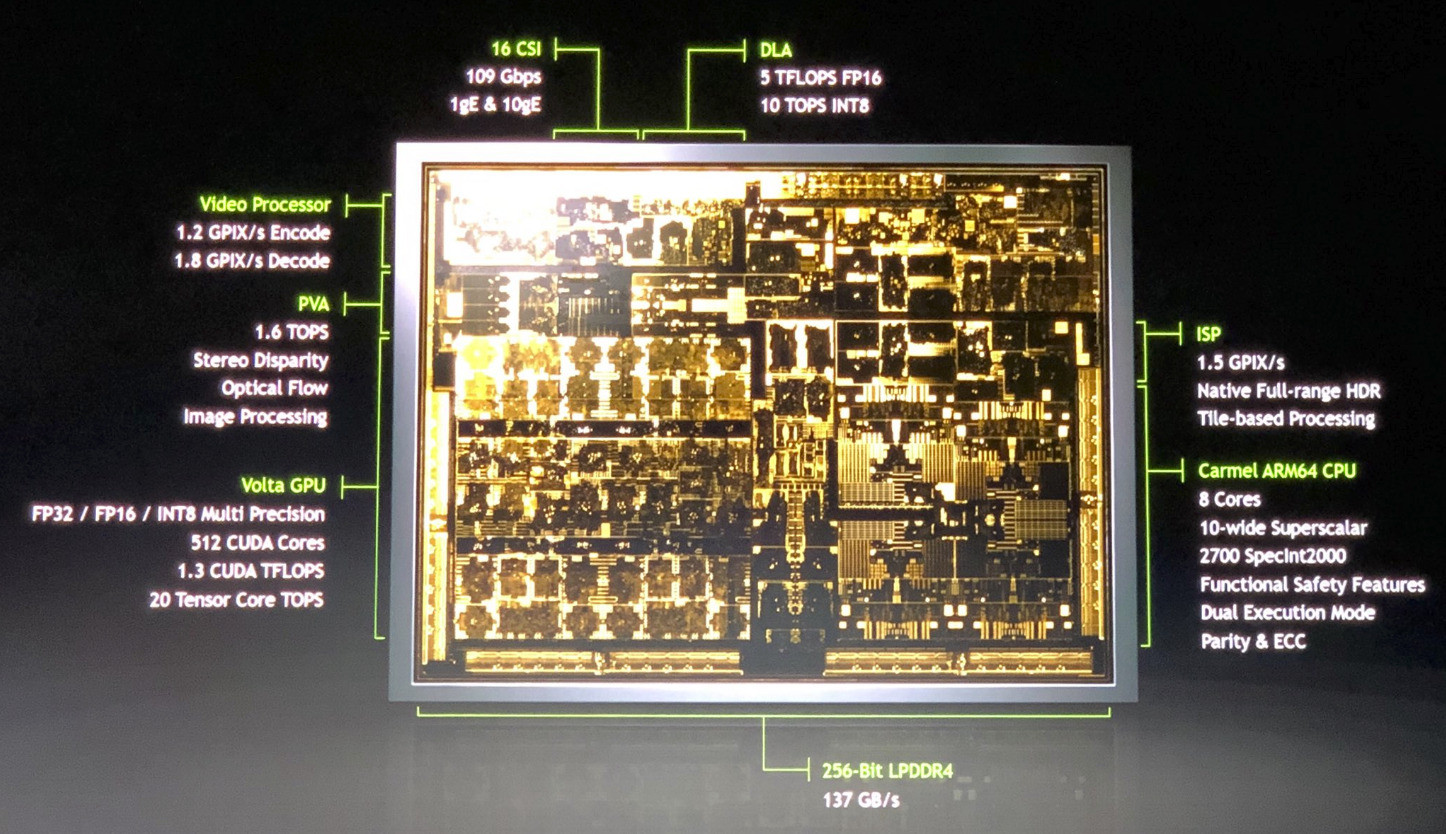
The slide shows that the silicon has gigabit and 10 gigabit embedded in (so it just needs a PHY to work), as well as 109 Gbps total networking support. On the Video Processor, it supports 1.8 gigapixel/s decode, which if we plug in some numbers (1080p60 = 124MPixel/s) allows for about a dozen or so cameras at 8bit color, or a combination of 4K cameras and other sensors. The images of the Xavier also show the ISP, capable of 1.5 gigapixel/s.

An mockup example from Aquantia showed a potential Level 4/5 autonomous arrangement, with 10 RADAR/LIDAR/SONAR sensors, 8 cameras, and a total of 18 PHYs, two controllers, and three switches. Bearing in mind that there is a level of redundancy for these systems (cameras and sensors should connect two at least two switches, if one CPU fails than another can take over, etc), then this is a lot of networking silicon to go into a single car, and a large potential for anyone who can get the multi-gigabit data transfer done right. The question then comes down to power, which is something Aquantia is not revealing at this time, instead preferring to allow NVIDIA to quote a system wide level power.
The image at the top is the setup shown to us by Aquantia at CES, demonstrating a switch using AQcelerate silicon capable of supporting various cables, including the vital 2.5 Gbps over a single pair.
Related Reading
- Aquantia Launches New 2.5G/5G Multi-Gigabit Network Controllers for PCs
- Aquantia Launch AQtion 5G/2.5G/1G Multi-Gigabit Ethernet Cards (NICs) for PCIe
- Lower Cost 10GBase-T Switches Coming: 4, 5 and 8-port Aquantia Solutions at ~$30/Port
- Dell Now Offers Aquantia AQtion AQN-108-Based 5 GbE Cards with Select PCs
Source: AnandTech – Solving the Automotive Bandwidth Problem: Aquantia Partners with NVIDIA for 10GbE
Save $8 On Anker's Excellent Qi Charging Pad

The recent release of Qi-compatible iPhones means that wireless charging pads are flying off the shelves, and you can score Anker’s 10W model for $8 off today with promo code BEST2539.
Source: LifeHacker – Save On Anker’s Excellent Qi Charging Pad
Mesa 18.0-RC3 Released With 50+ Changes
Emil Velikov announced the release today of Mesa 18.0-RC3 with 50+ changes comprising of many Intel ANV and Radeon RADV Vulkan driver fixes…
Source: Phoronix – Mesa 18.0-RC3 Released With 50+ Changes
The EVGA X299 FTW K Motherboard Review: Dual U.2 Ports
The EVGA X299 FTW K is our first X299 motherboard from EVGA. The FTW K aims to bring users a solid power delivery, three-way multi-GPU capabilities, two M.2 slots, and a unique feature so far on our X299 coverage: two U.2 ports. The X299 FTW K looks to fit into the crowded mid-range segment for X299 motherboards at its price point. We will put it on the test bed and gave it a thorough inspection.
Source: AnandTech – The EVGA X299 FTW K Motherboard Review: Dual U.2 Ports
2017 Weather Station round-up
As we head into 2018 and start looking forward to longer days in the Northern hemisphere, I thought I’d take a look back at last year’s weather using data from Raspberry Pi Oracle Weather Stations. One of the great things about the kit is that as well as uploading all its readings to the shared online Oracle database, it stores them locally on the Pi in a MySQL or MariaDB database. This means you can use the power of SQL queries coupled with Python code to do automatic data analysis.
Soggy Surrey
My Weather Station has only been installed since May, so I didn’t have a full 52 weeks of my own data to investigate. Still, my station recorded more than 70000 measurements. Living in England, the first thing I wanted to know was: which was the wettest month? Unsurprisingly, both in terms of average daily rainfall and total rainfall, the start of the summer period — exactly when I went on a staycation — was the soggiest:
What about the global Weather Station community?
Even soggier Bavaria
Here things get slightly trickier. Although we have a shiny Oracle database full of all participating schools’ sensor readings, some of the data needs careful interpretation. Many kits are used as part of the school curriculum and do not always record genuine outdoor conditions. Nevertheless, it appears that Adalbert Stifter Gymnasium in Bavaria, Germany, had an even wetter 2017 than my home did:
Where the wind blows
The records Robert-Dannemann Schule in Westerstede, Germany, is a good example of data which was most likely collected while testing and investigating the weather station sensors, rather than in genuine external conditions. Unless this school’s Weather Station was transported to a planet which suffers from extreme hurricanes, it wasn’t actually subjected to wind speeds above 1000km/h in November. Dismissing these and all similarly suspect records, I decided to award the ‘Windiest location of the year’ prize to CEIP Noalla-Telleiro, Spain.
This school is right on the coast, and is subject to some strong and squally weather systems.

Weather Station at CEIP Noalla-Telleiro
They’ve mounted their wind vane and anemometer nice and high, so I can see how they were able to record such high wind velocities.
A couple of Weather Stations have recently been commissioned in equally exposed places — it will be interesting to see whether they will record even higher speeds during 2018.
Highs and lows
After careful analysis and a few disqualifications (a couple of Weather Stations in contention for this category were housed indoors), the ‘Hottest location’ award went to High School of Chalastra in Thessaloniki, Greece. There were a couple of Weather Stations (the one at The Marwadi Education Foundation in India, for example) that reported higher average temperatures than Chalastra’s 24.54 ºC. However, they had uploaded far fewer readings and their data coverage of 2017 was only partial.
At the other end of the thermometer, the location with the coldest average temperature is École de la Rose Sauvage in Calgary, Canada, with a very chilly 9.9 ºC.

Weather Station at École de la Rose Sauvage
I suspect this school has a good chance of retaining the title: their lowest 2017 temperature of -24 ºC is likely to be beaten in 2018 due to extreme weather currently bringing a freezing start to the year in that part of the world.
Analyse your own Weather Station data
If you have an Oracle Raspberry Pi Weather Station and would like to perform an annual review of your local data, you can use this Python script as a starting point. It will display a monthly summary of the temperature and rainfall for 2017, and you should be able to customise the code to focus on other sensor data or on a particular time of year. We’d love to see your results, so please share your findings with weather@raspberrypi.org, and we’ll send you some limited-edition Weather Station stickers.
The post 2017 Weather Station round-up appeared first on Raspberry Pi.
Source: Raspberry Pi – 2017 Weather Station round-up
UK hits its 95 percent ‘superfast’ broadband coverage target
‘Superfast’ broadband with speeds of at least 24 Mbps is now available across 95 percent of the UK, according to new stats thinkbroadband.com published today. The milestone was actually achieved last month, meaning the government’s Broadband Delivery…
Source: Engadget – UK hits its 95 percent ‘superfast’ broadband coverage target
Ask Slashdot: How Can I Build a Private TV Channel For My Kids?
Long-time Slashdot reader ljw1004 writes:
I want to assemble my OneDrive-hosted mp4s into a “TV channel” for my kids — so at 7am while I sleep in, they know they can turn the TV on, it will show Mr Rogers then Sesame Street then grandparents’ story-time, then two hand-picked cartoons, and nothing for the rest of the day. How would you do this? With Chromecast and write a JS Chrome plugin to drive it? Write an app for FireTV? Is there any existing OSS software for either the scheduling side (done by parents) or the TV-receiver side? How would you lock down the TV beyond just hiding the remote?
“There are good worthwhile things for them to see,” adds the original submission, “but they’re too young to be given the autonomy to pick them, and I can do better than Nickeloden or CBBC or Amazon Freetime Unlimited.”
Slashdot reader Rick Schumann suggested putting the video files on an external hard drive (or burning them to a DVD), while apraetor points out many TVs now play files from flash drives — and also suggests a private Roku channel. But what’s the best way to build a private TV channel for kids?
Leave your best answers in the comments.


Read more of this story at Slashdot.
Source: Slashdot – Ask Slashdot: How Can I Build a Private TV Channel For My Kids?
Upgrade All of Your Lights With Smart Bulbs For Just $14 Each, No Hub Required

Anker makes smart light bulbs now, because of course they do, and you can get them at a discount today.
Source: LifeHacker – Upgrade All of Your Lights With Smart Bulbs For Just Each, No Hub Required
Fitness App's 'Anonymized' Data Dump Accidentally Reveals Military Bases Around the World

People around the world use the app Strava on their smartphones and Fitbits to track how far they run. But researchers have discovered that an “anonymized” data dump released by Strava last year has accidentally revealed sensitive locations, including US military bases around the world.
Source: Gizmodo – Fitness App’s ‘Anonymized’ Data Dump Accidentally Reveals Military Bases Around the World
Trump Administration Reportedly Considering Nationalized 5G Network To Combat Foreign Attacks

Security officials in the Trump administration are reportedly thinking about building a national, centralized 5G wireless network within the next several years. If that should happen, it would be an unprecedented move and sure to spark a debate, both within the White House and across the nation. The reason, however, is that some security officials
Source: Hot Hardware – Trump Administration Reportedly Considering Nationalized 5G Network To Combat Foreign Attacks
Rimac gives a shadowy tease of its next electric hypercar
 If you’re in the rare crossover group of folks who are rich, environmentally conscious and want to drive dangerously fast, Rimac is building your car. The company teased its next-generation Rimac Hypercar and promised to fully unveil it at the Geneva…
Source: Engadget – Rimac gives a shadowy tease of its next electric hypercar
Behold, Japan's Newest Giant Mecha

After six years, Japan’s Sakakibara Machinery Works Co. has unveiled its newest giant mecha.
Source: Gizmodo – Behold, Japan’s Newest Giant Mecha
ATM 'Jackpotting' Delivers Quick Cash Paydays For Hackers Warns US Secret Service

ATMs can be a blessing and a curse to financial institutions. On the one hand, they can process financial transactions quickly, allowing the machines to serve more people over a span of time than a human teller. However, ATMs are often the target of hackers, many using skimmers to obtain debit card numbers for later nefarious spending sprees.
Source: Hot Hardware – ATM ‘Jackpotting’ Delivers Quick Cash Paydays For Hackers Warns US Secret Service
Linux 4.16 Getting Tweak For Smarter Task Migration, Yielding Better Scalability
Ingo Molnar began sending in his various Git pull requests this morning for targeting the Linux 4.16 kernel merge window, including the scheduler updates…
Source: Phoronix – Linux 4.16 Getting Tweak For Smarter Task Migration, Yielding Better Scalability
Why animal testing in cosmetics will soon be a thing of the past

Dr. Catherine Willett explains how advances in biology are finally allowing ethics to catch up with science.
Source: TreeHugger – Why animal testing in cosmetics will soon be a thing of the past
Coincheck Crypto Exchange Issuing $400M In Refunds To Customers Hit By NEM Hot Wallet Hack

A cryptocurrency exchange in Japan is ponying up hundreds of millions of dollars out of its own pocket to compensate customers who had their NEM tokens stolen last week. The theft is believed to be the largest ever in the cryptocurrency community, with hackers plundering 523 million NEM coins worth anywhere from $400 million to $600 million,
Source: Hot Hardware – Coincheck Crypto Exchange Issuing 0M In Refunds To Customers Hit By NEM Hot Wallet Hack