Spider-Man: Homecoming is not your typical Marvel movie—and that’s exactly what makes it great.
Source: Gizmodo – Spider-Man: Homecoming Proves How Good Skipping the Origin Story Can Be

Spider-Man: Homecoming is not your typical Marvel movie—and that’s exactly what makes it great.
Source: Gizmodo – Spider-Man: Homecoming Proves How Good Skipping the Origin Story Can Be

Former Breitbart tech editor Milo Yiannopoulos is scheduled to publish his book Dangerous next Tuesday, on Independence Day. Ahead of that release Gizmodo has obtained a copy of the finished book, as well as the January draft previously leaked to Buzzfeed. Maybe “the most controversial book of the decade” was intended…
Source: Gizmodo – Milo Yiannopoulos’s Dangerous New Book Isn’t Even Worth Hating
WikiLeaks has published the documentation manual for an alleged CIA tool that can track users of Wi-Fi-capable Windows devices based on the Extended Service Set (ESS) data of nearby Wi-Fi networks. According to the tool’s 42-page manual, the tool’s name is ELSA. Bleeping Computer has an image embedded in its report that explains how the tool works. There are six steps that summarize the ELSA operation. Bleeping Computer reports: Step 1: CIA operative configures ELSA implant (malware) based on a target’s environment. This is done using a tool called the “PATCHER wizard,” which generates the ELSA payload, a simple DLL file. Step 2: CIA operative deploys ELSA implant on target’s Wi-Fi-enabled Windows machine. Because ELSA is an implant (malware), the CIA operator will likely have to use other CIA hacking tools and exploits to place the malware on a victim’s PC. Step 3: The implant begins collecting Wi-Fi access point information based on the schedule set by the operator. Data collection can happen even if the user is disconnected from a Wi-Fi network. Step 4: When the target user connects to the Internet, ELSA will take the collected Wi-Fi data and query a third-party database for geolocation information. Step 5: The CIA operative connects to the target’s computer and fetches the ELSA log. This is done via the tools that allowed the operator to place ELSA on his system, or through other tools. Step 6: The operator decrypts the log and performs further analysis on their target. Optionally, he can use the collected WiFi data to query alternate EES geo-location databases, if he feels they provide a better accuracy.


Read more of this story at Slashdot.
Source: Slashdot – WikiLeaks Dump Reveals CIA Malware For Tracking Windows Devices Via WiFi Networks
 Good news, everyone: after no small amount of hype, you can revisit the Futurama universe on your phone. Jam City’s TinyCo has released Futurama: Worlds of Tomorrow for free on both Android and iOS. It’s clearly another not-so-subtle attempt to cash…
Source: Engadget – The ‘Futurama’ crew returns today in a new mobile game
This morning AMD is introducing their Ryzen PRO processors for business and commercial desktop PCs. The new lineup of CPUs includes the Ryzen 3 PRO, Ryzen 5 PRO and Ryzen 7 PRO families with four, six, or eight cores running at various frequencies. A superset to the standard Ryzen chips, the PRO chips have the same feature set as other Ryzen devices, but also offer enhanced security, 24 months availability, a longer warranty and promise to feature better chip quality.
The AMD Ryzen PRO lineup of processors consists of six SKUs that belong to the Ryzen 7, Ryzen 5 and Ryzen 3 families targeting different market segments and offering different levels of performance. As one would expect, the Ryzen 7 PRO models are aimed at workstation applications and thus have all eight cores with simultaneous multithreading enabled, the Ryzen 5 PROmodels are designed for advanced mainstream desktops and therefore have four or six cores with SMT, whereas the Ryzen 3 PRO models are aimed at office workloads that work well on quad-core CPUs without SMT. The specifications of the Ryzen 7 PRO and the Ryzen 5 PRO resemble those of regular Ryzen processors. Meanwhile, the Ryzen 3 PRO are the first chips from the Ryzen 3 lineup and thus give us a general idea what to expect from such products: four cores without SMT operating at 3.1 – 3.5 GHz base frequency along with 2+8 MB of cache.
| AMD Ryzen PRO Specifications | ||||||||
| Cores/Threads | Frequency | Cache | TDP | |||||
| Base | Boost | L2 | L3 | |||||
| Ryzen 7 PRO 1700X | 8/16 | 3.5 GHz | 3.7 GHz | 4 MB | 16 MB | 95 W | ||
| Ryzen 7 PRO 1700 | 3 GHz | 3.7 GHz | 65 W | |||||
| Ryzen 5 PRO 1600 | 6/12 | 3.2 GHz | 3.6 GHz | 3 MB | ||||
| Ryzen 5 PRO 1500 | 4/8 | 3.5 GHz | 3.7 GHz | 2 MB | ||||
| Ryzen 3 PRO 1300 | 4/4 | 3.5 GHz | 3.7 GHz | 8 MB | ||||
| Ryzen 3 PRO 1200 | 4/4 | 3.1 GHz | 3.4 GHz | |||||
Just like other Ryzen CPUs, all the Ryzen PRO chips fully support ECC technology, but with certain limitations when it comes to data transfer rates and memory modules — these are peculiarities of the controller and the PRO moniker cannot change them. One of the things to note is that AMD used only DDR4-2400 memory for their internal testing of the Ryzen PRO CPUs, thus, expect PC makers to use the same speed DRAM for their desktops as well.
In fact, when it comes to their general feature set, all of the AMD Ryzen PRO CPUs support the same capabilities as their non-PRO brethren do, including AMD’s SenseMi, Precision Boost, Extended Frequency Range, Neural Net Prediction and so on. There is even the AMD Ryzen 7 PRO 1700X CPU in the lineup, completely with its extended performance and 95 W TDP (the first for any AMD PRO platform). Meanwhile, there are four things that the Ryzen PRO bring to the table that give it its PRO designation: enhanced security features, enterprise-class manageability, processor and platform longevity, and enhanced quality (which we are going to touch upon later).
With the launch of the Ryzen PRO, AMD is offering pure CPUs for business desktops for the first time ever. Previously the company only offered its A PRO-series of APUs with integrated graphics and TDPs ranging from 35 to 65 W. By contrast, the new CPUs are offered with 65 – 95 thermal envelops, which means that we are not going to see ultra-small form-factor workstations running AMD Ryzen PRO, but may finally see full-sized desktops.
It makes sense to note that all Ryzen PRO CPUs, including the highest performing and the most affordable SKUs, will support all of the advertised enterprise/business-grade capabilities. AMD is especially proud about that because their rival Intel does not support enterprise features (such as vPro) on lower-end Core i3 models. At this point AMD is not disclosing the prices of its Ryzen PRO CPUs, and the only metrics that AMD uses in comparing the PRO chips against competing SKUs is performance, not MSRPs or TDPs.
| AMD Ryzen PRO Competitive Positioning Based on Performance Tier | |||||||
| AMD | Intel | ||||||
| Model | Key Features | Price | Model | Key Features | Price | ||
| Ryzen 7 PRO 1700X | 8C/16T, 3.5/3.7 GHz, 16 MB L3 cache, 95 W | ? | – | – | – | ||
| Ryzen 7 PRO 1700 | 8C/16T, 3/3.7 GHz, 16 MB L3 cache, 65 W | Core i7-7700 | 4C/8T, 3.6/4.2 GHz, 8 MB L3 cache, 65 W | $303 – $312 | |||
| Ryzen 5 PRO 1600 | 6C/12T, 3.2/3.6 GHz, 16 MB L3 cache, 65 W | Core i5-7500 | 4C/4T, 3.4/3.8 GHz, 6 MB L3 cache, 65 W | $192 – $202 | |||
| Ryzen 5 PRO 1500 | 4C/8T, 3.5/3.7 GHz, 16 MB L3 cache, 65 W | ||||||
| Ryzen 3 PRO 1300 | 4C/4T, 3.5/3.7 GHz, 8 MB L3 cache, 65 W | Core i3-7100 | 2C/4T, 3.9 GHz, 3 MB L3 cache, 51 W | $117 | |||
| Ryzen 3 PRO 1200 | 4C/4T, 3.1/3.4 GHz, 8 MB L3 cache, 65 W | – | – | – | |||
Such comparison shows that AMD’s Ryzen PRO lineup for desktops can cover a wider range of performance requirements than Intel’s mainstream vPro offerings do. For example, the AMD Ryzen PRO 1700X does not have a direct competitor from Intel – at least, not by AMD’s accounting. In addition, AMD’s Ryzen 3 PRO 1200 also does not have a corresponding rival from the Core i3 lineup from performance point of view, based on AMD’s comparison. However, since Intel also offers Core i7 and Core i5 CPUs with TDP reduced to 35 W (for which AMD does not have announced competitors in the Ryzen PRO range), such performance-focused comparison does not draw a complete picture.
Now let;’s dive into the security features of the AMD Ryzen PRO platform. For years AMD’s processors for business PCs supported additional security technologies (collectively known as AMD Secure Processor and Platform Security Processor before that) enabled by the ARM TrustZone platform with the ARM Cortex-A5 core. AMD’s previous-gen PRO-series APUs included Secure Boot, Content Protection, per-Application security, fTPM 2.0, and support for Microsoft Device Guard, Windows Hello, fingerprint security, data protection and so on. The Ryzen PRO brings all of these features forward, and also adds Transparent Secure Memory Encryption (TSME) on top of them.

To explain what TSME is, it makes sense to refer to AMD’s Zen memory encryption technologies in general. The Zen microarchitecture features two important technologies: Secure Memory Encryption (SME) and Secure Encrypted Virtualization (SEV) that protect data in DRAM using a dedicated AES-128 engine.

When data is stored on storage devices, it is usually encrypted, but when it is being processed on a CPU or temporarily stored in RAM, it is almost never is, leaving open the possibility of snooping these unprotected areas. As the name suggests, Secure Memory Encryption encrypts content of DRAM in a bid to eliminate data snooping by unauthorized programs or administrators (this is more likely to happen in a server/datacenter environment, but still). This feature will be particularly important for NVDIMMs going forward as they store data even after unplugged from their hosts.

The SME encrypts data when it is written to DRAM and decrypts it when it is read. The AES-128 key is generated by a NIST SP 800-90-compliant hardware RNG and then managed by the AMD-SP hardware (thus, in a secure environment only). Although a dedicated engine performs the encryption/decryption, the process still takes time and thus adds latency to memory accesses. AMD claims that the actual performance impact is not significant, but we will have to test it ourselves before making any conclusions of our own. AMD’s Zen microarchitecture supports full and partial memory encryption for cases when performance is a concern. The one downside to this is that both partial and full encryption modes will require OSes and software to be modified in order to work properly.
More practical for daily workstation use is AMD’s Transparent SME mode. As the name impies, Transparent mode is transpartent to OSes and programs, and thus be used with legacy software. Transparent SME mode stil encrypts DRAM completely, and this mode can be enabled from BIOS. At this point Transparent SME is the only type of SME supported by the Ryzen Pro, but AMD’s EPYC processors support all of them.

Moving on, AMD’s other big security feature for the PRO lineup is Secure Virtualized Encyrption (SEV). SEV in many ways resembles the SME, but in this case, it enables owners to encrypt virtual machines, isolating them from each other, hypervisors, and hosting software. The SEV is an extension to AMD’s virtualization architecture that uses the same hardware as the SME to protect/sandbox selected VMs using different AES-128 keys and eliminating some of the security risks involved in using VMs, particularly in datacenter environments. As the SEV uses different keys for different VMs, it does not work with TSME. By contrast, SEV is fully enabled on AMD’s EPYC processors (it will be interesting to see whether Threadripper chips support the feature as well).
One thing that should be noted is that both SME and SEV require support not only at processors themselves, but also at the platform and software levels. Consequently, with the exception of TSME mode (which will still require BIOS/chipset support), it will take some time before actual systems can take advantage of the new technologies supported by AMD’s Zen microarchitecture. A good thing is that owners of the Ryzen PRO will be able to use TSME already this year, and this is where AMD’s new business platform excels Intel’s Core-series offerings.
In addition to the aformentioned security capabilities, business PCs require some other hardware features as well. Specifically, manageability modes.

First off, the Ryzen PRO platforms support the DASH management protocol, allowing PRO systems to be remotely managed using tools based on this industry standard (and typically developed by the individual computer vendors). AMD Pro-series processors have supported DASH for years, so for AMD this is a continuating of status quo.
Secondly, as you’d expect from a business-focused product lineup, AMD’s Ryzen PRO platforms have longer guarantees for platform stability and processor availability. Specifically, AMD is promising that the Ryzen PRO family will offer an 18 month window for platform stability and 24 month of processor availability. In other words, AMD is guaranteeing that the Ryzen PRO chips it launches this year will be available for two more years without changes to software, enabling business customers to buy and deploy new systems running the CPUs without modifying the software they use.
Finally, all AMD Ryzen PRO CPUs are covered with a 36-month limited warranty, up from 12-month warranty for consumer processors. The reason why AMD offers extended warranty for its business CPUs (apart from the fact that its customers demand this) is because it uses wafers with highest yields/least amount of defective parts to build the Ryzen Pro. AMD believes that wafers with the lowest manufacturing variability provide chips that are “set to meet long term reliability”.

AMD promises to share more information about their Ryzen PRO CPUs and supporting platforms on August 29. The company is not saying that actual systems will be available on this date, but since the firm already disclosed their plans to ship Ryzen PRO in the second half of this year, it is relatively safe to assume that at least some Ryzen Pro-based desktops will ship this fall.

As for vendors, expect the usual workstation/commercial PC makers like Dell, HP, Lenovo and other to offer desktops powered by AMD’s Ryzen Pro.


Source: AnandTech – AMD Launches Ryzen PRO CPUs: Enhanced Security, Longer Warranty, Better Quality

Making a mistake big enough to get you fired is a situation no one wants to be in, but knowing how to react could save you from losing your job. Here’s what to do, if you ever find yourself in such an awful spot.
Source: LifeHacker – What to Do If You Make a Big Mistake at Work

Motorola announced the new Moto Z2 Play four weeks ago, and the new mid-range Android smartphone is now available to purchase. However, we hope that you like Verizon Wireless’ service, because that’s the only place where you’ll be able to find the smartphone… for now.
Verizon customers can grab the phone for $0 down and pay $17 per month
Source: Hot Hardware – Motorola Moto Z2 Play Available Today, New Moto Mods Incoming

Matt Reeves discusses his hopes for The Batman. The cast of Netflix’s Castlevania show has been revealed. Deadpool 2‘s cast expands, and already starts throwing around comic book references. Plus, a very blurry Doctor Who set picture might confirm a months-old rumor. To me, my Spoilers!
Source: Gizmodo – Could James Bond Become the Next Big Shared Universe?
 You’ve probably already beaten Limbo and Inside from Danish development team Playdead. But if you’ve wanted a physical version of the pair, that hasn’t been available. Well, until now. Publisher 505 Games is partnering with the studio to put its maca…
Source: Engadget – ‘Limbo’ and ‘Inside’ will make for one creepy retail disc

From vintage trailers and tepees to mansions in the mountains, AirBnB has partnered with the National Parks Foundation for rentals near the country’s natural treasures.
Source: TreeHugger – 9 heavenly havens to rent for a National Park vacation

Whether you’re in the market for a new keyboard, mouse, webcam, or gaming headset, Amazon’s got what you need in today’s Logitech Gold Box.
Source: LifeHacker – Upgrade Your Computing Gear With Today’s Logitech Gold Box Deals
Hello, are ps3 southbridge chips interchangeable?
Source: PS4 News – PS3 southbridge chips question

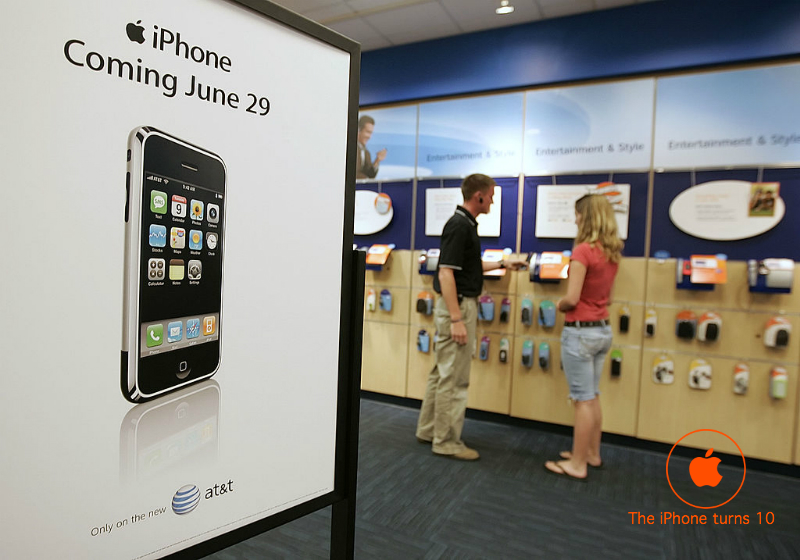
Enlarge / A poster announces the arrival of Apple’s iPhone at the AT&T store in Orem, Utah, Monday, June 18, 2007. (credit: Getty Images | Bloomberg)
Ten years ago today—on June 29, 2007—many waited (in line or online) for the first iPhone’s formal release. Apple’s now-signature product has made a lasting mark not only on our communications, but on many unexpected walks of life. This week as the iPhone turns 10, we’re examining its impact and revisiting the device that changed it all.
The first iPhone changed the technology industry in a lot of ways, mostly because it was a great device that lots of people wanted to use. But looking back at the device’s first decade, one of the most beneficial changes the iPhone brought about for consumers didn’t have much to do with the phone itself.
One of Apple’s biggest decisions before releasing the iPhone was to retain control of software updates. Apple gave AT&T exclusive rights to carry the iPhone in the US beginning in 2007 with the phone’s release. But Apple, not AT&T, would be in charge of updating the software.
Read 25 remaining paragraphs | Comments
Source: Ars Technica – With iPhone, Apple showed AT&T and Verizon who’s boss

Dell updated its Alienware 17 gaming laptop PAX West 2016 with NVIDIA Pascal graphics, but at the time Intel’s quad-core Kaby Lake mobile processors weren’t available yet. It was a short-lived update, however, as the Kaby Lake-powered Alienware 17 was announced a short time later at the start of the Consumer Electronics Show this past January….
Source: Hot Hardware – Alienware 17 R4 2017 Gaming Laptop Review: Powerful And Refined

Like that painful hangnail you’ve been eyeing for days—except billions of times larger, made of ice not keratin, and studied by dozens of scientists worldwide—a Delaware-sized glacier along Antarctica’s Larsen C ice shelf is hanging by a thread, poised to break off into the ocean any day now.
Source: Gizmodo – A Delaware-Sized Iceberg Is Tearing Off Antarctica Right Now
Prime Day 2017 will start at 6pm PT/9pm ET on Monday, July 10, giving Prime members 30 hours to shop instead of 24 like the previous events. As the name would suggest, you’ll need to be a Prime member to take part of the special deals, which include exclusive offers on Alexa devices and “one of its largest total volume TV deals in history.” I remember the first one being a bust and the second not much better, but we’ll see what happens this year.
The third annual Prime Day will be Tuesday, July 11, with hundreds of thousands of deals exclusively for Prime members around the world. New this year, members can enjoy 30 hours of deal shopping starting at 6pm PT/9pm ET on Monday, July 10 – and new deals as often as every five minutes. Prime Day has expanded to 13 countries this year, and Amazon is bringing new and existing members in the U.S., U.K., Spain, Mexico, Japan, Italy, India, Germany, France, China, Canada, Belgium and Austria the best deals of the year. Members will find millions of items in stock, including deals from thousands of small businesses and entrepreneurs.
Discussion
Source: [H]ardOCP – Amazon Announces Third Annual Prime Day
 Cox is bringing its terabyte internet data caps to a bunch of new territories, having already introduced the plan to Cleveland, Ohio; Omaha, Nebraska; Sun Valley, Idaho; Florida, and Georgia. As a result, customers in Arizona, Las Vegas, Louisiana, a…
Source: Engadget – Cox expands its 1TB data caps to more territories

Enlarge / Sorry, I’m not home right now. (credit: flickr user: Rosmarie Voegtli)
Once upon a time, it wasn’t crazy to think that social media would allow great ideas and high-quality information to float to the top while the dross would be drowned in the noise. After all, when you share something, you presumably do so because you think it’s good. Everybody else probably thinks what they’re sharing is good, too, even if their idea of “good” is different. But it’s obvious that poor-quality information ends up being extremely popular. Why?
That popularity might be a product of people’s natural limitations: in the face of a flood of information and finite attention, poor quality discrimination ends up being a virtual certainty. That’s what a simulation of social media suggests, at least.
A group of researchers from the Shanghai Institute of Technology, Indiana University, and Yahoo wanted to investigate the tradeoffs that happen on social media. Their simulated social network allowed them to tweak different parameters to see what would happen.
Read 15 remaining paragraphs | Comments
Source: Ars Technica – Information overload makes social media a swamp of fake news

The Islamic State has increasingly used drones and other robotic IEDs against American, Iraqi, and civilian targets in Iraq. And as the Coalition fights its way through Mosul, troops are discovering workshops filled with crude but deadly robotics used to bomb people sometimes dozens of times per day.
Source: Gizmodo – This is What an ISIS Drone Workshop Looks Like

Coworking spaces are a step up from working out of the local coffee shop, but there are some common-sense rules for good behavior to help keep everyone’s experience pleasant.
Source: TreeHugger – 6 essential etiquette rules for great coworking spaces