
This is actually an older story, but it is too cool for me to ignore: someone managed to build a version of Cortana that truly lives up to her Halo counterpart. A monitor and panes of mirror glass were used to display the hologram, and animations for the AI were captured with the help of a Kinect. I think the designer deserves some applause.
…this a Pepper’s Ghost hologram that uses Windows 10’s native Cortana experience. It’s all powered by a Windows 10 device with 4GB of RAM and a built-in Arduino used for controlling the platform lights. There’s a portable USB monitor on the top that reflects on 3 panes of mirror glass. The enclosure itself is a custom design I modeled. I then 3D printed each part of the assembly in PLA. There’s also an omnidirectional microphone that sits on top of the unit, and a decent mini speaker built into Cortana’s pedestal on the base.
Discussion
Source: [H]ardOCP – Working Concept of Holographic Cortana Assistant
Monthly Archives: May 2017
Radio Shack Closing Its Doors after 96 Years This Memorial Day Weekend
Radio Shack was actually where I bought my first PC (IBM Aptiva) but I don’t think I have any tears to shed for the retailer, as they never did a great job of innovating and competing with their rivals. While the franchise will live on through its online storefront, many of the brick-and-mortar stores that have managed to stay standing will be now be going away. They are actually auctioning off a bunch of “nostalgic memorabilia” from their historic archives in Fort Worth, Texas: these include unused original TRS-80 Microcomputers, Realistic Transistor Radios, Tandy computer software games, and original brick cell phones.
At its peak, RadioShack operated over 7,300 stores with retail sales and operating revenue in the billions of dollars and its locations were famously within 3 miles of more than 95% of households across America. This Memorial Day Weekend, we will be closing over 1,000 stores, leaving less than 70 corporate and 500 RadioShack dealer stores around the country. With 96 years of history, go say goodbye to the RadioShack in your neighborhood. This weekend you still have an opportunity to come visit your nearby store for your electronic needs at great liquidation sale prices, before we close the doors for good.
Discussion
Source: [H]ardOCP – Radio Shack Closing Its Doors after 96 Years This Memorial Day Weekend
Conan drops players into iconic fantasy battles—and their 1930s mindset

Enlarge (credit: Owen Duffy)
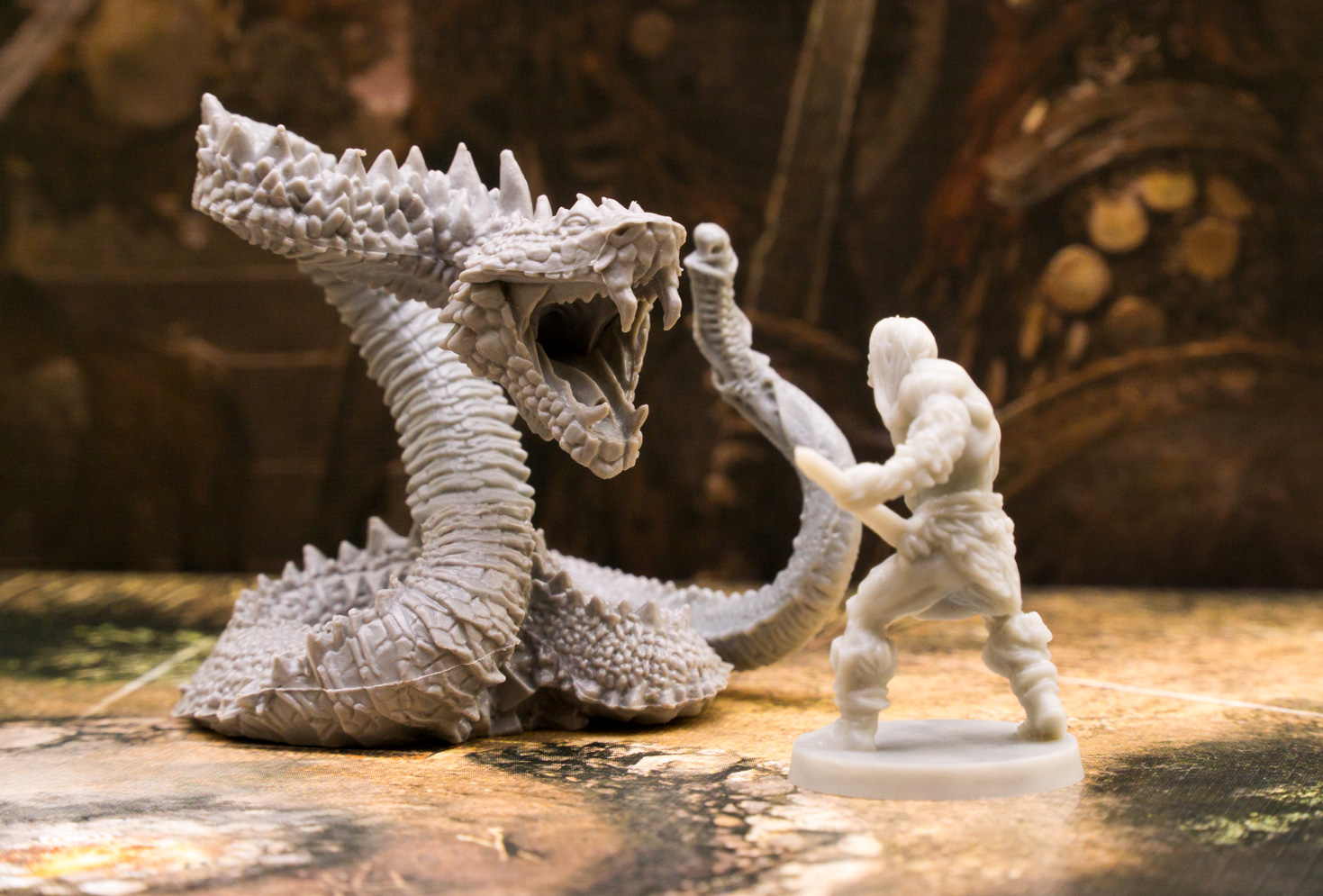
Welcome to Ars Cardboard, our weekend look at tabletop games! Check out our complete board gaming coverage at cardboard.arstechnica.com—and let us know what you think.
If you want to run a ridiculously successful board gaming Kickstarter campaign, use this tried and tested trick: cram your box full of plastic miniatures. For proof, see horror hit Kingdom Death: Monster, a game with a huge collection of figures which racked up $13 million, becoming the most lucrative gaming campaign in the history of the crowdfunding platform.
Other games have been quick to embrace the appeal of sculpted minis, which brings us to Conan, a licensed adaptation of the iconic fantasy stories by Robert E. Howard. It comes with an impressive 74 miniatures representing an array of heroes, villains, henchmen, and monsters. Vetted for authenticity by an expert in Howard’s work, the game proved to be a potent draw; backers forked out more than $3.3 million to bring the game into being.
Read 23 remaining paragraphs | Comments
Source: Ars Technica – Conan drops players into iconic fantasy battles—and their 1930s mindset
'Fallen London' and the secret to writing an infinite gothic game
 Writing a video game is nothing like penning a novel. But writing a never-ending, nonlinear, text-driven video game about a hellish alternate London stuffed with gothic intrigue and nearly a decade of backstory? That’s a different beast altogether….
Source: Engadget – ‘Fallen London’ and the secret to writing an infinite gothic game
Dell Launches 'VR Ready' XPS 27 AIO: 4K, Core i7-7700, Radeon RX 570, 10 Speakers

Dell has launched a new version of their XPS 27 all-in-one gaming PC. The VR Ready flavor of the XPS 27 has the same 4K display and the same 10-speaker audio sub-system as the latest iteration of the large XPS AIO, but is powered by a more powerful CPU from Intel along with AMD’s discrete Radeon RX 570 graphics board.
AIO PCs have existed for decades, with their continued popularity fueled by their compact, desk-sized footprint. In the recent years demand for higher performance and even gaming-grade all-in-ones increased noticeably, and manufacturers started to offer AIOs with rather powerful hardware. In fact, in early 2016 several PC makers even introduced Mini-ITX-based AIOs with top-of-the-range discrete graphics cards aiming at customers seeking for maximum performance.
Dell’s new XPS 27 with the VR Ready badge are designed for gamers with average requirements for performance. The systems are still considerably more powerful than their predecessors launched earlier this year are because they do not use integrated or mobile graphics, but rely on AMD’s Radeon RX 570 (2048 stream processors, 128 texture units, 32 ROPs, 256-bit memory bus, etc.) graphics adapter with 8 GB of memory. Meanwhile, the key feature of the latest XPS 27 remained intact: the audio sub-system with 10 speakers (six on the front, two down firing and two radiating) designed to enable surround sound without using bulky external audio equipment.

The VR Ready versions of the Dell XPS 27 are based on Intel’s Core i7-7700 CPU as well as the H170 PCH. By default, the systems are equipped with 16 GB of DDR4-2133 memory, but that is upgradeable to 64 GB. As for storage, the PCs have one M.2 slot (PCIe 3.0 x4) as well as two 2.5” bays for HDDs or SSDs, all accessible to the end user. When it comes to connectivity, the Dell XPS 27 feature 802.11ac Wi-Fi, Bluetooth 4.x, a GbE port, five USB 3.0 Type-A headers, one HDMI output, one DisplayPort 1.2, two Thunderbolt 3 ports (USB Type-C), an SD/MMC card reader, a 720p webcam with an IR sensor for facial recognition, a microphone and so on. Overall, there are plenty of ports to plug-in additional peripherals, including various VR gear.
| Dell XPS 27 7760 ‘VR-Ready’ Specifications | ||
| Non-Touch | Touch-Enabled | |
| Display | 27″ IPS with 3840×2160 resolution 1.07 billion colors, 100% Adobe RGB, 350-nit brightness |
|
| CPU | Intel Core i7-7700 4C/8T, 3.6/4.2 GHz 8 MB cache 65 W |
|
| PCH | Intel H170 | |
| Graphics | AMD Radeon RX 570 with 8 GB of GDDR5 2048 stream processors, 128 texture units, 32 ROPs, 256-bit memory bus |
|
| Memory | 16 GB of DDR4-2133 (four slots in total, upgradeable to 64 GB) | |
| Storage | 2 TB HDD 32 GB caching SSD (M.2) |
512 GB SSD (PCIe 3.0 x4) |
| Wi-Fi | IEEE 802.11ac Wi-Fi + BT 4.x | |
| Ethernet | GbE | |
| Display Outputs | 1 × HDMI 1 × DP 1.2 |
|
| Audio | 10 speakers 1 × audio out |
|
| USB | 5 × USB 3.0 Type-A (5 Gbps, one supports PowerShare) 2 × Thunderbolt 3 (USB Type-C) |
|
| Other I/O | 720p webcam with RGB and IR sensors SD/MMC card reader |
|
| Dimensions | 625 mm / 24.6″ × 435 mm / 17.1″ × 80 mm / 3.16″ | |
| Stand | regular | articulating stand |
| OS | Windows 10 Home | Windows 10 Home or Pro |
All Dell XPS 27 AIO PCs are constructed of CNC-machined aluminum and come with UltraSharp displays with a 4K (3840×2160) resolution. Meanwhile, computers with touch-enabled screens also feature articulating stands for added convenience. The stand comes at an extra cost, so some gamers may prefer to install a larger SSD and/or more memory and skip the touch option.

At present Dell offers two versions of the VR Ready XPS 27 featuring Intel’s Core i7-7700 CPU and AMD’s Radeon RX 570 GPU, but different storage configurations and touch support. The model with a 2 TB HDD and 32 GB caching SSD costs $1999.99, whereas the model with a 512 GB PCIe SSD, a touchscreen display with articulating stand and optional Windows 10 Pro comes at $2,649.99.
Gallery: Dell XPS 27 7760 ‘VR-Ready’


Related Reading:
- ASUS Launches the Zen AiO ZN270IE: A 27-inch Full HD Core i7 All-In-One
- ASUS Designo Curve MX34VQ Incoming: 34″ Ultrawide Curved Display with Qi Charging
- The Microsoft Surface Studio Review
- Microsoft Announces the Surface Studio: 28-inch AIO with Touch, Pen, 4500×3000, Skylake, GTX 980M
- CES 2016: 34-inch 3440×1440 AIO Hands-On at GIGABYTE
Source: AnandTech – Dell Launches ‘VR Ready’ XPS 27 AIO: 4K, Core i7-7700, Radeon RX 570, 10 Speakers
Investigation Demanded Over Fake FCC Comments Submitted By Dead People
An anonymous reader writes:
Fight for the Future has found another issue with the fake comments submitted to the FCC opposing net neutrality. “The campaign group says that some of the comments were posted using the names and details of dead people,” according to the BBC. The exact same comment was also submitted more than 7,000 times using addresses in Colorado, where a reporter discovered that contacting the people at those addresses drew reactions which included “I have never seen this before in my life” and “No, I did not post this comment. In fact, I disagree with this comment.” Fight for the Future also knocked on doors in Tampa, Florida, where the few people who answered “were shocked to hear that their name and address were publicly listed alongside a political message they did not necessarily understand or agree with.” An alleged commenter in Montana told a reporter she didn’t even know what net neutrality was.
14 people have already signed Fight for the Future’s official complaint to the FCC, which calls for notification of all people affected, an investigation, and the immediate removal of all fake comments from the public docket. “Based on numerous media reports, nearly half a million Americans may have been impacted by whoever impersonated us,” states the letter, “in a dishonest and deceitful campaign to manufacture false support for your plan to repeal net neutrality protections.”
Fight for the Future says they’ve already verified “dozens” of instance of real people discovering a fake comment was submitted in their name — and that in addition, more than 2,400 people have already used their site to contact their state Attorneys General demanding an investigation. They note the FCC has taken no steps to remove the fake comments from its docket, “risking the safety and privacy of potentially hundreds of thousands of people,” while a campaign director at Fight for the Future added, “For the FCC’s process to have any legitimacy, they simply cannot move forward until an investigation has been conducted.”


Read more of this story at Slashdot.
Source: Slashdot – Investigation Demanded Over Fake FCC Comments Submitted By Dead People
Airlie Is Looking At Tournier's Soft FP64 Work For R600-Rats
A few days ago I wrote about David Airlie’s work on a new “r600-rats” branch where he’s working on bringing up OpenGL 4.2 support to more Radeon HD 5000/6000 series hardware on R600g that’s currently limited to OpenGL 3.3. Some questions arose about the FP64 support…
Source: Phoronix – Airlie Is Looking At Tournier’s Soft FP64 Work For R600-Rats
The Wizarding World Theme Park Is the Best Harry Potter Anything Since the Books

The Wizarding World of Harry Potter is obnoxiously overpriced, small, and pretty gimmicky. And yet it is a much better experience for a Harry Potter fan than Fantastic Beasts, Cursed Child, or any of J.K. Rowling’s endless Pottermore essays.
Source: Gizmodo – The Wizarding World Theme Park Is the Best Harry Potter Anything Since the Books
Blizzard Job Posting Hints at Mobile Warcraft Game
Blizzard has a new job posting up for a new mobile game FX artist, and it features an interesting requirement: he or she must have “passion for creating imagery synonymous with the Warcraft IP.” Some think that this could merely be a companion app for World of WarCraft, while others are crazy enough to think this could be WarCraft 4. We may learn more about it at BlizzCon in November.
A new job posting appeared on the Blizzard careers website for an FX artist who will be located in Irvine, California. As you’d expect, Blizzard needs a lot of artists for its many projects, but there are two requirements for this job that stand out. The first is that it’s for a mobile project. The second is Blizzard specifically wants an artist with a “passion for creating imagery synonymous with the Warcraft IP.” There are many games or apps this could end up being. Blizzard already made it clear the original Warcraft game won’t be getting a remaster because the game isn’t fun anymore.
Discussion
Source: [H]ardOCP – Blizzard Job Posting Hints at Mobile Warcraft Game
Ars tests out Amazon’s first pick-up grocery store in the world

Enlarge / Amazon’s first public grocery store, now open in the Seattle neighborhood of Ballard. But you can’t go inside. Pickup only. (credit: Sam Machkovech)

SEATTLE—For years, Amazon’s worst-kept secret has been its interest in becoming a brick-and-mortar grocery company. After building permit leaks and employee-only beta tests, the online retailer’s first public stab at grab-and-go groceries (grab-and-gro?) launched in its home city of Seattle on Friday.
Amazon Fresh Pickup is now open in two Seattle locations, and its premise is simple: take the concept of Amazon Fresh (which delivers grocery orders to your door), then invite the customer to double as his or her own deliveryman. Since I was keen on seeing exactly how it works and happen to live 10 minutes from one of the locations, I decided to make up a Memorial Day-specific food order.
My first impression was nothing but smooth. For those customers whose grocery shopping matches Amazon’s Fresh Pickup vision, they’re in for a treat. But for everyone else, don’t rev your engines just yet.
Read 22 remaining paragraphs | Comments
Source: Ars Technica – Ars tests out Amazon’s first pick-up grocery store in the world
There Are 'Thousands' of Bugs Making Pacemakers Vulnerable to Hackers

The more of our lives are wired, the more they become vulnerable to things like software glitches and hackers. That includes pieces of technology we put in our bodies—recently, it’s become clear that vital medical devices like insulin pumps and pacemakers possess the same vulnerabilities as those ill-advised connected…
Source: Gizmodo – There Are ‘Thousands’ of Bugs Making Pacemakers Vulnerable to Hackers
Moto G5S Plus Leaks In The Wild With Metal Body And Snapdragon 625

Photos of the Moto G5S Plus were recently leaked and offer a revealing glimpse of the mysterious and much-anticipated device. The Moto 65S Plus appears to feature a metal body as well as a Qualcomm Snapdragon 625.
The Moto G5S Plus reportedly features an all-metal body. The G5 and G5 Plus only include an aluminum back-plate that is surrounded
Source: Hot Hardware – Moto G5S Plus Leaks In The Wild With Metal Body And Snapdragon 625
ICYMI: Control D-ing this show

Today on In Case You Missed It: When this show was announced on Engadget two years ago, we promised to find you the offbeat tech and science news you might have missed while following the previous day’s big headlines. I’ve felt a great responsibi…
Source: Engadget – ICYMI: Control D-ing this show
Saturday's Best Deals: Adidas Accessories, Yi Dash Cam, Breville Smart Oven, and More

Adidas accessories, Delsey luggage, and your favorite toaster oven lead off Saturday’s best deals.
Source: LifeHacker – Saturday’s Best Deals: Adidas Accessories, Yi Dash Cam, Breville Smart Oven, and More
Apple Reportedly Developing Powerful Neural Engine Chip For Future iPhone Artificial Intelligence

Rumor has it that Apple is developing a brand new processor dedicated to artificial intelligence tasks, including facial and speech recognition. Apple may have gotten an early start in AI with Siri, however, this chip would allow the company to catch up to competitors like Google and Amazon, which are blazing new trails with the Google Assistant
Source: Hot Hardware – Apple Reportedly Developing Powerful Neural Engine Chip For Future iPhone Artificial Intelligence
A fascinating graphic novel about the origins of Dungeons & Dragons
Almost 10 years ago, journalist David Kushner had a chance to interview Gary Gygax and Dave Arneson, the two creators of Dungeons & Dragons, before they died. Kushner’s reporting became a story for Wired, and now he’s expanded the scope of his tale into a graphic novel. Rise of the Dungeon Master, beautifully illustrated by Koren Shadmi, is both a moving portrait of two creative outsiders and a chronicle of how a new kind of storytelling changed pop culture forever.
Kushner recounts the story of Gygax and Arneson in the second person, addressing the reader as if Kushner were the dungeon master. “You” are young Gygax, the child of immigrants growing up in the midwest, seeking escape from ordinary life by exploring the wilderness, hunting, and eventually learning to break into an old, abandoned asylum. The narrative technique sounds gimmicky, but it works: you’re sucked into the story and into immediate sympathy with Gygax as he traces his fascination with adventure games back to his childhood, when he climbed around in the maze of tunnels below the creepy asylum’s rotting rooms.

Nation Books
Read 7 remaining paragraphs | Comments
Source: Ars Technica – A fascinating graphic novel about the origins of Dungeons & Dragons
Accused of Underpaying Women, Google Says It's Too Expensive To Get Wage Data
An anonymous reader quotes a report from The Guardian: Google argued that it was too financially burdensome and logistically challenging to compile and hand over salary records that the government has requested, sparking a strong rebuke from the U.S. Department of Labor (DoL), which has accused the Silicon Valley firm of underpaying women. Google officials testified in federal court on Friday that it would have to spend up to 500 hours of work and $100,000 to comply with investigators’ ongoing demands for wage data that the DoL believes will help explain why the technology corporation appears to be systematically discriminating against women. Noting Google’s nearly $28 billion annual income as one of the most profitable companies in the U.S., DoL attorney Ian Eliasoph scoffed at the company’s defense, saying, “Google would be able to absorb the cost as easy as a dry kitchen sponge could absorb a single drop of water.”


Read more of this story at Slashdot.
Source: Slashdot – Accused of Underpaying Women, Google Says It’s Too Expensive To Get Wage Data
Do You Still Use R600g OpenCL Clover?
While the ROCm OpenCL code was recently open-sourced, that new Radeon OpenCL code only supports newer GPUs like Fiji and Polaris and experimental support for “GFX7” GPUs like Hawaii. Due to this newer OpenCL stack, AMD hasn’t been investing in the “Clover” Gallium3D state tracker for providing OpenCL within Mesa. But there are at least some independent developers interested in still working on this older OpenCL code for previous Radeon GPUs, including pre-GCN hardware with R600g…
Source: Phoronix – Do You Still Use R600g OpenCL Clover?
TechInsights Publishes Preliminary Analysis of 3D XPoint Memory

Now that the Intel Optane Memory M.2 SSDs are readily available on the open market, anyone with an electron microscope and the skills to use it can begin to probe the secrets of 3D XPoint memory that Intel and Micron have been keeping tightly under wraps since announcing the new technology in August 2015. The reverse engineering experts at TechInsights have been doing just that, and they recently published their initial findings.

With some of the first high-resolution die photographs of 3D XPoint, TechInsights has provided precise measurements of the die size and memory density. The 128Gb 3D XPoint die is 206.5 mm2, much larger than is typical for modern NAND flash or DRAM but comparable to Intel’s 128Gb 20nm planar MLC NAND. A large total die size is typical for Intel and Micron, as they have historically not catered to the mobile market with their NAND flash while competitors like Samsung and Toshiba have strived to ensure their flash will physically fit in devices like smartphones. (That trend is changing with the introduction this year of 64-layer 3D NAND where Intel and Micron are producing both a larger 512Gb TLC part and a smaller 256Gb TLC part.)

The Intel Optane SSD DC P4800X is using memory of similar density to the Intel SSD DC P3700 that it is displacing as the flagship of Intel’s SSD product line. When comparing similar chips, die size is a strong predictor of manufacturing cost, but 3D XPoint memory is quite different from NAND flash memory, both older planar NAND or newer 3D NAND. Still, there’s some value in noting that the P4800X is arriving with a price tag about 25% higher than the P3700 initially carried. This suggests that the manufacturing process for 3D XPoint is either more expensive than planar NAND or that 3D XPoint yields are not mature enough, but a lot of the markup can also be explained by the lack of high-performance competition for Optane SSDs.

TechInsights calculates that 91.4% of the 3D XPoint die area is occupied by the memory array itself. This is a much higher figure than for NAND flash, where the record is 84.9% for Intel/Micron 3D NAND with its “CMOS under the array” design that puts a large portion of the peripheral circuitry underneath the memory array instead of alongside. Samsung’s current 48-layer 3D V-NAND manages an array efficiency of just 70%, and 3D NAND from Toshiba and SK Hynix has been comparable. This means that once Intel gets around to increasing they layer count in future generations of 3D XPoint memory, they should be able to get much closer to the ideal capacity scaling than 3D NAND memory can currently achieve.
The analysis from TechInsights confirms that 3D XPoint memory is manufactured using a 20nm process, with the same pitch in both the bitline and wordline directions of the memory array. The DRAM market is only just moving beyond this milestone, so comparing the density of 3D XPoint to current DRAM highlights the fundamental capacity advantage 3D XPoint enjoys: around 4.5 times higher density compared to typical 20nm DRAM, and about 3.3 times higher than the most advanced 1Xnm DDR4 on the market. This gap is likely to widen with future generations of 3D XPoint.

The materials and construction of an individual 3D XPoint memory cell have not been fully analyzed, but it appears to be a phase change memory element with a doped chalcogenide selector switch. The 3D XPoint memory array is constructed between the fourth and fifth metal interconnect layers above the silicon die.
Source: AnandTech – TechInsights Publishes Preliminary Analysis of 3D XPoint Memory
Watch The openSUSE Conference 2017 Sessions Online This Weekend
The openSUSE Conference 2017 kicked off yesterday in the beautiful Nürnberg, Bavaria. The event runs through Sunday but if you are sadly missing out on the event, there are video live streams and recordings available…
Source: Phoronix – Watch The openSUSE Conference 2017 Sessions Online This Weekend