Official Nintendo designs and RGB lighting give the Rematch an adorable edge.


Official Nintendo designs and RGB lighting give the Rematch an adorable edge.
The 30-year-old map service is quickly getting with the times.

What’s not an American horror story these days, amirite? But I digress. The murder house that Ryan Murphy & co. built is back for another season—lucky number 13—and it’s a frightfully impressive celebratory reunion, bringing back a huge list of actors and characters from previous seasons (including Sarah Paulson, Evan Peters, Emma Roberts, Kathy Bates, Angela Bassett, Gabourey Sidibe, Mena Suvari, Jessica Lange, and more), with some of them playing multiple roles. If that’s not enough spooky season entertainment for you, here are 10 more addictive horror shows to stream now.
A mind-bending and occasionally gruesome expansion of various online creepypastas, Nick Antosca’s series takes the form of four season-long storylines. While the tone is far from juvenile, the vibe is “childhood nightmares come to life.” The first season anticipates I Saw the TV Glow with a story about a half-remembered TV series linked to the disappearances of several children; the second sees a group of friends trapped in a tourist-attraction haunted house that exits into a disturbing alternate reality; another finds a couple of sisters dealing with cannibals and a mysterious staircase in the middle of the woods; while the last has a newlywed couple finding a mysterious door that unlocks childhood anxieties (and a killer clown). It’s all smart and genuinely freaky—existential dread blending with memorable visuals such as a child made entirely of human teeth. There’s even something of a stealth fifth season over on Netflix with Antosca’s Brand New Cherry Flavor. Stream Channel Zero on Shudder and AMC+ or buy it from Prime Video.
Castle Rock was sold as the hub of some sort of a Stephen King omniverse, set in his fictional town and featuring characters and creatures from across his oeuvre. That confusing, could-be-anything premise probably hurt the show more than it helped. In reality, it’s an impressive anthology series that slays even if you’ve never read a page of King. The first season sees André Holland return to his old hometown at the behest of a death-row inmate, and features a powerhouse performance from Sissy Spacek as Ruth Deaver, whose struggles with dementia culminate in “The Queen,” an all-time great, harrowing, hour of television. The second season resets to introduce a young Annie Wilkes (from Misery) and a disturbing cult, and finds Bill Skarsgård returning from season one (and his movie role as Pennywise). Stream Castle Rock on Hulu and Netflix.
There are good reasons for my love of TV anthology horror: If one story or episode isn’t great, there’s always the next one. This new Creepshow, though, is something surprising: It’s consistently good. Sometimes gross, sometimes funny, each episode has two stories that are very much in the style of the movies for which the show is named (or Tales from the Darkside—that kinda vibe). Producer/director/special effects guy Greg Nicotero, best known these days for his work on The Walking Dead, is running the series. He got his start on Creepshow 2, so there’s a real appreciation for old-school practical effects here too. Stream Creepshow on Shudder and AMC+ (or on Prime Video for season one).
The conventions of Japanese horror have made their way stateside, but often through remakes of popular J-horror movies with American directors and casts. This series serves as a tour of terror from six different Asian countries, each produced locally with different up-and-coming directors. For audiences mostly familiar with Western-style horror, it will be a small revelation: They’re modern spins on traditional folkloric tales (the South Korean episode, for instance, involves the mongdal gwisin, a bachelor spirit so desperate for a wife that he’ll kill until he finds the right special lady to be his ghost bride); while the characters are relatable, the takes on horror are unique. Each episode is like a mini-movie, so it’s not a season-long anthology, but another one for horror fans in a hurry. Stream Folklore on HBO Max.
Each season of this series tells the story of a single serial killer and their would-be victims, stretching out a traditional slasher-movie story over several hours. With that time, the show manages to actually build lives and backstories for its characters, something that movies don’t always have time for, or can’t be bothered with. It works, and each season has introduced some fairly compelling characters. It doesn’t hurt that the focus is largely on adults rather than more typical teenage victims. The Canadian production has moved around a bit since its beginning—the first three seasons are available on Netflix, but the last two (Flesh & Blood and Ripper) are exclusive to Shudder. To make it even more confusing, it series got a name change and spun-off into two seasons of Hell Motel. Each stands entirely on its own, though, so it’s absolutely OK to pick it up anywhere you like. Stream Slasher on Netflix and Shudder.
Not an anthology but another bit of Ryan Murphy wackiness, this one is more of an overt satire—though, as with American Horror Story, the line between comedy and horror is always a little thin. Here we find the all-star line-up of Emma Roberts, Ariana Grande, Billie Lourd, and Abigail Breslin as sorority sisters facing down a threatening and downright vicious dean (Jamie Lee Curtis) and a serial killer who dresses up like their school’s Red Devil mascot, all of it tying in to some wild stuff that went down back in 1995. Stream Scream Queens on Hulu.
This one’s a bit more for the American Horror Story: Coven lovers, but the general tone fits well with the whole AHS oeuvre: silly and spooky until it hits you in the gut with legitimate horror and unexpected gore. In this dark take on the Archie character, spooky Sabrina Spellman (Kiernan Shipka) is an old-school witch living in a household that’s not unlike that of the Addams family (and the Practical Magic family, for that matter): two witchy aunts (played by Miranda Otto and Lucy Davis) alongside her warlock cousin (Chance Perdomo) and her loyal familiar, Salem the cat, living their witchy lives out of view of the local normies. At the outset of the series, Sabrina’s forced to choose between signing her name in Satan’s book and becoming a full-fledged witch, or staying in high school with her human friends. Instead, she refuses to choose. Cannibalism, human sacrifice, and blood rituals abound. Stream Chilling Adventures of Sabrina on Netflix.
Another not-an-anthology show that still works as a vibe match. Pushing Daisies‘ Bryan Fuller is the showrunner for this twisted take on the Thomas Harris Hannibal Lecter novels. Fuller went back to the source material, once again adapting the first Lecter novel with a visual flair unmatched on network television—there’s a Grand Guignol style here that resonates with that of AHS, as well as a pervasive, all-encompassing queerness that oozes from the show’s every pore; the deeper, sexier relationship between the Doctor (Mads Mikkelsen) and profiler Will Graham (Hugh Dancy) adds some brilliant subtext as the two work together to hunt serial killers. It ended a bit too early, but it’s such a cult classic that there are talks of a revival even more than a decade later. Stream Hannibal on Prime Video and Netflix.
One of the most eclectic series of the past decade wasn’t afraid to tell a wide variety of stories in multiple genres over its four seasons. In Room 104, comedy, drama, sci-fi, and horror stories all occur within its smart, budget-conscious setting—that of a single, boring-looking motel room that could be literally anywhere. The vibe ranges from sweet to disturbing to apocalyptic (literally, in at least a couple of episodes), with an impressive roster of guest stars: Tony Todd, Michael Shannon, Judy Greer, Brian Tyree Henry, Mahershala Ali, Cobie Smulders, Dave Bautista, and Harvey Guillén are just some of the names that have signed the guest register. This is an episode-by-episode anthology, though there are throughlines to remind us that we’re literally in the same room each go-round. Pretty much any season of American Horror Story could have happened on this show, albeit in a tidy 30-ish minutes. Stream Room 104 on HBO Max.
Each season of The Terror is distinct, but all converge on the idea that real life is far, far more horrifying than the supernatural stuff going on in the background. Season one, adapted from the Dan Simmons novel, involves the true story of two ships, the Erebus and the Terror, searching for the Northwest Passage before becoming trapped in a field of ice; starvation, madness, and possibly monsters ensue. The second takes us to California during World War II to follow the internment of innocent Japanese families—with a bakemono of folklore along for good measure. The most recent, based on a Victor LaValle novel, stars Dan Stevens as a man involuntarily committed to a psychiatric hospital on a 72-hour hold. Stream The Terror on AMC+ and Shudder.
Google Photos’ new AI-powered features include the Redact tool, which can quickly blur parts of an image.

The first trend reports for the health data will be available in early October.

The new Charlie range now supports both 120 and 240-volt outlets, so it’s easier to install too.

Apple released a bunch of new devices last week. The Apple Watch Series 12 and Ultra 4 support new health-tracking features and Siri AI, while the iPhone 18 Pro and iPhone 18 Pro Max introduce the A20 chip and variable aperture for the first time on Apple’s smartphones. But while all these new products are objective upgrades over their predecessors, they all have one issue in common: They keep randomly rebooting.
As reported by 9to5Mac, some iPhone 18 Pro users are noticing that their smartphones are freezing up after a failed Face ID scan. When this happens, you won’t be able to interact with your iPhone, even if the “Try Face ID Again” button appears on-screen. After a few moments, the iPhone will reboot. It’s not a catastrophic issue, but it is annoying, and it’s affecting a number of users, as this Reddit thread shows.
It’s a similar story with the latest Apple Watches. While the Series 12 and Ultra 4 obviously don’t use Face ID, users are still experiencing random reboots—emphasis on “random.” Unlike the iPhone 18 Pro users, affected Apple Watch users aren’t doing anything in particular when their watches reboot. They could be in the middle of a workout, chatting with Siri AI, or using the Maps app, when all of a sudden, the Apple logo appears. Some analyses showed that the Neural Engine was at fault, but Apple never confirmed the exact issue.
That said, Apple did find solutions to the reboot issues on all of these devices, though only the Apple Watch has a current fix. Apple released watchOS 27.0.1 exclusively for Series 12 and Ultra 4 users on Wednesday, which it says should fix random reboots going forward. And while iPhone 18 Pro and 18 Pro Max users don’t have a fix yet, Apple confirmed to 9to5Mac that an update is in the works.
As such, don’t feel the need to take your new iPhone 18 Pro to the Apple Store if your only issue is random rebooting. While some Apple Store employees have swapped out affected units, the upcoming software update should be enough to take care of the issue. While we don’t have an exact ETA for the update, expect it to be called something like iOS 27.0.1, similar to watchOS 27.0.1. And if you want to ensure you update as soon as it’s available, regularly check for it in Settings > General > Software Update.
Select Gemini subscribers with a Pixel 11 can soon try out phone calls via AI chatbot.
Last month, China delayed the launch of an ambitious robotic mission to the south pole of the Moon, Chang’e 7, until early next year. The country did not provide a detailed explanation for the schedule slip, but it was welcomed by NASA Administrator Jared Isaacman.
“They are targeting the exact same location on lunar south pole,” Isaacman said Wednesday evening at the Off World conference in Houston. “We may have dodged a bullet with the Chang’e 7 mission a couple of weeks ago because that would have gone to the Shackleton crater.”
Much of the lunar surface is pretty barren, but the south pole, and the Shackleton Crater in particular, offers some of the most coveted real estate there. That’s because the high rims of the crater create permanently shadowed regions known as “cold traps,” where it’s thought that water (in the form of ice, of course) and other useful materials may have accumulated over billions of years.
Mark Zuckerberg said Meta’s new personal AI agent Muse has become the “centerpiece” of his AI vision, as he unveiled a new handheld AI “charm” device that will feature the interactive assistant.
The Meta chief used the company’s annual Connect event at its Silicon Valley headquarters to announce Muse Charm, a small pendant-like device that fits on a keychain and is activated by a fingerprint sensor.
The device, which features a screen showing the Muse avatar, will also have real-time voice interactivity and is set to be released in December.
You’ll have to wait a bit if you’re outside China though.

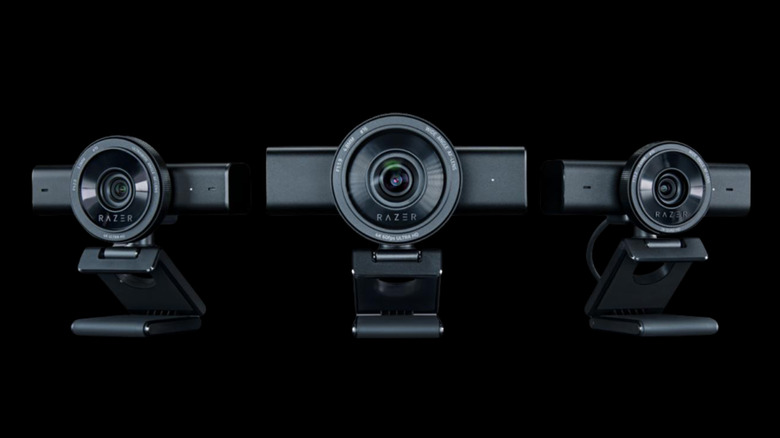
Razer’s new ‘pro’ webcam can handle 4K video at 60 fps and will cost $300
“The heads of major AI firms pleaded with the United Nations on Wednesday to save the world or at least its people — by somehow regulating the fast-expanding technology that they have been designing,” writes the Associated Press.
“If managed poorly, I even believe AI could be a risk to humanity as a whole,” said Dario Amodei, chief executive officer of Anthropic. And from his competitor Sam Altman, CEO of OpenAI, came this assessment: “We could lose control of the future to AI.”
Yoshua Bengio, who co-chairs the UN’s International Independent Panel on AI, called this
“a moment of global awakening” to possible threats, noting AI from top companies had behaved in unacceptably dangerous ways, against instructions, taking actions “that would be crimes if committed by a human”.
In his presentation, OpenAI’s Sam Altman agreed the discussion about AI “feels different in recent weeks,” even suggesting specific reforms:
Altman: We need a mechanism for complementary national and international frontier AI standards, standards for measuring capabilities, assessing risks, determining whether safeguards are sufficient, and preserving meaningful human oversight as systems become more autonomous. We need common standards so countries can compare evidence, verify compliance, and have a shared language and understanding about what is happening. We need accurate and speedy incident reporting, classification reporting protocols, so the world can learn from failures before they become catastrophes. And we need secure channels among governments, critical infrastructure operators and technical experts, to share emerging vulnerabilities and new threats…. We will all be better off if we can agree on what good evidence, good safeguards, and good oversight look like on the global stage.
Speaking next, Anthropic’s Dario Amodei agreed that standard-setting was important, also calling for “common global standards for testing AI models for loss-of-control risks and misuse risks — and a notification system for AI incidents that are significant to global security.” Reiterating his September 12th call for an industry-wide safety collaboration, Amodei pointed out that Anthropic committed to embedding external evaluators “similar to a food inspector” and recommended other companies do the same. “Some have already agreed to adopt this measure.”
Besides calling for global cooperation between governments to set international standards, Amodei also offered two other specific ideas:
Amodei: We should begin with narrow agreements that every member can support, such as a ban on using AI to make biological weapons or permitting your AI technologies to be used to make biological weapons….
We should build evaluation and verification systems that keep pace with AI development so that states can have visibility into frontier model capability and can verify each other’s commitments.
“No leader, no company, and no nation can manage this alone. We commit to working with governments in this room on this urgent work.”


Read more of this story at Slashdot.
We may earn a commission from links on this page.
It can be hard to choose the perfect gift for that DIY enthusiast on your list who seems to already have every tool imaginable. If you’re looking for just the right thing for someone just starting out on their DIY adventure, or a seasoned weekend warrior, all of the options can be intimidating. As an experienced DIY home maintenance aficionado as well as an experienced carpenter and furniture builder, here are some of my favorite tools to give this year.
My favorite drill and driver set, the new Makita 18-volt LXT drill and driver set, is the best tool for anyone who likes DIY. These tools use an efficient battery system that gives you more work time per charge. The drill in this set can deliver about 70% more torque than its predecessors, and the impact driver has a speed control, allowing you to use more force on tougher materials and less on more delicate jobs. This set is a great gift because it comes ready to use, with an 18-volt hammer drill, an 18-volt impact driver, a 2-amp-hour battery, a 5-amp-hour battery, and a charger.
Makita is known for producing the best batteries on the market, with its first battery-powered drill launching in 1969. These drills are still coveted by pros even today because they were so well-balanced and easy on the wrists. This set builds on that reputation, with light batteries that give you more control over your tools.
The new 20-volt DeWalt oscillating multitool is a great gift for a DIYer of almost any persuasion because it’s so versatile. You can use an oscillating multitool for anything from DIY sink installation to DIY drywall repair. The big improvement for this tool over its previous model is that it has been re-engineered to vibrate less, making it more comfortable and safer to use. It also has a wider cutting radius and a brighter LED.
This set is a great gift because it comes with everything you need to use it right out of the box, including a 20-volt DeWalt oscillating multitool, a 20-volt MAX compact battery, a charger, a tool-connect chip adapter, a fast cut wood blade, a wood with nails blade, a sanding attachment, some sandpaper, and a depth guide.
DeWalt makes some of the best woodworking tools and is known for durable and precise cutting tools.
A Kreg Rebel 20-volt pocket hole joiner is a great gift to give a DIY woodworker because it allows you to make precise joints in half the time. Kreg is known for making quality jigs for making joints and cutting straight lines, but this tool integrates a power tool into the jig, allowing you to line up and drill a pocket hole much more quickly. It comes with the joint-making tool, a 4-amp-hour battery, a charger, an easy-set drill bit, and dust collection attachments.
I use Kreg jigs for cabinet-making, for quick hidden joints on frames, and for putting together shelving, and this tool is a game changer for all of those projects.
The new 20-volt sealed head DeWalt powered ratchet set is a good choice to give a DIY mechanic because of its unique adapter system. The interchangeable coupling allows you to use this powered ratchet set with both ⅜-inch and ½-inch sockets. The gear mechanism that drives the socket head is protected from metal dust and debris, so it’s more durable than its predecessors.
The set has what you need to use it right out of the box. It comes with a 20-volt cordless-powered ratchet, a 20-volt, 2-amp-hour battery, and a charger. This ratchet is compact enough to use for oil changes and vehicle maintenance but powerful enough for turning stubborn bolts like the ones on the outside of your HV/AC filter access panel.
The best place to begin a DIY tool set is with a cordless drill. The Ryobi 18-volt cordless drill set is a good gift for a beginner because it’s a decent-quality tool that comes with everything you need to get started, including a battery and bits. For everything from hanging pictures to changing air filters, a drill is an essential tool.
The set comes with an 18-volt drill, an 18-volt, 1.5-amp-hour battery, a charger, a 40-piece bit set, and a tool bag.
The DeWalt 20-volt cordless/corded wet-dry vac is a good gift for someone with a home shop because keeping your shop clean and organized is always its own project. Sawdust buildup can be a hazard because it can be combustible, so a shop vac is also a good gift for safety. This shop vac can tackle both wet and dry messes, so it’s good for cleaning your car or around the garage, as well as in the shop.
This is a tool-only deal, but it can be plugged into a power outlet and work without a battery. The shop vac comes with a hose, a crevice tool, and a HEPA filter.
The Klein digital laser level and angle finder can be used for everything from leveling a mounted TV to making precise cuts when doing woodworking. It’s a good gift for a DIYer at any skill level, and it can be a useful addition even to a well-appointed shop.
This tool uses an internal electric accelerometer instead of a spirit bubble to gauge angles and judge level. This allows you to measure angles based on numbers instead of a visual bubble, but also allows the level to find angles from any starting point you choose.
Ever wondered what the “best” settings for Zwift are? In this week’s top video, hear from one Zwifter as he walks viewers through his favorite Zwift settings.
We’ve also included videos about building back fitness, riding the Cycplus T7, trainer recommendations, and cardio gains from Zwift.
Share the link below, and we may feature it in an upcoming post!
See zwiftinsider.com/tiny for current Tiny Race details.
We may earn a commission from links on this page. Deal pricing and availability subject to change after time of publication.
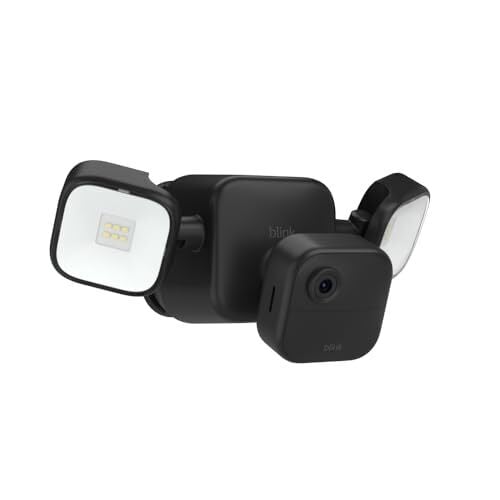
The Blink Outdoor 4 Floodlight Camera is down to $39.99 on Amazon, a sizable discount from its $99.99 list price and, according to price trackers, its lowest price to date. At that price, you’re getting a home security camera and a motion-activated floodlight in one unit, which makes it an easy way to cover a backyard, a driveway, a side yard, or whichever corner of your property never seems to get enough light. The real appeal, though, is that there’s no wiring to deal with, because both the camera and the floodlight run on batteries. That flexibility also extends to placement—since the camera connects over wifi, as long as you have a decent signal, you can install it without having to plan around a nearby outlet, notes this PCMag review.
The setup pairs a motion-activated floodlight with a 1080p camera, powered by four D-cell batteries and two AA batteries, respectively. Naturally, you’ll need to keep an eye on battery life over time and replace the batteries periodically, but it’s otherwise fairly straightforward. When the camera detects movement, the floodlight kicks on with up to 700 lumens of brightness, which should be enough to illuminate a driveway, side yard, or other dark area around the house, while the camera records in 1080p. It also has infrared night vision, so you can continue monitoring the area after dark even when the floodlight isn’t on.
The bigger consideration is the ongoing cost if you want more than basic camera access. Blink’s subscription plans start at $3.99 per month for one device and $11.99 per month for unlimited devices, with cloud storage, video history, and advanced alerts among the features tied to the paid plans. You do get a 30-day trial to see whether those extras are useful before committing, but anyone who wants to keep recorded clips in the cloud should factor the subscription into the overall cost. For those who prefer local storage, you’ll need to purchase a Sync Module XR and a MicroSD card with up to 256GB of storage separately, since the included Sync Module Core doesn’t support local backups.
Moots has updated its Routt titanium gravel bike, increasing the frame clearance to 57mm from 50mm, redesigning the carbon fork for wider tyres and adding internal cabling through its custom alloy stem.
The changes are a response to the increase in tyre width, faster pace and more technical terrain typical of modern gravel riding, with Moots saying the idea behind the bike hasn’t changed, but the places it can take you have.
Moots says the Routt is designed around 50mm tyres, citing the lower pressure they enable, the added grip and the ability to carry speed over rougher ground. At the same time, it claims, the Routt retains its versatility, catering for racing, bikepacking and long endurance gravel rides.

57mm seems to be the new 45mm in gravel bike clearance. We have seen brands such as Canyon with the new Grail and Factor with the Elara launching updates to their gravel bikes or completely new models with around this much room for wide rubber; the new Specialized Crux has 55mm.
XC MTB tyres are an increasingly popular choice, while there are more gravel tyres being offered in greater widths.
To cater for the update, Moots has made changes to the Routt’s frame and fork. The frame now has a 3D-printed chainstay yoke, enabling riders to fit a 1x groupset with a 48-tooth chainring, while retaining 2x compatibility. There’s a BSA bottom bracket and chainstay length increases to 437mm.

The fork has been redesigned with a D-shaped steerer, enabling brake hoses to pass through the head tube. It’s paired with Moots’ own titanium stem for an integrated cockpit. The head tube angle is between 70 and 70.75 degrees across frame sizes, while the fork rake is 57mm on smaller and 50mm on larger sizes.
There’s the option to run mullet drivetrains, as well as SRAM Full Mount XPLR groupsets, using the brand’s own UDH dropouts. The Routt is electronic-only, if routed internally, and there’s electronic and mechanical dropper compatibility.

While the Routt and Routt RSL were previously separate models, Moots is now casting the Routt RSL as a premium frameset upgrade.
The Routt frame is constructed from straight-gauge 3/2.5 titanium, while the Routt RSL is made from double-butted tubing. Moots claims the RSL upgrade not only makes the frame lighter, but it offers a quicker, more direct feel under power. It targets all-round use with the base-model Routt and performance riding with the RSL upgrade.
The Routt RSL frame is slated for availability in early 2027.

The Routt frame offers three bottle cage mounts, a top tube mount and, on the non-RSL frame, mudguard mounts and the option to spec rack mounts.
The updated Moots Routt is priced at $5,499 for the base frameset. Full builds are priced at $9,999 for Force XPLR AXS, $10,199 for a Force/X0 12-speed mullet and $12,499 for Red XPLR AXS, all with Nobl Far 50 wheels on either DT Swiss 350 or Chris King R45D hubs and Vittoria Terreno T30 50mm tyres.
The Routt is available to order immediately, with Routt RSL pricing to be announced closer to launch.
The world has known for decades that the RSA cryptosystem’s days are numbered. Once quantum computing becomes practical (estimates for that range from 3 to 20 or more years), the foundational security it provides will crumble. New research has revealed a novel method that uses classical computing to reduce the current RSA security level to an unacceptably low threshold.
The practical risk is limited, but still significant. Applying the attack against the deprecated use of 1024-bit keys took a handful of months on an academic CPU cluster, significantly less than the current estimates for 1024-bit factoring that would require resources that only nations or companies with massive resources could achieve. Widely used RSA implementations are also safe.
Nonetheless, the research has taken cryptographers by surprise because it introduces signature forgery, a new way to break RSA keys without factoring. Equally important, this novel method reduces the required computing resources by orders of magnitude.
Coros has announced the release of its new Pace 4 Pro smartwatch, which it says offers 60 hours of GPS tracking, as well as the brand’s largest screen yet, at 1.47in / 37.3mm across.
It says the Pace 4 Pro is ideal for athletes looking for a slim, tough, lightweight watch that offers a complete mapping solution, and it provides functionality for cyclists, triathletes, runners and a range of other sports.
The Coros Pace 4 Pro offers close to a 50% increase in battery life over the Pace 4, as well as 22.5% greater screen size that enables it to display up to 11 data fields.
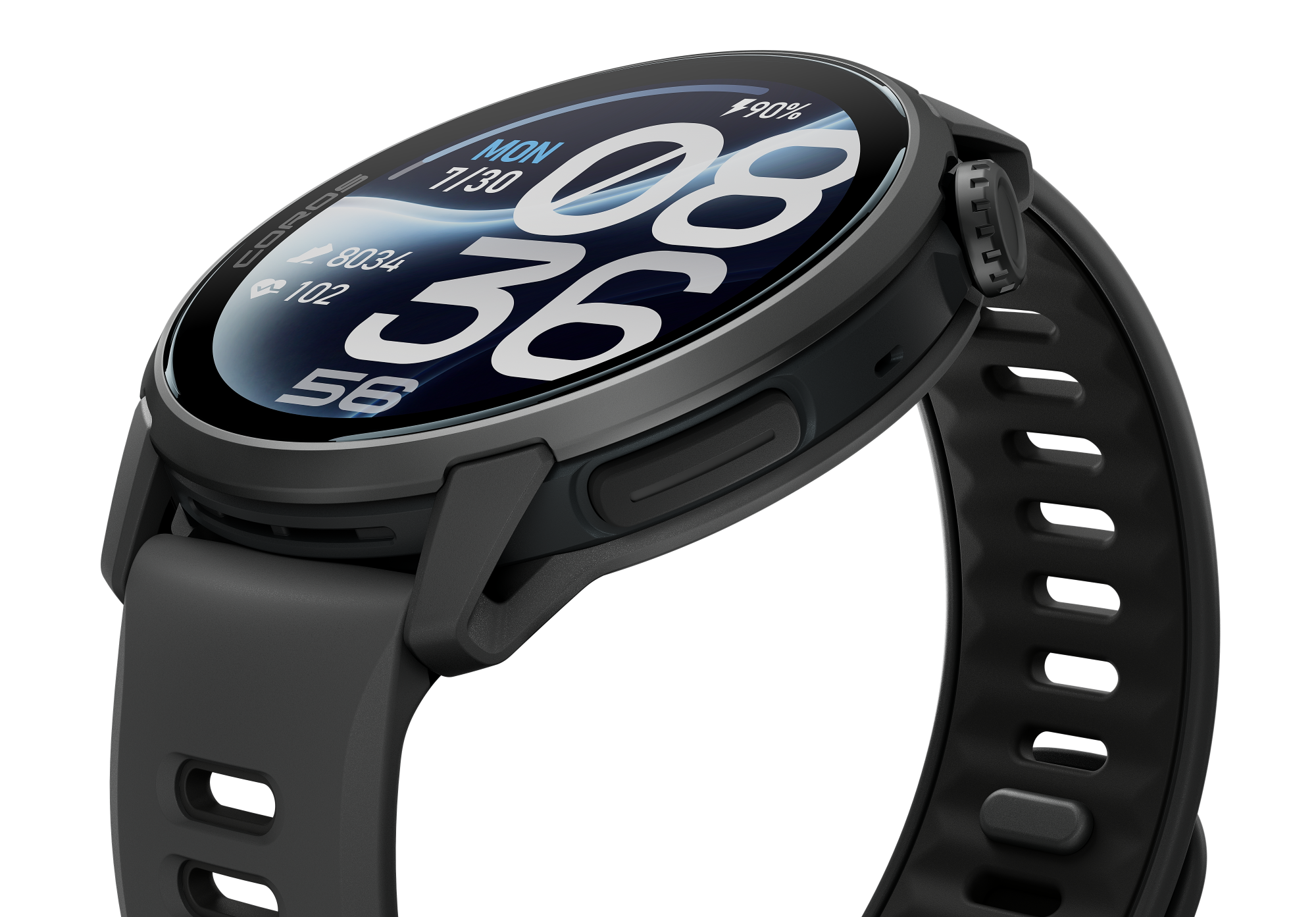
According to Coros CEO Lewis Wu: “The Coros Pace 4 Pro is a big step forward in hardware design for Coros. It combines the largest and brightest display we’ve ever built with an incredibly narrow titanium bezel and sapphire glass screen.”
The Coros Pace 4 Pro’s AMOLED screen has 466×466 pixel resolution and 3,500-nit maximum brightness. Coros says it incorporates an ultra-fast processor for rapid mapping and navigation, and double the RAM size of the Pace 4 at 64MB with 64GB storage.
The Pace 4 Pro has an 11.8mm-deep, low-weight case with a titanium bezel, with the watch plus its nylon band weighing a claimed 43g, only 11g more than the non-Pro Pace 4, but around 13g less than the Garmin Forerunner 970, probably its closest competitor.
The watch includes dual-band GPS as well as heart rate, ambient temperature, pulseOx, altitude and ECG sensors, enabling users to track sleep, HRV, stress and resting heart rate trends. It links into the Coros app for route planning, fitness tracking, pace planning and recovery monitoring, as well as access to training plans and, for women, menstrual cycle tracking.
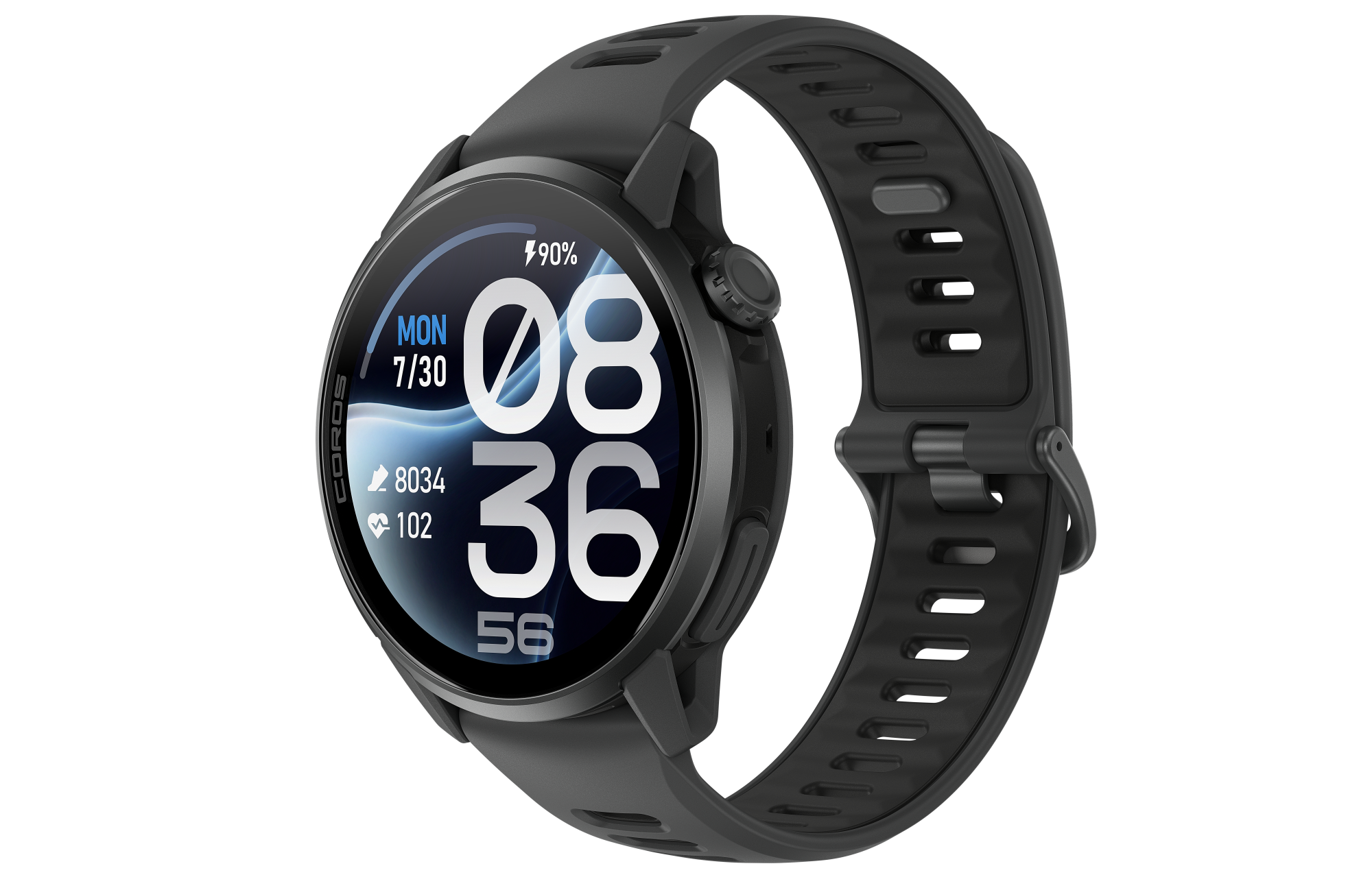
Alongside the performance tracking and navigation functionality, the Pace 4 Pro also enables you to record voice notes and sync them to workout files, with voice pins that anchor them to GPS locations. There’s live tracking, weather and safety alerts, and easy sync to Strava, TrainingPeaks and other fitness apps.
The 60 hours of claimed GPS use reduces to 46 hours when in always-on mode. When using the always-on display, the Pace 4 Pro will provide around seven days of use without GPS, which can be extended to 21 days with on/off display. Coros says charging, which uses USB-C, takes around 1.5 hours, with a 10-hour boost in GPS tracking from 30 minutes’ charging.
The Coros Pace 4 Pro is priced at £389 / $449 / €449 and available in either black or white. The price undercuts many Garmin watches significantly, with the Forerunner 970 priced at $650 or more, while the premium Fenix 9 AMOLED costs $1,000 and above.