Way back in 2019 when Kia introduced the first-generation Telluride, both the media and the car-buying public went nuts for it. Dealers struggled to keep the Telluride on their lots, and that’s before the insanity brought on by the COVID-19 pandemic a year later. Now, fast-forward six years, and there’s a new Telluride for the 2027 model year, and once again, Kia seems to have knocked it out of the park.
The 2027 Kia Telluride follows the same formula as the old one, but it has grown in every direction except engine cylinder count, and it looks a whole lot like the folks at Kia’s US design studio had “Greatest Hits of Range Rover” on repeat, which is a very good thing. Oh, and there’s finally a hybrid version.
Under the hood
The second-generation Telluride has fully ditched its old 3.8 L six-cylinder engine. In its place, it is now offering either a turbocharged 2.5 L four-cylinder gasoline engine that produces 274 hp (204 kW) and 311 lb-ft (422 Nm) of torque, or that same engine with a dual-motor hybrid system. The hybrid version produces a combined 329 hp (245 kW) and 339 lb-ft (460 Nm) while returning a claimed 35 mpg (6.7 L/100 km) combined.
Last year, Dell came this close to abdicating its throne as the maker of the best premium Windows laptops when it announced it was killing off the XPS brand. Thankfully, the company regained its wits, admitted its mistake and doubled down on its flagship notebook line by revealing a full redesign for 2026 with super sleek builds, improved performance and helpful tweaks to nearly everything else we loved about its predecessors. The one blemish to Dell’s crown jewel is some keyboard issues on early units. But make no mistake, the king of laptops is back.
Design and display
For this revamp, Dell didn’t stray away from the XPS line’s typical mix of glass and aluminum. However, this time around, the company streamlined pretty much everything. The XPS 16 now weighs just 3.65 pounds (or 3.85 if you opt for the heavier LCD display), which is almost a full pound lighter than its predecessor (4.56 pounds). That’s a massive drop and it makes this system closer in heft to a 15-inch MacBook Air (3.3 pounds) than a 16-inch MacBook Pro (4.7 pounds), despite the latter being XPS’s usual rival. It’s also noticeably thinner at 0.58 to 0.6 inches (depending on the exact configuration), which is once again a sizable decrease from the previous model (0.75 inches). Honestly, this laptop needs to be held to be truly appreciated. Even after using it for a while, it still feels impossibly sleek every time I pick it up.
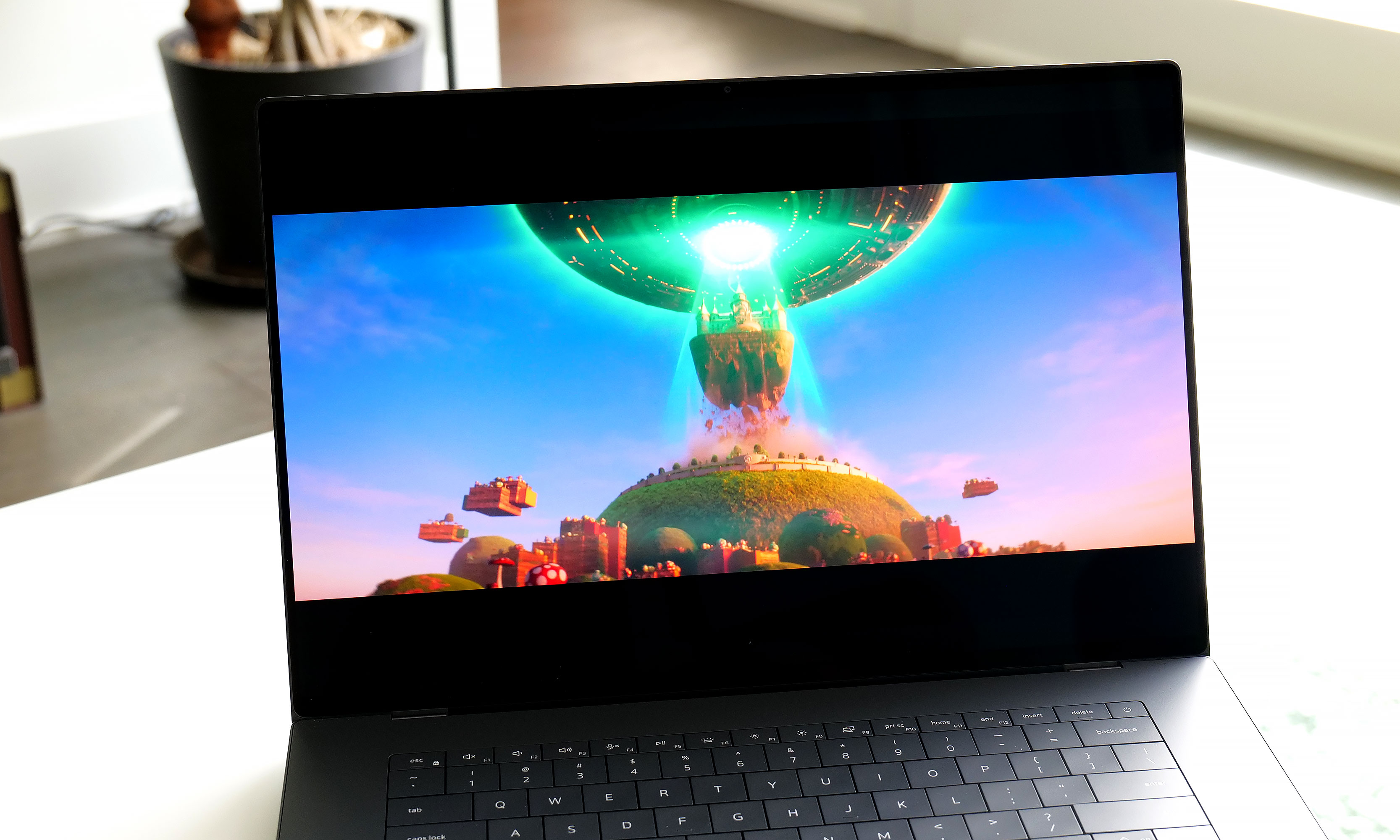
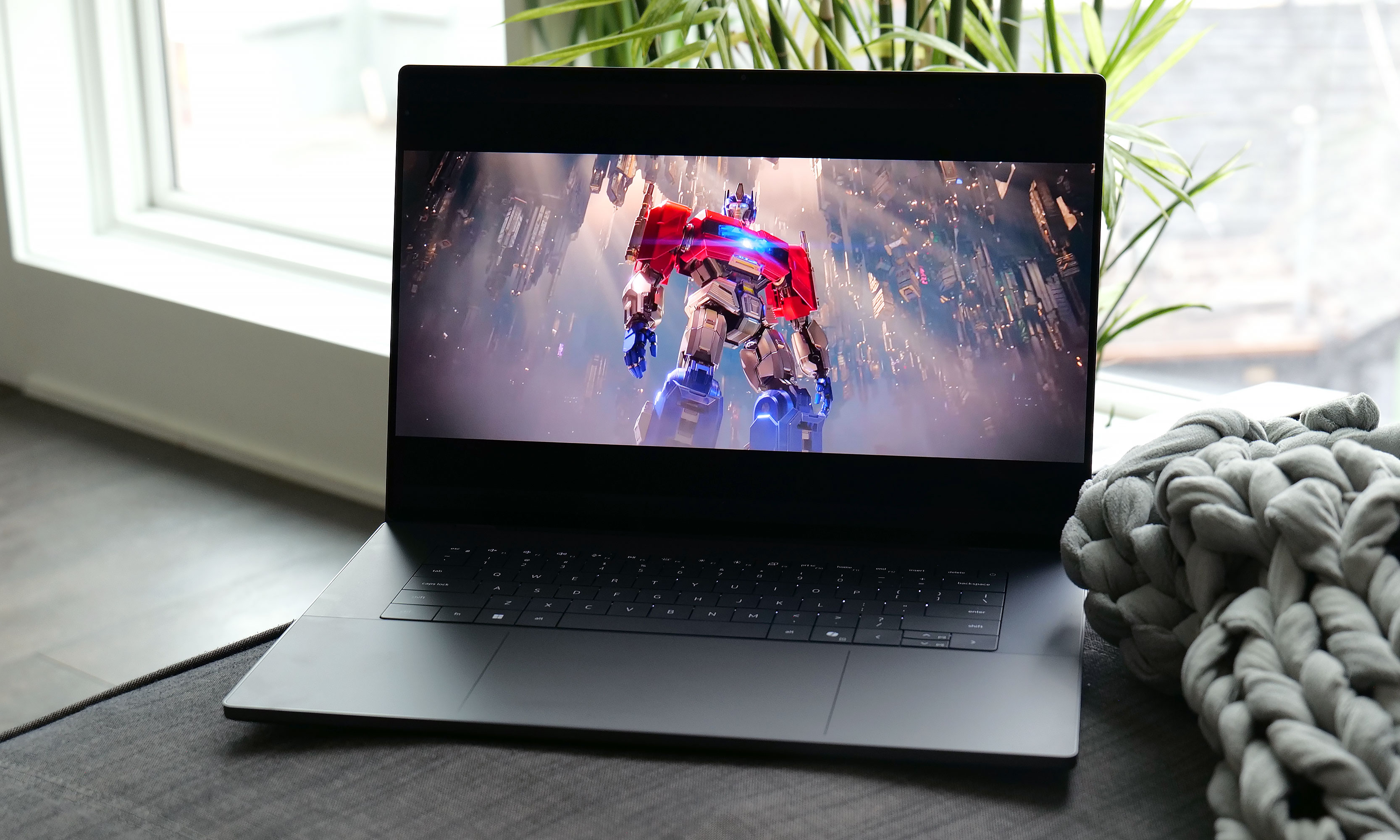
The optional 3.2K OLED display available on the XPS 16 is simply gorgeous.
Sam Rutherford for Engadget
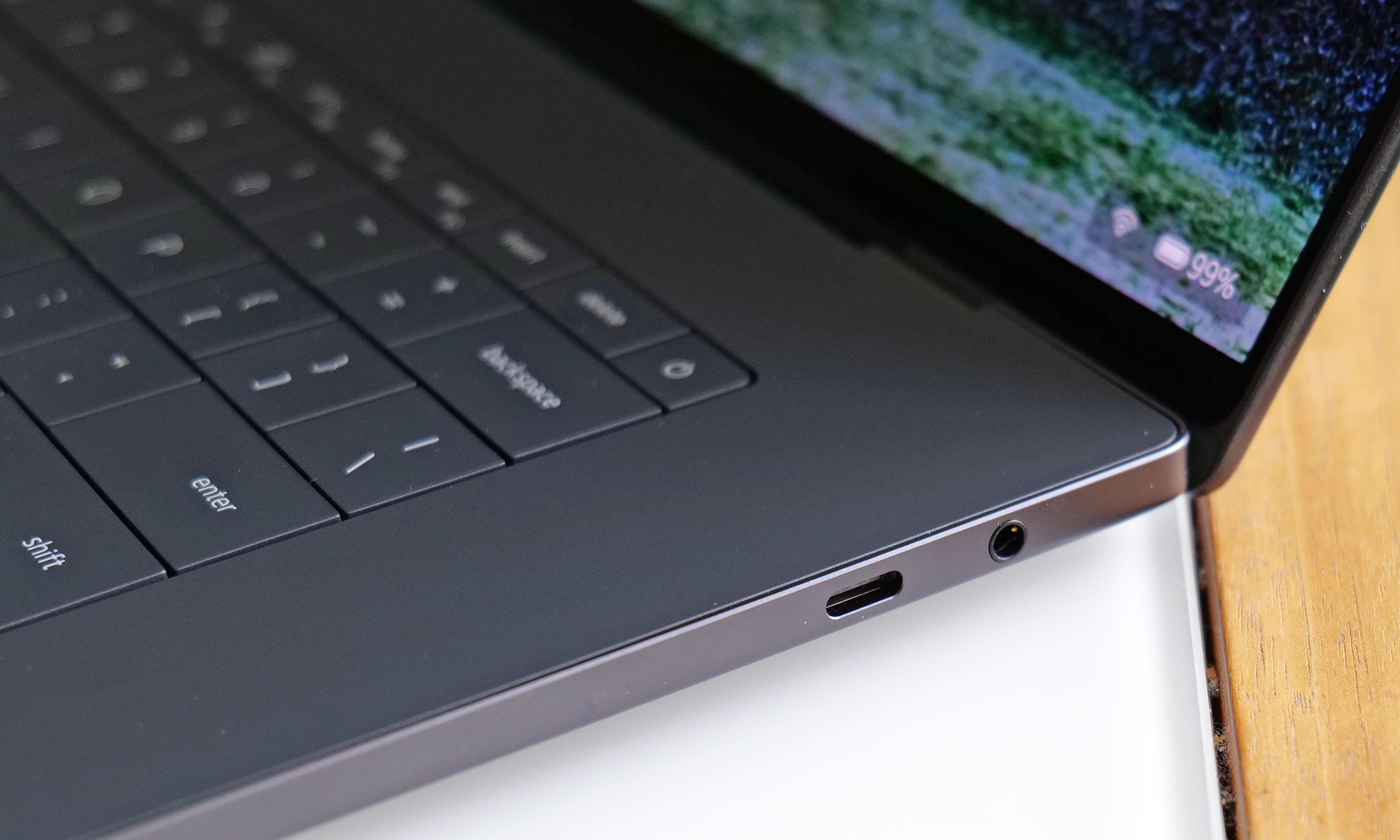
Elsewhere, Dell kept important features like the XPS line’s up-firing stereo speakers (which sound great), along with a decent mix of ports, including three USB-C jacks that support Thunderbolt 4, DisplayPort 2.1 and power delivery. The one thing I wish Dell had included though, is some sort of SD card reader. With the XPS 16 being the largest member of the family, it’s often a prime option for people who like to edit photos and videos on the go, so having an easy way to transfer media from a camera to the laptop would be really nice.
As for its display, Dell’s optional 3.2K tandem OLED panel like the one on our review unit reinforces the laptop’s role as a mobile editing platform. It produces vibrant hues and features a variable refresh rate that can go between 20 and 120Hz depending on what’s on the screen. Despite having a nominal peak brightness of 400 nits, it looks much brighter in person, so you’re getting an excellent viewing experience.
Keyboard and touchpad
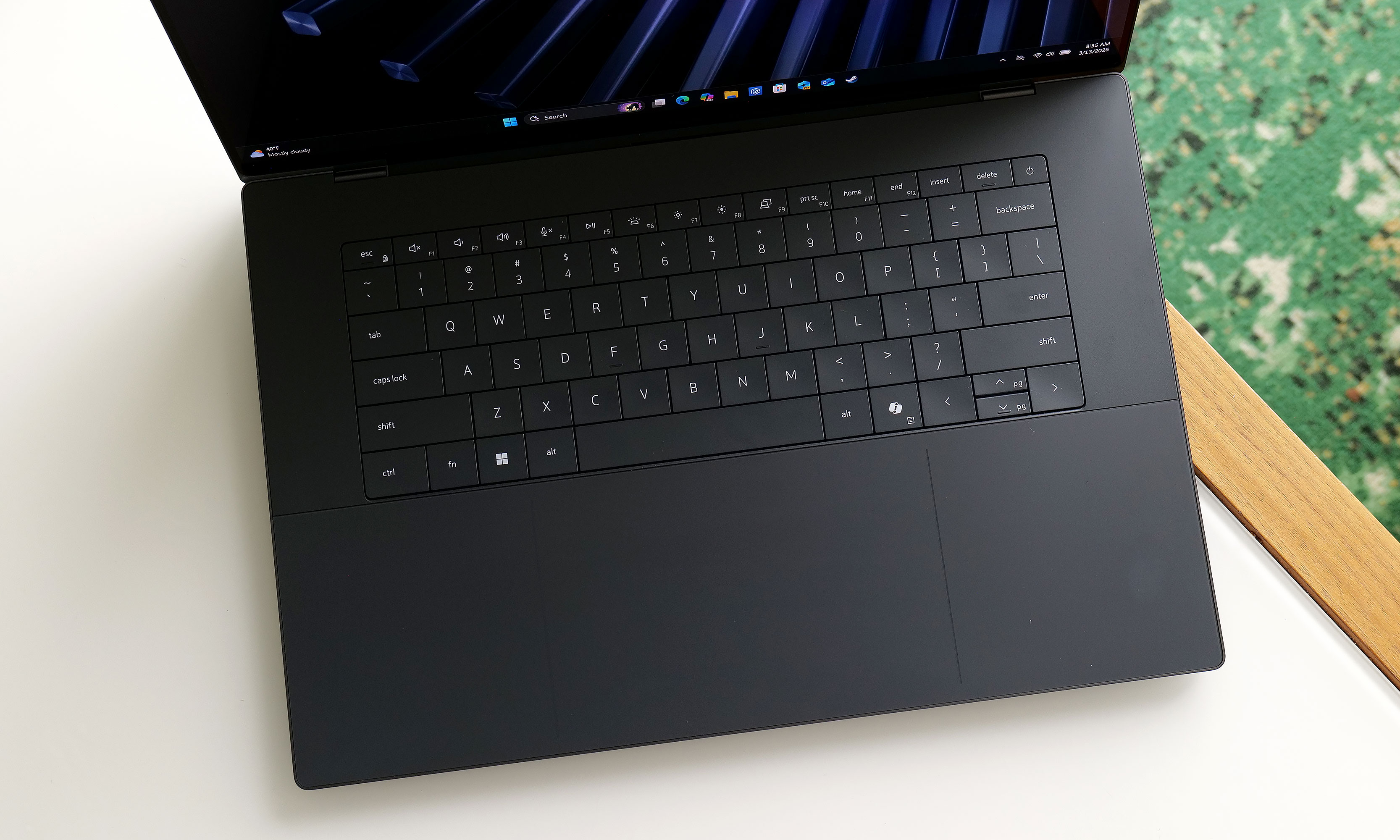
The XPS 16’s keyboard looks great, but the lack of an anti-ghosting feature and somewhat shallow key travel aren’t ideal.
Sam Rutherford for Engadget
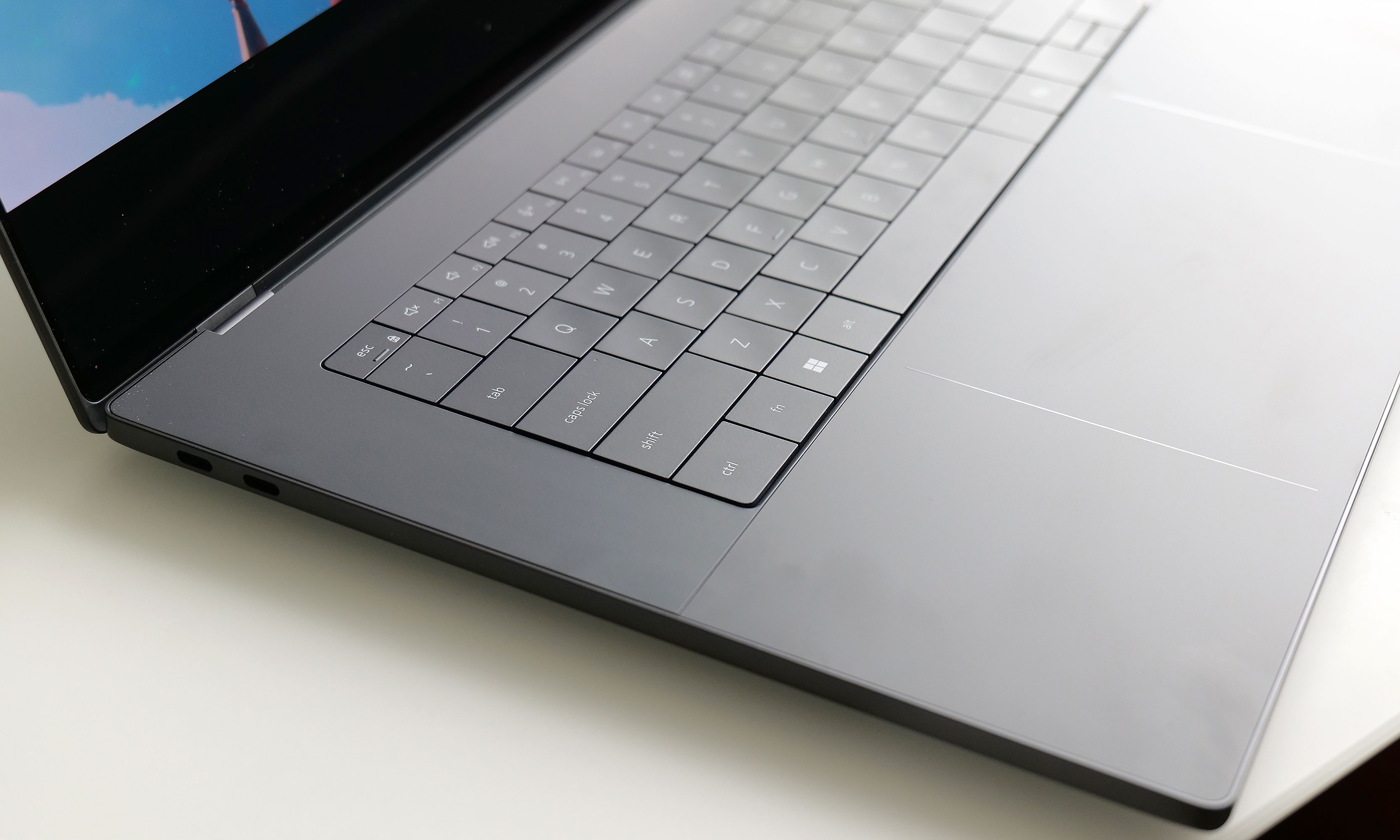
Perhaps the biggest change to the XPS line is its reworked keyboard and touchpad, which brings some ups and downs. Dell kept the glass deck and seamless touchpad used on previous models, except now there’s a faint line going around its perimeter, so you never have to guess where it is. The company also replaced the row of capacitive touch function and media controls from its predecessor with regular keys. As a fan of physical buttons, this is just great.
The issue is that for discerning typists, the keyboard seems to be missing anti-ghosting or N-key rollover tech. This means that if you press two keys very quickly one after another, the second press actually gets registered first, which can result in erroneous inputs. We ran into the same problem when testing the XPS 14. Dell claims this issue only impacts the first batch of systems off the line and that units on sale today have had this issue patched already. Furthermore, the company says it will release an update to address the issue on the remaining units, which should be out sometime in March. Though at the time of publication, I haven’t received anything yet.
The XPS 16 also features punchy up-firing stereo speakers that don’t leave much to complain about.
Sam Rutherford for Engadget
There is another nitpick about the keyboard. While I don’t mind that Dell retained its zero-gap layout instead of going with a more traditional chiclet-style design, the more I type on it the more I wish Dell would offer something with a bit more key travel and heavier actuation. For reasons out of my control, my company-assigned work machine is a Dell Precision 5680 from 2023. I don’t like it very much aside from its keyboard, which is significantly bouncier and just generally nicer to use than the one on the XPS 16.
Performance
A big reason why Dell was able to make the XPS 16 so thin and light is that the company didn’t leave room for discrete graphics. That means you can only choose between a handful of Intel’s latest Series 3 Core Ultra chips, ranging from the Ultra 5 325 to the Ultra X7 358H, with the latter being the one I tested here. That’s not a bad thing though, as the laptop easily handled all the various productivity tasks I threw at it. And even without a proper GPU, the XPS 16 still pumped out 62 fps in Cyberpunk 2077 at 1920 x 1080, using Ultra settings and Intel’s XeSS set to Quality. Those kinds of numbers aren’t going to make anyone toss out their dedicated gaming rig, but once again, that’s not too shabby for a notebook this easy to carry around.
Battery life
The XPS 16 comes with three USB-C port with Thunderbolt 4 which is nice, but sadly it lacks an SD card reader for quickly transferring media from a camera.
Sam Rutherford for Engadget
Thanks to a larger 99.5Whr battery, the XPS 16 fared better on our rundown test than its smaller sibling. This could be a deciding factor for anyone trying to choose between the two. In PCMark 10’s Modern Office battery benchmark, the XPS 16 lasted just shy of 12 hours (11:53), which is more than an hour and a half longer than what we got from the XPS 14 (10:21). As long as you’re not going to be gone for more than a day or you’re really pushing it, you should be able to leave its power brick at home.
Wrap-up
Instead of killing the XPS name for good, Dell wisely reconsidered and then doubled down. The result is fantastic new version of the XPS 16.
Sam Rutherford for Engadget
When Dell decided to bring back the XPS name, COO Jeff Clake said the company was going to get back to its roots. That’s the kind of messaging that’s easy to stay on a stage, but after testing out the reborn XPS 16, I can confirm it isn’t just flimsy rhetoric.
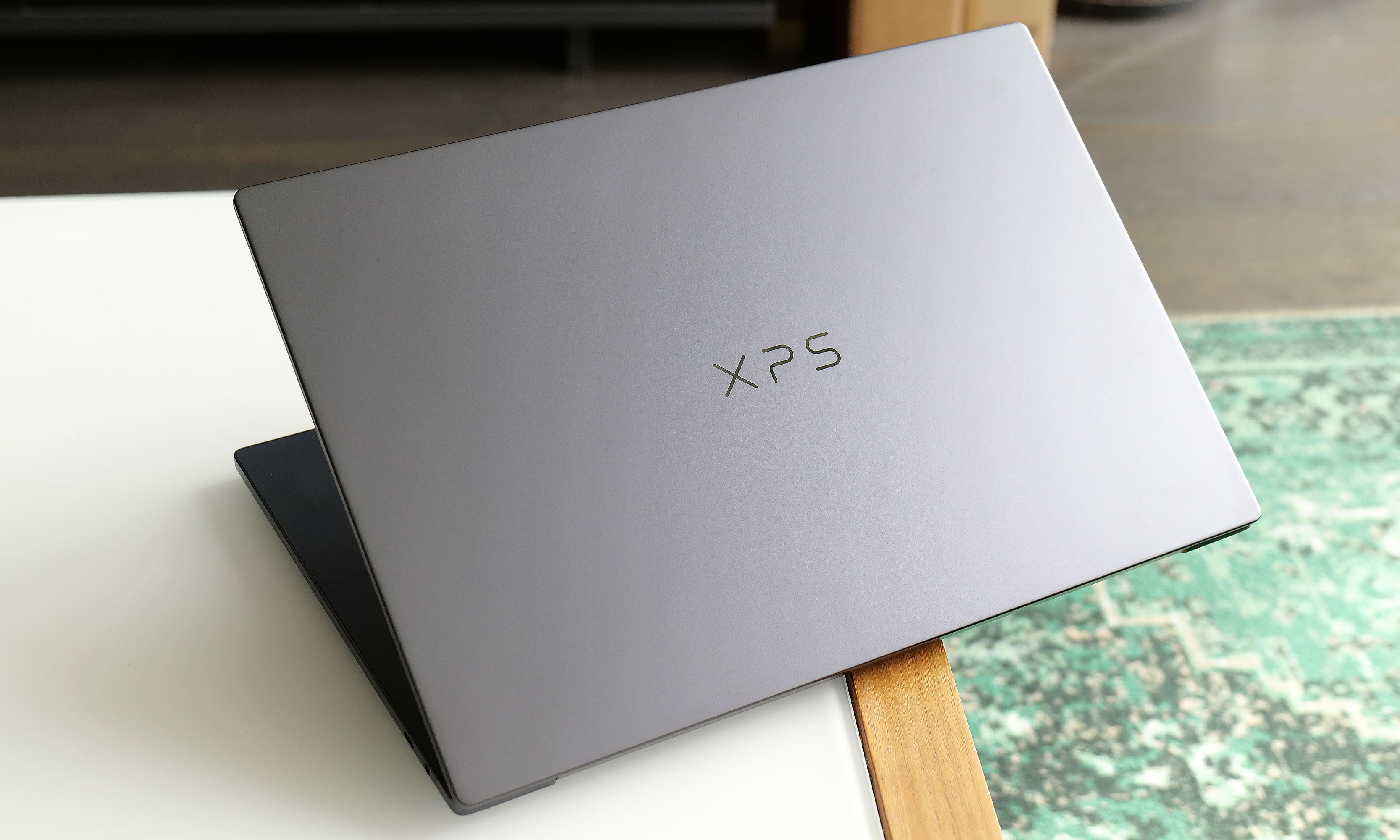
This laptop is a shining example of a premium ultraportable Windows laptop done well. It features a super sleek aluminum chassis, strong performance, solid battery life and an excellent display, particularly if you upgrade to the 3.2K OLED option. The connection to the iconic award-winning systems isn’t just skin deep. This thing is just as much an XPS as the ones we loved a decade ago and Dell is driving that point home by letting the XPS logo sit front and center on its lid instead of the company’s usual branding.
At just 3.65 pounds, the 2026 XPS 16 is basically a full pound lighter than its predecessor.
Sam Rutherford for Engadget
My one complaint is that I wish Dell would bring back the chiclet-style keyboards we got on models from the early 2020s. Though as long as the company can release updated software to fix the ghosting issues I’ve encountered, what’s on there now is more than good enough. Granted, at $2,349 for our review unit, the XPS 16 is a bit pricey, but that’s the going rate for a high-end notebook these days. If you snag a discount similar to the one Dell is currently running , suddenly, you’re looking at an even more enticing package at $1,900.
The biggest reason someone might want to hold off for now is if you do need more powerful graphics, as I’m expecting Dell to release an alternate version of the XPS 16 with room for a discrete GPU (and hopefully an SD card reader) sometime before the end of the year. Despite Dell nearly tossing decades of pedigree in the trash just months ago, the XPS 16 has returned to reclaim its spot at the top.
This article originally appeared on Engadget at https://www.engadget.com/computing/laptops/dell-xps-16-2026-review-return-of-the-king-130000906.html?src=rss
We may earn a commission from links on this page. Deal pricing and availability subject to change after time of publication.
A refurbished Nintendo Switch OLED (Mario Kart 8 Deluxe) bundle is currently selling for $269.99 on Woot, a noticeable drop from the $447 price for a new unit on Amazon and below the $299 typical price for a “like-new” refurb. This unit is listed as “Grade A” refurbished, meaning it has passed diagnostic testing and should only show minimal cosmetic wear that you likely won’t notice during normal use. Along with the console and standard accessories, you also get a download code for Mario Kart 8 Deluxe and a 12-month Nintendo Switch Online membership. That means you can start playing immediately without having to buy a game or subscription separately. Shipping is free for Prime members, while others pay $6, and the deal is expected to run for two weeks or until it sells out. Shipping is limited to the contiguous U.S.
The seven-inch OLED display is the main reason to pick this version. Colors appear more vibrant, and darker scenes look deeper and more defined when you’re playing in handheld mode. That difference is easy to notice in bright games like Mario Kart or platformers with colorful environments. Nintendo also replaced the small plastic kickstand from the older Switch with a wide, adjustable stand, which reportedly makes tabletop play more stable when you’re using detached Joy-Cons. Storage is 64GB out of the box (though you’ll still want a microSD card if you download a lot of games), and the dock includes a wired Ethernet port for more reliable online play, notes this PCMag review. None of this changes raw performance—games run the same as they do on the base Switch, so you are not getting higher frame rates or better graphics beyond the screen itself.
The bigger consideration now is how this compares to the latest Switch 2. Nintendo’s newer console introduces more powerful hardware and improved graphics, so players looking for the most future-proof option may lean in that direction. The counterargument is the price and the library. The original Switch already has years of games available, and most of Nintendo’s biggest titles were designed specifically around this hardware. And at $270 with a major game and a year of online access included, this bundle lowers the cost of entry considerably compared with buying new or moving to the newer console.
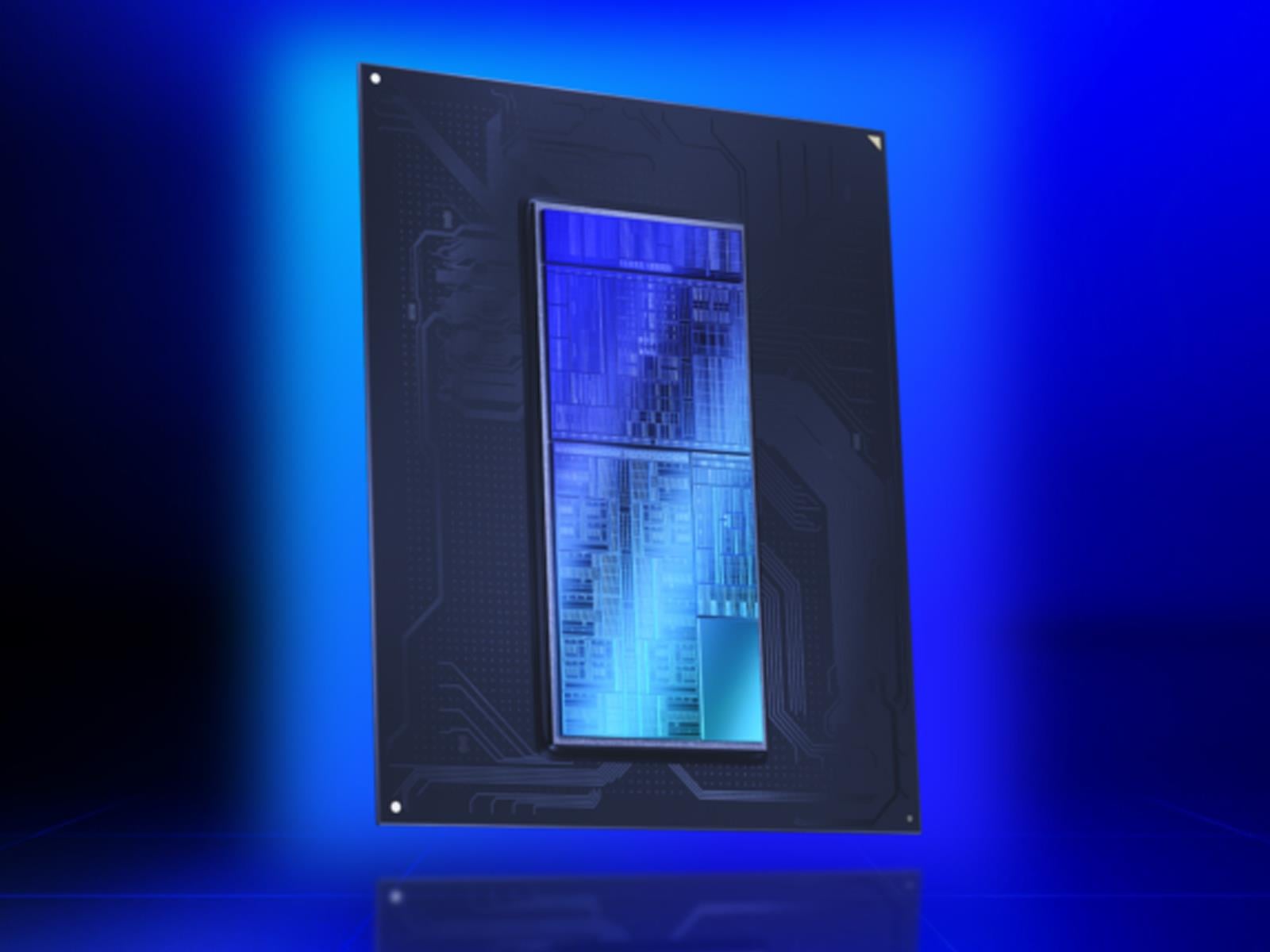
Intel is adding a couple of Plus models to its Core Ultra 200HX series lineup for laptops, and while the press release doesn’t explicitly designate the new CPUs as Arrow Lake Refresh, terminology it used for its desktop-bound Core Ultra 200S Plus models introduced last week, that’s essentially what these new parts are. And like their desktop
For the last three years, the technology industry has been held captive by a single narrative: the unstoppable rise of the AI data center. NVIDIA, through a combination of visionary leadership and a near-monopoly on high-end GPUs, has turned the “data center into the computer.” They have successfully convinced the world that AI is something that happens “out there”—in massive, power-hungry clusters that serve intelligence to us over a straw.
Last Friday, March 13, 2026, AMD formally challenged that consensus. With the announcement of their “Agent Computer” initiative, AMD isn’t just launching new chips; they are attempting a classic strategic flanking maneuver. While NVIDIA is focused on the training of foundational models, AMD is betting that the real value—and the real volume—lies in the local inference of autonomous agents.
It is a bold bet that the PC is not just a terminal for the cloud, but a sovereign server for a personal digital workforce.
The Graveyard of Early Assistants
AMD’s vision isn’t entirely new; the industry has been chasing the “digital agent” for decades. However, the path is littered with the corpses of high-profile failures. Before we can understand why AMD might succeed, we must look at why others failed.
We often point to Microsoft’s Cortana as the primary example of an agent that over-promised and under-delivered, but she was hardly alone. Apple’s Siri and Amazon’s Alexa suffered from the same fundamental flaw: they were “command-and-control” interfaces, not autonomous agents. They were built on rigid intent-matching systems that couldn’t handle multi-step reasoning.
More recently, specialized AI hardware like the Humane AI Pin and the Rabbit r1 attempted to create dedicated agentic devices. They failed primarily because they were “thin clients” tethered to the cloud. They suffered from high latency, privacy concerns, and a lack of local compute power. When your “agent” has to ask a server three states away for permission to summarize an email, the illusion of agency shatters.
AMD is arguing that these efforts underperformed because they lacked the local “muscle”—the combination of high-bandwidth memory and dedicated NPU silicon—to run complex models without a cloud umbilical cord.
The Flanking Maneuver: Client Inference vs. Cloud Training
NVIDIA’s dominance is rooted in the H100 and B200 ecosystems. They own the training market. AMD, realizing that catching up in the data center is a multi-year slog, is instead shifting the battlefield to the client.
By launching the Ryzen AI Max+ series with support for 128GB of unified memory, AMD is providing the specific hardware necessary to run massive, 100B+ parameter models locally. This is a direct shot at NVIDIA’s “Inference in the Cloud” model.
If a professional can run a Qwen 3.5 (122B) model locally on an AMD workstation with near-zero latency and total data privacy, the economic and security argument for NVIDIA’s cloud-based inference begins to crumble. AMD is banking on the idea that corporations will prefer “Sovereign AI”—agents that live within the corporate firewall—over sending sensitive data to a third-party data center.
The Roadmap to Success: What AMD Must Do
Announcing a vision is easy; executing it in a market dominated by NVIDIA’s CUDA software moat is the hard part. For the Agent Computer to hit critical mass, AMD needs to execute on three fronts:
Software Parity (ROCm): AMD must continue to aggressively fund and stabilize ROCm (Radeon Open Compute). Developers will only build for the Agent Computer if the software stack is as “invisible” and reliable as NVIDIA’s.
Open Standards: AMD’s support for OpenClaw is a great start. By embracing open-source agentic frameworks, they allow a community of developers to bypass proprietary ecosystems.
The OEM Push: AMD needs Lenovo, HP, and Dell to market these not as “faster PCs,” but as “Agent Workstations.” This requires a shift in how PCs are sold—focusing on outcomes (e.g., “This computer manages your supply chain”) rather than specs (e.g., “This computer has 5.0GHz”).
Life with Your Own Agent Computer
When this shift hits critical mass, likely around 2028, your relationship with technology changes from “operator” to “manager.”
Imagine starting your morning not by checking 50 unread emails, but by reviewing a three-paragraph summary from your Executive Agent. It has already cross-referenced your calendar, flagged a conflict in your 2:00 PM meeting, and drafted three potential responses to a client inquiry based on your past writing style.
This isn’t a chatbot you “talk” to; it’s a background process that has “agency.” You might tell it, “I need to plan the quarterly review,” and the computer—locally—spins up a Research Agent to pull data, a Design Agent to create the slides, and a Logistics Agent to invite the stakeholders. Your life changes from a series of manual micro-tasks to a series of high-level approvals.
Wrapping Up
AMD’s “Agent Computer” initiative is more than a product launch; it is a declaration of independence from the cloud-centric AI model pioneered by NVIDIA. By focusing on local, massive-memory inference and autonomous agentic frameworks like OpenClaw, AMD is attempting to redefine the PC as a local intelligence server.
To succeed, AMD must solve its historical software hurdles and convince a skeptical enterprise market that “Sovereign AI” is worth the investment. If they do, they won’t just be competing with NVIDIA; they will be leading the charge into the most significant computing shift since the graphical user interface. The age of the computer as a tool is ending; the age of the computer as a colleague has begun.
Smart home company Aqara has launched what it says is the first camera certified for Matter, the open source standard that enables interoperability across brands, like Google and Amazon. The Aqara G350 is an indoor security cam that also functions as a Zigbee and Matter hub in the Aqara Home app, which means the camera will enable you to control various devices across smart home protocols from different brands within one location.
The camera itself comes with a 4K wide-angle and a 2.5K telephoto lens, providing both panoramic and closeup views. It also has 9x hybrid zoom and a pan-tilt mechanism that can give you 360-degree coverage of the room it’s in. The camera uses AI-powered tracking to keep people and pets in frame, as well as to determine which events and sounds are truly meaningful before sending you an alert. The Camera Hub G350 is now available via Aqara’s website, Amazon and other retailers for $140.
Aqara has also introduced the G400 wired doorbell camera that can connect to the internet either via Ethernet or dual-band Wi-Fi 6. It has a lens with 2K resolution and 165-degree ultra-wide field of view, so that it can capture visitors even when they’re standing close. The camera has on-device detection capabilities to recognize people and motion even without being connected to the internet. Connected, its cloud-based AI features enable it to identify faces, packages, vehicles and animals. You can connect the Aqara G400 doorbell camera to major smart home platforms, such as Apple Home with Homekit, Amazon Alexa, Google Home and Samsung SmartThings. It’s now available for sale on Aqara’s website, Amazon and other retails for $100.
This article originally appeared on Engadget at https://www.engadget.com/home/smart-home/aqaras-matter-compatible-camera-promises-easier-smart-home-integration-124500865.html?src=rss
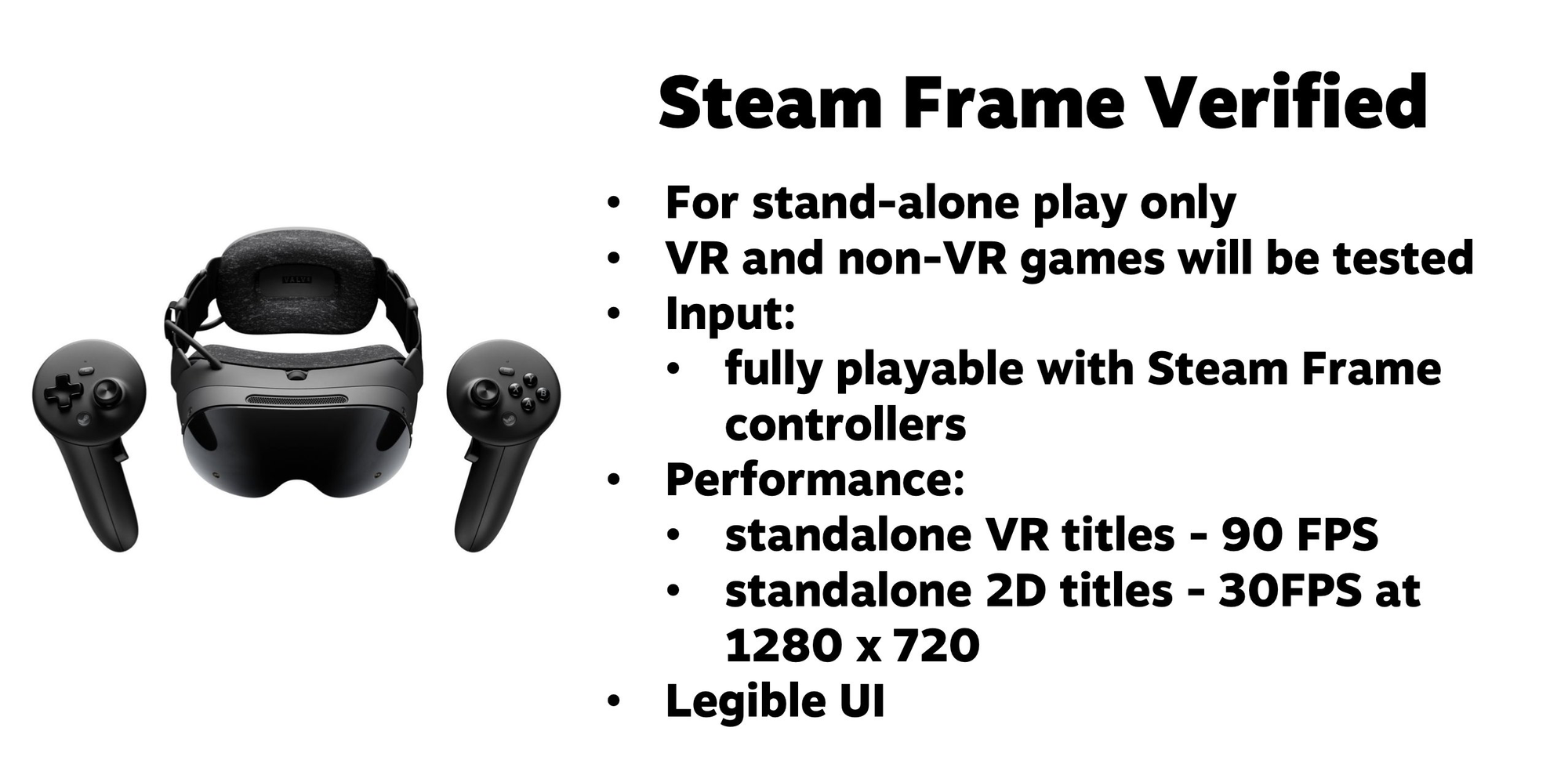
Valve announced the specific criteria for VR titles to receive the ‘Steam Frame Verified’ label on the Steam store.
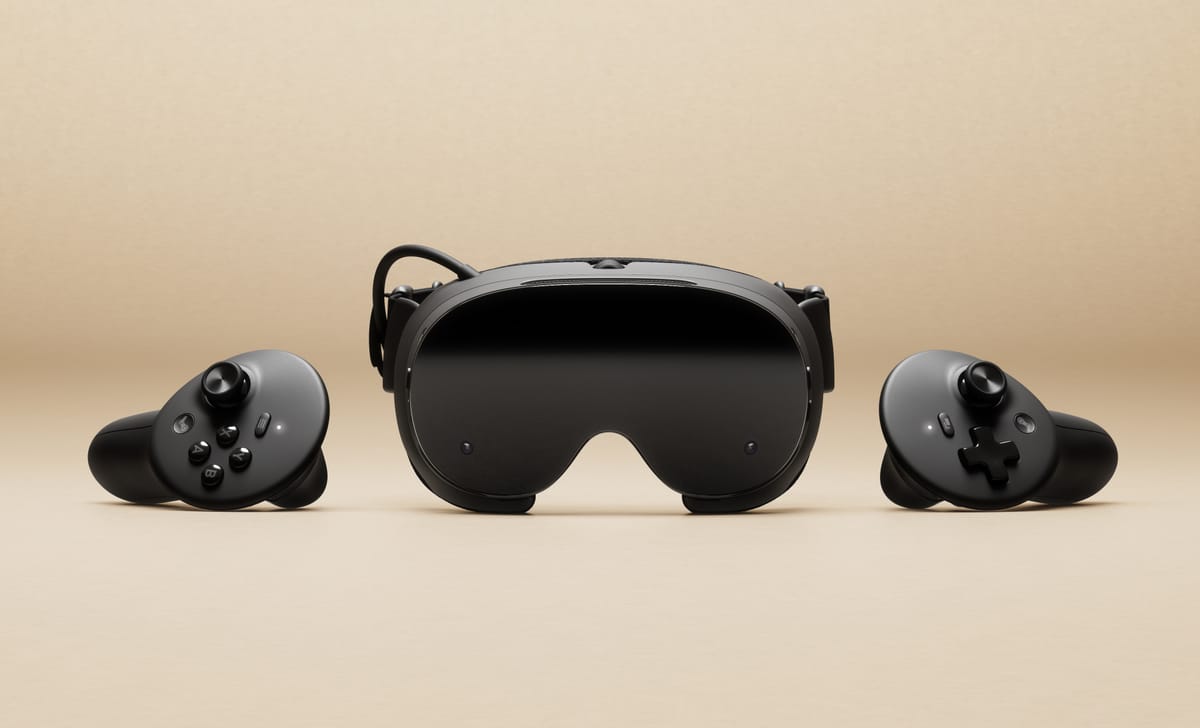
Steam Frame is marketed by Valve as a “PC streaming first” product, primarily meant for gaming PC owners, but it also supports fully standalone play without a PC, just like a Meta Quest or Pico headset.
The challenge with Steam Frame as a standalone experience, however, is that it accesses the regular Steam store, and the vast majority of VR content on Steam is designed to run on a powerful gaming PC that draws hundreds of watts from mains power.
Steam Frame is slightly more powerful than Quest 3, with around 30% more GPU power and eye tracking that can drive foveated rendering in supported titles. But it’s still significantly less powerful than a PC, due to running on a mobile chipset powered by a battery. While Steam Frame can run almost any VR title on Steam, it can’t run the majority well.
Since Steam Frame was announced, dozens of VR game developers have been working to optimize their titles to run standalone on Valve’s headset. Some are repurposing their Quest or Pico builds, leveraging the fact that Steam Frame can run Android APKs, while others are building a lower graphics tier than their current lowest.
Valve’s slide from GDC 2026.
For buyers of Steam Frame who want to use the headset standalone, Valve intends to make it easy to find titles optimized to run on Steam Frame by adding a ‘Steam Frame Verified’ label to those that it has tested and found to run well. It’s a continuation of its strategy with Steam Deck, which has a ‘Steam Deck Verified’ label.
At GDC 2026, Valve revealed the specifics behind what a game will need to do to earn the Steam Frame Verified label.
The label will apply to both VR and flatscreen titles. For standalone VR, the title must run at 90 FPS, while standalone flatscreen games need to run at 720p 30FPS at minimum.
Valve’s 90 FPS VR requirement is far stricter than the Meta Horizon Store or Pico Store, which both allow 72 FPS VR titles. The PlayStation Store allows 60FPS reprojected to 120Hz as the minimum.
In VR, a higher frame rate reduces the feeling of sickness that some people experience. And below 90 FPS, with the kind of low persistence displays needed for VR headsets, many people can see a distinct flicker in the periphery of the image for bright scenes. Valve is thus prioritizing the user experience over having as many Steam Frame Verified titles as possible – a fascinating move.
Still, getting VR content built for a powerful gaming PC to run at 90 FPS on a 10-watt mobile chipset from late 2023 will be no easy feat for developers, and for some it will be a downright impossible task.
It’s a reminder of Valve’s “PC streaming first” positioning for the product, and that the company is sticking to the values the industry established in early 2014, when both Oculus and Valve declared that 90Hz was the minimum bar for high-quality VR.
The looming question remains, of course: when will Steam Frame actually launch? Last month Valve announced that it needs to “revisit” its “exact shipping schedule and pricing” amid the global memory shortage, though the company said its goal is still to ship in the first half of this year.
Blender 5.1 is out today with many exciting improvements for this leading open-source 3D modeling software. From AMD GPU hardware ray-tracing being enabled by default at long last to more mature Vulkan support and performance, Blender 5.1 is a great release…
We may earn a commission from links on this page. Deal pricing and availability subject to change after time of publication.
The Amazon Echo Show 11 arrived in late 2025 as the successor to the Echo Show 10 (3rd Generation), and it now sits at its lowest price since release, according to price trackers. Amazon currently lists the smart display for $169.99 (originally $219.99). The Echo Show line has always been about turning Alexa into something you can see as well as hear, and this version leans heavily into the display. The 11-inch touchscreen runs at 1,920 by 1,200 resolution and measures about 8mm thick, making it thinner and larger than the screen on the Echo Show 10. In practice, it works well for everyday household tasks. You can follow a recipe from across the kitchen, keep a video call open while doing other things, or leave a calendar visible during the day.
The biggest design change from the Echo Show 10 is that the screen no longer rotates to follow you. Amazon replaced the moving display with a fixed panel that appears to float above a fabric speaker base. That said, if you want to rotate or tilt the display, Amazon does sell a $39.99 magnetic stand. As for connectivity, the Echo Show 11 supports Wi-Fi 6E and broader smart-home compatibility—it works well with Zigbee, Matter, and Thread, allowing it to function as a hub for lights, plugs, locks, and other connected gear without an extra bridge. One change longtime Echo users may notice is the lack of a physical camera shutter. Older models included one, so people who liked that extra privacy safeguard may miss it here.
Feature-wise, the Echo Show 11 runs the same experience as the smaller Echo Show 8. It launches with Alexa+, Amazon’s new AI-enhanced assistant, currently in Early Access and included with a Prime membership. The new Alexa+ feels more conversational and better at handling natural language requests, notes this PCMag review. The only real drawback is that the interface can feel busy, and you’re paying more for screen size rather than new features. If you want a bigger display and stronger sound in one unit, this deal makes sense. If you’re fine with a smaller screen, the Echo Show 8 delivers nearly the same experience for less.
Intel Graphics Compiler 2.30.1 is now available for this LLVM/Clang-based compiler stack used by the Compute Runtime on Linux and under Windows is used both for graphics and compute…
Flexibility is an underrated aspect of fitness, especially since we tend to lose some of our mobility as we get older—how many of the older folks in your life can comfortably reach overhead? But whether you’re doing it for lifestyle improvements or athletics, stretching can be boring, and progress can be slow. How do you know if you’re stretching enough? Fortunately, a study has given us some guidelines.
These guidelines are for static stretching, which is the traditional kind where you hold a position. (Other mobility work, including dynamic stretching, is still good for you, but it wasn’t included in this study.)
For immediate improvement, stretch for 4 full minutes
Stretching has both short-term and long-term effects. We often think of flexibility as a long-term journey (we are becominga more flexible person over time)—but there is also a more dramatic temporary effect that occurs during and right after the stretching session. Let’s talk about that first.
According to the study, you can maximize the short-term benefits of stretching from four total minutes of stretching for that muscle. That doesn’t have to mean a single four-minute stretch; it could be 30 seconds, eight times, or one minute four times. And they don’t have to be the same type of stretch, so long as they hit the same muscle. Less than four minutes will still give you some benefit, but four minutes is the most that the researchers found to help.
For long-term improvement, stretch for 10 minutes per week (per muscle)
If you’re looking to get more flexible in the long term, the number to aim for is 10 minutes, per muscle, per week. Again, this can be broken up. If you have a routine that stretches each muscle for two total minutes (4 sets of 30 seconds, for example), doing that routine five days a week will get you there.
Or perhaps you’re already interested in those short-term benefits I mentioned above, so you’re doing a warmup session that racks up three or four minutes per muscle. Those count toward your ten minutes for the week, so you may not need to do any extra stretching sessions beyond those warmups—as long as those warmups include all the muscles you are targeting.
You don’t have to do every stretch in existence; just pick a few muscles or body parts that you’d like to make more flexible. Pick a favorite stretch or two for each, and get into the habit of performing those stretches for a minute each day. Here are some of my favorite stretches to get you started:
Don’t fall into the trap of thinking that stretching is more effective the harder you do it. Stretching doesn’t need to be painful to be effective. The recent study found that hard stretching and gentle stretching both worked about equally well.
Flexibility trainers often say that your best bet is gentle stretching, where you can feel the stretch but it’s not painful. Being gentle about it lets you stretch longer and more often (and enjoy the process more!), which are the factors that really help you to make progress.
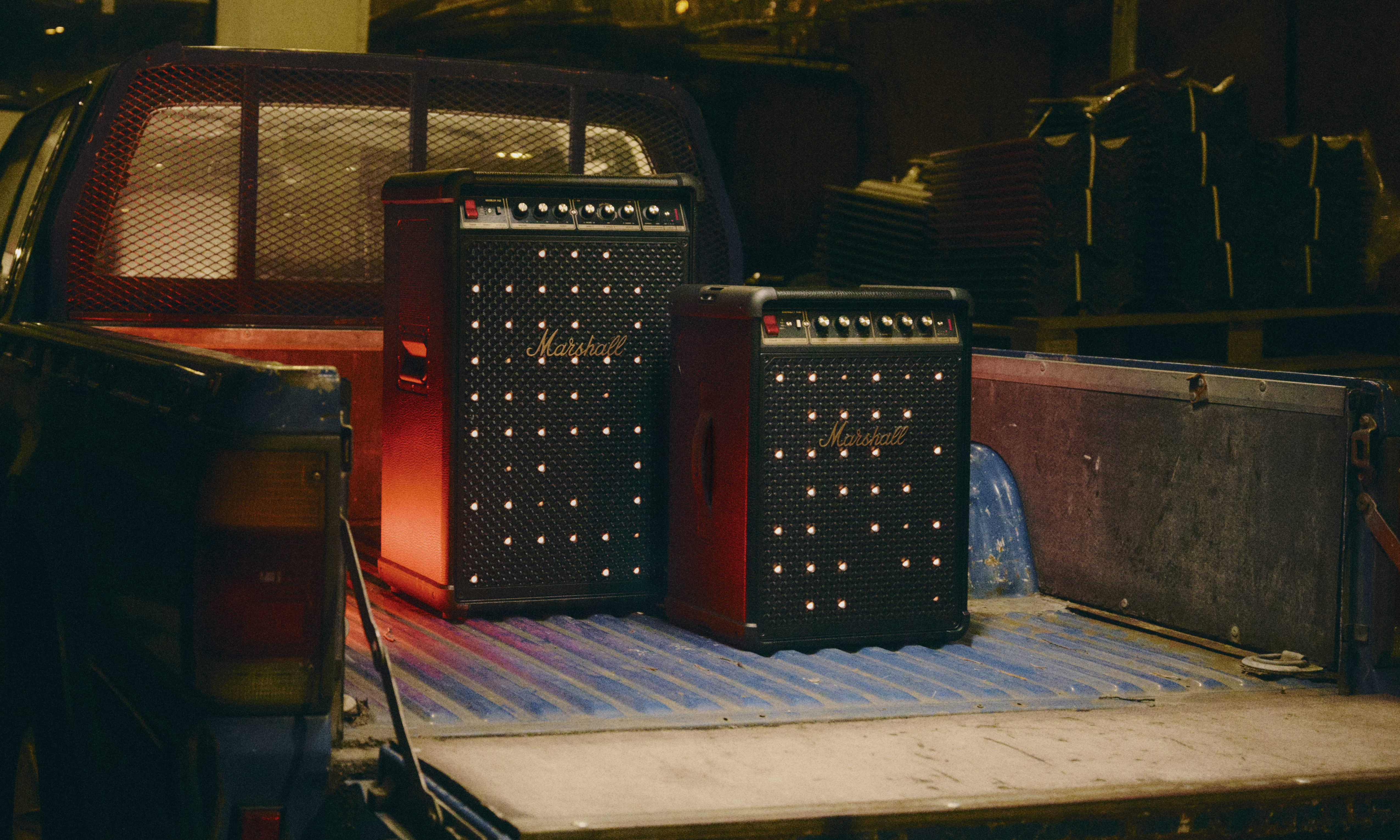
Marshall is launching a smaller companion for its highly rated Bromley 750 party speaker. The new Bromley 450 retains the larger model’s guitar-amp motif but comes in a petite, less expensive package.
The Bromley 450 carries over its larger sibling’s 360-degree audio trickery. Like equivalents from other companies, Marshall’s “True Stereophonic 360-degree sound” fools your brain into perceiving more directionality than its form factor allows. Lighting effects (“inspired by ‘70s stage shows”) also carry over from the larger model. However, this new speaker lacks the “sound character” control found in the Bromley 750.
Marshall says you can expect over 40 hours of playtime. If your party somehow goes on longer than that, you can swap out its battery on the fly (using the same one found in the Bromley 750). Or, you know, just plug it into a power outlet. And if your event turns into a performance, you’re covered with mic and instrument inputs.
The Bromley 750 (left) and Bromley 450
Marshall
The Bromley 450 measures 360 x 261 x 492mm, making it about 25 percent shorter than its big brother. At just under 27 lbs, it only weighs about half as much. That helps to explain Marshall’s decision not to include wheels on this model. (But don’t worry, it still has a handle.) The speaker has an IP55 rating for dust and water resistance.
The Marshall Bromley 450 may be less expensive than its larger counterpart, but it still costs a pretty penny. It’ll set you back $800 when it goes on sale on March 31. You can order it on Marshall’s website and from select retail partners (including Best Buy, Sweetwater and Crutchfield).
This article originally appeared on Engadget at https://www.engadget.com/audio/speakers/marshall-adds-a-junior-sized-party-speaker-to-its-lineup-120000871.html?src=rss
The Boys: Trigger Warning is coming to Quest 3 & Quest 3S next week.
ARVORE Immersive Games and Sony Pictures Entertainment have announced that The Boys: Trigger Warning will release on Quest 3 headsets on March 26. The made-for-VR game is adapted from the successful Amazon show, and features voice acting by several of the show’s cast.
The Boys: Trigger Warning presents a totally new story set in the world of The Boys. Players will choose stealth or chaos, use unstable Supe powers like telekinesis and laser eyes, and engage in brutal fights against enemy Supes.
0:00
/2:13
The immersive VR title comes just weeks ahead of the fifth and final season of the TV series.
The Boys: Trigger Warning launches on the Meta Horizon Store on March 26. The game will cost $29.99, with a limited-time pre-order price of $23.99.
The game is also coming soon to PlayStation, where it can now be wish listed.
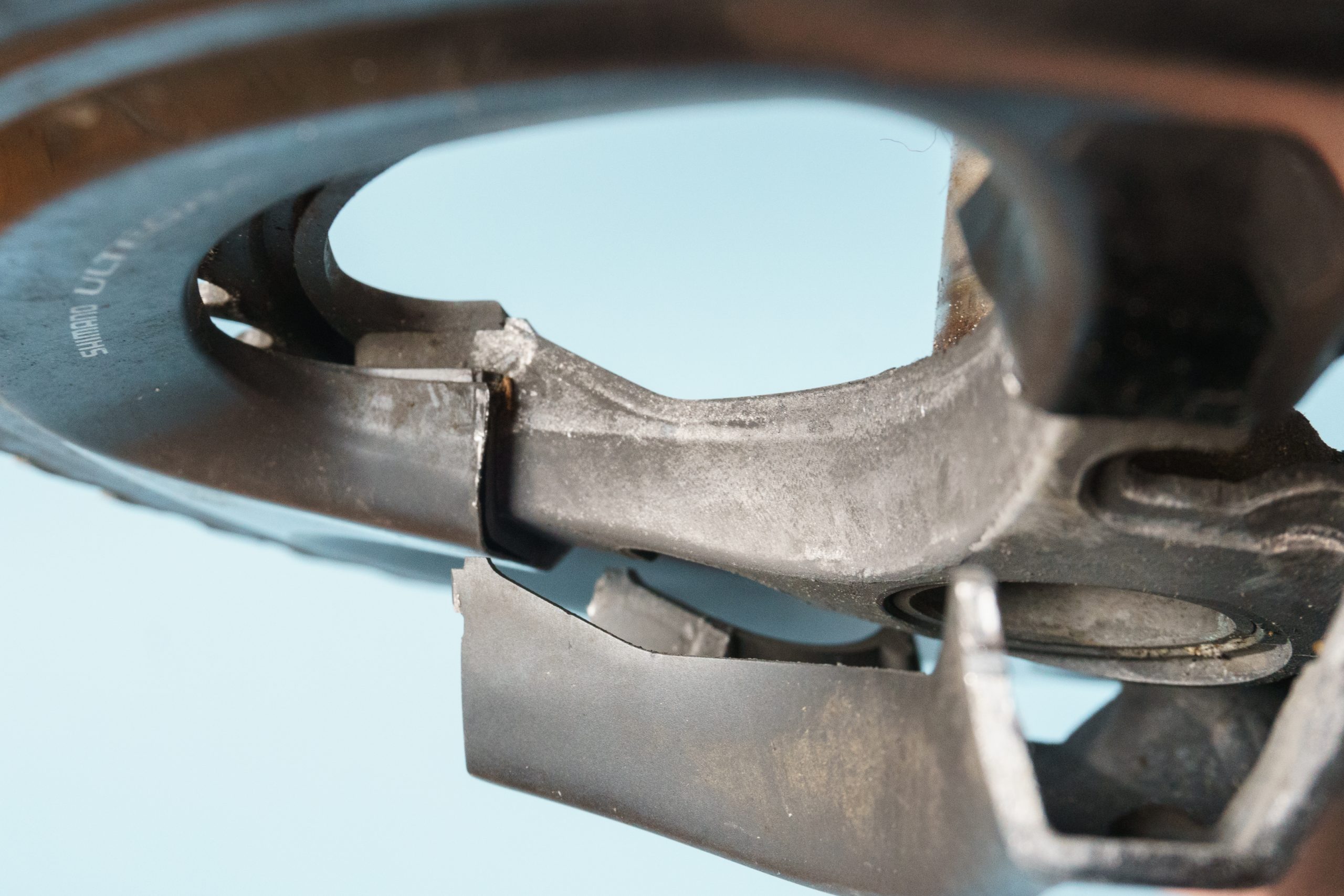
Shimano faces an $11.5 million penalty after the US Consumer Product Safety Commission (CPSC) concluded the company failed to promptly report a defect in its 11-speed road cranksets.
The regulator claims Shimano received “thousands” of warranty claims globally between 2013 and 2022, alongside reports of injuries “including bone fractures, joint displacement, and lacerations”.
According to the CPSC, Shimano possessed information that “reasonably supported the conclusion that the bicycle cranksets contained a defect which could create a substantial product hazard,” but did not immediately report this to the commission as required.
The issues saw more than 2.8 million cranksets returned. Jack Luke / Our Media
The penalty follows a large-scale recall announced in 2023, which saw a reported 2.8 million 11-speed Shimano cranksets returned globally as part of an inspection and replacement programme.
Affected cranks commonly saw the compound bonding the two cast halves fail, leading to delamination and potential crank failure.
In addition to the civil penalty, the settlement requires Shimano to maintain internal controls and procedures to ensure compliance with the Consumer Product Safety Act.
The company has also agreed to submit annual reports on its compliance programme, internal controls and audits.
The settlement has been provisionally accepted by the CPSC and remains subject to public comment.
A Shimano representative told Bicycle Retailer and Industry News the company could not comment beyond what was included in the public settlement.
After ByteDance suspended the global rollout of its new Seedance 2.0 AI video generator on the weekend, US senators have now told the company to “immediately shut down” the app. “Seedance 2.0 poses a direct threat to the American intellectual property system and, more broadly, to the constitutional rights and economic livelihoods of our creative community,” Senators Marsha Blackburn and Peter Welch wrote in a letter to the company.
The letter reflects an increasing worry in government about AI companies training their apps on copyrighted materials from artists, actors and filmmakers without permission. “Responsible global companies follow the law and respect core economic rights, including intellectual property and personal likeness protections,” the senators wrote. They cited Seedance AI examples including an AI generated Thanos and Superman battle, a rewritten Stranger Things ending and that famous (fake) Tom Cruise and Brad Pitt battle.
After pulling Seedance 2.0, ByteDance said on the weekend that it “respects intellectual property rights” and that it is “taking steps to strengthen current safeguards as we work to prevent the unauthorized use of intellectual property and likeness by users.”
However, Blackburn and Welch called that pledge “a delay tactic to continue to abuse the innovators and profit from their success,” adding that its regard for American IP is “part of a larger trend of artificial intelligence companies stealing protected work at the expensive of the creative community.”
Filmmakers have also taken action against Seedance 2.0, including the Motion Picture Association with recently sent a cease-and-desist letter to ByteDance. Yesterday, senators including Blackburn and Welch unveiled a partisan bill to help artists protect their IP by allowing them to access training records used for AI models, among other measures.
This article originally appeared on Engadget at https://www.engadget.com/ai/senators-tell-bytedance-to-shut-down-seedance-20-ai-video-app-immediately-112146241.html?src=rss
You may have a little Apple fatigue after last week’s barrage of Macs, iPhones and iPads. The company wasn’t done, however. Surprise! Here is an updated pair of AirPods Max. It’s a predictable surprise, perhaps, but one I wasn’t expecting after so many other new devices.
It’s also the first true update. The AirPods Max 2 look identical to their predecessor, but now have an H2 chip. First, the AirPods Pro 2 improve noise cancellation by 50 percent and add support for Adaptive Audio and Live Translation. It’s a much-needed update for headphones that, barring a USB-C option, haven’t changed since 2020.
What did I just say? Wrapping up the barrage of reviews of all that new Apple hardware (besides those new AirPods), we test out Apple’s most powerful new MacBook. The new Pro has an M5 Max chip, plenty of memory and is a beast. Thankfully, it still has all the ports you’d want.
The class action lawsuit says that the lives of three teens have been “shattered.”
xAI is facing a class-action lawsuit in California, after its Grok AI reportedly generated sexualized images of children. Three teenagers filed suit, alleging Grok used their photos to create child exploitation material. One teen was alerted in December that AI-generated, sexually explicit images of her and other minors were being shared “in settings with which she was familiar, but morphed into sexually explicit poses.” The Center for Countering Digital Hate estimated in January that Grok produced millions of sexualized images, including 23,000 potentially depicting children.
Google is rolling out a new feature for Chrome that will add a bookmark bar to the browser on Android foldables and tablets. Spotted by 9to5Google, this move will make the browsing experience on larger mobile devices more akin to that of laptops and desktops running Chrome. Perfect if you managed to grab Samsung’s Galaxy Z TriFold before it disappears forever.
It would cost £18.62 billion and take 12 years to repair all the local-authority controlled tarmac in England and Wales, according to a report published today by the Asphalt Industry Alliance (AIA).
Each year, the AIA commissions an independent survey of local authority highway departments in England and Wales to “take a snapshot of the general conditions of the local road network”.
This year, the Annual Local Authority Road Maintenance (ALARM) report found a total of 1.9 million potholes were filled in 2025 – more than 5,200 every day – at a total cost of £149.3m.
But local authorities say they do not have the budget to maintain their networks, despite a 17 per cent increase in the average annual highway maintenance budget.
David Giles, chair of the AIA, says: “[O]ur ageing network has become more fragile”. Christopher Furlong / Getty Images
David Giles, chair of the AIA, says in his introduction to the report that the condition of local roads in the two countries “has become a national disgrace”.
“Tracking ALARM data over the last decade shows that the amount needed to bring the carriageway up to scratch has increased dramatically, not helped by the inconsistent funding levels that local authorities have reported over this period.”
“Meanwhile, our ageing network has become more fragile and vital resurfacing takes place less frequently – now reportedly only once every 97 years on average,” adds Giles.
The report says that just over half of the local road network is now reported to be in good structural condition, while 49 per cent of the network is said to have less than 15 years’ structural life remaining.
AIA says its estimate of £18.62 billion to fix the backlog of local road repairs has increased by more than 54 per cent from the £12.06 billion reported in 2016.
The report found there is a £1.37 billion shortfall in the total carriageway maintenance budget, which is roughly £8.1 million per local authority.
The government has allocated £1.6 billion to local highway maintenance for this financial year, and has pledged to allocate £7.3 billion over the next four years.
Alongside additional allocations from local authorities’ own sources, this financial commitment has led to an increase in the average highway maintenance budgets in England and Wales.
But this has “only resulted in marginal improvements in condition”, with highway engineers telling the AIA that it is not a “silver bullet that will clear the backlog of repairs any time soon”.
The risk to cyclists
The condition of roads in England and Wales can pose particular risks to cyclists. In February, the cycling insurance specialist Cycleplan revealed that the damage to bikes caused by potholes leads to costs that are 50 per cent higher than the average claim.
After analysing a decade of internal claims, Cyclepan found pothole-related incidents – such as buckled wheels and twisted bicycle frames – result in an average repair cost of £1,017.74.
“Many cyclists reported being forced to ride over potholes after vehicles passed too closely or at speed, leaving them little room to manoeuvre safely,” Cycleplan said.
“Another concern highlighted by the data is delayed awareness of damage. Riders often did not realise their bike had been compromised until days later, sometimes continuing to ride with hidden faults that could pose safety risks,” it added.
Alan Thomas, CEO of Cycleplan, said: “Potholes remain a major frustration for everyone on the road, but cyclists can face far greater consequences.
“Beyond repair costs, there is a genuine risk of serious injury when a rider hits a pothole – particularly during colder months when freeze-thaw cycles worsen road surfaces.”
An anonymous reader quotes a report from Inside Climate News: Republican lawmakers in multiple states and Congress are advancing proposals to shield polluters from climate accountability and prevent any type of liability for climate change harms — even as these harms and their associated costs continue to mount. It’s the latest in a counter-offensive that has unfolded on multiple fronts, from the halls of Congress and the White House to courts and state attorneys general offices across the country.
Dozens of local communities, states and individuals are suing major oil and gas companies and their trade associations over rising climate costs and for allegedly lying to consumers about climate change risks and solutions. At the same time, some states are enacting or considering laws modeled after the federal Superfund program that would impose retroactive liability on large fossil fuel producers and levy a one-time charge on them to help fund climate adaptation and resiliency measures. But many of these cases and climate superfund laws could be stopped in their tracks, either by the conservative majority on the U.S. Supreme Court or by the Republican-controlled Congress.
Last month the court decided to take up a petition lodged by oil companies Suncor and ExxonMobil in a climate-damages case brought against the companies by Boulder, Colorado. The petition argues that Boulder’s claims are barred by federal law, and if the justices agree, it could knock out not only Boulder’s lawsuit but also many others like it. The court is expected to hear the case during its upcoming term that starts in October. There is also a possibility that Republicans in Congress will take action before then to gift the fossil fuel industry legal immunity, similar to that granted to gun manufacturers with the 2005 Protection of Lawful Commerce in Arms Act. Sixteen Republican attorneys general wrote (PDF) to U.S. Attorney General Pam Bondi in June suggesting that the Department of Justice could recommend legislation creating precisely this type of liability shield. And last month, one Republican congresswoman announced that such legislation is indeed in the works. “The ultimate democratic institution in America is the jury,” said former Washington Gov. Jay Inslee. Enacting policies that prevent or block climate-related lawsuits against polluters, he said, would effectively shutter “the doors of the courthouse to Americans that have been injured by oil and gas company pollution and by their lies and deceit about that pollution.”
“I really think it’s an un-American effort to deny Americans the traditional right of access to a jury,” Inslee said. Oil and gas executives are “terrified” by the prospect of having to stand before a jury and face evidence of their climate-change lies and deception, he added. “You’ll see the steam coming out of the jury’s ears when they hear about how they’ve been lied to for decades. [Oil companies] understand why juries will be outraged by it, and they are shaking in their boots. The day of reckoning is coming, and that’s why they’re afraid.”