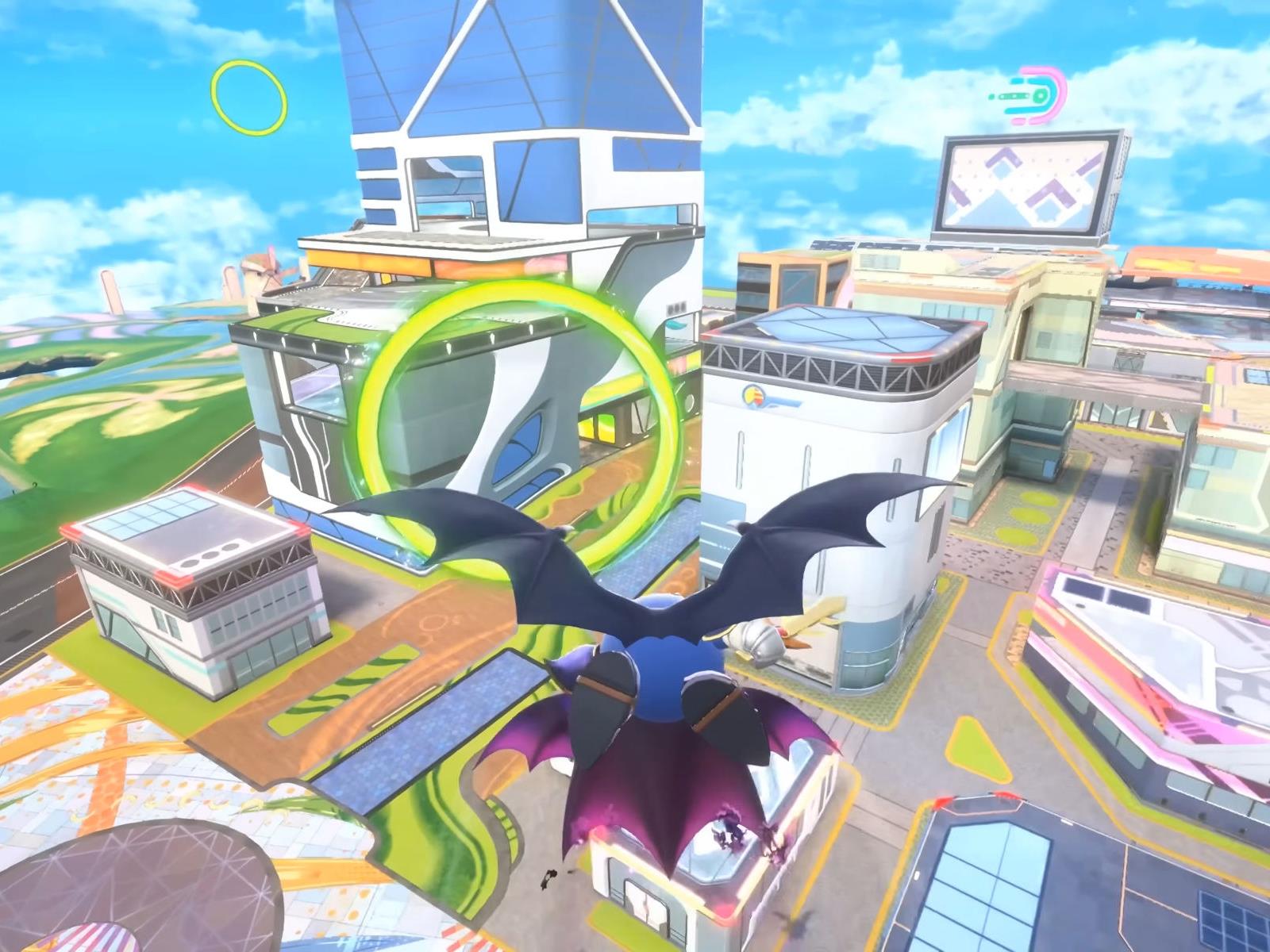
This morning, a huge Nintendo story hit the headlines: per Bloomberg, Nintendo is allegedly reducing Switch 2 manufacturing goals from 6 million units this quarter to 4 million units due to sales figures trailing expectations for the 2025 holiday season.
This report has proven to be contentious for a few reasons, not the least of which
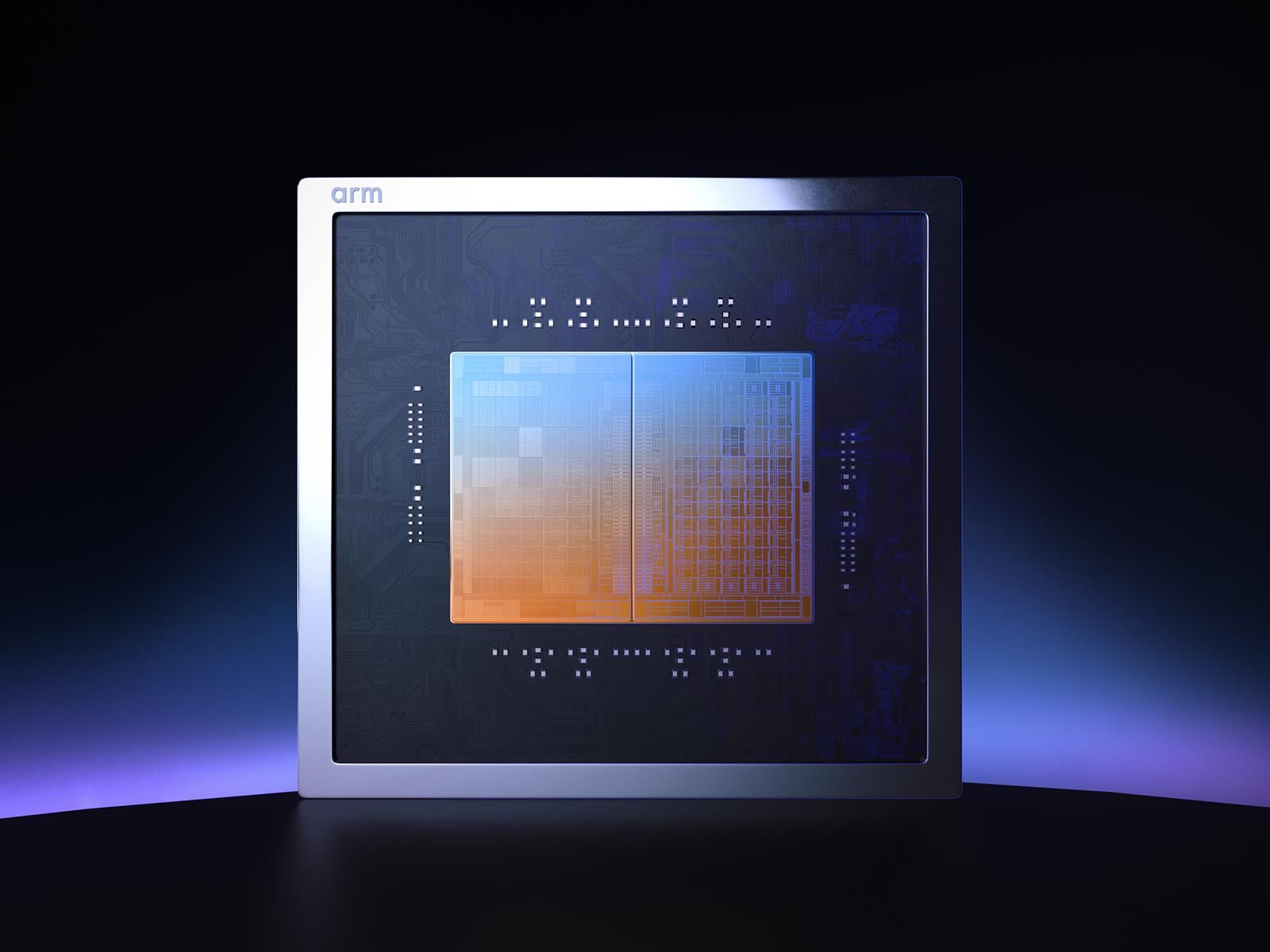
Arm announced their first silicon product in history with today’s AGI CPU. The Arm AGI CPU complements their existing IP offerings into a production-ready silicon product for AI data centers…
Apple TV’s long-running sci-fi show For All Mankind has just been renewed for a sixth and final season, ahead of this week’s season five premiere. This seems more like the natural endpoint of the story instead of a cancellation, according to remarks made by some of the creators.
“Getting to explore the For All Mankind universe over six seasons has been an amazing privilege, and we’re thrilled to have the opportunity to finish the story the way we’ve always hoped,” co-creators and showrunners Matt Wolpert and Ben Nedivi said. “We’re incredibly proud of what this series has become, and grateful to Apple TV and Sony Pictures Television for helping us see it through to its final chapter.”
The plan for the show has always been to bring it up to the modern day and it looks like the creators will get to do just that. Season five takes place in the 2010s, which gives season six plenty of time to catch up to the 2020s.
For the uninitiated, For All Mankind is an alt-history series that started in the 1960s with Russia beating America to the moon. The show absolutely loves time jumps, with each season covering a decade or two.
That initial discrepancy with our reality has ballooned into all kinds of butterfly effect-type stuff. For instance, humanity quickly moved beyond the moon to occupy Mars. Al Gore also got to be president in that timeline.
Despite the numerous time jumps, several of the show’s original cast members are still on board. Joel Kinnaman’s character, astronaut Ed Baldwin, is quite literally in his 80s at this point. The actor must be getting tired of all of those fake wrinkles.
Apple TV has unveiled first-look photos for “Star City,” the upcoming “For All Mankind” spinoff series that explores the same story from Russia’s point of view.
In any event, season five of For All Mankind premieres on March 27. The mainline show is coming to a close, but there’s still a spin-off to look forward to. Star City premieres on May 29. This looks to be a take on the events of the original show from the perspective of Russia.
This article originally appeared on Engadget at https://www.engadget.com/entertainment/tv-movies/for-all-mankind-is-returning-for-a-sixth-and-final-season-173859683.html?src=rss
Elon Musk must defend himself against a lawsuit alleging that he unlawfully seized too much power as the leader of the Department of Government Efficiency (DOGE), a judge ruled Monday.
According to the plaintiffs, Musk needed Senate confirmation before directing DOGE on drastic actions like eliminating agencies, mass firings, and steep budget cuts. Allegedly going far beyond the authority granted in President Donald Trump’s most expansive DOGE executive orders, Musk took every inch of power granted and then increasingly used it to overreach unlike any presidential advisor who came before, the suit says.
In her opinion partly denying a motion to dismiss, US District Judge Tanya S. Chutkan did not buy the US government’s defense that Musk held no office formally established by law—and therefore did not need Senate confirmation and cannot be alleged to have exceeded his authority under the Constitution’s Appointments Clause.
iOS and iPadOS 26.4 are here, with a surprising number of new features for a point release. Chief among them is a new AI playlist generator, similar to one Spotify launched in 2024.
Playlist Playground is Apple’s branding for the song list generator. It works as you’d expect: Type a prompt, and it spits out tracks that match it. As MacRumorsnoted, your prompts can relate to mood, feelings, activities and more.
Also new in iOS 26.4, an ambient music widget puts background sounds on your home screen. Like the corresponding Control Center tool, it brings up (Apple-curated) sounds for sleep, chill, productivity or well-being. Yet another music feature is Bandsintown integration: upcoming concert dates in your area will appear in the Apple Music app.
Unicode’s latest emoji characters arrive in the update, too. This includes “Hairy Creature,” also known as Bigfoot. Another fun one is fight cloud. (Think old-timey cartoons beating each other up inside a puff of vapor.) Also onboard are a trombone, a treasure chest, a distorted face, an apple core, an orca, ballet dancers and a landslide.
The update also has fixes for some of iOS 26’s nagging bugs. In Apple’s latest attempt to stem the tide of complaints about Liquid Glass, there’s a new “Reduce Bright Effects” setting. There’s also a fix for a keyboard bug that caused errors when typing rapidly.
Although we aren’t seeing it on our devices just yet, macOS Tahoe 26.4 should be arriving today as well. The update brings back the option to use Safari’s compact tab bar. (You’ll find this in iPadOS 26.4 as well.) Mac users can also customize their maximum charge level — anywhere from 80 to 100 percent. Meanwhile, watchOS 26.4 finally lets you start a workout with one tap.
This article originally appeared on Engadget at https://www.engadget.com/mobile/ios-264-is-here-with-playlist-playground-and-new-emoji-171343120.html?src=rss
The live music discovery platform Bandsintown’s partnership with Apple goes way back, but iOS 26.4 brings the deepest integration between the two companies to date. Concert listings from Bandsintown will now appear in Apple Music, allowing you to find out when either a band you already love, or one you’re discovering for the first time, is next playing live.
Artists who use Bandsintown to advertise their tour dates can promote upcoming shows in a number of ways through Apple’s app. A new Concerts tab will live within Search, allowing subscribers to search for shows by their genre, location and date, while participating artists can also connect their Bandsintown dashboard to their Apple Music artist page. By doing this, their tour dates will automatically appear in an “Upcoming Concerts” section within 48 hours of connecting the two services.
Apple Music users can tap listed events to see more details about a show and will be able to buy tickets through direct links to sellers. If you follow artists, you can also set up push notifications for their announced shows.
Bandsintown’s platform is already built into a number of other Apple apps and services, with the likes of Shazam, Apple Maps, Photos and Spotlight Search all able to pull through live event data. The new Apple Music features will be available on devices running iOS 26.4 when it leaves beta.
This article originally appeared on Engadget at https://www.engadget.com/entertainment/music/bandsintown-integration-for-concerts-is-coming-to-apple-music-170034229.html?src=rss
Ultrahuman finally has a smart ring back on the U.S. market, and it’s the Ring Pro, the new model with the feature-packed charging case. Pre-orders are now open, with early bird prices starting at $349. The regular price will be $479 for the ring plus case.
The ring will begin shipping May 15. The company is using a tiered model for early bird pricing, where the price bumps up after a certain number of rings are sold. Here’s the schedule:
$349 — first 1,000 orders ($130 off)
$389 — next 2,000 orders ($90 off)
$429 — next 3,000 orders ($50 off)
$449 — until pre-orders close.
Ultrahuman’s smart rings have been off the U.S. market since October 2025, due to legal action by Oura. As I detailed here, Oura sued several other smart ring makers over patent infringement and won a judgment by the U.S. International Trade Commission. As a result, most other smart ring companies had to leave the U.S. market or reach a deal with Oura. Ultrahuman found a third option—continuing to develop a ring they already had in the works, betting that the ITC would rule its design is different enough that it does not infringe Oura’s patent.
That bet seems to have paid off. U.S. Customs and Border Protection has officially signed off on the new design, allowing it to be sold here. Ultrahuman’s older designs, like the Ring Air I reviewed last year, are still banned.
What’s new with the Ultrahuman Ring Pro
I wrote more about the Ring Pro here. It’s got a faster processor with “on-chip machine learning,” a 15-day battery life, and the ability to hold 250 days of data if you’re unable to sync your ring for extended periods. The physical shape is similar to the Ring Air (no sensor bumps, but there is a flattened area at the bottom of the interior), and it has break points for easier removal of the ring in an emergency.
The cleverest feature of the Ring Pro is its charging case, which can store data, flash the firmware, and deliver haptic alerts. It also has a speaker for alarms and for sounding when you use the “find my case” feature. The charger can charge wirelessly.
Ultrahuman has since announced that you’ll have the option to buy the ring packaged with the charging case for $479, or with just a “mini charger” (presumably similar to the Ring Air’s charger) for $399. The case will be available separately for $100.
Epic Games is cutting more than 1,000 jobs as usage of its flagship title, Fortnite, falls. “The layoffs aren’t related to AI,” CEO Tim Sweeney noted. Reuters reports: The cuts, along with more than $500 million in savings from lower contracting and marketing spending and unfilled roles would put the company in “a more stable place,” Sweeney said in a note to employees. […]
“We’ve had challenges delivering consistent Fortnite magic,” Sweeney said, adding “market conditions today are the most extreme” since the early days of the company founded in 1991.
The move marks Epic’s second major round of layoffs in three years. In September 2023, the company cut about 830 jobs, or roughly 16% of its workforce. It was not immediately clear what percentage of staff would be impacted by Tuesday’s announcement.
Between your smartphone, smart TV, wireless router, and a plethora of other gadgets in your home, there’s a near 100% chance at least one of your devices is running silicon based on an Arm design or Arm IP. There’s also a 0% chance that Arm actually produced the silicon, because its model has strictly been focused on IP licensing since the
Pokémon Champions — a battle-focused game along the lines of Pokémon Stadium — now has a release date, and it’s pretty darn soon. It will hit Nintendo Switch and Switch 2 on April 8. A mobile version is in the works with support for cross-play with Nintendo’s consoles.
Nintendo released a new overview video that shows how the game works. You can recruit Pokémon in the game or transfer those you’ve found in previous titles and Pokémon Go via Pokémon Home. Then you’ll be able to take half a dozen of your Pokémon into strategic turn-based fights with other players. It’s definitely a Pokémon battle game!
There are ranked battles, a casual mode, private lobbies and online competitions. You’ll earn victory points, which you can use to swap a Pokémon’s moves, increase their stat points and make other modifications. In addition, victory points enable you to recruit Pokémon in Pokémon Champions more than once per day. Pokémon that you recruit with victory points can stay in your roster permanently instead of just a week. There’s a shop too, where you can spend points on accessories, Pokéball throwing styles, victory poses and battle music.
Pokémon Champions will be the second new Pokémon game to arrive this year, following the success of Pokémon Pokopia. There’s more to come in the not-too-distant future, as Pokémon Wind and Pokémon Wavesare scheduled to arrive on Switch 2 next year.
While Pokémon Pokopia is selling like hotcakes, the Switch 2 perhaps isn’t flying out of the door as quickly as Nintendo hoped. According to Bloomberg, Nintendo has cut back on production of the console after lower-than-expected sales over the holiday season. The company is said to be making 4 million units this quarter rather than the previously planned 6 million, with the lower production rate set to extend into April.
This article originally appeared on Engadget at https://www.engadget.com/gaming/nintendo/pokemon-champions-will-hit-switch-and-switch-2-on-april-8-165737121.html?src=rss
VMX, a VR gesture-controlled extreme sports and BMX title launches in Early Access on Steam this week.
Break Free Interactive has announced that their extreme sports BMX game will launch in Early Access on SteamVR on March 26. Alongside this news, the developers have released a new trailer that offers a detailed look at the game’s motion-driven trick system, realistic spray-paint customization, and the multiplayer skateparks and dirt tracks that players will be able to explore when VMX launches mere days from now.
VMX’s control system is built around the physical capabilities of VR. Players grip the controllers like real handlebars and execute tricks like flips, spins, whips, and more through natural body movements rather than just button presses.
0:00
/1:00
VMX’s Early Access build launches with five maps and three game modes. These modes include Time Attack, where players rack up as many trick points as possible before time runs out; Trick Repeat, where players replicate trick combos against other players in a test of skill and memory; and Free Ride, where the map opens up without restrictions.
All modes support full online multiplayer from launch.
VMX is the debut project from Break Free Interactive, a two-person indie team. While the initial release is strictly PC VR, support for Meta Quest 2 and 3 is planned.
VMX will be available on SteamVR beginning March 26.
Climb against up to four other people in the latest Peak Rhythm update, which adds multiplayer to the hyper-colored musical rhythm climbing game.
Zeitlos Interactive has announced that an update has just gone live which adds multiplayer to their musical rhythm climbing game, Peak Rhythm. The update allows up to four players to race to the beat of the game’s energetic soundtrack.
In addition to the multiplayer update, the game’s developers have also announced that the Peak Rhythm Soundtrack is available now on Spotify.
The OST features original tracks spanning several genres, including drum & bass, dubstep, and house, with tracks from FEISTLING, Killin’ Void, Ion Diary, and funiel, and while I admittedly hadn’t heard of these artists prior to my time with Peak Rhythm, their tunes are consistently great and the entire set list suits the game perfectly.
0:00
/0:56
I reviewed Peak Rhythm when it released in Early Access in early March, and found it to be a novel and compelling experience. Here’s an excerpt from the review:
After spending a few days scrambling up its skyscrapers, leaping, reaching, and scampering along with its eclectic (though limited) soundtrack thumping in my ears, Peak Rhythm feels like a favorite album, a game that I’ll return to again and again.
Peak Rhythm is out now in Early Access on Quest for $12.99.
Isle of Food combines cooking with a tropical island to forage for ingredients to prepare dishes.
In most cooking simulators, like Cook-Out for example, all of the ingredients you need are in your immediate surroundings. Isle of Food aims to change that, tasking players to explore an island around their restaurant to find everything needed to serve their customers.
Isle of Food was featured in the Spring 2026 VR Games Showcase and dropped a demo for the February 2026 Steam Next Fest.
0:00
/1:30
Isle of Food trailer
The game also features a dynamic weather system with a full day-night cycle that affects what and when ingredients are available. A progression system allows for equipment upgrades, new decorations, and adding additional management.
I played the demo during Next Fest, but could not get a good feel for the game. It was clear that elements of the game were removed for the demo, but it wasn’t a clean separation, leading to a lack of direction as to what to do. Presumably, that will be cleaned up before the full release.
Isle of Food is available to wishlist now on Steam and Quest, with a PlayStation VR2 release planned for a later date.
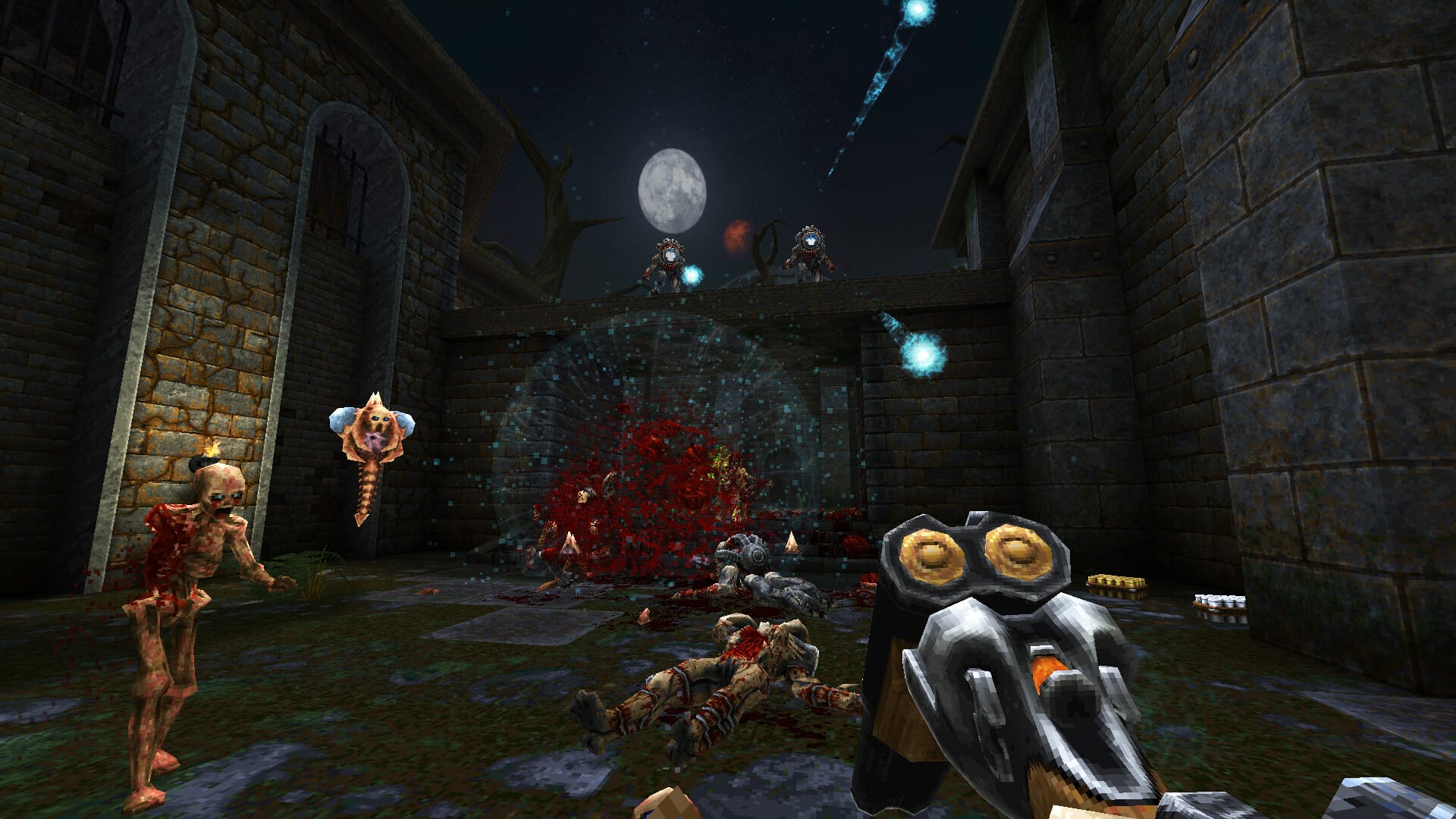
The long-awaited FPS heavily inspired by shooters of the 1990s launches in April. We went hands on with it at the Game Developers Conference this month. Read on for all the details and our impressions.
Now, come April, all of these anticipated titles will be in the hands of players. Flat2VR confirmed at the Spring 2026 VR Games Showcase in a new trailer that the fully titled Wrath: Aeon of Ruin Brutal Edition will release on April 9 for Meta Quest, PC VR, and PlayStation VR2.
0:00
/2:23
The port is being developed by veteran modders Team Beef, who have spent years porting classic games like the Star Wars: Jedi Knight series, Quake, and Duke Nukem, among others. Grant Bagwell from Team Beef narrates the trailer, explaining that the violence and gore has been ramped up from the original game.
A new slide mechanic has also been added to aid with the sensation of speed and freedom of movement for VR.
Our Impressions
At the Game Developers Conference earlier this month, I met with the Flat2VR team and played a demo build of Wrath for about thirty minutes. The build was running natively on a Quest 3 and I played on a prebuilt save with several weapons already available for me. We were not allowed to film and at the time of this article, I have not received any B-roll, so it will just be my words and some screenshots.
The first thing quickly apparent to me was the speed. Shooters of the 1990s like Doom and Quake were known for their rapid movement and this stood out immediately. I’ve grown accustomed to most VR shooters moving at a slower walking pace after years of games like The Walking Dead: Saints & Sinners and Metro: Awakening. Which also means I’ve always searched for the run button, so I don’t feel like I’m trudging through quicksand. That was unnecessary here. The normal walking speed is already faster than most VR games I play. Jumping (with an air dash), sliding, and overall movement feels fast and fluid. A much welcome change of pace.
Wrath: Aeon of Ruin VR Brutal Edition
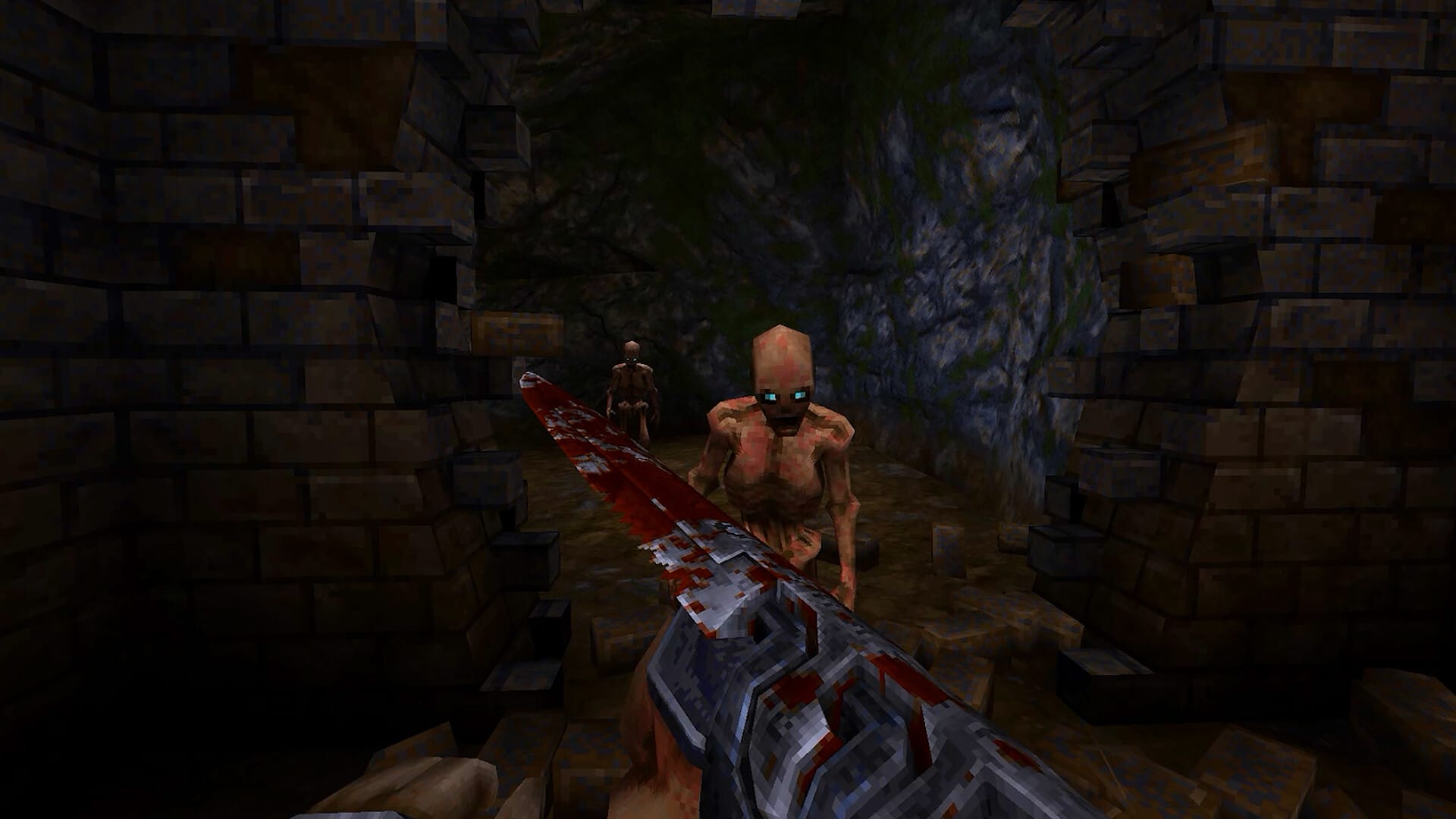
Which is a good thing because after I got acquainted with my loadout, a ludicrously oversized revolver, a shotgun, and an arm blade, I encountered my first enemies. After slashing through the first few and feeling like a Doom Slayer, I was quickly overwhelmed with enemy fire and forced to retreat to regroup, reload, and pick them off one at a time. I dispensed with trying to feel like a badass using the arm blade and blasted the monsters from afar.
Reloading is a simple flick of the wrist: backwards for the shotgun and to the side for the revolver. There was a moment where this wasn’t working for me until I realized I was simply out of ammo. Left with nothing but my blade, I strategically picked up a few to get ammo back and resumed the blasting. It was exhilarating. The other people in the room with me laughed as I was casually carrying on a conversation and every few minutes, I had to stop and lock in when a new horde found me. I died on my fourth rush of enemies, out of ammo and slashing for dear life hoping to get a health or ammo drop before I went down.
Also, as a lifelong RPG player, all of the pots in the game are smashable. This is important. I am glad it was included. VR players tend to play with the environments and objects in games a lot and the developers understood this.
Wrath: Aeon of Ruin VR Brutal Edition
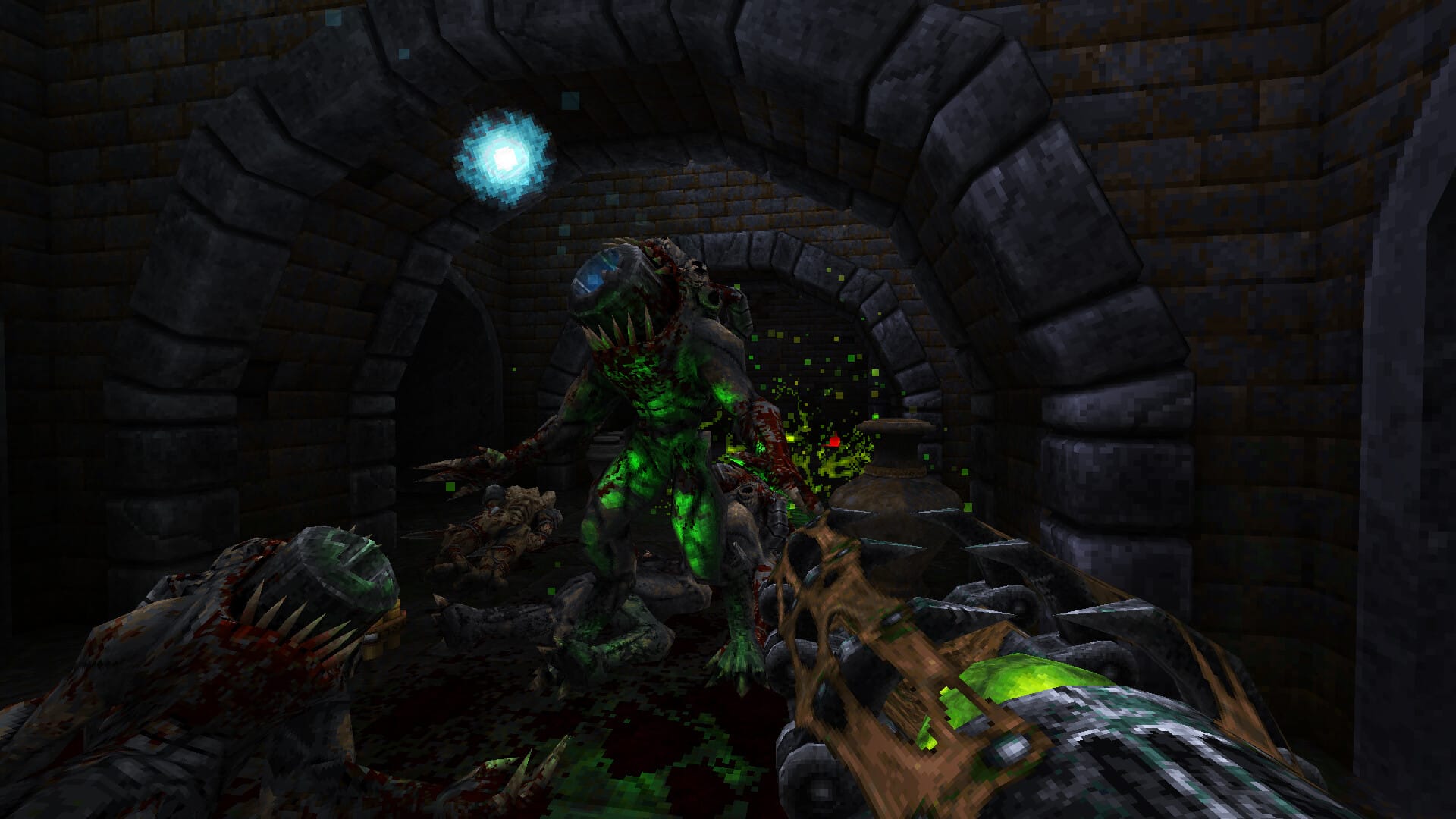
The visual aesthetic of Wrath is also an homage to the pixel art shooters of old, but there’s a notable lack of polish in this game (in a good way) that makes it feel dirtier and grittier than other VR retro shooters like Compound. Wrath is set in a dark fantasy world besieged with monsters. It’s not supposed to look clean and it doesn’t. The monster designs, the weapons, the gore (and there’s lots of gore) all feel ripped straight out of a last century game from Id.
If I had to point out any flaws, they are pretty minor and one is simply due to how my demo was structured. Playing on a preloaded save got me into the action faster, but I also had no idea where to go. The lack of an objective marker or a quick access map left me wandering around aimlessly going back and forth through portals for several minutes. Starting from a fresh save, I doubt this would be an issue. The second was a button press to throw switches. Being in VR, my natural instinct was to reach out, grab the switch with my virtual hand, and throw it. Seeing a prompt to press X instead was a bit depressing. I quickly got over it, but it stood out.
Wrath: Aeon of Ruin VR Brutal Edition
Overall, I walked away from my brief time in Wrath very impressed. Like Flat2VR’s Roboquest VR, movement is the standout feature here. This is not a game I will be recommending to new VR users as there are no guardrails to be found. Wrath is fast, gritty, and brutal, worthy of the Brutal Edition subtitle. I can’t wait to play more.
Wrath: Aeon of Ruin VR Brutal Edition releases on April 9 on Quest, Steam, and PS VR2.
VRAL Games has announced Squingle Arcade, a spatial game designed for relaxation and endless replayability in VR and MR.
In Squingle Arcade, players manipulate glowing spheres and attempt to make them travel through complicated tubular obstacle courses. The object of the game is to keep the orbs from touching the sides of the courses, to avoid obstacles, collect other orbs scattered along the route, and to do all of this in the shortest time possible. There are also multiplayer races.
0:00
/0:41
Squingle Arcade is playable in both VR and MR, with both touch controller and hand tracking support. It can be played seated, in small spaces, or even when traveling.
Squingle Arcade follows on from the previously-released Squingle, an award-winning 3D puzzle game that first debuted in 2021. On the Meta Horizon Store, Squingle has a 4.8 out of 5 stars rating, and costs $19.99 (a free trial for Meta Horizon+ subscribers is available).
Squingle Arcade is coming soon to Meta Quest, SteamVR, Apple Vision Pro, and Pico.
Explore long-lost skies in this open-world VR piloting adventure from developers Trebuchet.
Trebuchet, maker of Prison Boss, has revealed a first-look trailer at their upcoming open-world piloting adventure game Compass. The gorgeous flight game is targeting a release date sometime in Spring 2026, and will be launching on Quest, SteamVR, and PlayStation VR2.
Though details are a bit sparse at the moment, we can gather from the trailer that you’ll play as a “scout” piloting an upgradable cargo ship through pastel skies full of beautiful clouds and floating islands. Movement mechanics will play a massive role in gameplay, as you navigate hazardous floating landscapes and solve puzzles with your handheld grapples. The brief glimpse we’ve had so far points to a vast adventure, and an overworld ripe with quests.
0:00
/0:59
Trebuchet is working with VR game label Creature, a firm that supports independent studios with business development, production consulting, and release strategy. More details on Compass will be forthcoming via Creature’s Creature Feature event, planned for May 6th.
Sol Protocol is running an open alpha playtest on Meta Quest 3 and 3S this weekend, ahead of an Early Access launch in April.
Singular Perception has announced an open alpha playtest for Sol Protocol, the developer’s upcoming sci-fi 3-player co-op VR roguelike. The playtest will run on Meta Quest 3 and 3S from March 27 to March 29. The game is scheduled to launch in Early Access in April.
To access the open alpha, players will need to join via the game’s Discord server, which can be found here.
The alpha is being run to gather information and opinions from players centered around the game’s core systems, including cooperative ship management, boarding abandoned stations, scavenging resources, and defending against threats across the game’s procedurally-generated space environments.
0:00
/0:49
Sol Protocol is a co-op VR roguelike where players take control of fully interactive spaceships and work together to survive procedurally-generated deep-space encounters. The game has been inspired by Star Trek: Bridge Crew, FTL, and flat screen games like Void Crew.
The three-player crews operate different roles, including pilot, gunner, and engineer, requiring coordination to successfully explore, survive, and thrive in the rigorous environment of hostile space.
Players can leave their ship at any time to explore abandoned outposts and space stations.
The game can be wishlisted now on Meta Quest and Steam (the PC VR version is planned to follow the Quest release).
How to God’s latest update adds new systems, more buildings, additional quests and new rewards to the VR god simulator.
German developer Thoughtfish has unveiled a new trailer which showcases an upcoming update for their VR deity sim How to God. The update introduces several new game systems, new buildings, upgrades, and new quests and rewards. The update goes live on March 26 on Meta Quest.
This latest update follows previous updates which added a new quest line and cosmetic items, and it precedes a planned update in April which will add creature accessories and more. The team is targeting an update-every-3-weeks cycle.
0:00
/0:55
How to God is an immersive VR god sim game allowing you to step into the divine sandals of a beginner god. You’ll build villages, raise a unique creature, battle rival deities and command the elements to unlock new powers. A Good or Evil alignment system gives weight (and visual variety) to your choices.
We reviewed How to God when it launched in Early Access in December 2025, where we found the game to be “a solid addition to the god game genre across any platform – and a must-buy for VR enthusiasts of the genre especially.”
How to God is available now in Early Access on Meta Quest, and coming soon to SteamVR (demo available now).
The co-operative sci-fi PvE shooter will offer a one-time purchase Founders Edition.
PolarityOne has announced the release of Exoshock Founders Edition, a limited edition one-time buy that gives you instant access to Exoshock’s development build and every feature update as the game continues to grow.
The Founders Edition includes a new map, new weapons, new items, a new progression system, and extra mission-based objectives, leading up to the official store release where Founders will receive a digital game key for either Steam or Meta Quest. Founders will also be the first players to experience Exoshock’s full co-op multiplayer mode. They’ll also earn an exclusive Founder Discord role, exclusive Founder skin, plus their names immortalized in the game’s credits.
0:00
/1:41
You can buy the Founders Edition now for $12.99, allowing you to play the game right away, and get in at what the developers describe as “the cheapest price it will ever be.”
It was also announced that, while Exoshock currently supports SteamVR and Meta Quest 3 and 3S, it will also come to Valve Steam Frame and Sony PlayStation VR2 in the future. Flatscreen players on PC, PS5, and Steam Deck will also be able to join the fray with VR players via crossplay.
Developed by PolarityOne, Exoshock is a 1-4 player cooperative sci-fi PvE shooter with a gritty dystopian setting. This upcoming FPS promises intense firefights as you enter active war zones, prioritizing squad tactics as you adapt and fight using customizable loadouts.