
Discover an amazing GUI-based music player named Moosync to play your local, YouTube, Spotify (Ad-Free), or LastFM songs on Linux.
Source: LXer – Moosync: An Electron-based GUI Music Player for Linux
Monthly Archives: November 2023
The Kitchen Will Bring Daniel Kaluuya Into the Director's Chair

In addition to starring in the likes of Get Out, Nope, and Spider-Man: Across the Spider-Verse, Daniel Kaluuya’s previously written for TV. Back when he was playing Posh Kenneth on BBC’s Skins, he contributed to the writing for the show’s first two seasons and eventually penned his own episodes in the respective…
Source: Gizmodo – The Kitchen Will Bring Daniel Kaluuya Into the Director’s Chair
Cyber Monday Deals To Kickstart Your Twitch, YouTube, Kick, Or Zoom Livestreams
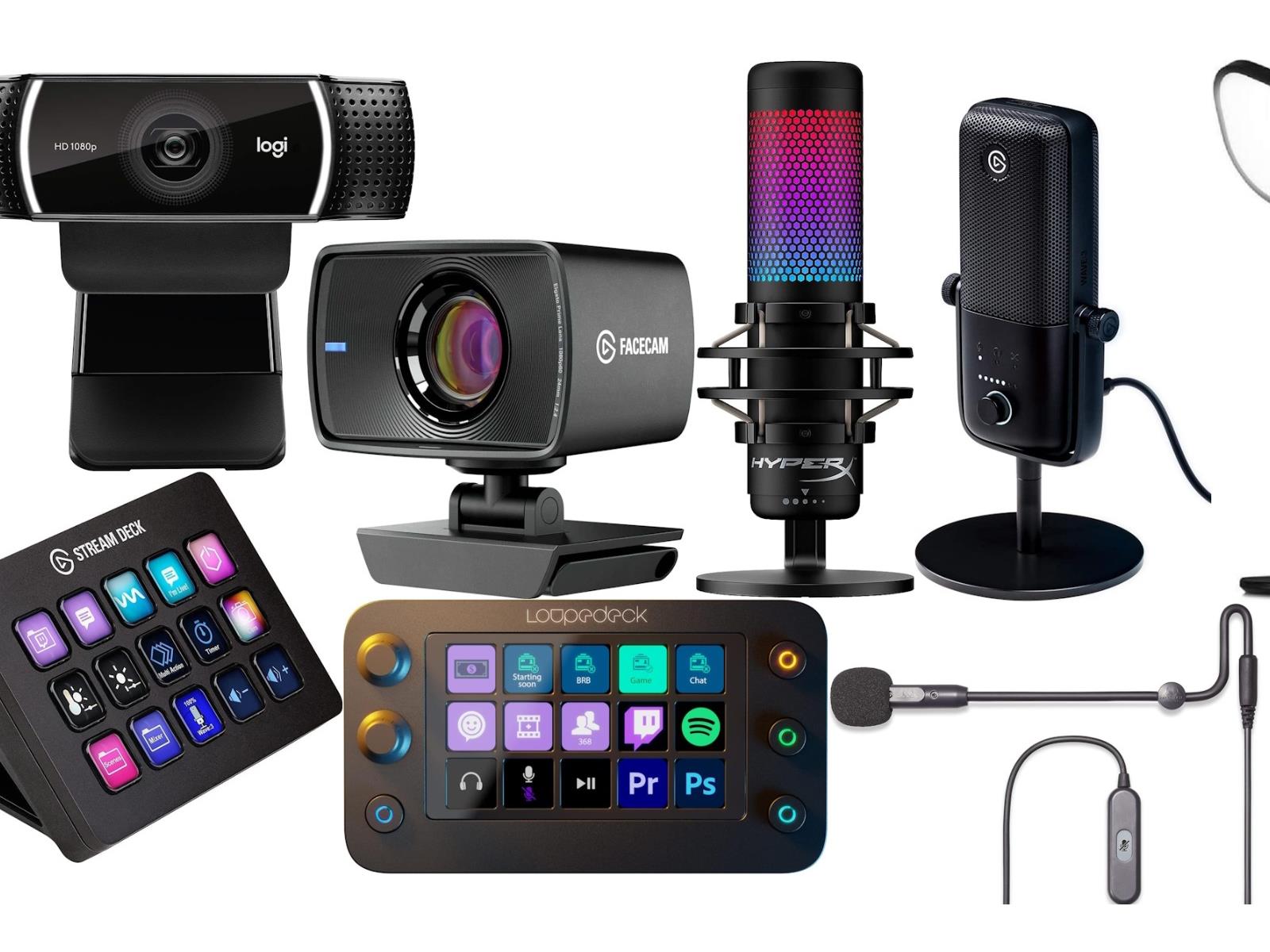
Cyber Monday is upon us, and with it comes a plethora of stellar tech deals that can net big savings on early Christmas gifts or just toys for yourself. This year, if you are looking to up your home office game or perhaps get into live streaming, there are a handful of essential streaming tech deals on Amazon that can make you look, sound,
Source: Hot Hardware – Cyber Monday Deals To Kickstart Your Twitch, YouTube, Kick, Or Zoom Livestreams
Ridley Scott Is Terrified of AI: 'It's a Technical Hydrogen Bomb'
“Several of your films have explored artificial intelligence,” Rolling Stone pointed out to 85-year-old Ridley Scott, before asking: “Does AI worry you?”
Ridley Scott: I always thought the world would end up being run by two corporations, and I think we’re headed in that direction. Tyrell Corp in Blade Runner probably owned 45-50% of the world, and one of his playthings was creating replication through DNA. Tyrell thinks he’s god and in the first Blade Runner has made a Nexus female. And the Nexus female will have a limited lifespan because AI will get dangerous. We have to lock down AI. And I don’t know how you’re gonna lock it down. They have these discussions in the government, “How are we gonna lock down AI?” Are you fucking kidding? You’re never gonna lock it down. Once it’s out, it’s out. If I’m designing AI, I’m going to design a computer whose first job is to design another computer that’s cleverer than the first one. And when they get together, then you’re in trouble, because then it can take over the whole electrical-monetary system in the world and switch it off. That’s your first disaster. It’s a technical hydrogen bomb. Think about what that would mean?
Rolling Stone: I wanted to ask you about what effect you think AI will have on Hollywood as it was a big sticking point in the writers’ strike, in particular. One fear is that studios will plug a book into AI, have it crap out an “adaptation,” and then pay actual screenwriters day rates to punch it up.
Ridley Scott: Yeah. They really have to not allow this, and I don’t know how you can control it. Another AI expert said, “We are way over-panicking. Of course, I have a computer that can defeat a chess master in an hour because we can feed him every conceivable move from data, and it’ll process 1,900 conceivable moves on what the person will do next in seconds, and the guy is in trouble.” There’s something non-creative about data. You’re gonna get a painting created by a computer, but I like to believe — and I’m saying this without confidence — it won’t work with anything particularly special that requires emotion or soul. With that said, I’m still worried about it.
The article also looks back more than 40 years, to when Ridley Scott was going to direct Dune in between filming Alien and Blade Runner. Scott says he had “a really good screenplay, had all the sets to go” — but the producer had wanted to save money by filiming it in Mexico City, and Scott “didn’t love” the idea of spending a year there.


Read more of this story at Slashdot.
Source: Slashdot – Ridley Scott Is Terrified of AI: ‘It’s a Technical Hydrogen Bomb’
US Energy Department Funds Next-Gen Semiconductor Projects to Improve Power Grids
America’s long-standing Advanced Research Projects Agency (or ARPA) developing the foundational technologies for the internet.
This week its energy division announced $42 million for projects enabling a “more secure and reliable” energy grid, “allowing it to utilize more solar, wind, and other clean energy.” But specifically, they funded 15 projects across 11 states to improve the reliability, resiliency, and flexibility of the grid “through the next-generation semiconductor technologies.”
Streamlining the coordinated operation of electricity supply and demand will improve operational efficiency, prevent unforeseen outages, allow faster recovery, minimize the impacts of natural disasters and climate-change fueled extreme weather events, and redcude grid operating costs and carbon intensity.
Some highlights:
The Georgia Institute of Technology will develop a novel semiconductor switching device to improve grid control, resilience, and reliability.Michigan’s Great Lakes Crystal Technologies (will develop a diamond semiconductor transistor to support the control infrastructure needed for an energy grid with more distributed generation sources and more variable loadsLawrence Livermore National Laboratory will develop an optically-controlled semiconductor transistor to enable future grid control systems to accommodate higher voltage and current than state-of-the-art devices.California’s Opcondys will develop a light-controlled grid protection device to suppress destructive, sudden transient surges on the grid caused by lightning or electromagnetic pulses.Albuquerque’s Sandia National Laboratories will develop novel a solid-state surge arrester protecting the grid from very fast electromagnetic pulses that threaten grid reliability and performance.
America’s Secretary of Energy said the new investment “will support project teams across the country as they develop the innovative technologies we need to strengthen our grid security and bring reliable clean electricity to more families and businesses — all while combatting the climate crisis.”


Read more of this story at Slashdot.
Source: Slashdot – US Energy Department Funds Next-Gen Semiconductor Projects to Improve Power Grids
Cyber Monday deals include up to $300 off Shark robot vacuums on Amazon
The shopping event of the year isn’t over just yet, and if you’re looking for a robot vacuum to keep your home clean, one of Engadget’s favorites is on sale for a stellar price this Cyber Monday. Right now, you can get the Shark AI Ultra for half off, or $300 less than its $600 MSRP. For those in the market for a robot vacuum that can clean their floors too, Shark also offers a version of the AI Ultra with mop functionality built-in. After a 43 percent discount, that variant is currently $400, down from $700. Either way, those are excellent prices for a pair of robot vacuums that offer a compelling mix of features and cleaning performance.
As mentioned above, we like the Shark AI Ultra a lot here at Engadget, with both the standard and 2-in-1 models appearing in our guide for the best robot vacuums. In fact, we consider the Shark AI Ultra to be the best midrange pick for most people. Setup is easy. All you need to do is take the vacuum out of the box, plug in the base and download Shark’s companion app on your phone. Once the AI Ultra completed its first “explore run,” we found it was a reliable cleaner, doing its best to avoid any obstacles that were left on the carpet or floor. It was also much quieter than competing models in and around the same price range. However, the best feature of AI Ultra is that it comes with an auto-empty station, and one that features a bagless design. That means you won’t need to spend extra money on the AI Ultra over time.
As for the 2-in-1 model, its water-and-solution based cleaning abilities are basic, but beat having to bring out an old-school mop and bucket. In our testing, the AI Ultra Ultra 2-in-1 left our hardwood and tile floors noticeably cleaner. As I said, both models are great options, particularly when they’re as affordable as they are right now.
Your Cyber Monday Shopping Guide: See all of Yahoo’s Cyber Monday coverage, here. Follow Engadget for Cyber Monday tech deals. Learn about Cyber Monday trends on In The Know. Hear from Autoblog’s experts on the best Cyber Monday deals for your car, garage, and home, and find Cyber Monday sales to shop on AOL, handpicked just for you.
This article originally appeared on Engadget at https://www.engadget.com/cyber-monday-deals-include-up-to-300-off-shark-robot-vacuums-on-amazon-183038708.html?src=rss
Source: Engadget – Cyber Monday deals include up to 0 off Shark robot vacuums on Amazon
Don’t Miss These Ten Amazon Sound Bar Deals Under $150

With Cyber Monday nearly upon us, tech deals abound. Right now, for example, there are some outstanding deals on sound bars available that can crank your home theater to eleven this holiday season.
Leading off, we have the Polk Audio Signa S2 Soundbar and Subwoofer combo for $149 flat, which is a 40% saving off the regular price. The S2
Source: Hot Hardware – Don’t Miss These Ten Amazon Sound Bar Deals Under 0
Continuing Commitment to Open Access, CERN Launches New Open Source Program Office
“The cornerstone of the open-source philosophy is that the recipients of technology should have access to all its building blocks…” writes the European Organization for Nuclear Research, “in order to study it, modify it and redistribute it to others.” This includes mechanical designs, schematics for electronics, and software code.
Ever since releasing the World Wide Web software under an open-source model in 1994, CERN has continuously been a pioneer in this field, supporting open-source hardware (with the CERN Open Hardware Licence), open access (with the Sponsoring Consortium for Open Access Publishing in Particle Physics — SCOAP3) and open data (with the Open Data Portal for the LHC experiments).
The CERN Open Data portal is a testimony to CERN’s policy of Open Access and Open Data. The portal allows the LHC experiments to share their data with a double focus: for the scientific community, including researchers outside the CERN experimental teams, as well as citizen scientists, and for the purposes of training and education through specially curated resources. The first papers based on data from the CERN Open Data portal have been published. Several CERN technologies are being developed with open access in mind. Invenio is an open-source library management package, now benefiting from international contributions from collaborating institutes, typically used for digital libraries. Indico is another open-source tool developed at CERN for conference and event management and used by more than 200 sites worldwide, including the United Nations. INSPIRE, the High Energy Physics information system, is another example of open source software developed by CERN together with DESY, Fermilab and SLAC.
And on Wednesday the European Organization for Nuclear Research launches its new Open Source Program Office “to help you with all issues relating to the release of your software and hardware designs.”
Sharing your work with collaborators in research and industry has many advantages, but it may also present some questions and challenges… The OSPO will support you, whether you are a member of the personnel or a user, to find the best solution by giving you access to a set of best practices, tools and recommendations. With representatives from all sectors at CERN, it brings together a broad range of expertise on open source practices… As well as supporting the CERN internal community, the OSPO will engage with external partners to strengthen CERN’s role as a promoter of open source.
Open source is a key pillar of open science. By promoting open source practices, the OSPO thus seeks to address one of CERN’s core ambitions: sharing our knowledge with the world. Ultimately, the aim is to increase the reach of open source projects from CERN to maximise their benefits for the scientific community, industry and society at large.
For Wednesday’s launch event “We will host distinguished open source experts and advocates from Nvidia, the World Health Organization and the Open Source Hardware Association to discuss the impact and future of open source.” There will be a live webcast of the event.


Read more of this story at Slashdot.
Source: Slashdot – Continuing Commitment to Open Access, CERN Launches New Open Source Program Office
Ultramarine Linux 39 Launches Featuring Fedora’s Latest Innovations
Ultramarine Linux 39 combines the latest kernel 6.5 with Budgie 10.8.2, offering a different Fedora computing experience. Here’s more on that!
Source: LXer – Ultramarine Linux 39 Launches Featuring Fedora’s Latest Innovations
Amazon Cyber Monday deals: Get 30 percent off our favorite TP-Link Kasa smart plugs
Smart plugs are a great way to bring even your non-IoT devices into the smart home ecosystem, and with a Cyber Monday deal on Amazon, you can pick up some of the best for super cheap. A four-pack of TP-Link’s Kasa Smart Plug Mini 15A is 30 percent off, bringing the price down to just $35 dollars from its usual cost of $50. These smart plugs work with all of the major smart home platforms, including Apple Homekit, Amazon Alexa, Google Home and Samsung SmartThings.
Kasa Smart Plugs are easy to set up through the app, available for both iOS and Android, and are great for anyone looking for a no-fuss experience. They top our list of the best smart plugs you can get today thanks to their versatility and ease of use. With the smart plugs, you’ll have access to voice and remote controls, device scheduling, grouping and even energy monitoring to see how much power your devices are consuming. While smart plugs won’t be able to handle complex smart home programming, they can be used to control simple functions like turning a lamp on or off.
The Smart Plug Mini is designed to take up minimal space, so it doesn’t block other outlets when it’s plugged into the wall — as can be an issue when plugging in chunky accessory blocks. It connects to your home Wi-Fi and can receive voice commands from Siri, Alexa, Google Assistant or Samsung SmartThings for hands-free use. Or, you can control the plugs and thus the connected devices through the app. While the app doesn’t have a built-in sharing mode to add multiple members of the household, you can use the same login on multiple devices, so multiple family members can have access.
Besides smart plugs, TP-Link has several smart home devices on sale for Cyber Monday. The color-changing Kasa Smart Light Bulbs, which are among the best smart light bulbs on the market, are 35 percent off. A four-pack of the light bulbs is just $26, down from its normal price of $40. The light bulbs support Google Assistant and Alexa for voice controls, as well as control via the app. There are also deals on IoT security cameras, dimmer switches and outdoor plugs.
Your Cyber Monday Shopping Guide: See all of Yahoo’s Cyber Monday coverage, here. Follow Engadget for Cyber Monday tech deals. Learn about Cyber Monday trends on In The Know. Hear from Autoblog’s experts on the best Cyber Monday deals for your car, garage, and home, and find Cyber Monday sales to shop on AOL, handpicked just for you.
This article originally appeared on Engadget at https://www.engadget.com/amazon-cyber-monday-deals-get-30-percent-off-our-favorite-tp-link-kasa-smart-plugs-173008455.html?src=rss
Source: Engadget – Amazon Cyber Monday deals: Get 30 percent off our favorite TP-Link Kasa smart plugs
Shrek's Test Footage is a Slightly Horrifying Blast from the Past

If you’re someone who likes knowing how media gets made and what things looked like before their final product, you’ll be pleased to hear that test footage of the original Shrek movie has been released online. And it’s…well, you can see below.
Source: Gizmodo – Shrek’s Test Footage is a Slightly Horrifying Blast from the Past
A NASA Spacecraft Could Carry Your Name to Jupiter in 2024
An anonymous reader shared this report from the Washington Post:
In 2024, a new spacecraft will hurtle toward Jupiter in a bid to learn whether its moon Europa is capable of supporting life. The craft will carry more than high-tech sensors: It also will bear a poem and hundreds of thousands of human names.
Yours could be one of them.
NASA is asking people to submit their names ahead of the mission’s October 2024 launch. Those submitted by the end of 2023 will go into space on the Europa Clipper spacecraft, which should enter Jupiter’s orbit in 2030… They’ll eventually be stenciled onto a dime-sized microchip in microscopic writing, then attached to a metal plate engraved with the poem that will accompany the craft.
700,000 names have been submitted so far — and they’ll all be carried a distance of over 1.8 billion miles.
They’ll travel through space with a poem that ends by describing what we humans on earth are made of — including “a need to call out through the dark.”


Read more of this story at Slashdot.
Source: Slashdot – A NASA Spacecraft Could Carry Your Name to Jupiter in 2024
Cyber Monday TV deals: The Samsung Frame TV is on sale for up to $1,000 off
Samsung’s The Frame smart TVs have hit record low prices for Cyber Monday and you can find the deals both at Amazon and Samsung directly. Discounts are available for all sizes — the 55-inch Frame TV is $520 off — a 35 percent discount — bringing it down to just $978. If you want to go big, the 85-inch Frame is a full $1,000 off, for a final price of $3,298. The big perk of the Frame is implied in its name: the TV is designed to look like artwork when not in use, complete with a matte finish, customizable frame-like bezels and Samsung’s Art Mode for displaying images and even your own photos.
The discounts apply to the most recent 4K QLED Frame TVs, all of which feature Samsung’s anti-reflection matte display. The Frame comes with a slim-fit wall mount so it can be hung flush with the wall, just like any painting or framed picture, and offers 100 percent Color Volume with Quantum Dot technology to make colors pop. When it’s not in use, you can put it in Art Mode, which will display the art of your choosing. The Frame is a game-changer for anyone who detests how TVs clash with their home decor.
Samsung offers 10 free artworks to choose from, or you can subscribe to the Samsung Art store for access to curated collections from its museum partners, like The Louvre. You can also upload your own images to display, and use it like a massive digital picture frame. When the TV is in Art Mode, it can be programmed to display artwork based on whether you’re in the room. With motion sensing, The Frame can identify when you’ve left and turn off the display so it isn’t projecting to an empty room. It’ll come back on when you return.
Like Samsung’s other smart TVs, The Frame is powered by Tizen, and it’ll have all the apps you need for your streaming purposes. You can also stream Xbox games to your TV through Samsung’s Gaming hub if you have Xbox Game Pass Ultimate. The Frame comes in seven sizes: 32-inch, 43-inch, 50-inch, 55-inch, 65-inch, 75-inch and 85-inch. It might normally be a bit of a splurge, but there’s potential to save hundreds of dollars with the current Black Friday sales.
Your Black Friday Shopping Guide: See all of Yahoo’s Black Friday coverage, here. Follow Engadget for Black Friday tech deals. Learn about Black Friday trends on In The Know. Hear from Autoblog’s experts on the best Black Friday deals for your car, garage, and home, and find Black Friday sales to shop on AOL, handpicked just for you.
This article originally appeared on Engadget at https://www.engadget.com/cyber-monday-tv-deals-the-samsung-frame-tv-is-on-sale-for-up-to-1000-off-162331687.html?src=rss
Source: Engadget – Cyber Monday TV deals: The Samsung Frame TV is on sale for up to ,000 off
Cyber Monday deals include 42 percent off one of our favorite Samsung microSD cards
For Cyber Monday, Amazon has discounted a selection of Samsung SSDs, including the company’s highly-regarded Pro Plus line of microSD cards. Through the end of tomorrow, the 128GB model is 42 percent off, making it just $11 before tax and shipping. If you need more storage, the 512GB model is also on sale, as are the 256GB variants of the Pro Ultimate and Evo Select models. After a modest 9 percent discount, the former is currently $32, down from $35.
Amazon has also discounted Samsung’s excellent T7 Shield portable drive. At the moment, the 1TB model is 6 percent off, or $5 off its typical $85 price. While this SSD is an Engadget favorite, we’ve seen it previously drop below the price Amazon is selling it for currently.
Samsung’s Pro Plus, Pro Ultimate and Evo Select lines are all featured in our guide to the best microSD cards. We like the Pro Plus models for their mix of performance and affordability. Although they’re not the fastest microSD cards Samsung sells (that distinction goes to the Pro Ultimate line), you’ll be hard pressed to find competing models in the same price range that offer better performance. In our testing, Samsung’s Pro Plus cards achieved sequential write speeds of around 130 MB/s and sequential read speeds of around 165 MB/s. Samsung also offers a 10-year warranty on its Pro Plus models.
If you’re unsure of what model to buy, your decision should be informed by what you plan to do with your new microSD card. If you intend to record a lot of 4K footage with either a camera or drone, you will need a faster card. Our guide has all the information to help you make your decision, but the short answer is to look for a model with at least a “V30” speed rating. For other cases such as storing dash cam footage and Switch games, you can save money by going for a slower model.
Your Black Friday Shopping Guide: See all of Yahoo’s Black Friday coverage, here. Follow Engadget for Black Friday tech deals. Learn about Black Friday trends on In The Know. Hear from Autoblog’s experts on the best Black Friday deals for your car, garage, and home, and find Black Friday sales to shop on AOL, handpicked just for you.
This article originally appeared on Engadget at https://www.engadget.com/cyber-monday-deals-include-42-percent-off-one-of-our-favorite-samsung-microsd-cards-161524306.html?src=rss
Source: Engadget – Cyber Monday deals include 42 percent off one of our favorite Samsung microSD cards
Amazon Cyber Monday deals drop the price of the 2nd-gen Apple Pencil to an all-time low of $80
Whether you’re an artist or an avid notetaker, an Apple Pencil can transform the way you work on your iPad. Normally, they don’t come cheap — but in a Cyber Monday deal on Amazon, Apple’s second-generation Apple Pencil is down to its lowest price yet at $80. You’ll be saving nearly $50 on the stylus that’s made just for the iPad. Without a discount, it costs around $130. The second-generation Apple Pencil brought a number of improvements over the previous version, including double-tap controls and magnetic attachment to the iPad for easy storage and wireless charging.
You can’t do any better than an Apple Pencil if you’re looking for a stylus to work with your iPad. It was crafted with Apple’s tablet in mind, and as such it’s one of the best iPad accessories available. The second-gen Apple Pencil offers low latency so there’s no lag as you’re writing or drawing on the touchscreen, and Apple says it achieves “pixel-perfect precision.” It also has pressure and tilt sensitivity for more natural control over things like stroke width, opacity and shading. You can double-tap the pencil to easily switch between tools.
The second-generation Apple Pencil doesn’t work with every model of iPad, though, and you’ll want to double-check compatibility before picking one up. It’s compatible with the iPad Pro 12.9-inch (third-generation and later), all generations of iPad Pro 11-inch, iPad Air (fourth- and fifth-gen), and the iPad mini (sixth-gen). The Apple Pencil can magnetically attach to the side of these iPads to charge wirelessly while it’s not in use. For those who have an iPad Pro, it also supports Apple Pencil hover, which lets you preview tools or colors before committing to them.
Apple also still offers the first-generation Apple Pencil, which is compatible with older iPad models, and it’s on sale for Cyber Monday too. It’s down to $80 from its usual price of $100, and works with iPad Pro 12.9-inch (first and second generation), iPad Pro 10.5-inch, iPad Pro 9.7-inch, the third generation iPad Air, fifth generation iPad mini, and iPad (sixth-gen and later). Apple’s more budget-friendly Apple Pencil with USB-C charging is discounted right now as well, dropping to $71 from $80. That model works with the same iPad models as the second-generation Apple Pencil, plus the 10th generation iPad.
Your Cyber Monday Shopping Guide: See all of Yahoo’s Cyber Monday coverage, here. Follow Engadget for Cyber Monday tech deals. Learn about Cyber Monday trends on In The Know. Hear from Autoblog’s experts on the best Cyber Monday deals for your car, garage, and home, and find Cyber Monday sales to shop on AOL, handpicked just for you.
This article originally appeared on Engadget at https://www.engadget.com/amazon-cyber-monday-deals-drop-the-price-of-the-2nd-gen-apple-pencil-to-an-all-time-low-of-80-154236215.html?src=rss
Source: Engadget – Amazon Cyber Monday deals drop the price of the 2nd-gen Apple Pencil to an all-time low of
Google Maps' New Color Scheme Draws Criticism Online
Google Maps has added “a fresh color scheme, including a different look for parks and city blocks,” writes SFGate. “But it’s the changes to the app’s all-important road maps that are rankling online commentators…”
Previously, highways and freeways were depicted in bright yellow, which stood out against a stark white grid. Now, the app shows every road in various shades of gray, with major thoroughfares like Interstate 80 and Highway 1 showing up darker and thicker than other roadways. Raynell Cooper, an employee at the San Francisco Municipal Transportation Agency, called the new look “cartographically disappointing” in a Monday post to X, formerly known as Twitter. He added, “major local roads and limited-access highways (freeways) are basically indistinguishable.”
TechRadar has a side-by-side comparison of the old and new color schemes, quoting one Reddit who says the new one is a bit harder to read quickly. “The toned down look is cute but not practical.”
And the Evening Standard shares more negative reactions, including one user who complained the new color scheme is “shockingly bad.”
“Hate it hate it hate it hate it. Yellow roads were so good, and everything was bright and cheery,” states another person on Reddit. “Now it’s depressing and the roads are hard to see when not fairly zoomed in, they just don’t pop like the yellow did.
One Reddit user offered another complaint. “I think the water is a fairly significant change, it’s a much closer shade to the green of the land which makes it a little harder to differentiate at a quick glance.”
And another criticism came from a post on X. “15 years ago, I helped design Google Maps…” wrote designer Elizabeth Laraki. “Last week, the team dramatically changed the map’s visual design. I don’t love it.”
It feels colder, less accurate and less human. But more importantly, they missed a key opportunity to simplify and scale… Google Maps should have cleaned up the crud overlaying the map. So much stuff has accumulated on top of the map. Currently there are ~11 different elements obscuring it.
Tech blogger John Gruber writes, “This is a very long way of saying that Google Maps’s app design should be like Apple Maps.”


Read more of this story at Slashdot.
Source: Slashdot – Google Maps’ New Color Scheme Draws Criticism Online
Black hole behavior suggests Dr. Who's 'bigger on the inside' Tardis trick is theoretically possible
Do black holes, like dying old soldiers, simply fade away? Do they pop like hyperdimensional balloons? Maybe they do, or maybe they pass through a cosmic rubicon, effectively reversing their natures and becoming inverse anomalies that cannot be entered through their event horizons but which continuously expel energy and matter back into the universe.
In his latest book, White Holes, physicist and philosopher Carlo Rovelli focuses his attention and considerable expertise on the mysterious space phenomena, diving past the event horizon to explore their theoretical inner workings and and posit what might be at the bottom of those infinitesimally tiny, infinitely fascinating gravitational points. In this week’s Hitting the Books excerpt, Rovelli discusses a scientific schism splitting the astrophysics community as to where all of the information — which, from our current understanding of the rules of our universe, cannot be destroyed — goes once it is trapped within an inescapable black hole.
Riverhead Books
Excerpted from by White Holes by Carlo Rovelli. Published by Riverhead Books. Copyright © 2023 by Carlo Rovelli. All rights reserved.
In 1974, Stephen Hawking made an unexpected theoretical discovery: black holes must emit heat. This, too, is a quantum tunnel effect, but a simpler one than the bounce of a Planck star: photons trapped inside the horizon escape thanks to the pass that quantum physics provides to everything. They “tunnel” beneath the horizon.
So black holes emit heat, like a stove, and Hawking computed their temperature. Radiated heat carries away energy. As it loses energy, the black hole gradually loses mass (mass is energy), becoming ever lighter and smaller. Its horizon shrinks. In the jargon we say that the black hole “evaporates.”
Heat emission is the most characteristic of the irreversible processes: the processes that occur in one time direction and cannot be reversed. A stove emits heat and warms a cold room. Have you ever seen the walls of a cold room emit heat and heat up a warm stove? When heat is produced, the process is irreversible. In fact, whenever the process is irreversible, heat is produced (or something analogous). Heat is the mark of irreversibility. Heat distinguishes past from future.
There is therefore at least one clearly irreversible aspect to the life of a black hole: the gradual shrinking of its horizon.
But, careful: the shrinking of the horizon does not mean that the interior of the black hole becomes smaller. The interior largely remains what it is, and the interior volume keeps growing. It is only the horizon that shrinks. This is a subtle point that confuses many. Hawking radiation is a phenomenon that regards mainly the horizon, not the deep interior of the hole. Therefore, a very old black hole turns out to have a peculiar geometry: an enormous interior (that continues to grow) and a minuscule (because it has evaporated) horizon that encloses it. An old black hole is like a glass bottle in the hands of a skillful Murano glassblower who succeeds in making the volume of the bottle increase as its neck becomes narrower.
At the moment of the leap from black to white, a black hole can therefore have an extremely small horizon and a vast interior. A tiny shell containing vast spaces, as in a fable.
In fables, we come across small huts that, when entered, turn out to contain hundreds of vast rooms. This seems impossible, the stuff of fairy tales. But it is not so. A vast space enclosed in a small sphere is concretely possible.
If this seems bizarre to us, it is only because we became habituated to the idea that the geometry of space is simple: it is the one we studied at school, the geometry of Euclid. But it is not so in the real world. The geometry of space is distorted by gravity. The distortion permits a gigantic volume to be enclosed within a tiny sphere. The gravity of a Planck star generates such a huge distortion.
An ant that has always lived on a large, flat plaza will be amazed when it discovers that through a small hole it has access to a large underground garage. Same for us with a black hole. What the amazement teaches is that we should not have blind confidence in habitual ideas: the world is stranger and more varied than we imagine.
The existence of large volumes within small horizons has also generated confusion in the world of science. The scientific community has split and is quarreling about the topic. In the rest of this section, I tell you about this dispute. It is more technical than the rest — skip it if you like — but it is a picture of a lively, ongoing scientific debate.
The disagreement concerns how much information you can cram into an entity with a large volume but a small surface. One part of the scientific community is convinced that a black hole with a small horizon can contain only a small amount of information. Another disagrees.
What does it mean to “contain information”?
More or less this: Are there more things in a box containing five large and heavy balls, or in a box that contains twenty small marbles? The answer depends on what you mean by “more things.” The five balls are bigger and weigh more, so the first box contains more matter, more substance, more energy, more stuff. In this sense there are “more things” in the box of balls.
But the number of marbles is greater than the number of balls. In this sense, there are “more things,” more details, in the box of marbles. If we wanted to send signals, by giving a single color to each marble or each ball, we could send more signals, more colors, more information, with the marbles, because there are more of them. More precisely: it takes more information to describe the marbles than it does to describe the balls, because there are more of them. In technical terms, the box of balls contains more energy, whereas the box of marbles contains more information.
An old black hole, considerably evaporated, has little energy, because the energy has been carried away via the Hawking radiation. Can it still contain much information, after much of its energy is gone? Here is the brawl.
Some of my colleagues convinced themselves that it is not possible to cram a lot of information beneath a small surface. That is, they became convinced that when most energy has gone and the horizon has become minuscule, only little information can remain inside.
Another part of the scientific community (to which I belong) is convinced of the contrary. The information in a black hole—even a greatly evaporated one—can still be large. Each side is convinced that the other has gone astray.
Disagreements of this kind are common in the history of science; one may say that they are the salt of the discipline. They can last long. Scientists split, quarrel, scream, wrangle, scuffle, jump at each other’s throats. Then, gradually, clarity emerges. Some end up being right, others end up being wrong.
At the end of the nineteenth century, for instance, the world of physics was divided into two fierce factions. One of these followed Mach in thinking that atoms were just convenient mathematical fictions; the other followed Boltzmann in believing that atoms exist for real. The arguments were ferocious. Ernst Mach was a towering figure, but it was Boltzmann who turned out to be right. Today, we even see atoms through a microscope.
I think that my colleagues who are convinced that a small horizon can contain only a small amount of information have made a serious mistake, even if at first sight their arguments seem convincing. Let’s look at these.
The first argument is that it is possible to compute how many elementary components (how many molecules, for example) form an object, starting from the relation between its energy and its temperature. We know the energy of a black hole (it is its mass) and its temperature (computed by Hawking), so we can do the math. The result indicates that the smaller the horizon, the fewer its elementary components.
The second argument is that there are explicit calculations that allow us to count these elementary components directly, using both of the most studied theories of quantum gravity—string theory and loop theory. The two archrival theories completed this computation within months of each other in 1996. For both, the number of elementary components becomes small when the horizon is small.
These seem like strong arguments. On the basis of these arguments, many physicists have accepted a “dogma” (they call it so themselves): the number of elementary components contained in a small surface is necessarily small. Within a small horizon there can only be little information. If the evidence for this “dogma” is so strong, where does the error lie?
It lies in the fact that both arguments refer only to the components of the black hole that can be detected from the outside, as long as the black hole remains what it is. And these are only the components residing on the horizon. Both arguments, in other words, ignore that there can be components in the large interior volume. These arguments are formulated from the perspective of someone who remains far from the black hole, does not see the inside, and assumes that the black hole will remain as it is forever. If the black hole stays this way forever—remember—those who are far from it will see only what is outside or what is right on the horizon. It is as if for them the interior does not exist. For them.
But the interior does exist! And not only for those (like us) who dare to enter, but also for those who simply have the patience to wait for the black horizon to become white, allowing what was trapped inside to come out. In other words, to imagine that the calculations of the number of components of a black hole given by string theory or loop theory are complete is to have failed to take on board Finkelstein’s 1958 article. The description of a black hole from the outside is incomplete.
The loop quantum gravity calculation is revealing: the number of components is precisely computed by counting the number of quanta of space on the horizon. But the string theory calculation, on close inspection, does the same: it assumes that the black hole is stationary, and is based on what is seen from afar. It neglects, by hypothesis, what is inside and what will be seen from afar after the hole has finished evaporating — when it is no longer stationary.
I think that certain of my colleagues err out of impatience they want everything resolved before the end of evaporation, where quantum gravity becomes inevitable) and because they forget to take into account what is beyond that which can be immediately seen — two mistakes we all frequently make in life.
Adherents to the dogma find themselves with a problem. They call it “the black hole information paradox.” They are convinced that inside an evaporated black hole there is no longer any information. Now, everything that falls into a black hole carries information. So a large amount of information can enter the hole. Information cannot vanish. Where does it go?
To solve the paradox, the devotees of the dogma imagine that information escapes the hole in mysterious and baroque ways, perhaps in the folds of the Hawking radiation, like Ulysses and his companions escaping from the cave of the cyclops by hiding beneath sheep. Or they speculate that the interior of a black hole is connected to the outside by hypothetical invisible canals . . . Basically, they are clutching at straws—looking, like all dogmatists in difficulty, for abstruse ways of saving the dogma.
But the information that enters the horizon does not escape by some arcane, magical means. It simply comes out after the horizon has been transformed from a black horizon into a white horizon.
In his final years, Stephen Hawking used to remark that there is no need to be afraid of the black holes of life: sooner or later, there will be a way out of them. There is — via the child white hole.
This article originally appeared on Engadget at https://www.engadget.com/hitting-the-books-white-holes-carlo-rovelli-riverhead-153058062.html?src=rss
Source: Engadget – Black hole behavior suggests Dr. Who’s ‘bigger on the inside’ Tardis trick is theoretically possible
Believe It: Naruto May Be Back on the Live-Action Movie Train

The success of One Piece’s live-action Netflix series means western studios are going to be looking at other popular shonen anime to bring to life. My Hero Academia is already on the docket over at Netflix, and we got one for Saint Seiya (or Knights of the Zodiac earlier this year. Next up might be none other than,…
Source: Gizmodo – Believe It: Naruto May Be Back on the Live-Action Movie Train
Top Cyber Monday Gaming Laptop Deals That Will Save You A Bundle

Well, what’s officially known as Black Friday has come and gone but let’s be real, we’re in the midst of an entire holiday season of deals. That said, retailers have pivoted to pushing Cyber Monday discounts. You don’t have to wait until Monday, though, as they’re already in effect. As such, we’ve rounded up a bunch of Cyber Monday deals on
Source: Hot Hardware – Top Cyber Monday Gaming Laptop Deals That Will Save You A Bundle
DietPi November 2023 news (version 8.24)
DietPi v8.24 was released a few days ago and it introduced support for a couple of Single Board Computers including the Orange Pi Zero 3, ROCK 5A and the ASUS Tinker Board 2. Additionally, there were other enhancements and bug fixes for other embedded devices. DietPi: DietPi is a lightweight and optimized OS based on […]
Source: LXer – DietPi November 2023 news (version 8.24)