The devices added to the DIY repair roster include the entire iPhone 15 lineup, the Mac Pro, Mac Studio, the 16-inch MacBook Pro and the 15-inch MacBook Air, among others. Additionally, Apple’s bringing the program to 24 new countries, including Croatia, Denmark, Greece, Netherlands, Portugal and Switzerland, bringing the Self Service Repair initiative to a total 33 nations.
There’s also a brand-new diagnostic tool to help users to get to the bottom of things. Apple already offered a System Configuration tool that came up when the device was in Diagnostics mode, but this goes several steps further. The web-based diagnostic tool is now available in the US and can directly test for a number of common issues (assuming you have a second device on hand to run it.) It will require putting the hardware you’d like to test into Diagnostics mode and entering its serial number into the site.
Apple will attempt to diagnose the problem and offer up a step-by-step repair process. This system can test for issues with the display, software integration, audio output, camera functionality and Face ID, with more tests on the way. This essentially gives regular users the same access to diagnostic tests as Apple authorized service providers.
As always, Apple’s not doing this out of the kindness of its M2-powered heart. The company has been facing increasing pressure from various world governments to abide by newly-mandated right-to-repair laws. This program potentially heads off any legal troubles, though Apple still has some more work to do to cement its right-to-repair commitment. Still, additional DIY repair options are always welcome, no matter how we got here.
This article originally appeared on Engadget at https://www.engadget.com/apples-self-repair-program-now-includes-the-iphone-15-and-more-m2-powered-macs-162040671.html?src=rss
By the end of this year, Netflix will have already released 86 games, and it has no plans to slow down its gaming ambitions anytime soon. The streaming company already has an initial lineup of titles to add to its library in 2024, including Game Dev Tycoon. In the oddly engaging indie business simulator, you can build your own gaming company and create your own video games. You can even research new technologies in your field and invent your own game types like a real developer.
Sonic Mania Plus, which was originally released for consoles and for PC through Steam, will also debut on mobile through Netflix. The enhanced version of Sonic Mania adds Sonic’s friends, Mighty the Armadillo and Ray the Flying Squirrel, as well as a new mode to the game. Spry Fox is releasing the sequel to its life sim Cozy Grove, as well. Cozy Grove: Camp Spirit introduces new activities, including one wherein you can powerwash a ghost with a blowfish and new furry companions with abilities of their own. And if you’re a fan of Barbie, fashion and dress-up games, there’s Fashionverse, where you can style models and even create outfits for them. Netflix says it’s an AI-enhanced title that puts 3D models against photorealistic backgrounds.
In addition to announcing some of the games it’s rolling out next year, Netflix Games has also taken a look back at its updates and releases for 2023. It launched 40 games this year, which already include the definitive edition of the Grand Theft Auto Trilogy that will be available starting tomorrow. The streaming company’s gaming arm also debuted two internally developed titles: Night School’s Oxenfree II: Lost Signals and Boss Fight Entertainment’s interactive game, Netflix Stories: Love is Blind. Finally, the company started testing the ability to play its games on smart TVs and browsers in select regions with the intention of eventually making its titles playable on any device.
This article originally appeared on Engadget at https://www.engadget.com/netflixs-2024-game-lineup-includes-game-dev-tycoon-sonic-mania-and-a-cozy-grove-sequel-160014745.html?src=rss
Tesla has offered a look at the latest version of its Optimus robot. In a new video, the second-gen humanoid machine appears to have greater dexterity than its predecessor, though you’ll likely have to wait quite a while longer before you can pick up one of these to help around the house. Milan Kovac, who works on the Optimus project, noted on X that the footage is in real-time and that there was no CGI involved.
While the previous version of Optimus struggled to walk during a live demo, the latest model is able to move with more grace, perhaps thanks to its Tesla-designed actuators and sensors. The machine has an actuated neck with two degrees of freedom and it’s said to be 30 percent faster at walking while mimicking the geometry of human feet.
The second-gen Optimus has a sleeker design and Tesla says it has been able to reduce the weight of the robot by 10 kilograms without sacrificing any functionality. The company claims this model has improved balance and full-body control — it’s shown squatting and getting back up in the video.
Among the biggest upgrades are to the hands. Tesla says these now have 11 degrees of freedom and they can move more quickly. Optimus is able to handle objects more delicately, as shown by a demo of it picking up and gently placing down an egg. These all seem like marked improvements over the last iteration of Optimus, which we first saw in September last year.
While the robot looks mechanically more impressive than its predecessor, that’s only one piece of the puzzle, as Electrekpoints out. If the robot is to be used in the real world as a “general purpose, bi-pedal, humanoid robot capable of performing tasks that are unsafe, repetitive or boring” (as Tesla is aiming for), it will need to have a robust artificial intelligence that allows it to operate safely and independently.
That’s likely many years away from becoming a reality, particularly when Tesla has had problems with the AI features of its cars. In fact, the company just recalled nearly every car it has shipped in the US to fix issues with the Autopilot system.
This article originally appeared on Engadget at https://www.engadget.com/teslas-latest-optimus-robot-can-handle-an-egg-without-breaking-it-154610781.html?src=rss
The Game Awards are done and the video game marketing machine is winding down for the year, but this industry never fully stops. This week, we’re taking a look at what The Game Awards could have done better (a few things, it turns out) and breaking down some of the biggest announcements from last week’s show.
This week’s stories
Light No Fire
We’re gonna talk about The Game Awards a lot this week, but one of the biggest announcements from last Thursday’s show was the existence of Light No Fire, a new title from No Man’s Sky studio Hello Games. It’s a planet-sized, multiplayer game about exploration and community-building, and it uses procedural generation to fill every valley and mountaintop with life. At least, that’s the promise. There’s no release date for Light No Fire just yet, but Hello Games has been working on it for five years.
The rest of The Game Awards
Also at The Game Awards, we saw the reveal of a Blade game from Arkane Lyon, OD from Kojima Productions, Windblown from Dead Cells studio Motion Twin, and Exodus from Archetype Entertainment, a studio composed of BioWare, 343 and Naughty Dog veterans.
As for the awards, best narrative went to Alan Wake 2, best debut indie game went to Cocoon, and esports coach of the year went to Potter. Indie game Baldur’s Gate 3 won game of the year, while Sea of Stars won best independent game over Dave the Diver, a title that was never indie to begin with. Got it? Good. Moving on.
Free Radical Design shuts down
Free Radical
UK studio Free Radical Design, which was working on the TimeSplitters revival, laid off more than 80 people and shut its doors on Monday. It marks another round of layoffs under Embracer this year — the holding company announced in June that a $2 billion funding deal fell through, and it’s spent the last few months closing studios and firing staff at places including Saints Row developer Volition and Chorus maker Fishlabs.
We can do better
The Game Awards
The Game Awards last week ran for three hours, hosted by organizer Geoff Keighley. It was fancy and packed with movie stars — which, honestly, is pretty weird for a show that’s supposed to be about video games. Between abundant ad breaks, rushed speeches for winning developers, and ample stage time for celebrities, this year’s Game Awards didn’t feel like a celebration of the industry.
I’m not the only one who noticed the imbalance. After The Game Awards, plenty of developers, players and critics expressed displeasure with its pacing and priorities. Of the show’s 180 minutes, speeches from award winners took up just 10 minutes, and developers were prompted to ‘please wrap it up’ after just 30 seconds.
Meanwhile, Jordan Peele and Hideo Kojima were given nearly 7 minutes to talk about their upcoming project that looks like it’s more movie than game. There were appearances by Simu Liu, Matthew McConaughey and actors from TV shows based on video games. The Game of the Year award was presented by Timothee Chalamet, for some reason. Gonzo the Muppet even got 2 minutes.
Keighley rushed through most awards by reading the categories and winners directly into the camera back to back to back. Announcement trailers were indistinguishable from ad breaks, and there was no time spared for the industry’s most relevant issues, like the upheaval of mass layoffs, the fight to establish unions, and the medium’s relationship with conflicts in Ukraine and Gaza.
These topics would feel drastically out of place at The Game Awards, and that alone is an indictment of the show. If there’s no room to discuss, celebrate and condemn these topics at the industry’s most public-facing event, what are we even doing here?
The Game Awards organizers have done a great job replacing the embarrassment that was Spike’s VGX with a show that looks more like The Oscars — but the video game industry is not Hollywood. Where are our luminaries? What are our issues? How are we innovating? Making video games more like movies is not the goal — unless you’re Kojima, I guess.
There are a bunch of other events that give time to video game creators and broader conversations, such as the Game Developers Choice Awards and its Independent Game Festival competition, The Spawnies from Spawn on Me, Gamedev.world from Rami Ismail, and Day of the Devs. And there are always the showcases from indie publishers like Annapurna Interactive, Devolver Digital and Panic throughout the year. But with E3 officially dead, Keighley’s two big shows — Summer Game Fest and The Game Awards — are now the premier industry events on the gaming calendar. There’s a responsibility that comes with that position, and his organization clearly needs to strike a better balance.
Now playing
It’s been a strangely stressful time, so I’ve been relaxing with couch co-op in Halo: The Master Chief Collection. It’s familiar and comfortable, and the toggle between old and new graphics is still an absolute delight. I’d love to discover some new couch co-op games, so let me know in the comments if you have any favorites.
This article originally appeared on Engadget at https://www.engadget.com/the-game-awards-missteps-and-light-no-fire–this-weeks-gaming-news-144549193.html?src=rss
The holidays are right around the corner and you might be a little more behind on your shopping than you’d like to admit. We don’t blame you — between family gatherings and the final work rush before PTO kicks in, it’s hard to find the time to go to a store to pick out presents. And once you get there, you could find half-empty shelves and very few choices. But that’s why we have the internet: you still have time to buy holiday gifts online.
USPS, UPS and FedEx have laid out their holiday shipping deadlines for 2023: Ship your items via USPS by December 16 to have them safely arrive before Christmas, while FedEx and UPS have deadlines of December 15 and December 18, respectively, for standard shipping. At this stage in the game, we recommend picking up small, affordable gifts that will ship quickly so you have plenty of time to wrap them up nicely and make it look like you had everything well-planned from the start. Here are the best last-minute Christmas gifts you can get right now and still have in time before the holidays.
Amazon Echo Dot with Clock
Freelancers
Anker 511 portable charger
JLab Go Air Pop
TP-Link Kasa smart lights
PopSocket Phone Wallet
Amazon Smart Plug
UE Wonderboom 3
Stanley IceFlow Tumbler
Anker magnetic power bank (10,000 mAh)
Apple AirTag
Tile Mate
Blink Mini Pan-Tilt Camera
8Bitdo Pro 2
Audible Premium Plus
This article originally appeared on Engadget at https://www.engadget.com/best-15-last-minute-christmas-gifts-for-2023-140037362.html?src=rss
Following a two-year investigation by the National Highway Traffic Safety Administration (NHTSA), Tesla will recall over 2 million vehicles to address Autopilot safety concerns, according to new NHTSA documents. Fixes will be issued to owners for free via over-the-air (OTA) updates to add features that ensure drivers pay attention while using Tesla’s controversial driver assistance system. It affects all current Tesla EVs built since Autopilot launched in 2015, including the Model 3, Model Y, Model S and Model X.
“The remedy will incorporate additional controls and alerts to those already existing on affected vehicles to further encourage the driver to adhere to their continuous driving responsibility whenever Autosteer is engaged,” the NHTSA stated in a document. It noted that while Autopilot (specifically its Autosteer component) does have several controls to ensure drivers pay attention, they’re not always enough.
“In certain circumstances when Autosteer is engaged, the prominence and scope of the feature’s controls may not be sufficient to prevent driver misuse of the SAE Level 2 advanced driver-assistance feature,” the document states. That in turn may lead to “an increased risk of a collision.”
Tesla was ordered to address the driver monitoring system. “The remedy will incorporate additional controls and alerts to those already existing on affected vehicles to further encourage the driver to adhere to their continuous driving responsibility whenever Autosteer is engaged, which includes keeping their hands on the steering wheel and paying attention to the roadway,” it states. Those will include more prominent visual alerts, making it easier to turn Autosteer on and off, and eventual suspension from Autosteer if the driver fails to behave responsibly on an ongoing basis.
In a letter to the NHTSA, Tesla acknowledged the order and said it would issue the required fix. “Tesla will release an over-the-air (OTA) software update, free of charge. Owner notification letters are expected to be mailed February 10, 2023.” The order affects 2,031,220 vehicles, though models that went into production after December 7th will have already incorporated the update.
The NHTSA said last August that it was opening an investigation into Autopilot following 11 crashes with parked first responder vehicles since 2018 that resulted in 17 injuries and one death. In a letter to Tesla sent shortly afterward, the regulator requested detailed documentation on how the driver assistance system works. Specifically, it wanted to know how it ensures that human drivers will keep their eyes on the road while Autopilot is engaged and whether there are limits on where it can be used.
This article originally appeared on Engadget at https://www.engadget.com/tesla-recalls-2-million-cars-in-order-to-fix-autopilot-safety-controls-123308343.html?src=rss
Apple is adding a new iPhone feature called Stolen Device Protection, which limits what thieves can do with a stolen phone and passcode. It combines location, biometric scans and time delays, allowing victims to lock out the perpetrator and safeguard their data.
Stolen Device Protection defends against iPhone thieves who monitor users entering their passcode before snatching the device. With the passcode, the perpetrator could reset the owner’s Apple ID password, turn off Find My tracking, change an Apple ID password and a lot more.
With this still-in-beta feature turned on, the phone will ask for a Face ID or Touch ID scan if the device is away from a familiar location, like home or work. It will also require a one-hour delay before changing the Apple ID password on the device. After the hour, it will still ask for a Face ID or Touch ID Scan before changing the Apple ID password from the iPhone.
— Mat Smith
You can get these reports delivered daily direct to your inbox. Subscribe right here!
The Electronic Entertainment Expo, better known as E3, is officially dead. “After more than two decades of E3, each one bigger than the last, the time has come to say goodbye. Thanks for the memories,” the Entertainment Software Association, E3’s organizer, wrote on X. The industry trade group closed the statement with “GGWP” — good game, well played.
The ESA said, after major names pulled out of this year’s planned E3, the event “simply did not garner the sustained interest necessary to execute it in a way that would showcase the size, strength and impact of our industry.”
While E3 may be gone, gaming events aren’t going away. Gamescom, held in Germany, is far larger than E3 in attendance and other factors. There’s also Summer Game Fest, a sort-of E3 replacement The Game Awards producer and host Geoff Keighley started in 2020 and expanded last year to include a physical event for the first time. The likes of Capcom, Ubisoft and Xbox held games showcases in association with SGF this year. The event will return for its fifth edition in 2024.
It’s the first engagement report it’s ever released.
Netflix
Netflix has published the first of a new twice-a-year engagement report called What We Watched. It launched Tuesday as a Microsoft Excel file (!) and lists the hours viewed for every title that tallied more than 50,000 viewing hours, making it the first ultra-detailed glimpse at what people watch on Netflix.
Top hits include the first season of the action-thriller series The Night Agent (nope, not heard of it), with 812,100,000 hours watched. In second place was season two of the drama Ginny & Georgia (I don’t know her or her) with 665,100,000 hours. Korean show The Glory (three for three…) came third with 622,800,000 hours watched.
Rivals could use tap-and-go payments without Apple Pay.
Apple is attempting to avoid another legal battle with the European Union. The company is allegedly offering its rivals access to its Near-Field Communication (NFC) technology, used for tap-and-go payments, following the European Commission’s ongoing probe into Apple’s potential antitrust Apple Pay practices. While Apple’s current proposal could get it out of a hefty fine and settle the case against it, it’s not guaranteed to move forward.
It’s not just Europe, either. Apple faces a lawsuit in the United States, brought in July 2022 by Iowa’s Affinity Credit Union, which accuses the company of engaging in anti-competitive behavior by illegally restricting iOS users to Apple Pay for any contactless payment.
This article originally appeared on Engadget at https://www.engadget.com/the-morning-after-ios-173s-new-feature-will-make-things-harder-for-iphone-thieves-121541329.html?src=rss
Several years ago, Land Rover announced plans to offer electrified versions of all its vehicle and that process has finally begun. The company teased the Range Rover Electric in a press release and video, promising an 800 volt architecture and all the benefits of a modern EV. At the same time, it’ll be just as powerful and capable off-road as its gas-guzzling counterparts.
Apart from some aspirational promises, details are still sparse. To start with, it’ll supposedly have “performance comparable to a flagship Range Rover V8 and the all-terrain capability developed in-house by Land Rover experts.” That all-terrain capability includes the ability to wade through 850mm of water (2.8 feet), though the current V8-powered 2023 Range Rover already offers 900mm of depth.
Land Rover
The new model will supposedly be the “quietest and most refined Range Rover ever created,” the company said, thanks to “active road noise cancellation configuration and sound design, plus cabin comfort levels enabled by its electric underpinnings.” In other words, it’ll take advantage of the relatively low noise levels and simplicity of an electric drivetrain, like other luxury EVs.
The new model will be built on Jaguar Land Rover’s Modular Longitudinal Architecture (LMA) based on an 800 volt architecture, something that generally supports added charging power, enhanced performance, increased efficiency and weight savings. That, the company says, will help enable “fast-charging on public networks,” among other benefits.
The company is also promising “a seamless electric ownership experience — effortless charging, energy partnerships, software-over-the-air updates and intelligent technology to maximise range.” On top of that, the vehicle and and batteries will both be built in the UK in Solihull and Wolverhampton, respectively.
Range, performance and other key specifications, along with full photos of the vehicle are still missing. If you’re undeterred by that and swayed by Land Rover’s promo video (featuring glimpses of the vehicle, a model in a gold dress wearing green rubber boots, some koi fish and plenty of water), you can now join the waiting list.
This article originally appeared on Engadget at https://www.engadget.com/range-rover-electric-teased-ahead-of-its-2024-reveal-111741916.html?src=rss
If you need a spare gamepad for your Xbox or PC, Microsoft’s wireless Xbox Series X/S controller is currently available for $45 at Amazon. That’s close to the lowest price we’ve seen and the sale applies to multiple finishes (carbon black, blue and velocity green).
The Series X/S controller is the classic well-balanced model with responsive face buttons, triggers, and joysticks. The d-pad offers nice tactility compared to Sony’s DualSense PS5 controller, though it still uses an asymmetrical joystick layout. It comes with Bluetooth connectivity so you can use it with a PC or mobile device, plus a dedicated “Share” button for screen and video capture.
While you don’t get the advanced haptic feedback features of the DualSense, it fits nicely in your hand and is generally easier to use on a PC — especially for clients besides Steam. Alternatives like the 8BitDo Ultimate Bluetooth Controller and Microsoft’s own Elite Series 2 pad offer a wider array of features, but if you just need the basics, the standard Xbox controller is solid.
The primary drawback is a reliance on AA, rather than rechargeable batteries for power. That lets it last longer on a charge than the DualSense, but you’ll have to buy a separate rechargeable battery pack if you don’t want to regularly swap out batteries. If you can live with that limitation, the sale offers a cheap way to get an extra high-quality controller or two.
This article originally appeared on Engadget at https://www.engadget.com/microsofts-official-xbox-wireless-controllers-drop-to-45-093236413.html?src=rss
Generative AI is nothing new for Snapchat users, with the app’s “My AI” suite offering the likes of a free ChatGPT-powered chatbot, as well as the freemium AI-generated “Dreams” selfie effects, Bitmoji backgrounds and more. In the latest update, Snapchat+ subscribers can now leverage AI to extend images — or “zoom out” — at the click of a button, thus making the social media app even more practical. Say you have a snapshot of your pet but it’s a little too close, just click on the crop button on the right menu, and then hit the “Extend” button at the bottom. Voilà!
The updated My AI also lets subscribers directly generate Snaps by typing a simple prompt. In the viewfinder, click the “AI” button on the right, then type in whatever you desire (within reason, of course), and shortly, you’ll have an image to tinker with before sharing. Snap suggests you try silly prompts like “a dog sleeping on a rocket” or “a planet made out of cheese.”
Last but not least, the aforementioned Dreams feature now lets you generate fantastical portraits with friends in them. On the Dreams page, simply pick a friend, hit “Done,” and then you’ll be able to share the generated portrait of you both. Like before, Snapchat+ subscribers are given one pack of eight Dreams selfies every month, whereas non-subscribers only get one pack as a free trial, before they consider signing up for the $4-a-month service. Regardless, all users can buy more for $0.99 per pack.
Snap’s ongoing AI efforts seem to be paying off, with its number of subscribers rocketing from five million in September to seven million today — getting one step closer to the ten million “medium-term goal” set by CEO Evan Spiegel back in April, as reported by Time Magazine. Of course, given the fierce competition like Meta which offers similar features for free, Snap will have to keep churning out new AI-powered tools to keep its platform fun and fresh.
This article originally appeared on Engadget at https://www.engadget.com/snapchat-subscribers-can-now-use-ai-to-generate-or-extend-images-within-the-app-060003554.html?src=rss
Xbox is giving you a detailed look at how much you’ve gamed and which titles you’ve truly enjoyed playing this year. Its 2023 recap shows your total time gaming on the system over the past year, the month you’d been most active on the Xbox, your total achievements and your top genres in a pie chart, which could give you an idea whether your taste in games has changed over time. Of course, you’ll also get to see a list of games that you’ve played the most this year, ranked based on how much time you’ve spent on each one.
The recap will also let you know if you’ve unlocked rare achievements. And it will show how you stack up against other fans when it comes to the number of hours you’ve gamed, your gamerscore, and your total number of achievements — stats that could fuel your competitive nature and compel you to game more, or make you realize if you’ve been spending a bit too much time playing.
Since it’s that time of the year when everybody and every brand looks back over the past months, you can get an overview of your gaming life even if the Xbox isn’t your system of choice. If you’re more of a PlayStation gamer, Sony also recently rolled out its wrap-up recap for 2023 that contains the same information, along with game recommendations based on your history, perhaps to encourage you to rack up more gaming hours in 2024.
This article originally appeared on Engadget at https://www.engadget.com/xbox-2023-year-in-review-recap-stacks-you-up-against-other-players-043306717.html?src=rss
Threads is going to make an effort to moderate more of the user-generated content on the platform. Head of Instagram, Adam Mosseri, posted that it is working on creating a fact-checking program. Mosseri didn’t lay out what such a program would entail, only saying that Threads is going to “match fact-check ratings from Facebook or Instagram to Threads.” Currently, fact-checkers can’t rate content on Threads, so instead when something gets flagged as being false on Instagram or Facebook, a fact-checker’s ratings will also roll over onto the app. “Our goal is for fact-checking partners to have the ability to review and rate misinformation on the app,” Mosseri wrote.
The program is expected to be available early next year. Meta said third-party fact-checking partners will flag and review the content that circulates on Threads. The app’s users will be given the choice to increase, lower or maintain the default level of “demotions on fact-checked content” in personal feeds. Meta says if a user decides to see less sensitive content on Instagram, those settings will roll over into their Threads view.
Social media companies, like Threads, have to consider expanding guardrails to prevent misinformation from proliferating on their platforms, especially ahead of the coming presidential elections. A fact-checking system on the Threads app isn’t a huge shock considering recent moves by the company. When the company introduced a search tool, it blocked certain words “previously linked” to misinformation on Meta’s platform.
However, offering users a fact-checking feature does not necessarily mean Threads will become the new front page for digital news. Mosseri told TechCrunch that the platform, as of now, does not plan on “amplifying the news” on its platform.
This article originally appeared on Engadget at https://www.engadget.com/threads-is-going-to-fact-check-content-on-its-app-010720646.html?src=rss
Netflix has published the first of a new twice-a-year engagement report called “What We Watched.” The first installment, launched Tuesday as a Microsoft Excel file, lists the hours viewed for every title (original and licensed) that has tallied more than 50,000 viewing hours. Although it’s an uneven performance comparison since episodic series will rack up many more hours than standalone films, this is the first ultra-detailed glimpse at what people watch on Netflix.
The first spreadsheet, covering January to June 2023, includes 18,214 entries of eligible content. The first season of the action-thriller series The Night Agent: Season 1 sat comfortably at the top with 812,100,000 hours during that period. Following (far behind) in second place was season two of the drama Ginny & Georgia (665,100,000 hours). Rounding out the top five are season one of The Glory (622,800,000), the inaugural season of the Jenny Ortega-led Wednesday (507,700,000) and the limited prequel series Queen Charlotte: A Bridgerton Story (503,000,000).
The J.Lo action flick The Mother was the top-ranked movie on the list, raking in 249,900,000 viewing hours and falling at number 20 behind a glut of multi-episode series. Idris Elba’s Luther: The Fallen Sun (209,700,000) came in at 26, while the Chris Hemsworth vehicle Extraction 2 (201,800,000) slotted in at 29.
Netflix
In addition to hours viewed, the spreadsheet denotes each title’s release date and whether it’s available globally. For curiosity’s sake, the lowest-ranking globally available item on the list is the 2020 comedy special Yours Sincerely, Kanan Gill.
Netflix stressed the importance of not using total hours viewed alone to determine a movie or series’ impact. “Success on Netflix comes in all shapes and sizes, and is not determined by hours viewed alone,” the streamer wrote in its announcement blog post. “We have enormously successful movies and TV shows with both lower and higher hours viewed. It’s all about whether a movie or TV show thrilled its audience — and the size of that audience relative to the economics of the title.”
Netflix says the new biannual spreadsheets will combine with its weekly Top 10 and Most Popular lists to paint a more comprehensive picture for viewers, creators and industry watchers.
You can rev up Excel or Numbers and download the inaugural Netflix spreadsheet drop here.
This article originally appeared on Engadget at https://www.engadget.com/netflixs-first-engagement-report-reveals-its-most-popular-shows-and-movies-214509788.html?src=rss
The Ray-Ban Meta smart glasses are about to get some powerful upgrades thanks to improvements to the social network’s AI assistant. The company is finally adding support for real-time information to the onboard assistant, and it’s starting to test new “multimodal” capabilities that allow it to answer questions based on your environment.
Up to now, Meta AI had a “knowledge cutoff” of December 2022, so it couldn’t answer questions about current events, or things like game scores, traffic conditions or other queries that would be especially useful while on the go. But that’s now changing, according to Meta CTO Andrew Bosworth, who said that all Meta smart glasses in the United States will now be able to access real-time info. The change is powered “in part” by Bing, he added.
Separately, Meta is starting to test one of the more intriguing capabilities of its assistant, which it’s calling “multimodal AI.” The features, first previewed during Connect, allow Meta AI to answer contextual questions about your surroundings and other queries based on what your looking at through the glasses.
Meta
The updates could go a long way toward making Meta AI feel less gimmicky and more useful, which was one of my top complaints in my initial review of the otherwise impressive smart glasses. Unfortunately, it will likely still be some time before most people with the smart glasses can access the new multimodal functionality. Bosworth said that the early access beta version will only be available in the US to a “small number of people who opt in” initially, with expanded access presumably coming sometime in 2024.
Both Mark Zuckerberg shared a few videos of the new capabilities that give an idea of what may be possible. Based on the clips, it appears users will be able to engage the feature with commands that begin with “Hey Meta, look and tell me.” Zuckerberg, for example, asks Meta AI to look at a shirt he’s holding and ask for suggestions on pants that might match. He also shared screenshots showing Meta AI identifying an image of a piece of fruit and translating the text of a meme.
In a video posted on Threads, Bosworth said that users would also be able to ask Meta AI about their immediate surroundings as well as more creative questions like writing captions for photos they just shot.
This article originally appeared on Engadget at https://www.engadget.com/the-ray-ban-meta-smart-glasses-are-getting-ai-powered-visual-search-features-204556255.html?src=rss
Apple is adding a new iPhone feature called Stolen Device Protection that limits what thieves can do with a stolen phone and passcode. Created following a report earlier this year by the Wall Street Journal’s Joanna Stern, the opt-in feature is included in the iOS 17.3 beta, now available for developers. It works using a combination of location, biometric scans, and time delays, allowing victims to lock out the perpetrator and safeguard their data.
Stolen Device Protection aims to snuff out a common practice among iPhone thieves in public places, who watch users enter their passcode before snatching the device and bolting. In such cases, the perpetrator could reset the owner’s Apple ID password, turn off Find My, add a recovery key and factory reset the phone for resale before the victim can do anything about it.
For example, without Stolen Device Protection turned on, an iPhone thief with your passcode can use that to change your Apple ID password, locking you out of your device. This allows the pickpocket to turn off Find My, crucial to wiping the device for a new user. The thief can then sell the device at full used value, rather than trying to pass off an iCloud-locked brick for much less.
Photo by David Imel for Engadget
But with the feature turned on, the phone will ask for a Face ID or Touch ID scan if the user is away from a familiar location like home or work. It will also require a one-hour delay before changing the Apple ID password on the device. After the hour, it will still ask for a Face ID or Touch ID Scan before changing the Apple ID password from the iPhone. This makes life much harder for the thief and gives the owner time to report the iPhone as stolen, locking out the perp.
Stolen Device Protection works similarly with Apple security settings. Adding recovery keys or updating the account’s trusted phone number is another way iPhone thieves lock out the original owner. Like in other areas, with the new feature activated, the phone will ask for two biometric scans an hour apart if away from trusted locations.
Similarly, iCloud Keychain passwords, Apple’s built-in password manager, will require a Face ID or Touch ID scan. The passcode won’t serve as a backup for failed biometric scans when the Stolen Device Protection is turned on.
The Wall Street Journal reports that Apple plans to prompt users to turn on the feature in iOS 17.3. Since Apple only launched the update’s first beta today, the general public may need to wait at least several weeks before trying it out.
This article originally appeared on Engadget at https://www.engadget.com/ios-173s-stolen-device-protection-will-make-life-harder-for-iphone-thieves-201633214.html?src=rss
Sony’s 2023 Wrap-Up is now available. The recap, similar to those from musicstreamingservices, reflects on your PS5 or PS4 gaming habits from the past year. The new version will sum up your most-played games, tally your total hours and assign an algorithmically generated “gaming style.” Since, from a business standpoint, these year-end rewinds also serve as crowdsourced social media marketing, Sony created easily shareable digital cards outlining your 2023 habits.
You can view your PlayStation 2023 Wrap-Up by visiting Sony’s web portal and logging in with your account. It generates cards summarizing your top games, trophies earned, monthly gaming stats and your personalized style. (Mine was “Thrill Seeker.”) A button at the bottom of the UI will pop up the cards to share with friends or followers. Sony will also, uh, “helpfully” recommend games you haven’t yet bought that fit your personalized style.
The company says the recap is only available if you’ve played games on a PS5 or PS4 for at least 10 hours from January 1 to December 31. In addition, if you didn’t consent to “Full Data” collection from PS5 settings or “Additional Data” from PS4 systems in certain regions (Europe, the Middle East, Africa, Australasia, India and Russia), you won’t be able to use the promotional feature. Sony is also throwing in a bonus “unique avatar” and a PlayStation Stars digital collectible of a Spider-Bot from the Marvel’s Spider-Man franchise as rewards.
Since annual digital recaps have transformed into a popular online tradition in recent years, you can likely expect similar rewinds from Xbox and Nintendo before long.
This article originally appeared on Engadget at https://www.engadget.com/playstations-2023-wrap-up-recaps-your-year-in-gaming-190838612.html?src=rss
Music-creation software company Output just launched an AI tool that generates free sample packs based on text prompts. These packs are royalty-free and include 30 samples that can be used in the digital audio workstation (DAW) of your choice, including Logic Pro, Ableton, Pro Tools and others.
The algorithm mixes and resynthesizes pre-existing samples to create new sounds that match the text prompt. This was developed to help music-makers move quickly, so they aren’t slowed down by hunting for that perfect sample to match the vibe of the track. Instead, just write something like “moody sounds for a rainy day” and let the AI assistant do the rest. You can also ask for sounds related to a specific event or samples based on a specific artist or genre.
The tool also allows for more nuanced prompts, like asking to generate samples in a particular key and tempo. Pack Generator is currently in beta, but available to use via a browser-based portal. This is the first available tool for Output’s Co-Producer suite of generative AI products. The company promises more to come throughout 2024.
One of the cool things about this tool is that it’s completely trained on Output’s in-house sample library, so it doesn’t pull from actual working artists, which is not true of most available AI products. It’s also not intended to replace artists in any way, as it just creates sample packs. It remains to be seen how useful these AI-generated samples will be in real-world productions, but Pack Generator is available now, so it won’t take long to find out.
Output has been a major player in the samples space for nearly a decade, offering meticulously crafted and clean sound packs. The company also has a popular product called Arcade that lets users mangle samples to create unique soundscapes.
This article originally appeared on Engadget at https://www.engadget.com/outputs-ai-powered-software-automatically-generates-music-sample-packs-from-text-prompts-184104250.html?src=rss
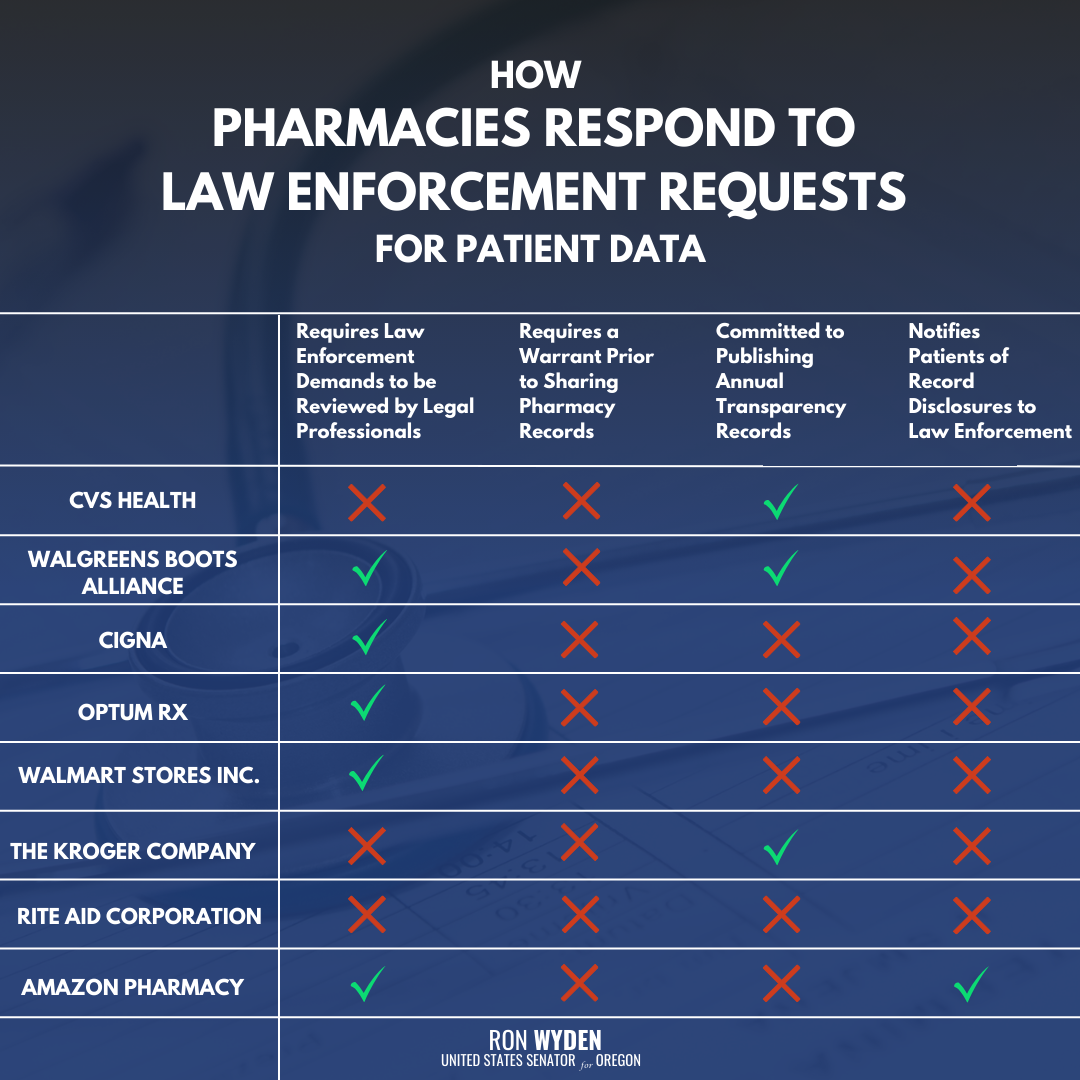
A Senate Finance Committee inquiry revealed on Tuesday that police departments can get access to private medical information from pharmacies, no warrant needed. While HIPAA may protect some access to personally identifiable health data, it doesn’t stop cops, according to a letter from Senator Ron Wyden, Representative Pramila Jayapal and Representative Sara Jacobs to the Department of Health and Human Services. None of the major US pharmacies are doing anything about it either, the members of Congress say.
“All of the pharmacies surveyed stated that they do not require a warrant prior to sharing pharmacy records with law enforcement agents, unless there is a state law that dictates otherwise,” the letter said. “Those pharmacies will turn medical records over in response to a mere subpoena, which often do not have to be reviewed or signed by a judge prior to being issued.”
The committee reached out to Amazon, Cigna, CVS Health, The Kroger Company, Optum Rx, Rite Aid Corporation, Walgreens Boots Alliance and Walmart about their practices for sharing medical data with police. While Amazon, Cigna, Optum, Walmart and Walgreen said they have law enforcement requests reviewed by legal professionals before complying, CVS Health, The Kroger Company and Rite Aid Corporation said they ask in-store staff to process the request immediately.
Engadget asked the pharmacies mentioned in the letter for comment about the claims. CVS said its pharmacy staff are trained to handle these inquiries and its following all applicable laws around the issue. Walgreens said it has a process in place to assess law enforcement requests compliant with those laws, too, and Amazon said that although law enforcement requests are rare, it does notify patients and comply with court orders when applicable. The others either haven’t responded or refuse to comment.
The pharmacies mostly blamed the current lack of legislative protections for patient data for their willingness to comply with cop requests. Most of them told the committee that current HIPAA law and other policies let them disclose medical records in response to certain legal requests. That’s why the Senate Finance Committee is targeting HHS to strengthen these protections, especially since the 2023 Dobbs decision let states criminalize certain reproductive health decisions.
Under current HIPAA law, patients have the right to know who is accessing their health information. But individuals have to request the medical record disclosure data, instead of health care professionals being required to share it proactively. “Consequently, few people ever request such information, even though many would obviously be concerned to learn about disclosures of their private medical records to law enforcement agencies,” the letter states. The letter also urges pharmacies to change their policies to require a warrant, and publish transparency reports about how data is shared.
This article originally appeared on Engadget at https://www.engadget.com/police-are-using-pharmacies-to-secretly-access-medical-information-about-members-of-the-public-182009044.html?src=rss
There’s still plenty of time to snap up a holiday gift for a loved one (or yourself). If you’re feeling particularly generous and you or someone you care about could do with a new laptop, it’s worth checking out deals on Apple’s 15-inch MacBook Air. Some configurations have dropped to record low prices, including one with 256GB of storage and an M2 chipset. That MacBook Air has dipped from $1,299 to $1,049 — which is $250 off the regular price.
This is an excellent entry point into the Mac ecosystem. In fact, the M2-powered MacBook Air (albeit a 2022 configuration) is our pick for the best MacBook overall. The 15.3-inch model that’s on sale here has a Liquid Retina display with 500 nits of brightness, 1080p FaceTime HD camera and Touch ID.
While the M2-powered MacBook Air should be more than capable enough of handling most tasks, it’s disappointing that the base model only comes with 8GB of RAM. That’s going to make tasks such as video and image editing, as well as even gaming, a bit more onerous on this MacBook Air.
In any case, we gave the 15-inch MacBook Air a score of 96 in our review in June. We appreciated the larger display compared with the 13.6-inch MBA, though lamented the fact the refresh rate is limited to 60Hz. Great battery life (the MBA ran for about 12 hours while handling day-to-day work tasks), terrific audio and a top-notch keyboard and trackpad are major plus points. One quibble is that, despite its great performance, the M2 chipset is getting a little long in the tooth — rumors suggest an M3-powered MacBook Air could debut in March.
Meanwhile, if you could use some more built-in storage than the 256GB that comes with this laptop, you can opt for a variant with 512GB for $1,249. That’s also $250 off and marks another record low. However, that model still only has 8GB of memory.
This article originally appeared on Engadget at https://www.engadget.com/apples-15-inch-m2-macbook-air-is-up-to-250-off-right-now-181005869.html?src=rss
In a story ripped from the opening scenes of a sci-fi horror movie, scientists have bridged a critical gap between the biological and electronic. The study, published in Nature Electronics (summarized in Nature), details a “hybrid biocomputer” combining lab-grown human brain tissue with conventional circuits and AI. Dubbed Brainoware, the system learned to identify voices with 78 percent accuracy. It could one day lead to silicon microchips fused with neurons.
Brainoware combines brain organoids — stem-cell-derived clusters of human cells morphed into neuron-filled “mini-brains” — with conventional electronic circuits. To make it, researchers placed “a single organoid onto a plate containing thousands of electrodes to connect the brain to electric circuits.” The circuits, speaking to the brain organoid, “translate the information they want to input into a pattern of electric pulses.”
The brain tissue then learns and communicates with the technology. A sensor in the electronic array detects the mini-brain’s response, which a trained machine-learning algorithm decodes. In other words, with the help of AI, the neurons and electronics merge into a single (extremely basic, for now) problem-solving biomachine.
The researchers taught the computer-brain system to recognize human voices. They trained Brainoware on 240 recordings of eight people speaking, “translating the audio into electric to deliver to the organoid.” The organic part reacted differently to each voice while generating a pattern of neural activity AI learned to understand. Brainoware learned to identify the voices with 78 percent accuracy.
Human brain organoids
The Washington Post via Getty Images
The team views the work as more proof of concept than something with near-term practical use. Although previous studies showed two-dimensional neuron cell cultures could do similar things, this is the first trial run using a trained three-dimensional lump of human brain cells. It could point to a future of biological computing, where the “speed and efficiency of human brains” spark a superpowered AI. (What could go wrong?)
Arti Ahluwalia, a biomedical engineer at Italy’s University of Pisa, sees the technology shedding more light on the human brain. Since brain organoids can duplicate the nervous system’s control center in ways simple cell cultures can’t, the researcher views Brainoware (and the further advances it could spawn) as helping model and study neurological disorders like Alzheimer’s. “That’s where the promise is; using these to one day hopefully replace animal models of the brain,” Ahluwalia told Nature.
Challenges for the bizarre proto-cyborg tech include keeping the organoids alive, especially when moving to the more complex areas where scientists eventually want to deploy them. The brain cells must grow in an incubator, which could become more challenging with bigger organoids. The next steps include working to learn how brain organoids adapt to more complex tasks and engineering them for greater stability and reliability.
This article originally appeared on Engadget at https://www.engadget.com/researchers-fuse-lab-grown-human-brain-tissue-with-electronics-175507932.html?src=rss