AMD + ITX + TB3? It's the ASRock X570 Phantom Gaming-ITX/TB3 Motherboard Review

When it comes to small form factor systems, options are few and far between. For AMD’s X570, out of the 35+ motherboards currently available, just four of them are smaller than mATX. This doesn’t give users much to choose from. In this case, mini-ITX implementations have to get it right, and over the last few years ASRock has been at the forefront of the enthusiast small form factor market with an array of models. Today we are reviewing its latest mini-ITX motherboard, the ASRock X570 Phantom Gaming-ITX/TB3. This unique product incorporates Thunderbolt 3 into the frame, pairing it with 802.11ax Wi-Fi 6 as well. Read on for our review.


Source: AnandTech – AMD + ITX + TB3? It’s the ASRock X570 Phantom Gaming-ITX/TB3 Motherboard Review

G.Skill Launches 32 GB DDR4 Modules, 256 GB Kits: Up to DDR4-4000

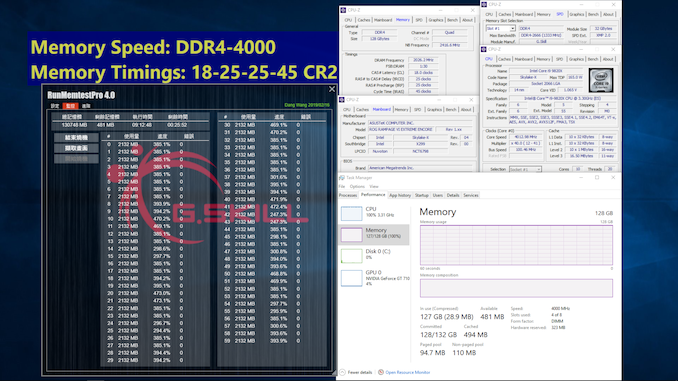
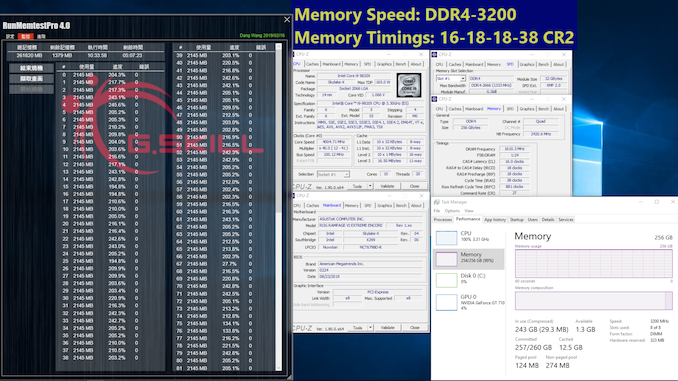
G.Skill has now rolled out its 32 GB unbuffered DDR4 modules in dual-channel and quad-channel memory kits. The modules are offered with data transfer rates from 2666 MT/s to 4000 MT/s and various modules are compatible with AMD’s Ryzen 3000/X570 as well as Intel’s X299/Z390 platforms.


Based on pre-binned 16 Gb memory chips and proprietary PCBs, G.Skill’s hardware boils down to sets of 32 GB DDR4 unbuffered DIMMs. Lower-end modules are set to be available as single pieces as they can be used by PC makers that need to lower their BOM cost, whereas higher-end parts will be offered as dual-channel and quad-channel kits for high-end desktops and workstations. The UDIMMs feature an XMP 2.0 SPD for setting speeds beyond JEDEC.


G.Skill’s 32 GB Trident Z UDIMMs and Kits
Speed CL Timing Voltage Kit

Config.
Kit

Capacity
DDR4-2666 CL18 18-18-43 1.2 V 1×32 GB 32 GB
2×32 GB 64 GB
3×32 GB 128 GB
4×32 GB 256 GB
CL19 19-19-43 1×32 GB 32 GB
2×32 GB 64 GB
4×32 GB 128 GB
8×32 GB 256 GB
DDR4-3200 CL16 18-18-38 1.35 V 1×32 GB 32 GB
2×32 GB 64 GB
4×32 GB 128 GB
8×32 GB 256 GB
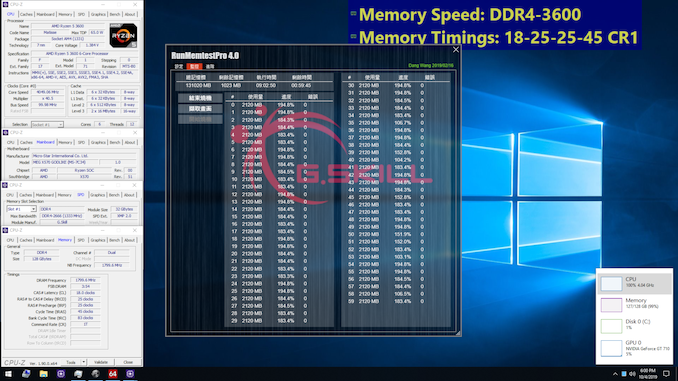
DDR4-3600 CL18 25-25-45 1.4 V 2×32 GB 32 GB
4×32 GB 64 GB
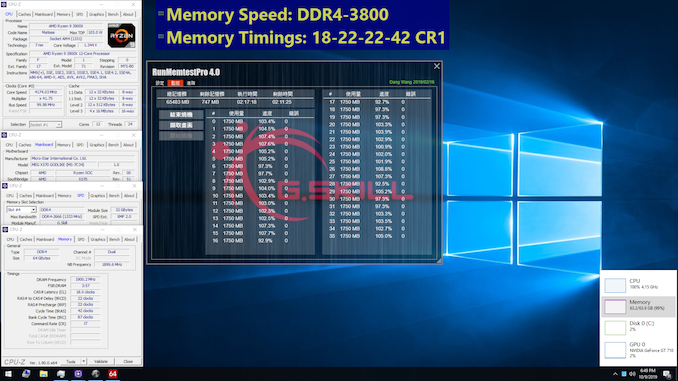
DDR4-3800 CL18 22-22-42 1.35 V 2×32 GB 64 GB
DDR4-4000 CL18 25-25-45 1.4 V 4×32 GB 128 GB

As there are several platforms used by enthusiasts today, G.Skill will offer two families of products:


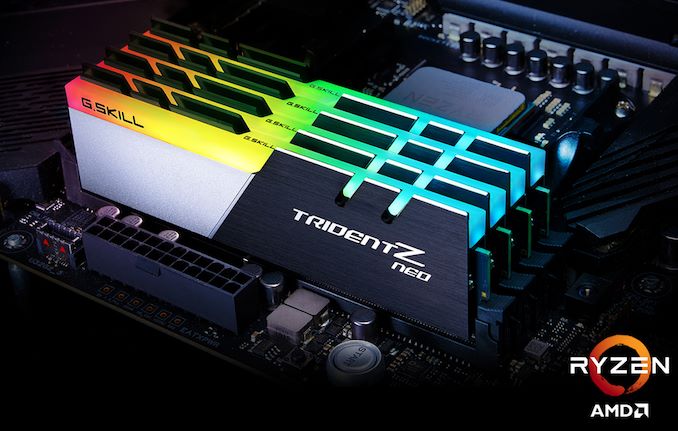
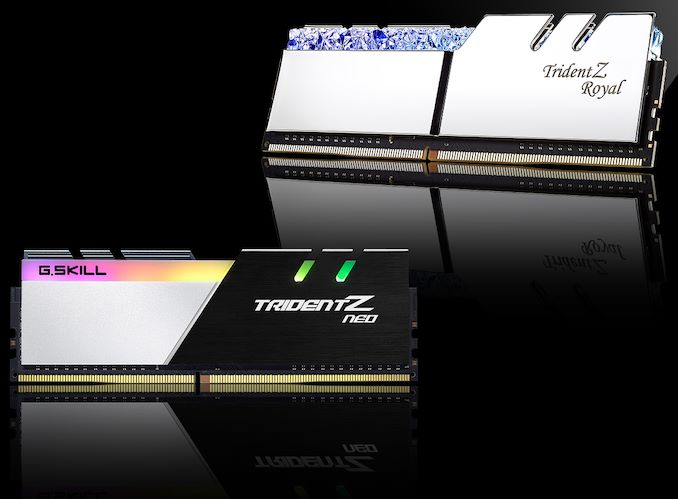
  • Trident Z Neo for AMD Ryzen 3000/X570 platforms
  • rident Z Royal for Intel platforms.

For AMD Ryzen 3000-based PCs, the highest-performing kits will be 64 GB DDR4-3800 CL18 as well as 128 GB DDR4-3600 CL18 offerings. For the Intel platform, the highest end kits will be 128 GB DDR4-4000 CL18 as well as 256 GB DDR4-3200 CL16. Validation for AMD is done using the MSI MEG X570 Godlike motherboard, whereas validation for Intel is made on the ASUS ROG Rampage VI Extreme Encore motherboard. Other motherboards will be validated over time, and likely up to the motherboard manufacturers in their own QVL.


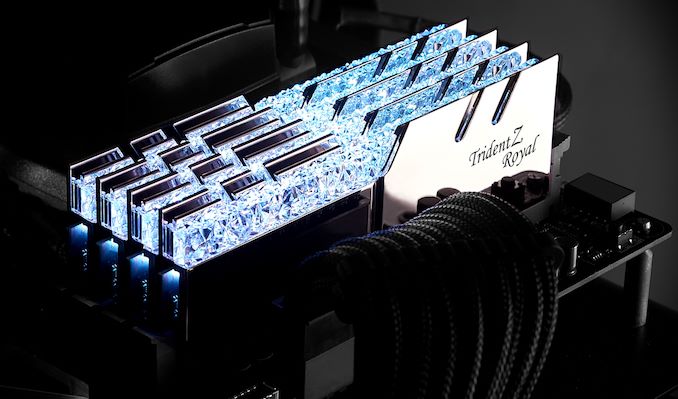
All enthusiast-class 32 GB unbuffered DIMMs from G.Skill will be equipped with aluminum heat spreaders with an RGB lightbar with multiple lighting zones. The Trident Z Royal will come with polished silver or gold heat spreaders as well as a crystalline RGB lightbar, whereas the Trident Z Neo will use matte heat spreaders and an RGB lightbar.


One thing to keep in mind about 32 GB UDIMMs is that they may require a BIOS update as not all motherboards support them out-of-box.


G.Skill will start sales of its 32 GB UDIMMs as well as dual-channel and quad-channel kits that use them later this quarter. Pricing will depend on capacity as well as rated performance levels, but since these products are designed for high-end PCs, they will be priced accordingly.


Related Reading


Source: G.Skill


Source: AnandTech – G.Skill Launches 32 GB DDR4 Modules, 256 GB Kits: Up to DDR4-4000

Team Group Joins PCIe 4.0 SSD Race with Cardea Zero Z440 Drives

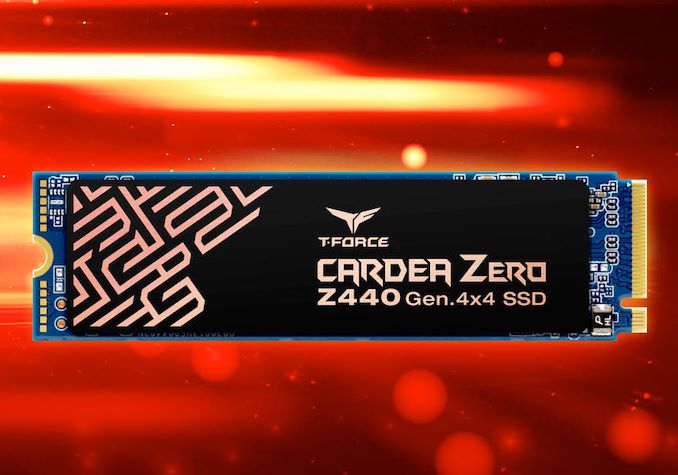
The rollout of AMD’s PCIe 4.0 Ryzen platform has accelerated releases of PCIe 4.0 x4 SSD drives. Team Group this week introduced its versions of SSDs based on Phison’s PS5019-E16 controller. Interestingly, unlike competing drives using the same chip from other makers, Team Group’s T-Force Cardea Zero Z440 do not feature an aluminum heat spreader, but relies on a different cooling system.


Set to ship in 1 TB and 2 TB configurations, Team Group’s M.2-2280 T-Force Cardea Zero Z440 SSDs use 3D TLC NAND. As far as performance is concerned, the drives promise up to 5000 MB/s sequential read speeds, up to 4400 MB/s sequential write speeds, as well an 750K peak read/write random IOPS, which is in line with competitors.


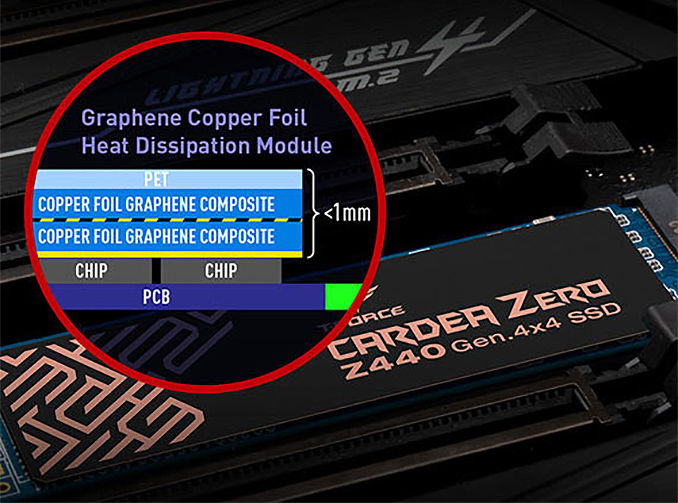
Unlike most of drives featuring the Phison PS5019-E16 controller, Team Group’s T-Force Cardea Zero Z440 SSDs does not use a massive aluminum heat spreader, but comes with a graphene copper foil heat dissipation module that is only 1 mm thick. The use of a very thin cooler makes the drive compatible with upcoming laptops featuring a PCIe 4.0 x4 interface that will be available in the future. Meanwhile, according to Team Group, the graphene copper foil heat dissipation sticker reduces controller’s temperature from 61.8°C to 56.5°C when compared to the lack of any heat spreader.


As far as endurance and reliability levels are concerned, Team Group’s T-Force Cardea Zero Z440 SSDs are rated for up to 1800 or 3600 TB written over a five-year warranty period, depending on the drive’s capacity.


Team Group’s T-Force Cardea Zero Z440 SSDs
Capacity 1 TB 2TB
Model Number TM8FP7001T0C311 TM8FP7002T0C311
Controller Phison PS5016-E16 (PCIe 4.0 x4)
NAND Flash 3D TLC NAND
Form-Factor, Interface M.2-2280, PCIe 4.0 x4, NVMe 1.3
Sequential Read 5000 MB/s
Sequential Write 4400 MB/s
Random Read IOPS 750K IOPS
Random Write IOPS 750K IOPS
Pseudo-SLC Caching Supported
DRAM Buffer 1 GB 2 GB
TCG Opal Encryption No
Power Management ?
Warranty 5 years
MTBF ? hours
TBW 1800 TB 3600 TB
MSRP $249 $499

Team Group will start sales of its T-Force Cardea Zero Z440 drives in the near future. The 1 TB version comes at a $249 MSRP, whereas the 2 TB model will cost $499.


Related Reading


Source: Team Group


Source: AnandTech – Team Group Joins PCIe 4.0 SSD Race with Cardea Zero Z440 Drives

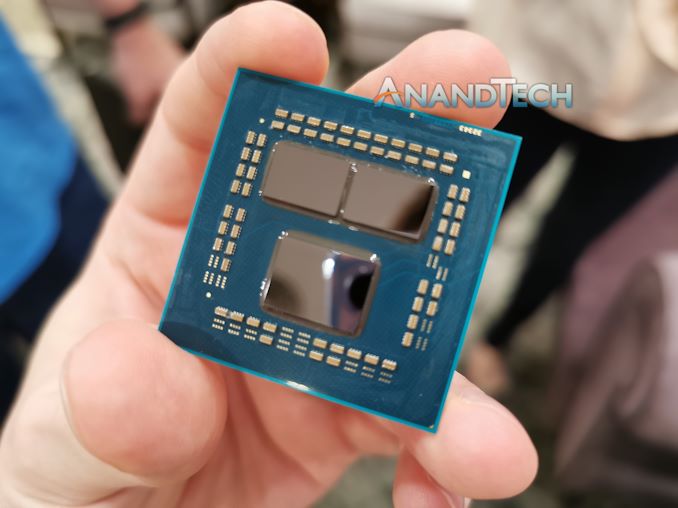
AMD Brings Ryzen 9 3900 and Ryzen 5 3500X To Life

Seemingly always with AMD’s product portfolio, there is a persistent drip of new products being inserted into the product stack throughout the lifetime of a given generation of hardware. Aside from the five Ryzen 3000 series processors launched back in July, we are expecting a new 16-core flagship on top of that list come in November. Until then, AMD has inserted two new processors: one for worldwide consumption, and another for the Chinese OEM market only.


Source: AnandTech – AMD Brings Ryzen 9 3900 and Ryzen 5 3500X To Life

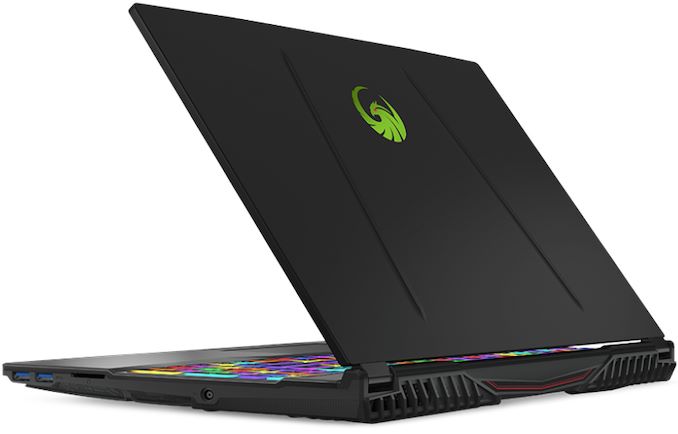
MSI’s Alpha 15: AMD Ryzen 3750H and Radeon RX 5500M

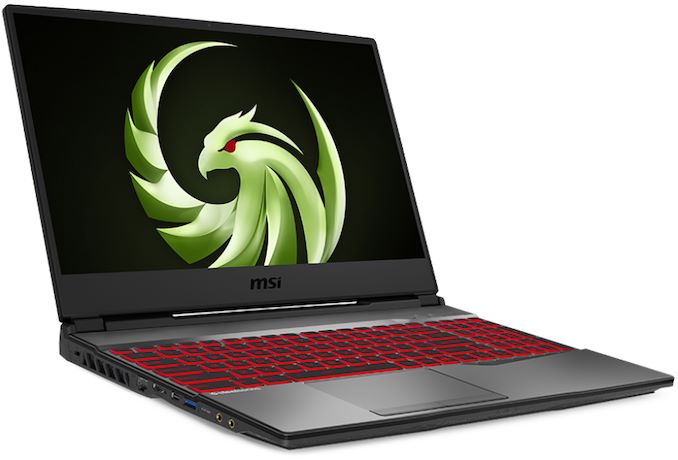
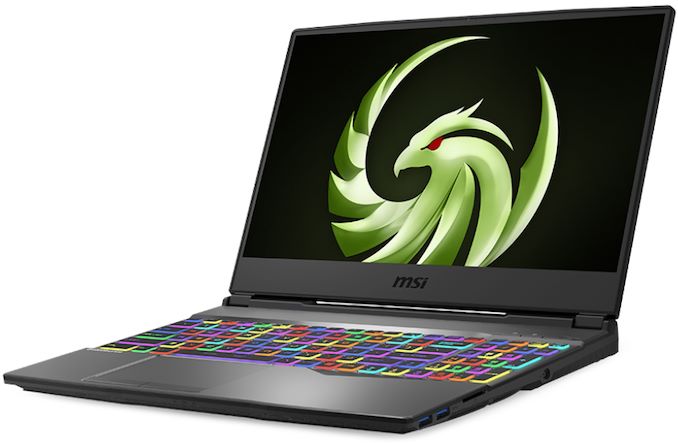
MSI is preparing to release a gaming laptop based exclusively on AMD’s CPU and GPU mobile hardware. The Alpha 15 from MSI will be among the first notebooks to use AMD’s latest Radeon RX 5500M GPU.


As the name suggests, MSI’s Alpha 15 is a 15.6-inch class laptop that comes with a Full-HD IPS-class display featuring a 120 Hz, 144 Hz, or 240 Hz refresh rate as well as AMD FreeSync variable refresh, depending on the model. The Alpha 15 weighs 2.3 kilograms and features a 27.5 mm z-height, making it as portable as other gaming notebooks on the market.


MSI’s Alpha 15 notebooks – which the company calls world’s first 7nm gaming laptop – will be based on AMD’s Ryzen 7 3000-series mobile CPU family up to four cores, and is accompanied by the Radeon RX 5500M GPU with 4 GB of GDDR6 memory. To cool down the CPU and the GPU, MSI uses a cooling system featuring seven heat pipes as well as two blowers. Depending on exact configuration, the Alpha 15 can be equipped with up to 64 GB of DDR4 memory, one M.2 SSD (with a PCIe 3.0 x4 or SATA interface), and one 2.5-inch SATA hard drive.


When it comes to connectivity, MSI’s Alpha 15 features Wi-Fi 5, Bluetooth 5.0, a gigabit Ethernet port (a Rivet Networks Killer controller is used in case of premium models), one USB 3.2 Gen 1 Type-C port, three USB 3.2 Gen 1 Type-A connectors, two display outputs (HDMI 2.0, mDP), a card reader (microSD or SD), and 3.5 mm audio connectors. In addition, the system comes with a 720p HD webcam, 2 W stereo speakers co-developed with Giant Speaker, and a backlit keyboard co-designed with Steelseries.


MSI’s Alpha 15 notebooks will come equipped with a 51 Wh battery and a 180 W power brick. The manufacturer does not disclose a proposed battery life.


General Specifications of MSI’s Alpha 15 laptops
  Alpha 15 A3DDK Alpha 15 A3DD
LCD Diagonal 15.6-inch
Resolution 1920×1080
Type IPS
VRR AMD FreeSync
Refresh Rate 144 Hz

240 Hz
120 Hz

144 Hz
CPU up to AMD Ryzen 7 3750H
Graphics Integrated up to AMD Radeon RX Vega 10
Discrete AMD Radeon RX 5500M
RAM up to 64 GB DDR4 DRAM
Storage SSD 1 × M.2 SSD (SATA or PCIe)
HDD 1 × 2.5-inch
Card Reader MicroSD Card reader SD Card reader
Wireless Wi-Fi 5 + Bluetooth 5.0
USB 1 × USB 3.2 Gen 1 Type-C

3 × USB Gen 3.2 Gen 1 Type-A
Wired Ethernet GbE Killer GbE
Cameras Front 720p HD webcam
Other I/O Microphone, 2 stereo speakers, audio jack, microphone in, mDP, HDMI
Battery 51 Wh
Dimensions Width 357.7 mm
  Depth 248 mm
  Thickness 27.5 mm
Weight 2.3 kilograms
Launch Price ?

MSI’s Alpha 15 will be available in the near future. Pricing will depend on exact configurations.


Related Reading


Sources: MSI


Source: AnandTech – MSI’s Alpha 15: AMD Ryzen 3750H and Radeon RX 5500M

TSMC: N7+ EUV Process Technology in High Volume, 6nm (N6) Coming Soon

TSMC announced on Monday that its customers have started shipping products based on chips made by TSMC using its N7+ (2nd Generation 7 nm) process technology that uses extreme ultraviolet lithography (EUVL) for up to four layers. The company also said that its clients are on track to tape out chips to be made using N6 node next year.


When compared to N7 (1st Generation 7 nm) that solely relies on deep ultraviolet lithography, TSMC lists its N7+ process as providing a 15% to 20% higher transistor density as well as 10% lower power consumption at the same complexity and frequency. Furthermore, after less than two quarters in production, TSMC is stating that N7+ now matches N7’s yields, which has been used for over a year now.


Use of EUVL enables TSMC to reduce usage of multipatterning technologies when printing highly complex circuits. This also means that TSMC’s EUV tools can offer output power of greater than 250 watts for day-to-day operations while reaching target goals for availability.


Advertised PPA Improvements of New Process Technologies
Data announced by companies during conference calls, press briefings and in press releases
  TSMC
16FF+

vs

20SOC
10FF

vs

16FF+
7FF

vs

16FF+
7FF

vs

10FF
7FF+

vs

7FF
6FF

vs

7FF
5FF

vs

7FF
Power 60% 40% 60% <40% 10% ? 20%
Performance 40% 20% 30% ? same (?) ? 15%
Area Reduction none >50% 70% >37% ~17% 18% 45%

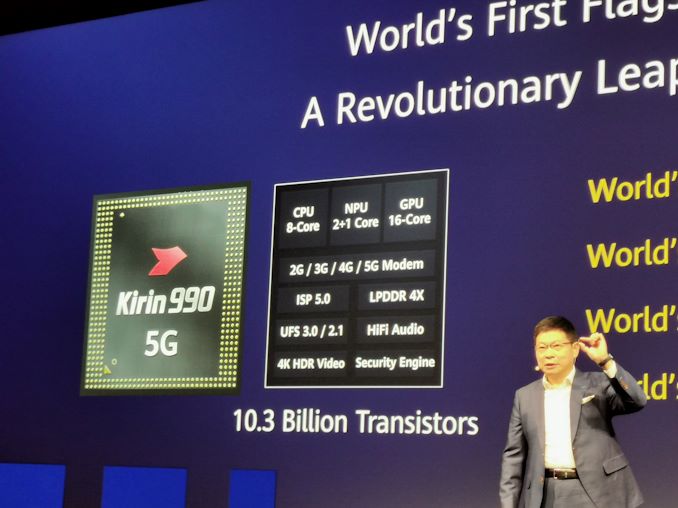
At present, TSMC uses N7+ to produce chips for multiple customers. Two known customers of N7+ are Huawei’s Hisilicon with the Kirin 990 5G, and Apple’s A13.


TSMC is on track to start risk production of semiconductors using its N6 process technology in the first quarter of 2020 and initiate high-volume production using this node by the end of next year. TSMC’s N6 is a further development of N7 that offers 18% higher transistor density, uses EUVL for up to five layers and enables designers of chips to re-use the same design ecosystem (e.g., tools, IP, etc.), which lowers development costs. By contrast, N7+ uses different design rules, but also provides more benefits than N6 when compared to N7.


Related Reading


Source: TSMC


Source: AnandTech – TSMC: N7+ EUV Process Technology in High Volume, 6nm (N6) Coming Soon

MSI's Motherboard Refresh for Cascade: Three New Professional X299 Offerings

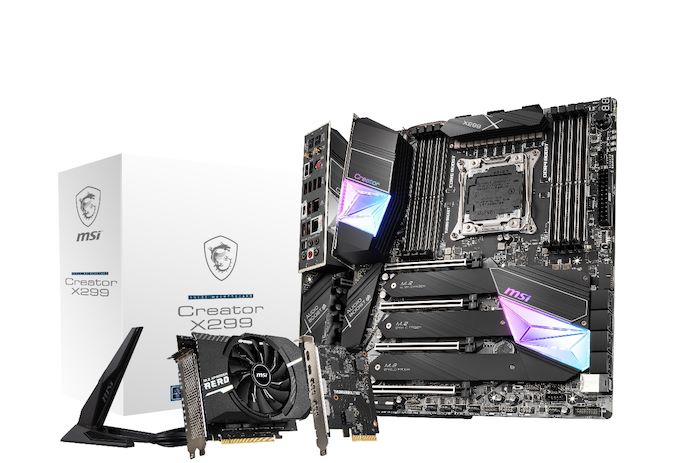
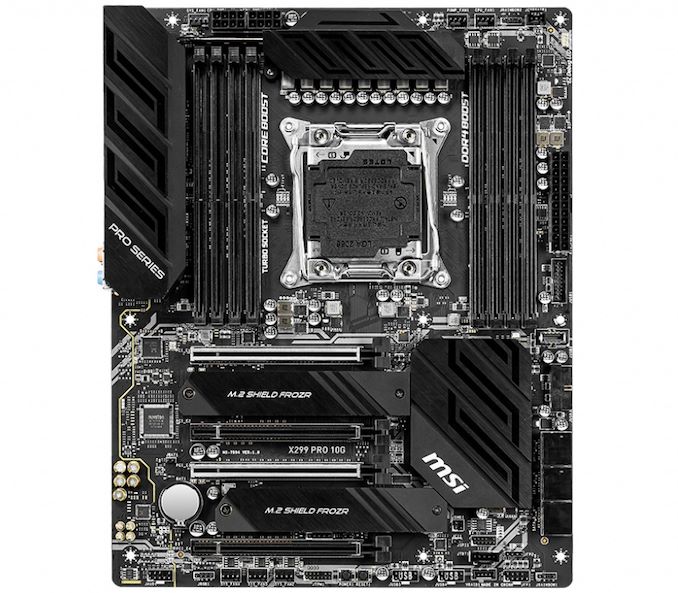
On the back of Intel’s upcoming launch of its HEDT Cascade Lake-X processors in November, MSI has unveiled three new X299 motherboards for content creators, and professional users. The MSI Creator X299, MSI X299 Pro 10G, and the MSI X299 Pro (non-10G) all feature dual Ethernet ports on the rear panel, Realtek ALC1220 HD audio codecs, eight memory slots that support quad-channel DDR4 memory, and also includes USB 3.2 G2 connectivity with ASMedia’s ASM3242 USB controller.


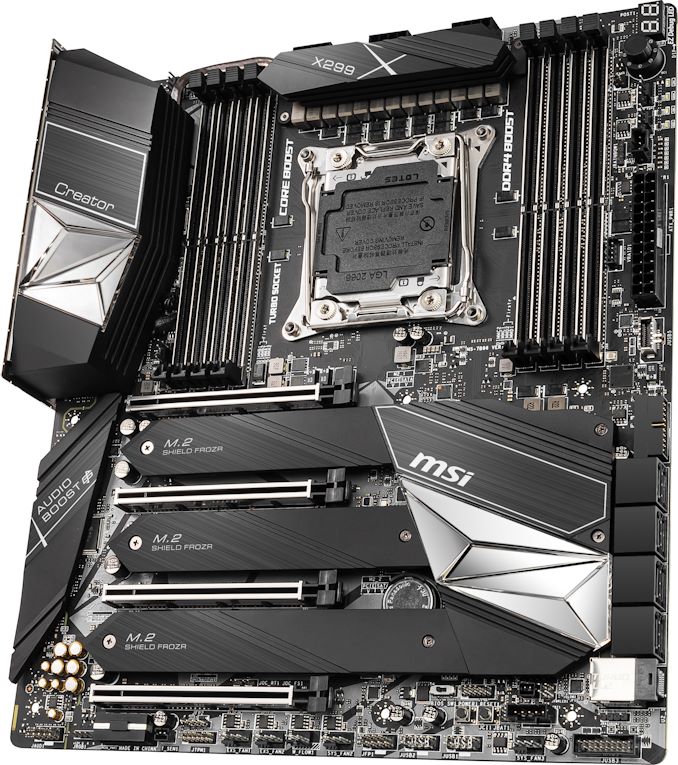
MSI Creator X299


The E-ATX sized MSI Creator X299 model will include plenty of premium features such as an Aquantia AQC107 10 GbE port which is assisted by an Intel I219-V Gigabit NIC providing dual Ethernet ports on the rear, with an Intel AX200 802.11ax wireless interface offering users both Wi-Fi and BT 5.0 connectivity. Focused on content creators and professional users, the Creator X299 allows users the ability to install up to seven PCIe 3.0 x4 M.2 devices; three PCIe 3.0 x4 M.2 slots on the PCB and four with the included MSI M.2 Xpander-Aero add-on card. Other storage options include eight SATA ports and a single PCIe 3.0 x4 U.2 slot for NVMe based storage devices.


A total of eight memory slots with the ability to use DDR4-4266 and install up to 256 GB is present, as well as four full-length PCIe 3.0 slots operating at x16/x8/x8/x8 when used with a 48-lane processor further enhances the board’s capabilities. Included in the accessories bundle is a Thunderbolt M3 add-on card which adds dual Type-C and dual DisplayPort 1.4 inputs which further bolsters the appeal of the Creator X299 to content creators and professionals.


MSI X299 Pro 10G and non-10G


The MSI X299 Pro shifts more onto regular markets with a smaller ATX frame and has a similar networking layout to the Creator X299, but with the 10G coming through a bundled Aquantia AQC107 10 GbE add-on card. This model retains dual Ethernet on the rear panel with one slot controlled by an Intel I1219-V, and the other powered by a Realtek RTL8125-CG 2.5 GbE controller. The X299 Pro 10G has two onboard PCIe 3.0 x4 M.2 slots with room for an additional pair with MSI including an M.2 Xpander-Z dual M.2 slot add-on card in the accessories bundle. This is in addition to six SATA ports which have support for RAID 0, 1, 5, and 10 arrays. 


The MSI X299 Pro has support for DDR4-4200 with scope for up to 256 GB across eight available slots and has support for up to quad-channel memory. There are four full-length PCIe 3.0 slots with the second and third slot having just a slot of space between them; an obvious space limitation of its ATX sized frame. The full-length slots operate at x16/x8/x16/x8 when a processor supporting 48-lanes is installed with a clear focus for users to add a Cascade Lake-X processor for maximum support.


MSI hasn’t unveiled specifications on the MSI X299 Pro at present, but it’s likely to be similar to the X299 Pro 10G but without the 10G add in card. Availability and pricing information is scarce, but a source indicated that the MSI Creator X299 is set to cost £495 in the UK which represents fantastic value for money with the included Thunderbolt 3 AIC, support for up to seven PCIe 3.0 x4 M.2 slots, and 10 gigabit Ethernet as well. Availability on all three models isn’t known, but it is likely that all three models will be available to coincide with the launch of Intel’s Cascade Lake-X processors in November.


Related Reading


Source: AnandTech – MSI’s Motherboard Refresh for Cascade: Three New Professional X299 Offerings

Arm TechCon 2019 Keynote Live Blog (Starts at 10am PT/17:00 UTC)

Kicking off today is Arm’s annual technical conference, Arm TechCon. Now in its 15th year, the company is looking to continue their long, successful run in the IP market, with Arm designs powering everything from toasters to servers. To do so, the company not only needs to keep current customers happy, a bigger challenge in the face of the success of ISA and IP rival RISC-V, but also to continue to grow Arm into new & expanding markets.


For today’s keynote, we’ve been told to expect specific announcements and discussions on IoT, autonomomous vehicles, and what Arm is calling “Total Compute”. So it sounds like Arm has an interesting show ahead.


Source: AnandTech – Arm TechCon 2019 Keynote Live Blog (Starts at 10am PT/17:00 UTC)

Intel Starts End-of-Life Plan for Kaby Lake-G

Intel this week initiated its product discontinuance plan for its Kaby Lake-G processors with on-package Radeon RX Vega graphics. The products will be available to order for about the next ten months from now. Considering the fact that very few OEMs actually adopted Intel’s Kaby Lake-G, the impact on PC makers should be minimal.


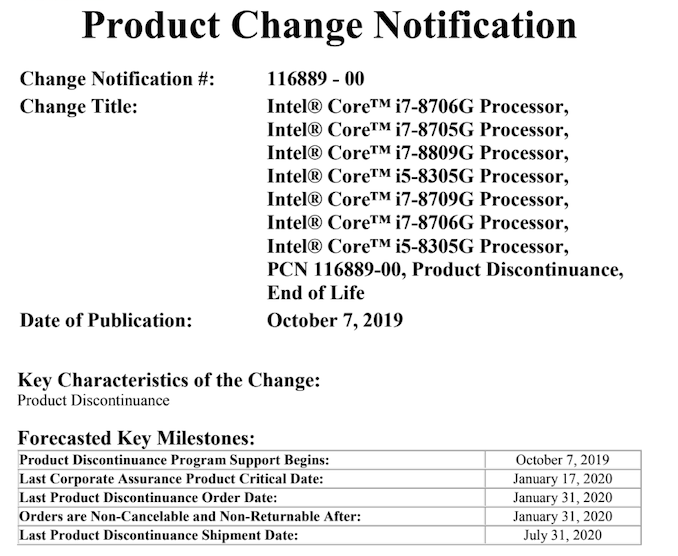
Intel advises its customers to make final orders for its Core i5-8305G, Core i7-8705G, Core i7-8706G, Core i7-8709G, and Core i7-8809G processors by January 31, 2020. All the shipments will be made by July 31, 2020.


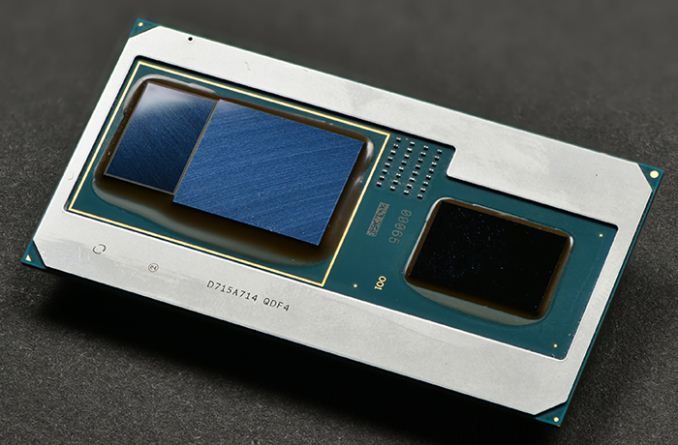
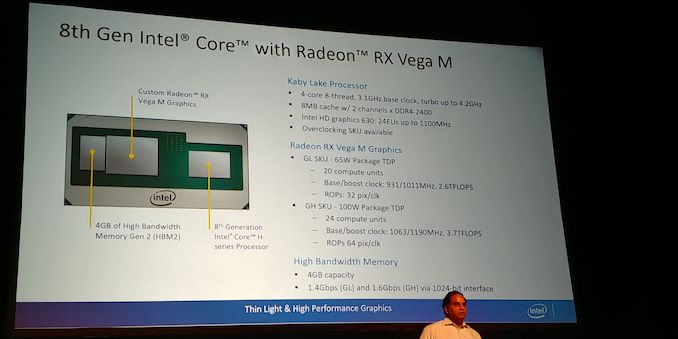
Released in early 2018, the Kaby Lake-G processors with on-package Radeon RX Vega graphics featuring an HBM2 cache were meant to enable relatively compact systems to offer similar performance to a discrete GPU. The TDP of Intel’s Kaby Lake-G CPUs ended up at 65 W or 100 W, which essentially limited their market to 15.6-inch machines that are available from select manufacturers.


Intel has since released its Ice Lake processors with Iris Plus graphics that radically increases its own native performance when compared to typical integrated GPUs, which somewhat reduces appeal of the Kaby Lake-G CPUs. Furthermore, Intel has renewed focus on its own integrated and discrete graphics plans.


Related Reading


Source: Intel


Source: AnandTech – Intel Starts End-of-Life Plan for Kaby Lake-G

The Modular PC: Intel’s new Element brings Project Christine to Life

Way back at CES 2014, Razer’s CEO introduced a revolutionary concept design for a PC that had one main backplane and users could insert a CPU, GPU, power supply, storage, and anything else in a modular fashion. Fast forward to 2020, and Intel is aiming to make this idea a reality. Today at a fairly low-key event in London, Intel’s Ed Barkhuysen showcased a new product, known simply as an ‘Element’ – a CPU/DRAM/Storage on a dual-slot PCIe card, with Thunderbolt, Ethernet, Wi-Fi, and USB, designed to slot into a backplane with multiple PCIe slots, and paired with GPUs or other accelerators. Behold, Christine is real, and it’s coming soon.


Source: AnandTech – The Modular PC: Intel’s new Element brings Project Christine to Life

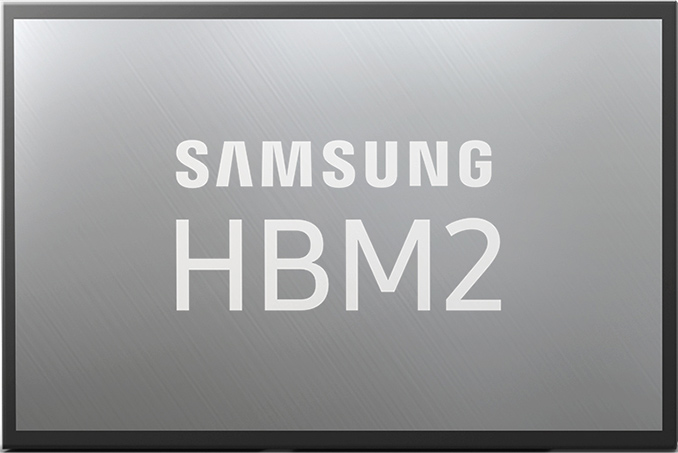
Samsung Develops 12-Layer 3D TSV DRAM: Up to 24 GB HBM2

Samsung on Monday said that it had developed the industry’s first 12-layer 3D packaging for DRAM products. The technology uses through silicon vias (TSVs) to create high-capacity HBM memory devices for applications that benefit from high memory bandwidth and capacities, such as higher-end graphics, FPGAs, and compute cards.


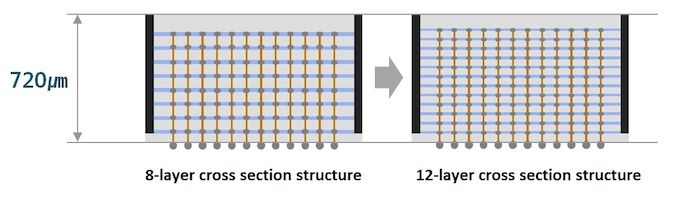
Samsung’s 12-layer DRAM KGSDs (known good stack die) will feature 60,000 TSV holes which is why the manufacturer considers its technology one of the most challenging packaging for mass production. Despite increase of the number of layers from eight to 12, thickness of the package will remain at 720 microns, so Samsung’s partners will not have to change anything on their side to use the new technology. It does mean that we’re seeing DRAM layers getting thinner, with acceptable yields for high-end products.


One of the first products to use Samsung’s 12-layer DRAM packaging technology will be the company’s 24 GB HBM2 KGSDs that will be mass produced shortly. These devices will allow developers of CPUs, GPUs, and FPGAs to install 48 GB or 96 GB of memory in case of 2048 or 4096-bit buses, respectively. It also allows for 12 GB and 6 GB stacks with less dense configurations.


Samsung did not disclose how much will 12-layer 24 GB HBM2 devices cost, but since they will be available exclusively from Samsung, we expect the manufacturer to charge a premium.


Here is what Hong-Joo Baek, executive vice president of TSP (Test & System Package) at Samsung Electronics, had to say:


“Packaging technology that secures all of the intricacies of ultra-performance memory is becoming tremendously important, with the wide variety of new-age applications, such as artificial intelligence (AI) and High Power Computing (HPC). As Moore’s law scaling reaches its limit, the role of 3D-TSV technology is expected to become even more critical. We want to be at the forefront of this state-of-the-art chip packaging technology.”


Related Reading


Source: Samsung


Source: AnandTech – Samsung Develops 12-Layer 3D TSV DRAM: Up to 24 GB HBM2

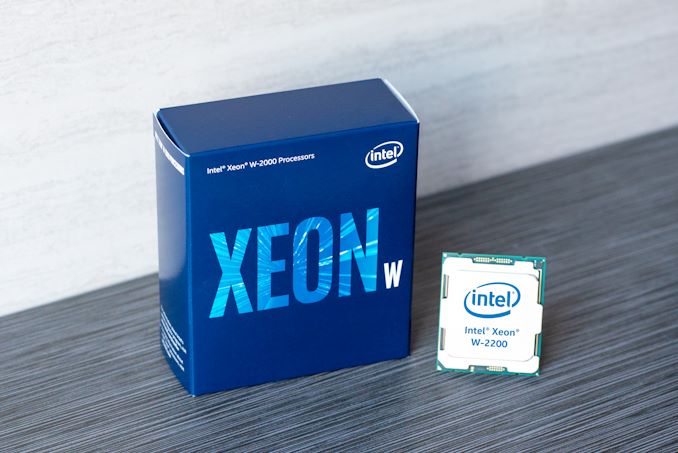
Intel Xeon W-2200 Family: Cascade Lake-X with ECC and 1TB Support

We recently saw the launch of the consumer Cascade Lake high-end desktop processors last week, featuring up to 18 cores at a low launch price. This week Intel is launching the professional versions of those processors, focused on workstations. The W-2200 family is an upgrade over the older W-2100 family, offering more frequency, more memory support, faster memory support, and a more affordable pricing structure.


Source: AnandTech – Intel Xeon W-2200 Family: Cascade Lake-X with ECC and 1TB Support

Intel Announces Price Cut for 9th Generation F and KF Processors

One of the interesting developments of Intel’s 9th Generation Core processors for desktops, known as the S-series, was that the company decided to release versions of the hardware with the graphics disabled in order to use every chip from the wafer. At the time Intel was criticised on its pricing: it was offering the same processor minus graphics for the same bulk unit cost, with no discount. Today Intel is adjusting its strategy, and pricing these F and KF processors lower than before.


Source: AnandTech – Intel Announces Price Cut for 9th Generation F and KF Processors

AMD Announces Radeon RX 5500 Series: 1080p Gaming for Desktop & Mobile, Coming This Quarter

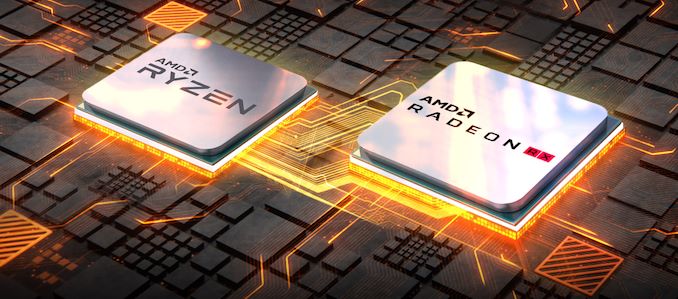
Coming off of an incredibly busy summer for AMD that saw some of its most important product launches in recent history across both CPUs and GPUs, AMD is gearing up to finish out the year on a high note as well. This morning the company is announcing the next series in its Radeon RX 5000 family of video cards, the Radeon RX 5500 series. Based on the same RDNA architecture as AMD’s flagship RX 5700 parts, the new RX 5500 series is being built around a new, smaller Navi GPU that will allow AMD to bring their latest Radeon technologies down to more affordable, mainstream video cards, as well as laptops for the first time.


Source: AnandTech – AMD Announces Radeon RX 5500 Series: 1080p Gaming for Desktop & Mobile, Coming This Quarter

Already Working on 2nd Gen: AMD’s Ryzen Microsoft Surface Edition and what Semi-Custom Means

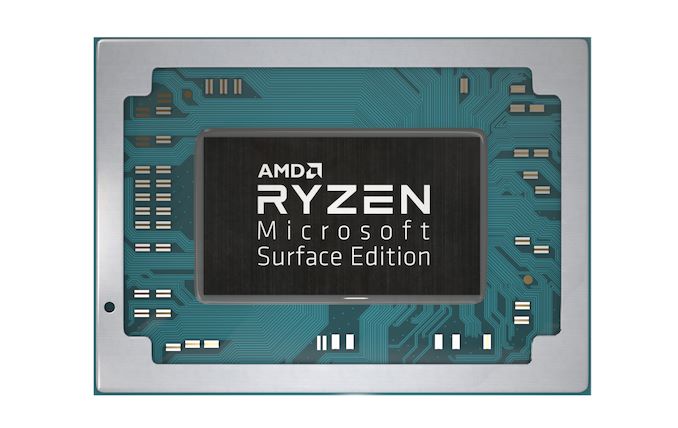
One of the key takeaways from Microsoft’s launch this week was that the company was spreading its wings with devices made by all three major SoC vendors: Intel, AMD, and Qualcomm. Both the AMD and Qualcomm design wins are especially important given that these companies did not traditionally have a foothold in this space. Both companies showcased unique silicon for Microsoft, with AMD’s Ryzen Microsoft Surface Edition going into the consumer-grade Surface Laptop 3, and Qualcomm’s Snapdragon SQ1 in the Surface Pro X. We sat down with AMD to get to grips with this partnership.


Source: AnandTech – Already Working on 2nd Gen: AMD’s Ryzen Microsoft Surface Edition and what Semi-Custom Means

Gen-Z PHY Specification 1.1 Published: Adds PCIe 5.0, Gen-Z 50G Fabric

The Gen-Z Consortium this week released Physical Layer Specification 1.1 for Gen-Z interconnects. The new standard adds enhanced support for PCIe Gen 5 as well as Gen-Z 50G Fabric and Local PHY. The publication of the new PHY revision enables chip developers to implement support for the technologies in upcoming devices featuring Gen-Z interconnects.


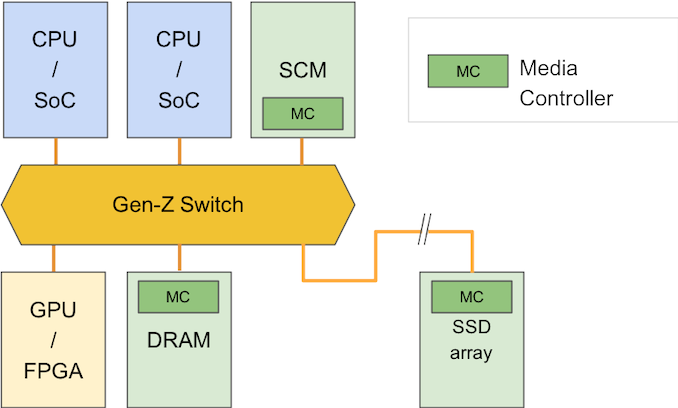
Designed to offer high bandwidth and low latency for connections between processors, co-processors/accelerators, and memory/fast storage, Gen-Z 1.0 uses a PCIe physical layer and a modified IEEE 802.3 Ethernet electrical layer standards to provide per-lane speeds of up to the 56 GigaTransfers/second. The Gen-Z 1.0 physical layer specification only defined usage of PCIe Gen 1-4 protocols as well as a 25 GT/s PHY. Thus, to take advantage of all the capabilities of the Gen-Z 1.0 core specification, one needs to comply with the Gen-Z PHY that describes logical, functional, electrical, and channel characteristics for various PHY layers.


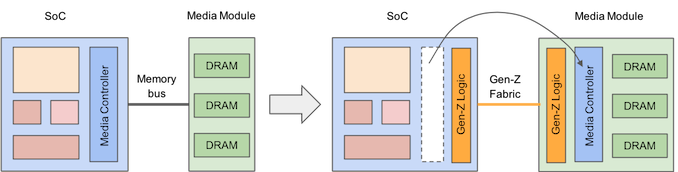
From CPU-memory interface to media-agnostic fabric


The Gen-Z Physical Layer Specification 1.1 defines how to implement a Gen-Z layer capable of operating at PCIe Gen 5 32 GT/s per lane speeds. Revision 1.1 also outlines how to implement a medium to reach a Gen-Z-E-PAM4-50G-Fabric link with a raw data rate of 53.125 GT/s per lane using a 4-level Pulse Amplitude Modulation (PAM4) signaling over the fabric with an ultra-low-latency Phit Forward Error Correction (Phit FEC) encoding using a BCH codeword. Finally, the specification 1.1 describes the implementation of a very short reach Gen-Z-E-PAM4-50G-Local link at 53.125 GT/s per lane using a PAM4 signaling with Forward Error Correction (raw data-rate of 47.222 GT/s).


System architecture with Gen-Z


In addition to the Physical Layer Specification 1.1, Gen-Z has eight more final specifications and five draft specifications available.


Related Reading


Source: Gen-Z Consortium

Image Source: PLDA


Source: AnandTech – Gen-Z PHY Specification 1.1 Published: Adds PCIe 5.0, Gen-Z 50G Fabric

Acer Ships ConceptD CP7271K P: A Professional 4K 144 Hz Monitor with G-Sync Ultimate

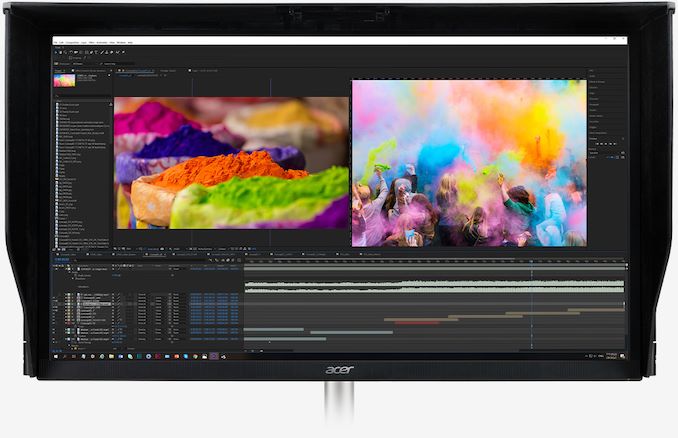
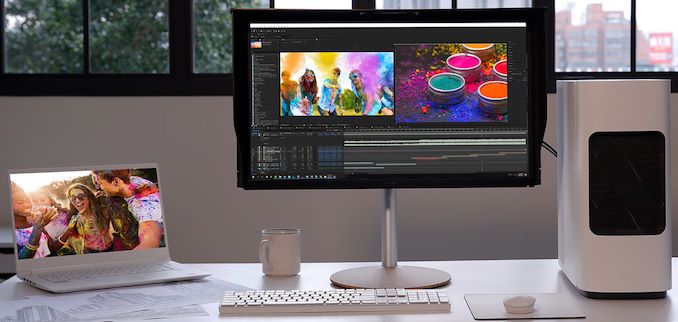
Acer has started shipments of its ConceptD CP7271K P professional monitor designed for developers of fast-paced color-critical HDR content such as animation, games, and movies. The monitor brings together a 4K Ultra-HD resolution, an accurate color reproduction, a 144 Hz refresh rate, VESA’s DisplayHDR 1000, and Pantone Validated certifications as welll as NVIDIA’s G-Sync Ultimate (former G-Sync HDR) variable refresh rate technology.


Aimed at color-critical workloads, the ConceptD CP7271K P uses a premium 27-inch IPS panel of a 3840×2160 resolution that features 600 nits native brightness, 1000 nits peak HDR brightness, a 1000:1 contrast ratio, a 4 ms GtG response time, 178° viewing angles, and a variable refresh rate of up to 120 Hz (that can be overclocked to 144 Hz). The professional monitor comes factory calibrated to a Delta <1 accuracy, it can display 1.07 billion colors as well as reproduce 99% of the AdobeRGB and 93% of the DCI-P3 color spaces (required by professionals working with today’s digital content). In addition, it is Pantone Validated.



Gaming displays supporting NVIDIA’s G-Sync Ultimate technology feature a quantum dot-enhanced full-area local dimming (FALD) backlighting for ultimate color clarity and high contrasts. For some reason, Acer does not advertise either technology in case of the ConceptD CP7271K P (which does not automatically mean that it does not use similar technologies). Meanwhile, the monitor carries VESA’s DisplayHDR 1000 badge, so it has to feature not only 1000 nits peak brightness, but also at least 0.05/0.10 nits blacks (corner/tunnel) that require some kind of local dimming, according to VESA.


There is one important thing to point out about NVIDIA’s G-Sync Ultimate implementation on modern monitors. Formally, all of the displays carrying this badge support a 4K (or similar) resolution and an up to 144 Hz variable refresh rate. Meanwhile, since these displays connect to host PCs using a DisplayPort 1.4 interface with its bandwidth limitations, chroma subsampling is required beyond 98 Hz for 4K HDR content. That said, although G-Sync Ultimate LCDs feature a 120 Hz or 144 Hz maximum refresh rate, colors will not look best at these rates.


When it comes to connectivity, the monitor has a DisplayPort 1.4, an HDMI 2.0 input, and a five-port USB 3.0 hub. In addition, it has two 4 W speakers.


As with virtually all professional displays, the Acer ConceptD CP7271K P can be adjusted to its user’s environment and comes with a stand that can regulate height, tilt, and swivel. Furthermore, to guarantee consistent color quality, the LCD comes with a lighting hood.


The Acer ConceptD CP7 27-Inch P G-Sync Ultimate Display
  ConceptD CP7271K
Panel 27″ IPS
Native Resolution 3840 × 2160
Maximum Refresh Rate 120/144 Hz VRR (normal/overclocked)
Variable Refresh Rate G-Sync Ultimate
Response Time 4 ms GtG
Brightness 600 cd/m² (sustained)

1000 cd/m² (peak)
Contrast 1000:1
Viewing Angles 178°/178° horizontal/vertical
HDR DisplayHDR 1000

HDR10
Backlighting LED
Pixel Pitch 0.1557mm²
Pixel Density 163 ppi
Display Colors 1.07 billion
Color Gamut Support DCI-P3: 93%

Adobe RGB: 99%

Rec. 2020: ?

sRGB: ?
Aspect Ratio 16:9
Stand Hight, Tilt, and Swivel adjustable
Inputs DisplayPort 1.2

HDMI 2.0
USB Hub Five-port USB 3.0 hub
Launch Date Q4 2019

Acer’s ConceptD CP7 27-inch G-Sync Ultimate monitor can be obtained directly from Acer as well as from its resellers for $2,199.99. For those who do not need G-Sync Ultimate and DisplayHDR1000, Acer also offers its ConceptD CP3271K P with similar characteristics for $1,299.99.


Related Reading


Source: Acer


Source: AnandTech – Acer Ships ConceptD CP7271K P: A Professional 4K 144 Hz Monitor with G-Sync Ultimate

Micron: 128-Layer 4th 3D NAND with RG Architecture Coming Soon

Micron has taped out its first 4th Generation 3D NAND memory devices with its new replacement gate (RG) architecture. The tape out confirms that the company is on track to produce commercial 4th Gen 3D NAND memory in calendar 2020, but Micron warns that memory using the new architecture will only be used for select applications and therefore its 3D NAND cost reductions next year will be minimal.

Micron’s 4th Gen 3D NAND uses up to 128 active layers and continues to use a CMOS under the array design approach. The new type of 3D NAND memory changes floating gate technology (that has been used by Intel and Micron for years) for gate replacement technology in an attempt to lower die size and costs while improving performance as well as enabling easier transitions to next-generation nodes. The technology was developed solely by Micron without any input from Intel, so it is likely tailored for applications that Micron wants to target the most (likely high ASPs, such as mobile, consumer, etc.).

The tape out of Micron’s 4th Gen 128-layer 3D NAND indicates that the company’s new design is more than just a concept. At the same time, Micron does not have plans to transit all of its product lines to its initial RG process technology, so its company-wide cost per-bit will not drop significantly next year. Nonetheless, the firm promises that it will see meaningful cost reductions in FY2021 (starts in late September, 2020) after its subsequent RG node is broadly deployed.


Right now, Micron is ramping up production of 96-layer 3D NAND and next year that will be used across the vast majority of its product lines. The 128-layer 3D NAND hardware will not bring significant per-bit costs declines immediately, but over time. A succeeding node (Micron’s 5th Gen 3D NAND?) is likely to feature at least 128 layers and if used widely, it will predictably lower the company’s per-bit costs substantially compared to today.


Sanjay Mehrotra, CEO and president of Micron, said the following:


“We achieved our first yielding dies using replacement gate or “RG” for short. This milestone further reduces the risk for our RG transition. As a reminder, our first RG node will be 128 layers and will be used for a select set of products. We don’t expect RG to deliver meaningful cost reductions until FY2021 when our second-generation RG node is broadly deployed. Consequently, we are expecting minimal cost reductions in NAND in FY2020. Our RG production deployment approach will optimize the ROI of our NAND capital investments.”


Related Reading:


Sources: Micron


Source: AnandTech – Micron: 128-Layer 4th 3D NAND with RG Architecture Coming Soon

The ASRock Z390 Phantom Gaming 7 Motherboard Review: Prepare for 9900KS

The battle between Intel and AMD fighting over market share is hotter than it has ever been. With each of the two colossal chip makers doing battle for brand supremacy, we’ve seen two primary desktop chipsets set the standard in the world of desktop motherboards; the Z390 and X570 chipsets. While the Z390 market is now mature, ASRock launched two new motherboards into its Intel Z390 product stack, and today we are taking a look at one of them, the ASRock Z390 Phantom Gaming 7. With a feature set spearheaded by a 2.5 GbE port, it sits between the ASRock Z390 Phantom Gaming 9 and Z390 Phantom Gaming 6, aiming for a more mid-range user.


Source: AnandTech – The ASRock Z390 Phantom Gaming 7 Motherboard Review: Prepare for 9900KS

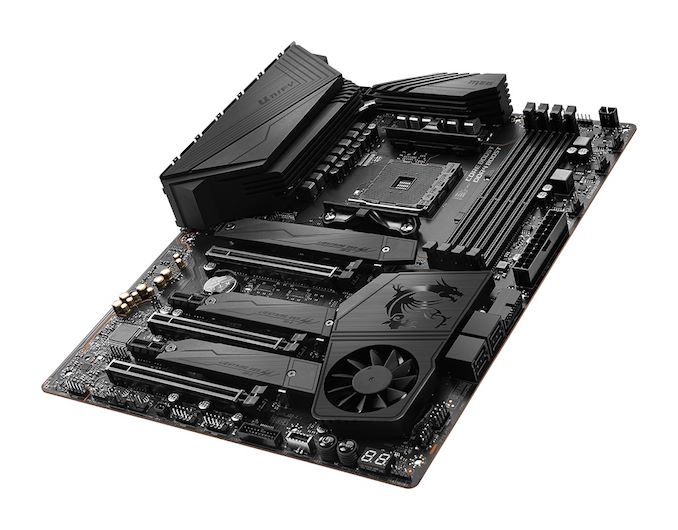
New MSI MEG X570 Unify: An All-Black Motherboard with no RGB!!

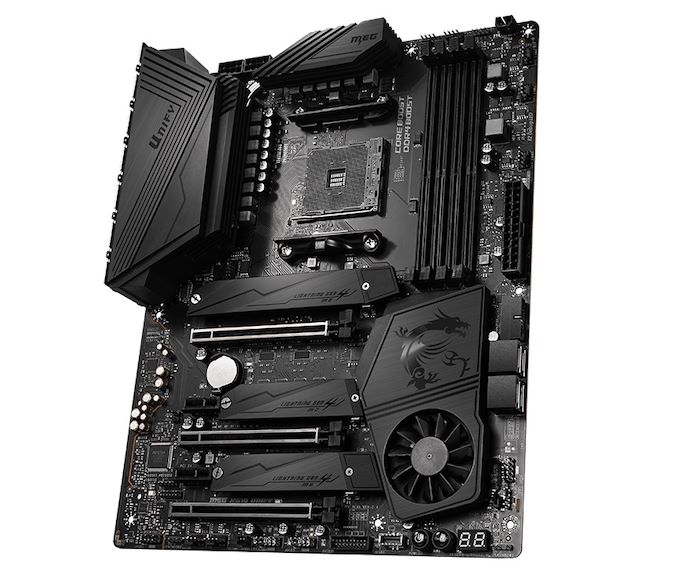
The concept and implementation of RGB can be a deal-breaker when buying a new motherboard. With many models to choose from, not many are brave enough to drop the rainbow lighting money spinning feature. The new MSI MEG X570 Unify takes a different approach with a unified all-black design and drops all integrated RGB LEDs and shares the same core feature set as the X570 Ace model with 2.5 gigabit Ethernet, a Wi-Fi 6 802.11ax wireless interface, and three PCIe 4.0 x4 M.2 slots.


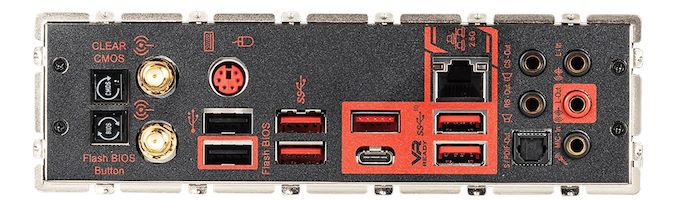
The MSI MEG X570 Unify combines sleek and uniformed all-black aesthetics without the swathes of RGB LEDs which some users find garish. With similar specifications to the MSI MEG X570 Ace which we reviewed at launch, the MEG X570 Unify takes a more direct approach with some very interesting features. Not only has MSI dropped all of the fancy plastic on the rear panel cover and removes the integrated RGB LEDs, but the power delivery heatsink is incorporated into the large aluminium rear panel cover to create a massive and robust cooling solution for power users; the X570 Unify is using a 14-phase power delivery design and two 8-pin 12 V ATX connectors for power. The Unify is more focused towards enthusiasts and represents MSI’s higher-tier of X570 models. 


Looking at the core feature set, the MSI MEG X570 Unify includes three PCIe 4.0 x4 M.2 slots which each come with individual heatsinks for improved cooling performance when used with NVMe based drives. Also included four SATA ports and for the networking, a Realtek RTL8125 2.5 GbE port, and an Intel AX200 Wi-Fi 6 802.11ax wireless interface. On the rear panel, there is a Realtek ALC1220 HD audio codec with three USB 3.1 G2 Type-A, one USB 3.1 G2 Type-C, two USB 3.1 G1 Type-A, and two USB 2.0 ports. Also present is a clear CMOS button, a Flash BIOS button, and a PS/2 combo port. There are three full-length PCIe 4.0 slots which operate at x16, x8/x8, and x8/x8/x4, as well as two PCIe 4.0 x1 slots. Supported memory speeds allow for DDR4-4600 and up to 128 GB to be installed.


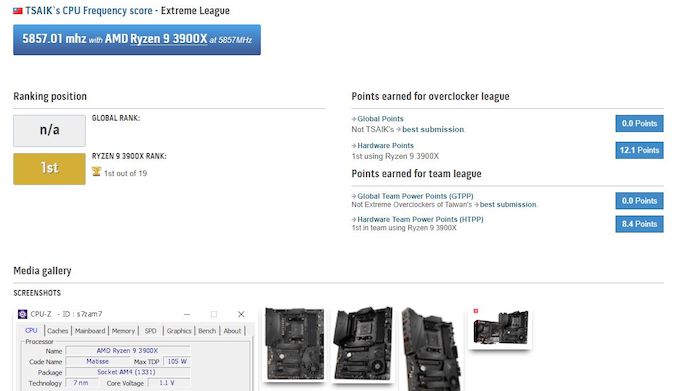
The Ryzen 9 3900X at 5.85 GHz using the MSI MEG X570 Unify


Everything about this model screams enthusiast, but without all of the bells and whistles of the MEG X570 Ace. The MSI MEG X570 Unify even managed to push a Ryzen 9 3900X to 5857.01 MHz which is the current highest frequency for this processor on HWBot. That sends a very clear message that this model is suited for overclocking, but still provides users with the same premium desktop motherboard features as other competitive models in its product segment.


At present, there is no pricing information available for the MSI MEG X570 Unify, but it is expected to hit the shelves soon and it’s likely the launch of this model was due to coincide with the launch of the 16-core 7nm AMD processor, the Ryzen 9 3950X which has been pushed back to November.


Related Reading


Source: AnandTech – New MSI MEG X570 Unify: An All-Black Motherboard with no RGB!!