Apple’s iPhone and iPad devices running iOS and iPadOS 26, respectively, have become the first consumer-grade mobile devices officially approved to handle classified NATO information. This certification, announced by Apple following an evaluation by Germany’s Federal Office for Information Security (BSI), allows personnel across all 32 NATO
theodp writes: On Tuesday, Microsoft GM of Education and Workforce Policy (and former Code.org Chief Academic Officer) Pat Yongpradit posted an obituary of sorts for coders. “Computer programmers and software developers are codified differently in the BLS [Bureau of Labor Statistics] data,” Yongpradit wrote. “The modern AI-infused world needs less computer programmers (coders) and more software developers (more holistic and higher level). So when folks say that there is less hiring of computer programmers, they are right. But there will be more hiring of software developers, especially those who have adopted an AI-forward mindset and skillset. […] The number of just pure computer programming roles has already been declining due to reasons like outsourcing, AI will just accelerate the decline.”
On Wednesday, Yongpradit’s colleague Allyson Knox, Senior Director of Education and Workforce Policy at Microsoft, put another AI nail in the coder coffin, testifying before the House Committee on Education — the Workforce Subcommittee on Early Childhood, Elementary, and Secondary Education on Building an AI-ready America: Teaching in the Age of AI. “Thank you to Chairman Tim Walberg, Ranking Member Bobby Scott, Chair Kevin Kiley, Ranking Member Suzanne Bonamici and members of the Subcommittee for the opportunity to share Microsoft perspective and that of the educators and parents we hear from every day across the country,” Knox wrote in a LinkedIn post.
“Three themes continue to emerge throughout these discussions: 1. Educators want support to build AI literacy and critical thinking skills. 2. Schools need guidance and guardrails to ensure student data is protected and adults remain in control. 3. Teachers want classroom-ready tools, and a voice in shaping them. If we focus on these priorities, we can help ensure AI expands opportunity for every student across the United States.”
Yongpradit and Knox report up to Microsoft President Brad Smith, who last July told Code.org CEO Hadi Partovi it was time for the tech-backed nonprofit to “switch hats” from coding to AI as Microsoft announced a new $4 billion initiative to advance AI education. Smith’s thoughts on the extraordinary promise of AI in education were cited by Knox in her 2026 Congressional testimony. Interestingly, Knox argued for the importance of computer programming literacy in her 2013 Congressional testimony at a hearing on Our Nation of Builders: Training the Builders of the Future. “Congress needs to come up with fresh ideas on how we can continue to train the next generation of builders, programmers, manufacturers, technicians and entrepreneurs,” said Rep. Lee Terry said to open the discussion. So, are reports of computer programming’s imminent death greatly exaggerated?
Netflix backed out of its deal to acquire Warner Bros. Discovery’s (WBD’s) streaming and movie studios businesses on Thursday night. After increasing its bid for all of WBD by $1 per share on Tuesday, Paramount Skydance is poised to become the new owner of WBD, including Game of Thrones, DC Comics, and other IP, as well as the HBO Max streaming service and cable channels CNN and TBS.
Netflix and WBD announced merger intentions on December 5. Netflix was going to pay an equity value of $72 billion, or an approximate total enterprise value of $82.7 billion, for part of WBD. At the time, NBC News reported that WBD’s total market value was $60 billion.
But Paramount has reportedly been eyeing WBD for years and followed December’s merger announcement with an aggressive hostile takeover bid. On Tuesday, in addition to raising its offer to buy all of WBD, Paramount also agreed to pay a $7 billion regulatory termination fee should a Paramount-WBD merger fail to close due to antitrust regulation, as well as a $0.25 per share ticking fee for every quarter that the deal doesn’t close, starting on September 30.
NASA Administrator Jared Isaacman announced sweeping changes to the Artemis program on Friday morning, including an increased cadence of missions and cancellation of an expensive rocket stage.
The upheaval comes as NASA has struggled to fuel the massive Space Launch System rocket for the upcoming Artemis II lunar mission, and Isaacman has sought to revitalize an agency that has moved at a glacial pace on its deep space programs. There is ever-increasing concern that, absent a shakeup, China’s rising space program will land humans on the Moon before NASA can return there this decade with Artemis.
“NASA must standardize its approach, increase flight rate safely, and execute on the President’s national space policy,” Isaacman said. “With credible competition from our greatest geopolitical adversary increasing by the day, we need to move faster, eliminate delays, and achieve our objectives.”
Samsung’s Unpacked event midweek revealed three new phones and two sets of earbuds, but the real standout, as usual, is the Galaxy S26 Ultra. This year, the Ultra actually features a bit of genuine tech innovation — and no, we don’t mean it folds.
Let’s talk about its new Privacy Display. This isn’t a shimmery, holographic screen protector that’s hard to read and constantly peels off at the corners; this tech is engineered directly into the S26 Ultra’s OLED display.
Samsung Display revealed its Flex Magic Pixel technology back in 2024. The S26 Ultra’s Privacy Display is built off the back of this. It controls the direction of light emitted from the AMOLED at the pixel level, integrating wide-angle and narrow-angle pixel arrays so the display can switch between a wide-angle viewing experience and more private, straight-on views.
While HP’s SureView tech is similar, the amount of customization possible is incredible — and we all have our phones out in public much more than our… HP laptops. It could be perfect for keeping prying eyes off your banking apps, messaging apps and even dating apps.
Otherwise, the rest of the S26 series offers incremental updates with better cameras and newer processors. This makes the base S26 and S26+ a harder sell unless your current Galaxy phone is several years old. Also, following the 2026 trend, they are all pricier this year.
Make sure you check out our early impressions (S26 Ultra, S26, Galaxy Buds 4); reviews are coming soon.
Ambient’s dedicated alarm clock offers many of the conveniences of your smartphone alarms — highly customizable alarm schedules, a library of soundscapes and noise masks and even Bluetooth so you can connect earbuds. There’s no subscription, it sounds great and sleep insights are supposedly incoming. However, $250 is a lot. Check out our full review.
By a video game news site owned by ClickOut Media.
Review aggregator Metacritic has removed a review of Resident Evil Requiem because it was AI generated. Kotaku explained the review was published by UK gaming site VideoGamer, but appears to be “written” by a fake AI journalist rather than a real person. “Brian Merrygold” doesn’t seem to exist.
The author’s profile on VideoGamer is just as awkwardly written as the review, and the profile picture of the account also appears to be AI-generated. Literally, the file name includes “ChatGPT-Image.”
ClickOut Media, the company that owns VideoGamer and a collection of other publications, reportedly laid off the staff of its gaming sites earlier this month to pivot to AI-generated content. Here it is.
We may earn a commission from links on this page. Deal pricing and availability subject to change after time of publication.
If you need to start a cordless tool kit or replace a set that’s worn out or broken, this Ridgid 18-volt, eight-tool combo set has all the basics you need for home DIY and beginner woodworking projects. Because cordless tools can be expensive, getting a good deal on a set is a way to stretch your DIY budget. I’ve used this set for shop work building shelving and displays, and the tools are durable and the batteries hold a charge well after years of use. At 65% off, it’s a great deal for eight tools and
Ridgid tools has been around for a century, and it makes tools with a reputation for durability and good battery life. The company is best known for inventing the pipe wrench in 1923, and since then, they have developed a line of over 30 cordless tools that can be used for anything from lawn care to carpentry. Ridgid is unique in the industry of cordless tools for offering a lifetime warrantee on their tools sold through Home Depot that includes the batteries. Once you own this set and register it with the company, you will have the battery set for as long as you want to use the tools.
I used the Ridgid tools that come in this bundle on the set of a haunted house over the course of several years and they held up, without the need for a warrantee replacement even with daily use for several hours of overtime a day. The impact driver and drill are well-balanced and comfortable to use and the new, slimmer batteries are lightweight, allowing smaller precision tools like the drywall cutout tool to be operated easily.
Why this Ridgid combo set is a good deal
The Ridgid 18-volt, eight-tool combo set is on sale at Home Depot right now for $283, 65% off its regular price. The set comes with a drill, an impact driver, a circular saw, a reciprocating saw, a random orbital sander, a work light, a mini shop vac, a blower, a 4-amp-hour battery, a 2-amp-hour battery, a charger, and a tool bag.
Because this set comes with a set of batteries covered by a lifetime warranty, you’ll save a lot on replacing batteries over time as well as in the short term by shopping the sale. In order to access the warranty on this set, you need to register the set with proof of purchase within 90 days of buying them, and they have to come from Home Depot to be eligible for the coverage. The warranty also covers all of the 18-volt tools that Ridgid makes, so if anything goes wrong, you can get a replacement or a repair at no cost.
A tool set that comes with a drill and driver is a good way to start, and this set also has saws and some accessories to build your home DIY kit. The mini shop vac is great for a home shop in a mixed use space, like a basement because you can clean up quickly using the same batteries you use for your driver and saw.
If you are planning spring or summer travel, you may want to slow down and pay close attention to the process. Scammers have a lot to gain by targeting travelers: The Federal Trade Commission tracked more than 58,000 reports of travel, vacation, and timeshare plan fraud in 2024 totaling $274 million in losses. And AI is helping them get away with it.
How scammers are targeting travelers
Some of the most common travel scams involve impersonation: of people, brands, and listings. For example, fraudsters will post fake vacation rental listings and collect payment (sometimes by pressuring you to use wire transfers or peer-to-peer apps) and leave you stranded with no place to stay or stuck in accommodations way worse than what you booked and paid for. On the back end of a trip, a dishonest host may try to make fraudulent damage claims and pressure you into paying hundreds or thousands of dollars for something you didn’t do.
Scammers will also impersonate travel agents and booking platforms, allowing them to collect sensitive personal information and money before you clock the fraud. Booking.com is a common target for scams. Multiplecampaigns have used a spoofed version of the site to spread malware—another known as “I Paid Twice” targeted both Booking.com and Expedia.
Other travel scams involve fake flight cancellation notifications (which direct you to rebook on a phishing website), fake customer service numbers promoted via both sponsored ads and legitimate business listings, and deals that are too good to be true.
AI facilitates travel scams
These days, even savvy consumers can fall victim to these travel scams. As travel expert and consumer advocate Christopher Elliott writes for The Seattle Times, AI has rendered traditional scam red flags practically obsolete. We can no longer rely on obvious grammar and spelling errors to differentiate between what’s real and what isn’t, as tools like ChatGPT and Gemini are capable of nearly flawless replication of human speech and generating authentic-looking content—like photos, rental listings, and entire websites—in almost no time.
According to McAfee, one of the most common ways AI has changed the travel scam landscape is via voice cloning. Threat actors can make deepfake calls using just a few seconds of voice samples pulled from promotional material or customer service recordings. You may not be able to differentiate between a fake airline representative, hotel staff, or travel agent and a real one, and fraudsters use this to get everything from passport information to credit card numbers.
AI also makes phishing attempts far harder to spot, as scammers can craft booking confirmations and other communication using authentic branding and perfect text. And fake booking sites (as described above), rental listings, and tour pages are nearly indistinguishable from real ones, thanks to AI-generated photos, videos, and reviews.
How to identify AI-powered travel scams
Thankfully, AI hasn’t eliminated every scam indicator. Urgency should always raise alarms, as scammers count on targets responding to demands before having time to think. If you’re being pressured to provide information or pay money or book before a deal expires, it might be a scam. Slow down and verify before taking action.
If you’re asked to send money via crypto, wire transfers, gift cards, or apps like Venmo and Zelle, it’s almost certainly a scam. Always book travel over trusted platforms using credit cards, which have fraud protection and can be tracked or disputed.
If a customer service rep contacts you about your trip, ask them to verify your booking details before providing any additional information. If they cannot confirm things like your reservation number or card on file, they are likely not legitimate. If you’re unsure, hang up and call the hotel, airline, or travel agent using contact information obtained from an official source.
Finally, check travel websites carefully for subtle signs of a scam. Be wary of URL tricks like homograph attacks and typosquatting, which are used to spread malware. Legitimate businesses will also have contact information and privacy policies on their websites. Avoid getting to websites through search results and unsolicited emails and social media messages—instead, go directly through trusted communication or type the correct URL into the address bar.
This week, we’re diving into the big changes at Xbox and what it all means for Microsoft’s gaming future. Phil Spencer, the longtime face of Xbox, announced he’s retiring last week. He’ll be replaced by Microsoft’s former CoreAI CEO Asha Sharma, instead of his longtime deputy Sarah Bond, who plans to leave the company. Will this change actually help the beleaguered Xbox division, or is it another example of Microsoft shoving AI into everything?
Also, Samsung held its latest Unpacked event this week to announce its new Galaxy S26 family. They look pretty much the same as last year, but the Ultra model includes a unique privacy feature that can instantly make the screen unreadable to bystanders. It’s one of those features we expect to see in every phone eventually.
Xbox leadership falls apart. what happens next with Phil Spencer and Sarah Bond out? – 1:53
Samsung Unpacked: Privacy display on the S26 Ultra looks amazing – 27:27
U.S. Defense leadership gives Anthropic a Friday deadline to let it use Claude as it sees fit – 42:38
MrBeast editor accused of insider trading on Kalshi – 50:40
Discord delays age verification program after user revolt – 54:09
Around Engadget – 1:04:04
Working on – 1:05:16
Pop culture picks – 1:08:21
Credits
Hosts: Devindra Hardawar and Igor Bonifacic Producer: Ben Ellman Music: Dale North and Terrence O’Brien
This article originally appeared on Engadget at https://www.engadget.com/gaming/xbox/engadget-podcast-xboxs-leadership-shakeup-and-samsungs-galaxy-s26-150000180.html?src=rss
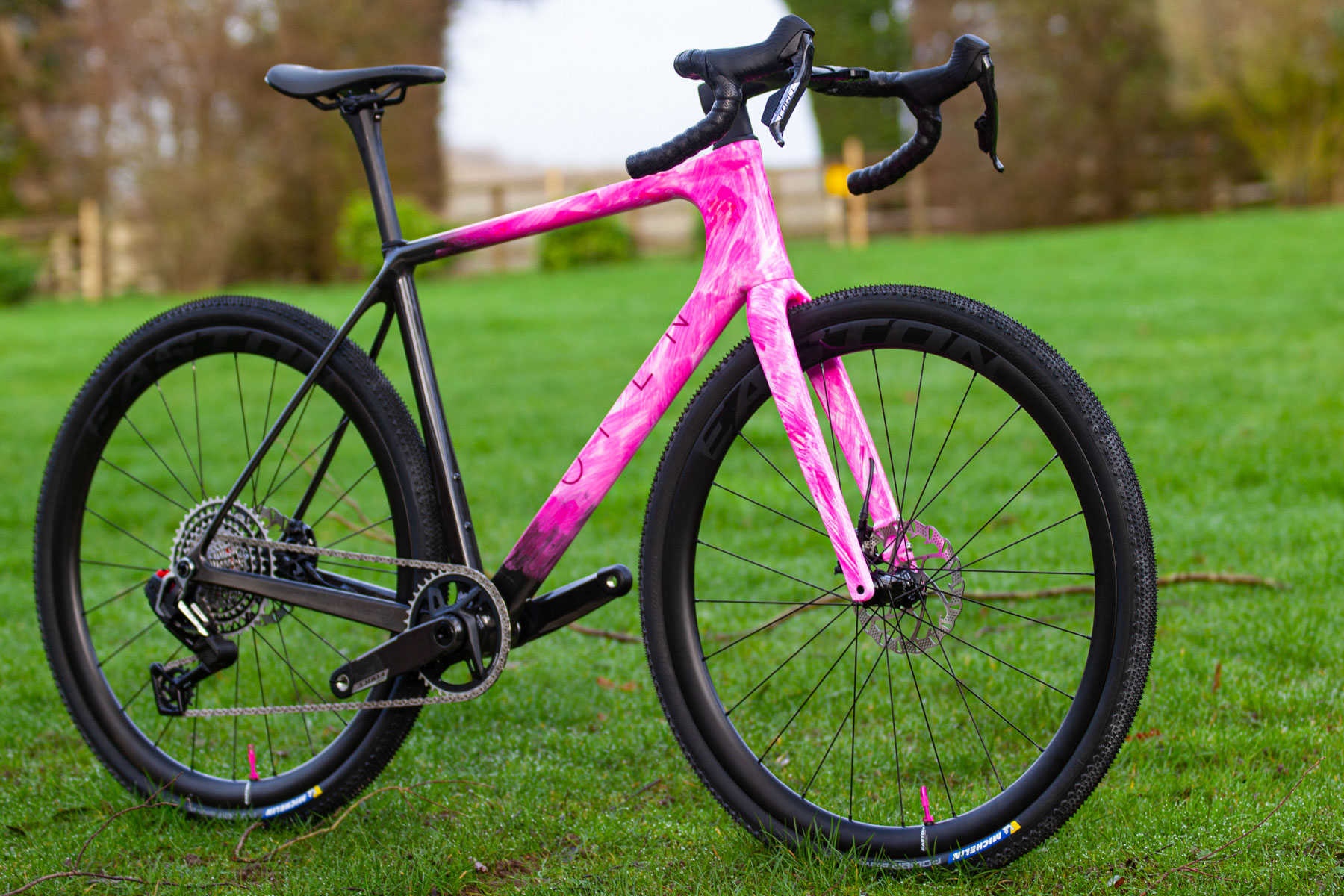
Gravel bike pioneer Open’s latest incarnation of the ground-breaking UP, the UP.PER 2.0 builds on the original striking design. The Swiss brand claims the new bike brings crisper handling alongside increased tyre clearance of 46mm.
The UP.PER 2.0 is described as the ideal bike for fast group rides on- and off-road, alongside gravel racing and bikepacking.
For riders looking for more clearance, Open offers the WI.DE frameset, or if you want a more all-road oriented lightweight design, there’s the CONCE.PT, which we first saw at the COREbike show in 2025.
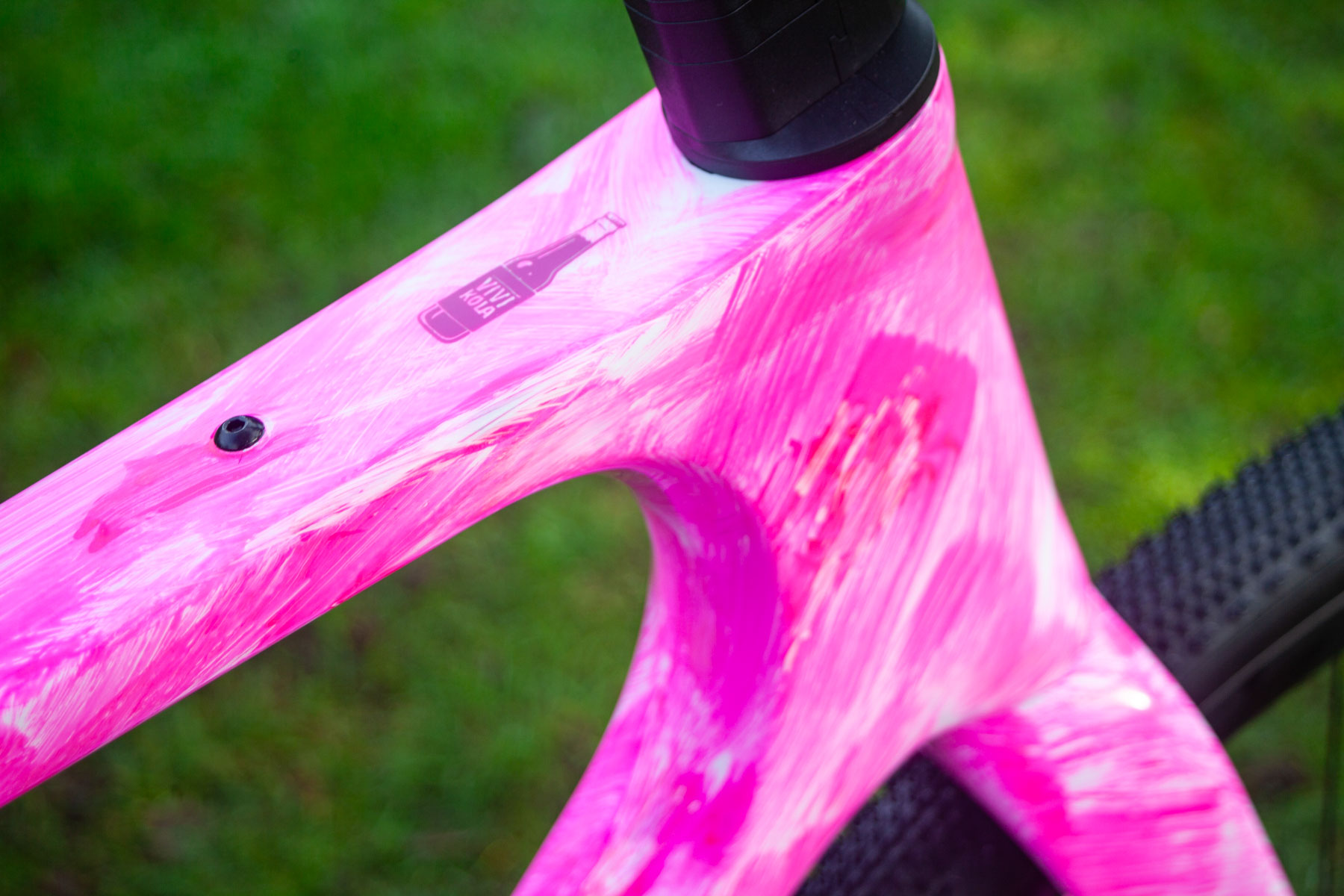
The custom paint finish is one of only two made. Warren Rossiter / Ourmedia
Open promises improved aerodynamics and frame compliance from the UP.PER 2.0 – the two factors that combine to enable faster and further rides.
As ever with Open, the details are everything, with the frame and fork having size-specific dimensions across all five sizes.
The size-specific fork crown is an industry first, ensuring the all-important handling is the same from the smallest to largest bike sizes.
The new UP.PER frame and fork are said to offer improved aerodynamics and comfort. Warren Rossiter / Ourmedia
Open is also offering two fork choices – a mount-less, deep-bladed aero option and an anything-mounts equipped, narrower adventure variant.
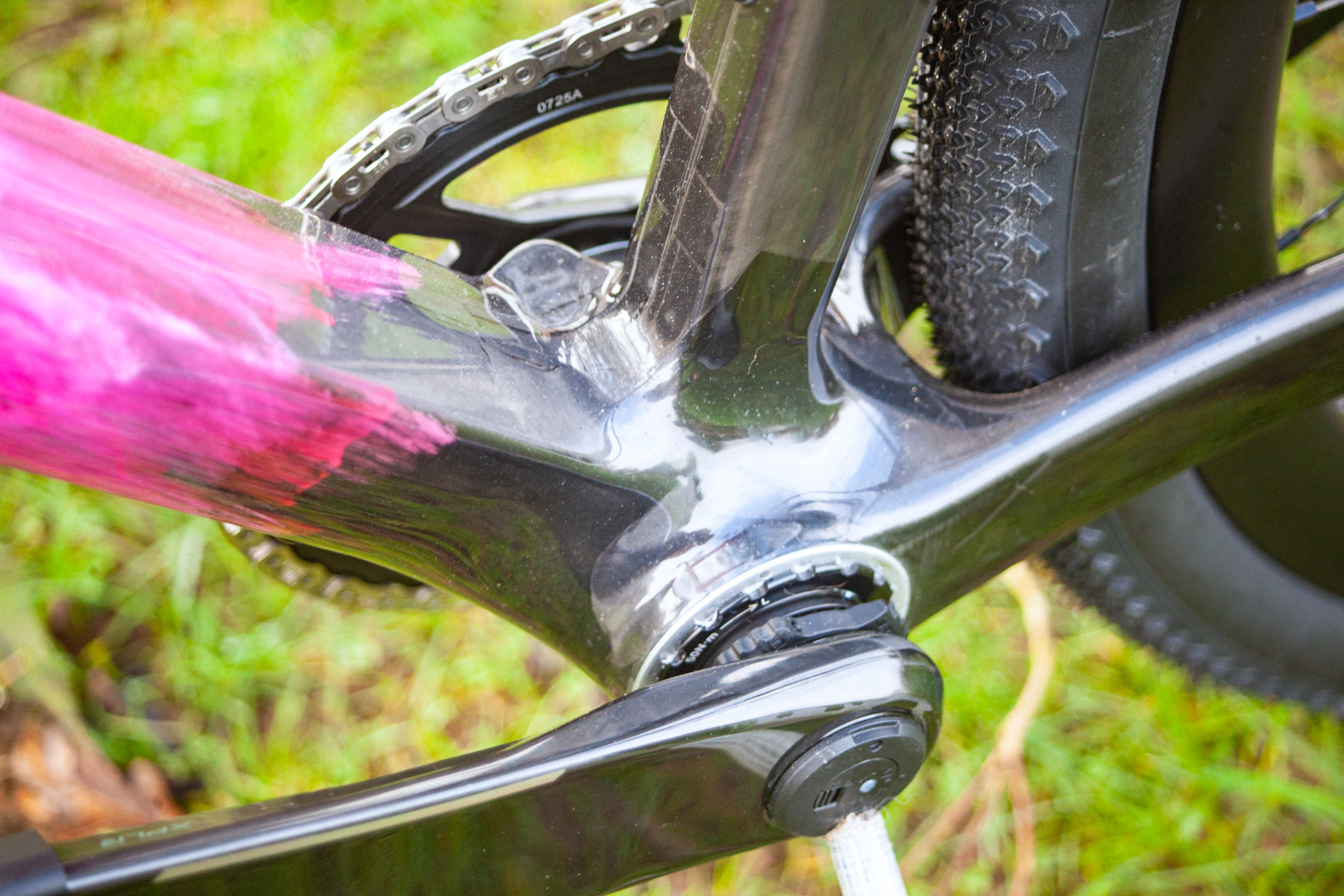
The made-in-Portugal frames come with a UDH-compatible rear dropout, T47 threaded bottom bracket shell and full internal routing.
The UP.PER 2.0 has a T47 threaded bottom bracket shell. Warren Rossiter / Ourmedia
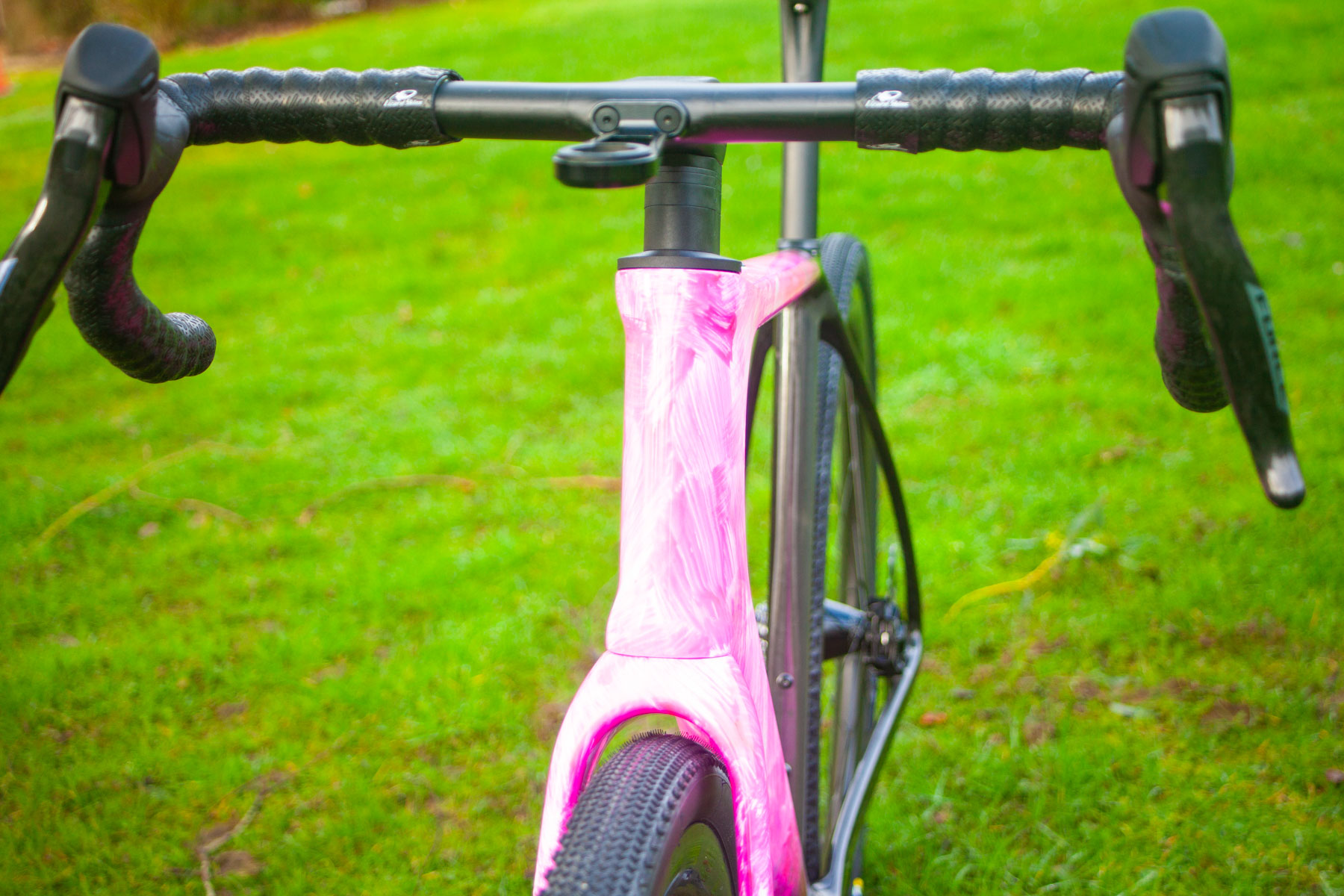
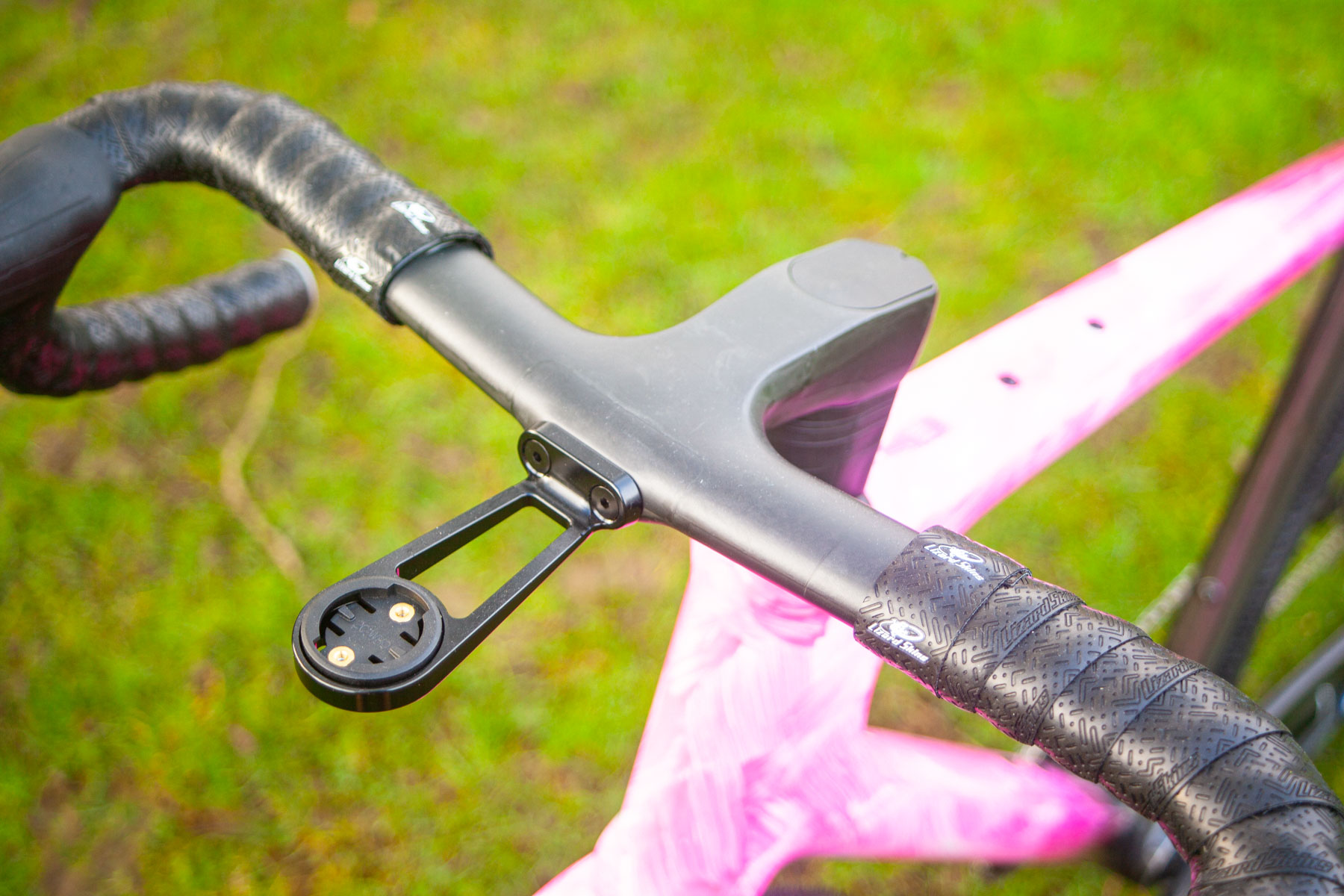
Combined with the frame and fork is Open’s own one-piece aero cockpit, called the B.A.R. (available in 10 sizes from 60 to 130mm reach and 380mm to 440mm width).
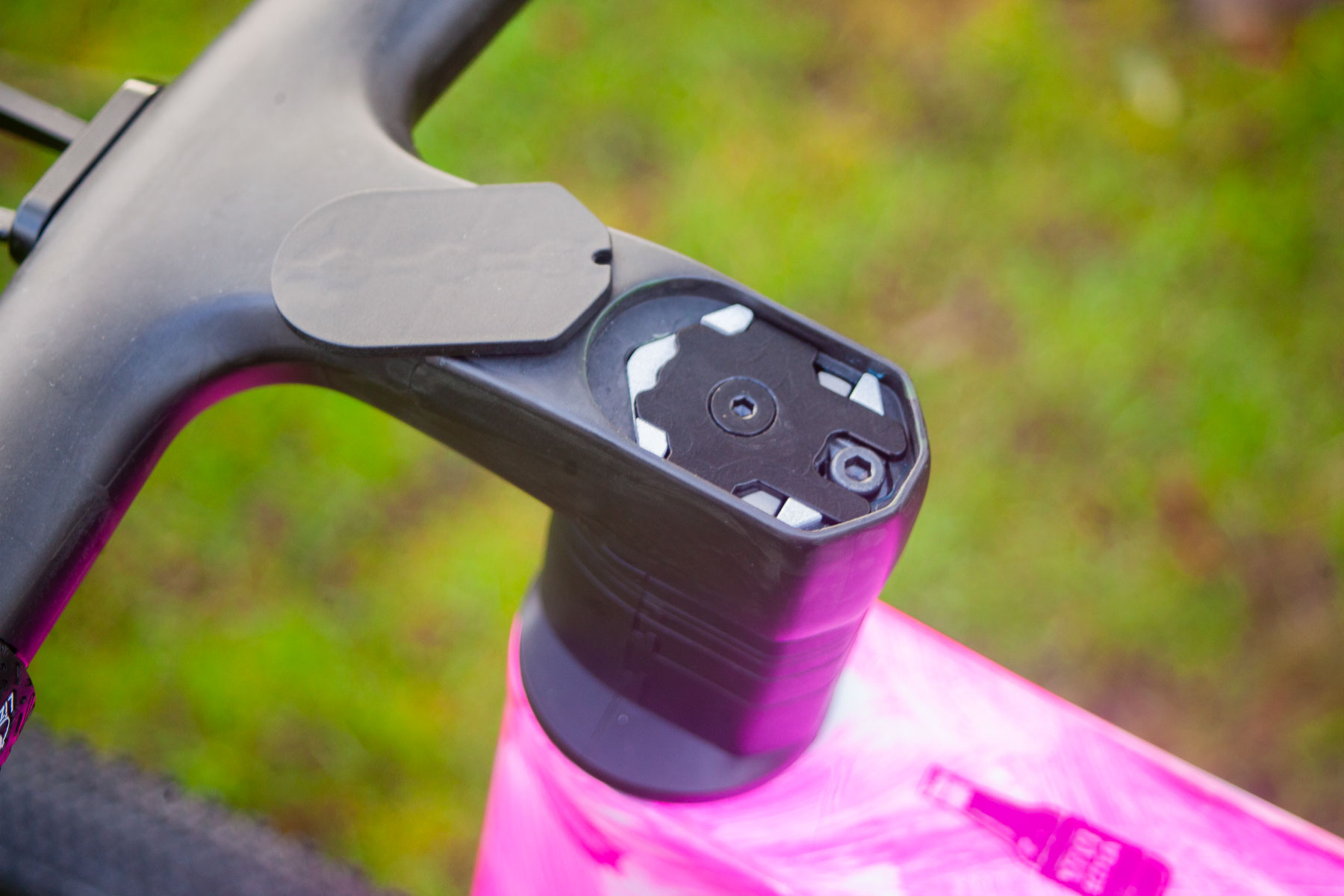
All the cockpits feature a unique reach adjustment for the stem section. A second bolt sitting ahead of the usual compression bolt adjusts a slider system that can alter the reach by up to 15mm in 5mm increments.
The new Open B.A.R. cockpit is available in 10 sizes. Warren Rossiter / Ourmedia
The improved compliance comes from details such as the super-thin seatstays (named wire-stays). These have a bowed shape, which Open says is ‘pre-set’ to allow vibration-absorbing flex.
On the new frame design, the flex has been rotated 90 degrees so the stays bow out sideways under load instead of downwards as on previous incarnations.
The new Open cockpit offers 15mm of reach adjustment in 5mm increments. Warren Rossiter / Ourmedia
While Open pioneered the original dropped-stay design to improve tyre clearance, the UP.PER 2.0 has much more aesthetically pleasing straight chainstays, yet maintains a 46mm tyre clearance.
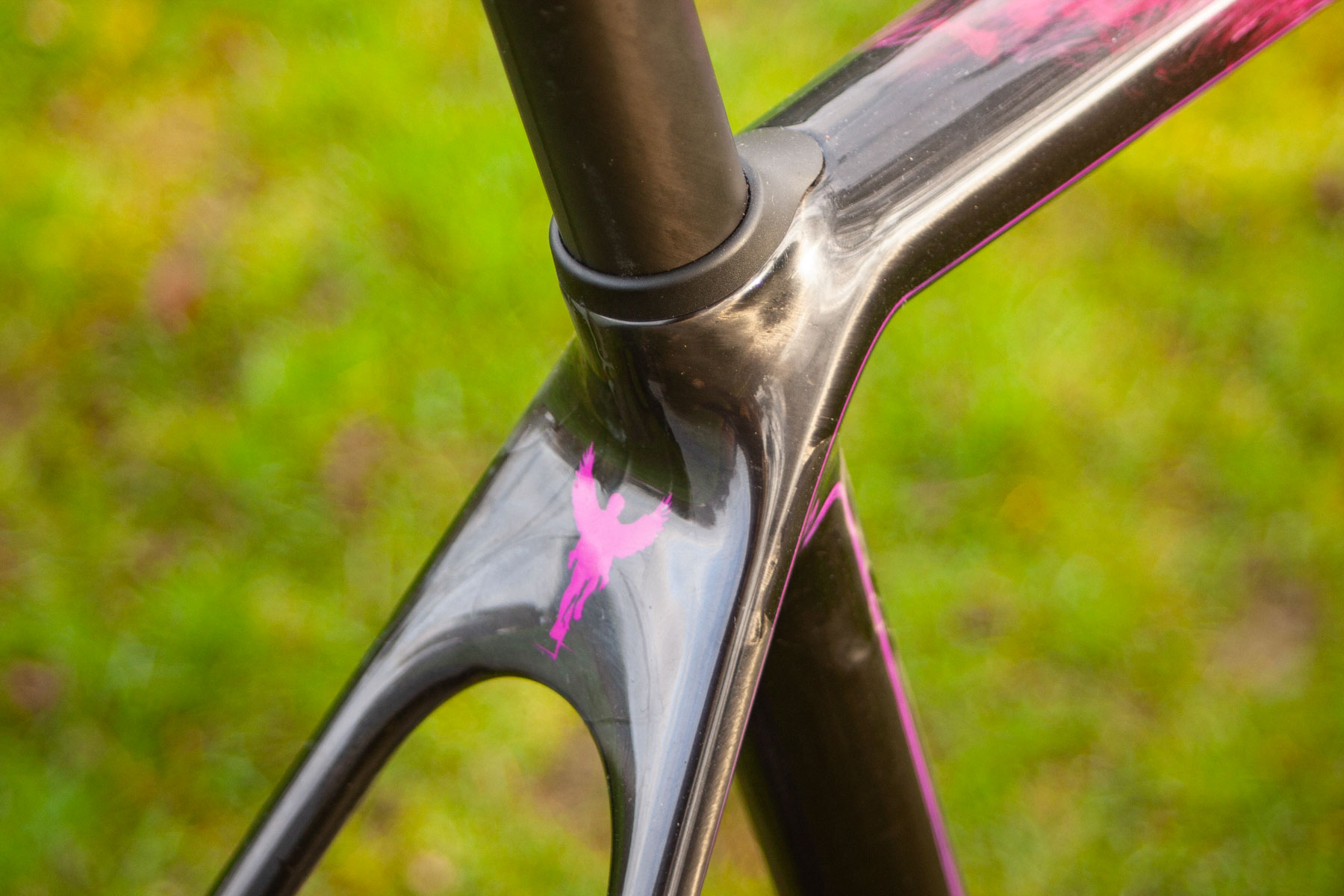
The UP.PER 2.0 frame has a 27.2mm round seatpost. Warren Rossiter / Ourmedia
Sensibly, Open has opted for a 27.2mm-diameter round post rather than a proprietary design. That means a wide range of suspension and dropper-post compatibility.
Price and weight details
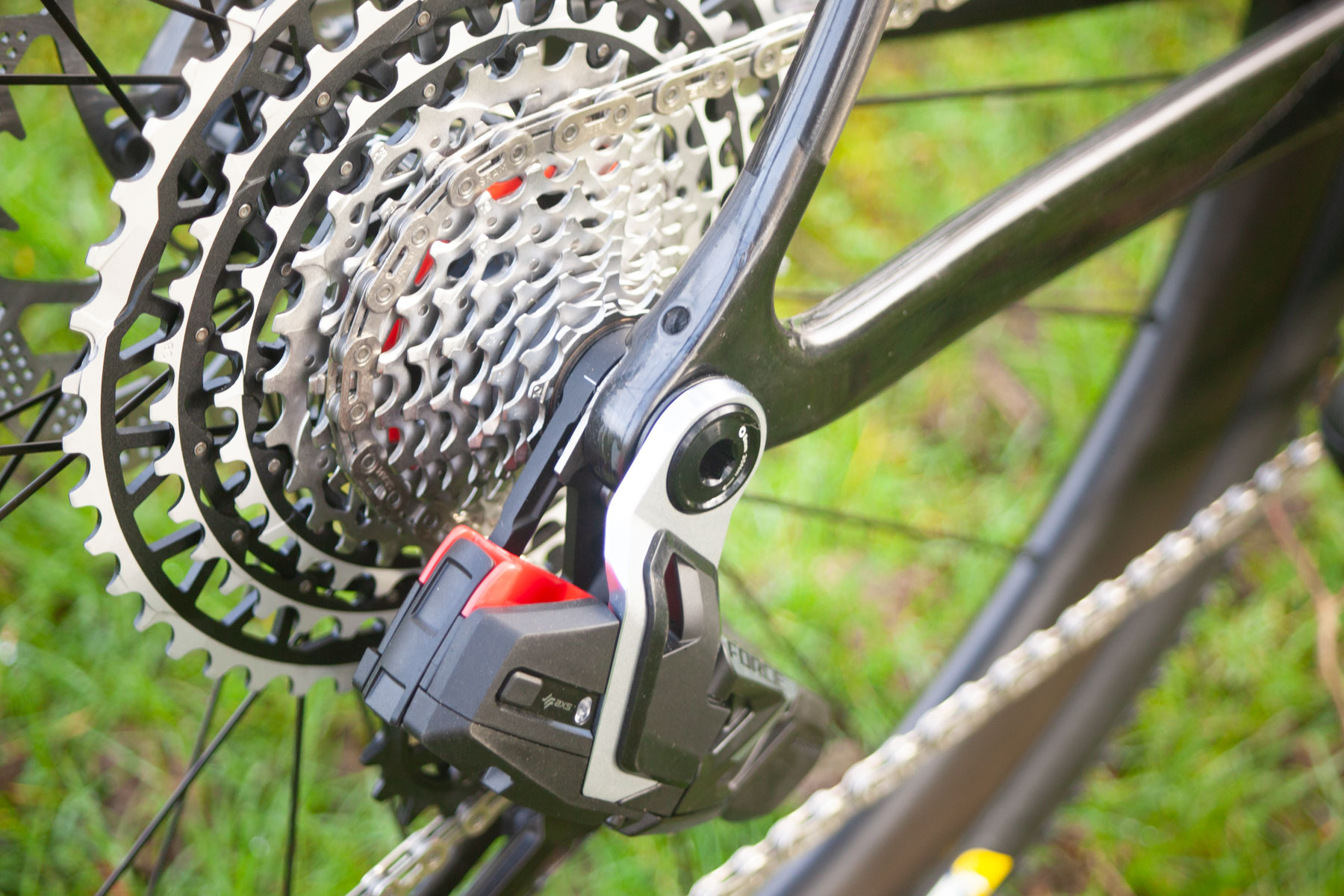
The UDH rear dropout offers lots of compatibility options. Warren Rossiter / Ourmedia
The UP.PER 2.0 has a claimed frame weight of 880g, with the fork adding 375g.
The frameset (including the fork and bar system) is priced at £4,999 / $5,300 / €4,200.
Ready-to-paint custom
Alongside a wide range of standard colours, all of Open’s frames are available in RRTP (raw-ready-to-paint). As the name suggests, a finished frame is left raw and ready to be finished by a painter of your choice or one of Open’s partners.
The custom-paint option here is one of two, from the brand’s partner in Italy, Tony Spray.
The frameset is one of two worldwide and the custom build is by UK Open distributor Silverfish. Warren Rossiter / Ourmedia
The build is a custom specification from UK Open distributor Silverfish, based around a SRAM Force XPLR drivetrain, running Easton EC90 AX gravel wheels and Michelin Power Gravel tyres, inflated with Peaty’s new fast-flow tubeless valves.
It featurs an SDG Bel Air V3 Overland carbon saddle, sitting atop an Easton EC90 AX post. The brake rotors are Galfer’s lightweight Wave rotors.
A build like this would retail for between £9,000 and £10,000 before adding the custom paint finish.
The International Testing Agency (ITA) has fired back at criticisms of its power-data monitoring trial, telling BikeRadar that “a majority of the comments and ‘unanswered questions’ surrounding the project have actually been addressed from the start”.
The scheme, which was announced by cycling’s international governing body, the UCI, last year, was revealed to be in progress by the president of the professional riders’ union, Adam Hansen, in an interview with Domestique in January.
Speaking on the Domestique Hotseat podcast, Hansen said that while the trial was being conducted on a voluntary basis, there were a number of outstanding concerns surrounding how the data would be interpreted, and what would happen in instances where riders were unable to submit their data for analysis.
According to the ITA, however, the trial “aims at finding out whether the power data can be used as a potential indicator for doping or not”, and that “these tools would only be used if they prove to be reliable”.
Why monitor power data?
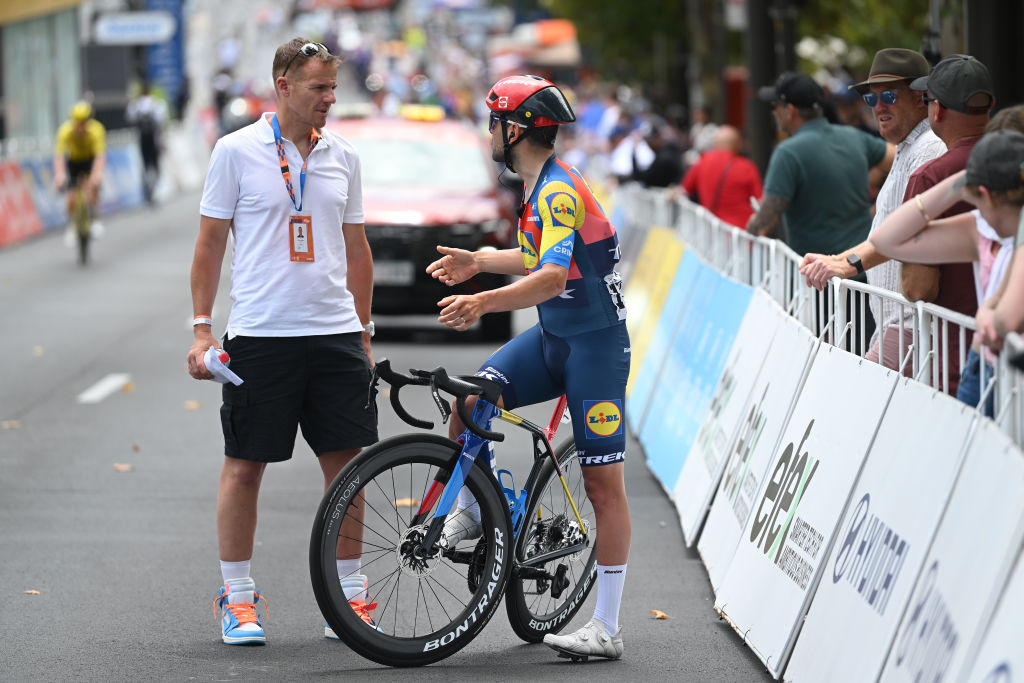
Adam Hansen (left) at the 2026 Tour Down Under. Dario Belingheri / Getty Images
Concerns around feasibility aside, a core tenet of Hansen’s argument against the collection and monitoring of rider’s power data was that it would represent an additional stress on athletes who are already subject to a number of anti-doping tools (such as post-race controls, the Whereabouts system and the athlete biological passport).
The ITA, however, says “power data is at the core of professional road cycling”, and is already “scrutinised” by riders and teams to monitor and improve riders’ performance.
It says the power data of professional riders is discussed routinely by riders themselves, their teams, the media and fans of the sport, but that “paradoxically, the ITA does not have access to it”.
The trial, the ITA says, is therefore designed to study the feasibility of collecting and analysing rider data as “a supplementary tool to help identify potential indicators of doping”.
Counter to Hansen’s claim that irregularities in a rider’s power data could one day lead to them being sanctioned for a doping violation, the ITA says the power-profiling scheme is intended to act as “a supplementary anti-doping tool only.”
The ITA said riders “would not be sanctioned for potential anti-doping rule violations through an unexpected excess performance as determined by the modelling”.
How would the ITA’s power-data passport work?
To make a power passport that would work, the ITA says it is working with the University of Kent and University College London on a “2-year feasibility and pilot study” for the scheme, with a view to using it to “inform anti-doping strategies as a supplementary intelligence tool”.
Before it is implemented as a mandatory scheme for all professional cycling teams, though, the ITA says the trial must clear the following hurdles:
Establishing typical levels of variability within training and race data, taking into account power-meter systematic and random error.
Understanding the relationship between training data and race performance.
Developing longitudinal training and race profiles for riders within UCI Professional Road Cycling Teams.
Development of a plausible approach for the implementation of performance monitoring in professional road cycling using power data, built on the concept of excess performance that is informed by longitudinal analysis of training data, past race history and relative race performance.
The ITA says it’s important to collect data from both training and racing, in order to “define what constitutes “normal variation” and identify typical rates of progression throughout a rider’s career in comparison to age matched counterparts“.
It says race data alone may not fully represent a rider’s capabilities, if tactical considerations “limit their maximal effort”.
Nevertheless, the ITA says “longitudinal profiles will be built on race performance, not training data considering its reliability”.
Training data will instead be used to “help estimate each rider’s likely maximal performance capacity” and “to review suspicious profiles that present unexpected excess performance”.
What happens when riders can’t submit data?
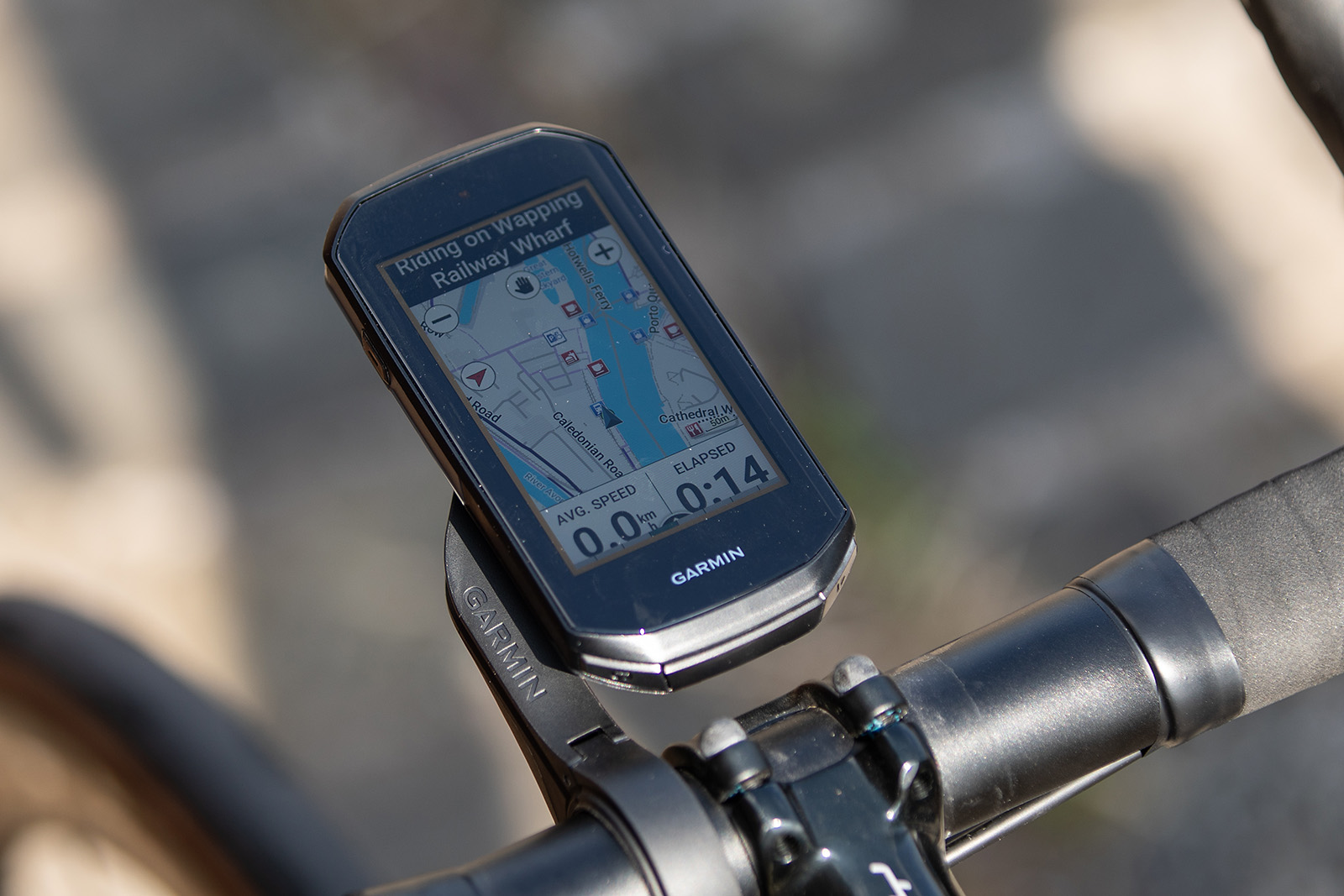
Hansen’s concern over what would happen if a power meter ran out of battery or a computer was lost is “exactly why” the ITA is conducting a feasibility study. Scott Windsor / Our Media
Directly addressing Hansen’s claim that it was unclear what would happen if a rider’s power meter ran out of battery mid-ride, or if they lost their bike computer, the ITA told BikeRadar that this is “exactly why the feasibility study is being conducted”.
The trial aims to establish “what level of performance change can be systematically detected, and how did this relate to actual race performances?” the ITA says.
“The focus is on changes over time, not the impact of individual training sessions.”
As for factors that may affect a rider’s power output on a day-to-day basis, such as sleep quality, fatigue, their training plan and so on, the ITA says simply “If a rider’s performance changes, whether positively or negatively, we are concerned only with the outcome, the change in performance itself. It does not matter to us how the change came about, because we do not have the data to explain the underlying cause”.
“The analysis is simply intended to highlight performance progressions or gains that fall outside the statistically expected “normal” range for that rider and compared with their peers.”
The ITA says that if a rider were “flagged” by the system, it would “follow up by reviewing additional data (e.g. training calendar, whereabouts) to determine whether there is an obvious explanation, such as an altitude camp or other influencing factors.”
Nevertheless, it says the tool would be used “only to inform and refine the testing strategy”, and that the system flagging a rider for further analysis “does not imply wrongdoing” because “there may be entirely legitimate reasons for their performance change”.
“In such cases, even if they are tested, they would not be expected to produce an adverse analytical finding (AAF),” the ITA adds.
On power-meter accuracy and variability
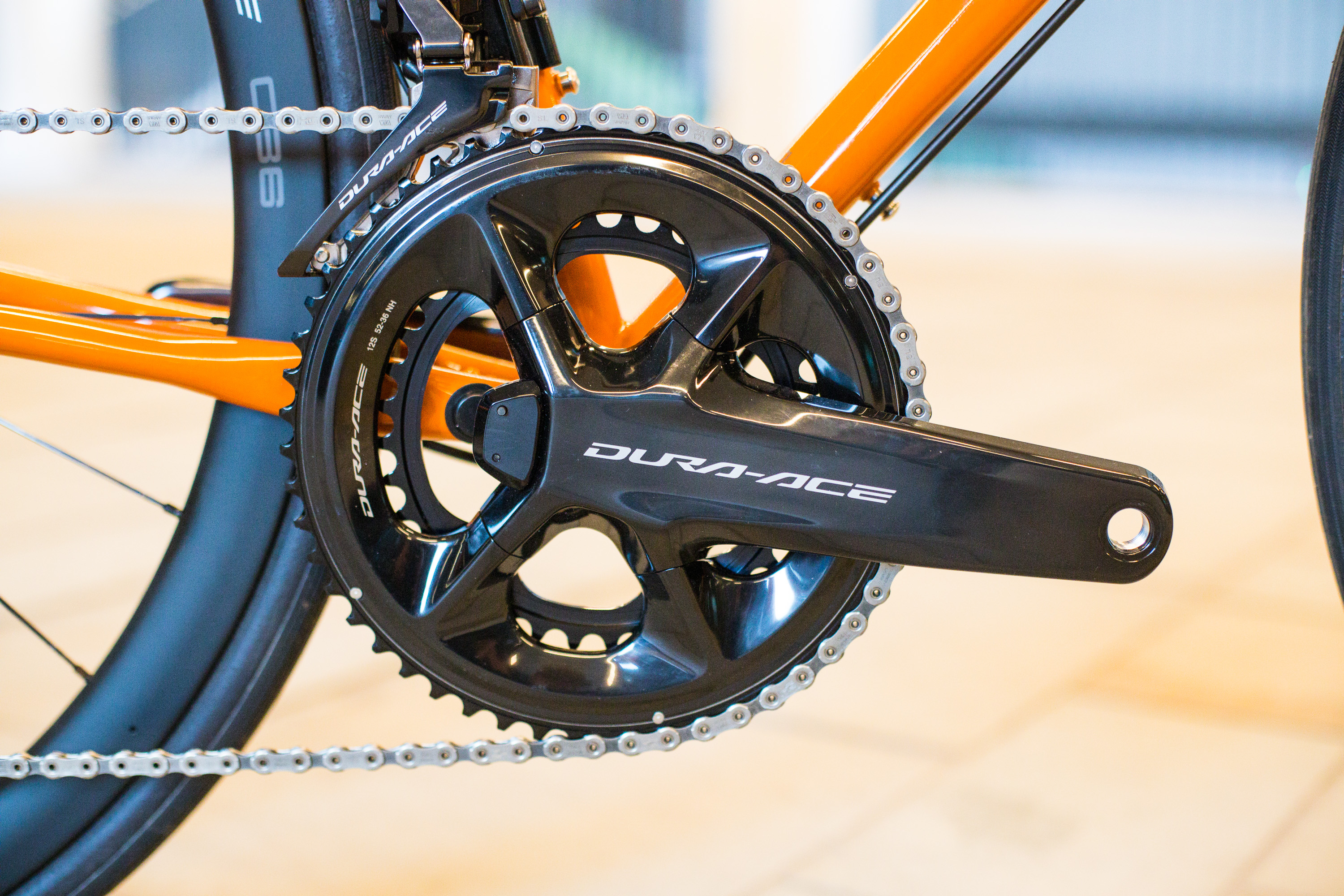
One reviewer called Shimano’s Dura-Ace FC-R9200-P power meter crankset “astonishingly inaccurate”. Simon von Bromley / Our Media
Shimano’s current Dura-Ace FC-R9200-P power meter crankset, which is used by several professional teams, is widely believed to suffer from accuracy issues, with one respected tester labelling it “astonishingly inaccurate” in 2023.
On this point, the ITA said: “There is no doubt that the inter- and intra-device precision and reliability of commercially used power meters, calibration methods and standards is variable across manufacturers.
“We need to understand the accuracy of power meters and the reliability of devices used by professional cyclists to capture data, and variables that can affect these things.”
Nevertheless, it says these issues are “precisely the reason why we are conducting the feasibility study and results will be shared at the end of the study – to see whether implementing power monitoring is feasible given these, and other challenges”.
Voluntary, for now
The ITA confirmed Hansen’s claim that four pro teams are involved with the trial, and said “around 50 riders have signed up with the project and consented to share their historical power data”.
It said that riders were given “information notice explaining the purpose and legal basis of the project, data collection and processing methods, data sharing protocols and rights of the riders”, before they consented to participate in the study.
Nevertheless, it did also say that “Depending on the development and outcomes of the feasibility study, it is anticipated that the sharing of power data will be integrated into UCI regulations. Therefore, data collection will shift from voluntary consent to a regulatory mandate.”
For a short while, NVIDIA was pushing out a new Game Ready GPU driver release optimized for Resident Evil Requiem, one of the most anticipated games of the year so far. However, NVIDIA ended up pulling its 595.59 WHQL driver package, including both Game Ready and Studio builds, after gamers took to NVIDIA’s forum to complain about fan and
Bright Data, a company that operates one of the world’s largest residential proxy networks, has been running an SDK inside smart TV apps that turns those devices into nodes for web crawling — collecting data used by AI companies, among other clients — and most consumers have had no idea it was happening.
The company has published more than 200 first-party apps to LG’s app store alone and still lists Samsung’s Tizen OS and LG’s webOS as supported platforms, though LG says the SDK is “not officially supported” and its operation on webOS “is not guaranteed.” Google, Amazon, and Roku have all since adopted policies restricting or banning background proxy SDKs, and Bright Data no longer supports those platforms.
Several Roku apps still running the SDK disappeared from the store after a journalist with The Verge behind this reporting contacted the company.
Greg Kroah-Hartman has announced the 6.19.4 and 6.18.14 stable kernels. Shortly after
6.19.4 was released Kris Karas reported “getting a repeatable Oops right
when networking is initialized, likely when nft is loading its
ruleset“; the problem did not appear to be present in 6.18.14. Users
of nftables may wish to hold off on upgrades to 6.19.4 for now. We
will provide updates as they are available.
An Ars Technica colleague recently bought a new M4 MacBook Air. I have essentially nothing bad to say about this hardware, except to point out that even in our current memory shortage apocalypse, Apple is still charging higher-than-market-rates for RAM and SSD upgrades. Still, most people buying this laptop will have a perfectly nice time with it.
But for this colleague, it was also their first interaction with macOS 26 Tahoe and the Liquid Glass redesign, the Mac’s first major software design update since the Apple Silicon era began with macOS 11 Big Sur in 2020.
Negative consumer reaction to Liquid Glass has been overstated by some members of the Apple enthusiast media ecosystem, and Apple’s data shows that iOS 26 adoption rates are roughly in line with those of the last few years. But the Mac’s foray into Liquid Glass has drawn particular ire from longtime users (developers Jeff Johnson and Norbert Heger have been tracking persistently weird Finder and window resizing behavior, to pick two concrete examples, and Daring Fireball’s John Gruber has encouraged users not to upgrade).
Most of us believe that we would never, ever fall for a scam. We think we know the “tells,” like poorly formulated communication that sounds urgent. Unfortunately, social engineering—tactics that prey on human emotions and instincts to get us to act against our own interests—can work on anyone.
Romance scams are a textbook example of emotional manipulation in which the perpetrator exploits a victim’s feelings of loneliness, love, or desire for connection to build trust over the long term. Beyond the emotional toll, the financial consequences are significant: The FBI’s Internet Crime Complaint Center (IC3) reported $672 million in romance scam losses in 2024, and this number is almost certainly only a fraction of the real total.
Scammers are increasingly employing AI tools in romance scams, making these campaigns even harder to detect and therefore even more dangerous for targets. Experian predicts that AI-powered romance scams will be among the top fraud threats in 2026.
How a romance scam works
As McAfee describes in a recent report on the state of romance scams, this type of fraud is a long con. A romance scam typically starts with a “hook,” like a DM, follow request, “wrong number” text, or match on a dating app. Once a scammer gets a response, they’ll move into love bombing in an attempt to quickly build intimacy and trust while encouraging you to keep the relationship a secret. They’ll take time to build credibility around their persona, which likely includes a job or lifestyle that prevents them from meeting you.
Next comes a minor request for financial support, which may escalate into opening an account, “investing” in a business venture, or co-signing a loan. Increasingly, these schemes involve fraudulent investments in cryptocurrency. (Another term for this is “pig butchering.”) Once they’ve got what they want, scammers disappear, leaving victims to deal with the consequences.
Romance scams work because they don’t start with obvious exploitation. Fraudsters build up trust over weeks and months, so it’s more likely to feel like a real relationship than a scam until victims are already in too deep.
AI is making romance scams worse
AI is making romance scams even easier for fraudsters to run. In a review of recent research, Bitdefender notes that in order to build trust, scammers have traditionally had to devote significant time and attention to each individual target. While playing the long game in this way is often worth the effort—as the payoff is often significant—it limits the number of potential victims any one scammer could reach.
AI removes these barriers. Large language models (LLMs) are capable of maintaining natural conversations without the red flags of a scam, such as poor grammar and misspellings. AI can mirror personality, reflect emotion, and match tone, and it’s less likely than a human to come off as pressured or rushed. Chatbots can retain and integrate personal details from earlier conversations, and it requires very little effort to sustain for a very large number of victims.
Automated chatbots are especially adept at handling the early stages of a romance scam, and humans are required to step in only at critical moments to offer reassurance or initiate a financial request. Because scammers can maintain many conversations at once, they can also test out different tactics and quickly refine based on what works best to keep victims engaged. As the Global Cyber Alliance puts it, AI adds “speed, scale, and consistency” to the traditional romance scam.
Research suggests that victims may actually find AI more trustworthy than a human. McAfee found that a third of American adults believe it’s possible to develop romantic feelings toward an AI bot. Deepfake audio and video make these AI-powered scams even more credible, as victims can no longer rely on a scammer’s refusal to actually speak with them as a red flag.
How to catch a romance scam
Even a well-trained chatbot has limitations. According to McAfee, the most common clues that you’re interacting with a bot or fake profile include scripted or repetitive responses, instant (and perfectly crafted) replies, and photos that are obviously generated by AI. Other red flags include a contact who avoids voice and video calls as well as unusual requests early in the relationship.
To avoid getting wrapped up in an AI-powered romance scam, slow down. Be wary of perfectly crafted responses, which may indicate automation. Try asking unexpected questions or creating friction, which can throw a chatbot off. Remember that relationships shouldn’t rely on secrecy or be contingent on financial support. Social media and dating sites are full of fake profiles, so seeing is not always believing.
Block, the fintech group headed by Twitter cofounder Jack Dorsey, will cut its workforce by “nearly half” in one of the clearest signs of the sweeping changes AI tools are having on employment.
Shares in the payment company soared more than 25 percent in after-hours trading on Thursday as it announced it would shed more than 4,000 jobs from its 10,000-strong workforce.
“Intelligence tools have changed what it means to build and run a company. We’re already seeing it internally,” Dorsey wrote in a letter to shareholders.