
After 16 years of alpha releases, the open-source real-time strategy game 0 A.D. ships release 28, Boiorix, as its first non-alpha version.
Monthly Archives: February 2026
KDE Plasma 6.6.1 Released With Initial Batch Of Bug Fixes
Following last week’s Plasma 6.6 release, KDE developers today shipped Plasma 6.6.1 as the first point release with an assortment of different bug fixes…
The US military will reportedly use Elon Musk’s Grok AI in its classified systems
The US Department of Defense has reportedly reached a deal to use Elon Musk’s Grok in its classified systems, according to Axios. That follows news that the Pentagon is currently in a dispute with another AI company, Anthropic, over limits on its technology for things like mass surveillance.
Last year, the White ordered Grok, along with ChatGPT, Gemini and Anthropic’s Claude to be approved for government use. Up until now, though, only Anthropic’s model has been allowed for the military’s most sensitive tasks in intelligence, weapons development and battlefield operations. Claude was reportedly used in the Venezuelan raid in which the US military exfiltrated the country’s president, Nicolás Maduro, and his wife.
However, the Pentagon demanded that Anthropic make Claude available for “all lawful purposes” including mass surveillance and the development of fully autonomous weapons. Anthropic reportedly refused to offer its tech for those things, even with a “safety stack” built into that model.
xAI, by contrast, agreed to a standard that would allow the DoD to employ its AI for any purpose it deems “lawful.” However, the xAI model is not considered by officials to be as cutting-edge or reliable as Anthropic’s Claude, and they admit that replacing Claude with Grok would be a challenge. The Pentagon is reportedly also negotiating deals with OpenAI and Gemini, both of which it considers to be on par with Anthropic.
xAI had announced a version of Grok for US government agencies in July 2025. Shortly before that, though, the chatbot started spouting fascist propaganda and antisemitic rhetoric while dubbing itself “MechaHitler.” All of that followed a public spat between Musk and Trump over the president’s spending bill, after which GSA approval of Grok seemed to stall. Earlier this week, Anthropic accused three Chinese AI labs of abusing Claude’s AI with “distillation attacks” to improve their own models.
This article originally appeared on Engadget at https://www.engadget.com/ai/the-us-military-will-reportedly-use-elon-musks-grok-ai-in-its-classified-systems-110049021.html?src=rss
CGIT 1.3 Web Frontend For Git Released After Six Years
Jason Donenfeld of WireGuard and Linux cryptography fame has taken a break from that to release a new version of CGIT, the lightweight web interface for Git repositories. CGIT 1.3 is the first new release in six years and comes with a lot of changes…
Apple will start making Mac minis in the US
Starting later this year, Apple will start manufacturing Mac minis meant for sale in the US within the country. The company took The Wall Street Journal on a tour of its Houston facility, where Foxconn is also building servers for Apple Intelligence, and was shown an empty warehouse. Apple says it will turn the space into a 220,000 square feet plant where it will produce the compact desktop computers. The decision to produce Mac minis for local sales within the US is part of the company’s efforts to make good on its pledge last year that it will spend $500 billion in the US over the next four years.
If you’ll recall, Apple announced it was going to ramp up its investments and hiring in the US after Tim Cook met with President Trump. The president said at the the time that the company was growing its US investments because it wanted to avoid tariffs. Prior to that pledge, during the Biden administration in 2021, Apple vowed to invest $430 billion domestically over the following five years.
As the Journal notes, Apple previously made Mac Pros in a facility in Texas, but production in the plant has dwindled in recent years. Sabih Khan, Apple’s COO, told the Journal that the company feels more confident in projecting the Mac mini’s long term demand. At the same time, the model makes up a tiny portion of Apple’s sales, making it one of the company’s best options if it wants bring more production into the US. It will be incredibly difficult, after all, to move the production of a more in-demand product, say the iPhone, stateside. The companies making and assembling iPhones in China already have factories fitted for and people with skills honed for the production of Apple’s best-selling device.
Khan said the Houston facility will be able to meet local demand as production ramps up, insinuating that it might start small. Apple will also continue manufacturing Mac minis in Asia for everyone else in the world.
This article originally appeared on Engadget at https://www.engadget.com/big-tech/apple-will-start-making-mac-minis-in-the-us-101000341.html?src=rss
Quantum Algorithm Beats Classical Tools On Complement Sampling Tasks
alternative_right shares a report from Phys.org: A team of researchers working at Quantinuum in the United Kingdom and QuSoft in the Netherlands has now developed a quantum algorithm that solves a specific sampling task — known as complement sampling — dramatically more efficiently than any classical algorithm. Their paper, published in Physical Review Letters, establishes a provable and verifiable quantum advantage in sample complexity: the number of samples required to solve a problem.
“We stumbled upon the core result of this work by chance while working on a different project,” Harry Buhrman, co-author of the paper, told Phys.org. “We had a set of items and two quantum states: one formed from half of the items, the other formed from the remaining half. Even though the two states are fundamentally distinct, we showed that a quantum computer may find it hard to tell which one it is given. Surprisingly, however, we then realized that transforming one state into the other is always easy, because a simple operation can swap between them.”


Read more of this story at Slashdot.
Tour de France faces increasing risk of extreme heat according to 50 years of climate data
The Tour de France has weathered its share of interruptions over the years, from rider strikes and roadblocks by climate activists to the regular farmers’ protests. There have been tangible climate issues too, from stages raced in 40ºC temperatures to the 2019 Tour, where stages 19 and 20 were shortened due to mudslides.
But new research shows the likelihood of extreme heat in France in July, when the race takes place, is increasing steadily.
Published in Scientific Reports, the study, led by the French National Research Institute for Sustainable Development, looked at 50 editions of the race stretching back to 1974.
Heat-stress risk increasing
The study examined temperature and wet bulb temperature records (which assess other factors including humidity and solar radiation) to assess the level of risk of heat stress over this time, finding it had increased steadily.
The largest number of extreme-heat events were found to have occurred in the last 10 years. But the research concluded that the Tour has, so far, avoided the conditions of maximum health risk, in some cases by only a few days.
According to the study’s lead author, Ivana Cvijanovic: “In our analysis, we observe that the city of Paris, for example, has crossed the high-risk threshold for heat on five occasions in July, four of them since 2014. Other cities have experienced many days of extreme heat in July, but thankfully not on the date of a Tour de France stage.”
Cvijanovic says the Tour has been lucky so far, but predicts it’s only a matter of time before the race runs into a day or more of extreme heat.
Southern-French hotspots
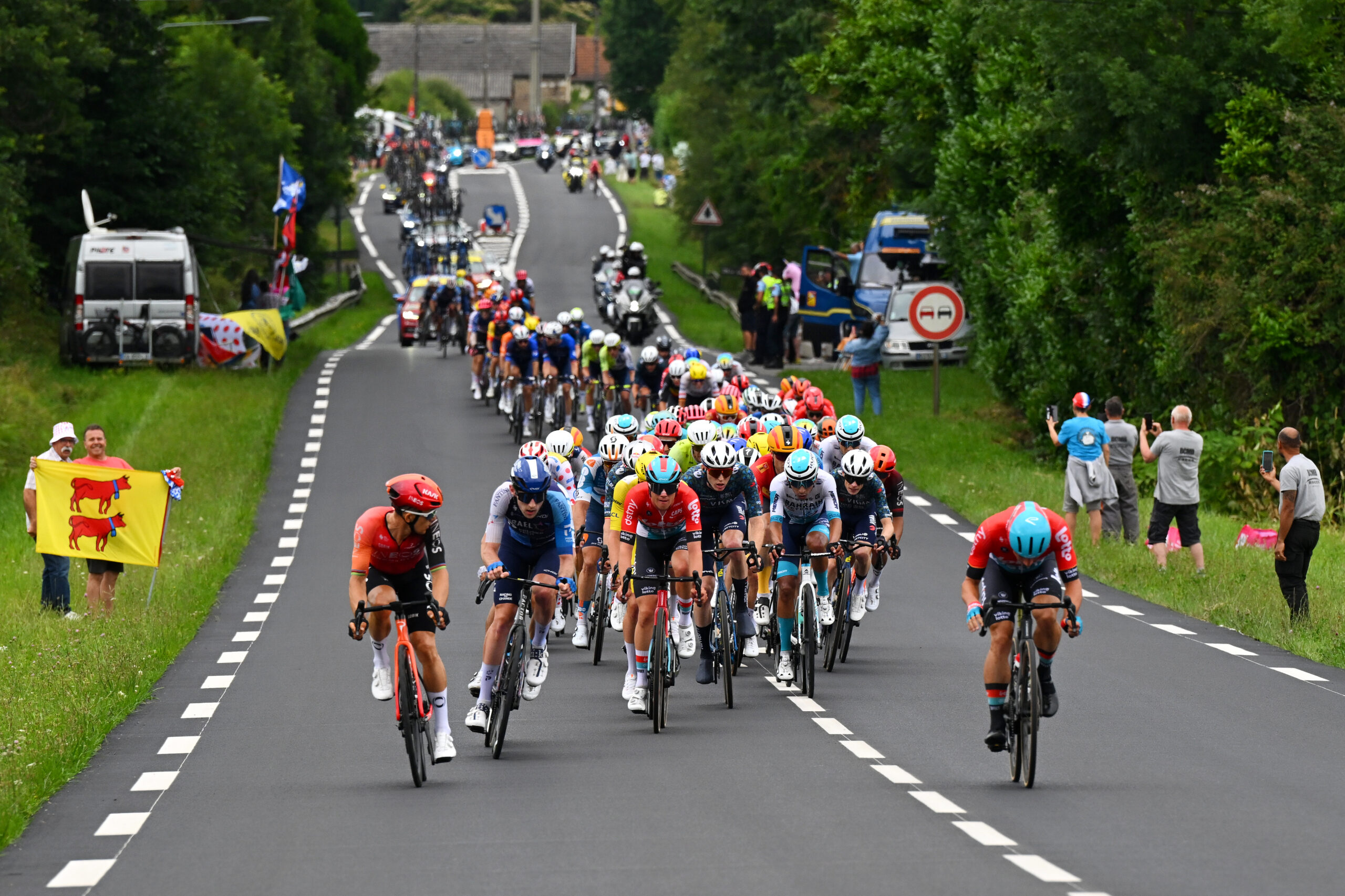
Hotspots – literally – often on the Tour’s route include Toulouse, Pau and Bordeaux in the south west, as well as Nîmes and Perpignan in the south east. The study found high mountain stages present a low to moderate heat stress risk, though, despite the valleys on their approach sometimes being very hot.
The researchers point out that mornings are less prone to extreme heat than afternoons and that start times and routes might in future need to be altered to reduce risks, not only to cyclists but to spectators and event staff.
The UCI has had a heat protocol in place since 2023, which has been invoked in other races. But the researchers point out there’s little research on the effect of heat stress on elite athletes and no universal standard applied across different sports.

It’s not only the Tour de France that is at risk of extreme heat. It’s even more of an issue for the Vuelta a España, where temperatures in southern and central Spain in August frequently reach 40ºC and riders have been hospitalised due to heat exhaustion.
The queen stage of this year’s men’s Tour Down Under was shortened due to the 40ºC heat and fire risk in South Australia in January.
There have been calls, meanwhile, for the Vuelta to swap its place in the calendar with the Giro d’Italia, where snow and freezing rain in Italy in May are often more of a problem than heat.
Tesla sues California DMV after it banned the term ‘Autopilot’
Tesla is suing California’s Department of Motor Vehicles (DMV) to reverse a ruling that prevented the automaker from using the terms “Autopilot” and “Full Self-Driving” to sell cars, CNBC reported. That follows a December ruling by a California administrative law judge that forced Tesla to clean up its marketing language or risk a suspension of its sales license. Last week, the DMV determined that Tesla had made the necessary changes, including changing the name to “Full Self-Driving (Supervised),” and that no suspension would occur.
However, if you had “Tesla is going to sue them back” in your office pool, you can go ahead and claim your prize. The company filed a complaint on February 13 alleging that the DMV “wrongfully and baselessly” called Tesla a false advertiser. Calling the order “factually wrong” and “unconstitutional,” Tesla demanded that order be set aside.
The DMV had originally argued that Tesla’s terms for its driver assistance program gave consumers the impression that its cars were safe to drive without a human at the wheel. However, Tesla said that the DMV never proved that buyers were confused and that it was “impossible” to buy a Tesla without seeing “clear and repeated statements” that its systems aren’t fully autonomous.
Tesla’s appeal of the ruling isn’t a shocker given that the company is essentially betting its future on autonomous vehicles. CEO Elon Musk has long promised buyers that its vehicles would eventually become fully autonomous and that you’d even be able to rent them out to provide robo-taxi services. “If you fast forward a year, maybe [15 months], we’ll have over a million robo-taxis on the road,” he wrongly predicted back in 2019.
Following a sales decline last year that was particularly steep in Europe, Tesla is banking on its Cybercab two-seater to boost its fortunes. The company has started limited testing of automated vehicles as part of its Robotaxi pilot in Austin, Texas.
Last week, however, Tesla lost an appeal in a $243 million lawsuit verdict over a 2019 crash of a Model S — largely over its use of the terms “Autopilot” and “Full Self-Driving.” Last month, the company canceled Autopilot, its basic of advanced driver assistance tier, on new Model 3 and Model Y vehicles and switched its FSD (Supervised) tier to subscription-only.
This article originally appeared on Engadget at https://www.engadget.com/transportation/evs/tesla-sues-california-dmv-after-it-banned-the-term-autopilot-090845766.html?src=rss
KaOS Explains Why It’s Ending Its 12-Year KDE Plasma Era
After more than a decade focused on KDE Plasma, KaOS has shared the technical and systemd-related reasons for its big desktop change.
Texas Is About To Overtake California In Battery Storage
U.S. battery storage installations hit a record 57.6 GWh in 2025, and Texas is now poised to surpass California as the nationâ(TM)s largest storage market in 2026. Electrek reports: According to the US Energy Storage Market Outlook Q1 2026 from the Solar Energy Industries Association (SEIA) and Benchmark Mineral Intelligence, installations are now four times higher than totals from just three years ago. The US had a total of 137 GWh of utility-scale storage installed as of 2025, plus 19 GWh of commercial and industrial systems and 9 GWh of residential storage. Analysts expect the growth streak to continue. More than 600 GWh of energy storage is projected to be deployed nationwide by 2030, even as the Trump administration targets clean energy industries.
Two-thirds of utility-scale storage installed in 2025 was built in red states, including nine of the top 15 states for new installations. Texas is projected to surpass California as the countryâ(TM)s largest battery storage market in 2026. Standalone battery projects accounted for nearly 30 GWh of new capacity in 2025, while solar-plus-storage installations made up about 20 GWh. Residential storage deployments reached 3.1 GWh last year, a 51% increase year-over-year. Analysts say virtual power plant programs in states such as Massachusetts, Texas, Arizona, and Illinois are helping drive adoption by reducing costs and easing strain during peak demand periods.
The supply chain is shifting to support the boom. In 2025, some battery cell manufacturers pivoted production from EV batteries to dedicated stationary storage cells, converting existing lines and adjusting future plans. Lithium-ion cell manufacturing for stationary storage reached more than 21 GWh in 2025, enough to power Houston overnight, according to SEIAâ(TM)s Solar and Storage Supply Chain Dashboard. Meanwhile, US factories now have the capacity to manufacture 69.4 GWh of battery energy storage systems annually.


Read more of this story at Slashdot.
Join Us for Fedora Hatch at SCaLE 23x!
Fedora is heading back to sunny Southern California! As we gear up for SCaLE 23x, we are thrilled to announce a special edition of Fedora Hatch. This is taking place on Friday, March 6 as an embedded track at SCALE. Whether you’re a long-time contributor, a curious user, or someone looking to make your very […]
US Farmers Are Rejecting Multimillion-Dollar Datacenter Bids For Their Land
An anonymous reader quotes a report from the Guardian: When two men knocked on Ida Huddleston’s door last May, they carried a contract worth more than $33m in exchange for the Kentucky farm that had fed her family for centuries. According to Huddleston, the men’s client, an unnamed “Fortune 100 company,” sought her 650 acres (260 hectares) in Mason county for an unspecified industrial development. Finding out any more would require signing a non-disclosure agreement. More than a dozen of her neighbors received the same knock. Searching public records for answers, they discovered that a new customer (PDF) had applied for a 2.2 gigawatt project from the local power plant, nearly double its annual generation capacity. The unknown company was building a datacenter. “You don’t have enough to buy me out. I’m not for sale. Leave me alone, I’m satisfied,” Huddleston, 82, later told the men.
As tech companies race to build the massive datacenters needed to power artificial intelligence across the US and the world, bids like the one for Huddleston’s land are appearing on rural doorsteps nationwide. Globally, 40,000 acres of powered land – real estate prepped for datacenter development — are projected to be needed for new projects over the next five years, double the amount currently in use. Yet despite sums that often dwarf the land’s recent value, farmers are increasingly shutting the door. At least five of Huddleston’s neighbors gave similar categorical rejections, including one who was told he could name any price.
In Pennsylvania, a farmer rejected $15m in January for land he’d worked for 50 years. A Wisconsin farmer turned down $80m the same month. Other landowners have declined offers exceeding $120,000 per acre — prices unimaginable just a few years ago. The rebuffs are a jarring reminder of AI’s physical bounds, and limits of the dollars behind the technology. […] As AI promises to transcend corporeal fallibility, these standoffs reveal its very physical constraints — and Wall Street’s miscalculation of what some people value most. In the rolling hills of Mason county and farmland across America, that gap is measured not in dollars but in something harder to price: identity.


Read more of this story at Slashdot.
GNU Octave 11 Open-Source Scientific Programming Language Officially Released
GNU Octave 11 has been officially announced today for this open-source, free, and cross-platform high-level language, primarily intended for numerical computations.
New Microsoft Gaming CEO Has ‘No Tolerance For Bad AI’
In her first major interview as Microsoft’s new gaming chief, Asha Sharma said that “great games” must deliver emotional resonance and a distinct creative voice, while making clear that she has “no tolerance for bad AI.” Stepping in after Phil Spencer’s retirement, she’s pledging consistency, community trust, and a human-first approach to storytelling as Xbox enters a new era. Variety reports: Sharma was quick in laying out her top priorities for Microsoft Gaming in an internal memo announcing her promotion, noting “great games,” “the return of Xbox” and the “future of play” as her three main commitments to the gaming community. So first, what makes a great game for Sharma, whose roles prior to CoreAI include top positions at Instacart and Meta? The new Microsoft Gaming CEO tells Variety it’s all about games with “deep emotional resonance” and “a distinct point of view.” She wants to develop stories that make players “feel something,” like the kind of feelings Campo Santo’s 2016 first-person mystery “Firewatch” elicited in her.
Sharma takes on the mantle as head of the leading competitor to Sony’s PlayStation and Nintendo knowing full well she’s entering the role as an outsider to the larger gaming community and has “a lot to learn” still. But Sharma says she’s got a commitment to “being grounded in what the community is telling us.” “I’m coming into gaming as a platform builder,” Sharma said, adding that her goal is to “earn the right to be trusted by players and developers” and show the fanbase that “consistency” over time. In her interview with Variety, Sharma acknowledged the tumultuous state of the gaming industry, referencing Matthew Ball’s recent State of Video Gaming in 2026 report as evidence that the larger “transformation” of the sector is “protecting what we believe in while remaining open-minded about the future.”
Due to her strong background in AI, initial reactions to Sharma’s appointment have raised concerns about what her specific views are on the use of generative AI in game development. Sharma says her stance is simple: she has “no tolerance for bad AI.” “AI has long been part of gaming and will continue to be,” Sharma said, noting that gaming needs new “growth engines,” but that “great stories are created by humans.”


Read more of this story at Slashdot.
Neon Genesis Evangelion: Δ Cross Reflections Will Be Playable At Live Events This Year
A demo of the immersive XR game will be playable this year at special public events.
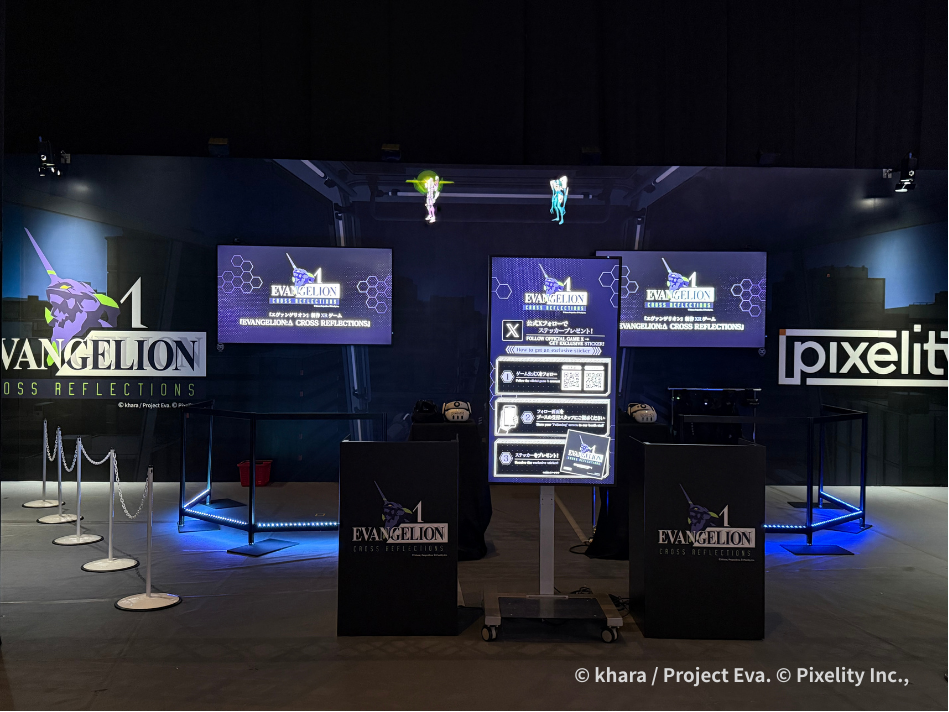
Pixelity Inc., developers of Evangelion: Δ Cross Reflections, announced that a demo of the game will be playable throughout the year at live events all around the world.
The game has thus far only been playable to an extremely small segment of the public. In December, it was playable at a limited event spanning three days in Tokyo, then at a one-day event in California. In order to try the game, applicants needed to apply through Evangelion: Δ Cross Reflections’ X account and be selected to participate. More recently, the demo was playable for lucky lottery winners who attended the Evangelion 30th Anniversary Event, which just wrapped up.

Supporting both VR and mixed reality gameplay, Evangelion: Δ Cross Reflections is the first installment in a planned trilogy that aims to cover all 26 episodes of the TV series. The game will tell a new story from the perspective of an original protagonist who dreams of becoming a pilot, making connections between the anime’s “key episodes” and the game’s new characters.
“Players will enjoy the story set in the locations from the anime from their own perspective. Battles between Evangelions and Angels, various interactive elements, and engaging captivating storylines with original characters are also planned,” Pixelity noted in a press release.
Originally created by the filmmaker Hideaki Anno, and first airing in 1995, Neon Genesis Evangelion is a critically-acclaimed post-apocalyptic anime mech series focusing on the fight between NERV, a paramilitary group, and the Angels, otherworldly antagonists seemingly bent on humanity’s destruction.
The anime series has been massively influential within and outside of its native Japan, expanding to manga, merchandise, anime retellings, video games and more. While the franchise has dabbled in VR before with Bandai Namco’s 2017 release, Evangelion VR: The Throne of Souls, that arcade VR experience was only playable on-site at VR Zone locations in Japan. Evangelion: Δ Cross Reflections is the first Evangelion VR/XR game designed for home use via consumer headsets.
News broke this week that a new Evangelion animated series is in production. The new series is being written by Yoko Taro, the unconventional video game creator most-known for Nier and Nier: Automata, in collaboration with Hideaki Anno’s Studio Khara.
An Evangelion: Δ Cross Reflections public demo is scheduled to launch in the first half of 2026. Specific platforms and release dates remain unconfirmed, and while no dates or details have yet been revealed regarding the aforementioned live events, Pixelity encourages anyone interested in trying the game to watch their official X account for announcements.
Microsoft Says Bug In Classic Outlook Hides the Mouse Pointer
joshuark quotes a report from BleepingComputer: Microsoft is investigating a known issue that causes the mouse pointer to disappear in the classic Outlook desktop email client for some users. This bug has been acknowledged almost two months after the first reports started surfacing online, with users saying that Outlook became unusable after the mouse pointer vanished while using the app.
[…] Microsoft explained in a recent support document that the mouse pointer (and in some cases the cursor) will suddenly vanish as users move it across Outlook’s interface. “When using classic Outlook, you may find that the mouse pointer or mouse cursor disappears as you move the pointer over the Outlook interface,” it said. “Although the mouse pointer is not there, the email in the message list will change color as you hover over it. This issue has also been reported with OneNote and other Microsoft 365 apps to a lesser degree.”
Microsoft added that the Outlook team is investigating the issues and will provide updates as more information becomes available. While a timeline for a permanent fix is not yet available, Microsoft has offered three temporary workarounds that require affected users to click an email in the message list when the cursor disappears, which may cause it to reappear. Alternatively, switching to PowerPoint, clicking into an editable area, and then returning to Outlook may also restore the mouse pointer.


Read more of this story at Slashdot.
Mesa PanVK Driver Seeing Up To 25.7x Speedup For MSAA
The open-source PanVK driver providing Vulkan support for modern Arm Mali graphics hardware is seeing big speed-ups in the multi-sample anti-aliasing (MSAA) performance in Vulkan tests as a result of new code merged today to Mesa 26.1…
Viral Doomsday Report Lays Bare Wall Street’s Deep Anxiety About AI Future
A 7,000-word “doomsday” thought experiment from Citrini Research helped trigger an 800-point drop in the Dow, “painting a dark portrait of a future in which technological change inspires a race to the bottom in white-collar knowledge work,” reports the Wall Street Journal. From the report: Concerns of hyperscalers overspending are out. Worries of software-industry disruption don’t go far enough. The “global intelligence crisis” is about to hit. The new, broader question: What if AI is so bullish for the economy that it is actually bearish? “For the entirety of modern economic history, human intelligence has been the scarce input,” Citrini wrote in a post it described as a scenario dated June 2028, not a prediction. “We are now experiencing the unwind of that premium.”
Many of Monday’s moves roughly aligned with the situation outlined by Citrini, in which fast-advancing AI tools allow spending cuts across industries, sparking mass white-collar unemployment and in turn leading to financial contagion. Software firms DataDog, CrowdStrike and Zscaler each plunged more than 9%. International Business Machines’ 13% decline was its worst one-day performance since 2000. American Express, KKR and Blackstone — all name-checked by Citrini — tumbled. That anxiety, coupled with renewed uncertainty about trade policy from Washington, weighed down major indexes Monday. The Dow Jones Industrial Average led declines, falling 1.7%, or 822 points. The S&P 500 shed 1%, while the Nasdaq composite retreated 1.1%.
[…] Monday’s market swings extended a run of AI-linked volatility. A small research outfit that has garnered a huge Substack following for macro and thematic stock research, Citrini said in its new post that software firms, payment processors and other companies formed “one long daisy chain of correlated bets on white-collar productivity growth” that AI is poised to disrupt. […] Shares in DoorDash also veered 6.6% lower Monday after Citrini’s Substack note called the delivery app a “poster child” for how new tools would upend companies that monetize interpersonal friction. In the research firm’s scenario, AI agents would help both drivers and customers navigate food deliveries at much lower costs.


Read more of this story at Slashdot.
Trump’s ‘Board of Peace’ Explores Stablecoin For Gaza
An anonymous reader quotes a report from the Financial Times: Officials working with Donald Trump’s “Board of Peace” are exploring setting up a stablecoin for Gaza as part of efforts to reshape the devastated Palestinian enclave’s economy, according to five people familiar with the discussions. The talks around introducing a stablecoin — a type of cryptocurrency whose value is pegged to a mainstream currency, such as the US dollar — are at a preliminary stage, and many details of how one could be introduced in Gaza remain to be determined.
But officials have discussed the idea as part of their plan for the future of the enclave, where economic activity collapsed during Israel’s two-year war with Hamas and the traditional banking and payments system has been severely impaired. A person familiar with the project said the stablecoin was expected to be tied to the US dollar, with the hope that Gulf Arab and Palestinian companies with expertise in the field of digital currencies will help spearhead the effort. “This will not be a ‘Gaza Coin’ or a new Palestinian currency, but a means to allow Gazans to transact digitally,” the person said.
Work on the idea is being led by Liran Tancman, an Israeli tech entrepreneur and former reservist who is now working as an unpaid adviser to Trump’s “Board of Peace,” the US-led body tasked with rebuilding Gaza, according to two people familiar with the matter. […] According to the person familiar with the project, the “Board of Peace” and NCAG will decide on the stablecoin’s regulatory framework and access, although “nothing definitive” has yet been finalized. Speaking at a meeting of the “Board of Peace” in Washington last week, Tancman said the NCAG was working on building “a secure digital backbone, an open platform enabling e-payments, financial services, e-learning, and healthcare with user control over data”, but did not elaborate.


Read more of this story at Slashdot.
Teravail branches out from tyres and unveils a new carbon clunker bar for your gravel bike or MTB
Teravail, best known for its adventure and MTB tyres, has branched out into components with a new full-carbon clunker bar, the Moonstone, among its new range on display at the COREbike show.
As part of USA bike group QBP, home to Salsa, Whisky Parts Co and Surly among others, Teravail has until now specialised in tyres for gravel, adventure riding and mountain biking.
However, all your favourite Salsa bars and components from across the QBP portfolio will now come under the Teravail banner, with tweaked designs, and new graphics, names and finishes. There are some rather funky new bars, too.
Updated and refined
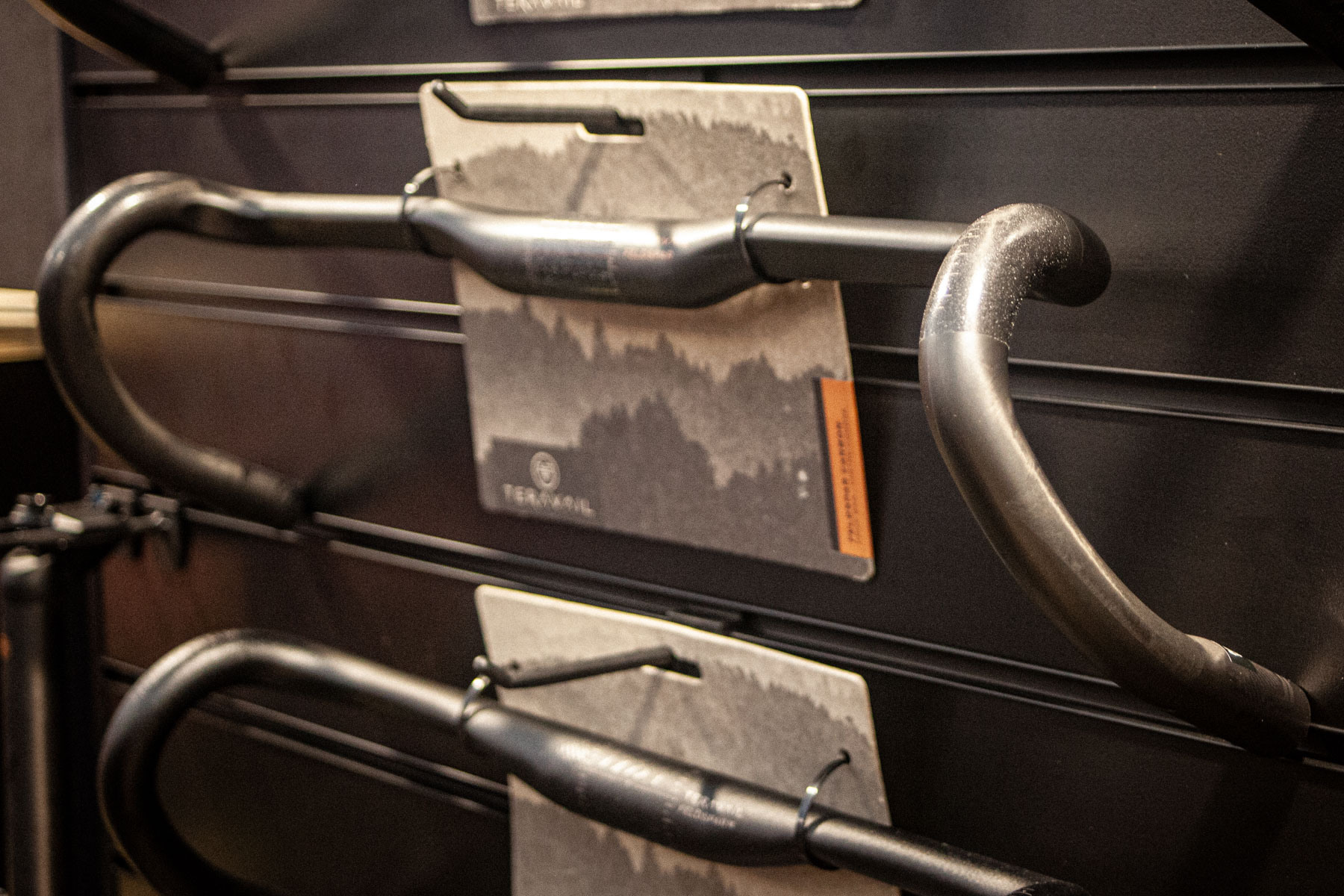
The move sees classic Salsa bar designs updated and refined under the Teravail name.
Everything in the new Teravail range will be available in both alloy and carbon, with more components due to arrive soon.
Teravail is also planning to release a wider range of mountain bike parts this year, with the first unveiling rumoured to be set for spring’s Sea Otter Classic show in California.
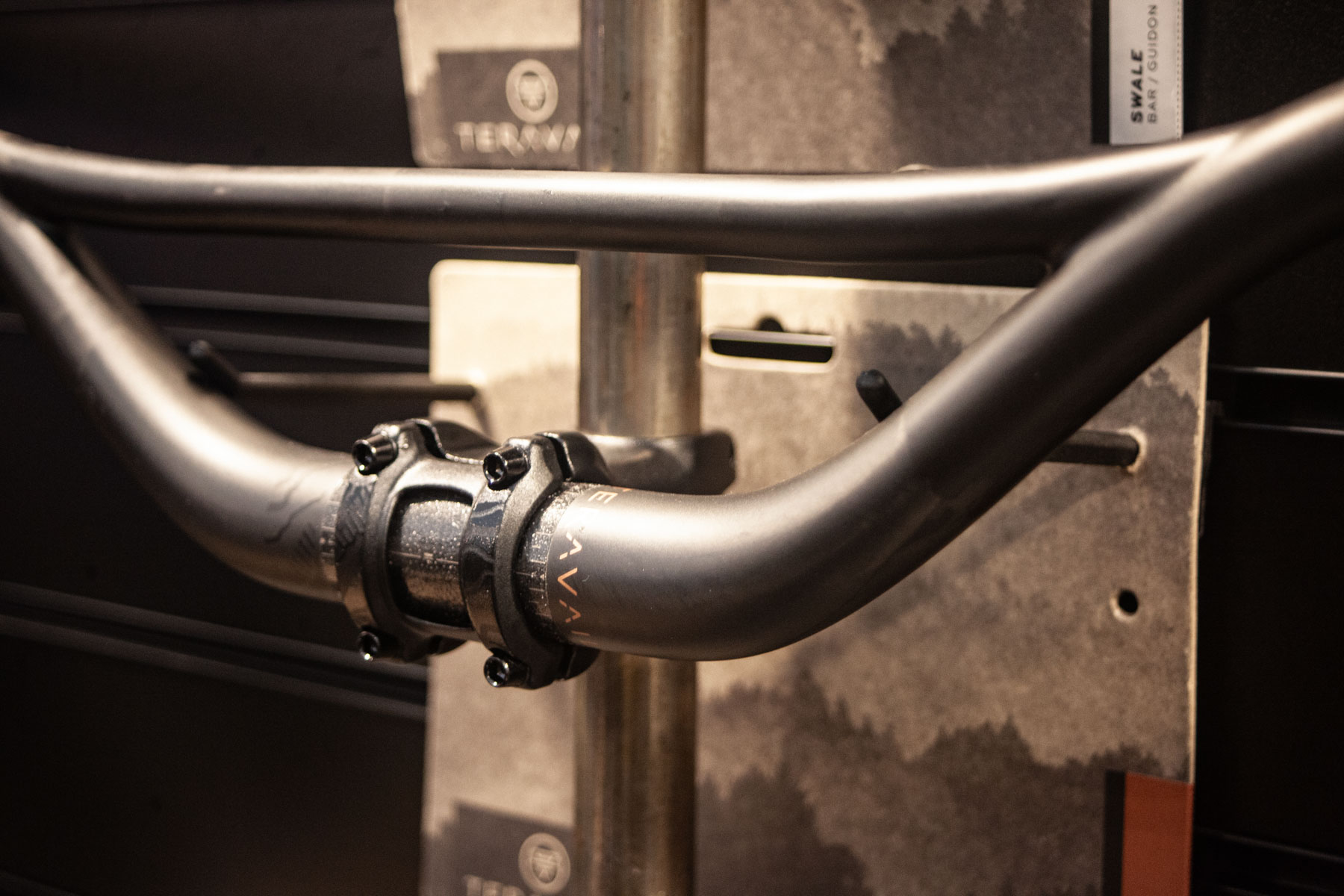
The first and most distinctive release from the new range is a full-carbon clunker bar replete with cross-member because, well, why not?
If you want to to get the classic clunker look on your mountain bike or adventure bike without the weight penalty, the new Moonstone bar may be just what you’re looking for.
The 826mm-wide bar has a 16-degree backsweep and huge 85mm rise. No pricing has been set yet.

The other new addition to the Teravail range that caught my eye at COREbike was the Feldspar carbon gravel bar, previously available in a short run from Whisky and oddly named the Spano.
The refined and reimagined Feldspar is available in a range of widths, from 40 to 48cm in 2cm increments, and comes with a 12-degree flare at the hoods that widens to 20 degrees at the drops. It’ll be fitted as standard to the Salsa Flyway and Salsa Journeyer gravel/all-road bikes.
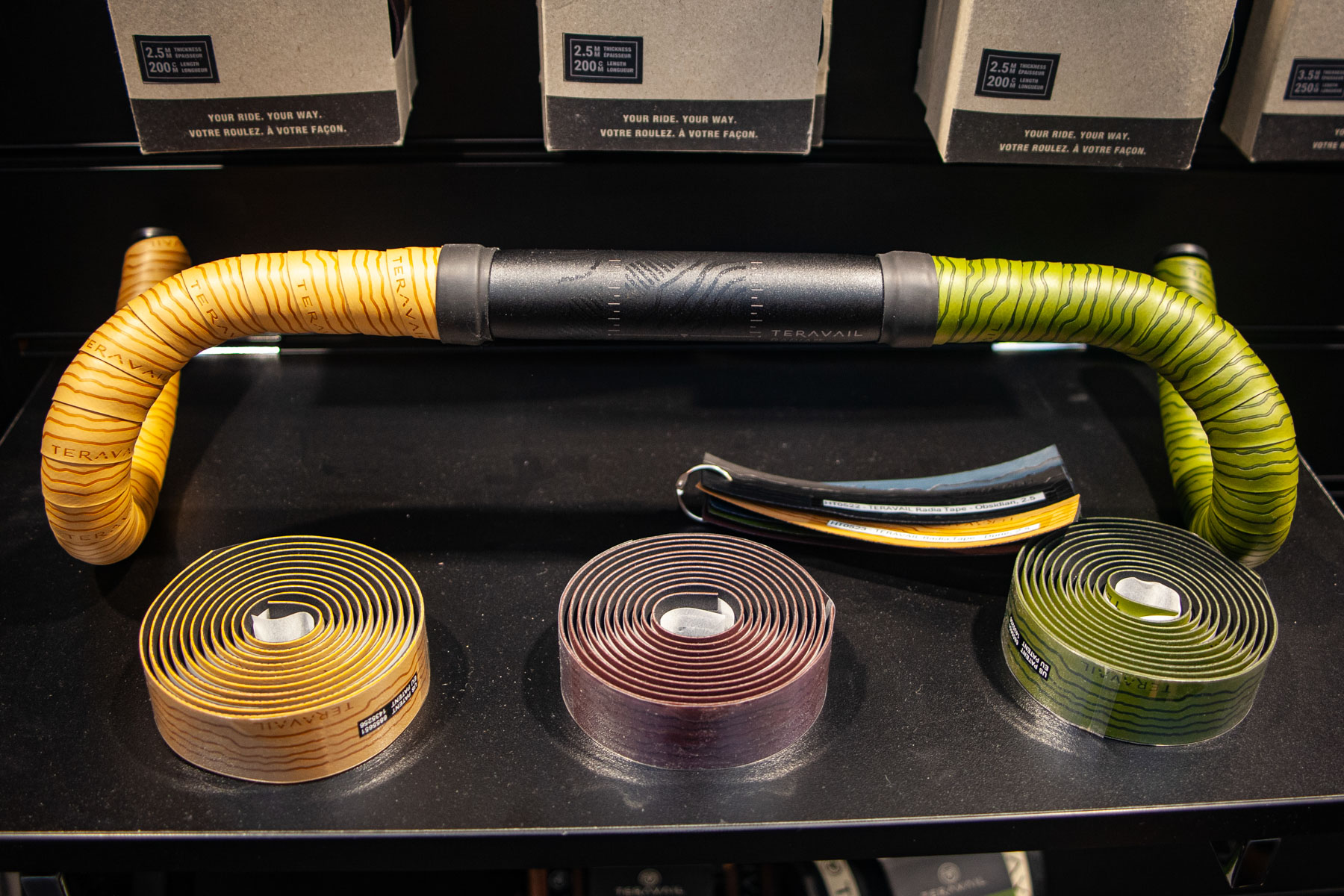
The semi-flattened top section isn’t intended for aero; it has been designed to offer more comfort when you’re holding the flats.
Designed to be paired with the new bars is a new tape range available in some eye-catching finishes – a woodgrain-style topographic print and myriad colours. The tape is available in 2.5mm and 3.5mm thicknesses and without a glue-back. This should make for easier wrapping, adjustment and removal for cleaning.