Overwatch Rush is a top-down shooter that’s in early development starring heroes from the main game

Overwatch Rush is a top-down shooter that’s in early development starring heroes from the main game
It’s been a little over a week since Discord said it will take its age verification mandate global, and despite promises that most users wouldn’t need to verify, the company is still in hot water with gamers.
Most recently, Discord’s been discovered to have worked with Peter Thiel-backed company Persona, which itself is embroiled in multiple scandals. These include allegations that it was keeping personal identifying data from Discord users longer than was initially stated, and a reveal that the company accidentally left some of its data available to view on the open internet. Discord now says it’s backing away from its partnership with Persona, but is it worth sticking around after all this?
When Discord announced that it would soon require age verification globally, it actually followed age verification programs that had already started in regions like Australia and the UK. Discord’s only known age verification partner in the United States is k-ID, which uses on-device facial scanning, but users discovered that in the UK, the company had also partnered with Persona. Discord’s partnership with Persona was for an “experiment” that could have seen users submitting information that would have been “temporarily stored for up to seven days, then deleted.”
According to reporting from PCGamer, the information came to light following reports that some UK-based Discord users had gotten requests to submit information to Persona, which prompted concerns about their facial data leaving their devices despite the initial announcement’s promise that only government ID data would go to the cloud, as well as how long any uploaded data would stay in the cloud. In a now-deleted support page, Discord clarified that the partnership was indeed real and part of an experiment, and added the note about the potential seven-day window for deletion, which contradicted statements that uploaded data would be deleted directly after age verification.
In a post on X, the CEO of Persona, Rick Song, attempted to defend the workflow, saying that “on-device facial scanning” is “unfortunately too easy to bypass today,” before later adding that uploaded information is still “processed and then deleted.” However, Song did not provide a timeline for deletion. And data potentially leaving the user’s device despite initial promises that it wouldn’t was only one part of the concern.
Over the weekend, a trio of hacktivists also discovered a vulnerability in Persona’s data front end, which—according to analysis from independent publication The Rage and anti-malware organization Malwarebytes—left 2,456 files accessible to the open internet. Both the hackers and Persona’s CEO, who have been in “good faith” communication, say that Persona itself was not hacked, and that the data was accidentally leaked and viewable to anyone with the know-how to find it (it has since been deleted).
The full report of the findings has been published by one of the hackers, Celeste, and details that the leak was apparently found via a U.S. government-authorized endpoint that had somehow been isolated from its regular work environment. While the hackers did not find personal identifying information in the leaked files, they did find that Persona often performs far more than age verification on data sent to its servers. According to the leaked code, the company uses facial recognition to perform 269 separate verification checks against watchlists across 14 categories (including terrorism and espionage) and tags its reports with codenames related to known public-private partnerships for tracking anything from cannabis distribution to money laundering. Information including collected IP addresses, browser and device fingerprints, phone numbers, names, faces, and more, can be stored for up to three years, according to the hackers’ findings.
Granted, it’s possible that Persona was not implementing all of these checks on users submitting age verification information via Discord, or keeping data for longer than the seven days mentioned on the now deleted support page. But it has not been a good look for either Persona or Discord.
Following user outrage about personal data leaving their devices or staying on the cloud for an unknown period of time, as well as the news that the company responsible for said data had apparently allowed so many of its files to leak to the open internet, Discord has begun damage control.
The company told Ars Technica that only a “small number of users was included in the experiment” involving Persona, and that it “ran for less than one month.” More importantly, now that the experiment is purportedly over, Discord told both Ars and The Verge that it is no longer partnering with Persona, and that it will “keep our users informed as vendors are added or updated.”
On Persona’s end, the company clarified to Ars that it doesn’t have any government contracts. CEO Rick Song also said in communication with the hackers that the leaked information was based on publicly available records, before iterating that Persona does not store data that users send to it. Song also said that Persona does not use AI, and despite being funded in part by Peter Thiel, does not have a relationship with Palantir.
While it’s unclear the extent to which Persona was storing or analyzing user data, that it came as a surprise to so many users has been enough to see a massive increase in users trying alternatives like Teamspeak, which itself has taken the opportunity to criticize Discord’s security.
Personally, I likely won’t uninstall Discord right away (if only because I need it to write stories like this), but I would think twice about uploading information if asked to verify my age. Note, however, that Discord can use metrics like your signup email to guess your age even if you don’t send it personal identifying information—that’s actually how it’s planning to avoid pestering most of its users with age verification prompts.
But even if you divest from Discord, it should be noted that, depending on the services you use in your life, you might still have to interact with Persona. While Discord will no longer work with the age verification company, Persona still has active relationships with social media sites including Reddit and LinkedIn, games like Roblox, and even payment service Square and access management platform Okta.
Most notable might be Persona’s relationship with OpenAI: This appears to be how Persona’s code could have leaked in the first place. The hacktivists that discovered the leak found OpenAI signifiers in it—which, according to The Rage, means that OpenAI might have built an internal database for accessing Persona identity checks. This could explain how Persona’s data found its way onto a U.S. government computer despite the company supposedly not having any government contracts.
At any rate, as the internet becomes more connected and age verification becomes more common, flipping one switch, like divesting from a single app, likely isn’t enough to fully wipe your online presence anymore. It’s worth controlling what you can—Discord lets you delete information like sent messages or server channels—but it’s legally obligated to retain purchase information, and also chooses to retain additional information such as database backups as well, even after account deletion. You can see a full list of retained Discord information on the company’s website.
In the meantime, check out these 10 tips from my colleague Pranay Parab for staying secure while online.

Meta has struck a multi-billion dollar chip deal with AMD that could lead to the Facebook owner taking a 10 percent stake in the group, sending shares in the US chipmaker surging on Tuesday.
The social media giant said it would acquire customized chips with a total capacity of 6 gigawatts from AMD as it races to develop and deploy its AI models.
AMD’s chief executive Lisa Su said that “each gigawatt of compute is worth double-digit billions” under the deal.
Good news for all Ryan Coogler fans: The Sinners director is bringing back a beloved TV show. Hulu has officially green lit a pilot of Coogler’s X-Files reboot, a project three years in the making, Deadline reports. Coogler has a five-year exclusive television deal with Disney, Hulu’s parent company.
Coogler is directing and writing the pilot episode, with Jennifer Yale coming on as showrunner. She previously held the role on The Copenhagen Test. Actress Danielle Deadwyler, known for roles in Till and The Harder They Fall, has signed on as co-lead.
The show will follow the original storyline of two FBI agents who bond as they work on cases around paranormal and unexplained phenomena. No confirmation has come over whether former stars Gillian Anderson and David Duchovny will have any role in the reboot.
The news came on Sunday, the same day Coogler won the BAFTA for Best Original Screenplay for Sinners. Coogler made history this year with a record 16 Oscar nominations for Sinners, including Best Original Screenplay and Best Picture. Coogler also wrote and directed Creed, Black Panther and Black Panther: Wakanda Forever.
This article originally appeared on Engadget at https://www.engadget.com/entertainment/tv-movies/ryan-cooglers-x-files-reboot-gets-the-green-light-at-hulu-140735536.html?src=rss
Scotch tape has been a household mainstay for nearly a century, but it still holds some scientific surprises. Researchers have discovered that the screeching sound emitted when one rapidly peels Scotch tape—akin to the screech of fingernails on a chalkboard—is the result of shock waves produced by micro-cracks propagating along the tape at supersonic speeds, according to a new paper published in the journal Physical Review E.
It was a 3M engineer named Richard Drew who developed the first transparent sticky tape in 1930. The impetus came from car manufacturing, specifically two-color designs, where the adhesives used were so sticky they often removed the paint when peeled off; the paint then needed to be manually touched up. Drew found a sandpaper adhesive with just the right amount of stickiness and used it to coat a roll of cellophane tape. (Fun fact: Drew also co-invented the snail-style dispenser for the tape with his 3M colleague, John Borden.) The tape was hugely popular during the Great Depression; consumers used it to repair everyday items rather than replace them. That popularity has never waned.
Scotch tape has also generated considerable interest among physicists. Back in 1939, scientists noticed that peeling tape could produce light—specifically, a glowing line where the tape end pulls away from the roll. The phenomenon was first recorded in the 17th century and is known as triboluminescence: the generation of light when a material is crushed, ripped, rubbed, or scratched. Diamonds, for instance, sometimes glow blue or red during the cutting process, while ceramics emit yellow-orange light when being cut by abrasive water jets.
We may earn a commission from links on this page. Deal pricing and availability subject to change after time of publication.
Home security cameras usually come with a tradeoff. You either run wires through your walls or climb a ladder every few weeks to recharge a battery. The TP-Link Tapo SolarCam C402 Kit skips both. It’s currently $39.98 on Amazon, down from its usual $59.99, and price trackers confirm this is its lowest tracked price to date.
Setup is straightforward: Mount the camera, position the panel where it gets steady sun, and let it handle the rest. TP-Link says around 45 minutes of direct sunlight per day is enough to keep the battery charged, and with an IP65 rating, the housing is designed to handle rain and dust. That makes it a budget-friendly option for a backyard, driveway, or shed where running power lines would be inconvenient.
Video tops out at 1080p and is not ultra-smooth, but it is detailed enough to identify someone approaching your door, and its 125-degree field of view captures a broad stretch of yard without the heavy curve you get from some wide-angle lenses. At night, you can switch between standard infrared for black-and-white video or use the built-in spotlight to capture color footage. The color mode looks better when there’s at least some nearby lighting, like a porch light or streetlamp, notes this PCMag review. There is also two-way audio for speaking to visitors and a built-in siren if you want an audible alert.
For storage, you can insert a microSD card up to 512GB, sold separately, or opt for Tapo’s cloud plan at $3.49 per month after a 30-day trial, which adds 30 days of video history and smart clip organization. On the plus side, it supports person, pet, and vehicle detection even without a paid subscription (which is not always the case with budget cameras). It also supports Amazon Alexa, Google Assistant, and IFTTT, though Apple HomeKit is not included. The main compromise is the 15fps video and the fact that you are relying on sunlight, so placement matters. For $40, though, this is one of the simpler ways to add a wire-free outdoor camera that does not demand constant maintenance.
There’s a type of knife tech often seen in science fiction that revolves around vibrating a blade to increase its sharpness. We’ve seen examples of this in franchises like Star Wars (vibroblades), Evangelion (the prog knife), Dune (pulse-swords) and the Marvel universe (vibranium), but what might surprise you is that the underlying science is sound. By vibrating a cutting tool at high frequencies, not only do you reduce friction, you essentially turn the blade into a saw, as tiny oscillations enhance the inherent sharpness of a blade.
However, up until recently, this tech largely only existed in fiction or for large companies that have the money to utilize the tech on an industrial scale. But that’s changing in a big way for home cooks this year thanks to Seattle Ultrasonics, which is releasing the world’s first ultrasonic chef’s knife: the C-200. After chopping, smashing and cooking with it for about a month, I’m convinced that this is the future of kitchen knives.
From afar, the C-200 looks a lot like a regular 8-inch chef’s knife, but with a slightly more contemporary design. It features a three-layer san mai blade made from Japanese AUS-10 steel with a 13-degree edge angle per side (26 degrees total). However, upon closer inspection, you’ll notice there are some features that seem a bit out of place on a premium knife.
The first is that the C-200 doesn’t have a full tang, which is the back end of a blade that ideally extends into the handle to provide added strength and durability. This is usually a major no-no, particularly on a $400 knife. However, when you consider that Seattle Ultrasonics needed somewhere to put its vibration tech, there really isn’t any room for it other than inside the knife’s grip.
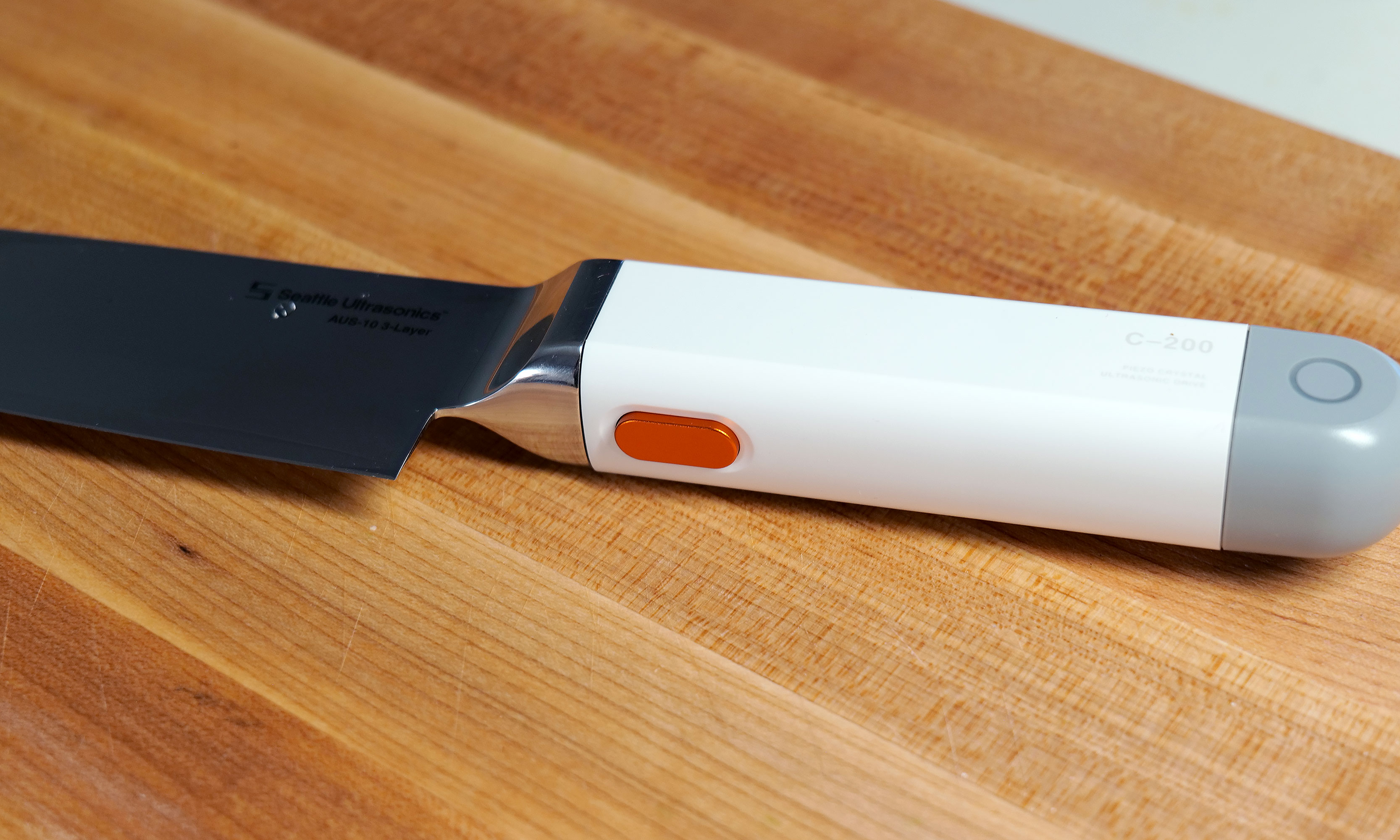
The knife’s second quirk is that the back of the plastic handle features small indicator lights on either side, which is obviously a bit weird. Furthermore, the entire gray section can be removed to reveal a small 1,100mAh battery with an onboard USB-C port. Frankly, the presence of a battery in a knife is just kind of funky. But hey, the power to vibrate the knife has to come from somewhere because it definitely isn’t being generated by your hands. And while Seattle Ultrasonics doesn’t include a charging adapter or cable in the box, I don’t mind because the company wisely took cues from the larger gadget industry and went with a power spec that’s already widely in use. Honestly, I wish more kitchen tech makers would do the same.
However, the knife’s biggest oddity is the big orange button on the bottom of its handle. This is what you use to make the blade vibrate, which it does at 33kHz. It’s positioned well so that it’s easy to press regardless of whether you do a traditional pinch grip or if you’re a bit more casual and prefer to hold the knife only using its handle. In the future, I can see this button becoming a touch-sensitive sensor, but for now, it’s simple and effective.

The main downside to the C-200’s design is that at 328 grams (around 0.75 pounds) it’s heavier and bulkier than a typical knife. When compared to other knives I own, which are made from a wide variety of materials including, ceramic, molybdenum steel, carbon steel and even titanium carbide, it weighs more than everything else aside from my big Chinese cleaver (396 grams). And while it fits nicely in my hand, my wife said it takes a bit more effort for her to wield. It’s not too much to the point where you don’t want to use it. But for quick tasks, sometimes I found myself subconsciously reaching for lighter options like my 6-inch ceramic knife, which weighs just 97 grams.
From a user standpoint, putting the C-200 to work couldn’t be simpler. Just press the button and let the knife do its thing. The big difference from how knives like this work in sci-fi is that there’s no audible hum or detectable vibration when it’s on. It’s practically silent (well, most of the time, but more on that later), so you have to trust that it’s on or check the indicator light on the handle. That said, if you still don’t believe anything is happening, you can run the edge of the blade under water or scrape it over some cut citrus, at which point the blade’s vibration will atomize nearby liquid into a fine mist. It’s a cool party trick that also doubles as a way to amp up a cocktail by adding a faint essence of lemon, lime or anything else you can think of.

Inside, the knife relies on PZT-8 piezoelectric ceramic crystals to generate up to 30,000 vibrations per second, which propagate down the blade and make the knife function as if it’s sharper than it actually is. This all sounds rather fantastic, so how does it function in the real world?
To really put the C-200 through its paces, I cooked over a dozen meals that involved neatly slicing or preparing a wide variety of foods — including Hasselback potatoes, flank steak, pork belly, chives, sushi-grade tuna and all sorts of fruit.

In short, the C-200’s effectiveness depends a lot on what you’re chopping. For soft things like strawberries or a piece of cake, I didn’t notice much of a difference. To make things even more difficult, the knife arrived out of the box with an incredibly fine edge — the kind that makes shearing through a sheet of paper child’s play. So even though Seattle Ultrasonics says its knife can reduce cutting effort by up to 50 percent, there’s not much gain to be had when slicing foods that could just as easily be cut by a butter knife.
However, as I used it more, I found that the C-200 excels at cutting through delicate items like tomatoes, scallions and fish, where using a dull knife often results in bruising the food as you chop. This was most evident when I made poke at home, where Seattle Ultrasonic’s knife delivered cleaner, more precise cuts than anything else I own.

When I whipped up some pico de gallo, I distinctly noticed how neatly the C-200 sliced through the skin of a tomato, instead of initially putting a crease in it before cleanly passing through its interior — which often happens when using dull knives. An additional benefit is that because of the vibrations, I found some foods like garlic didn’t stick to the side of the blade as much. This made it easier to keep track of how much I chopped while simultaneously reducing the mess from things falling willy-nilly during prep. But perhaps the most obvious demonstration of the knife’s prowess was when I diced an onion. When using my other knives or the C-200 without powering it on, I could feel when I tried to cut through thicker, more sturdy layers. But then, at the touch of a button, I was able to slice down with practically no resistance. It’s almost shocking because it feels like magic.

The C-200 even has the ability to reduce the importance of certain knife techniques. Anyone who’s seen all the posts on r/kitchenconfidential about cutting chives will already know what I’m talking about. As J Kenji Lopez-Alt neatly demonstrated, the ideal way to get crisp, clean slices is to do a subtle forward or back cut instead of simply chopping straight down. But with Seattle Ultrasonics’ knife, I’ve found that it’s so sharp you can get away with almost any motion and still get good results. And if you do it the right way, things are even better.
Other types of food that makes the C-200 really shine are denser ingredients like meat and potatoes, where you can really feel the added cutting power. Previously, when I had to break down thick cuts of protein, I sometimes wished I owned a serrated electric knife. You know, the kind you break out once a year on Thanksgiving and then it sits and gathers dust for the other 364 days. But the C-200 made that desire a thing of that past, as it quickly and easily worked through flank steak while once again producing neat, uniform slices.

My favorite application of the C-200 was when I was doing prep for Taiwanese braised pork (aka 滷肉飯). Despite this being one of my most beloved dishes that I taught myself how to cook because I couldn’t easily find it from local restaurants, I don’t make it very often because it’s a lot of work to cut multiple pounds of pork belly into small lardon-shaped pieces. Here, the knife’s vibrations made it so much easier to cut through all those layers of meat, fat and skin. If there’s any situation where the C-200 makes it 50 percent easier to slice through something, it’s this.

During my testing, two small issues cropped up. While it was quite rare, the knife would sometimes emit a faint high-pitched whine. When I asked Seattle Ultrasonic’s founder Scott Heimendinger about this behavior, he was rather frank, saying that this can occur when water or moisture accumulates in just the right spots on the blade. Furthermore, he said this only happens on a small number of V1 models, which the company is working to fix in the future. Thankfully, I don’t mind, but if it bothers you, making the noise go away is as easy as wiping down the knife down with a cloth or paper towel.

The other complication came while I was working through the multiple pounds of pork belly I mentioned earlier. After 10 to 15 minutes of continuous use, the knife beeped and its indicator light turned red. Turns out the knife had overheated, which was something I had not even considered. This led to higher-than-normal temperatures inside the knife’s sealed electronics causing it to shut off. But after just 30 seconds, it returned to form. During later uses, I learned that simply taking my finger off the button between tasks, which happens naturally as you prep anyway, was more than enough to stop that situation from happening ever again.
On the flipside, I was happy to discover that despite lacking a full tang, the C-200 can handle fairly rough tasks, including laying the knife on its side to smash garlic or jamming it into an avocado to remove its pit. That said, I would really recommend against doing the latter, because between its inherent sharpness and its vibration tech, this is the first knife I’ve used that can slice cleanly through an entire avocado with almost no extra effort.

The last big concern about a knife with built-in electronics is how it handles clean-up. Thankfully, the C-200 features an IP65 rating for dust and water resistance. That means it can withstand rinsing and splashes without issue. And it’s actually even tougher than that, because the front of the knife, including its bolster and button, are rated IP67. This means it can take full submersions in water if need be. However, just because you can, doesn’t mean you should. Good kitchen protocol says you don’t throw knives you care about in the sink and forget them, just like how you wouldn’t put one in the dishwasher either.
But perhaps the greatest advantage of this tech is that it allows you to go longer between needing to get your knives sharpened, which if you’re like most home cooks, is probably never. To be clear, I haven’t tested this and in some respects I wish I had been able to test out a dull version of the C-200. That said, science dictates that slice for slice, an ultrasonic knife will simply cut better than an equivalent blade without the extra tech. So if you believe in the adage that a dull knife is more dangerous than a sharp one because you need to apply more force to get the same results, this is another bonus for both safety and convenience.
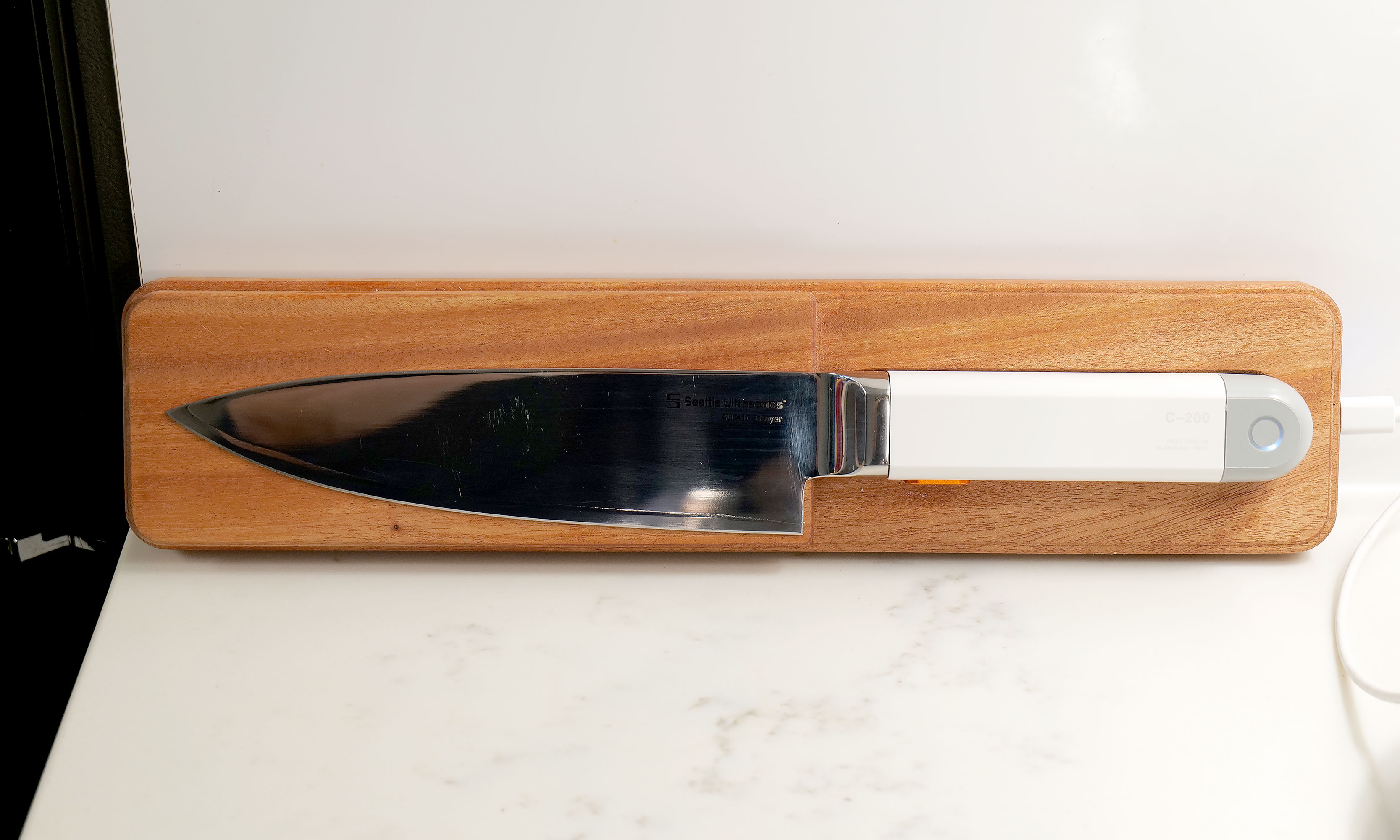
I fully admit the need to keep a knife charged up is a major annoyance and something I or anyone else probably doesn’t want to do. Thankfully, Seattle Ultrasonics thought of that by including support for wireless charging via the C-200’s magnetic tile and it’s dead simple to use. Just toss it on the charger when you’re not using and it will take care of itself, so you never have to worry about how much of its normal 20-minute runtime it may or may not have left. There are also holes around back so you can easily mount the charger on a wall or shelf. In short, the added convenience the charging tile brings is so valuable that I don’t really consider it an optional accessory. If you’re getting the C-200, you need to buy this too, which sadly means you’re looking at an all-in price of $500 for the bundle instead of just $400 for the knife by itself.
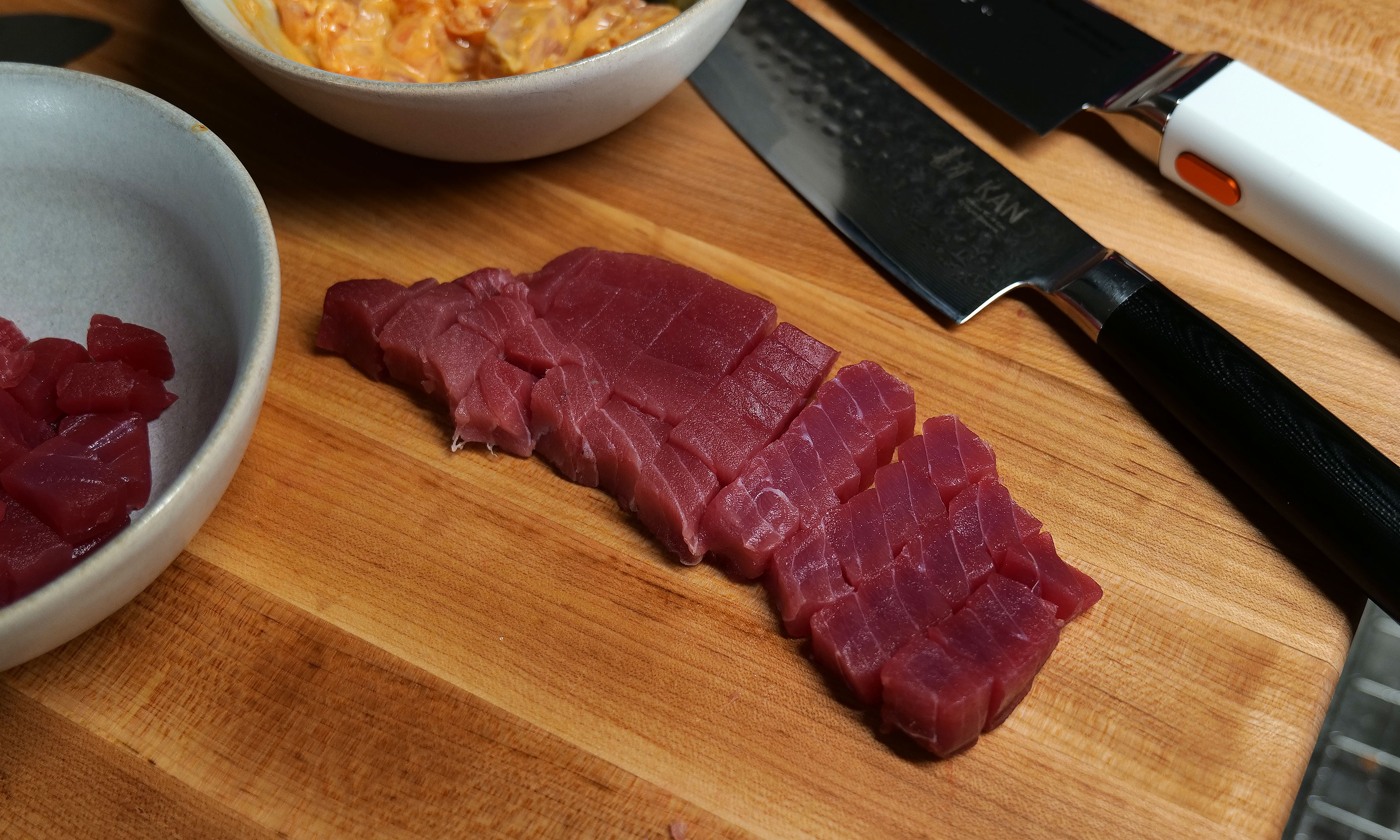
After using the C-200, I don’t think people need to rush out and throw all their old-school knives in the trash. The beauty of an ultrasonic blade like this is that it can handle everything your old cutlery is meant for, but with the touch of a button, it delivers sharpness unlike anything you’ve experienced before. And while it has some quirks, they’re nothing like the kind you typically encounter on first-gen gadgets. Its biggest drawback is that its magnetic charging tile feels like an essential accessory, but it adds extra cost on top of a product that already has a deservedly premium price tag.
Even though I’m sure knife makers will continue tweaking blade shapes and alloy mixes from now until the end of time, the addition of ultrasonic vibrations to a chef’s knife unlocks a completely new tier of performance. That’s because this technology is additive. All it does is enhance what a blade already does best. And when you look at related gadgets in the maker space, I don’t think it’s a coincidence that there’s a similar revolution that resulted in Adam Savage of Mythbusters fame naming a sonic cutter as one of his favorite things of 2025. When viewed that way, it makes me even more confident that the C-200 is the flagbearer for a new breed of kitchen knives.
This article originally appeared on Engadget at https://www.engadget.com/home/kitchen-tech/seattle-ultrasonics-c-200-review-this-is-the-future-of-kitchen-knives-140000051.html?src=rss
Russia has opened an investigation into Telegram founder Pavel Durov for “abetting terrorist activities,” [non-paywalled source] in the latest sign that his uneasy relationship with the Kremlin has broken down. From a report: Two Russian newspapers, including the state-run Rossiiskaya Gazeta and Kremlin-friendly tabloid Komsomolskaya Pravda, alleged on Tuesday that the messaging app had become a tool of western and Ukrainian intelligence services.
The articles, credited to materials from Russia’s FSB security service, accused Telegram of enabling attacks in Russia and said that Durov’s “actions … are under criminal investigation.” Russia has restricted Telegram’s functions, accusing it of flouting the law and is seeking to divert users towards Max, a state-run rival messenger. The steps escalate pressure on a platform that remains deeply embedded in Russian public life.


Read more of this story at Slashdot.
Meta has struck a deal with AMD to buy up to six gigawatts worth of AI chips, both companies announced. The agreement is structured in a way that could see AMD issue Meta up to 160 million shares of its common stock provided GPU shipment milestones are achieved — meaning Meta could own up to 10 percent of AMD if the deal fully completes.
Meta plans to purchase six gigawatts of AMD’s Instinct GPUs based on the MI450 architecture and optimized for Meta’s workloads, with the first gigawatt deployment set to begin in the second half of 2026. AMD and Meta will also expand on their EPYC CPU partnership, with Meta deploying “millions” of AMD EPYC CPUs and become a launch customer for its sixth-generation EPYC CPUs.
The tranche of AMD common stock will vest with the first one gigawatt of shipments, with additional tranches vesting as Meta scales to 6 gigawatts. Vesting is tied to AMD hitting certain stock price thresholds and Meta achieving certain technical and commercial milestones. The deal is very similar to one that AMD structured with OpenAI last year, with AMD obtaining up to a 10 percent stake in AMD in exchange for six gigawatts of Instinct GPUs.
Such deals are being likened to circular transactions that have created a tangle of interconnected dependencies between AI companies and chip manufacturers. Analysts have observed that such deals may magnify losses if demand for AI doesn’t match the sky-high market expectations.
The agreement also shows that AI companies are keen to diversify away from NVIDIA, with AMD being a key alternative. “By diversifying our partnerships and technology stack, we’re building a more resilient and flexible infrastructure,” Meta wrote in its news release.
This article originally appeared on Engadget at https://www.engadget.com/ai/meta-may-trade-ai-chips-for-shares-in-its-latest-amd-deal-134259842.html?src=rss


At the Neon Genesis Evangelion 30th Anniversary event in Tokyo this weekend, Pixelity showed off its upcoming XR game EVANGELION: Δ CROSS REFLECTIONS, revealing it’s going all-in on hand-tracking.
On stage at the event, game director MK Choi gave a quick overview of the game, noting that Evangelion: Cross Reflections will feature “controller-free interaction, utilizing hand-tracking technology that allows players to perform all actions using only hand and finger movements.”
Demo booths were available on-site, giving a few lucky event-goers a first public hands-on with the game. We haven’t seen a full demo session in action yet, although X user ‘togepytogepi‘ showed off a bit of the hand-tracking-based interactions, seen in the videos below:
EVANGELION: Δ CROSS REFLECTIONS demo, courtesy @togepytogepi pic.twitter.com/0qIxhauyvJ
— Scott Hayden (@vrbosenet) February 24, 2026
From the video, it appears the user is punching, shooting and selecting specific buffs that trigger quick-time events, requiring the user to punch a series of stars in order.
While the demo appears to focus on combat and less on story elements, X user ‘EVA_Armaros‘ also managed to capture what appears to be the game’s first official hype video:
エヴァゲー最新作たのしみすぎる!!!
VRデバイス買わなきゃ pic.twitter.com/6glGNkXbJZ— アルマロス@エヴァフェス1,3日目参戦 (@EVA_Armaros) February 21, 2026
Evangelion: Cross Reflections is slated arrive as a three-part series based on the story of all 26 episodes of the original anime, with the first instalment expected to arrive in 2026. The studio hasn’t detailed target platform yet, however it seems fairly clear we can count at least on the Quest platform.
There are set to be new characters however, as following Choi’s presentation, four voice actors portraying the game’s newly created characters took the stage: Gakuto Kajiwara as Martin Dason Holloway, Hana Hishikawa as Rimi Okada, Tasuku Hatanaka as Tomohito Yagi, and Manaka Iwami as Erisa Nozaki.
On stage, it was also announced that global hands-on events are scheduled to take place throughout the year leading up to release this year. We’ll be following the studio’s X profile for more information in the meantime.
Although Evangelion: Cross Reflections could include support for standard VR controllers, the decision to primarily rely on hand-tracking essentially signals that it’s targeting much casual gameplay.
At least from the limited gameplay we’ve seen—which rightfully might even be in-progress tutorial stuff—it’s suggesting that Evangelion fans should probably expect something more in the vein of a VR narrative experience, similar to what we saw with Mobile Suit Gundam: Silver Phantom.
Personally speaking, I honestly it’s going going to be as on-rails as Mobile Suit Gundam: Silver Phantom, which felt like it was straddling passive film and dulled gameplay stuff. For me, it ended up feeling more like an extended demo (or brand activation) than something that really tapped into the immersive possibility of having your own mecha fighting robot.
The post ‘Evangelion’ VR Game Will Primarily Use Hand-tracking, Increasing Ease-of-use at Cost of Interaction Fidelity appeared first on Road to VR.
We may earn a commission from links on this page. Deal pricing and availability subject to change after time of publication.
The Beats Powerbeats Pro 2 were designed with workouts in mind, but their $249.99 list price has made them a harder sell unless you really value a locked-in fit. Right now, however, Grade-A refurbished pairs are $159.99 at Woot. For comparison, new units are listed at around $212 on Amazon, and used pairs are about $168. According to price trackers, the previous low was about $179.95, so this dip is roughly $20 below that mark. All told, that’s a $90 discount if you don’t mind a pre-owned device that has been tested and verified to work as intended. Prime members also get free shipping, while non-Prime customers pay a $6 fee.
The adjustable ear hooks of these earbuds keep them secure during runs, strength training, or high-impact workouts, and the IPX4 rating means sweat and light splashes won’t cause problems. The sound leans bold, with strong bass that keeps pace with hip-hop and electronic playlists. Active noise canceling reduces background noise at the gym, while transparency mode lets you hear traffic and announcements during outdoor runs. They also pair easily with Apple devices and support features similar to AirPods, though in a design that is more secure for exercise. For more on how these stack up in Apple’s ecosystem, see Senior Technology Editor Jake Peterson’s coverage of the Powerbeats Pro 2 fitness features in iOS 26.
Setup is simple, though if you need help with it, you can follow Lifehacker’s guide on how to configure every feature of your Powerbeats Pro 2. Battery life runs about eight to 10 hours per charge, and the case stretches total listening time to roughly 45 hours. That said, the built-in heart rate tracking is not flawless. Our Senior Health Editor, Beth Skwarecki, found it did not always sync reliably, especially when an iPhone was juggling workout apps and music at the same time. There is also no companion equalizer app, so you cannot tweak the sound profile beyond what Beats has tuned.
A change merged to upstream LLVM Git yesterday for LLVM 23 is moving AMD’s HIP to using the new/modern offload driver by default. This aligns with a prior change for NVIDIA CUDA and already in place for OpenMP offloading too…
For the price of a sandwich, you can help keep FOSS journalism free — in every sense of the word.
The post How ‘Sandwich Money’ Can Keep Independent FOSS Reporting Alive appeared first on FOSS Force.

We asked folks to tell us a story of how the series had affected their lives for the better
Last week, the Zagreb Cycling Federation took an important step into the world of virtual cycling by launching Zagreb League 1, the first organized virtual cycling league of its kind in Croatia. Organizers tell me the idea behind the league is simple: to promote virtual cycling as an accessible and enjoyable form of training and racing – especially during the colder, rainy winter months when outdoor riding is limited.
The debut race delivered an impressive turnout, with 129 riders on the start line, including around 40 riders from Croatia. Feedback after the first race was overwhelmingly positive, and with five races still to come, the hope is that even more riders will join this week!
There’s a lot about the Zagreb League’s setup that makes it stand out from the crowd:
Zagreb League 1 consists of six races, held weekly on Thursdays at 18:20 UTC/13:20 ET/10:20 PT, running until the end of March.
Sign up at zwift.com/events/tag/zbsvirtucup/ >
Register for upcoming races at zwift.com/events/tag/zbsvirtucup.
More information on Zagreb League 1 can be found in the Google race doc.
Join the Zwift club, named “ZBS Virtual” to see future events.
See race results on ZwiftPower at zwiftpower.com/league.php?id=3197
Share below!
Samsung’s ready to launch its first new devices of 2026, and it’s got an Unpacked event in San Francisco to stream everything. The keynote starts at 10AM PT (1PM ET) and will be livestreamed on YouTube. The announcement on February 10 also said this launch will mark “a new phase in the era of AI as intelligence becomes truly personal and adaptive.”
What are we expecting? Based on leaked images of the new lineup, the company is not likely to have radically reinvented the look of the Galaxy S26, Galaxy S26+ or Galaxy S26 Ultra, sticking instead with a similar design to the Galaxy S25.
We’re expecting Qualcomm’s new Snapdragon 8 Elite Gen 5 chip to be in all Samsung Galaxy S26 phones, though Korean news site Yonhap News reports Samsung’s relatively new Exynos 2600 chip could be in some devices, depending on the region.
Despite the launch of the Qi 2 wireless charging standard, which added support for convenient magnetic alignment, Samsung still hasn’t brought the feature to its phones. Rumours suggest the S-series will have the spec’s higher speed wireless charging rates but will lack built-in magnets and have to depend on cases to add MagSafe-style charging and mounting.
Honestly? It could be a pretty mild launch event, especially after wowing everyone with the Galaxy TriFold at the start of the year.
Are you more interested in foldables than traditional candy bar devices? (If so, get ready for MWC 2026, kicking off next week. We’re expecting a lot of foldables.)
— Mat Smith
Engadget review recap: Sony WF-1000XM6, ASUS Zenbook Duo and more
Falcon Northwest FragBox review: A compact gaming rig that does everything right
Yes, a truly new Neon Genesis Evangelion series is coming. The announcement came during a 30th-anniversary event in Japan. However, franchise creator Hideaki Anno won’t write the scripts. His replacement will be Yoko Taro, creator of the NieR video game series, who wears a giant spooky moon mask for interviews and game briefings. He’s also a cool guy underneath. Evangelion veteran Kazuya Tsurumaki will be on hand to direct episodes, produced by Studio Khara and Cloverworks.
In a detailed blog post, Bungie took a very declarative position against those caught trying to cheat: “We are taking a strong stance against cheating and anyone found to be cheating or developing cheats will be permanently banned from playing Marathon forever, no second chances.” The blog post added that an appeals system will be in place.
However, Bungie’s anti-cheat standards go beyond punishment. In the blog post, Bungie explained that Marathon’s dedicated servers have full authority on movement, shooting, actions and inventory. Since these key actions rely on the server, it will translate to smoother gunplay for players as well as the prevention of cheats related to teleportation, unlimited ammo or damage manipulation.
Looks like Nothing.
This article originally appeared on Engadget at https://www.engadget.com/general/the-morning-after-engadget-newsletter-122906428.html?src=rss
Pavel Durov, the founder of Telegram, is reportedly under criminal investigation by Russian authorities for “abetting terrorist activities.” According to the Financial Times, state-run publications are accusing Durov of enabling attacks on Russia and Telegram of becoming an intelligence tool for Ukraine and the west. Telegram was one of the apps that Russia blocked in the country just a few days ago, along with WhatsApp, in what seemed to be an effort to push local users towards the unencrypted state-owned app, Max.
When Telegram was banned, pro-Russian voices criticized the country’s decision, because it was apparently harming frontline operations. Russia’s own soldiers are using the app to communicate and coordinate their moves. Authorities near the Ukrainian border, for instance, send out warning for incoming drone and missile attacks through the messaging app. Even Vladimir Putin’s spokesperson uses Telegram to speak to the media.
Now, the Times says Russia is accusing Telegram of being the main instrument for “NATO countries’ secret services and the Kyiv regime.” Rossiiskaya Gazeta, a Russian state-run publication, added that Telegram was “intercepting location data, selling secret information and intimidating soldiers and their families.” Digital platforms like Telegram, the publication said, are “becoming strategic weapons.” Rossiiskaya Gazeta said its information came from Russia’s Federal Security Service, the country’s primary domestic security agency.
Durov has yet to issue a statement, but after Russia blocked access to Telegram, he said the country was restricting access” to the application to “force its citizens onto a state-controlled app built for surveillance and political censorship.” The Telegram founder was born in Russia and co-founded the country’s largest social network, VK. He left his country after Kremlin pressured him to sell his stake in the social network.
This article originally appeared on Engadget at https://www.engadget.com/apps/telegram-founder-pavel-durov-is-reportedly-under-criminal-investigation-in-russia-121000511.html?src=rss
Nobody wants to find out their bike has been stolen. It can be a devastating experience, which prompts a string of frustrating steps, such as reporting the theft to the police and speaking to your insurance provider. It also raises the question, how am I going to get around?
That’s where Brompton has decided to step in. It is offering any Londoners who have had their bicycle stolen free bike hire while they seek a replacement.
Brompton has decided to offer complimentary cycle hire following London Cycling Campaign’s report into bicycle theft, which was published last week. LCC estimates 40,000 bicycles are stolen annually in the capital city and that only 2 per cent of these bikes are recovered.
Julian Scriven, managing director of Brompton Bike Hire, says: “It is saddening to hear the scale of bike thefts in the Capital, especially since the popularity of travelling via two wheels has increased dramatically in recent years.”
“We’re delighted to be able to help Londoners get back into the saddle and reduce the worries of finding an immediate bike replacement by providing complimentary access to a bike from one of our many hire stations across the city,” Scriven adds.
Londoners can email brompton@wearetheromans.com to receive a code that will provide them with complimentary bike hire for two weeks from the folding bicycle company’s Brompton Bike Hire locations via the Brompton app.
To find your closest bike hire station, you can look at Brompton’s interactive map.

LCC’s survey of 1,924 London cyclists also found that 79 per cent of those reporting the loss of a bike said the Metropolitan Police had taken no action and 68 per cent considered the police response inadequate.
The campaign group has launched a petition that accompanies its report, which calls on the deputy mayor for policing and crime to implement its recommendations to reduce bike theft in London.
The recommendations include that the mayor reinstates the cycling theft task force; that the Met Police tracks bicycle theft properly; and that the government makes bike marking and logging with a bike register mandatory, as it is in France.
In January, we reported that the British Transport Police had reversed its decision not to investigate thefts of bicycles that had been left outside train stations for more than two hours.
There was a call from the Liberal Democrats last year to implement “bike bait” operations to catch bicycle thieves.
Brompton’s latest accounts reveal losses of £2m and a drop in sales. CEO Will Butler-Adams said this was driven by challenges in the industry and “wider global economic uncertainty” but the company “remains optimistic”.
King of Meat‘s reign is ending. The game will end service on April 9, less than a year after its October 2025 debut. The Amazon Games-published title will be playable until that date, but will then be taken entirely offline.
“Despite the creativity and innovation Glowmade brought to King of Meat, the game has unfortunately not found the audience we hoped for,” the announcement read.
Developer Glowmade had high hopes for King of Meat, its debut game, but it fell starkly short of expectations. The developer wanted a concurrent player count of at least 100,000, but peaked at 320, according to Insider Gaming. The game had a multi-million dollar marketing budget that included a video on MrBeast’s YouTube channel and custom-wrapped London buses. The company even made a pilot for an animated TV show. Here at Engadget, we were so-so on a preview version of the game.
December brought voluntary redundancies to Glowmade after previous assurances to staff. Anyone who has purchased King of Meat will be able to get a refund through their purchase platform and, in most cases, these refunds should process automatically by April 9.
While it seems that King of Meat struggled to reach its audience, Amazon has a history of pulling games that are popular. Last fall, Amazon Games announced it would wind down support for New World: Aeternum, which first debuted in 2021. The news came as the division faced layoffs, but just that week the game had reached almost 50,000 concurrent players on Steam.
This article originally appeared on Engadget at https://www.engadget.com/gaming/amazon-games-is-winding-down-king-of-meat-113049172.html?src=rss