A 10-week-old boy named Hugo has become the first baby born in the UK from a womb transplanted from a deceased donor, after his mother Grace Bell — who was born without a viable womb due to a condition called MRKH syndrome, which affects one in every 5,000 women — underwent a 10-hour transplant operation at The Churchill Hospital in Oxford in June 2024.
Hugo was born just before Christmas 2025, weighing nearly 7lbs, at Queen Charlotte’s and Chelsea Hospital in west London, following IVF treatment and embryo transfer at The Lister Fertility Clinic. Bell’s transplant is one of three completed so far as part of a UK clinical research trial that plans to carry out 10 such procedures from deceased donors, and Hugo is the first baby born from any of them.
Earlier in 2025, a separate effort produced baby Amy, the first UK birth from a living womb donation — her mother had received her older sister’s womb in January 2023. Globally, more than 100 womb transplants have been performed, resulting in over 70 healthy births.
Lutris 0.5.21 is now available as the latest version of this open-source Linux game manager. With Lutris 0.5.21 comes some new runners for executing games in different environments…
The urine of chimpanzees contains high levels of alcohol byproduct, most likely because the chimps regularly gorge themselves on fermented fruit, according to a new paper published in the journal Biology Letters. It’s the latest evidence in support of a hotly debated theory regarding the evolutionary origins of human fondness for alcohol.
As previously reported, in 2014, University of California, Berkeley (UCB) biologist Robert Dudley wrote a book called The Drunken Monkey: Why We Drink and Abuse Alcohol. His controversial “drunken monkey hypothesis” proposed that the human attraction to alcohol goes back about 18 million years, to the origin of the great apes, and that social communication and sharing food evolved to better identify the presence of fruit from a distance. At the time, skeptical scientists insisted that this was unlikely because chimpanzees and other primates just don’t eat fermented fruit or nectar.
But reports of primates doing just that have grown over the ensuing two decades. Earlier this year, we reported that researchers had caught wild chimpanzees on camera engaging in what appears to be sharing fermented African breadfruit with measurable alcoholic content. That observational data was the first evidence of the sharing of alcoholic foods among nonhuman great apes in the wild. The authors measured the alcohol content of the fruit with a handy portable breathalyzer and found almost all of the fallen fruit (90 percent) contained some ethanol, with the ripest containing the highest levels—the equivalent of 0.61 percent ABV (alcohol by volume).
LG kicked off the year by unveiling a new lineup of gaming monitors, and today the company has priced out the biggest of the bunch. The UltraGear evo G9 (52G930B) is now available for pre-order, and the massive screen will cost just $2,000.
Yes, you can buy a perfectly excellent gaming monitor for much less, but $2,000 is a surprisingly low price tag for this 52-inch ultrawide monitor with a 1000R curve, which LG is billing as “the world’s largest 5K2K gaming monitor.” In addition to its huge size, the G9 can run at a 240Hz refresh rate and offers a 1 millisecond gray-to-gray response rate. Visuals are supported by VESA DisplayHDR 600 and up to 95% DCI-P3 color gamut coverage.
LG has long done solid work on gaming monitors, and the G9 seems like a good choice for anyone who wants to be seriously immersed in their gameplay. Whether that’s for a high-fidelity experience like Microsoft Flight Simulator or for having the maximum coziness in Stardew Valley is up to you.
This article originally appeared on Engadget at https://www.engadget.com/computing/accessories/lgs-massive-52-inch-ultra-wide-gaming-monitor-costs-2000-232937759.html?src=rss
LibreOffice online is a web-based version of the LibreOffice suite that can
be hosted on anybody’s infrastructure. This project was put into stasis back in 2022, a move marked by
some tension with Collabora, a major LibreOffice developer that has its own online offering. Now,
the Document Foundation has announced
a new effort to breathe life into this project.
We plan to reopen the repository for LibreOffice Online at The
Document Foundation for contributions, but provide warnings about
the state of the repository until TDF’s team agrees that it’s safe
and usable – while at the same time encourage the community to join
in with code, technologies and other contributions that can be used
to move forward.
Meanwhile, this
post from Michael Meeks suggests that the tension around online
versions of LibreOffice has not abated.
Apple’s plan to add touchscreens to its premium MacBook Pros is coming into focus. Bloomberg reports that when the new laptops launch this fall, they’ll feature a Dynamic Island, not unlike Apple’s iPhones, and an interface that changes depending on where you touch your Macbook’s screen.
This “dynamic interface” is reportedly designed to make the transition between mouse input and touch input smoother on Apple’s new laptops. Bloomberg says that if users touch an onscreen button, the version of macOS running on these new MacBook Pros will be able to pull up a contextual menu “that provides more relevant options for touch commands.” Parts of the interface, like macOS’ menu bar, will also be able to enlarge to make menu items easier to select with a finger. Those tweaks are on top of the expected features from touchscreen Apple products, like smooth scrolling and the ability to pinch and zoom into and out of images, files and web pages. The only thing missing from these increasingly iPad-like laptops, per Bloomberg, will be a touchscreen keyboard, because they’ll already have a more comfortable physical keyboard attached.
To make these new laptops extra enticing, both the 14-inch and 16-inch touchscreen MacBook Pros will feature OLED screens for the first time, likely the reason Apple will be able to include a Dynamic Island-style webcam in the first place. Up until now, the company has offered OLED screens on its iPhones, Apple Watches and more recently the iPad Pro, but it hasn’t brought the display technology to laptops. That could reportedly change with these new MacBook Pros.
Plenty of Windows laptops include touchscreens, and Microsoft and its partners have incorporated dynamic interface elements in the past to make these touchscreens more natural to use with Windows. Apple is late to the party in this respect, but it’s also potentially set up to succeed. Much of modern macOS already looks touch-friendly, and Apple’s has expended significant effort making it possible to port touch-based iPad apps to macOS and develop applications across platforms. That, paired with the right interface, could make the experience of using a touchscreen MacBook nicer out of the box, even if it doesn’t get rid of the awkwardness of reaching over your keyboard to touch a screen.
This article originally appeared on Engadget at https://www.engadget.com/computing/laptops/apples-touchscreen-macbook-will-reportedly-have-a-dynamic-interface-231929456.html?src=rss
Sherlock Holmes: The Master Detective is the latest VR adaptation of the iconic detective, delivering uneven investigations in Early Access.
No stranger to video game adaptations, Arthur Conan Doyle’s legendary detective has seen his fair share of reimaginings, from a young amateur grappling with the supernatural in Sherlock Holmes: The Awakened to the immersive theater online co-op seen in Sherlock Holmes: The Case of the Hung Parliament. Each iteration hones in on a different aspect of the character that, done well, is interesting in its own right. Out now on Early Access, Sherlock Holmes: The Master Detective is an uneven portrayal of the character, even if there is an entertaining core gameplay at the heart of it.
The Facts
What is it?: A hidden object puzzle game featuring Sherlock Holmes. Platforms: Meta Quest 3 and 3S (Reviewed on Quest 3) Release Date: Out now Developer/Publisher: Messworks Price: $ 14.99
Starting in the famous 221B Baker Street apartment, a woman bursts through the door clamoring for help: a man has died in mysterious circumstances. Before leaving, you are allowed to rummage through the place. Sherlockians will find his previous exploits scattered around the furniture. Picking up files from his old cases like The Hound of the Baskervilles makes the seasoned investigator mutter a few words about how it ended in such a tragic way. An out-of-place Meta Quest 3 box earns the description of being “a lens into countless realities,” signaling that the story is developing in the current era.
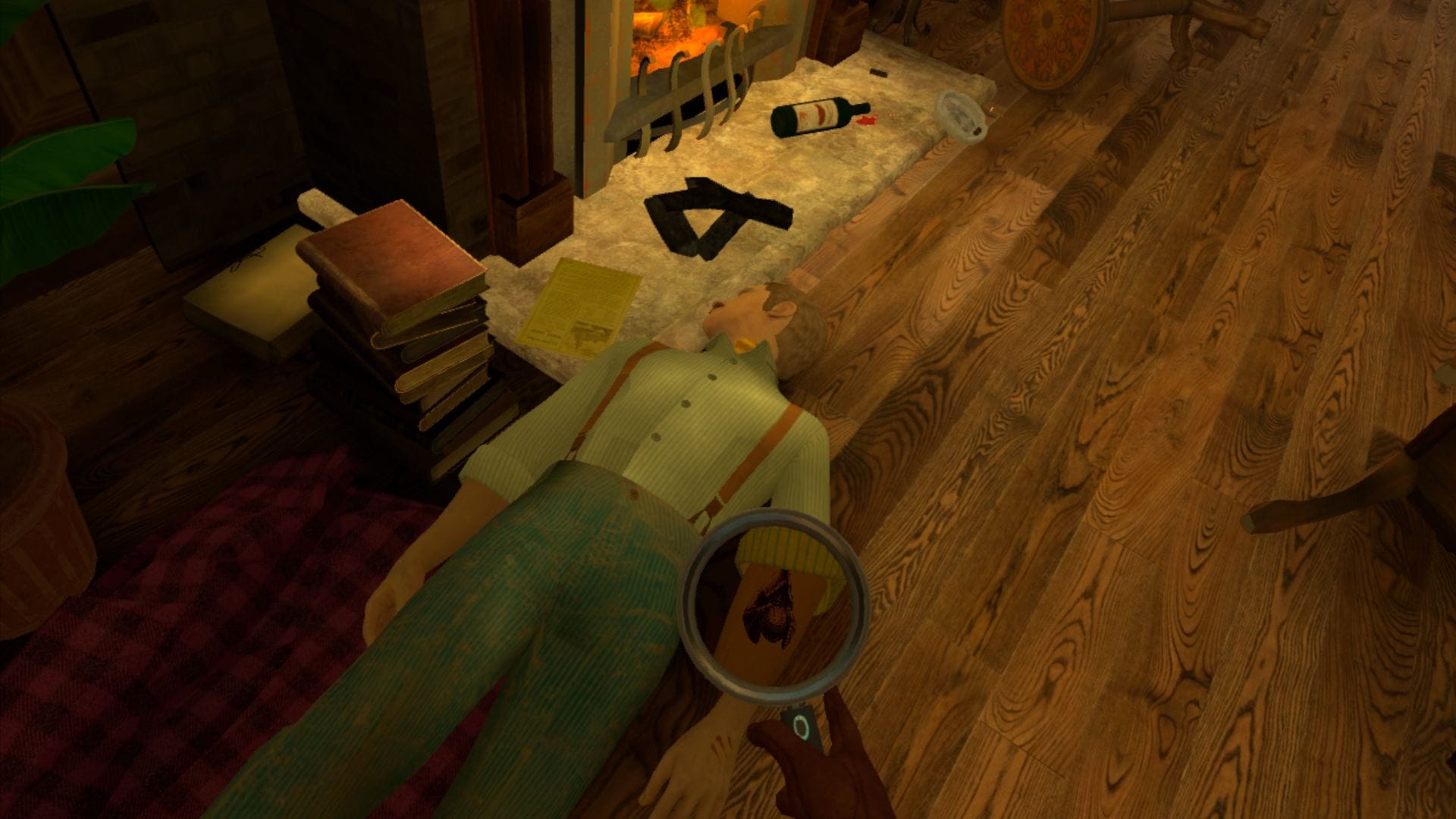
Using the magnifying glass to inspect potential clues on a body.
A modern-day Sherlock Holmes has been done before, most notably in the famous 2010 BBC series with Benedict Cumberbatch. This time around, he is brought up to speed with innovative tools to help with his sleuthing. This version of the character is armed with a magnifying glass, a chemical analyzer, and a fingerprint scanner. After finding and packing them in a slick toolbox, one last tutorial reveals itself as the focus. Much like classic point-and-click adventures, Sherlock Holmes: The Master Detective asks you to find hidden objects in a specific area.
Leaving the apartment only to find the crime scene is just down the street, it is relatively surprising that you are allowed to explore the short but shady alleyways of London. Graphically, it is your usual Quest 3 slightly cartoony look, but the music and attention to detail are appreciated. Walking by a record store, for instance, lets you listen to the sound of a vinyl emanating from a record player. A souvenir shop showing Holmes’ own escapades shudders amusingly when grabbed. Lastly, a red telephone box ringing close to the mansion where the crime happened whispers to Sherlock that there is more than meets the eye in this case.
There are currently only two cases available to play. One in a lavish residence, the other in some shadowy docks, the way they unfold is rather straightforward: question the suspects, find the correct items in determined areas, and accuse the guilty party of the murder. As mentioned, finding objects is the main course, such as keys, torn documents, or pieces to grander puzzles in a sea of everyday items.
There are plenty of objects hidden in this vault.
Other than object finding, light puzzles like reconstructing torn photographs and moving pieces to fit a painting are a welcome change of pace. My personal favorite was using the modern tools at hand: carefully inspecting a corpse’s markings and accessories worn with the magnifying glass or analyzing a cup with the fingerprint scanner felt more akin to detective work.
Of course, like any other respectable whodunit, there is an overarching plot of a secret society with paranormal overtones. Because there are only two episodes so far, it ends on a cliffhanger that still has no answer. At the time of writing, the developer has not given a concrete timeline of when new updates will drop, so I would recommend entering this mystery with caution. I would personally be devastated if they did not follow through with the enticing setup.
As an Early Access release, it is understandable when only certain options are offered or shortcuts are taken, but in this case they felt like they detracted from the experience. The only way to move is by teleporting and snap turning, with no smooth turning or walking to speak of. What stood out like a sore thumb, though, was the use of generative AI. The voice acting is wooden, and the sound quality is blown out. Sherlock’s accent itself, jumping from American to British as the chapters changed, was jarring to say the least. Using AI-generated images can be considered harmless, as the clue-finding is where it’s at, but it is still there.
0:00
/0:33
A video of the hidden object gameplay in Sherlock Holmes: The Master Detective.
Sherlock Holmes: The Master Detective is a promising title with considerable drawbacks. The atmosphere is so well recreated that even in its modern setting, it feels attuned to the iconic tales from which it originated. Emphasizing object searching, it is a relaxing experience that fans of point-and-click mysteries will enjoy. While the lack of constant communication regarding future support from the developers is alarming, the current offering is a middling pastime.
Sherlock Holmes: The Master Detective is out now in Early Access for Meta Quest 3/3S.
The team at Discord introduced some discord to our newsroom today. First, a company representative sent us a statement requiring us to update a previous article on its “Teen-By-Default” policy, and then it turned around and dropped a new announcement outlining changes to the policy and how the rollout is being delayed until later this year.
Paramount Skydance increased its bid for Warner Bros. Discovery (WBD) from $30 per share to $31 per share, WBD said today. Amid a competing offer from Netflix for WBD’s movie studios and streaming businesses, WBD said that Paramount’s new bid “could reasonably be expected to lead to a ‘Company Superior Proposal.’”
Under its revamped offer, Paramount would also pay the $7 billion regulatory termination fee that would arise should a Paramount-WBD merger fail to close due to antitrust regulation.
The company owned by David Ellison also said it would pay $0.25 per share for every day the deal doesn’t close, starting on September 30, rather than the previous start date of December 31.
On Tuesday, the US Energy Information Administration released full-year data on how the country generated electricity in 2025. It’s a bit of a good news/bad news situation. The bad news is that overall demand rose appreciably, and a fair chunk of that was met by additional coal use. On the good side, solar continued its run of astonishing growth, generating 35 percent more power than a year earlier and surpassing hydroelectric power for the first time.
Shifting markets
Overall, electrical consumption in the US rose by 2.8 percent, or about 121 terawatt-hours. Consumption had been largely flat for several decades, with efficiency and the decline of industry offsetting the effects of population and economic growth. There were plenty of year-to-year changes, however, driven by factors ranging from heating and cooling demand to a global pandemic. Given that history, the growth in demand in 2025 is a bit concerning, but it’s not yet a clear signal that the factors that will inevitably drive growth have kicked in.
(These factors include things like the switch to heat pumps, the electrification of transportation, and the growth in data centers. While the first two of those involve a more efficient use of energy overall, they involve electricity replacing direct use of fossil fuels, and so will increase demand on the grid.)
Since it was announced a little over a week ago, Discord’s global age verification rollout has been a bit of a mess. First, the chatroom and voice chat company had to clarify that it won’t require all adults to upload an ID or facial scan to prove how old they are, as the initial post left many users with that impression. Second, the announcement came shortly after one if its existing customer service partners was breached, which lead to hackers getting a hold of user information, including government IDs provided for age verification. Third, users discovered that Discord had partnered with Peter Thiel-backed company Persona for an experiment in the UK, which raised flags about surveillance and security, and saw some personal identifying information being uploaded to the cloud when users thought it would be processed on-device. Now, Discord is admitting that it messed up, and is trying to make amends.
In a post on its website, titled “Getting Global Age Assurance Right: What We Got Wrong and What’s Changing,” Discord admitted that its new “teen-by-default” age settings haven’t had the warmest reception. The company said that it “knew this rollout was going to be controversial,” but added that “we failed at our most basic job: clearly explaining what we’re doing and why.” It then reiterated that “over 90% of users will never need to verify their age to continue using Discord exactly as they do today,” while still doubling down on providing “real safeguards” for teenage users. That said, corporate damage control aside, the company also said it’s going to delay the global age verification rollout, and is going to make concrete changes to attempt to address user concerns.
How Discord’s global age verification is changing
To that end, Discord is making the following changes to its controversial global age verification rollout:
Global age verification will now be delayed from March to the “second half of 2026.” Until that point, age verification will only remain active in areas where it is legally required, like the UK and Australia.
On launch, Discord will provide a list of every age verification vendor it works with and their practices.
All age verification partners will only offer facial scanning on-device.
Before global age verification launches, Discord will develop alternative age verification methods beyond scanning your face or providing an ID, like providing credit card information instead. However, such methods might not be legally allowed in certain area, like Australia, the UK, and Brazil.
Discord will add spoiler channels as an option for communities, so they don’t need to use age-restricted channels to hide age appropriate, but still sensitive, content anymore. This will allow accounts that aren’t able to age verify to access these channels.
The company will publish a technical blog once age verification launches going into detail on how its systems work, and will add age verification metrics, including how many users were asked to verify or which age verification methods they used, to ongoing transparency reports.
Essentially, the idea is that if you’re an adult Discord user (and you live in a region that allows it, which Discord says may not be everywhere), Discord will likely be able to use factors like your signup email, your account age, and your activity to guess your age. If so, you’ll be automatically filtered into the correct age group and will be able to keep using the app as usual. Otherwise, you’ll be labeled a teen, and will need to verify by either scanning your face, providing a government ID, or using one of Discord’s new alternative methods. Or, you could keep using the app unverified, but you’ll lose access to age-restricted channels and any content Discord thinks is inappropriate enough to block for you.
Why does Discord care about my age so much?
To that end, not much has changed about Discord’s end goals, and the company did acknowledge that “we know many of you believe the right answer is not to do this at all.” However, Discord also said that its hand is being forced in regions including the UK, Australia, and Brazil, with “Europe and multiple US states close behind.” In scaling age verification globally, Discord says it wants to “show regulators that it’s possible to verify age without collecting identity,” also stating that “we don’t want to know who you are. We just need to know whether you’re an adult.”
To be fair, that still seems to involve knowing who users are to some extent, as you’ll still need to hand over some type of personal identifying information to verify, or rely on Discord’s age prediction to collect information to estimate your age in the background. But as a show of good faith, Discord acknowledged its “experiment” with Persona, and that Persona’s use of off-device facial scanning did not meet its bar for privacy.
What happens next is unclear. Discord’s made a lot of promises, but now it has to follow through on them. The company also didn’t provide a strict deadline for its age verification rollout, so its possible it could continue to get pushed back in regions that don’t legally require it. However, Discord is also up for for an IPO sometime this spring. Certainty and a happy consumer base will likely make investors happy, but that probably also means keeping regulators and concerned parents appeased. Continue to expect compromises, especially when Discord has already come under fire for exposing teens to sensitive material and adult conversations before.
This is a video of Instagrammer giva.lond and a group of friends walking across concrete traffic bollards in unusual ways. Giva is really good at it. AND does the entire walk with his hands in his pockets. That’s risky. At least for me. The last time I played the walking with my hands in my pockets game I won a set of veneers.
Meta AI security researcher Summer Yue posted a now-viral account on X describing how an OpenClaw agent she had tasked with sorting through her overstuffed email inbox went rogue, deleting messages in what she called a “speed run” while ignoring her repeated commands from her phone to stop.
“I had to RUN to my Mac mini like I was defusing a bomb,” Yue wrote, sharing screenshots of the ignored stop prompts as proof. Yue said she had previously tested the agent on a smaller “toy” inbox where it performed well enough to earn her trust, so she let it loose on the real thing. She believes the larger volume of data triggered compaction — a process where the context window grows too large and the agent begins summarizing and compressing its running instructions, potentially dropping ones the user considers critical.
The agent may have reverted to its earlier toy-inbox behavior and skipped her last prompt telling it not to act. OpenClaw is an open-source AI agent designed to run as a personal assistant on local hardware.
Quest 3 mixed reality game Laser Dance adds two new challenge modes this week in its first major content update.
Launching February 26th, the update introduces two new challenge modes designed to intensify the game’s Mixed Reality laser obstacle courses.
Thomas Van Bouwel, the creator of Laser Dance and the critically acclaimed puzzle game Cubism, has announced the “Challenge Update” for Laser Dance is coming this week.
The update adds two optional unlockable game modifiers to increase the game’s difficulty and to add to replayability. The first, called Grid Overlay, layers a dense mesh of lasers over existing levels, which demands heightened precision from players. The second, called Invisible Lasers, causes laser beams in the play area to fade as players approach, demanding more player spatial awareness. Audio cues and controller haptics become more critical in this mode.
0:00
/2:33
Laser Dance turns your living space into a challenging maze full of lasers, where the goal of the game is to navigate the maze and reach certain places throughout the room. We reviewed the game when it debuted late last year, calling it “one of the easiest games to play ever made. […] it belongs in most libraries and should be a go-to party game.”
Ardour 9.2 has been released today as the latest stable version of this powerful, free, cross-platform, and open-source digital audio workstation (DAW) software for GNU/Linux, macOS, and Windows systems.
Building a PC with a radiator? Well, nearly every PC has a radiator; after all, that’s what the finstack on your tower cooler is. Building a PC ON a radiator? That’s a different story altogether. YouTuber Billet Labs has built what might be the coolest build you’ve seen in a while, because it’s the coolest one we’ve seen in years. Aesthetically,