NASA recently ended a manned mission to the International Space Station (ISS) a month early, citing a medical issue with one of the astronauts. The space agency just revealed that the impacted astronaut was Mike Fincke. This was the first medical evacuation in the history of the ISS.
NASA wrote a statement saying that the astronaut experienced an unknown medical event on January 7 “that required immediate attention” from his fellow crew members. Fincke added that his “status quickly stabilized” thanks to the “quick response and the guidance” of the flight surgeons.
However, the incident did force NASA to cancel a spacewalk planned for January 8. Soon after that, the agency announced it would be ending the Crew-11 mission a month early. The four-person crew included Fincke, NASA astronaut Zena Cardman, Japanese astronaut Kimiya Yui and Russian cosmonaut Oleg Platonov.
They had been living and working aboard the ISS since August and were expected to stay until February. The crew returned on January 15, which was a decision made by NASA’s chief health and medical officer. Once the crew had landed, administrator Jared Isaacman said it was a “serious situation” but didn’t go into any detail.
Fincke has said he is currently “doing very well” and still participating in standard post-flight reconditioning at NASA’s Johnson Space Center in Houston. “Spaceflight is an incredible privilege, and sometimes it reminds us just how human we are,” he said. “Thank you for all your support.”
We don’t know what medical issue Fincke is going through, and it’s certainly his business and not ours. In any event, we wish for a speedy recovery.
NASA also moved up the launch of Crew-12 to replace the prematurely-returned astronauts. That team docked at the ISS on February 14 and are scheduled to stay on the space station for around eight months.
This article originally appeared on Engadget at https://www.engadget.com/science/space/the-astronaut-whose-illness-forced-an-early-return-from-the-iss-was-mike-fincke-163752239.html?src=rss
New York Attorney General Letitia James has filed a major lawsuit against Valve, alleging that the company’s loot boxes in games like Counter-Strike 2, Dota 2, and Team Fortress 2 constitute illegal, unlicensed gambling that targets minors. The complaint, filed in Manhattan state court, seeks to end the practice and demands that the Bellevue-based
Instagram will soon alert parents if their teen repeatedly searches for content related to suicide and self-harm on the platform. According to an announcement from Meta, these notifications will be available to parents in the U.S., UK, Australia, and Canada who supervise their teen’s accounts starting next week.
As TechCrunch reports, this feature is being rolled out amid numerous lawsuits over how Meta and other tech companies have failed to protect kids and teens across their platforms.
How the new safety alerts work
Instagram will use teens’ search activity to generate alerts. Searches that are flagged include “phrases promoting suicide or self-harm, phrases that suggest a teen wants to harm themselves, and terms like ‘suicide’ or ‘self-harm,'” according to Meta.
Parents will receive alerts via email, text, or WhatsApp as well as an in-app notification. The message lets parents know that their teen has “repeatedly searched” for content related to suicide or self-harm and includes resources for supporting teens.
Instagram already blocks searches associated with suicide and self-harm, directing users to resources instead. While users can post about their personal experiences, Meta’s policies do not allow content that promotes or glorifies these topics, and Instagram hides related content from teens (even if it’s from someone they follow).
Enable parental supervision on Instagram
To receive alerts, parental supervision must be enabled on your teen’s account. Supervision allows parents to set app time limits, enable sleep mode, and monitor and manage things like account settings, followers, accounts followed, content topics searched, and app usage. Parental supervision is available for teens ages 13–17, and teens have to agree to participate.
To send a supervision invite to your teen, open the More menu in the bottom-left and click Settings. Select Supervision > Create Invite, review the information, and hit Continue. From here, you can copy the invite to send via any messaging app. Note that teens can decline supervision requests—the feature is opt-in for both parties.
An anonymous reader shares a report: Burger King is launching an AI chatbot that will live in the headsets used by employees. The voice-enabled chatbot, called “Patty,” is part of an overarching BK Assistant platform that will not only assist employees with meal preparation but also evaluate their interactions with customers for “friendliness.”
Thibault Roux, Burger King’s chief digital officer, tells The Verge that the company compiled information from franchisees and guests on how to measure friendliness, resulting in the fast food chain training its AI system to recognize certain words and phrases, such as “welcome to Burger King,” “please,” and “thank you.” Managers can then ask the AI assistant how their location is performing on friendliness. “This is all meant to be a coaching tool,” Roux says, adding that the company is “iterating” on capturing the tone of conversations as well.
Google has launched its new image generation model, the Nano Banana 2, which is powered by Gemini 3.1 Flash Image. The company says the new model has the capabilities, world knowledge and reasoning of Nano Banana Pro, but it can accomplish tasks at “lightning-fast speed.” That enables rapid editing and the quick creation of various iterations using a single prompt.
Nano Banana 2 will give more people access to capabilities that were previously exclusive to the Pro model. That includes Pro’s ability to pull real-time information and images from web searches to create, say, infographics and diagrams. It will also be able to generate texts on images for marketing materials and greeting cards.
Google says Nano Banana 2 can maintain character resemblance for up to five characters in a single workflow, which could be especially valuable if you’re using it to create storyboards or visual stories. It can follow precise instructions for complex requests, as well, and can generate input with up to 4K in resolution with richer textures and sharper details than its predecessors could.
Nano Banana Pro could already generate images so realistic, it’s almost impossible to tell that they were AI-generated. Google even had to limit its use due to high demand. Whether Nano Banana 2 can generate images that are markedly better than what Pro could create — and whether we could still tell if an image was made by AI — remains to be seen. The new model will replace Nano Banana Pro in the Gemini app, but Google AI Pro and Ultra subscribers will retain access to Nano Banana Pro for specialized tasks. It will also be the default model in Search for AI Mode and Lens, as well as in Google’s Flow AI creative studio.
This article originally appeared on Engadget at https://www.engadget.com/ai/googles-nano-banana-2-is-a-faster-version-of-nano-banana-pro-160000695.html?src=rss
If you’ve ever searched for a bike maintenance video on YouTube, you’ll have run into Calvin Jones. Park Tool’s director of education has been with the tool brand since 1997, but is best-known for his extensive contributions to the brand’s YouTube channel. Boasting 900,000 subscribers and 13 million annual views, Jones has also contributed to nearly 200 detailed guides on Park Tool’s website.
Before Park Tool, Jones’ bike maintenance career, which started in 1973, included a spell as a mechanics instructor at the US Olympic Training Centre.
Ahead of his recently announced retirement from Park Tool, we caught up with Jones to tap into his expertise and get his top tips for budding home or professional bike mechanics.
BikeRadar: What is the number one mistake that mechanics make?
Calvin Jones: Probably being over-confident. You should know your limits and remember that the right to repair is also the right to fail. That mistake that you made is learning.
BikeRadar: What is the best way for people to improve as bike mechanics?
Calvin Jones: Shop mechanics, it happens anyway; home mechanics should start repairing your friends’ bikes.
Shop mechanics are repairing other people’s bikes – that’s a big responsibility. But you get to work on a lot of different bikes, and that should make the professional better.
BikeRadar: What is the best way to prevent long-term costs?
Calvin Jones: Preventive maintenance, as boring as it sounds, is the way. Chains are probably the least expensive part of the drivetrain. Maintain it as you go.
Does it mean washing your bike every time you ride? Maybe not. Keep it clean, but don’t go too far. With too much scrubbing, water ingress can carry stuff with it.
BikeRadar: What is the one job you cannot stand?
Calvin Jones: It’s all fun. Being under pressure when changing wheels for the mountain bike World Cup, when the downhill starts in 10 minutes and you’ve got to swap wheels out to change from mud tyres because the course has dried out. That’s probably the least favourite.
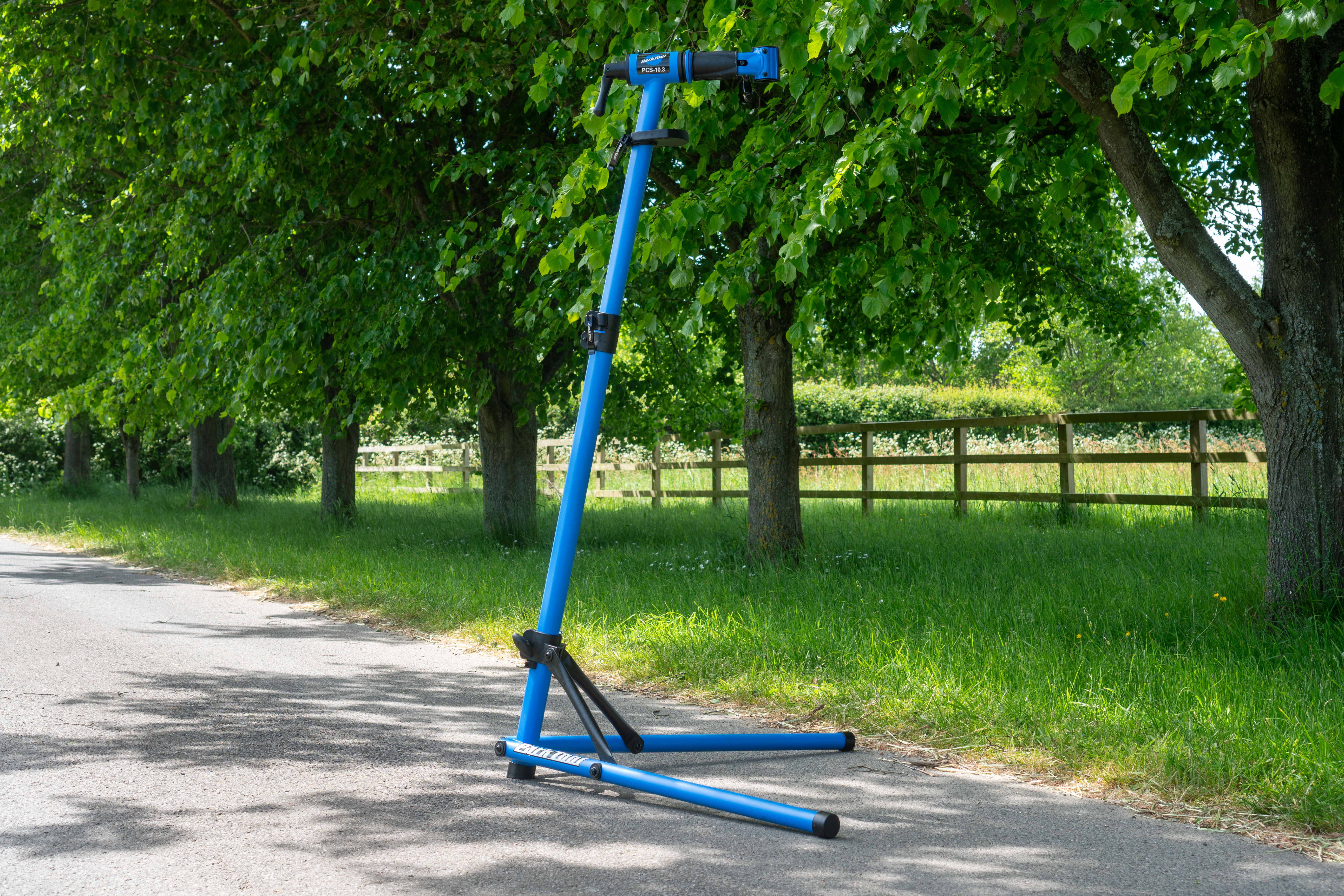
Jones says a workstand is the one thing he’d never skimp on. Oscar Huckle / Our Media
BikeRadar: What is the tool you shouldn’t skimp on?
Calvin Jones: I wouldn’t skimp on the repair stand. That doesn’t mean you need our electric lift stand, but get a really nice consumer stand. If you get the stand, you’re going to all of a sudden have friends. You’ll get a lot of life out of that stand – don’t skimp on it.
BikeRadar: Bikes have changed a lot; what are the effects of design trends for riders?
Calvin Jones: We’re still running with two wheels, mostly. There’s still a handlebar and you’re turning your feet around. That’s all the same.
It’s always been an arms race, but I think that’s ramped up more now. That’s a little unfortunate, as it can stop people from getting out there and riding. I want you to go out there with what you have.
We used to ride our steel bikes on gravel, when they were called ‘bikes’. I think we’re starting to lose that, which is unfortunate. Don’t let the tech get in the way, just ride what you’ve got.
Jones says that changing consumer habits make it more important than ever for shops to offer additional value to consumers. Scott Windsor / Our Media
BikeRadar: What are the challenges for the cycling industry and cycling uptake?
Calvin Jones: Getting people on bikes. Not just kids, anybody that’s willing to ride should be able to ride. We want to make people as comfortable and safe as possible.
Politicians may not listen to consumers, but they’re more likely to act on what business owners say and maybe improve the cycling infrastructure in their cities.
BikeRadar: And what are the opportunities for the cycling industry?
Calvin Jones: We’ve gotten through a storm that we’ve kind of created a bit ourselves. We pretend it’s gone away, but it’s the same challenges. The internet has changed how people shop, so you have to be competent there, you have to offer them value. How can the retailer do that and be part of that? That’s the challenge.
BikeRadar: So, what’s next for you now you’re retiring?
Calvin Jones: It’s going to be more of the same. I’m going to do bike stuff, just differently. I want to ride my bike more. More teaching. Curriculum for schools, training kids and mechanics.
We’re sure all the cyclists who’ve turned to CalvinJones for help over the years join BikeRadar in wishing him all the best for his retirement from Park Tool and his future riding.
Modern vehicle computer systems have become vectors for security and privacy hacking. However, who would’ve thought that the humble and not-very-high-tech tire pressure monitoring system (TPMS) would be identified as vulnerability gateway?
Basically, each TPMS relies on radio frequency (RF) signals transmitted by the small sensors located
Woot is hosting a massive sale on gaming products with deep discounts on games, systems, and peripherals of up to 84% off. That in and of itself is notable. However, to sweeten the pot, it’s also offering additional savings with coupon code LEVEL20 knocking another 20% off (capped at $30) at checkout.
It’s hard to overstate the role that Wi-Fi plays in virtually every facet of life. The organization that shepherds the wireless protocol says that more than 48 billion Wi-Fi-enabled devices have shipped since it debuted in the late 1990s. One estimate pegs the number of individual users at 6 billion, roughly 70 percent of the world’s population.
Despite the dependence and the immeasurable amount of sensitive data flowing through Wi-Fi transmissions, the history of the protocol has been littered with security landmines stemming both from the inherited confidentiality weaknesses of its networking predecessor, Ethernet (it was once possible for anyone on a network to read and modify the traffic sent to anyone else), and the ability for anyone nearby to receive the radio signals Wi-Fi relies on.
Ghost in the machine
In the early days, public Wi-Fi networks often resembled the Wild West, where ARP spoofing attacks that allowed renegade users to read other users’ traffic were common. The solution was to build cryptographic protections that prevented nearby parties—whether an authorized user on the network or someone near the AP (access point)—from reading or tampering with the traffic of any other user.
Astronomers have captured the largest and most detailed image of the Milky Way’s core to date, revealing a chaotic web of cosmic filaments at our galaxy’s center. Using the Atacama Large Millimeter/submillimeter Array (ALMA) in Chile, a research team mapped the Central Molecular Zone (CMZ), the star formation engine that spans more than 650
NVIDIA is out here living its best life as it rides an AI wave that has yet to break to yet another quarter of record earnings, driven primarily by more explosive growth in its Data Center division.
Total revenue for the fourth quarter, which ended January 26, 2026, tallied $68.1 billion for a 20% sequential gain and a massive 73% year-over-year
At least 25 million people have had their personal information stolen in a major hack on business services company Conduent. The data breach itself isn’t new—it was initially disclosed in January 2025, and Conduent has already notified millions of individuals whose data was compromised in the incident. However, the breach is now believed to be larger in scale than previously reported, possibly among the largest to affect healthcare.
Who is Conduent?
Conduent is a New Jersey-based business processing outsourcing (BPO) company that provides services like printing, payment, and document and claims processing to state and federal government agencies as well as large commercial and transportation organizations. According to the company’s 2025 annual report, these offerings include disbursement of benefits, such as food assistance and child support, and administration of government healthcare programs (like Medicaid). For large corporations, services include workplace and unemployment benefits management.
Conduent was spun off from Xerox in 2017 and now employs around 51,000 people worldwide.
What happened with the Conduent breach?
In January 2025, Conduent suffered an outage that was later confirmed to be the result of a “cybersecurity incident.” The disruption lasted several days, during which agencies across the U.S. were unable to process some benefit payments. While the breach was discovered in January, hackers reportedly gained access to Conduent’s systems months earlier on October 21, 2024. The Safepay ransomware gang later took credit for the attack.
While Conduent confirmed in April 2025 that client information had been stolen in the breach, it didn’t begin notifying affected individuals until October. According to those notices, the compromised data included names, Social Security numbers, dates of birth, health insurance policy information, and medical information.
How many people were impacted by the breach?
The scope of the breach continues to grow, but the total number of individuals affected currently sits around 25 million. The greatest impact appears to be in Texas and Oregon, though residents in California, Delaware, Maine, Massachusetts, New Hampshire, and New Mexico have also received notices. (For reference, the total number of users impacted by the 2024 ransomware attack on Change Healthcare is now estimated at 190 million.)
What to do if you were affected
If you receive a notice saying your information was compromised, you should take every precaution to secure your identity: At a minimum, ensure your credit is frozen, and set up a one-year fraud alert on your credit files to prevent someone from applying for credit using your information. None of the notices we’ve seen have offered any type of credit monitoring or identity theft protection services to affected individuals, but you could utilize these services as well.
At this point—given the ubiquity of data breaches and information compromise—you should be keeping a close eye on your credit report and financial accounts at all times to quickly catch anything suspicious. If you do find fraudulent activity, report it to your bank and/or credit issuer immediately, and file an identity theft report.
HBO Max will be cracking down on password sharing around the world. From a report: The streamer first started cracking down on password sharing in the United States late last August. Subscribers are now able to add an additional out-of-household account for $7.99 a month. Before that August change, Warner Bros. Discovery had been testing for months to determine who may or may not be a “legitimate user,” as CEO and President for Warner Bros. Discovery Global Streaming and Games JB Perrette described the plan.
On Thursday during the company’s fourth quarter earnings call for 2025, WBD revealed that the streaming limitations would be expanding. This news came as part of an answer about which levers the company plans to pull to grow HBO Max. Password crackdowns have proven to be a lucrative way to both boost revenue and subscriptions. Netflix, for example, saw 9 million more subscribers after its first wave of password crackdowns in 2024. The caveat is that password crackdowns do not lead to consistent growth, and they often infuriate subscribers.
New York state has filed a lawsuit against Valve alleging that randomized loot boxes in games like Counter-Strike 2, Team Fortress 2, and Dota 2 amount to a form of unregulated gambling, letting users “pay for the chance to win a rare virtual item of significant monetary value.”
While many randomized video game loot boxes have drawn attention and regulation from various government bodies in recent years, the New York suit calls out Valve’s system specifically for “enabl[ing] users to sell the virtual items they have won, either through its own virtual marketplace, the Steam Community Market, or through third-party marketplaces.” The vast majority of Valve’s in-game loot boxes contain skins that can only be resold for a few cents, the suit notes, while the rarest skins can be worth thousands of dollars through marketplaces on and off of Steam. That fits the statutory definition of gambling as “charging an individual for a chance to win something of value based on luck alone,” according to the suit.
The Steam Wallet funds that users get through directly reselling skins “have the equivalent purchasing power on the Steam platform as cash,” the suit notes. But if a user wants to convert those Steam funds to real cash, they can do so relatively easily by purchasing a Steam Deck and reselling it to any interested party, as an investigator did while preparing the lawsuit.
Apple CEO Tim Cook has teased “a big week ahead” for Apple, starting on the morning of Monday, March 2. The company had already announced an in-person event for media and creators on March 4, while rumors had pointed toward Apple revealing at least five products over three days next week, so it looks like the stars are aligning for that to actually be the case.
Cook all but confirmed that Apple is about to reveal its newest MacBooks in the coming days. His tweet features a short video of someone shaping an Apple logo on a surface that appears to have the company’s classic space gray colorway.
We’re expecting to see a new MacBook Air next week, along with updated 14- and 16-inch MacBook Pros. It’s believed that the M5 Pro and M5 Max will debut in the higher-end devices. Apple may also be cooking up an entry-level MacBook that’ll be available in an iMac-style array of bright colorways. New iPads and the iPhone 17e could well be in the hopper too.
This article originally appeared on Engadget at https://www.engadget.com/computing/laptops/tim-cook-confirms-a-week-of-apple-product-reveals-144758464.html?src=rss
The US space agency has released a “pre-solicitation” for what is expected to be a hotly contested contract to develop a spacecraft to orbit Mars and relay communications from the red planet back to Earth.
Ars covered the intrigue surrounding the spacecraft in late January, which was initiated by US Senator Ted Cruz, R-Texas, as part of the “One Big Beautiful Bill” legislation in the summer of 2025. The bill provided $700 million for NASA to develop the orbiter and specified funding had to be awarded “not later than fiscal year 2026,” which ends September 30, 2026. This legislation was seemingly crafted by Cruz’s office to favor a single contractor, Rocket Lab. However, multiple sources have told Ars it was poorly written and therefore the competition is more open than intended.
The pre-solicitation released this week is not a request for proposals from industry—it states that a draft Request for Proposals is forthcoming. Rather, it seeks feedback from industry and interested stakeholders about an “objectives and requirements” document that outlines the goals of the Mars mission.