Zwift Updates Drafting on Inclines and Declines

Yesterday, Zwift enabled an adjustment/fix for drafting which will be particularly noticeable on descents. Here’s what was posted on their forum:

We’ve made an adjustment/fix to the drafting effect that’s now enabled for game version 1.102 and newer. Here’s how you can check what version you’re using.

Up until now our drafting algorithm didn’t properly use road incline/decline percentage in the equations and this change will fix the issue. The steeper the climb or descent, the more the change will be noticeable.

The end result is:

  • You’ll be able to stay with riders just ahead on steep climbs with slightly less effort than before.
  • Staying in the draft behind a rider while going downhill will be much easier than before – you should be able to draft supertucked riders easily now.
  • Pack speeds on the downhills will be slightly higher than before in general, on the order of 10-15% on steeper descents.
  • Drafting on flat roads is unchanged, and speeds while riding solo are also unaffected.
  • For group rides and races making it to the top of a climb with the group is more important than before because of the points above

What Was Fixed?

Zwift says, “Up until now our drafting algorithm didn’t properly use road incline/decline percentage in the equations and this change will fix the issue.” So what was actually broken (and fixed)?

It’s an interesting little bug that is easy to understand. In Zwift, as in real life, every rider casts a draft “shadow” behind them as they cut through the wind. If you’re in another rider’s draft shadow, you’re hitting less air resistance, making it easier to move forward. Cycling 101.

But Zwift’s algorithm was calculating perfectly horizontal draft shadows regardless of road pitch. This works fine on flattish roads, but as the gradients get steeper, horizontal draft shadows will impact riders behind less and less! Zwift confirmed with me that the draft shadows now now extend parallel to the slope of the draft-giving rider.

How Does It Feel?

In my tests, the results of Zwift’s draft update are exactly as described above. It’s particularly noticeable on descents, where the draft is simply stronger than it used to be. Riders used to have to put out some power to hold the wheel of a supertucking rider, but you can now sit on that wheel at 0W, because the draft off that supertucking rider is stronger.

So while supertuck is still a fast and easy way to descend steeper hills, its utility as a weapon of attack has been blunted.

One important result of this change is that it’s now easier for lightweight riders to hold a good pack position on descents, as they sit in the stronger draft.

Coming Soon: More Tests

It’s time for me to run fresh tests and update this post, which showed how much power it took to sit on another rider’s wheel while they were descending in the supertuck or at certain wattage, in race events or group rides.

Questions or Comments?

Go do a test ride or two, then report back your thoughts on the updated draft for climbing and descending. Chime in on the Zwift forum topic, or comment below!

Formation of oceans within icy moons could cause the waters to boil

Our explanation of the outer Solar System has revealed a host of icy moons, many with surface features that suggest a complex geology. In some cases, these features—most notably the geysers of Enceladus—hint at the presence of oceans beneath the icy surfaces. These oceans have been ascribed to gravitational interactions that cause flexing and friction within the moon, creating enough heat to melt the body’s interior.

Something that has received a bit less attention is that some of these orbital interactions are temporary or cyclical. The orbits of any body are not always regular and often have long-term cycles. That’s also true for the other moons that provide the gravitational stress. As a result, the internal oceans may actually come and go, as the interiors of the moons melt and refreeze.

A new study, released today by Nature Astronomy, looks at one of the consequences of the difference in density between liquid water and ice (about 10 percent): the potential for the moon’s interior to shrink as it melts, leaving an area of low pressure immediately below its icy shell. If the moon is small enough, this study suggests, that could cause the surface of the ocean to boil.

Read full article

Comments

The Morning After: The best early Black Friday 2025 deals

Yes, it’s Tuesday, but the Black Friday sale bonanza continues to start earlier (wielded by even more retailers) each year. Our team was, is and will be curating the best Black Friday tech deals for this year’s retail push and with less than a week to go, plenty of the best offers are already live. 

One surprise: PlayStation 5 discounts, with $100 off all the versions of the console . That brings the PS5 Digital Edition down to $399, the standard PS5 to $449 and the new PS5 Pro to $649. 

It’s also a good year for home tech, whether you’re looking for an air fryer upgrade or even a Dyson robot vacuum with $600 off. It’s not the right season for it, but Ninja’s ice cream maker is down to $180 too. 

In recent years, Black Friday sales have included even the most premium recent models, though the discounts are a little less remarkable. For example, the AirPods Pro 3 are currently on sale with a $29 discount on Amazon. Sadly, no discount for the iPhone Pocket.

— Mat Smith

The biggest stories on Engadget.com

Black Friday streaming deals include one year of HBO Max for $36

Get the ad-supported plan for $3 per month for one year.

HBO Max has rolled out a limited-time one-year subscription for $3 per month, a total cost of $36 for a year. The deal’s Basic With Ads plan, which allows full HD streaming on two devices, costs $11 a month at full price.

The MasterClass Black Friday deal has up to 50 percent off subscriptions. Annual plans cost $120 to $240, so it’s a notable discount — and it works for returning users too. 

Meanwhile, Audible is offering three months for $3, with access to Audible’s enormous library of published audiobooks, podcasts and Audible Originals. Sadly, it’ll then revert to the usual $15 a month.

More Black Friday deals on subscription services.

Meta allegedly buried research showing its products are harming users

Deactivating Facebook may lessen depression, anxiety and loneliness.

Meta allegedly suspended internal research into the mental health effects of its products after it showed that people who stopped using Facebook experienced less depression, anxiety and loneliness. This comes from unredacted court filings in a lawsuit filed by multiple US school districts against major social media companies. According to Reuters, the filings also showed internal research staff expressing the findings had merit. One compared the findings to the tobacco industry “doing research and knowing cigs were bad and then keeping that info to themselves.” 

Yesterday, Malaysia announced it plans to ban social media for young people, like Denmark and Australia.

Continue reading.

Dell 16 Premium laptop review

Stylish to a fault.

Dell 16 TMA
Dell 16 TMA
Engadget

Dell’s 16 Premium looks as beautiful as ever, but the company’s usability issues from the XPS lineup remain. It’s kept the invisible trackpad, and the keyboard’s function keys disappear under sunlight. It’s gorgeous and fast, but as a premium device, we want more functionality, more battery life, more ports. Just… more.

Continue reading.

This article originally appeared on Engadget at https://www.engadget.com/general/the-morning-after-the-best-early-black-friday-2025-deals-121500600.html?src=rss

Mushroom foragers collect 160 species for food, medicine, art, and science

Like many mushroom harvesters, I got interested in foraging for fungi during the COVID-19 pandemic.

I had been preparing for a summer of field work studying foraged desert plants in a remote part of Australia when the pandemic hit, and my travel plans were abruptly frozen. It was March, right before morel mushrooms emerge in central Pennsylvania.

I wasn’t doing a lot other than going on long hikes and taking classes remotely at Penn State for my doctoral degree in ecology and anthropology. One of the classes was an agroforestry class with Eric Burkhart. We studied how agriculture and forests benefit people and the environment.

Read full article

Comments

Is this the reason the Giro-Tour double is so hard?

In 2024, Tadej Pogačar won both the Giro d’Italia and the Tour de France, joining Fausto Coppi and Eddy Merckx among only eight male riders and Annemiek van Vleuten as the only female rider to complete the feat.

Prior to Pogačar‘s Giro-Tour double, this hadn’t been achieved since Marco Pantani in 1998 and no one has ever won the Giro, Tour and Vuelta a España in the same year. 

Pogačar went on to win the World Championship, cementing his place alongside Merckx, Stephen Roche and van Vleuten as one of four riders to win cycling’s triple crown in a single season.

Is there a metabolic limit?

The high energy output needed to complete the Tour de France may not be sustainable over longer periods. Tim de Waele / Getty Images

A new study by a team of North American researchers published in Current Biology possibly helps to explain why it’s so difficult to sustain the high energy expenditure needed to win multiple grand tours in a season.

Their study suggests that there’s a metabolic ceiling that limits the maximum sustainable rate of calorific expenditure over longer periods to around 2.5-times basal metabolic rate, which is how many calories you need to burn just to keep the lights on. 

The research, reported in Scientific American magazine, looked at the metabolic output of 12 male and two female, mostly professional, elite ultramarathon runners, triathletes and cyclists, finding that they could burn as many as 11,000 calories in a day. But the researchers found that there was a limit to how long they could sustain this level of energy expenditure.

Riders in the Tour can be burning up to five times as many calories as at rest. Getty Images

Previous studies have looked at cyclists in the Tour de France and found that over the 23 days of the race they were expending between four and five times their basal metabolic rate. In shorter races such as ultramarathons and Iron Man triathlons, athletes have been found to reach close to ten times their basal metabolic rate.

The new research supports the hypothesis that, although elite athletes can sustain very high metabolic rates over shorter periods, over durations of 30 weeks or more their calorie burn cannot exceed 2.5 times their basal metabolic rate.

That equates to around 3,750 calories per day in a fit 70kg athlete.  

In the study, athletes were asked to drink double-labelled water, which contains heavier, non-radioactive isotopes of hydrogen and oxygen. Testing how quickly this is passed into urine allows the calculation of how fast food is being metabolised to produce energy.

The study results indicated that, although participants could reach up to seven times their basal metabolic rate during races, over a 30 week period, their metabolic rates fell to 2.5 times their basal rate or less.

Riding a grand tour has pay-backs that take time to recover from. Tim De Waele

Scientific American quotes evolutionary biologist Amanda McGrosky of Elon University in North Carolina, who says that there’s evidence that intense physical activity has pay-backs including a slowing of digestion, lowered immunity and temporary shrinkage of brain tissue, as well as lowered sexual arousal. 

The root cause of the putative limit is not clear. There’s a suggestion that it may be related to a limit in the body’s digestion and nutrient absorption, but it’s something that it’s thought possible could be exceeded thanks to advances in modern sports nutrition.  

For now, the research suggests that it’s very hard to peak for two three-week grand tours in a season, let alone three, and may help explain why Pogačar‘s main priority after winning the 2025 Tour de France was a well-deserved rest, even if he did bounce back to win the World Championships for a third time eight weeks later.

Inu Atsume VR Is A Dog Lover’s Best Friend

Considering the success Hit-Point has had with Neko Atsume on both mobile and VR, it’s been a surprising wait for the company to make a dog-themed follow-up to the pet care simulator that won the hearts of millions. Rather than making its way to the platform after finding success elsewhere, Inu Atsume VR is debuting in mixed and virtual reality. As more of a dog person myself, I’m delighted.

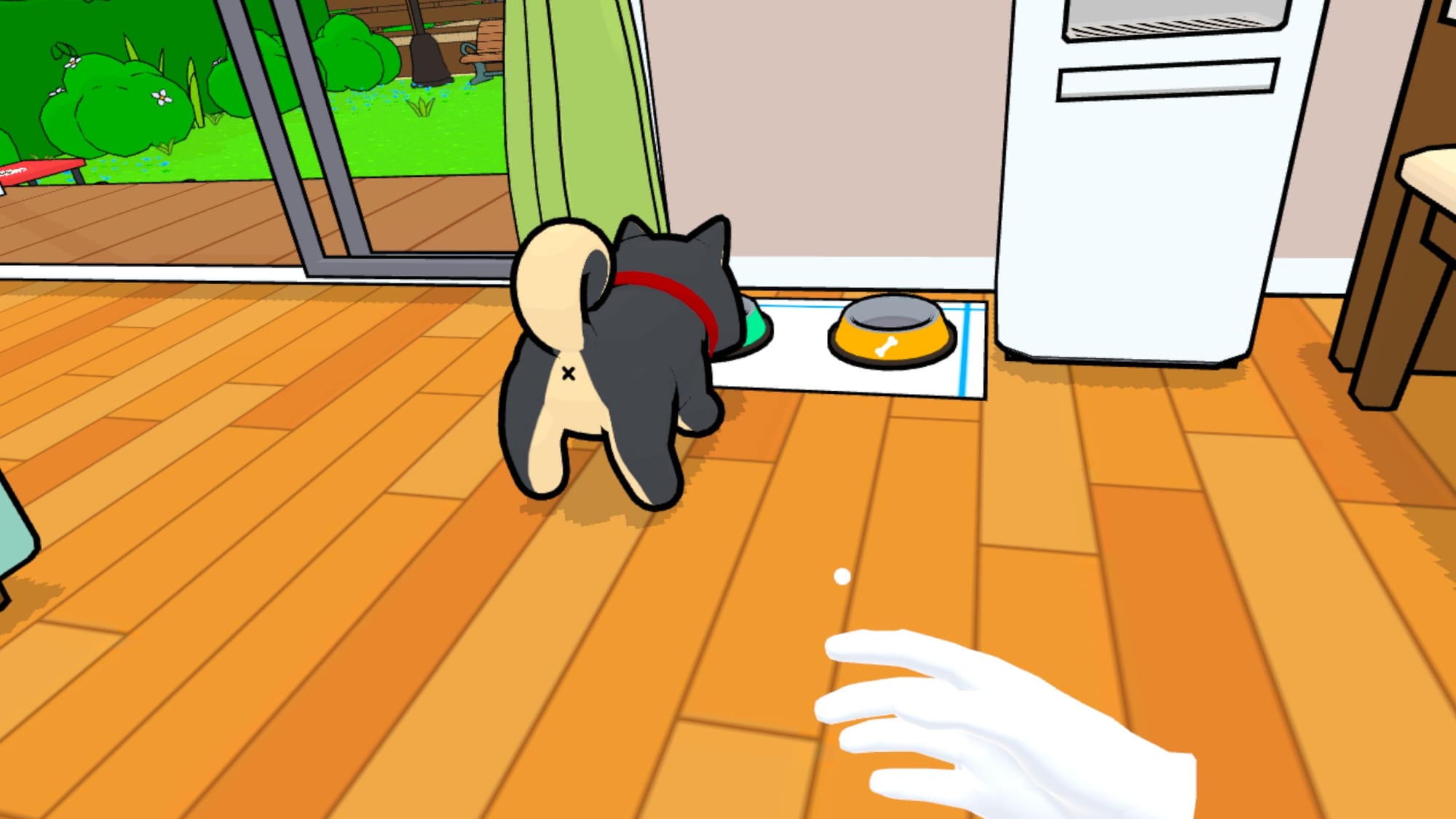
Inu Atsume VR will be instantly familiar to anyone who enjoyed their time with Neko Atsume Purrfect. There isn’t an adventure to beat, just pets to meet, photograph, play with, adopt, befriend, train, and love for as long as you like. It’s an immersive Nintendogs offering everything you need to pretend you have a dog without the cleaning or vet bills that come with one.

0:00

/1:30

Official trailer

Dogs are very different animals from cats, so there are certainly aspects of the game loop that differ compared to Neko Atsume VR. You pick your first dog by playing fetch with a frisbee in the park and giving them a collar, though you can also play with and befriend any dogs you encounter without the commitment of bringing them home when you visit in the future. After that, they live with you, and you need to give them enough to keep them entertained.

They’ll need a bed and food and water, naturally, but you can also get more toys and presents for them. You can teach them tricks and, if incentivized by enough treats, they’ll learn them permanently. You can have them sit or lie down on command at any time.

If they’re done digging holes in the garden to find currency for new toys, gizmos, and other surprises, you can simply call them over and pet and stroke them. Endlessly. Having lived with dogs for much of my life while living in the UK, I’ve only been able to see the family dog through a screen since moving abroad. Even spotting a dog while on a walk and sometimes getting to greet them can be a highlight. Getting to do that at any time in Inu Atsume VR, especially with how adorable they are, is worth the price of admission. I could watch them run and stroke these virtual dogs in my pets-not-allowed apartment for hours.

Actually, I think I spent close to an hour doing this before I even realized it during my first session.

With dogs being more active creatures than the aloof and independent feline, Inu Atsume VR offers a few features not found in its predecessor for interacting with your dog. You can take them to events – simplistic minigames such as maze navigation offer a break from the more passive experience found elsewhere. In this maze game, for example, you can navigate your dog through simplistic labyrinths using either a navigation panel in front of you or voice commands. Unfortunately, voice recognition is very poor and rarely works. Attempting to call and respond to my dog is neat, yet I found myself going to menus and buttons both in and out of minigames. It’s only worked for me around 10% of the time during my experience with the title.

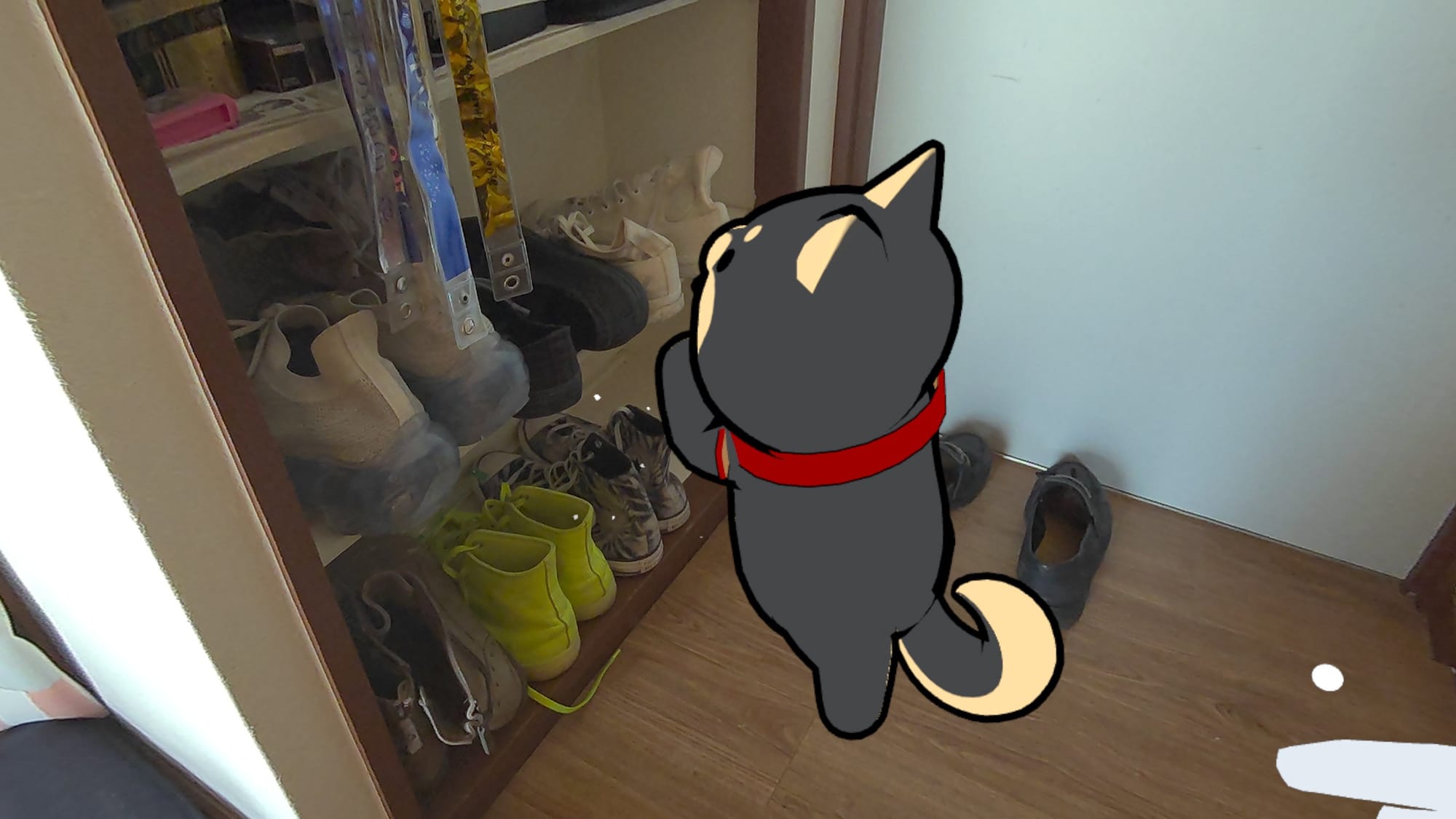
That said, it’s the returning Mixed Reality mode from Neko Atsume Purrfect that remains a highlight. Using your room as a space for this dog to roam, playing with them or simply watching them walk around, is one of the platform’s best uses. I say that as someone who misses the joy a dog’s mere presence can bring to any room. I watch George scratch at my shoes with joy, not anger, and find myself doing odd tasks with my Quest headset in this mode in a way I haven’t in other mixed reality modes, just so I can occasionally spot them having fun as I clean my room.

Mixed reality often falls short, not from poor execution but from how unnatural it feels to have these events taking place in the real world. Yet despite the stylized appearance of these dogs, it simply feels right. I actually felt a little sad when the headset was put away and George wasn’t around, which I didn’t expect.

Mostly, though, this isn’t a game to pick up and play for long sessions. Your coins needed to play minigames and get toys are only drip-fed, and once you’ve fed and played with your pets, it’s perfectly acceptable to go about your life until returning the following day. The daily login system encourages this further, offering goodies for every day you log in.

A dog lover like myself would inevitably prefer Inu Atsume VR compared to Neko Atsume Purrfect, but Hit-Point has done more than a species swap with this new game. It’s taken advantage of VR to bring new features and ideas that feel natural to the medium and make this an engaging and adorable pet simulator that can stick with you for months. Now, if you don’t mind, George needs some food, and then we’re off to play frisbee.

Inu Atsume VR is out now on the Meta Quest platform.

Rad Power Bikes’ batteries pose fire hazard warns CSPC, as brand insists they are safe 

The US Consumer Product Safety Commission issued a warning linking some Rad Power Bikes electric bike batteries to fires, stating they “pose a risk of serious injury and death”.

The batteries can “unexpectedly ignite and explode” especially when the battery or the harness has been exposed to water or debris, according to the CPSC, adding that it is aware of 31 reports of fire, including 12 reports of property damage totalling approximately $734,500. 

The CPSC says: “Some of these incidents occurred when the battery was not charging, the product was not in use, and the product was in storage.” 

Rad Power Bikes issued a statement in response to the CPSC’s warning, refuting the claims and stating that it “firmly stands behind” its batteries.

The CPSC says the affected batteries were sold with the following Rad Power Bikes electric bikes:

  • RadWagon 4
  • RadCity HS 4
  • RadRover High Step 5 
  • RadCity Step Thru 3
  • RadRover Step Thru 1
  • RadRunner 2
  • RadRunner 1
  • Radrunner Plus 
  • RadExpand 5

The batteries were also sold as replacement models. They have the battery model number HL-RP-S1304 or RP-1304, which is printed on a label on the back or rear of the ebike battery.

CPSC urges consumers to remove the battery from the electric bike and dispose of the battery following local hazardous waste disposal procedures. “Do not sell or give away these hazardous batteries,” it adds. 

Rad Power Bikes has refused to agree to a recall and is unable to offer replacement batteries or refunds due to its financial situation.

The Seattle-based company filed a Work Adjustment and Retraining Notification with the Washington state regulators just last week, as part of an “advance written notice of a potential cessation of operations that could occur as early as January 2026,” a spokesperson told Geekwire

The shutdown would affect 64 jobs at the company’s headquarters, including the CEO and CFO, but Rad Power Bikes said no final decision has been made and that it is seeking buyers and investors to continue operating. 

In its statement in response to the CPSC warning, Rad Power Bikes said: “Reputable, independent third-party labs tested Rad’s batteries, both as part of our typical product testing and again during the CPSC investigation, and confirmed compliance with the highest industry standards. Our understanding is that the CPSC does not dispute the conclusions of these tests. It is also our understanding that the battery itself was not independently examined per industry-accepted test standards.”

“The incident rate associated with the batteries in the CPSC’s notice is a fraction of one per cent. While that number is low, we know even one incident is one too many, and we are heartbroken by any report involving our products.

“It is also widely understood that all lithium-ion batteries – whether in ebikes, e-scooters, laptops, or power tools – can pose a fire risk if damaged, improperly charged, exposed to excess moisture, subjected to extreme temperatures or improper modifications to the electrical components, all of which Rad repeatedly advises against in user manuals and customer safety guides. Contrary to the CPSC’s statement, mere exposure to water and debris does not create a hazard; rather, significant water exposure, as warned against in our manuals, can pose a hazard,” the statement continued.

How Ada Computer Science empowers students: Survey findings

Listening to the voices of young people is crucial in creating genuinely effective learning resources. That’s why we recently ran a survey of students who use Ada Computer Science, our platform designed to help students learn and revise key computer science concepts.

“The different topics are nicely categorised and it is easy to find the information I wish to revise.” – Ada Computer Science student

We were delighted to hear from 103 students, most of whom are 16–19 years old and studying in England, and their insights are invaluable in helping us to continue to develop Ada CS.

Students think Ada CS is high quality and useful

The most common ways students use Ada CS are for revision and to check whether they understand concepts. The majority of respondents are building Ada CS into their regular study habits, with over half of respondents using the platform every week.

Photo of a class of students at computers, in a computer science classroom.

We were pleased to see the benefits of updates we’ve made, including a redesign of the question finder released in March 2025 — students reported that it is easy to navigate the platform and find what they need: 81% reported being able to find relevant content, and 77% could find the questions they were looking for.

“It’s SO EASY to find exactly what I want.” – Ada Computer Science student

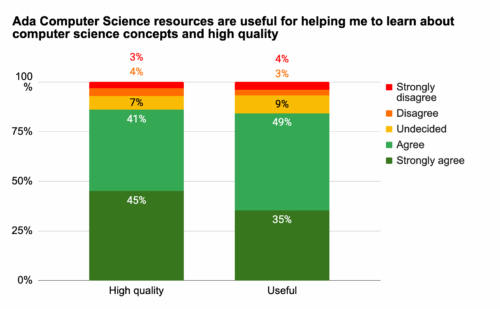
Overall, students perceive Ada CS as both useful for learning about computer science concepts and of high quality. They reported finding the content clear, with a good level of detail.

“The topics are broken down into easily digestible sections, and the provided diagrams really help with understanding the topics.”  – Ada Computer Science student

“The resource is really well designed, short and concise.”  – Ada Computer Science student

We also received helpful suggestions for future improvements. Students shared feedback on how the information on the platform is presented, asking for more concise, revision-friendly content as well as guidance for exploring concepts in more depth. We’ll therefore be looking into alternative ways to structure content as we continue to develop Ada CS. 

Graph depicting how strongly students felt that Ada Computer Science helps them to learn about computer science concepts.

Students rate the quizzes highly

The most popular feature is the quizzes and practice questions, including the immediate feedback and hints provided. Students value how these resources help them solidify their knowledge, learn from mistakes, and prepare for assessments. 

“The questions are clear and make me think, they’re relevant to my studies and the hints for the questions are very useful.” – Ada Computer Science student

We also appreciated the suggestions we received for how we can further develop this feature, for example, creating more questions, extending the range of question types per topic, and making improvements to the hints.

Impact on learning

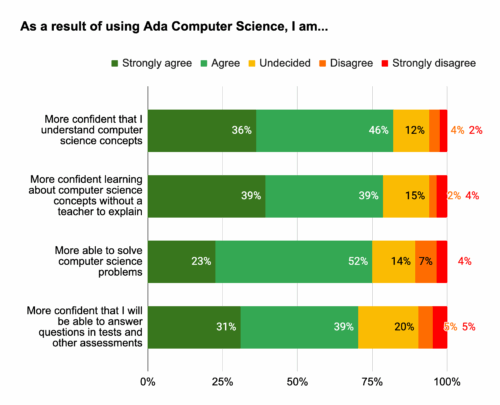
Students also feel that using Ada CS has a tangible impact on their learning. 82% agreed they were more confident that they understand CS concepts as a result of using Ada CS and 79% feel more confident learning about computer science concepts without a teacher to explain.

“I do CS A level but I hadn’t done the GCSE and I found that all of the resources gave me enough information to learn the concepts from scratch and now I’m much more confident in my knowledge of the theory.” – Ada Computer Science student

Graph depicting how students feel using Ada CS has on their learning.

What’s coming next?

Students provided us with lots of useful feedback and suggestions for how we can further improve Ada CS, especially relating to practice questions. We’re already working on adding more questions across topics, creating more challenging questions, and adding more question types that will enhance students’ learning experience. We’ve got some other exciting developments in the pipeline too, which we’ll announce soon!

Thank you to everyone who took the time to complete the survey. These findings are invaluable for shaping the future of Ada Computer Science, helping us to continue to provide the best possible learning platform for students.

The post How Ada Computer Science empowers students: Survey findings appeared first on Raspberry Pi Foundation.

Signal extends backup feature to iOS users

Fortunately, we live in a time when most information can be recovered from another device or the cloud. Now, iPhone users can add another app to that list. Signal has announced that secure backups are now available for iOS devices. It follows a similar launch for Android devices in early September. The company shared the news on X and linked to the previous Android blog post for all additional information.

At the time, Signal noted that secure backups would be an opt-in feature and available in Android users’ latest beta release. The company stated this was to test the feature on a smaller scale before it came to iOS and desktop — so clearly something worked. 

The end-to-end encrypted backup offers no-cost storage of a user’s text messages and up to 45 days of media. Keeping older media costs $2 per month — Signal’s first paid offering. “The reason we’re doing this is simple: media requires a lot of storage, and storing and transferring large amounts of data is expensive,” Signal said at the time. “As a nonprofit that refuses to collect or sell your data, Signal needs to cover those costs differently than other tech organizations that offer similar products but support themselves by selling ads and monetizing data.”

Anyone who opts-in will have their messages backed up each day. The secure backups use a 64-character recovery key that is available exclusively on a user’s device. It’s required to access the backup and Signal is unable to recover it. 

This article originally appeared on Engadget at https://www.engadget.com/apps/signal-extends-backup-feature-to-ios-users-133006884.html?src=rss

EPA Approves New ‘Forever Chemical’ Pesticides For Use On Food

The EPA has approved new pesticides that qualify as PFAS “forever chemicals” (paywalled; alternative source), sparking criticism from scientists and environmental groups who warn these decisions could increase Americans’ exposure through food and water at a time when many states are moving to restrict such substances. The Washington Post reports: This month, the agency approved two new pesticides that meet the internationally recognized definition for per- and polyfluoroalkyl substances, also known as PFAS or fluorinated substances, and has announced plans for four additional approvals. The authorized pesticides, cyclobutrifluram and isocycloseram, which was approved Thursday, will be used on vegetables such as romaine lettuce, broccoli and potatoes. The agency also announced plans to relax a rule requiring companies to report all products containing PFAS and has proposed weakening drinking water standards for the chemicals. “Many fluorinated compounds registered or proposed for U.S. pesticidal use in recent years offer unique benefits for farmers, users, and the public,” EPA spokeswoman Brigit Hirsch said in a statement.

“It is important to differentiate between the highly toxic PFAS such as PFOA and PFOS for which the EPA has set drinking water standards, versus less toxic PFAS in pesticides that help maintain food security,” notes Doug Van Hoewyk, a toxicologist at Maine’s Department of Agriculture, Conservation and Forestry. He added that concerns about food residue depend on the PFAS and the quantity.

Nathan Donley, a senior scientist at the Center for Biological Diversity, also commented: “The data we have about the use of PFAS pesticides is already seven years old, and since there have been many new approvals during that time, those numbers are sure to underestimate the amount were using today.”


Read more of this story at Slashdot.