
Patina 13.0 is now available as this Rust implementation of UEFI firmware. Patina has been working to replace the core UEFI firmware components in a pure Rust implementation to avoid the use of C code…
Monthly Archives: October 2025
Europe’s Big Three Aerospace Manufacturers Combine Their Space Divisions
Airbus, Leonardo, and Thales are merging their space divisions into a new France-based company that aims to create a “leading European player in space.” The joint venture, expected to launch operations by 2027 pending regulatory approval, will pool R&D resources to accelerate satellite development and strengthen Europe’s technological sovereignty in space. Engadget reports: The companies Airbus, Leonardo and Thales have finalized this deal. The new unnamed entity will be based in France and will employ around 25,000 people. Airbus will own 35 percent, while the other two companies will each own 32.5 percent. Executives are hoping this company will better serve Europe’s need for “sovereignty” in space and help it create a rival to SpaceX’s Starlink communications network. Increasing a presence in space is also seen as a good thing for security and defense.
This isn’t just bluster. Thales and Airbus have long been rivals in the satellite market, but it looks like they are friends now. Leonardo is known for space systems and services. Combining all three could actually give SpaceX a run for its money, but we will have to wait and see. There are no planned site closures, as the companies say that each home country will keep its existing capabilities. This will be a standalone company, so think of it as an extremely well-financed startup. The first task for the upstart? Reporting indicates it’ll be to find more efficient ways to develop and manufacture satellites.


Read more of this story at Slashdot.
Linux’s Kconfig Is No Longer Orphaned
Back in August, open-source developer Masahiro Yamada stepped down from maintaining the Kconfig and Kbuild areas of the Linux kernel. While Kbuild maintainership was quickly passed on, no one immediately stepped up to maintain Kconfig as the infrastructure code for configuring the Linux kernel builds. That led to Kconfig officially being orphaned code within the kernel but now that situation has been addressed…
Wilier updates its Filante aero all-rounder race bike, claiming a 13.6% improvement in aerodynamics
Wilier has launched an update to its Filante pro-level race bike, ridden by the Groupama-FDJ WorldTour pro team.
Wilier claims the new Filante ID2 is 13.6% more aero than its predecessor, based on its analyses at the Silverstone wind tunnel in the UK. That’s greater than Wilier had expected based on its CFD modelling, which predicted a 12% improvement in aerodynamics. When it placed a rider atop the bike, it registered a 4.5% aero benefit.
Wilier says that equates to a 14.15-watt drag reduction at 40km/h, or a 1 minute, 45 seconds faster time over 70km when riding at 290W.
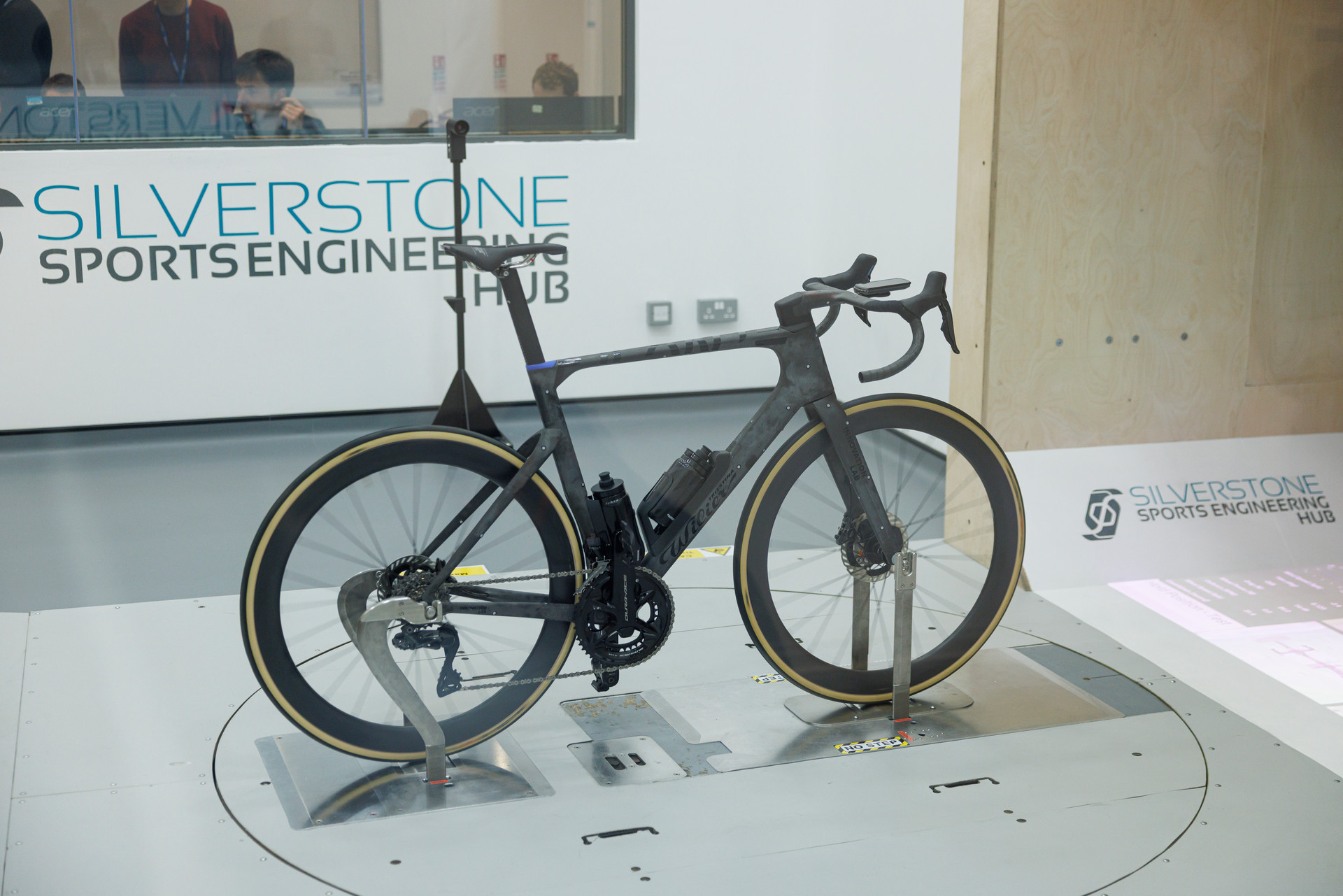
The brand has also carried out a head-to-head comparison against five WorldTour bikes, claiming the new Filante ID2 is 2.42% faster on average.
Wilier uses a mix of M46JB, T1100 and T800 carbon fibre for the bike’s frame and claims an 860g frame weight, as well as a 7.5% increase in bottom-bracket stiffness over the previous-generation Filante. It says a complete bike equipped with Shimano Dura-Ace weighs 7.1kg.
Aero bottles and cages

Wilier says much of the Filante ID2’s aero gain comes from its down tube shape, designed to shield the custom-designed aero bottles and cages, which are a collaboration with Elite.
As with other bikes, such as the Trek Madone Gen 8, Wilier says the Filante ID2 is more aero with bottles in place than without, claiming they reduce drag by more than two thirds compared to standard bottles and cages.
Like the Madone, its system is compatible with regular round bottles as well as its aero bottles, an important consideration for bikes used in races.
There’s 1,100ml total capacity with the aero bottles in place, or the option to hold a 750ml round bottle on the seat tube to carry more.
New flared bar
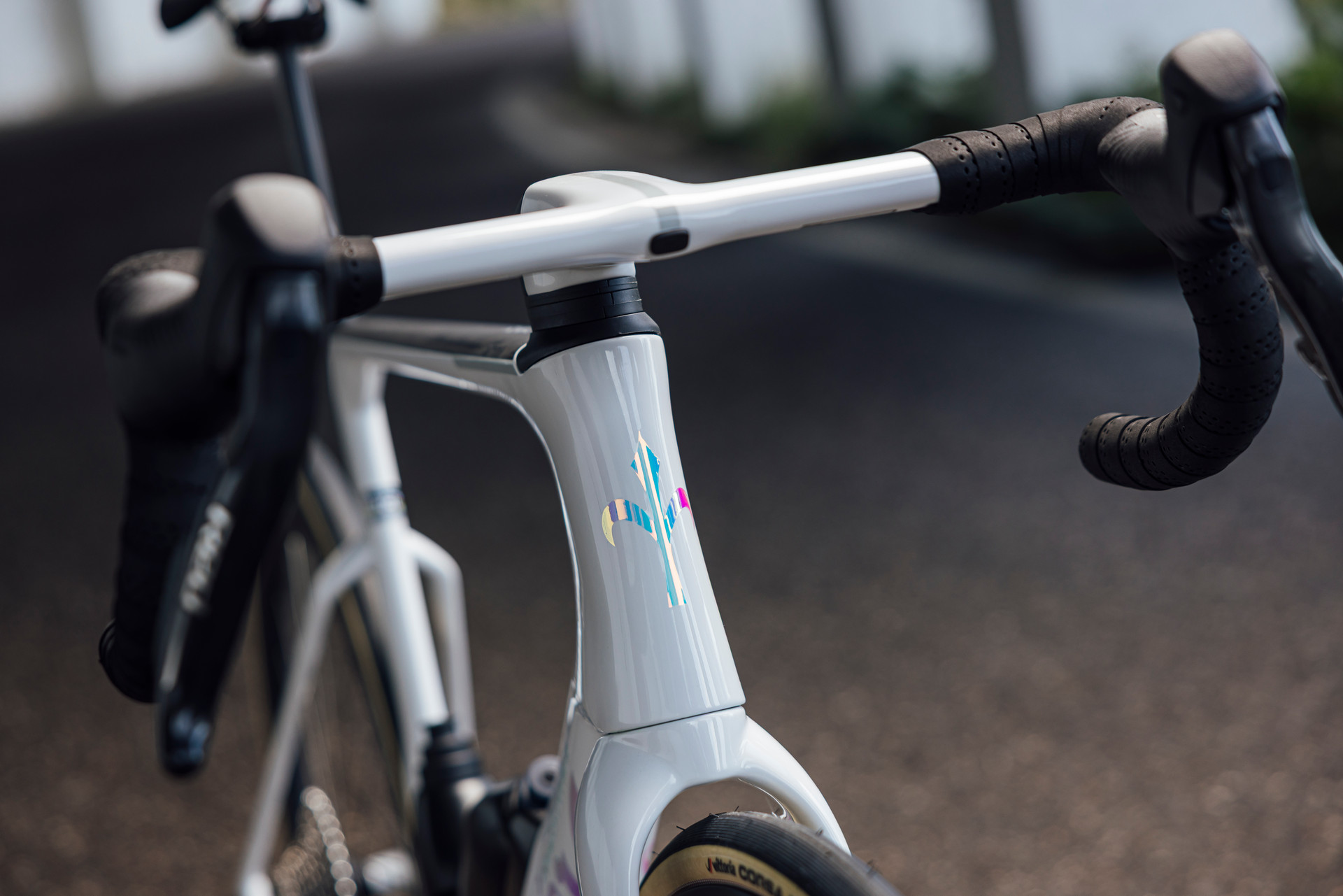
Wilier adopted front-end integration as long ago as 2016 and the Filante ID2 is fitted with its latest bar/stem iteration, which it calls the F-Bar ID2.
As is now common on new performance race bikes, including Wilier’s own Verticale, there’s a flare to the bar – in this case, 3 degrees. Wilier has three widths available: 350/380mm, 370/400mm and 390/420mm. Effective stem lengths run from 75mm to 120mm.
The new handlebar completely encloses the clamping hardware, protecting it from contamination.
Wilier has also borrowed the aero, vibration-absorbing seatpost profile from its Supersonica SLR time trial bike. It comes stock in 0mm setback, but you can request a 15mm-setback version when ordering.
As is increasingly the case with modern road bike designs, including the Specialized Tarmac SL8 and the Cannondale SuperSix Evo, there’s not enough room in the seatpost to fit a Shimano Di2 battery, so Wilier has moved it to the bottom bracket area, where it’s housed in a resin casing. It can be removed easily if needed.
Wilier says the placement also lowers the bike’s centre of mass, improving high-speed stability.
Updated fork and seatstay profiles

Wilier has worked on its fork design, with a new aero blade profile, a more robust fork crown for increased torsional stiffness, an aero fin on the left leg that helps improve aerodynamics around the brake caliper and rotor, and a blind thru-axle bolt on the right leg to smooth airflow.
There’s been more work done on the rear triangle, which now offers 34mm tyre clearance and a UDH dropout, with a slightly increased 41.1cm chainstay length. The seastays are now angled slightly inwards, with the 2.5-degree angle claimed to improve aerodynamic interaction between the stays and the rider’s legs.
Along with the Universal Derailleur Hanger at the rear, the front derailleur hanger can be removed, so the Filante ID2 is compatible with SRAM Full Mount 1×13-speed groupsets or a 56-tooth single chainring.
Wilier Filante ID2 specs and prices
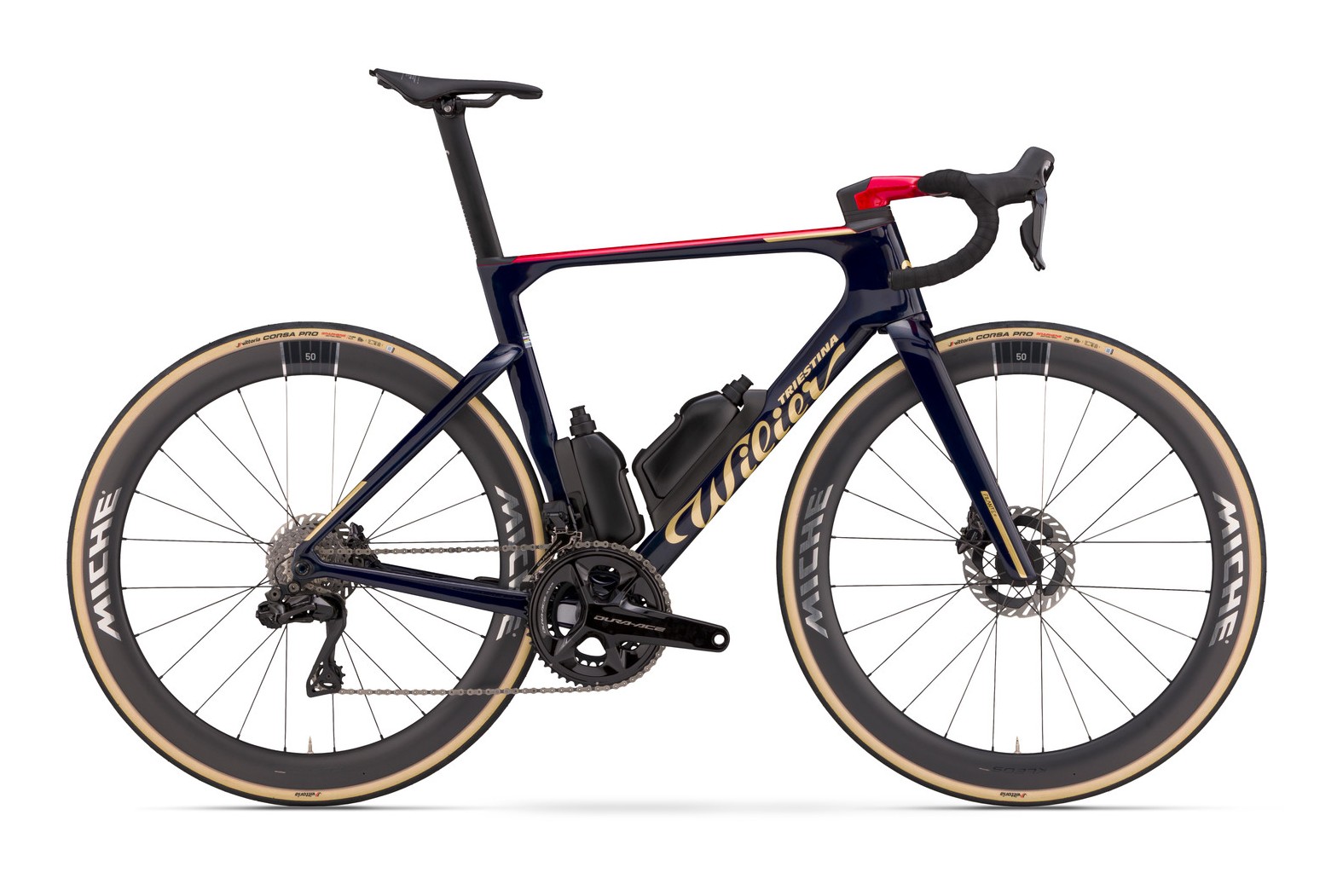
Wilier will sell the Filante ID2 equipped with a range of top-tier groupsets, including options with and without a power meter.
There are two wheelset options: the higher-spec 1,445g Miche Kleos RD 50 and the lower-spec Kleos 50 with a 1,545g claimed weight. There’s also a frame-kit option, complete with bar/stem, and aero bottles and cages.
There are six frame sizes available, which in combination with the different component choices and setups offer 420 different sizing options. The Filante ID2 is available in five colours.
- Campagnolo Super Record 13 w/o power meter, Miche Kleos RD 50 wheelset: €13,100
- SRAM Red AXS w/ power meter, Miche Kleos RD 50 wheelset: €12,900
- Shimano Dura-Ace w/ power meter, Miche Kleos RD 50 wheelset: €12,700
- Shimano Dura-Ace w/o power meter, Miche Kleos RD 50 wheelset: €11,900
- Shimano Dura-Ace w/o power meter, Miche Kleos 50 wheelset: €10,900
- Shimano Ultegra w/o power meter, Miche Kleos 50 wheelset: €9,700
- SRAM Force AXS w/ power meter, Miche Kleos 50 wheelset: €10,300
- SRAM Force AXS w/o power meter, Miche Kleos 50 wheelset: €9,900
- Frameset w/ F-Bar ID2, aero kit, computer mount: €5,800
Summary of the Amazon DynamoDB Service Disruption in Northern Virginia (US-EAST-1) Region
We apologize for the impact this event caused our customers. While we have a strong track record of operating our services with the highest levels of availability, we know how critical our services are to our customers, their applications and end users, and their businesses. We know this event impacted many customers in significant ways. We will do everything we can to learn from this event and use it to improve our availability even further.
Programmer Gets Doom Running On a Space Satellite
An Icelandic programmer successfully ran Doom on the European Space Agency’s OPS-SAT satellite, proving that the iconic 1993 shooter can now run not just everywhere on Earth — but in orbit. ZDNet reports: Olafur Waage, a senior software developer from Iceland who now works in Norway, explained at Ubuntu Summit 25.10 how he, a self-described “professional keyboard typist” and maker of funny videos, ended up making what is perhaps the game’s most outlandish port yet: Doom running on a real satellite in orbit, the European Space Agency (ESA) OPS-SAT satellite. OPS-SAT, a “flying laboratory” for testing novel onboard computing techniques, was equipped with an experimental computer approximately 10 times more powerful than the norm for spacecraft. Waag explained, “OPS-SAT was the first of its kind, devoted to demonstrating drastically improved mission control capabilities when satellites can fly more powerful onboard computers. The point was to break the curse of being too risk-averse with multi-million-dollar spacecraft.” (The satellite was decommissioned in 2024.) […]
Running Doom in orbit was partly a challenge of portability and partly a challenge of the limitations of space hardware and mission control. The on-board ARM dual-core Cortex-A9 processor, while hot stuff for space computing hardware (which tends to be low-powered and radiation-hardened), was slow even by Earth-bound standards. Waage chose Chocolate Doom 2.3, a popular open-source version of Doom, for its compatibility with the Ubuntu 18.04 Long Term Support (LTS) distro, which was already running on OPS-SAT. Besides, Waage noted, “We picked Chocolate Doom 2.3 because of the libraries available for 18.04 — that was the last one that would actually build.
Updating software in orbit is extremely difficult, so relatively little code would have to be uploaded. As Waage said, “Doom is relatively straightforward C with a few external dependencies.” In other words, it’s easy to port. […] The only sign that Doom was running in space at first was a lone log entry. So, the team used the satellite’s camera to snap real-time images of the Earth, then swapped Doom’s Mars skybox for actual satellite photos. “The idea was to take a screenshot from the satellite and use that as the sky, all rendered in software using the game’s restricted 256-color palette,” explained Waage. Even this posed unexpected difficulties: “Trying to draw all of these beautiful colors with those colors,” said Waage, “it’s probably not going to work right off. But we tried gradient tests, NASA demo photos. It took quite a bit of tweaking.” Eventually, instead of a fantasy Mars as the sky background, they got a good-looking, real Earth in the game’s sky. The game itself ran flawlessly. After all, Waage said, “It ran beautifully. It’s on Ubuntu.”


Read more of this story at Slashdot.
Nissan made a nifty solar panel system for its Sakura EV
As we’ve seen with Toyota’s Prius Prime, putting a solar panel on a car’s roof is a nifty idea but can only gain you a few free miles a day due to the limited size. With a new prototype of its hyper-popular Sakura “kei” EV, Nissan has the answer: a bigger solar panel roof called the AO-Solar Extender. When fully stretched out on a sunny day, it can add about 1,864 miles of driving distance a year and power multiple accessories.
The panel works whether you’re driving or parked. When extended (in “solar pompadour” mode as my colleague put it), it generates 500 watts on sunny days. At the same time, it helps block sunlight from the windshield, “reducing cabin temperature and lowering the need for air conditioning power consumption,” Nissan noted.
NISSAN DESIGN
When retracted in driving mode, it still pumps out 300 watts in the sun (80 watts in the rain), quite a bit more than the 185 watts max generated by the Prius Prime’s solar roof. And if you’re worried about aerodynamics, Nissan said the roof is designed to minimize drag and integrate well with the Sakura’s design.
It’s not just a fun exercise, as Nissan said it’s planning to launch the AO-Solar Extender commercially, with details to follow at a later date. It could be a useful accessory on the Sakura, which has been Japan’s most popular EV since 2022 thanks to its “sufficient” range, cute kei looks and spacious interior. The automaker will show it off at the Japan Mobility Show starting on October 30, 2025.
This article originally appeared on Engadget at https://www.engadget.com/transportation/evs/nissan-made-a-nifty-solar-panel-system-for-its-sakura-ev-061235566.html?src=rss
Dinosaurs Were Thriving Until Asteroid Struck, Research Suggests
An anonymous reader quotes a report from The Guardian: Dinosaurs would not have become extinct had it not been for a catastrophic asteroid strike, researchers have said, challenging the idea the animals were already in decline. About 66 million years ago, during the late Cretaceous period, a huge space rock crashed into Earth, triggering a mass extinction that wiped out all dinosaurs except birds. However, some experts have argued the dinosaurs were already in decline. Now researchers say the dating of a rock formation in New Mexico throws doubt on that idea, suggesting dinosaurs were thriving until the fateful impact.
Dr Andrew Flynn, the first author of the research at New Mexico State University, said: “I think based on our new study that shows that, at least in North America, they weren’t going towards extinction.” Writing in the journal Science, Flynn and colleagues report how they dated a unit of rock called the Naashoibito Member in the San Juan basin using two methods. Flynn said the perception that overall dinosaur diversity was falling before the asteroid hit could be a result of there being fewer exposed rocks, and hence fossils, dating to the end of the Cretaceous period than earlier in the epoch. “It looks like, as far as we can tell, there’s no reason they should have gone extinct except for [the] asteroid impact,” he said.


Read more of this story at Slashdot.
One Of The Biggest Competitive Pokémon Players Is Taking A Break Because Of Fan Harassment

Wolfe “Wolfey” Glick says fans have ‘groped’ him and otherwise overstepped at competitive events
The post One Of The Biggest Competitive <em>Pokémon</em> Players Is Taking A Break Because Of Fan Harassment appeared first on Kotaku.
‘Analog Bags’ Are In. Doomscrolling Is Out.
alternative_right shares a report from Axios: The latest must-have accessory is a “stop-scrolling bag” — a tote packed with analog activities like watercolors and crossword puzzles. We spend hours glued to our screens. “Analog bags,” as they’re also called, are one way millennials and Gen Zers are reclaiming that time. “I basically just put everything I could grab for instead of my phone into a bag,” including knitting, a scrapbook and a Polaroid camera, says Sierra Campbell, the content creator behind the trend.
The 31-year-old keeps one bag at home in Northern California, carrying it from room to room, and another in her car. The trend has quickly spread on social media, part of a bigger shift to unplug. Roughly 1,600 TikTok posts were tagged #AnalogLife during the first nine months of 2025 — up over 330% from the same period last year, according to TikTok data shared with Axios. “It speaks to an incredible desperation and desire for experiences that return our attention to us, that fight brain-rotting, that are tactile … that involve creating over scrolling,” says Beth McGroarty, vice president of research at the Global Wellness Institute.


Read more of this story at Slashdot.
VMScape: Cracking VM-Host Isolation in the Speculative Execution Age & How Linux Patches Respond
In the world of modern CPUs, speculative execution, where a processor guesses ahead on branches and executes instructions before the actual code path is confirmed, has long been recognized as a performance booster. However, it has also given rise to a class of vulnerabilities collectively known as “Spectre” attacks, where microarchitectural side states (such as the branch target buffer, caches, or predictor state) are mis-exploited to leak sensitive data.
OpenAI Buys AI Startup That Built Interface For Apple Computers
OpenAI has acquired Software Applications Incorporated, the 12-person startup behind Sky — an AI interface for Mac computers that can understand on-screen context and perform tasks across apps. The deal follows OpenAI’s recent acquisitions of Statsig and Jony Ive’s io. CNBC reports: The startup’s product called Sky allows users of Mac computers to prompt it with natural language to get help with writing, coding, planning and managing their days, OpenAI said in a blog post. Sky can take actions through apps and understands what’s on a user’s screen.
“Sky’s deep integration with the Mac accelerates our vision of bringing AI directly into the tools people use every day,” Nick Turley, the head of ChatGPT at OpenAI, said in a statement. Software Applications was founded in 2023, and the company unveiled Sky in May. OpenAI CEO Sam Altman contributed to the startup’s $6.5 million seed funding round, according to its website.


Read more of this story at Slashdot.
Intel Begins Adding Nova Lake Xe3P To Linux OpenGL/Vulkan Drivers – Some Will Lack Ray-Tracing
Intel recently began sending out Xe3P kernel graphics driver patches for Nova Lake that will begin landing in the upcoming Linux 6.19 kernel cycle. Now on the user-space side, merged today for Mesa 26.0 were the first enablement patches for Xe3P Nova Lake for their open-source OpenGL and Vulkan drivers on Linux…
Fedora Linux 43 Cleared For Release Next Week
Fedora 43 complete with its rocket-themed default desktop background on Fedora Workstation 43 is cleared for lifting off next week…
Anthropic’s Google Cloud Deal Includes 1 Million TPUs, 1 GW of Capacity In 2026
Google and Anthropic have finalized a cloud partnership worth tens of billions of dollars, granting Anthropic access to up to one million of Google’s Tensor Processing Units and more than a gigawatt of compute power by 2026. CNBC reports: Industry estimates peg the cost of a 1-gigawatt data center at around $50 billion, with roughly $35 billion of that typically allocated to chips. While competitors tout even loftier projections — OpenAI’s 33-gigawatt “Stargate” chief among them — Anthropic’s move is a quiet power play rooted in execution, not spectacle. Founded by former OpenAI researchers, the company has deliberately adopted a slower, steadier ethos, one that is efficient, diversified, and laser-focused on the enterprise market.
A key to Anthropic’s infrastructure strategy is its multi-cloud architecture. The company’s Claude family of language models runs across Google’s TPUs, Amazon’s custom Trainium chips, and Nvidia’s GPUs, with each platform assigned to specialized workloads like training, inference, and research. Google said the TPUs offer Anthropic “strong price-performance and efficiency.” […] Anthropic’s ability to spread workloads across vendors lets it fine-tune for price, performance, and power constraints. According to a person familiar with the company’s infrastructure strategy, every dollar of compute stretches further under this model than those locked into single-vendor architectures.


Read more of this story at Slashdot.
1000x View Of Tardigrades Hatching
This is a 1000x magnification of tardigrades (aka waterbears) hatching. The mother tardigrade produces the eggs then sheds her skin with the eggs inside, which are protected until hatching. They’re also trapped and have to find their way out of the skin or die. The whole hatching process takes about 15 minutes, which is 10 minutes longer than it took me to be born because I’m the perfect child and always have been. No need asking my mom for corroboration.
Trump Eyes Government Control of Quantum Computing Firms
An anonymous reader quotes a report from Ars Technica: Donald Trump is eyeing taking equity stakes in quantum computing firms in exchange for federal funding, The Wall Street Journal reported. At least five companies are weighing whether allowing the government to become a shareholder would be worth it to snag funding that the Trump administration has “earmarked for promising technology companies,” sources familiar with the potential deals told the WSJ.
IonQ, Rigetti Computing, and D-Wave Quantum are currently in talks with the government over potential funding agreements, with minimum awards of $10 million each, some sources said. Quantum Computing Inc. and Atom Computing are reportedly “considering similar arrangements,” as are other companies in the sector, which is viewed as critical for scientific advancements and next-generation technologies. No deals have been completed yet, sources said, and terms could change as quantum-computing firms weigh the potential risks of government influence over their operations. […]
The administration will lean on Deputy Commerce Secretary Paul Dabbar to extend Trump’s industry meddling into the quantum computing world, the WSJ reported. A former Energy Department official, Dabbar co-founded Bohr Quantum Technology, which specializes in quantum networking systems that the DOE expects will help “create new opportunities for scientific discovery.” While the firm he previously headed won’t be eligible for funding, Dabbar will be leading industry discussions, the WSJ reported, likely hyping Trump’s deals as a necessary boon to ensure US firms dominate in quantum computing. A Commerce Department official denied the claims, saying: “The Commerce Department is not currently negotiating equity stakes with quantum computing companies.”
In August, the Trump administration took a 10% stake in Intel to help fund factories that Intel is currently building in Ohio.


Read more of this story at Slashdot.
Engineering The World’s Fastest Quadrocopter Drone (363MPH)
These are a couple videos highlighting the journey of father/son team Mike and Luke Bell as they attempt to reclaim the world record for fastest quadrocopter drone after their record was snatched from them last year. There’s a lot of interesting discussion about the engineering and testing of the drone, but, besides the occasional drone fire, the best footage is the actual test flights. At full throttle (which would drain the battery in just 23 seconds) the drone reaches an impressive 363MPH. Damn, what I wouldn’t give to experience flying that fast. “Commercial planes fly at like 600MPH.” What! *ahem* I meant I totally knew that, I was talking about with a jetpack.
Videos below, test footage towards the end, 14:25 in the first video.
Microsoft Puts Office Online Server On the Chopping Block
Microsoft is retiring Office Online Server on December 31, 2026, ending support and updates for organizations running browser-based Office apps on-premises. The Register reports: After this, there won’t be any more security fixes, updates, or technical support from Microsoft. “This change is part of our ongoing commitment to modernizing productivity experiences and focusing on cloud-first solutions,” the company said. Office Online Server provides browser-based versions of Word, Excel, PowerPoint, and OneNote for customers who want to keep things on-prem without having to roll out the full desktop applications. Microsoft’s solution is to move to Microsoft 365, its decidedly off-premises version of its applications. The company said it is “focusing its browser-based Office app investments on Office for the Web to deliver secure, collaborative, and feature-rich experiences through Microsoft 365.”
Other than migrating to another platform when the vendor pulls the plug, affected customers have few options. The announcement will also hit several customers running SharePoint Server SE or Exchange Server SE. While those products remain supported, Office Online Server integration will go away. The company suggested Microsoft 365 Apps for Enterprise and Office LTSC 2024 as alternatives for viewing and editing documents hosted on those servers.
Skype for Business customers will also lose some key features related to PowerPoint. Presenter notes and high-fidelity PowerPoint rendering will go away. In-meeting annotations, which allow meeting participants to write directly to slides without altering the original file, will no longer be available, and embedded video playback will run at lower fidelity. Features like whiteboards, polls, and app sharing shouldn’t be affected. Microsoft’s solution is a move to Teams, which the company says “offers modern meeting experiences.”


Read more of this story at Slashdot.
EA partners with the company behind Stable Diffusion to make games with AI
Electronic Arts has announced a new partnership with Stability AI, the creator of AI image generation tool Stable Diffusion. The company will “co-develop transformative AI models, tools, and workflows” for the game developer, with the hopes of speeding up development while maintaining quality.
“I use the term smarter paintbrushes,” Steve Kestell, Head of Technical Art for EA SPORTS said in the announcement. “We are giving our creatives the tools to express what they want.” To start, the “smarter paintbrushes” EA and Stability AI are building are concentrated on generating textures and in-game assets. EA hopes to create “Physically Based Rendering materials” with new tools “that generate 2D textures that maintain exact color and light accuracy across any environment.”
The company also describes using AI to “pre-visualize entire 3D environments from a series of intentional prompts, allowing artists to creatively direct the generation of game content.” Stability AI is most famous for its powerful Stable Diffusion image generator, but the company maintains multiple tools for generating 3D models, too, so the partnership is by no means out of place.
It helps that AI is on the tip of most video game executives’ tongues. Strauss Zelnick, the head of Grand Theft Auto publisher Take-Two, recently shared that generative AI “will not reduce employment, it will increase employment,” because “technology always increases productivity, which in turn increases GDP, which in turn increases employment.” Krafton, the publisher of PUBG: Battlegrounds, made its commitment to AI even more clear, announcing plans on Thursday to become an AI-first company. Companies with a direct stake in the success of the AI industry, like Microsoft, have also created gaming-focused tools and developed models for prototyping.
The motivations for EA might be even simpler, though. The company is in the midst of being taken private, and will soon be saddled with billions in debt. Theoretically cutting costs with AI might be one way the company hopes to survive the transition.
This article originally appeared on Engadget at https://www.engadget.com/gaming/ea-partners-with-the-company-behind-stable-diffusion-to-make-games-with-ai-222253069.html?src=rss