Why a Chest Strap Is the Best Way to Track Your Heart Rate During Exercise

We may earn a commission from links on this page.

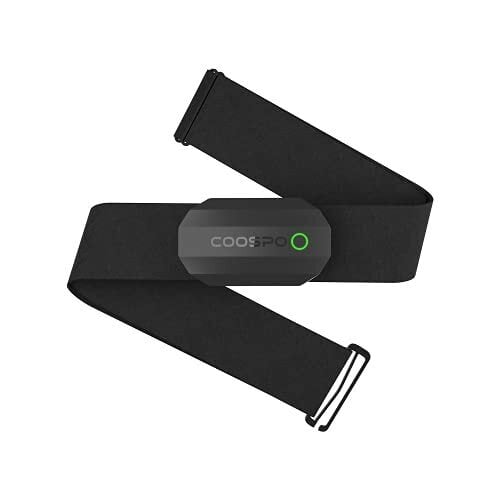
Pretty much every fitness tracker and smartwatch has an optical heart rate sensor, but they’re not always perfectly accurate. Not only can you get better accuracy by wearing a chest strap heart rate monitor, you can even use a chest strap without a fitness watch—just connect it to your phone. Chest straps don’t break the bank, either; my favorite is around 30 bucks.
Why chest straps are more accurate than watches

Chest straps come in two varieties: electrical and optical. When I say a chest strap is more accurate than a watch, I’m talking about the electrical kind. These use electrodes that contact your skin, and sometimes you may need to wait until you’ve worked up a bit of a sweat before they get a good connection (although I haven’t found that to be an issue in my workouts).

That makes them far more accurate than optical sensors, which are the type you’ll see on the back of a smartwatch. Optical sensors are also on armbands like the Polar Verity Sense, and on some chest straps. Most chest straps are the electrical type, including the Polar H10, the Wahoo TRACKR, and the Coospo I mentioned above. You can tell an electrical sensor because it has metal connectors or contact points instead of a green light.

The optical sensors in watches use a green light, and they pick up your heart rate by detecting the light that bounces off your blood vessels as the blood pulses through. Relying on light means that they don’t always work as well through tattoos and may struggle with accuracy on darker skin tones. They can also be confused by outside light, which is why they aren’t as accurate if your watch is worn loosely or is too large to get a good fit. Runners sometimes experience “cadence lock,” where the cadence of their footsteps (170 steps per minute, let’s say) causes the watch to think your heart is beating at exactly that rhythm. If your app reports a heart rate that is the same as your cadence, there’s a good chance it wasn’t measuring your heart rate at all.

You can sidestep all of those issues by wearing a chest strap. As I’ve found in my device reviews, even the most accurate watches won’t always record your heart rate perfectly 100% of the time. If you care a lot about your heart rate in training, just get the chest strap.

Why the Coospo is my favorite

I’ve been wearing a cheap Coospo heart rate monitor for years. I didn’t borrow it for a review, I just bought one because I wanted a cheap and easy way to track my heart rate without a watch. (I was doing a lot of kettlebell workouts, and the kettlebell rests gently on your wrist during overhead exercises, where a watch would be in the way.

I’ve kept using it since then. It’s been happily paired with an iPhone, a Peloton, an Apple Watch, a series of Garmins, and probably a bunch of others I’ve forgotten about. When I write the “accuracy” section in my fitness watch comparisons and reviews, I use the Coospo (either paired to my phone or to a third watch) to get a gold-standard heart rate graph to see how the tested devices stack up.

The Coospo heart rate monitor I have is a slightly older version of the one linked above (since I’ve had it so long). It uses Bluetooth and also supports ANT+, and it gets its power from a coin cell battery that I have to change out roughly once a year. It doesn’t have any on-device storage space, which I don’t need, because it beams the data directly to the connected watch or phone. It’s comfortable and easy to adjust. The device pops off so I can wash the strap. And even though there are more expensive straps out there (like the $100 Polar H10, which I’ve heard is great), I cannot think of a single chest strap feature I could possibly care about that I don’t already have.

How to use a chest strap without a watch

On my iPhone, I found the simplest way was to download the Polar Beat app (free on iOS and Android), which pairs with my strap over Bluetooth. If you’re going for a run or a bike ride while carrying your phone, it can also use your phone’s GPS to track your pace and record where you went on a map.

I tend to use mine for indoor cycling, though, and for kettlebell workouts (which I log as “other indoor”). Using a strap without a watch is especially handy with kettlebells, since the bell otherwise knocks into the watch in certain positions. But if you have a fitness watch and you like using it, most models will allow you to pair the watch with a chest strap directly. That way you can get the most accurate readings, and be able to check the numbers from your wrist.

WordPress creator files countersuit against WP Engine over trademark violations

There’s been another turn in WordPress creator Automattic’s ongoing legal battle with WordPress provider WP Engine. In a counterclaim Automattic filed as part of WP Engine’s lawsuit against the company, the WordPress creator claims investment from private equity firm Silver Lake led WP Engine to violate its trademarks and fail to contribute to the open-source WordPress project.

Automattic believes that following a $250 million investment from Silver Lake, which gave the firm a controlling interest in WP Engine, the hosting provider “sought to inflate its valuation and engineer a quick, lucrative exit.” It allegedly did that, per the counterclaim, by describing itself as the “WordPress Technology Company” and allowing its partners to refer to it as “WordPress Engine,” violations of the WordPress trademark. Automattic claims products WP Engine released like “Core WordPress” and “Headless WordPress” further obfuscated who created and developed the blogging platform’s technology, while the company also failed to commit a promised “five percent of its resources to support the WordPress project.”

The counterclaim goes on to say that Automattic and WordPress co-found Matt Mullenweg tried to work out these issues with WP Engine by offering a “fair trademark license,” but the company only “pretended to engage in licensing discussions,” while actually delaying any kind of agreement because it would “impact its earnings.” Keeping earnings up was important to WP Engine because Silver Lake was allegedly trying to sell WP Engine at a $2 billion valuation, and had even made “overtures to Automattic” about it.

That’s a different story than the one WP Engine spun in its original lawsuit against Automattic, which accused Mullenweg of “abuse of power, extortion and greed.” WP Engine’s original complaint claimed that Automattic asked the company for eight percent of its monthly revenue as a royalty payment. Mullenweg’s attempts to punish WP Engine were seen as so aggressive at the time that over 100 Automattic employees voluntarily left the company in response. WP Engine won a preliminary injunction in response to its lawsuit, but it seems like the story might be more complicated than it originally appeared.

This article originally appeared on Engadget at https://www.engadget.com/social-media/wordpress-creator-files-countersuit-against-wp-engine-over-trademark-violations-182123827.html?src=rss

EU accuses Meta of violating content rules in move that could anger Trump

Meta violated the Digital Services Act (DSA) by failing to give Facebook and Instagram users simple mechanisms to report illegal content, the European Commission said in a preliminary decision announced yesterday. Meta also failed to give users an effective way to challenge content moderation decisions, the EC said.

“When it comes to Meta, neither Facebook nor Instagram appear to provide a user-friendly and easily accessible ‘Notice and Action’ mechanism for users to flag illegal content, such as child sexual abuse material and terrorist content,” the EC press release said. The EC said that Meta mechanisms seem to “impose several unnecessary steps and additional demands on users. In addition, both Facebook and Instagram appear to use so-called ‘dark patterns,’ or deceptive interface designs, when it comes to the ‘Notice and Action’ mechanisms.”

The EC also found that the content moderation appeal mechanisms used by Facebook and Instagram do not “allow users to provide explanations or supporting evidence to substantiate their appeals. This makes it difficult for users in the EU to further explain why they disagree with Meta’s content decision, limiting the effectiveness of the appeals mechanism.”

Read full article

Comments

I want to see your sketchy hacks and ultralight bikes at the UK National Hill Climb Championships

Bank Road in Matlock plays host to the 2025 CTT National Hill Climb Championship this weekend and BikeRadar will be there, hunting down the weirdest, lightest, sketchiest and most wonderful bikes on show.

The Nationals mark the finale of Britain’s short but savage hill climb season, a uniquely British racing niche that sits entirely outside UCI regulation.

This sees riders strip their bikes to the bare minimum in pursuit of speed, racing solo against the clock in a time trial format on climbs lasting anywhere from one to 20 minutes.

From high-end carbon frames with the paint sanded off, to featherweight fixies and DIY creations held together with little more than hope, the National Hill Climb always delivers a brilliant mix of ingenuity and pure suffering.

Always a professional and personal highlight of my year, I’ll be there this year for the whole weekend to document the best bikes on show. If you’re racing and think your setup deserves a moment in the spotlight, send a few photos and a short description of your bike to news@bikeradar.com. If it catches our eye, I’ll be in touch – and you and your bike can enjoy your five minutes of fame.

This year’s course covers 834 metres of Bank Road and Rutland Street, finishing on Wellington Street. It averages a brutal 14 per cent, pitching up to 20 per cent near halfway – short, sharp, and guaranteed to make even the fittest riders see stars.

We’ve been to Bank Road before, and it never fails to deliver. Back in 2016, former BikeRadar staff member Joe Norledge rode the Nationals on a custom 5.1kg Engineered Bikes fixed gear, stripping every gram he could while still keeping it rideable.

Inspired by the sound of this gloriously painful event? Come and watch the action unfold on Bank Road, Matlock, from 10:45 on Sunday 24 October.

Wikipedia Drama Goes Mainstream

Larry Sanger, who helped launch Wikipedia in 2001 before being ousted by co-founder Jimmy Wales a year later, has spent years arguing the online encyclopedia has abandoned its commitment to neutrality. Leading conservatives in the second Trump administration are now amplifying his critique. Elon Musk announced plans to launch an AI-powered alternative called Grokipedia this week, calling Wikipedia “hopelessly biased.” Senator Ted Cruz sent a letter to the Wikimedia Foundation demanding answers about what he termed “ideological bias.” House Republicans opened an investigation into possible platform manipulation.

Sanger published “Nine Theses” on reforming Wikipedia and appeared on Tucker Carlson’s show. His arguments circulated widely among conservatives, including Trump’s AI czar David Sacks. Sanger recently converted to Christianity and voted for Trump in 2024. He is working to recruit hundreds of conservatives to become active Wikipedia editors. Wikipedia co-founder Jimmy Wales maintains that neutrality remains the site’s core policy.


Read more of this story at Slashdot.

Zwift Extends Partnership with Tour de France Femmes Through 2029

This week, as the Tour de France Femmes avec Zwift 2026 route was presented, Zwift announced a 3-year extension of their TdFFaZ presenting partnership with Amaury Sport Organisation (A.S.O.). Read yesterday’s press release below…


Zwift, the global online fitness platform for cyclists, is today proud to announce the extension of its sponsorship of  Tour de France Femmes avec Zwift, continuing as Presenting Partner until at least 2029. The deal marks a continuation of a long-term partnership with A.S.O. that saw the introduction of the Tour de France Femmes avec Zwift to the UCI calendar in 2022.

“This is much more than a sponsorship for Zwift, it’s a part of our identity, underpinned by our mission to make more people, more active, more often.” Says Eric Min, Zwift CEO and Co-Founder of Zwift. “Growing women’s participation in cycling is a critical mission. We truly believe that to be successful, the Tour de France Femmes avec Zwift is essential. The first four years of this partnership have been incredible. The excitement is tangible and the impact is clear. I can’t wait to see what we can achieve over the next four years and beyond.”

The Tour de France Femmes avec Zwift was born from a shared vision between Zwift and A.S.O. to elevate women’s cycling to the global stage it deserves. The partnership began with the Virtual Tour de France in 2020, launched during the pandemic with equal fields for both men and women, to keep racing alive and connect fans around the world. The success of this event cemented the co-determination to bring back a Tour de France for women. That vision became reality with the launch of the Tour de France Femmes avec Zwift, a milestone moment that continues to inspire, engage, and grow the sport globally.

“The Tour de France has always been the most famous race in cycling and it has been fantastic to have it added to the calendar for the women’s peloton,” says Kasia Niewiadoma-Phinney, CANYON//SRAM zondacrypto rider and 2024 Tour de France Femmes avec Zwift winner. “Winning the iconic yellow jersey has been the highlight of my career and it is so exciting that the Tour de France Femmes avec Zwift will continue to be the biggest race on the calendar and show off the excitement of women’s cycling to people around the world.”

Central to Zwift’s mission to grow women’s cycling is the Watch The Femmes campaign. Over four years, the call to action has evolved into a movement, inviting everyone who supports women’s cycling, from media and industry partners to brands and fans, to unite around a shared goal: growing the sport and ensuring women’s cycling receives the visibility and recognition it needs to continue thriving. The impact of this united effort is clear in the rising visibility and audience engagement around women’s cycling. There is no race on the women’s calendar that has helped bring more attention to the sport. 2025 brought an average audience of 2.7 million viewers per stage, in France alone, with the coverage accounting for a 31.6% audience share. The final stage with Pauline Ferrand-Prevot storming to victory brought a peak audience of 7.7 million. Since the introduction of the Tour de France Femmes avec Zwift in 2022, Zwift has also seen an increase in the number of women joining the platform. Currently, 23% of new subscribers are women – a notable increase since the first edition of the race in 2022, where women accounted for 18% of new subscribers.

“The Tour de France Femmes avec Zwift continues to break records and exceed even our own expectations,” says Marion Rousse, Director of the Tour de France Femmes avec Zwift. “It’s a pleasure to work alongside a partner that helps amplify the race and women’s professional cycling in the way that Zwift does. We’ve achieved a lot already and I’m excited that we can continue this journey together.”

For more information on the Tour de France Femmes avec Zwift, head to www.letourfemmes.fr/en

More information on Zwift’s Watch The Femmes, head to https://www.zwift.com/watchthefemmes 

Instagram adds a watch history for Reels

Instagram’s latest feature should make it easier to resurface videos you’ve viewed. On Friday, Adam Mosseri revealed a new watch history for Reels. “Hopefully, now you can find that thing that you were trying to find that you couldn’t find before,” the Instagram CEO said.

We could see the feature coming in handy. For example, when you see something interesting but lose it due to an accidental tap or app refresh.

You can find it on Instagram under Settings > Your activity > Watch history. The feature lets you sort by newest to oldest or vice versa. You can also jump to a specific date or date range, and filter by the account that posted it.

This article originally appeared on Engadget at https://www.engadget.com/social-media/instagram-adds-a-watch-history-for-reels-175555668.html?src=rss

Intel Core Ultra 5 338H Panther Lake CPU With Arc B370 GPU Makes A Benchmark Cameo

Intel Core Ultra 5 338H Panther Lake CPU With Arc B370 GPU Makes A Benchmark Cameo
A new entry in the Geekbench 6 database has turned up another example of Intel’s forthcoming Panther Lake mobile silicon, and this one brings a few twists. Unlike earlier leaks, the integrated graphics device name is properly filled in, so the listing identifies the processor as a Core Ultra 5 338H with an integrated Intel Arc B370 GPU. That

Amiga A1200 Makes A Glorious Comeback After 30 Years With 25 Classic Games

Amiga A1200 Makes A Glorious Comeback After 30 Years With 25 Classic Games
These last few years have seen a spate of classic computer hardware recreated with updated features fit for modern displays and gaming. The next device to get this treatment will be the legendary Amiga A1200, which will be brought back to life by Retro Games Ltd as THEA1200. If you recall, Retro Games Ltd did something similar with the successful

Browser Promising Privacy Protection Contains Malware-Like Features, Routes Traffic Through China

A web browser linked to Chinese online gambling websites and downloaded millions of times routes all internet traffic through servers in China and covertly installs programs that run in the background, according to findings published by network security company Infoblox. The researchers said the Universe Browser, which advertises itself as offering privacy protection, includes features similar to malware such as key logging and surreptitious connections.

Infoblox collaborated with the United Nations Office on Drugs and Crime on the research. The investigators found links between the browser and Southeast Asia’s cybercrime ecosystem, which has connections to money laundering, illegal online gambling, human trafficking and scam operations using forced labor. The browser is directly linked to BBIN, a major online gambling company that has existed since 1999. Infoblox researchers examined the Windows version of the browser and found that it checks users’ locations and languages when launched, installs two browser extensions, and disables security features including sandboxing.


Read more of this story at Slashdot.

Rivian agrees to settle shareholder lawsuit for $250 million

Rivian has agreed to settle a 2022 shareholder lawsuit. The automaker will pay out $250 million to qualifying investors if the agreement is approved. The lawsuit stemmed from alleged deception surrounding a March 2022 price hike for the R1S SUV and R1T truck.

The class-action lawsuit alleges that Rivian misled investors around the time of its 2021 IPO. The core accusation is that the automaker failed to disclose that the R1s and R1T were initially priced lower than their production costs. Shareholders claim this made the eventual price increases inevitable, something they (understandably) believe Rivian should have shared.

Rivian raised the base price of the R1S and R1T by $12,000 in March 2022. That initially included most reservations. However, the company quickly reversed course on the last bit: Following a backlash, it allowed customers who pre-ordered before the announcement to pay the original price after all.

Rivian framed the settlement as a chance to move forward. “The company denies the allegations in the suit and maintains that this agreement to settle is not an admission of fault or wrongdoing,” the automaker wrote in a statement. “However, settling will enable Rivian to focus its resources on the launch of its mass market R2 vehicle in the first half of 2026.”

The US District Court for the Central District of California, Western Division, will still need to approve the settlement.

News of the proposed agreement comes a day after Reuters reported that Rivian is laying off 4.5 percent of its workforce (over 600 workers). Last month’s expiration of $7,500 tax credits and President Trump’s tariffs, combined with weakened EV demand, are making profitability more of an uphill climb.

This article originally appeared on Engadget at https://www.engadget.com/transportation/evs/rivian-agrees-to-settle-shareholder-lawsuit-for-250-million-171251731.html?src=rss

Microsoft’s Mico heightens the risks of parasocial LLM relationships

Microsoft is rolling out a new face for its AI, and its name is Mico. The company announced the new, animated blob-like avatar for Copilot’s voice mode yesterday as part of a “human-centered” rebranding of Microsoft’s Copilot AI efforts.

Mico is part of a Microsoft program dedicated to the idea that “technology should work in service of people,” Microsoft wrote. The company insists this effort is “not [about] chasing engagement or optimizing for screen time. We’re building AI that gets you back to your life. That deepens human connection.”

Mico has drawn instant and obvious comparisons to Clippy, the animated paperclip that popped up to offer help with Microsoft Office starting in the ’90s. Microsoft has leaned into this comparison with an Easter egg that can transform Mico into an animated Clippy.

Read full article

Comments

I Put Over 1,000 Miles on a Pair of Cheap Running Shoes, and Here’s What I Learned

We may earn a commission from links on this page.

I broke one of the biggest rules in the running book and lived to tell about it. Everybody knows you need to replace your running shoes after 300 to 500 miles to avoid injury (or 200 to 400, or whatever running companies are saying these days). Well, I put over 1,000 miles on mine, and I’m not sorry. 

I know it’s been over 1,000 miles because I’ve been tracking my shoes’ mileage in the Garmin Connect app. My watch logs the mileage, and I make sure the credit goes to the appropriate shoe in the app. I carefully ported my shoe miles to and from the Coros app when I switched ecosystems for a bit this past summer. Some of my runs are in a trail shoe, some in a water-resistant shoe, and the rest are in my Nike Downshifters. That four-digit number in the app is real, and I’m sure of it. 

What are these magic shoes? 

Nike Downshifters, side and sole view
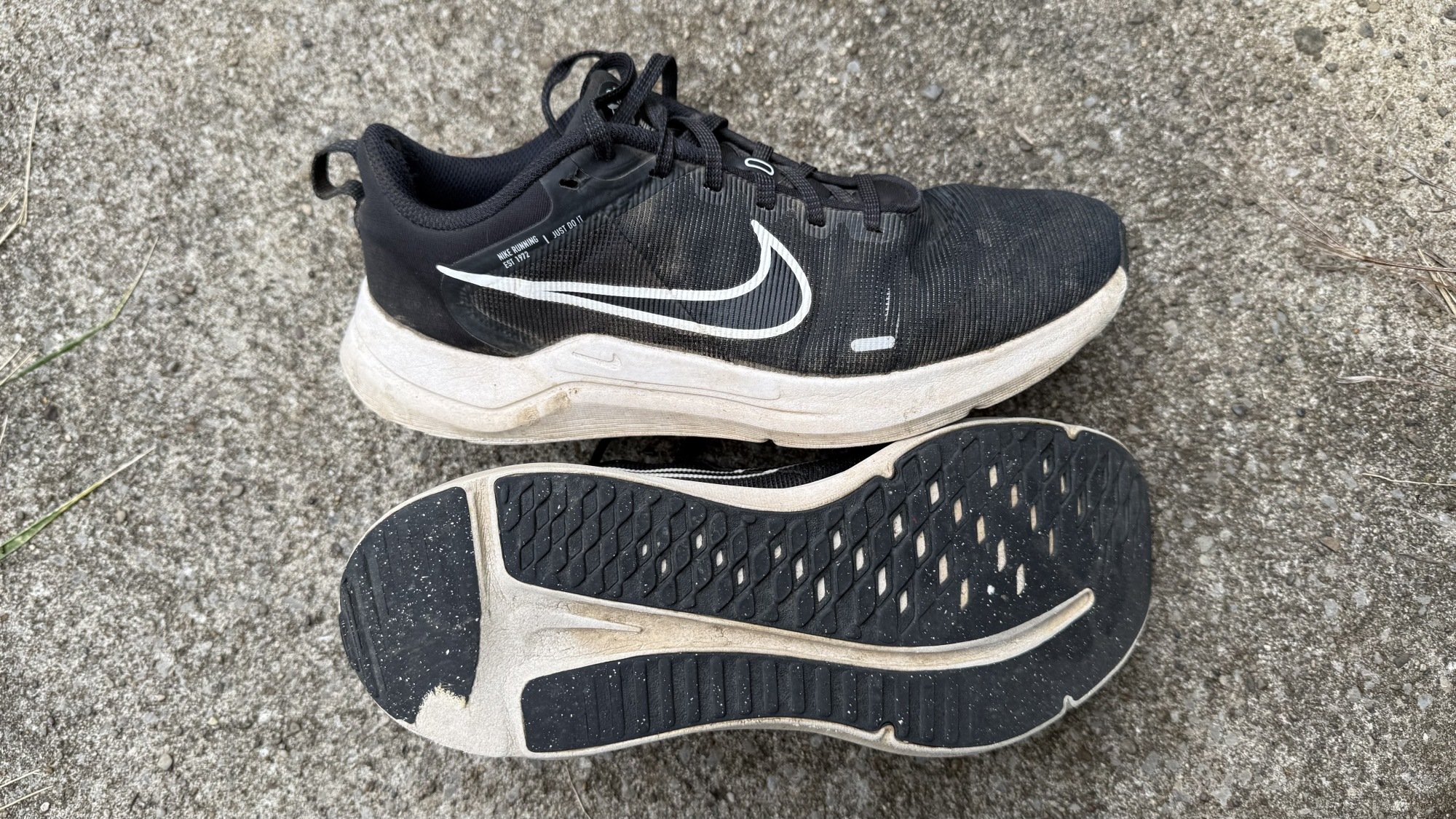
Some rips in the upper, but honestly looking pretty good for their age.
Credit: Beth Skwarecki

Meet the honored pair. These are the Nike Downshifter 12, in a women’s U.S. size 8.5. I bought them from Amazon in 2024 and paid $66.94 including tax. As I’m writing this, my records show I’ve worn them for 294 activities since June 25 of last year, and they’ve logged a total of 1,024 miles in running workouts. (That’s 6.5 cents per mile, surely a personal record.) For context I run about 20-30 miles most weeks, often but not always in these shoes. 

The Downshifter is a beginner-level running shoe from Nike, but I’m a lifelong runner, not a beginner. I bought my first pair of them out of frustration with other shoes. 

See, I always bought Nike Frees, but Nike kept changing the Free from year to year. Some I liked, some I didn’t. Over time, it seemed like the Frees were getting more expensive every year, and wearing out sooner. Often within a few months of purchase, the foam underfoot would wear unevenly and I’d be running on uncomfortable lumps.

So one day in 2023, I decided I needed to find a shoe that would either last longer, or would be cheap enough that I wouldn’t care. (I ended up with a shoe that checked both boxes.) I browsed sales and bought two pairs, including a purple pair of Downshifter 12’s. I didn’t love them right out of the box, but over the season, they became my favorites. I ran in them all spring and summer, and then ran a half-marathon in them that fall. 

Afterward, I looked up some reviews of the Downshifters, just for fun. One said that the Downshifter is “not the shoe for runners regularly going over four miles.” I laughed. I replaced those purple Downshifters with a new (black) pair in 2024, just because it had been a while and they were probably close to the oft-advised 500-mile limit. That’s what you’re supposed to do, right? 

Why did I put 1,000 miles on these shoes? 

Fate had something different in mind for these new Downshifters. I was curious how long they would last, so I entered them into the gear logging section of my Garmin app. When you add a new shoe, Garmin asks you to set a mileage target so it can let you know when to replace them. I put 500. 

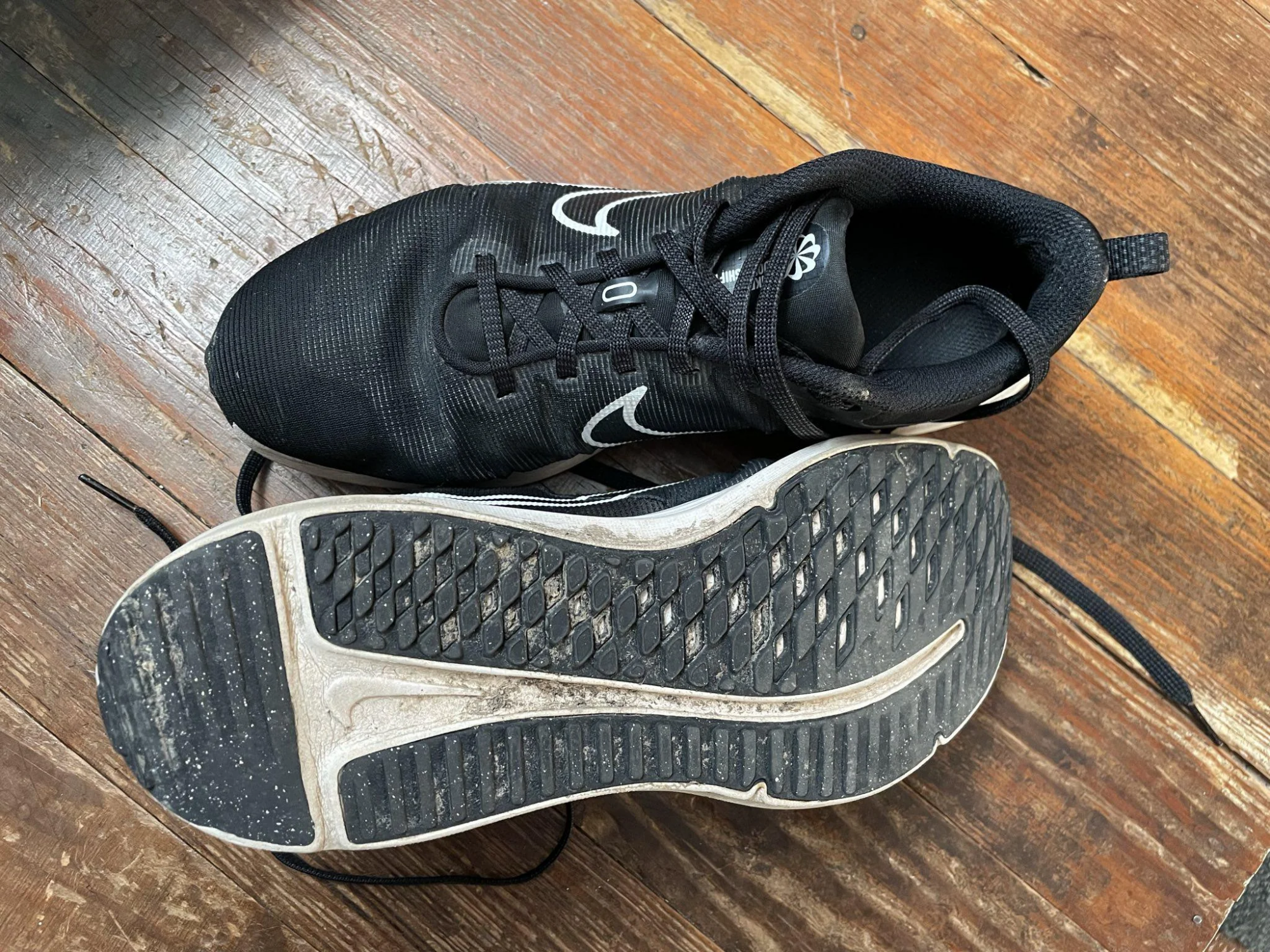
After every run, Garmin would automatically add up my miles. (If I ran in a different pair of shoes, I’d make sure to note that—I’ve put about 200 miles each on two other pairs of shoes within this timeframe.) When I had over 400 miles on the black Downshifters, I ordered a new pair, which still sits untouched in its shoebox to this day. At 500, I ignored the notification to replace my shoes. At 600, “I wonder if I can get these to 1,000” was a dumb thought that entered my head and did not leave. For comparison, here is how they looked at 500 miles:

Downshifters at 500 miles
How they looked at 500 miles. There’s still some tread on the heel, and the upper is in OK shape.
Credit: Beth Skwarecki

I kept tracking my shoe mileage carefully. This dumb thought is why I was so particular about keeping the miles-per-shoe numbers accurate even when I switched apps. 

The day I hit 1,000 was an anti-climax. I remember them being at 998 miles before joining my husband for an early morning run a few weeks ago. I mentioned to him during the run that the shoes were probably crossing 1,000 miles at that exact moment. “Nice!” he said, and we jogged on. I’ve kept running in them since then. I ran in them today. They feel fine. 

Why I think these shoes lasted so long

I’m no shoe-construction expert, but judging from the feel, it seems there’s just a simple slab of foam under my foot. My previous pairs, the less-durable ones, may have had lighter foams and they usually had more complicated shapes, with cutouts and grooves and such. 

The running shoes on the market are all so different that I don’t think it’s fair to come up with a blanket mileage recommendation that applies to everything. I’ve had running shoes that felt awful to run in after probably less than 100 miles. And then there are others that can go, apparently, 10 times as long. 

These Downshifters are the first pair where I confirmed the exact mileage, but I can think of two other pairs that seemed to last forever: an original 2004 Free 5.0, and a “Free RN Distance” from sometime in the 2010s. I replaced the 2004s when I realized I needed to go a half size bigger to avoid black toenails during marathon training. (No idea of the mileage, but I’d been using them off-and-on for eight years at that point.) I got rid of the RN Distance shoes during a decluttering binge because I hated the color. I soon regretted that decision. Neither pair actually wore out. 

My unscientific opinion is that these shoes lasted so long because they were simple. Just a slab of foam, no fancy shaping, and certainly no high-performance foam technology that might give better dynamics at the cost of longevity. Or maybe I was just lucky. Who knows.

What I think of shoe mileage rules in general

The advice to replace your shoes after 300 to 500 miles originated with a 1985 study that only tested shoes up to 500 miles, no further. It used a machine to simulate the effects of running. After 50 miles, shoes from several manufacturers only had 75% of their initial shock absorption capability. Between 250 and 500 miles, they were down to 60%. (The machine was harder on the shoes than actual runners; after 500 miles, human-worn shoes still had 70% of their initial shock absorption.) 

Surely shoe foams in 2025 are not the same as in 1984. And surely the various shoe models on the market are all different from each other in construction and foam type. But still the 300 to 500 mile rule has persisted, and I have to wonder if shoe makers are designing their shoes to meet the expectation of a 300 to 500 mile lifespan. 

A fascinating article at Runner’s World gets into detail about the different foams that are used these days and what we know about how long they last. Some “super shoes” lose their peak performance after just 100 miles, but even a worn-out super shoe may still perform better than a brand new budget shoe. The article doesn’t make any mileage recommendations, instead landing on advice to “listen to your body, rather than relying on arbitrary yardsticks.” 

I’ve also collected some advice from experienced runners on Reddit on how often they actually switch out their shoes, and as you might expect, the answers are all over the place. There are people who set a hard cap on the mileage they’ll allow a shoe to accrue, and others who go based on vibes. Some people only get 300 miles out of each pair; others say they routinely take theirs into the quadruple digits. 

Ultimately I don’t think much of any rule, and I’m skeptical of the idea that worn-out shoes are a recipe for injury. Running itself is a recipe for injury—I dare you to find an experienced runner who hasn’t dealt with some type of overuse injury, even if they follow every rule in the book. I think some runners use a shoe mileage cap as sort of a good-luck talisman. 

But injury isn’t that predictable, and neither our bodies nor our shoes will always behave in a predictable way over the years. Some shoes agree with our bodies better than others, and some last longer than others. When you find a pair that works for you, you might as well stick with it. 

Microsoft Outlook is Getting an AI Overhaul Under New Leaders

Microsoft has reorganized its Outlook team under new leadership as part of a broader effort to integrate AI into its core products. Gaurav Sareen, a corporate vice president at the company, recently assumed direct leadership of the Outlook division after Lynn Ayres, who previously ran the team, began a sabbatical. The move represents the latest in a series of AI-focused restructurings across Microsoft’s divisions. Sareen wrote in an internal memo that the company now has an opportunity to reimagine Outlook from the ground up rather than add AI features to existing systems, according to The Verge.

Ryan Roslansky, the chief executive of LinkedIn, took on an expanded role earlier this year as head of Office. Sareen now reports to Roslansky, who oversees the Office suite, Outlook and Microsoft 365 Copilot teams. The restructuring comes after Microsoft spent several years developing One Outlook, a web-based version meant to replace separate Windows, Mac, and web applications.


Read more of this story at Slashdot.