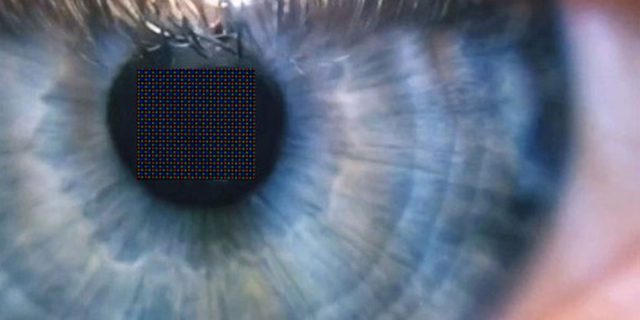
A group of Sweden-based researchers proposed a novel e-ink display solution that could make way for super compact, retina-level VR headsets and AR glasses in the future.
The News
Traditional emissive displays are shrinking, but they face physical limits; smaller pixels tend to emit less uniformly and provide less intense light, which is especially noticeable in near-eye applications like virtual and augmented reality headsets.
In a recent research paper published in Nature, a team of researchers presents what a “retinal e-ink display” which hopes to offer a new solution quite unlike displays seen in modern VR headsets today, which are increasingly adopting micro-OLEDs to reduce size and weight.
The paper was authored by researchers affiliated with Uppsala University, Umeå University, University of Gothenburg, and Chalmers University of Technology in Gothenburg: Ade Satria Saloka Santosa, Yu-Wei Chang, Andreas B. Dahlin, Lars Österlund, Giovanni Volpe, and Kunli Xiong.
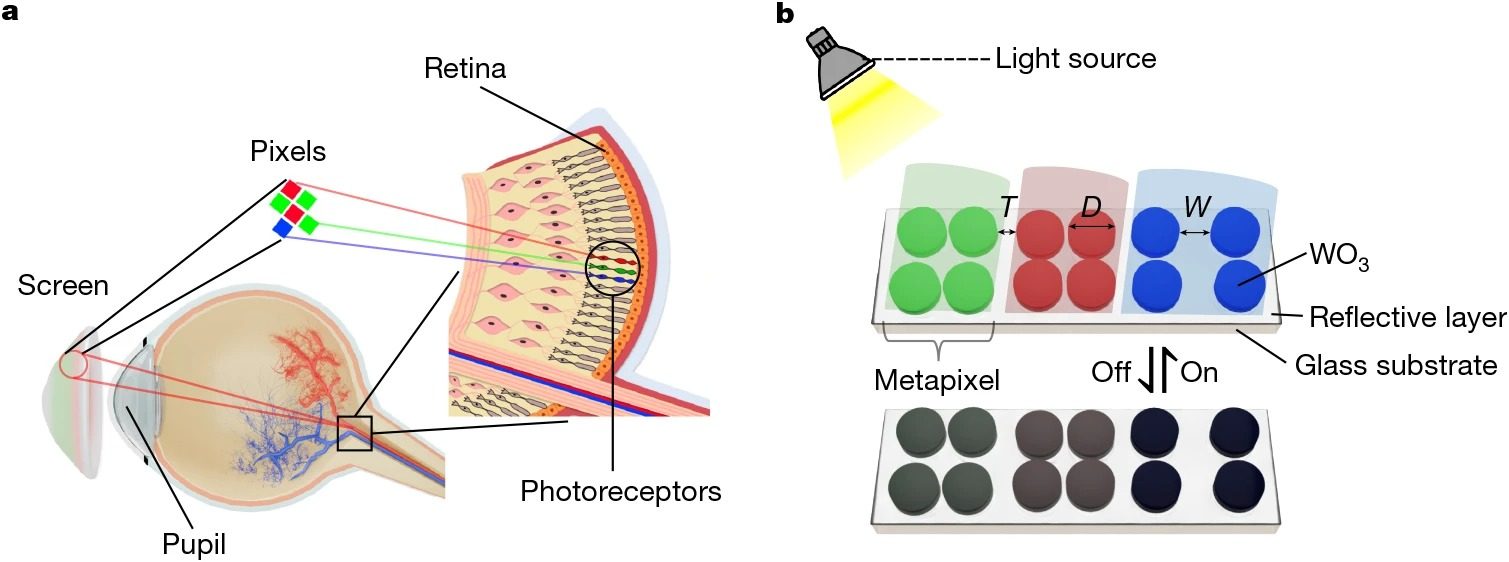
While conventional e-paper has struggled to reach the resolution necessary for realistic, high-fidelity images, the team proposes a new form of e-paper featuring electrically tunable “metapixels” only about 560 nanometres wide.
This promises a pixel density of over 25,000 pixels per inch (PPI)—an order of magnitude denser than displays currently used in headsets like Samsung Galaxy XR or Apple Vision Pro. Those headsets have a PPI of around 4,000.
Image courtesy Nature
As the paper describes it, each metapixel is made from tungsten trioxide (WO₃) nanodisks that undergo a reversible insulator-to-metal transition when electrically reduced. This process dynamically changes the material’s refractive index and optical absorption, allowing nanoscale control of brightness and color contrast.
In effect, when lit by ambient light, the display can create bright, saturated colors far thinner than a human hair, as well as deep blacks with reported optical contrast ratios around 50%—a reflective equivalent of high-dynamic range (HDR).
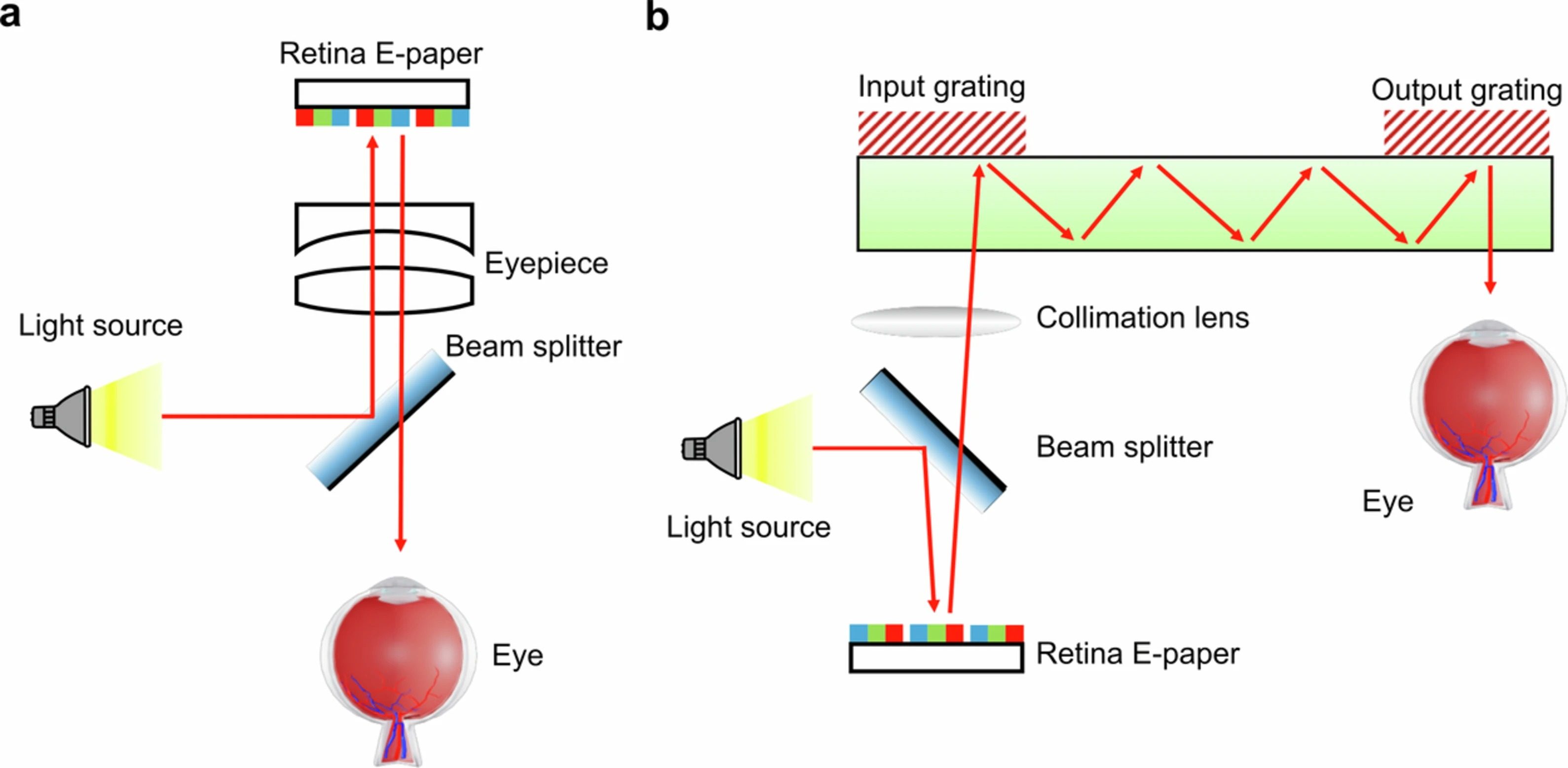
And the team says it could be useful in both AR and VR displays. The figure below shows a conceptual optical stack for both applications, with Figure A representing a VR display, and Figure B showing an AR display.
Image courtesy Nature
Still, there are some noted drawbacks. Beyond sheer resolution, the display delivers full-color video at “more than 25 Hz,” which is significantly lower than what VR users need for comfortable viewing. In addition to a relatively low refresh rate, researchers note the retina e-paper requires further optimization in color gamut, operational stability and lifetime.
“Lowering the operating voltage and exploring alternative electrolytes represent promising engineering routes to extend device durability and reduce energy consumption,” the paper explains. “Moreover, its ultra-high resolution also necessitates the development of ultra-high-resolution TFT arrays for independent pixel control, which will enable fully addressable, large-area displays and is therefore a critical direction for future research and technological development.”
And while the e-paper display itself is remarkably low-powered, packing in the graphical compute to put those metapixels to work will also be a challenge. It’s a good problem to have, but a problem none the less.
My Take
At least as the paper describes it, the underlying tech could produce XR displays approaching the size and pixel density that we’ve never seen before. And reaching the limits of human visual perception is one of those holy grail moments I’ve been waiting for.
Getting that refresh rate up well beyond 25 Hz is going to be extremely important though. As the paper describes it, 25 Hz is good for video playback, but driving an immersive VR environment requires at least 60 Hz refresh to be minimally comfortable. 72 Hz is better, and 90 Hz is the standard nowadays.
I’m also curious to see the e-paper display stacked up against lower resolution micro-OLED contemporaries, if only to see how that proposed ambient lighting can achieve HDR. I have a hard time wrapping my head around it. Essentially, the display’s metapixels absorb and scatter ambient light, much like Vantablack does—probably something that needs to be truly seen in person to be believed.
Healthy skepticism aside, I find it truly amazing we’ve even arrived at the conversation in the first place: we’re at the point where XR displays could recreate reality, at least as far as your eyes are concerned.
The 2025 Fall Classic has already reached Game 3 between the Los Angeles Dodgers and the Toronto Blue Jays. The tied-up World Series heads to Los Angeles tonight — Monday, Oct. 27 — at 8PM ET/5PM PT, with the Dodgers getting their turn at a home field advantage at Dodger Stadium, Los Angeles. Shohei Ohtani and the Dodgers are aiming to win their second consecutive championship, while Vlad Guerrero Jr. and the Blue Jays are eyeing their first ring since 1993. Despite Toronto’s victory over Los Angeles last night, the World Series odds still favor the Dodgers ahead of Game 3. Every 2025 MLB World Series game will air on Fox and Fox Deportes.
Of course, Fox is a “free” over-the-air channel, so any affordable digital antenna will pull in the game if you live close enough to a local affiliate. But if that’s not an option, here’s a full rundown of how to watch the Dodgers vs. Blue Jays World Series, even without cable.
How to watch the L.A. Dodgers vs. Toronto Blue Jays, Game 3
You can stream Fox on any live TV streaming service that airs Fox local stations, including DirecTV, Fubo and Hulu + Live TV. MLB World Series games will also be available on Fox’s new streaming platform, Fox One.
More ways to watch the 2025 World Series
When is the Dodgers vs. Blue Jays game time?
Game 3 of the Dodgers vs. Blue Jays World Series is tonight, Oct. 27 at 8PM ET/5PM PT.
What channel is playing the Los Angeles Dodgers vs. Toronto Blue Jays?
Game 3 of the World Series between the Dodgers and Blue Jays is scheduled for Oct. 27, 2025.
Los Angeles Dodgers vs. Toronto Blue Jays World Series schedule
All times Eastern. Series tied 1-1.
Game 1: Friday, Oct. 24, 8PM ET
Game 2: Saturday, Oct. 25, 8PM ET
Game 3: Monday, Oct. 27, 8PM ET
Game 4: Tuesday, Oct. 28, 8PM ET
Game 5*: Wednesday, Oct. 29, 8PM ET
Game 6*: Friday, Oct. 31, 8PM ET
Game 7*: Saturday, Nov. 1, 8PM ET
*if necessary
This article originally appeared on Engadget at https://www.engadget.com/entertainment/streaming/dodgers-vs-blue-jays-game-3-tonight-how-to-watch-the-2025-mlb-world-series-without-cable-153110828.html?src=rss
The Galaxy S25 Edge has impressed since its release, with excellent reviews from many tech sites, including PCMag. The reviews praise its thin design (around 5.84mm), which doesn’t come at the expense of battery life or performance. You can expect over 16 hours of use on a single charge (tests conducted with YouTube videos playing at full brightness), which is the longest of all the latest S Series phones. It is powered by the Qualcomm Snapdragon 8 Elite for Galaxy chip, comes with 12GB of RAM, and starts with 128GB of storage, although this deal is for the 512GB model.
It also has a dual camera setup with a 200 MP wide lens and 12 MP ultra-wide and front lenses, but no telephoto camera. The AI features are what you’d expect from Samsung: enhanced multitasking tools, a desktop mode (Dex), and Galaxy AI. A big plus is Samsung’s promise to give this phone seven generations of OS updates and seven years of security fixes (through May 31, 2032).
If you’re looking for a deal on a thin and lightweight Android phone that excels in battery life, performance, and will be around for many years, consider the Galaxy S25 Edge for $729.99.
Our Best Editor-Vetted Early Black Friday Deals Right Now
The U.S. has formed a $1 billion partnership with AMD to construct two supercomputers that will tackle large scientific problems ranging from nuclear power to cancer treatments to national security, said Energy Secretary Chris Wright and AMD CEO Lisa Su. From a report: The U.S. is building the two machines to ensure the country has enough supercomputers to run increasingly complex experiments that require harnessing enormous amounts of data-crunching capability. The machines can accelerate the process of making scientific discoveries in areas the U.S. is focused on.
Energy Secretary Wright said the systems would “supercharge” advances in nuclear power and fusion energy, technologies for defense and national security, and the development of drugs. Scientists and companies are trying to replicate fusion, the reaction that fuels the sun, by jamming light atoms in a plasma gas under intense heat and pressure to release massive amounts of energy. “We’ve made great progress, but plasmas are unstable, and we need to recreate the center of the sun on Earth,” Wright told Reuters.
As Jamaica braces for what may be the most powerful storm in the island nation’s history, Cuba and the Lucayan Archipelago may face direct hits soon after.
Countries signed their first UN treaty targeting cybercrime in Hanoi on Saturday, despite opposition from an unlikely band of tech companies and rights groups warning of expanded state surveillance. From a report: The new global legal framework aims to strengthen international cooperation to fight digital crimes, from child pornography to transnational cyberscams and money laundering. More than 60 countries were seen to sign the declaration Saturday, which means it will go into force once ratified by those states. UN Secretary General Antonio Guterres described the signing as an “important milestone”, but that it was “only the beginning”.
“Every day, sophisticated scams, destroy families, steal migrants and drain billions of dollars from our economy… We need a strong, connected global response,” he said at the opening ceremony in Vietnam’s capital on Saturday. The UN Convention against Cybercrime was first proposed by Russian diplomats in 2017, and approved by consensus last year after lengthy negotiations. Critics say its broad language could lead to abuses of power and enable the cross-border repression of government critics.
Hurricane Melissa will make landfall in southern Jamaica less than 24 hours from now, and it is likely to be the most catastrophic storm in the Caribbean island’s history.
As it crawled across the northern Caribbean Sea on Monday morning, Melissa officially became a Category 5 hurricane with 160 mph winds, according to the National Hurricane Center.
The hurricane will likely fluctuate in intensity over the next day or so, perhaps undergoing an eyewall replacement cycle. But the background conditions, including very warm Caribbean waters and low wind shear, will support a very powerful hurricane and the potential for further strengthening.
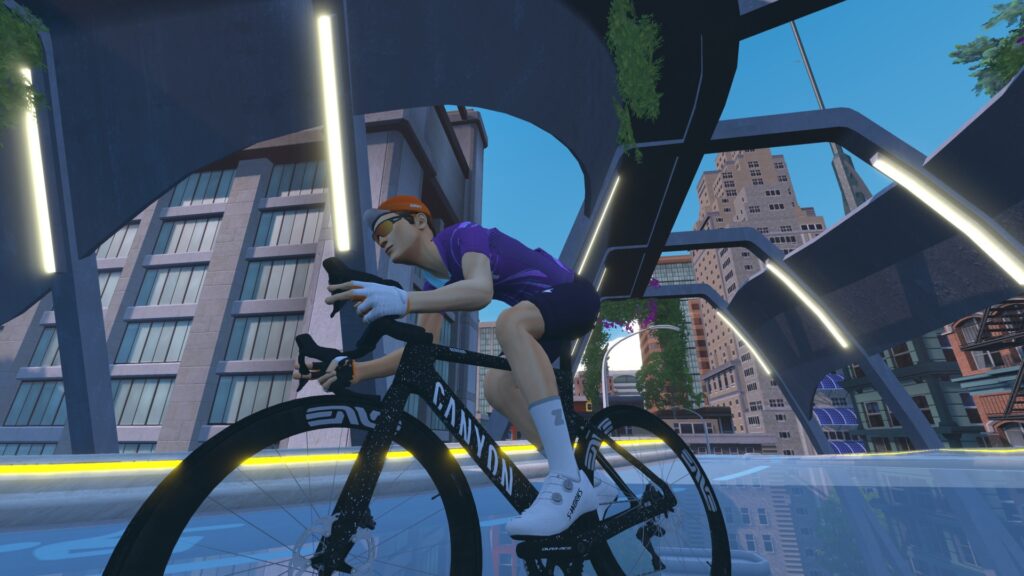
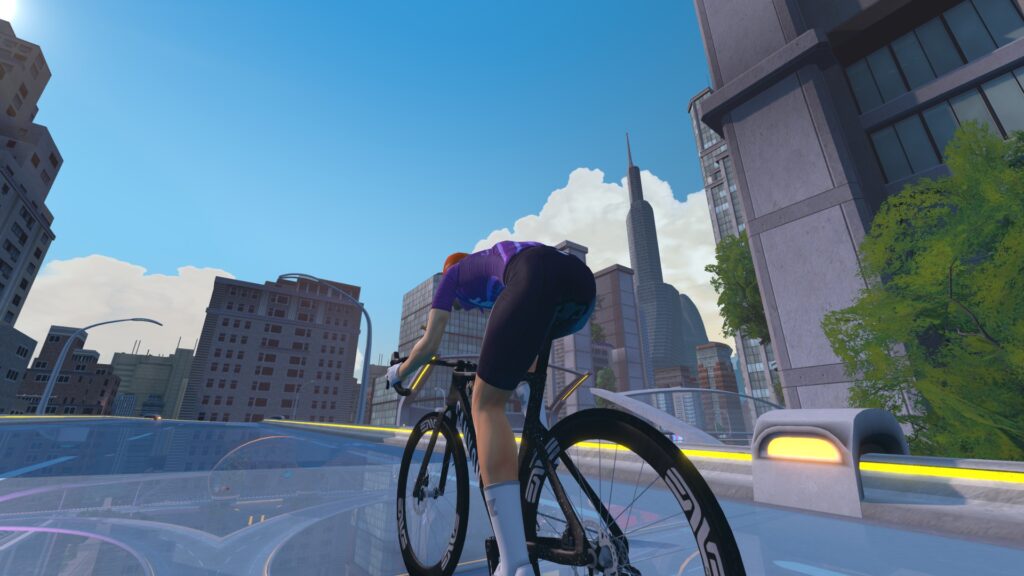
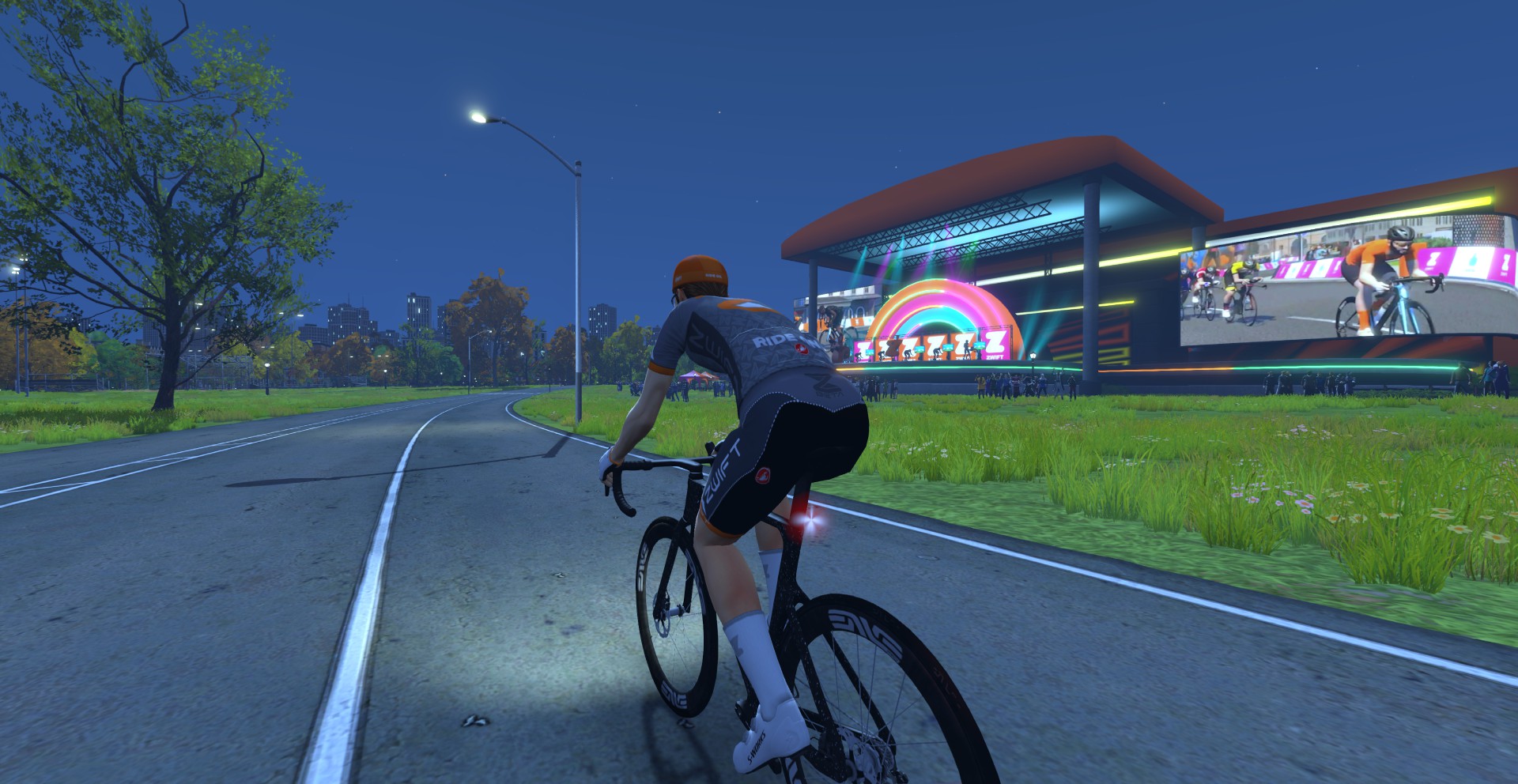
Zwift has released its “biggest map expansion in five years” today, with 31km of new virtual roads added to its new New York map.
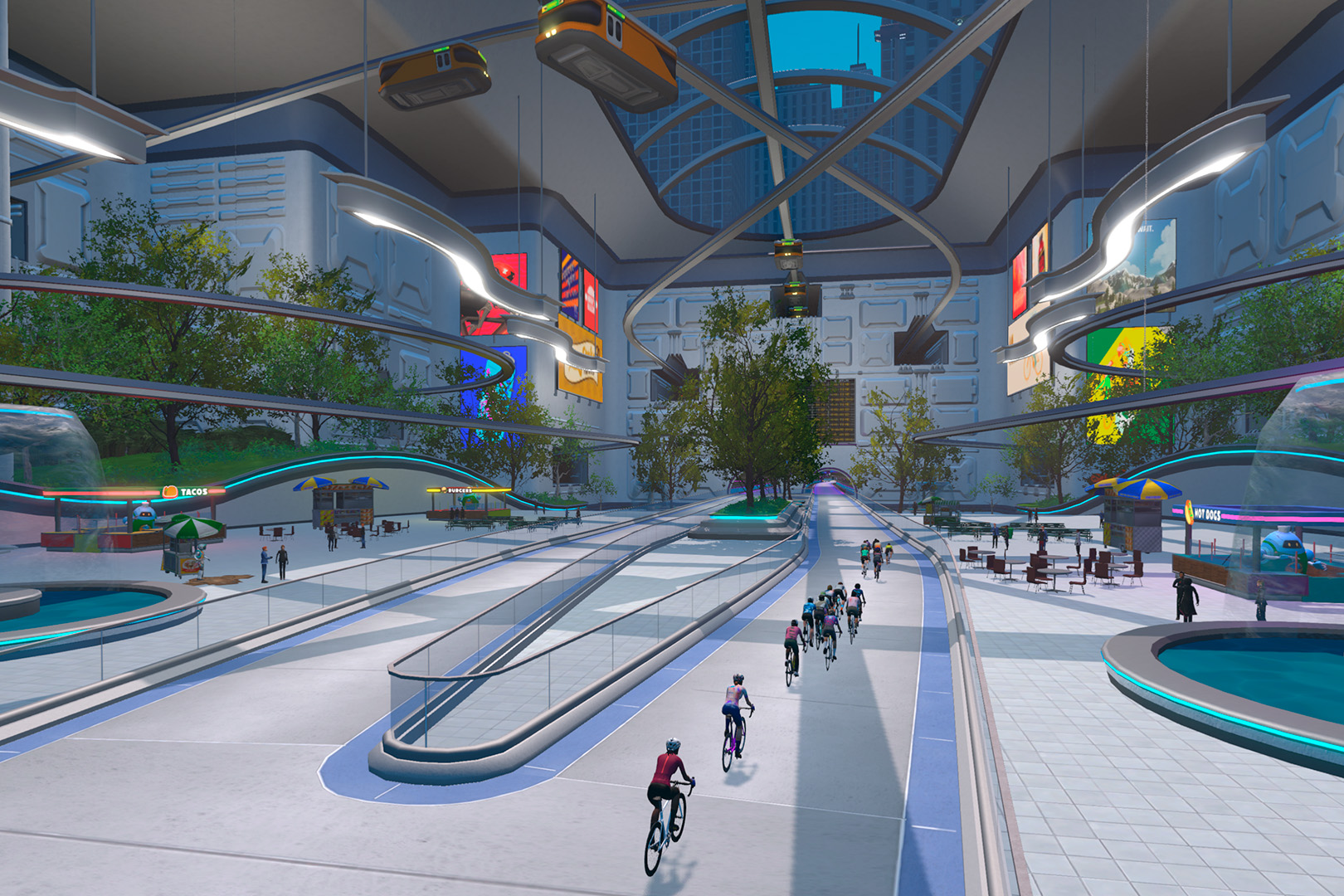
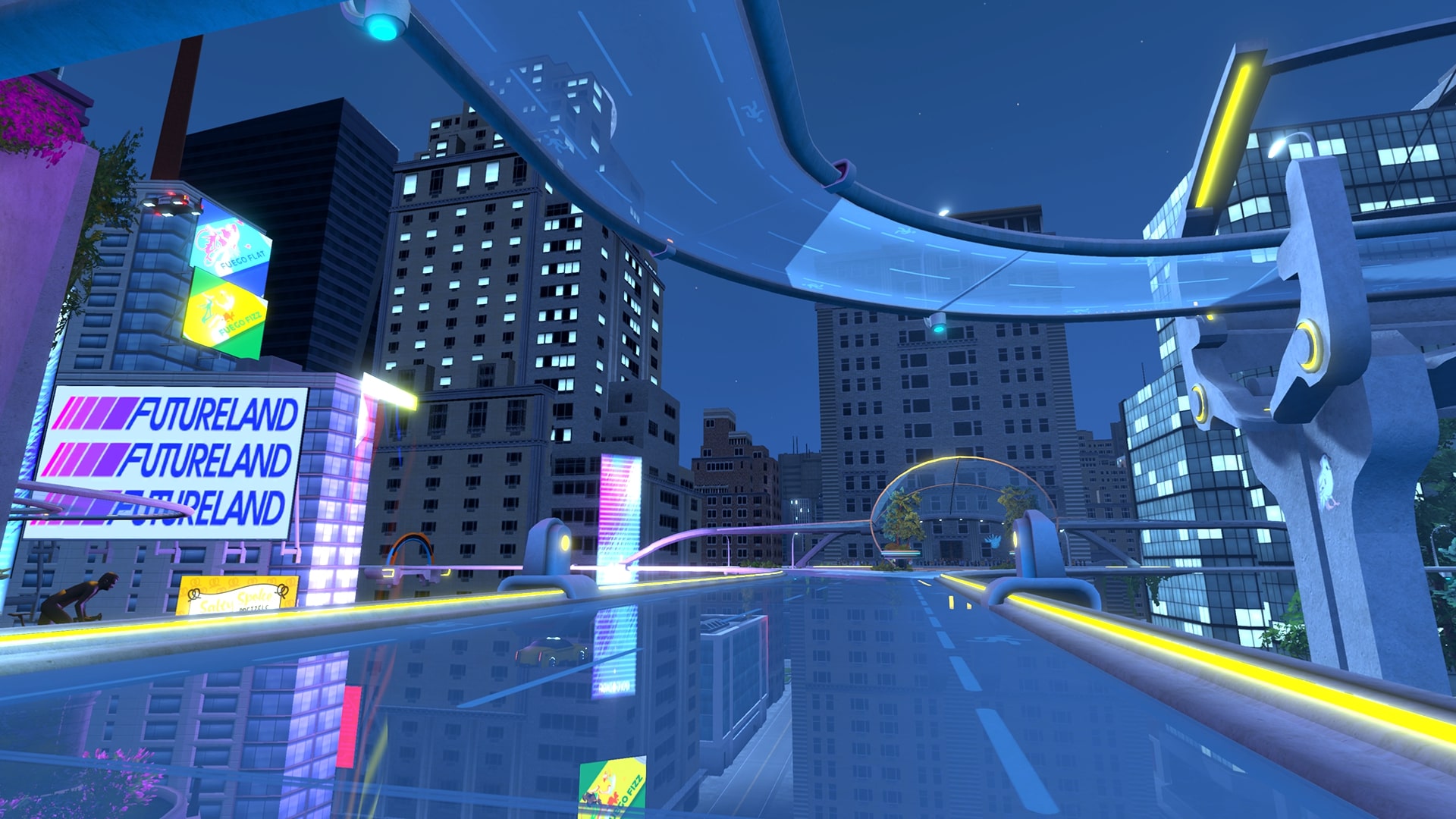
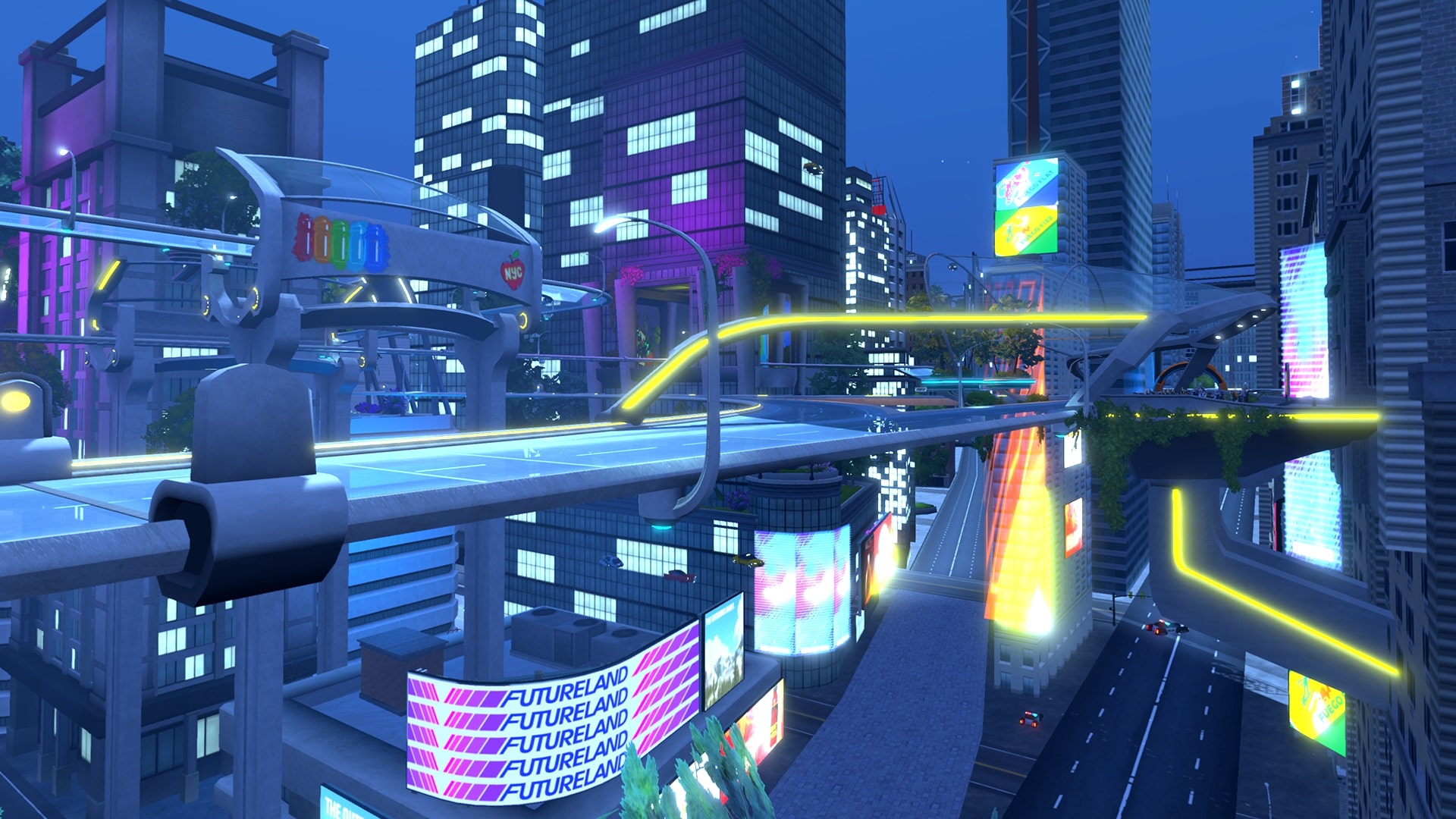
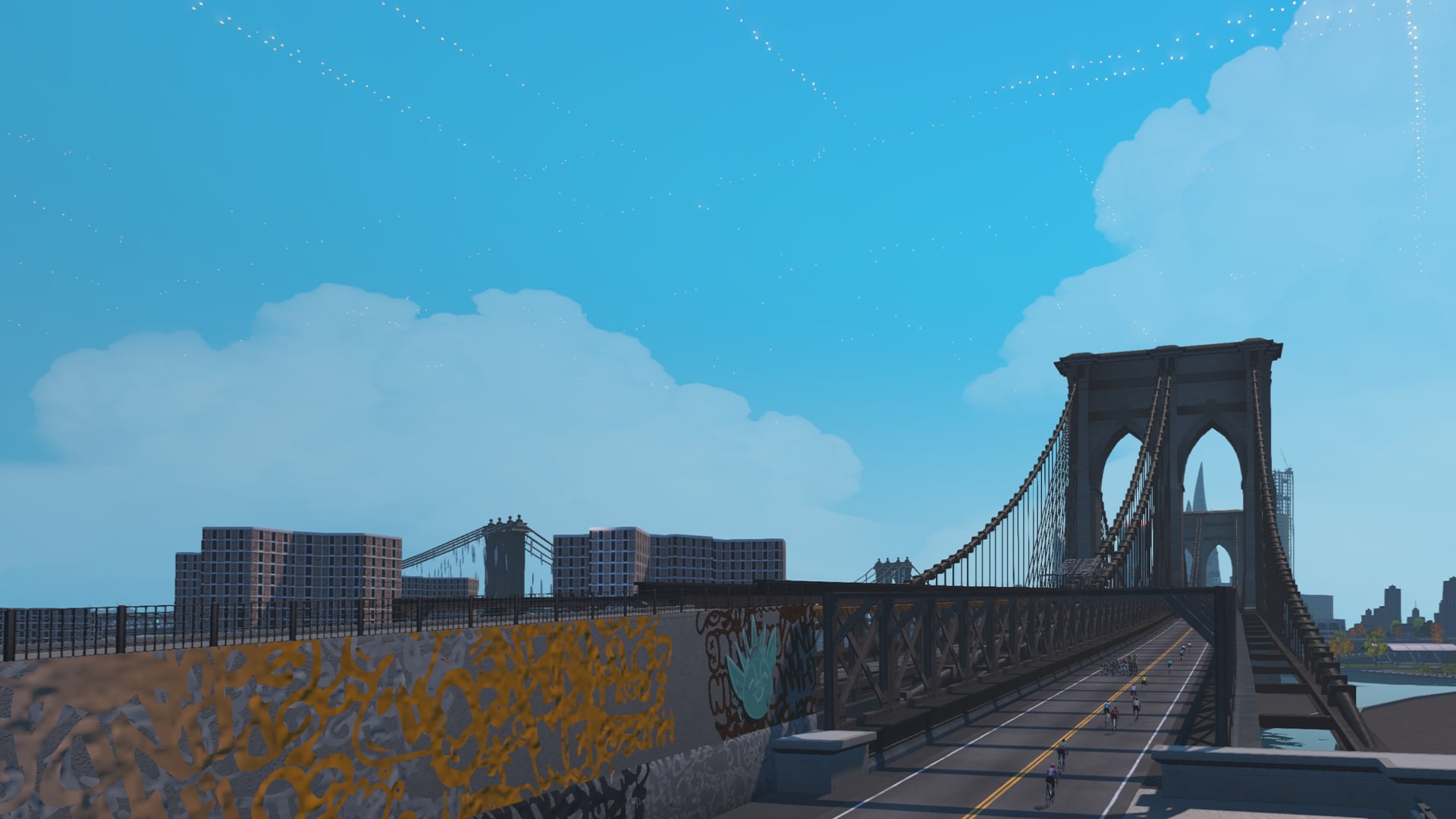
The New York map is set 100 years into the future with a “futuristic” network of glass sky roads around Central Park. But the expansion also heads out of Manhattan across the Brooklyn Bridge and into Prospect Park.
Zwift says that “in contrast to the challenging climbs of around Central Park, this expansion brings new faster, rolling roads.”
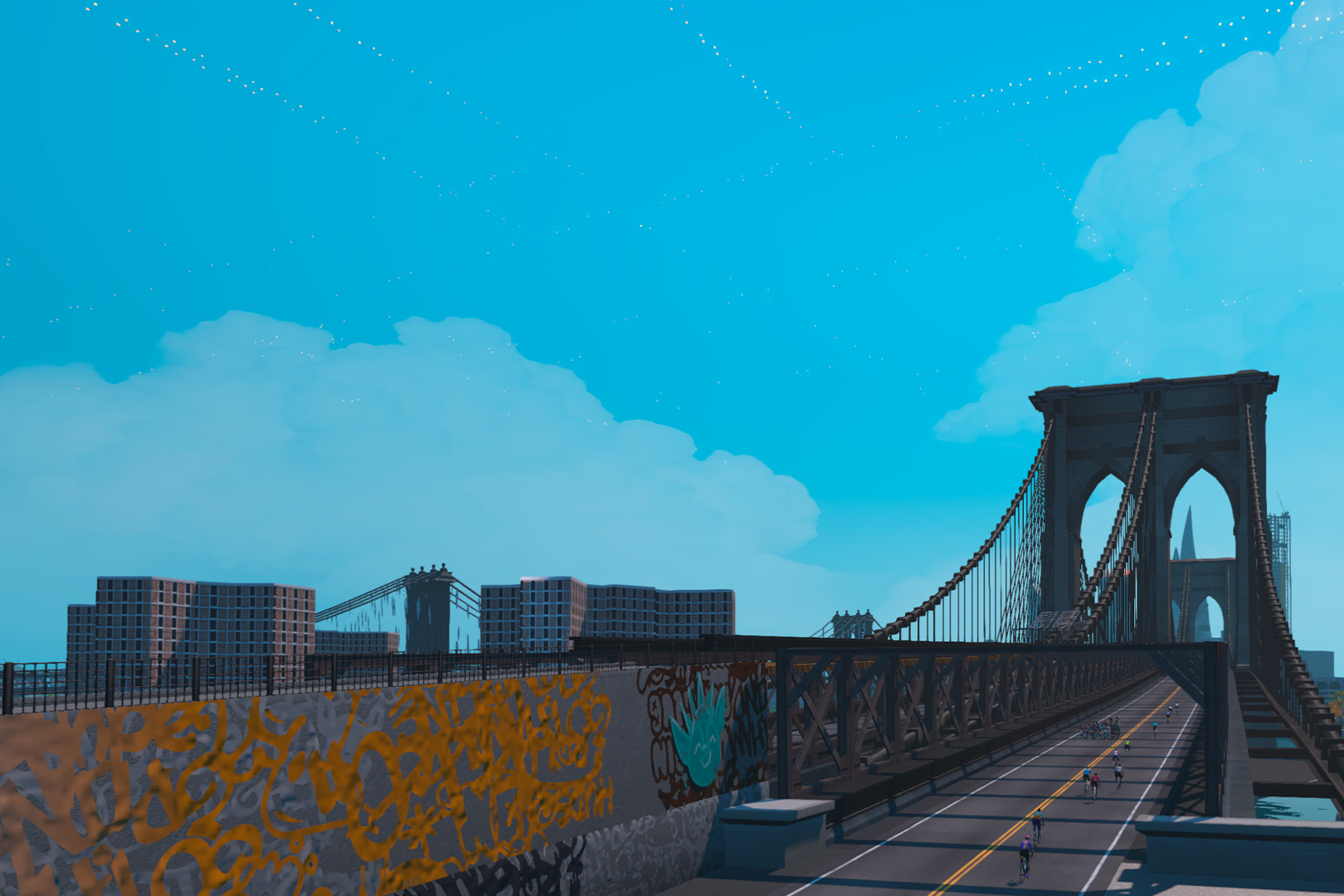
Zwift’s New York map now heads out over Brooklyn Bridge. Zwift
Alongside the expanded map, Zwift has also revealed a new take on its Timed Sprint Segments.
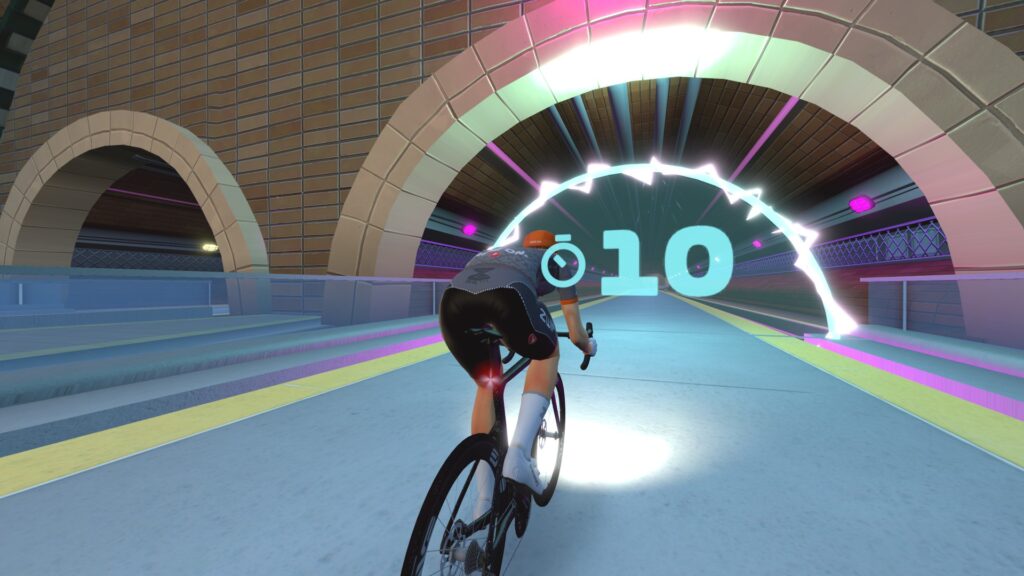
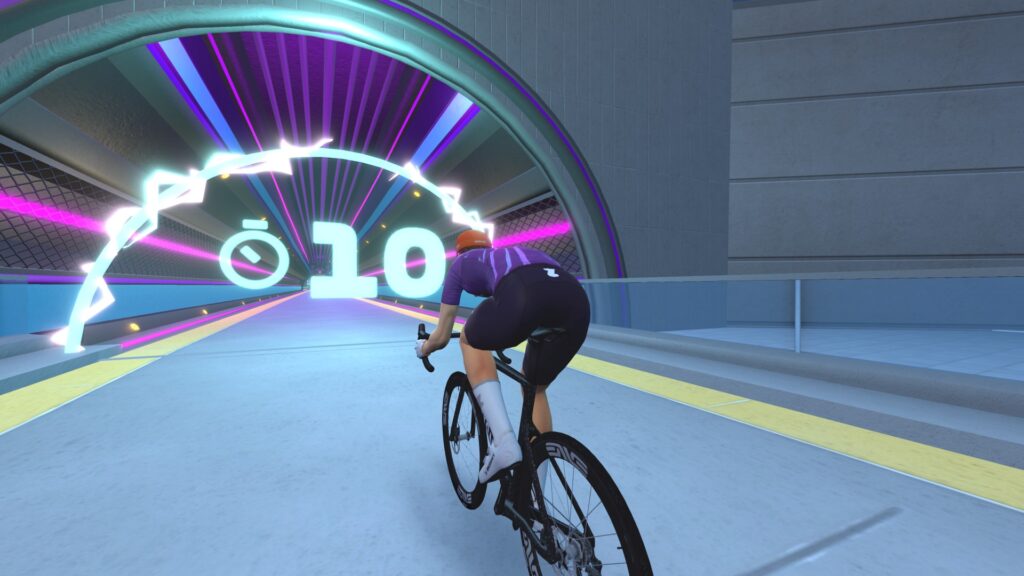
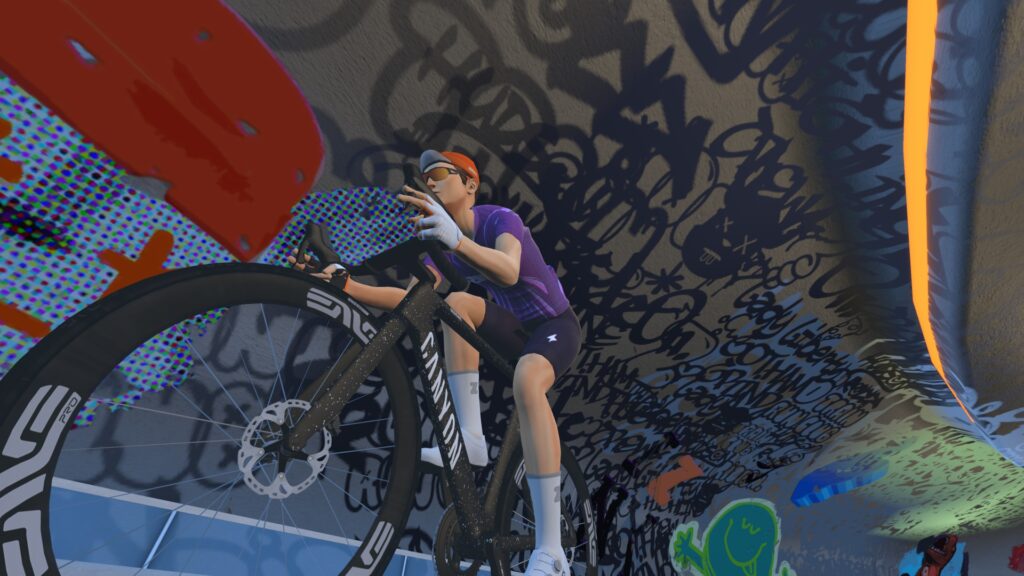
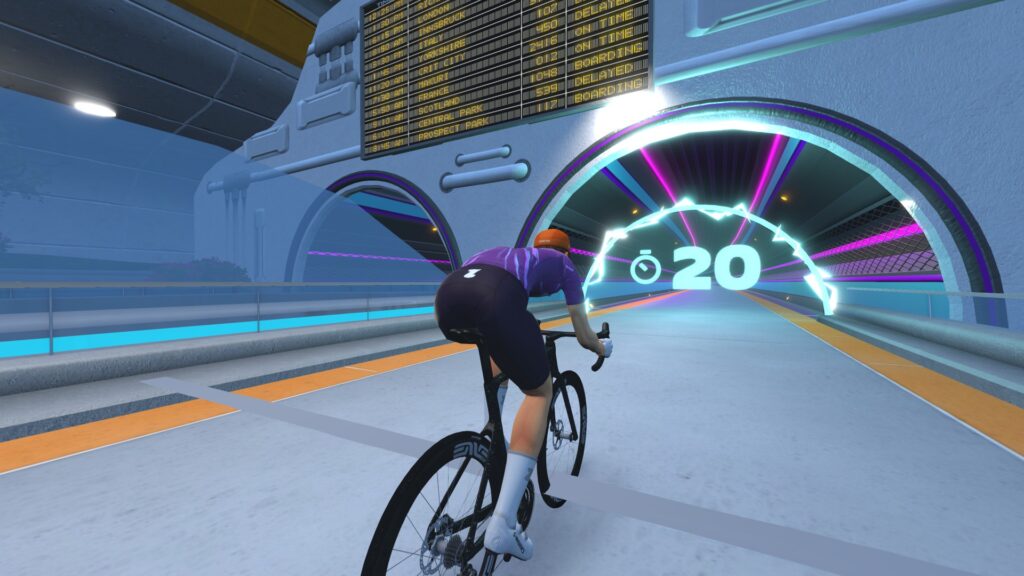
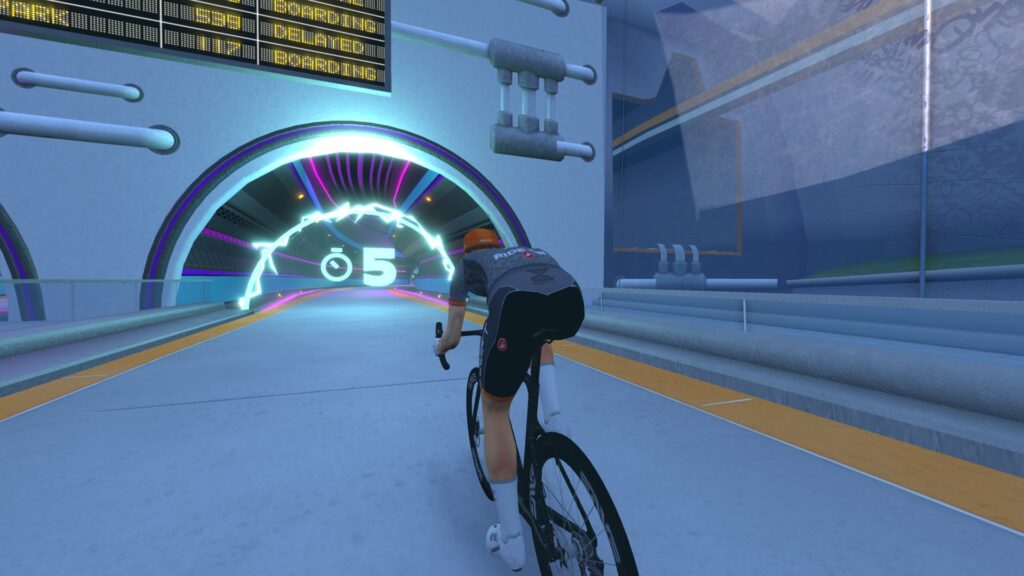
When riding in Zwift’s New York subway, you’ll find Power Segments on the map with a glowing start arch and timer displayed. Once you ride through the arch, the aim is to hold maximum power for the specified duration.
An average wattage display alongside graphics showing your 90-day and one-year power bests will be shown on screen.
There will be six Power Segments to tackle, helping you work on your 5-, 10- and 20-second peak power, according to Zwift.
“Jerseys are on offer for those with the biggest watts but personal improvement is the main aim here, so personal results will take priority when crossing the finish arch,” Zwift says.
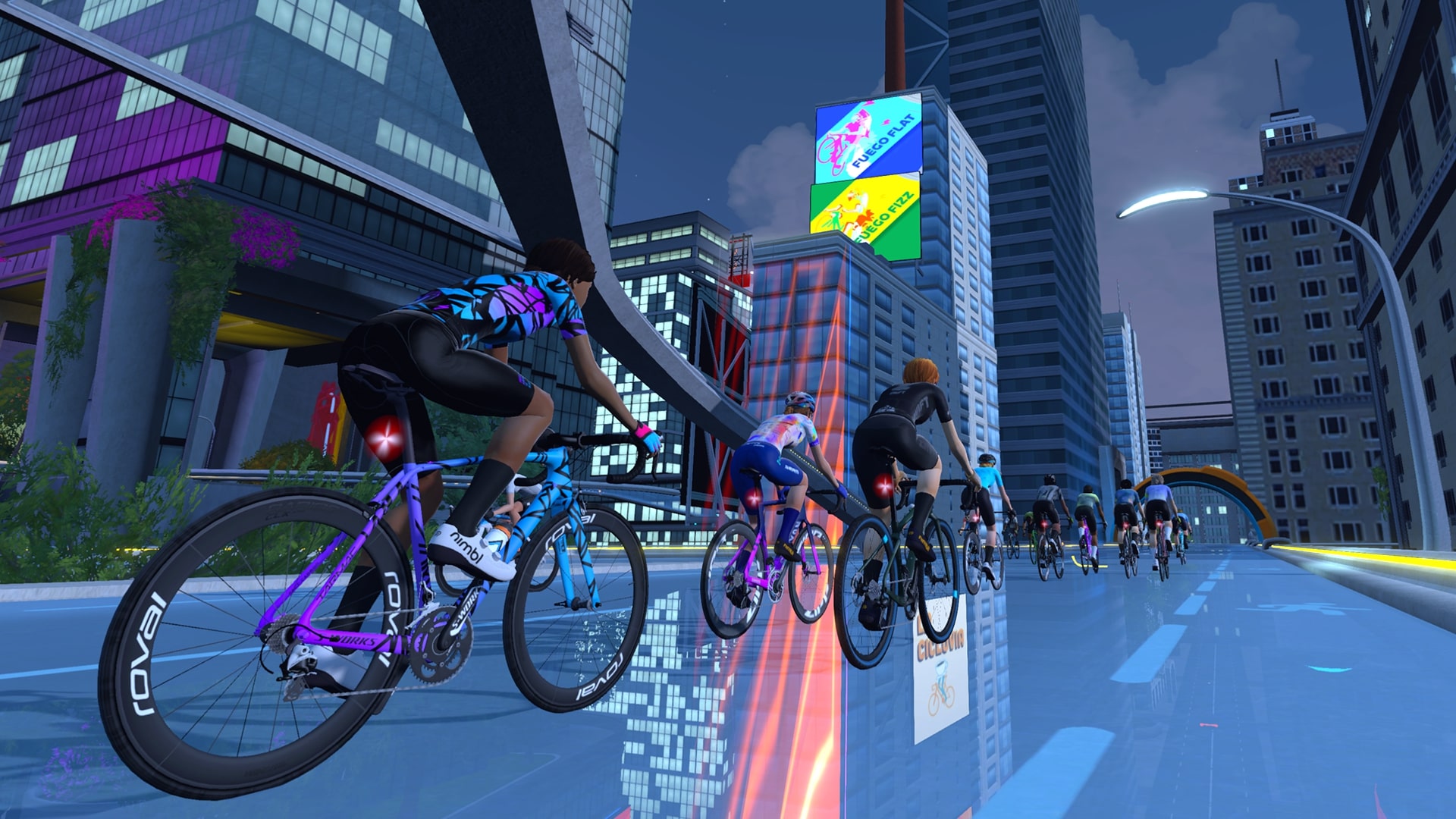
There will also be more futuristic parts of Zwift’s New York map. Zwift
The expansion is stage 4 of Zwift Unlocked, a new Zwift Tour that replaces the Tour of Watopia and runs from 6 October to 16 November, and is your first opportunity to ride the expansion.
At launch, Zwift says there will be 12 new rides to explore:
Watts the Limit: 31km; 219m
Double Span Spin: 12.6km; 120m
Prospect Park Loop: 5.5km; 37m
Green to Screen: 28.4km; 207m
Double Parked: 42.4km; 330m
Fuhgeddaboutit: 79km; 838m
Spinfinity: 19.3km; 155m
Spinfinity Ultra: 35km; 291m
The Greenway: 36.8km; 292m
Toefield Tornado: 10.3km; 53m
Avon Flyer: 5.1km; 30m
Issendorf Express: 7.3km; 53m
Zwift says five additional routes will be unlocked in the coming months.
Today, Zwift released the much-anticipated New York map expansion. With ~30km of new roads, this is Zwift’s largest expansion ever of an existing map, more than doubling New York’s existing ~20km.
Zwift has kept the “future NYC” theme, reimagining how New York City may exist 100 years in the future. But they’ve also included many references to present-day NYC, so native New Yorkers should feel right at home. Read on for a tour of the Big Apple’s new tarmac and surrounding sights…
A Tour of the New Roads
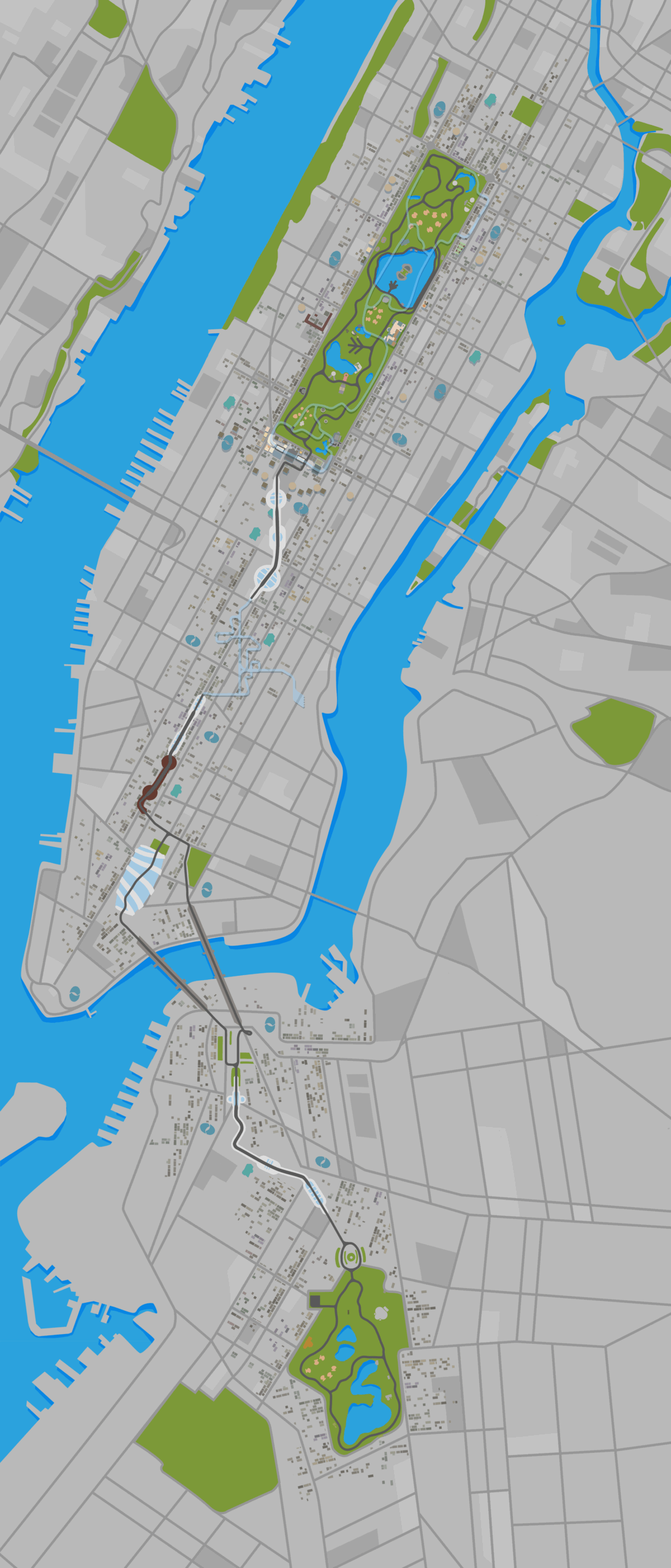
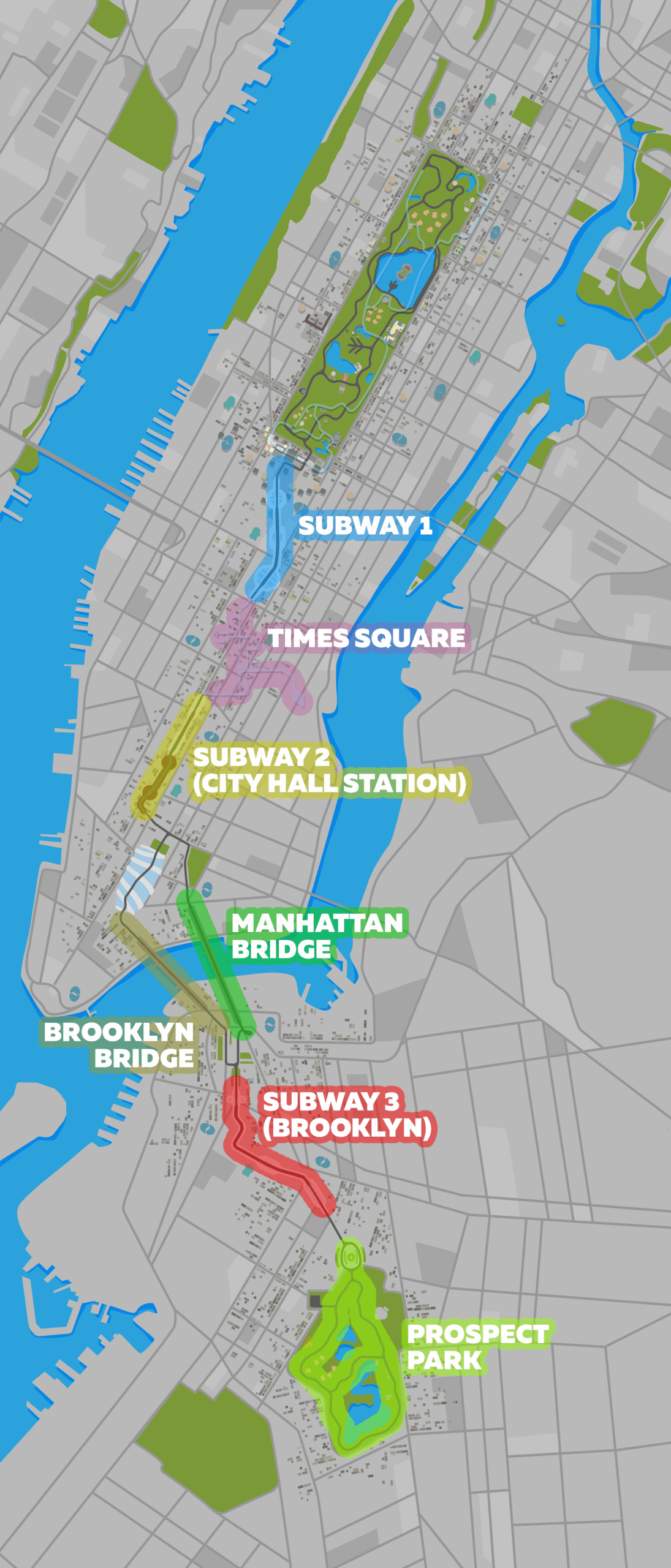
Zwift’s expansion adds ~30km of new roads south of the existing Central Park area. Most of the new surface roads are located in the same places as their real-life counterparts, including 6th Avenue exiting Central Park, Brooklyn Bridge, Manhattan Bridge, Flatbush Avenue, Grand Army Plaza, and Prospect Park.
The subways and Times Square, on the other hand, take plenty of liberties in their layouts. While they are roughly located in the same place as their present-day counterparts, their layouts don’t match what exists today.
Below you’ll find a “clean” version of Zwift’s updated New York map, and a marked-up version showing each of the new sections:
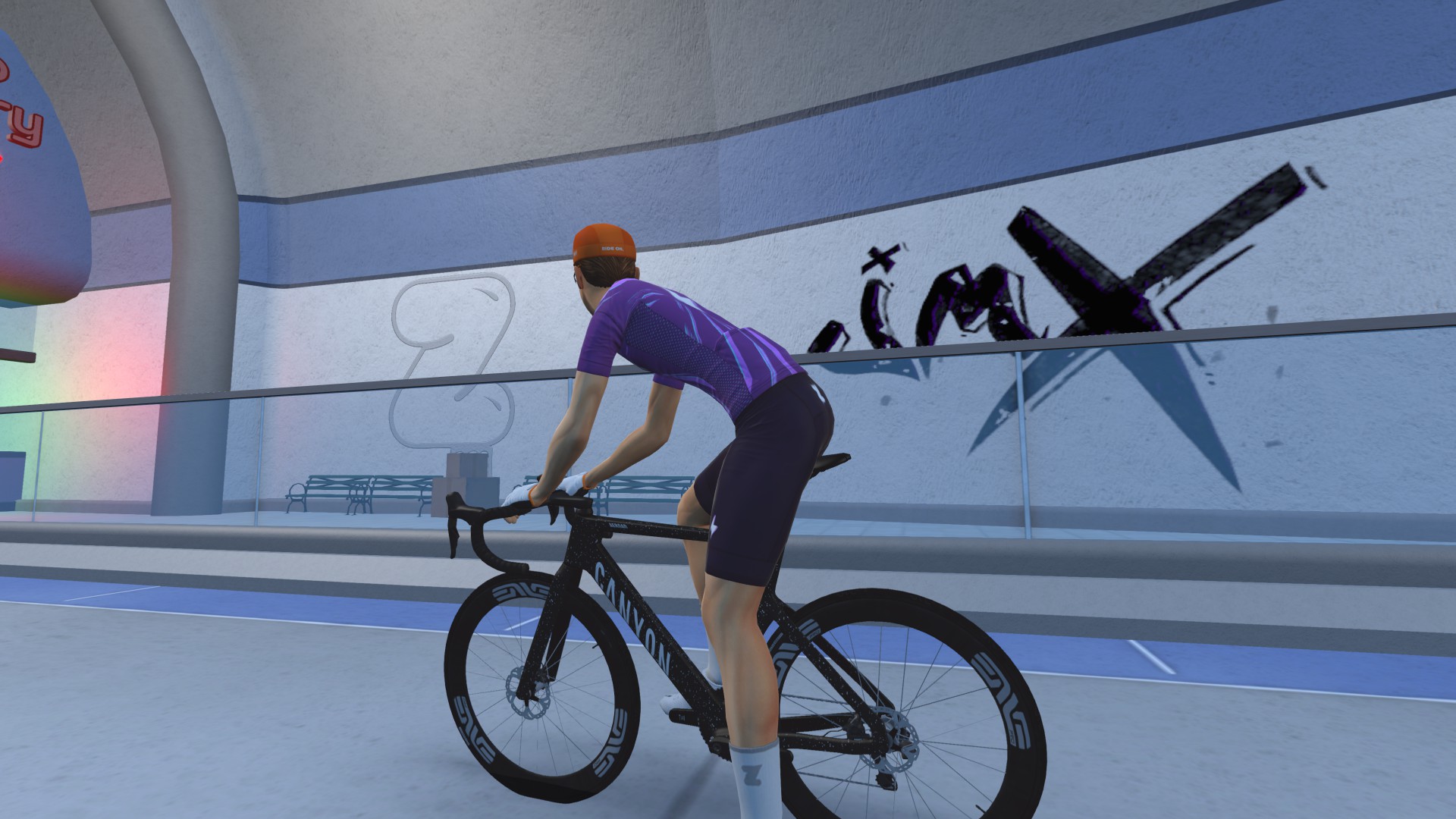
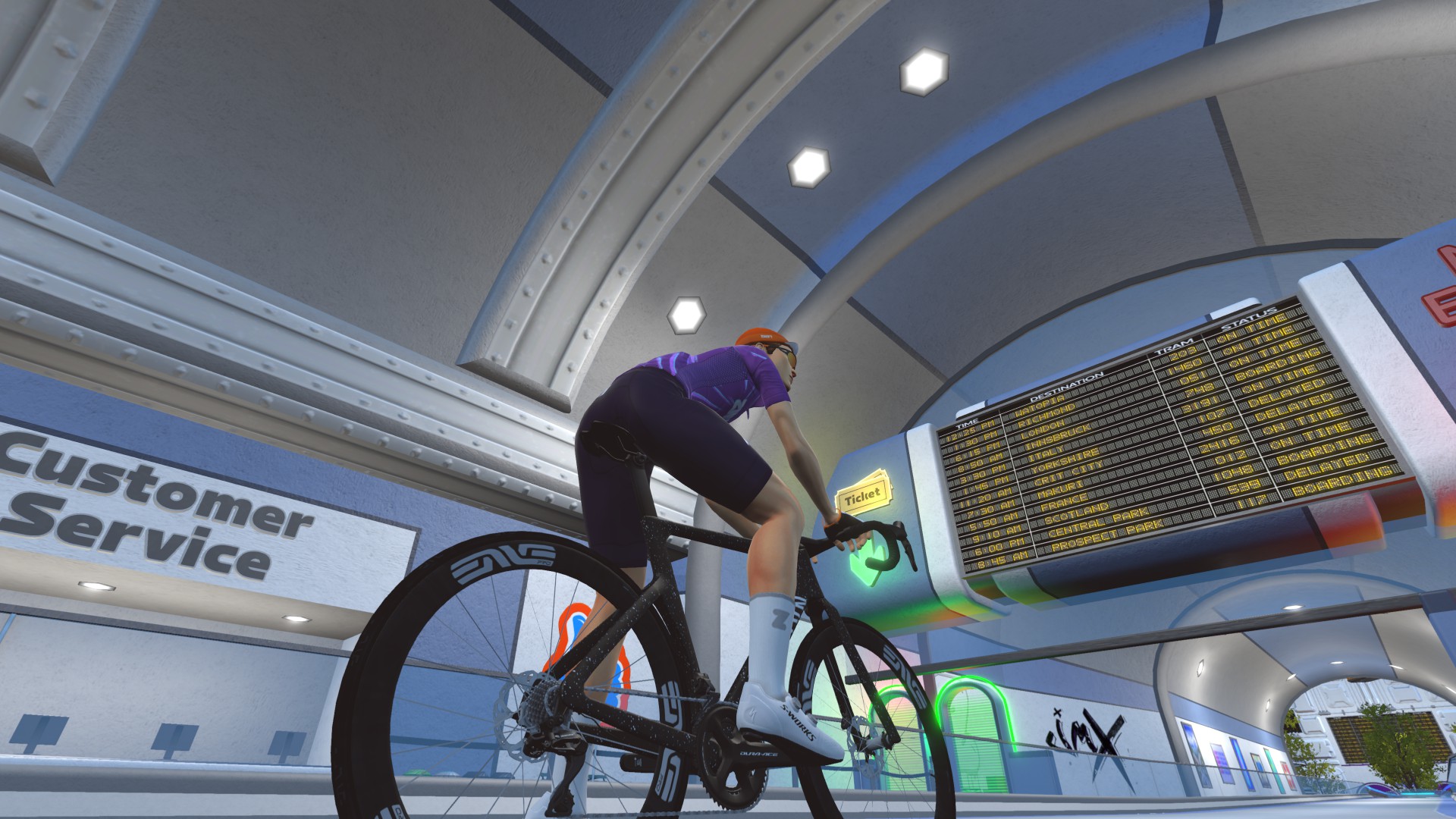
Subway 1
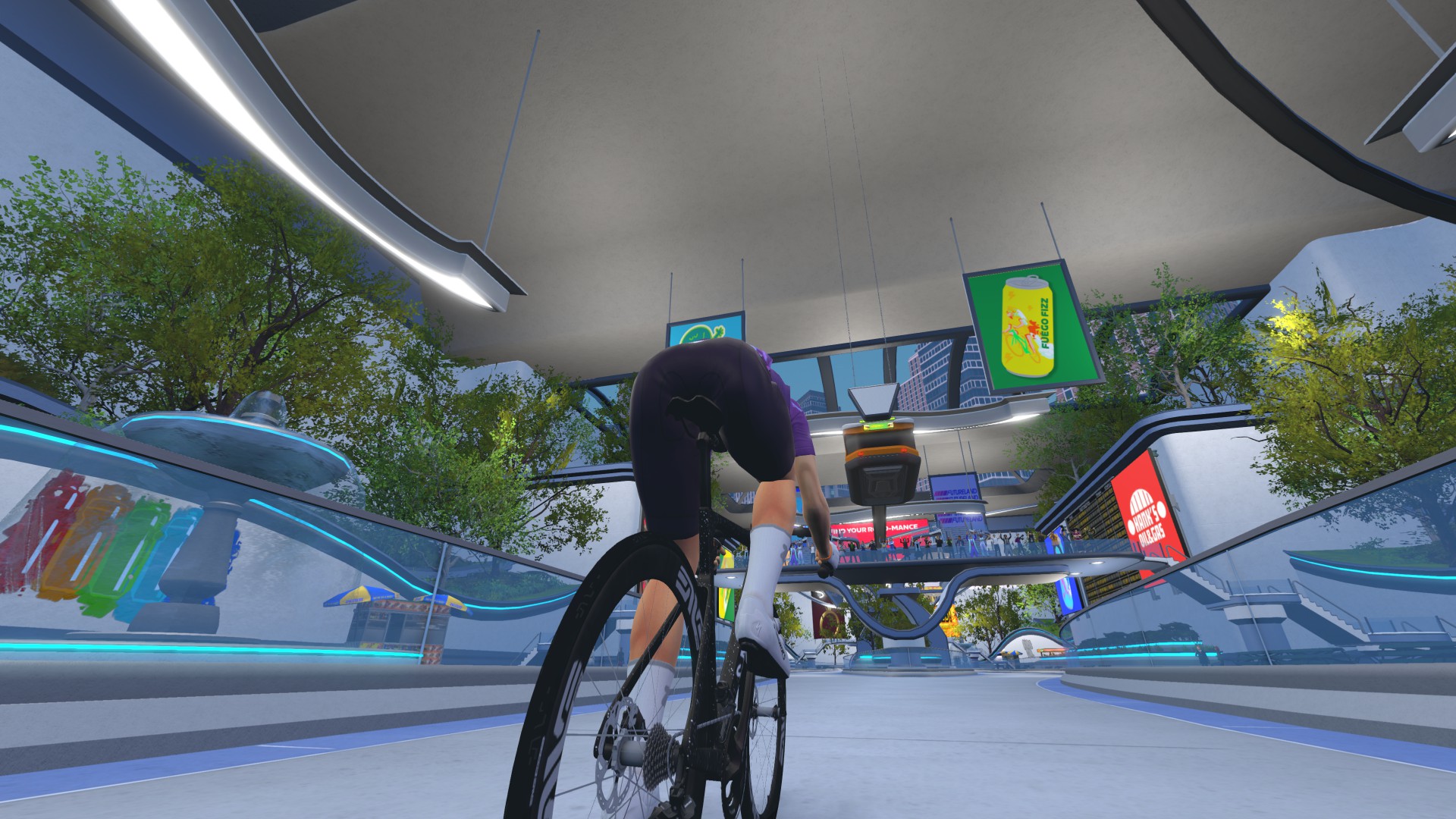
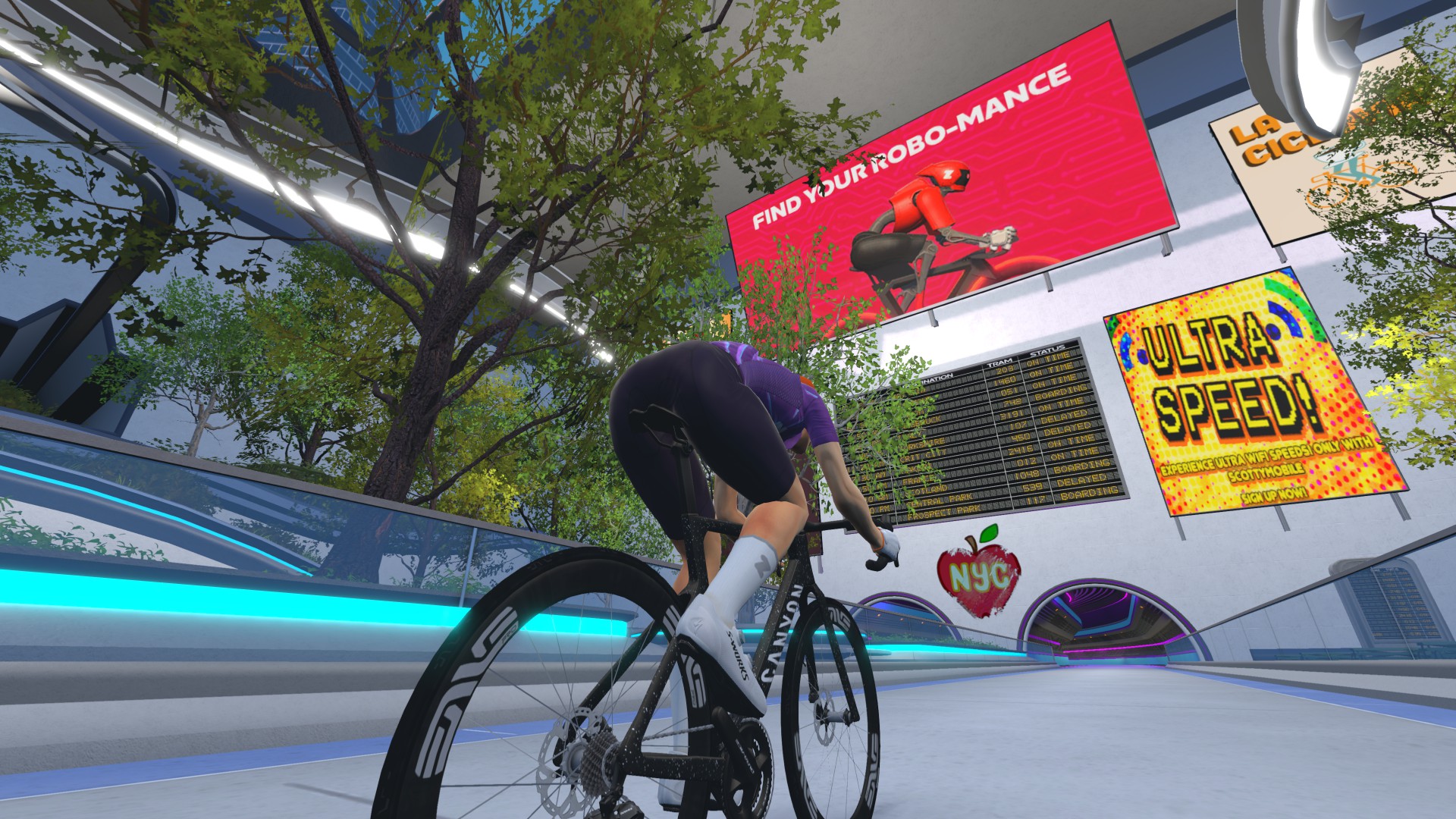
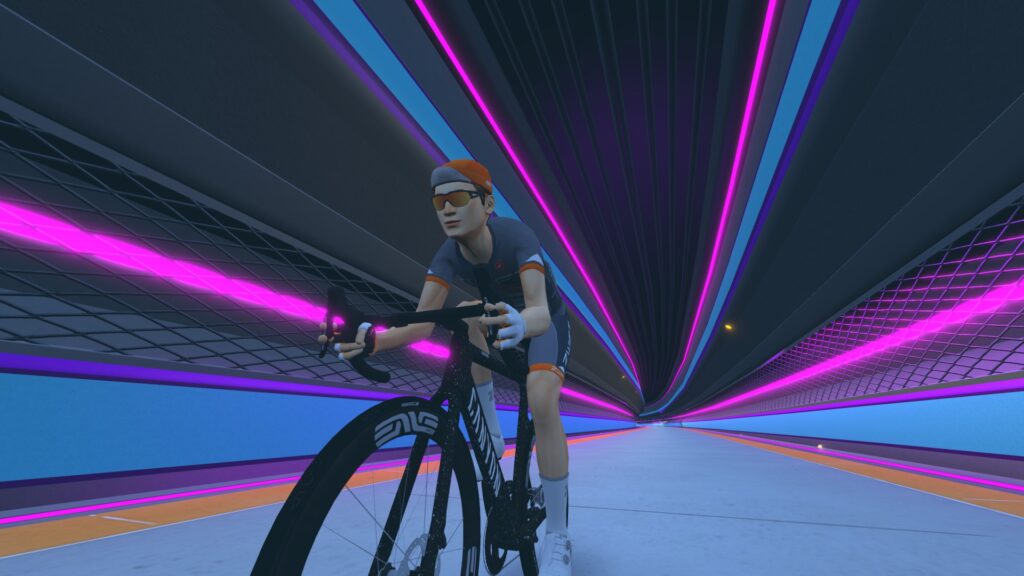
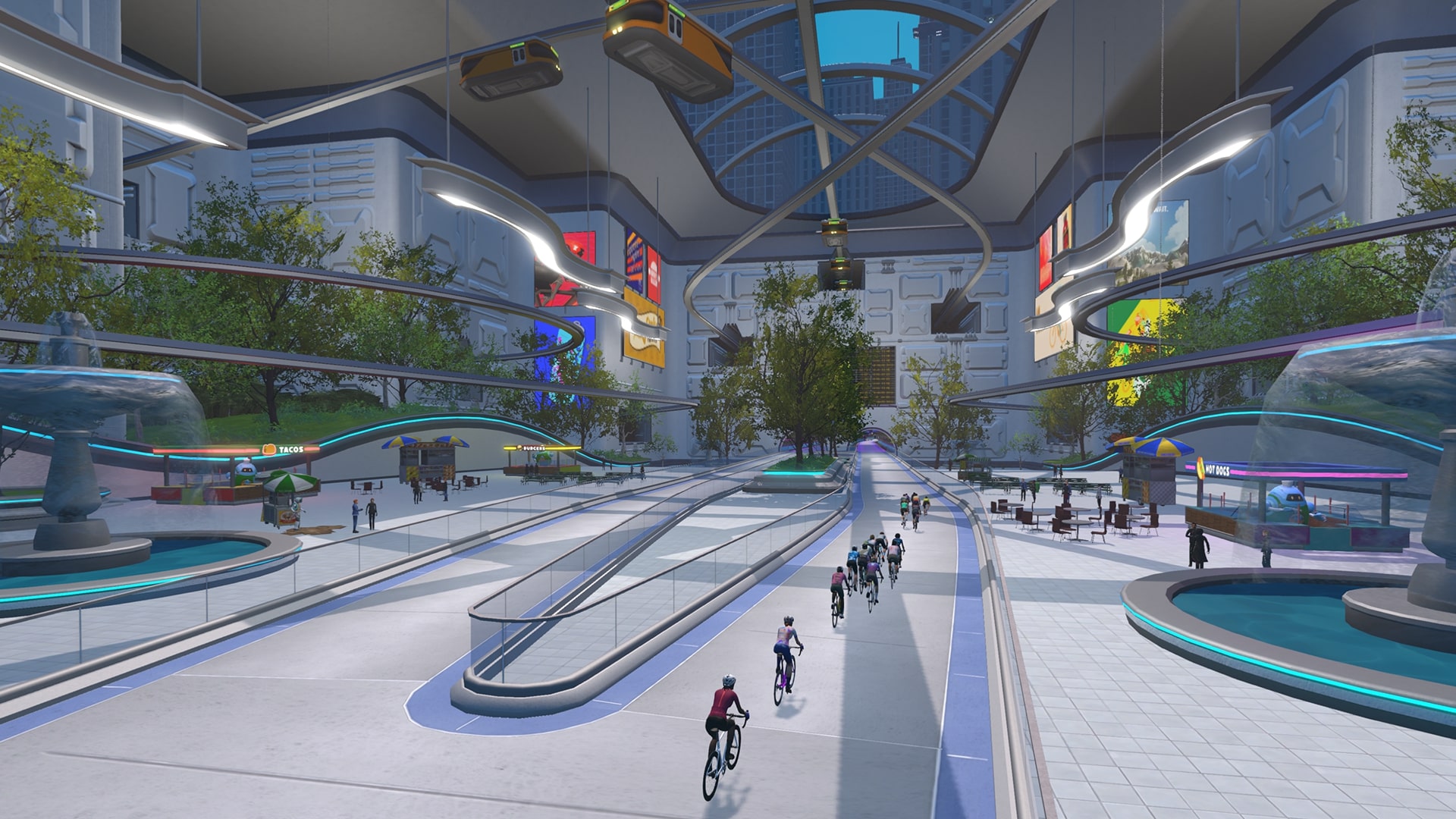
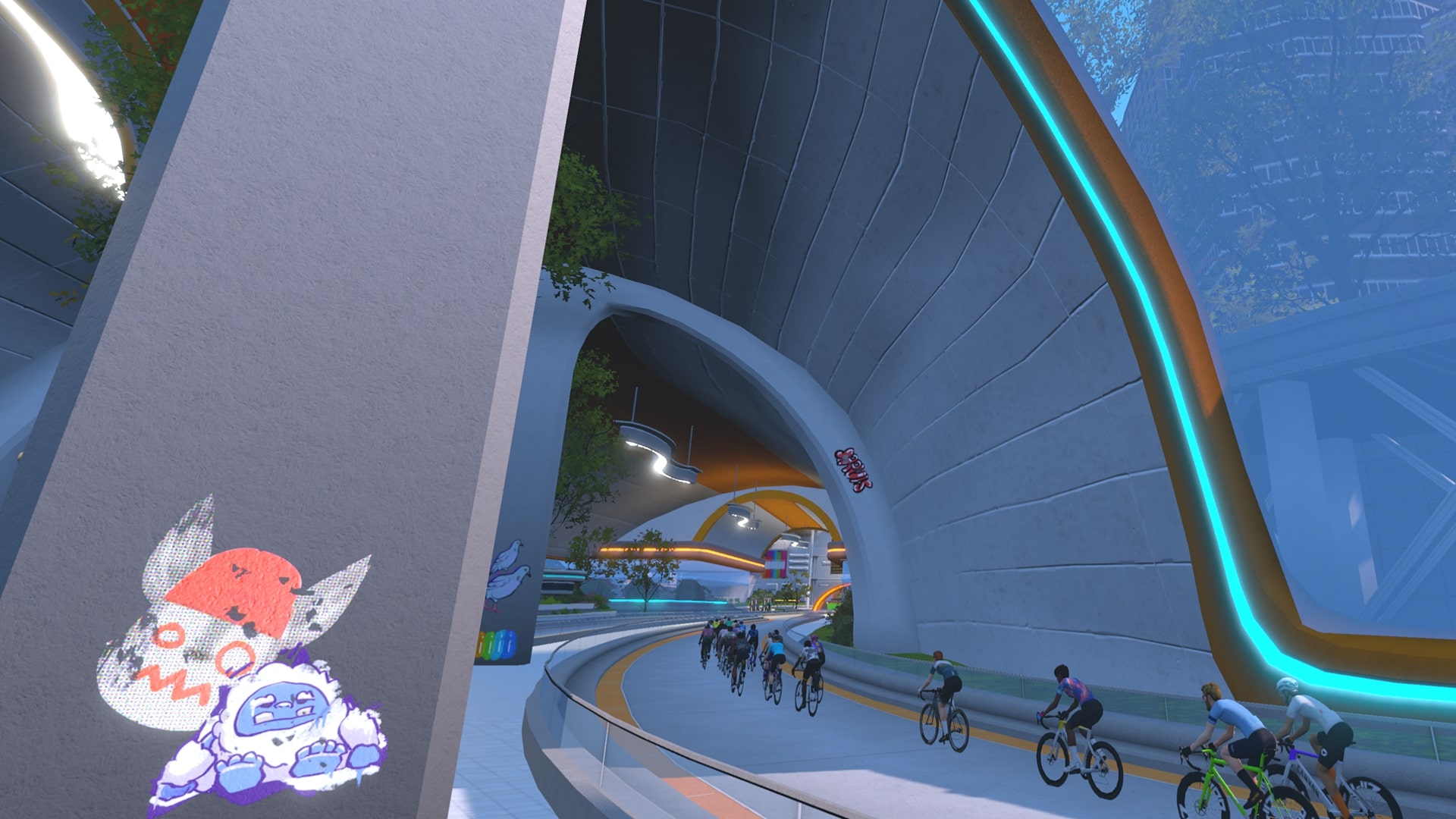
The first of three subway sections as you travel north to south, this subway feels most like a traditional New York station. Its distinctive visual feature is a plethora of advertising billboards, which include cheeky throwbacks to other Zwift maps and features. You’ll see a sign advertising “Fuego Fizz” soda as well as “Fuego Flat”, a Robopacer (dating?) ad, and more.
You’ll also see the first bits of graffiti, including a “jmX” tag you’ll find elsewhere in this expansion. (It’s a nod to Jon Mayfield, original creator of what would become Zwift, who named his software “jmX Trainer Coach”.)
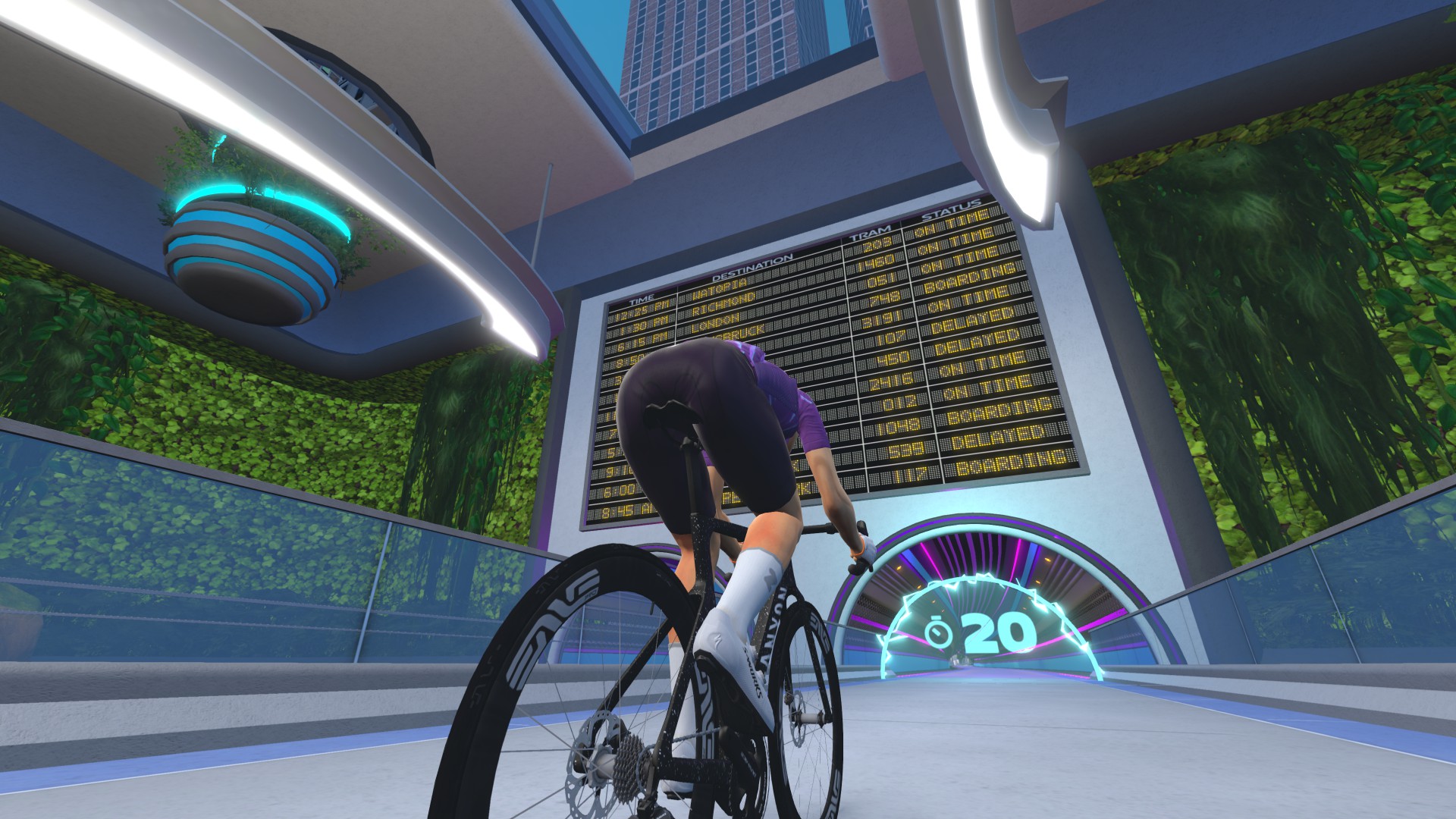
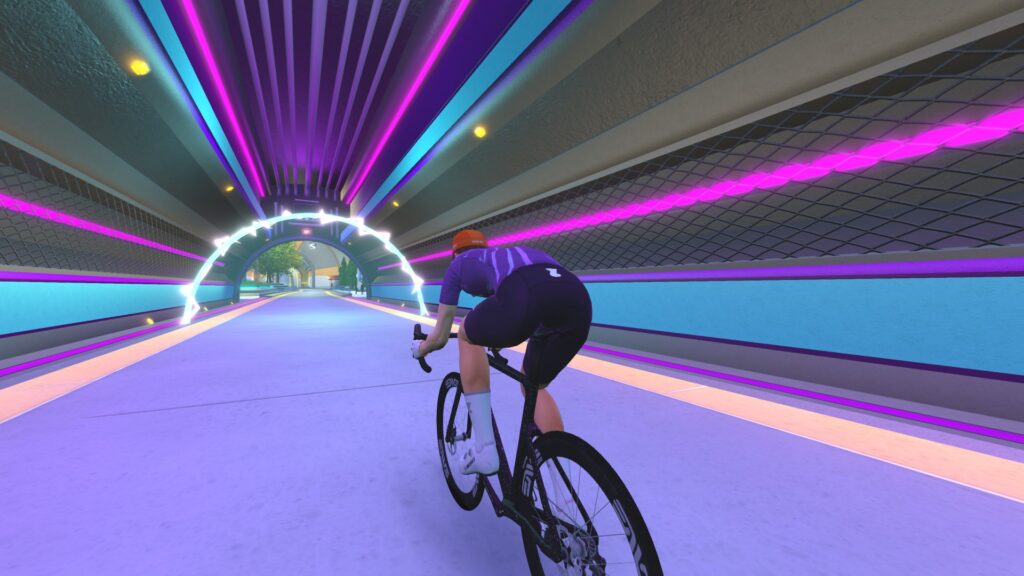
This subway, like the other two, includes Power Segments in both directions. Traveling south, you’ll hit a 5-second Power Segment, while north contains a 20-second segment. These sections of road are one-way, meaning you cannot u-turn.
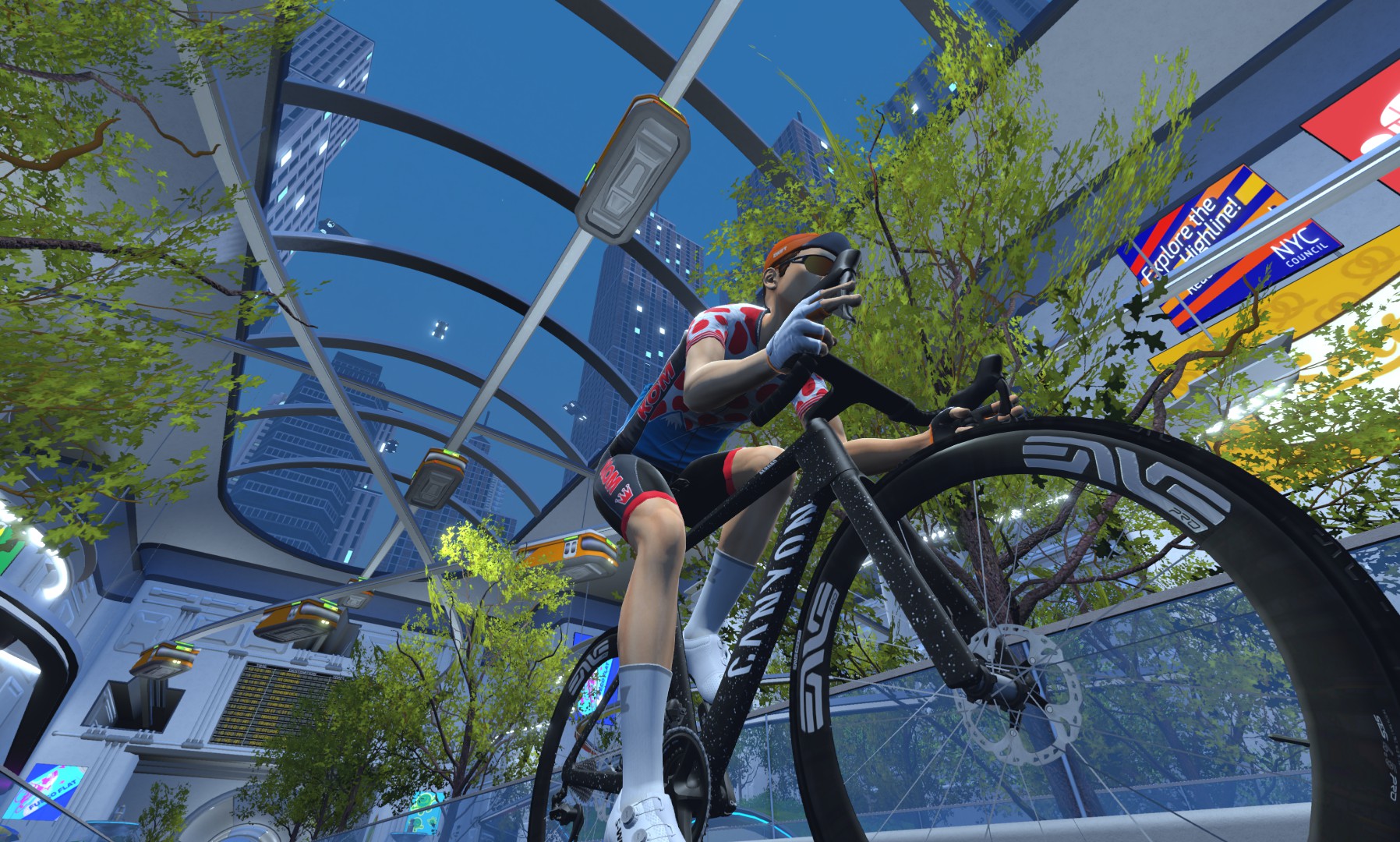
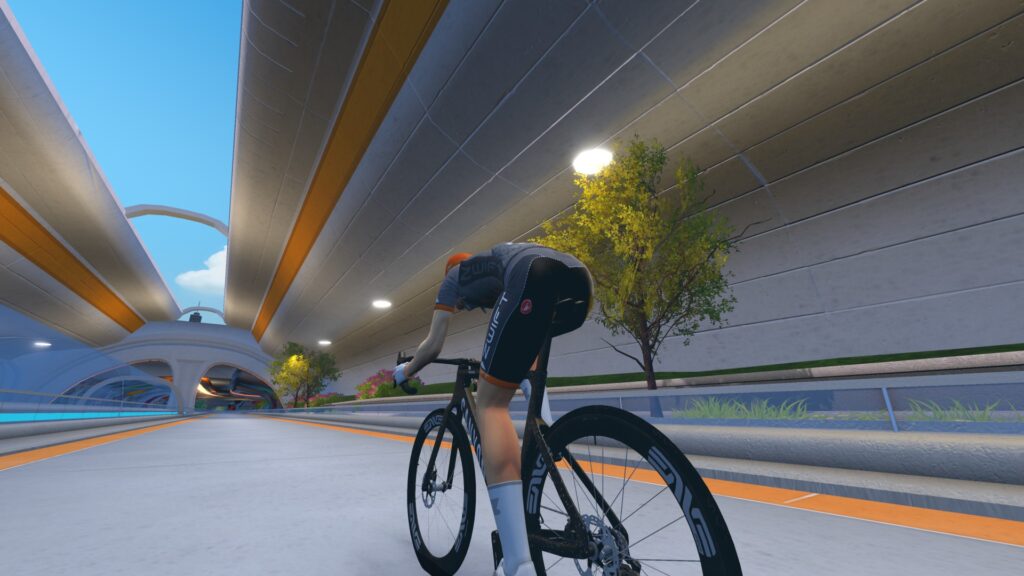
To exit this and the other two subways, you’ll ride up a steep ramp. Good news, though: there’s a bit of an “escalator” built into the ramp to help you to the top! Here’s what it looks like:
Escalator photo taken from the third subway, in Brooklyn
Times Square
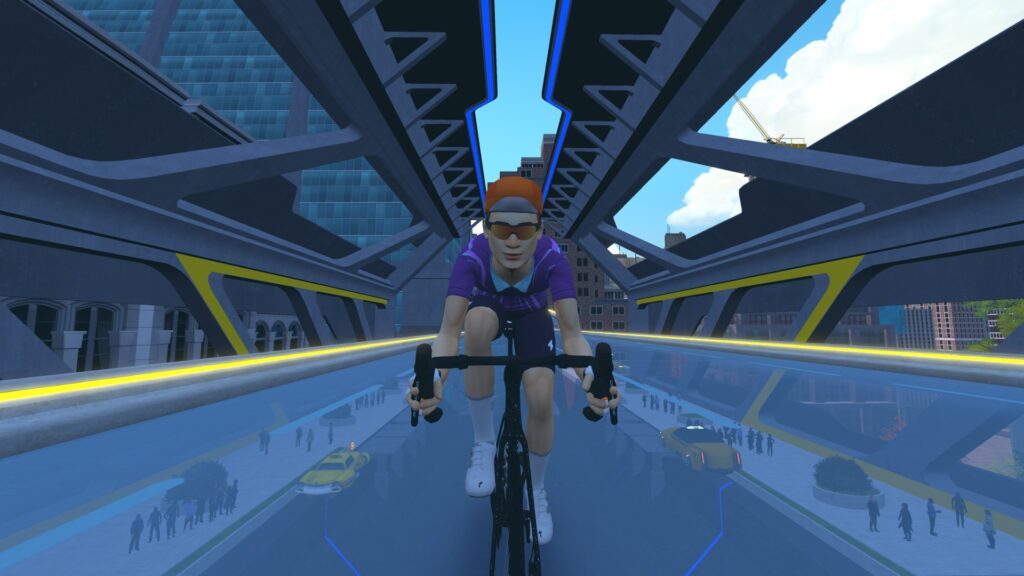
The Times Square section is a 3.5km glass road circuit with a leaderboard that awards an orange jersey to the current fastest man and woman on course, in both directions. There are also new start pens located on this circuit.
While the idea of more glass roads in New York may strike fear in the heart of non-climbers like myself, in talking to Tony Yruegas, Zwift’s Game Art Director, he explained that they pulled a bit of a visual trick in this section by sinking the ground-level roads so the glass roads could appear elevated without much climbing being needed to reach them. “Overmuscled” cyclists everywhere salute you, Tony and team!
While this section doesn’t have many distinctive visual features beyond the glass roads, Tony tells me it will be the site of future celebrations (parades, confetti, etc.), including a possible NY-style Ball Drop on New Year’s.
Subway 2 (City Hall Station)
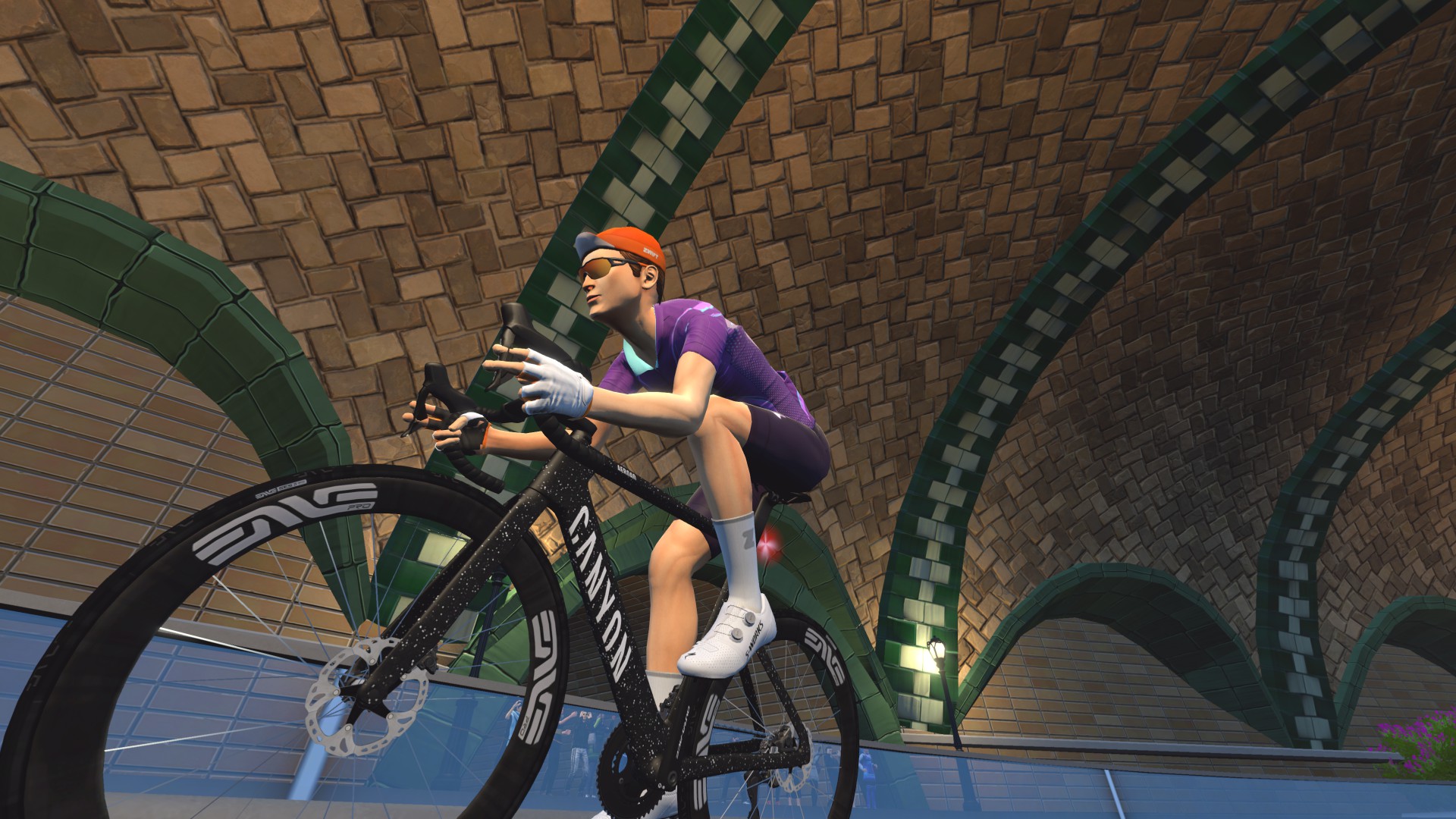
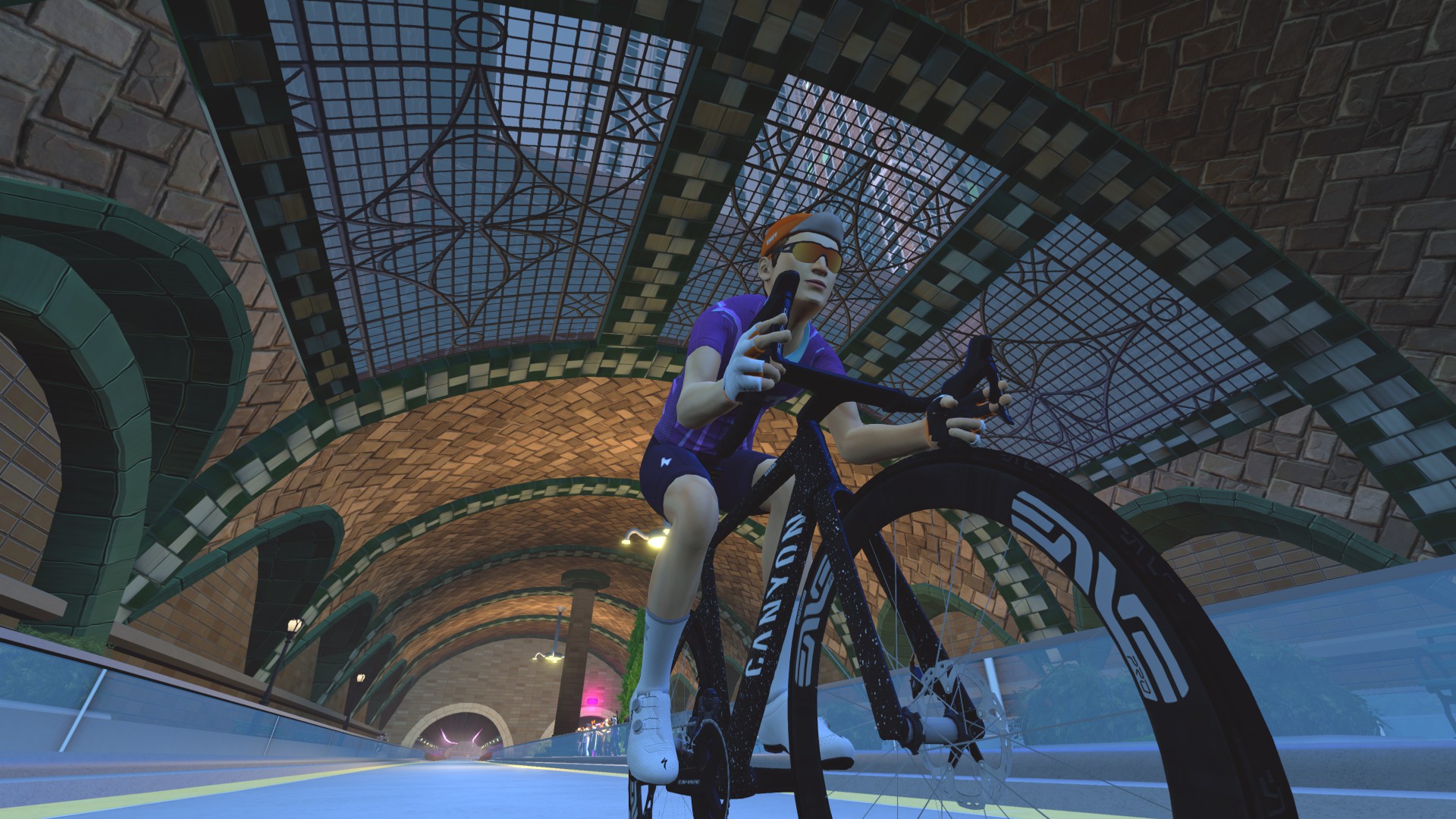
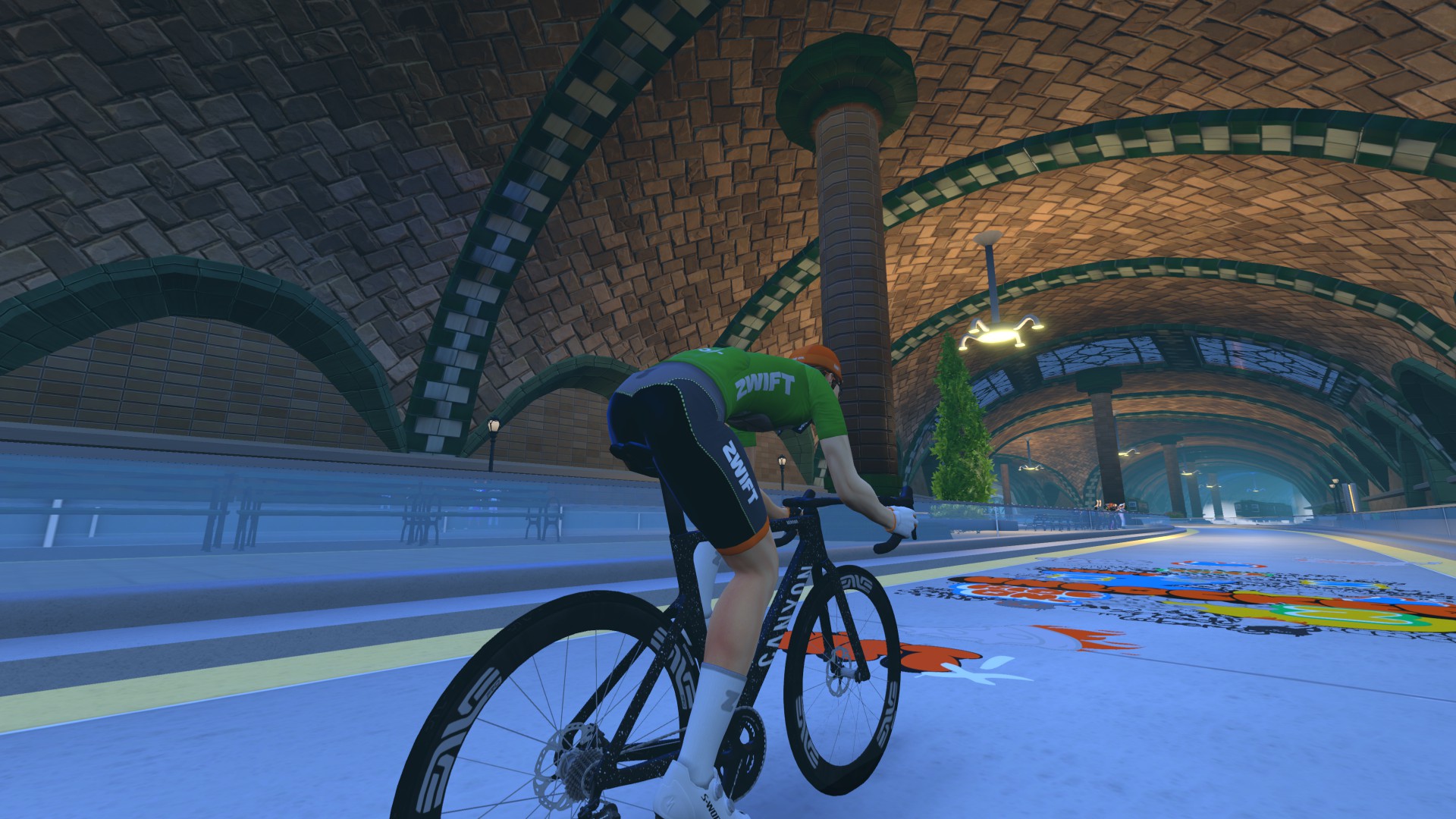
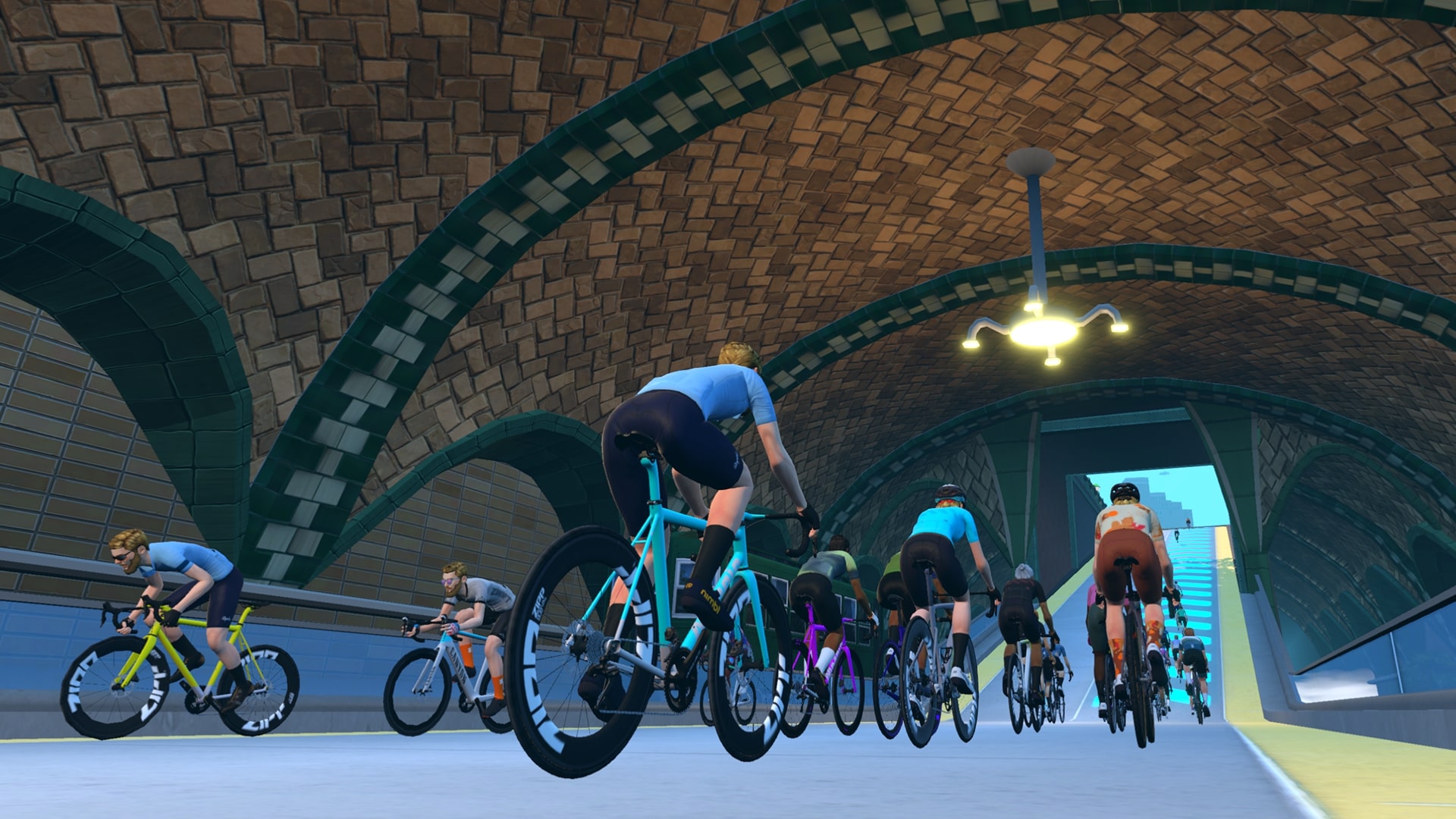
Continuing south, we descend into the second subway section, which is a throwback to New York’s City Hall station. This station opened in 1904, but has been closed since 1945, although you can still tour it today. It features distinctive brick archways, which Zwift has replicated in game:
This section includes 10-second Power Segments in both directions:
Manhattan Bridge
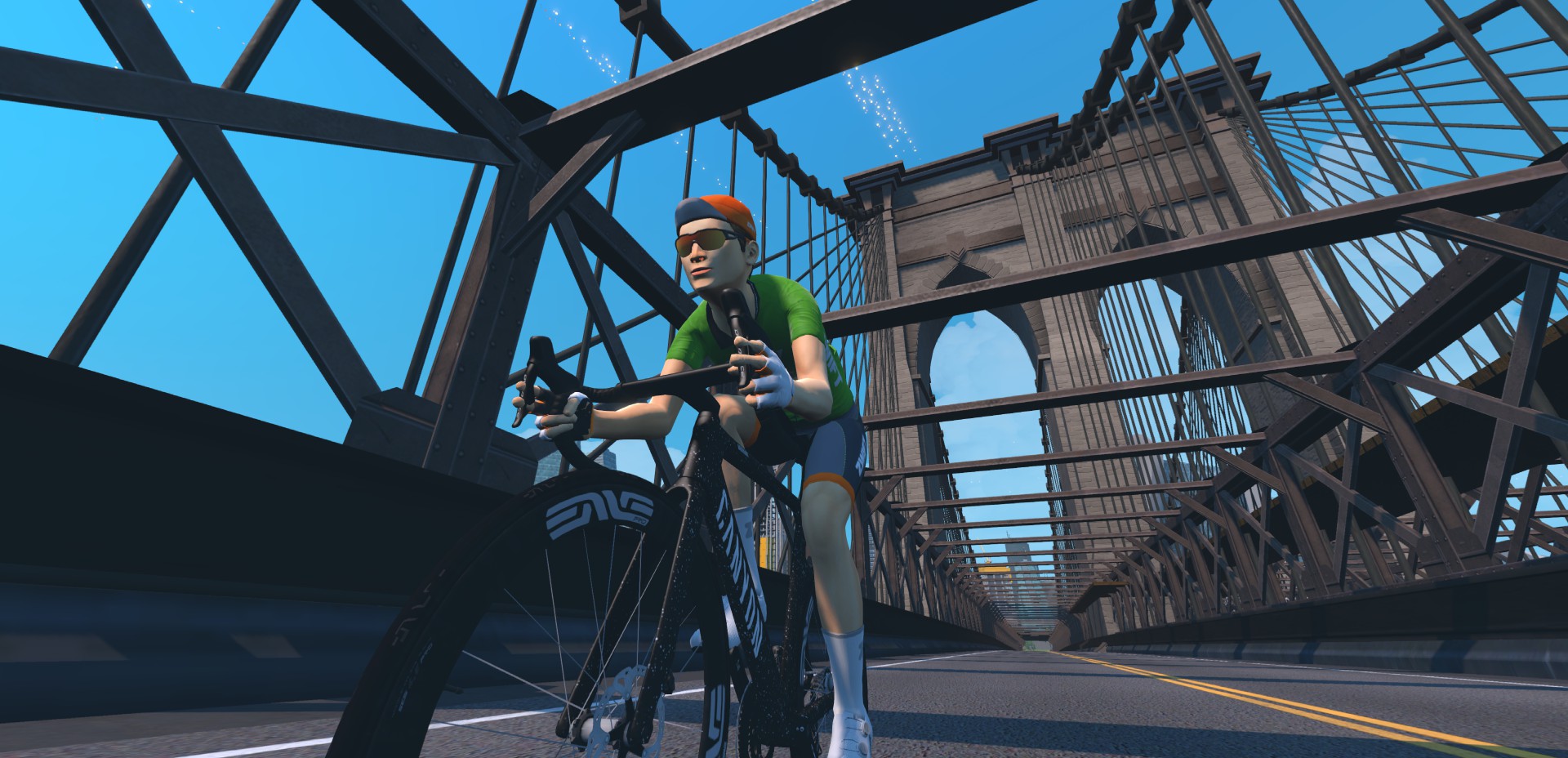
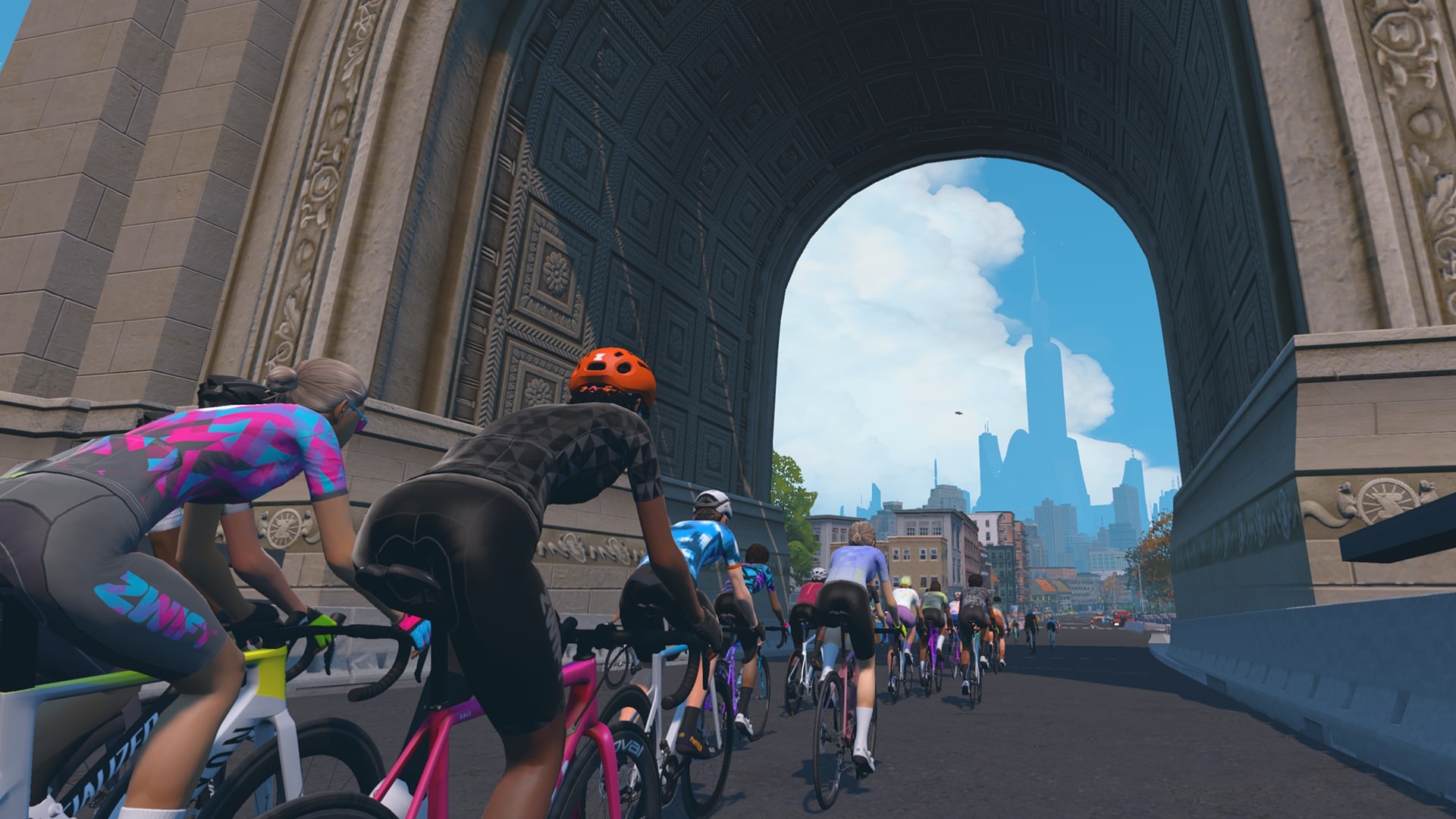
Traveling north to south, the first bridge you’ll encounter is the Manhattan Bridge. For non-NYC natives, the Manhattan Bridge is easily distinguished from the Brooklyn Bridge by its ironwork towers and grey steel girders. (The Brooklyn Bridge, in contrast, has stone/concrete towers and horizontal iron beams which block the skyline views.) The Manhattan Bridge also includes a huge stone archway at the entrance to the Manhattan side:
Looking for your best skyline view from a bridge? It’s found on Manhattan Bridge, heading toward Manhattan.
Manhattan Bridge has 250-meter sprint segments in both directions. Both sprints are slightly uphill, since the bridge arches a bit:
A large stone arch marks the bridge’s exit on the Manhattan side, while a corkscrew road is the exit on the Brooklyn side.
Brooklyn Bridge
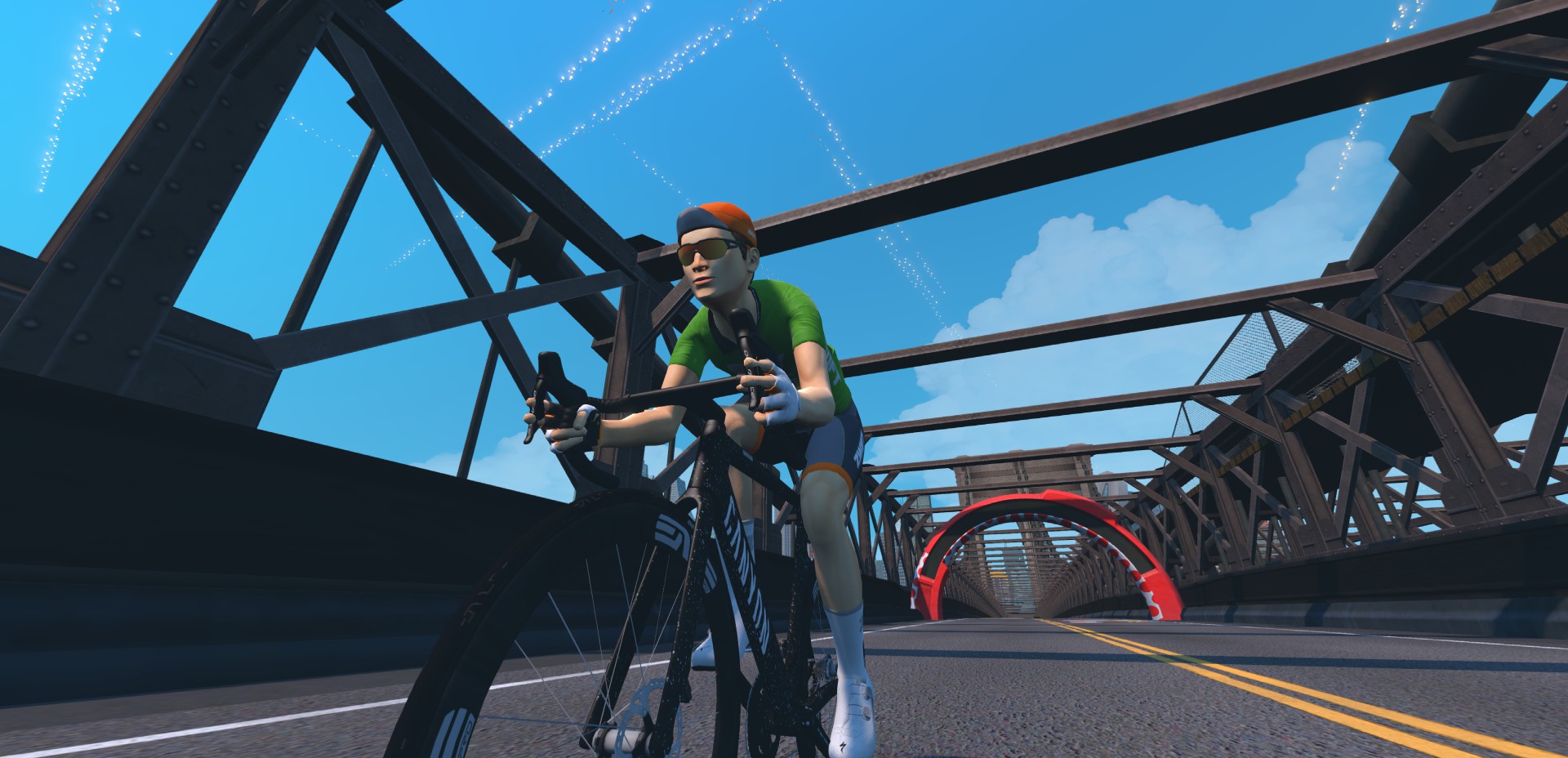
The Brooklyn Bridge includes a KOM section (Brooklyn Bridge KOM, 2km, 1.7%) which runs in only one direction, from the Manhattan side to the center of the bridge. It’s an interesting KOM, too, because it actually begins with a descent! (So don’t let that 1.7% number fool you, as this is really more like 1.5km at 3.6%.)
Subway 3 (Brooklyn)
Almost to Prospect Park! After crossing the East River via the Brooklyn or Manhattan bridges, you’ll descend into the third and final subway section. This is the only one located on the Brooklyn side.
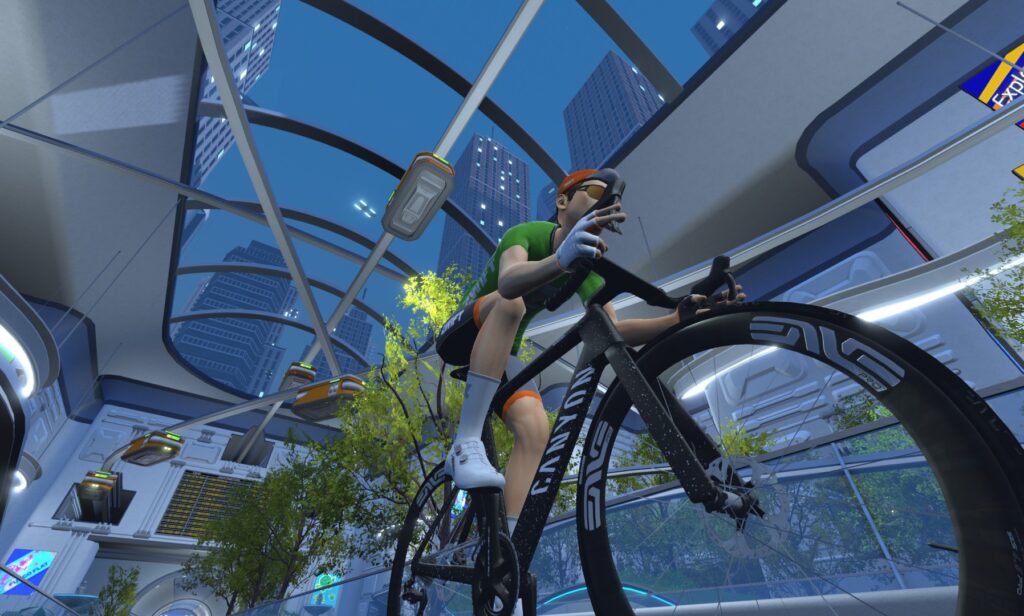
This subway is the “greenest” of the three, with more open skylights and windows to let the sun shine on the trees and plants in the station. This is also the most graffiti-heavy of the three stations, especially as you exit out the Prospect Park side.
The Brooklyn subway includes two Power Segments. Traveling southeast toward Prospect Park you’ll hit a 20-second Power Segment, while northwest includes a 5-second segment.
Prospect Park
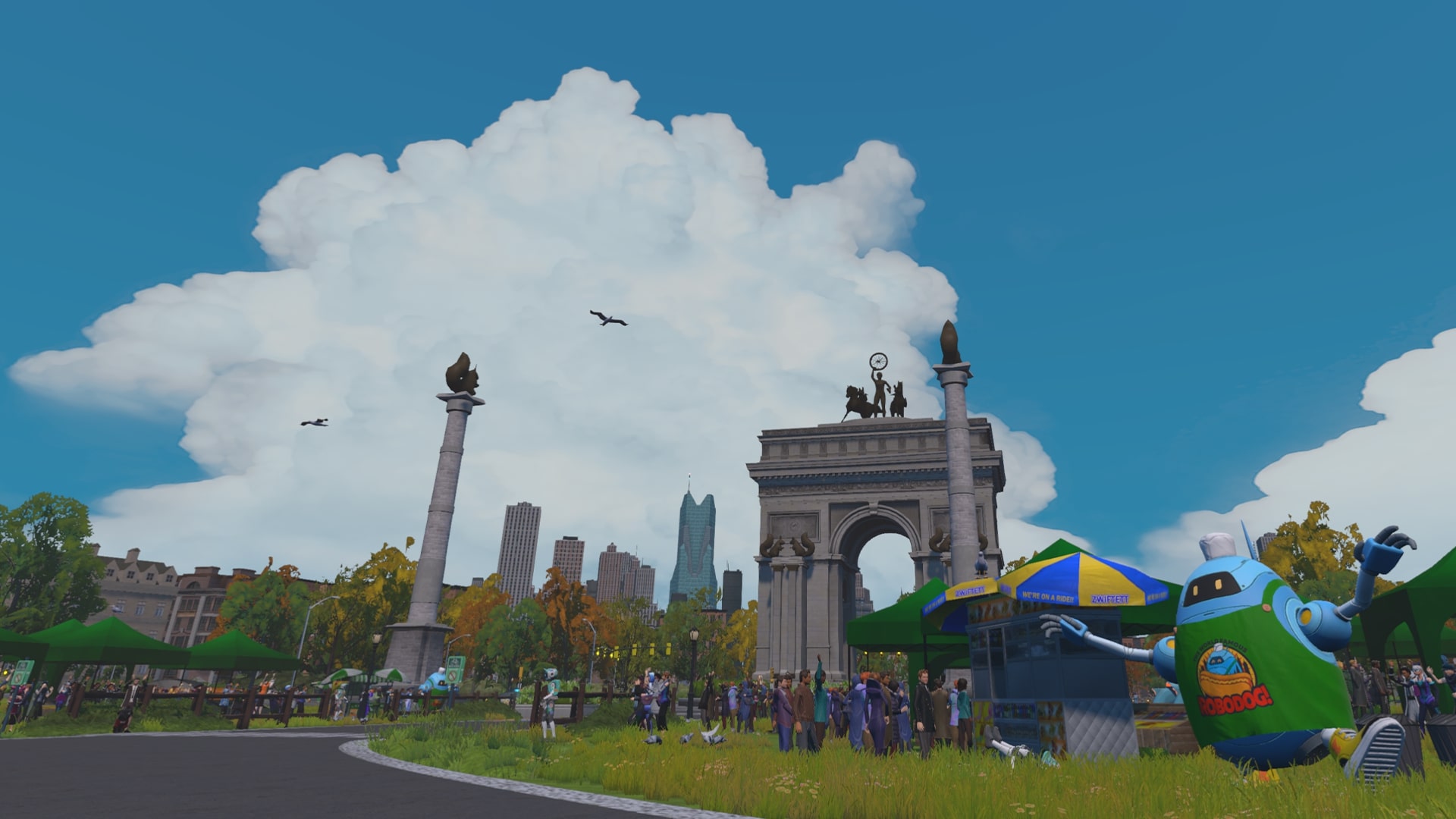
Exiting the subway, you’ll travel south down Flatbush Avenue (which is actually a climb), arriving at a ring road that takes you around Grand Army Plaza to the entrance of Prospect Park.
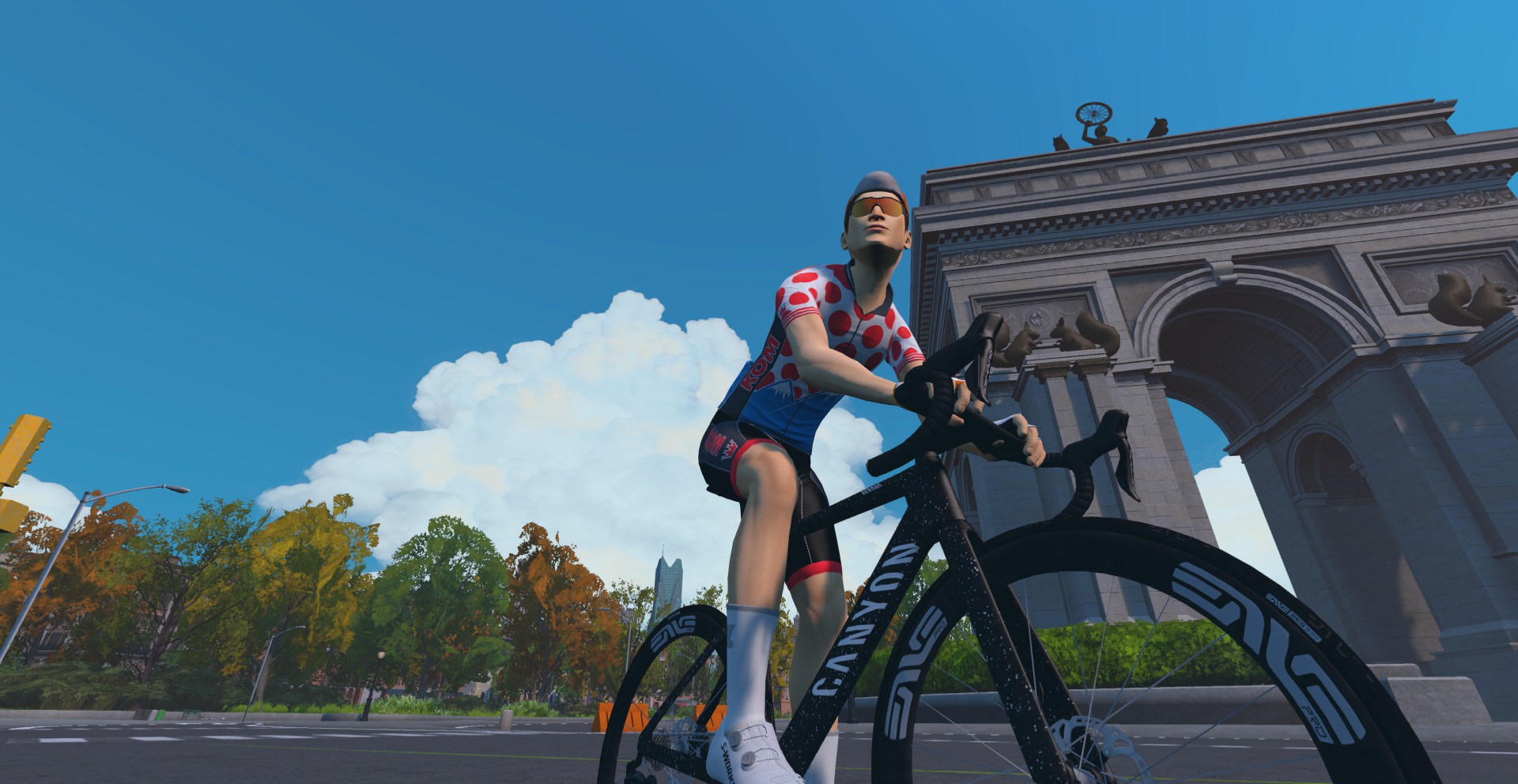
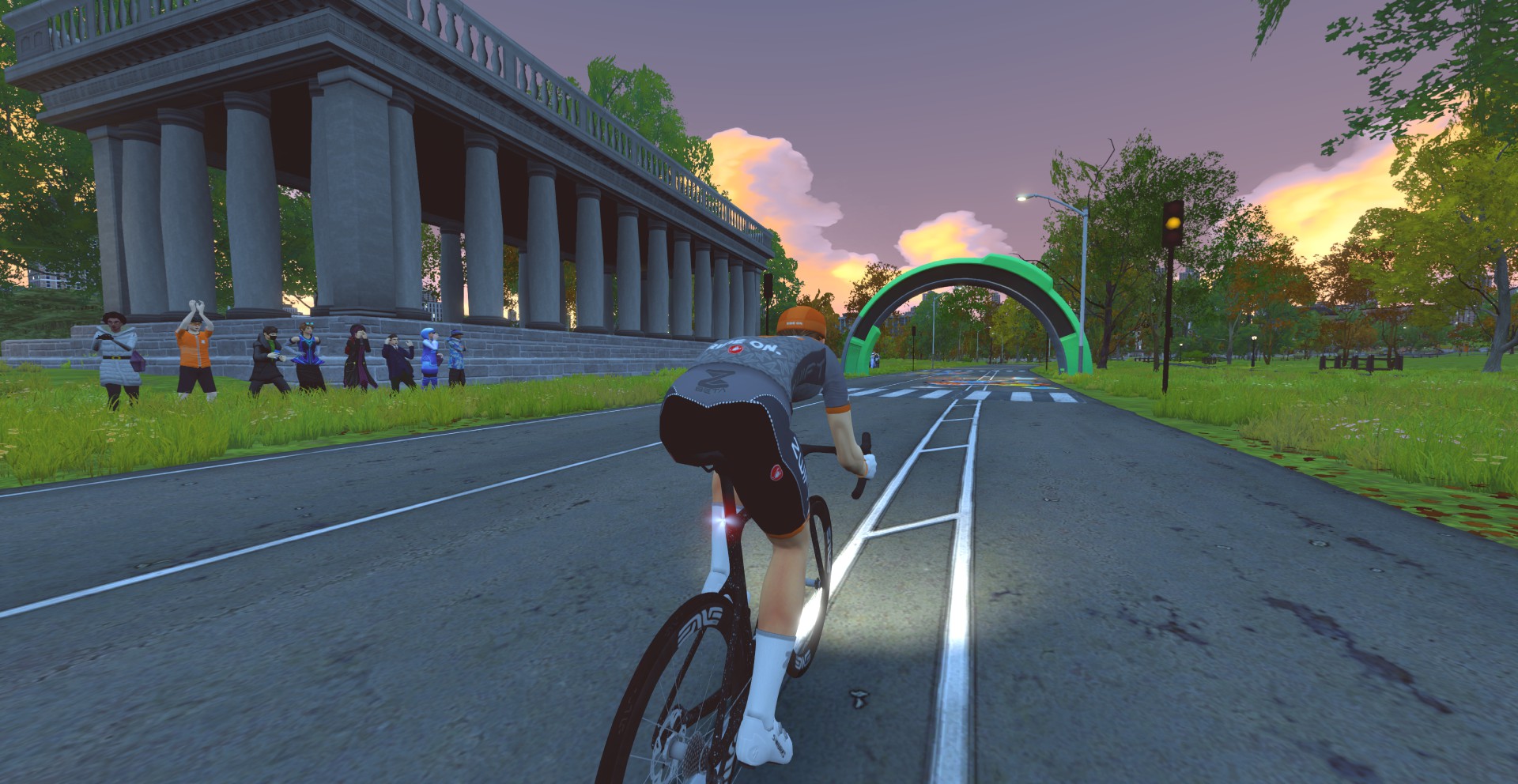
Grand Army PlazaThe BandstandThe Peristyle Sprint
This park was designed by Frederick Law Olmsted and Calvert Vaux 8 years after they collaborated to design Central Park. Zwift’s layout matches the IRL park roads, including a 5.5km loop and a central road (aptly named Center Drive) that offers a shortcut to the other side.
Prospect Park includes 2 sprint banners and one KOM:
The Hill KOM Reverse (length and gradient unknown – while it shows on the leaderboard, there is no visible start line on course)
As you make your way around the circuit counterclockwise, you’ll notice various sites: the lap banner, which comes just after the new Prospect Park start pens. The Bandshell, which has received significant upgrades in Zwift’s reimagining. The Peristyle, which hosts the banner for a sprint that runs in both directions. And the Prospect Park Zoo, here much more visible than the real-life zoo, which is hidden behind a high gate!
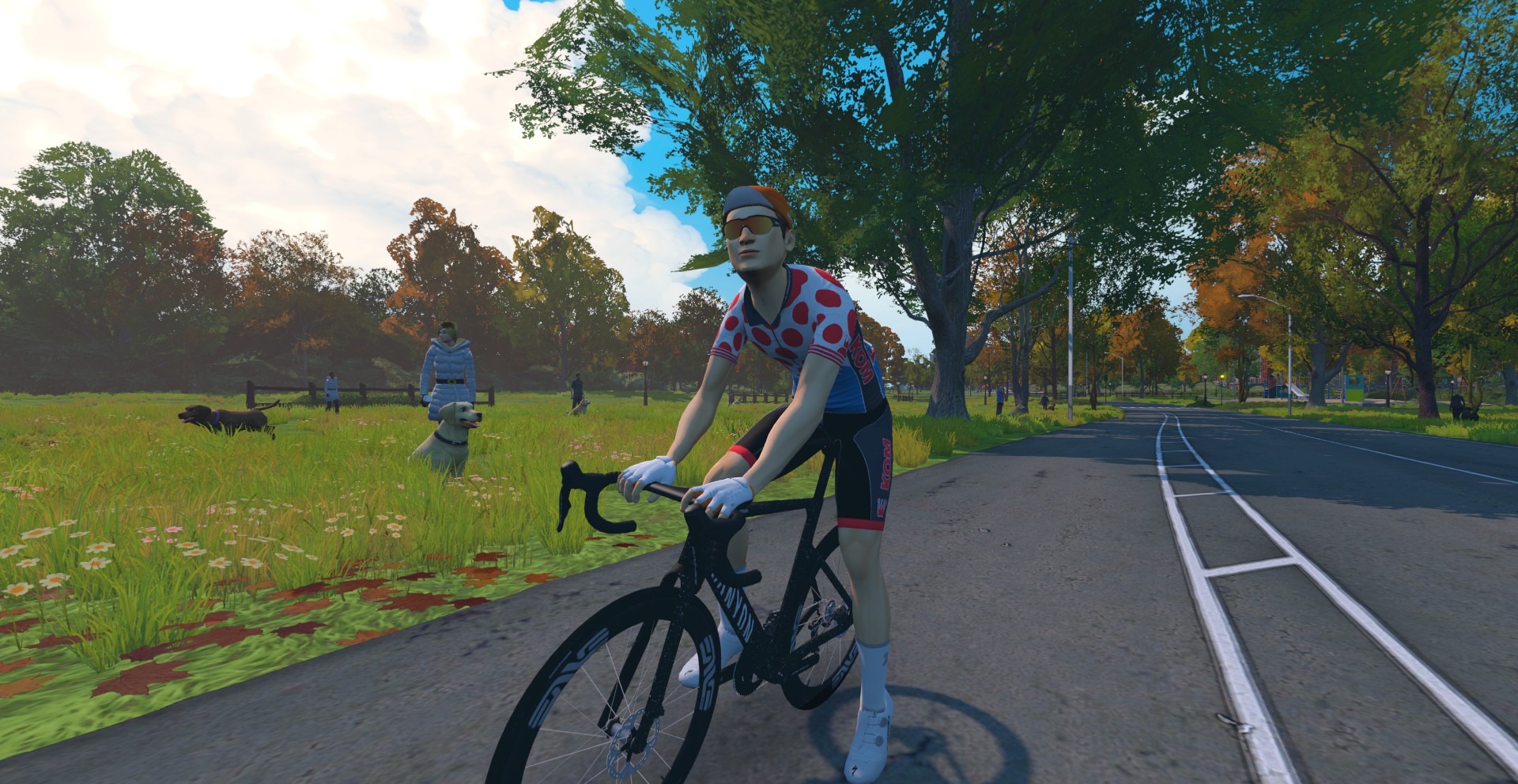
Lots of dogs, with their humansLap bannerKOM banner
There are lots of nods to real-life Prospect Park layouts and features, too. The Peristyle Sprint is where the original sprint finish of Prospect Park’s IRL bike races was located. You’ll see lots of people chasing their dogs in the northwest portion, because dogs can be walked off-leash before 7am IRL. And you’ll pass Prospect Park Lake and the ballfields, whose real versions I saw when riding through the park with Jon Mayfield a few weeks ago.
Detailed List of New Routes
Here’s a complete list of the new routes Zwift released today, including short descriptions from me:
Avon Flyer (5.1km, 30m)*: named for Greg Avon, level 100 Zwifter and Prospect Park race organizer, this simple loop takes in the southern half of Prospect Park.
Double Parked (42.2km, 330m): begin with an almost complete lap of Prospect Park, then head all the way up to do a lap of Central Park before coming back down to finish that Prospect Park lap.
Double Span Spin (12.6km, 120m): a CCW circuit of the Manhattan and Brooklyn Bridges.
Fuhgeddaboudit (79km, 838m): the new longest route in NYC, this doozy covers all the roads on the map, including some in both directions!
Green to Screen (28.4km, 207m): perhaps the best route for seeing most of NYC’s new roads within an hourlong ride, as it covers nearly every bit of new tarmac from Times Square south.
Issendorf Express (7.3km, 53m): named for Charlie Issendorf (NYC racer, Prospect Park race organizer, and former head of events at Zwift), this route is a figure 8 of Prospect Park and Center Drive.
Prospect Park Loop (5.5km, 37m)*: a good place to chase the orange jersey, this is a simple CCW loop of the Prospect Park circuit.
Spinfinity (19.3km, 155m): start and finish in Times Square, with a jaunt down to ride across the two bridges.
Spinfinity Ultra (35km, 291m): almost like two laps of Spinfinity, except you cross the bridges in a different direction on the second lap.
Stay Puft Pursuit (31.2km, 416m): starting in Times Square and traveling south to turn around at the bridges, this is the only route in the expansion that takes on the NY KOM in Central Park, both ways.
The Double Borough (17.9km, 147m): starts in Central Park and travels directly south, turning around by way of the Manhattan Bridge after crossing the Brooklyn Bridge.
The Greenway (36.8km, 292m): ride the northern half of Prospect Park, then up to the two bridges. Then do it again, hitting the bridges in the other direction this time.
Toefield Tornado (10.3km, 53m)*: named for legendary Prospect Park race organizer Al Toefield, this route matches Issendorf Express, apart from three cheeky loops of Grand Army Plaza thrown in near the end.
Watts the Limit (31km, 219m): an out-and-back course that begins in Central Park and travels south to loop around Grand Army Plaza and return by the same roads.
* While all 12 routes listed have achievement badges and accompanying bonus XP for riders, only those marked with * have an achievement badge for runners.
How To Experience the New Routes Today
Want to ride the NY expansion today? While New York isn’t featured in the guest map rotation until November 5, getting on the new tarmac is sort of like navigating Manhattan traffic: it’s not too difficult, if you know what you’re doing!
But Zwift tells me that, starting today, Club events and Meetups can be scheduled on any of the routes listed above. So you’ll start seeing events popping up on the expansion roads this week, including Zwift Insider’s 100km Pizza Burner and Tiny Races!
Free Rides and Workouts
If you’re looking to ride the new routes as a free ride or on-demand workout, that’s easy as well. Oddly enough (and this is one of those “if you know what you’re doing” Zwifty things), both activities work the same way, since New York isn’t on the guest map schedule until next month.
To free ride/run one of the new routes, or cover it in a workout, select your workout, then select your desired New York route from the pop-up menu.
If you’re only looking to free ride the route, once your avatar arrives in New York, you can tab through all the workout intervals to quickly skip through the workout and revert to free ride mode. I call it the “fake workout” hack (see three other ways to ride any Zwift route at any time).
Prospect Park entrance, with Grandy Army Plaza in the background
Upcoming Routes Releases
Zwift says, “Over the coming months, an additional five routes will be unlocked, allowing Zwifters to explore more.” I don’t have any further details on these new routes at this time.
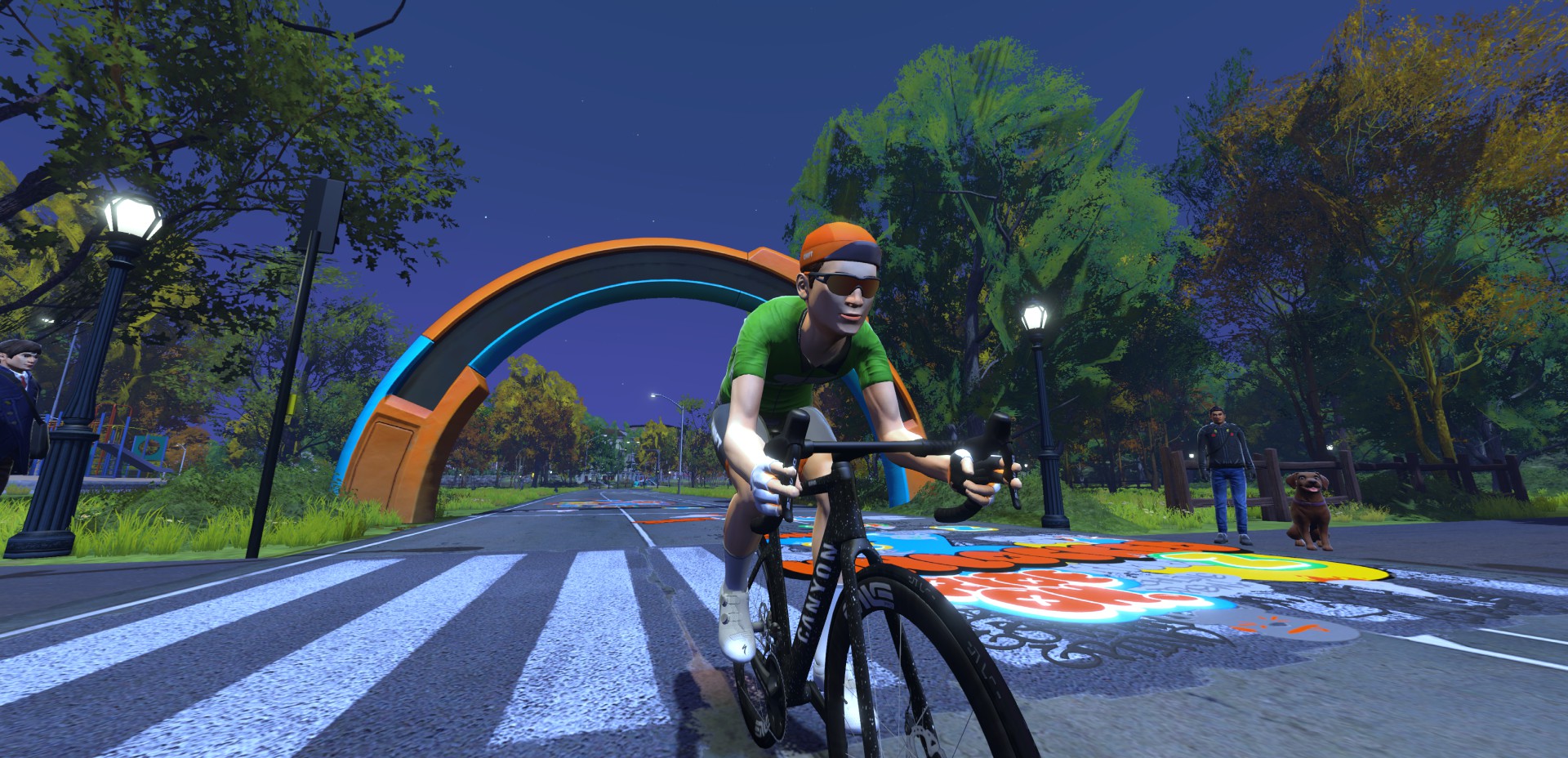
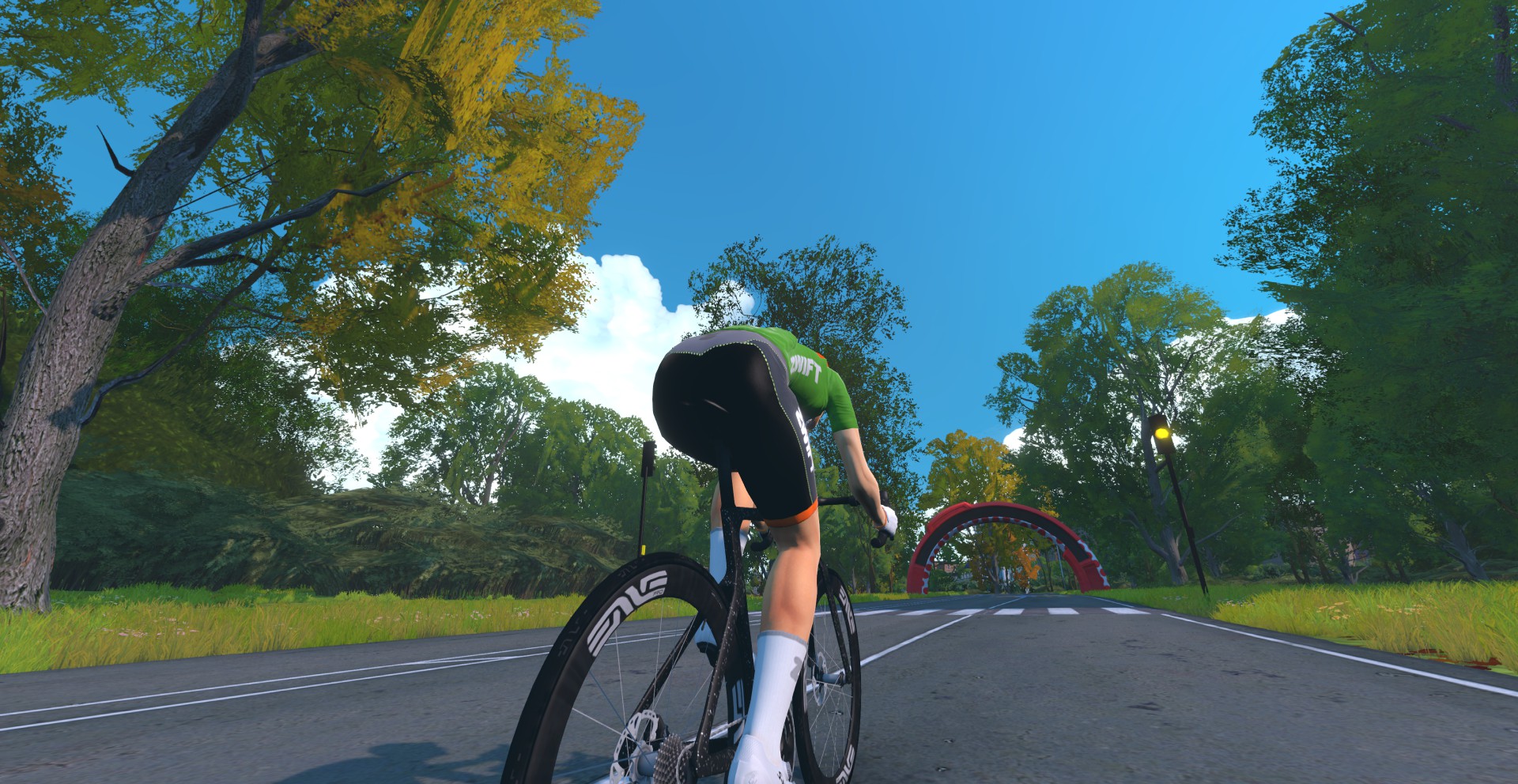
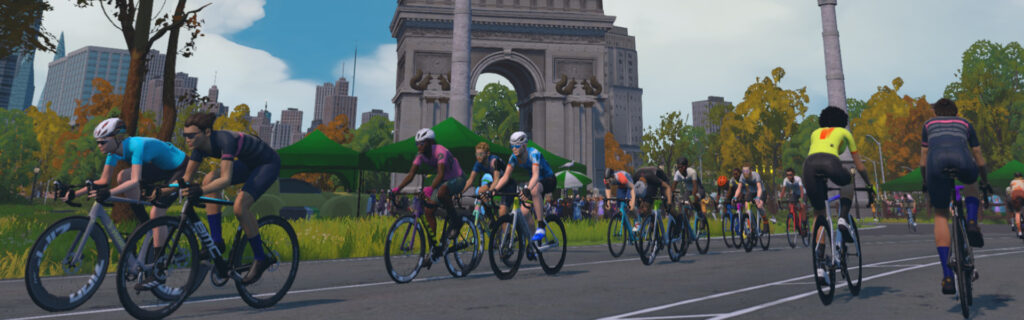
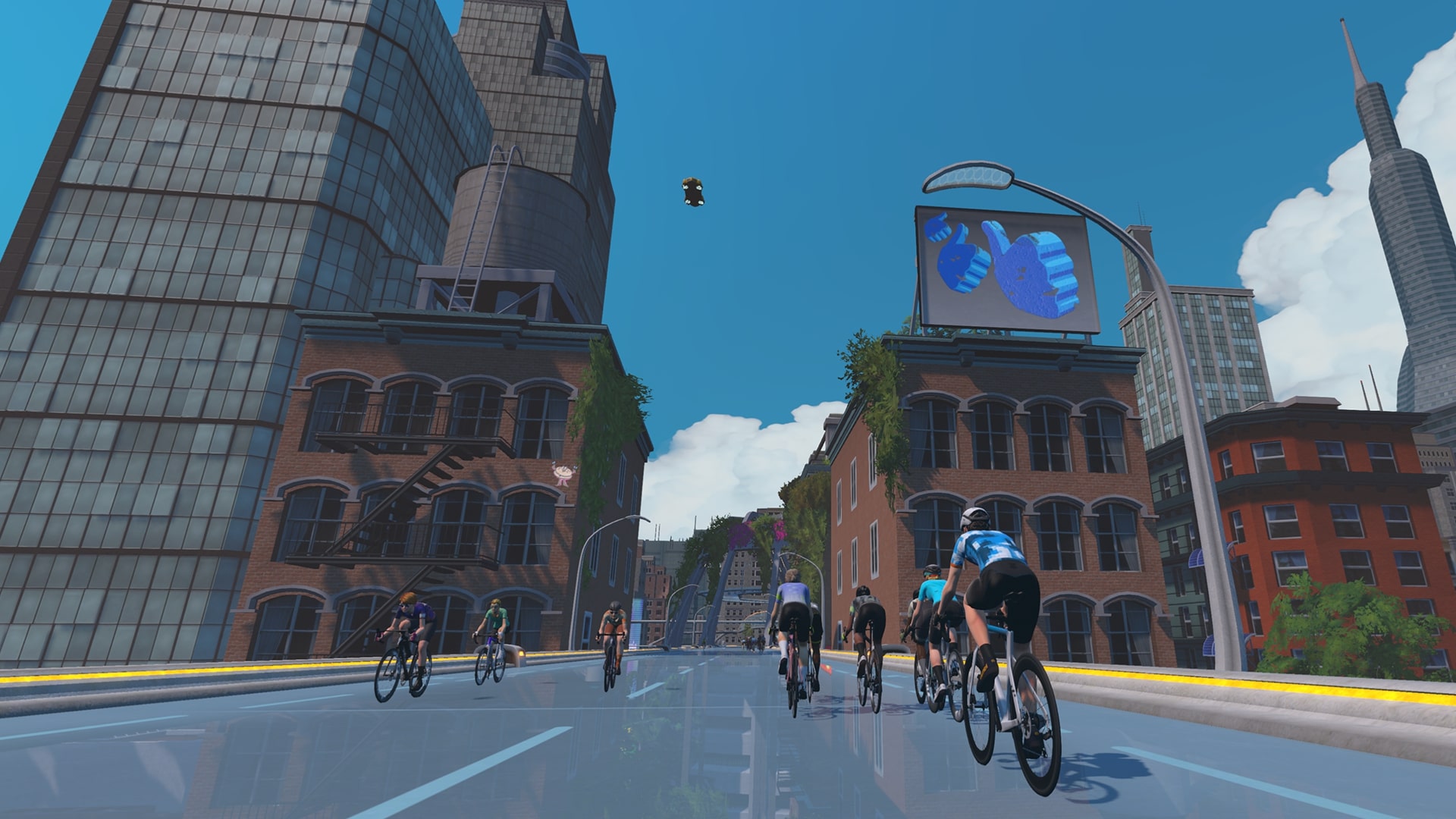
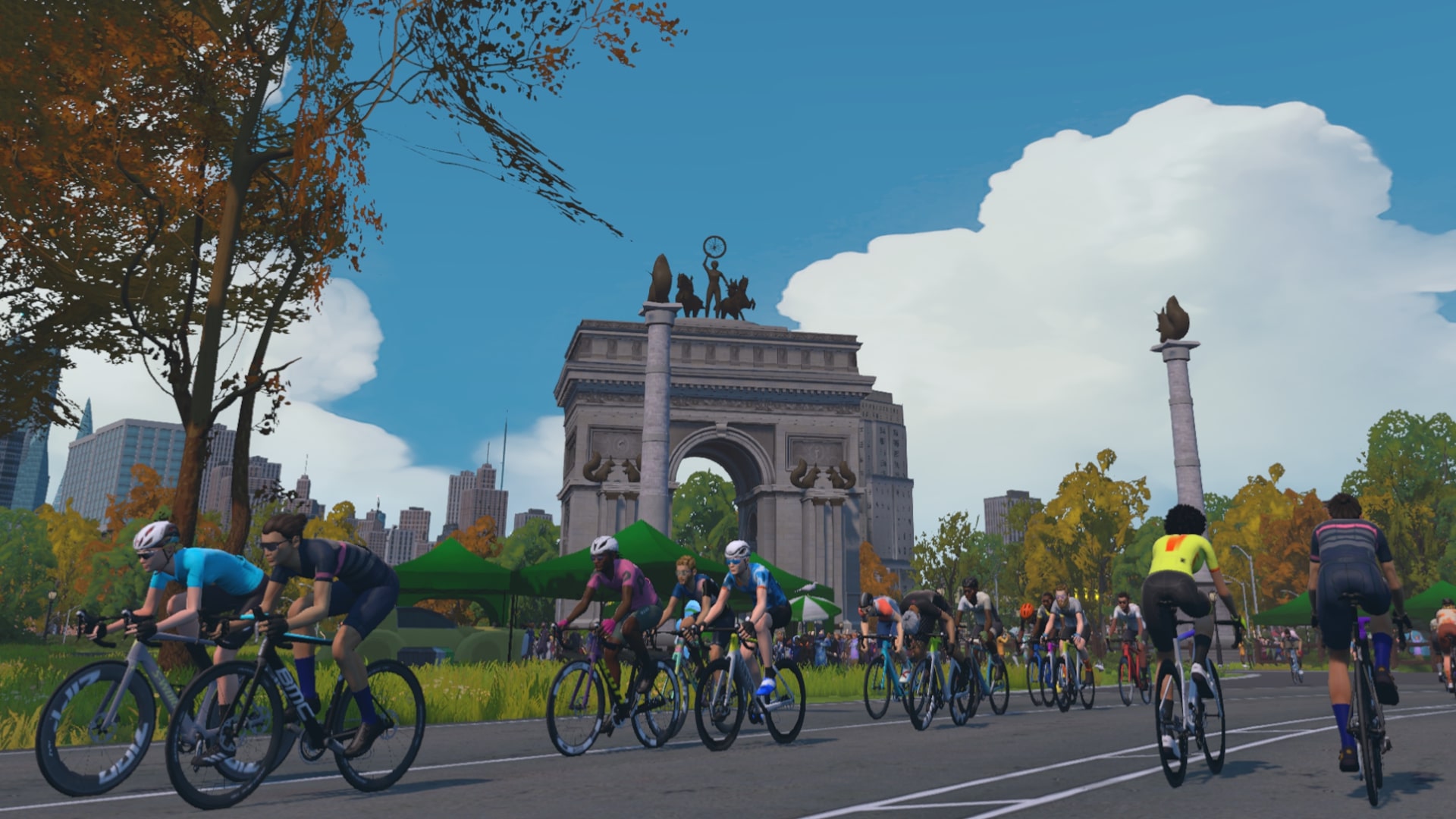
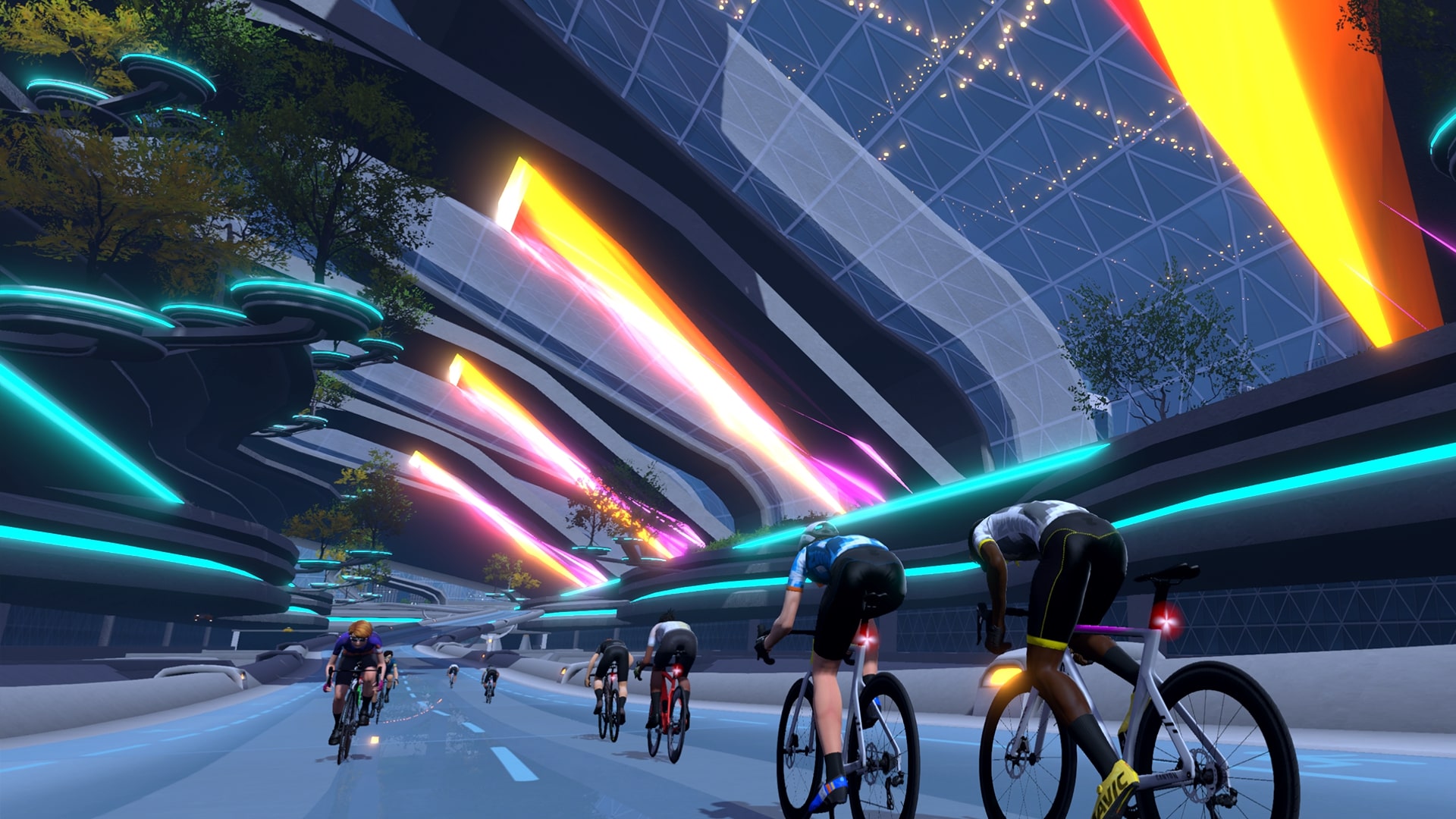
I’ll wrap up with a gallery of images Zwift sent over, since these are the only shots available that show multiple riders, giving us a better feel for what things will look like when it all goes live:
The one image still missing? The Statue of Liberty. Or should I say… the Scottie of Liberty. Yup. They did it!
Beyond packing many exciting new features and changes, Linux 6.18 is expected to become this year’s Long Term Support (LTS) kernel version. Assuming the Linux 6.18 LTS designation, this next kernel version will see lots of use in enterprise environments and thus recently carried out some AMD EPYC 9965 2P “Turin” benchmarks between Linux 6.17 stable and the Linux 6.18 development kernel state…
Qualcomm quietly unveiled the Snapdragon 6s Gen 4, a chipset designed to inject some features once exclusive to flagship devices into more affordable handsets. Not just a minor refresh, the new 4nm processor is poised to be a huge boon for mobile gamers on a budget, with the company claiming a a 59% faster GPU and 144 frames per second support.
Using Spotify on Apple TV might be a smoother experience going forward. Spotify has released an entirely new “experience” that integrates many of its mobile features to Apple TV, including managing your queue and viewing lyrics.
The updated Spotify for Apple TV app also includes remote control via Connect — hopefully there won’t be any future issues with changing the volume. You can also use Spotify DJ, the AI-powered guide for choosing what to listen to next.
If you’re a big video person then there’s another update for you. Apple TV will now be able to show podcast videos and let you adjust playback speed on any videos. It’s good timing as Spotify recently announced that some of its podcast videos will come to Netflix in early 2026.
The update also brings one of Spotify’s newer ventures to Apple TV: music videos. Any Premium subscribers in one of the 97 beta markets with the feature can choose “switch to video” on any song that has a music video. It works just like the tool for Podcasts.
All of these updates come with an entirely new interface that Spotify has created specifically for tvOS, redesigned Spotify for Apple TV should roll out for everyone by mid-November.
This article originally appeared on Engadget at https://www.engadget.com/entertainment/music/spotifys-redesigned-tvos-app-brings-podcast-and-music-videos-to-apple-tv-143512134.html?src=rss
The site formerly known as Twitter has been “X” for over two years now. Nevertheless, many of us still call the site by its old, iconic name. In fact, anytime I feel the need to visit, I go to twitter.com, not x.com—even though the site always redirects to the latter. Is it muscle memory? A small protest? Probably a little of both. But my days of typing “t” in Safari’s address bar and clicking the autofilled twitter.com URL are likely coming to a close, as X seems poised to finally retire its Twitter domain for good.
That news started with a post from X’s “Safety” account on Friday. The post stated that, by Nov. 10, all accounts using a security key for two-factor authentication (2FA) should re-enroll their key to continue using X. The account says you can re-enroll an existing key, or enroll a new one, and that if you choose the latter, other security keys on your account will stop working unless you re-enroll them as well. If you don’t take action, your account will be locked after the 10th.
This change set off speculation that someone had compromised X’s authorization infrastructure, which forced X’s Safety account to make another post clarifying its reasoning for the security change. Not only was there no security concern, the issue only affected Yubikeys and passkeys, not authenticator apps or other 2FA protocols. But the lede was buried within this post: The keys are currently tied to the twitter.com domain: X plans to retire that domain, requiring users to re-enroll with the x.com domain.
If X really does go ahead and retire the domain, it truly will be the end of an era. Nothing will change with the platform itself: X will still be a site for posting your thoughts and dodging the worst of humanity. But once twitter.com stops working, it really will become X through and through. Maybe that will be enough to finally get me to quit it.
Of course, the immediate issue here is for users with security keys tied to Twitter, not X. Those users won’t be able to access their accounts after Nov. 10—unless they take some simple steps to comply with the changes.
Don’t get locked out of X
If you’d like to make sure you can continue using X once the twitter.com domain is retired, you’ll need to make sure your 2FA setup is compliant.
X’s Safety account says if you have a Yubikey or passkey that is affected, you will be prompted to automatically re-enroll with the x.com domain. However, you can also take it upon yourself to re-enroll, by heading to your X account’s 2FA settings and following the on-screen instructions. If you don’t want to re-enroll a key, you can instead choose a different 2FA method, or ditch 2FA entirely—though I strongly encourage you not to choose the last option, for the sake of your account’s security.
Another Ryzen processor with 3D V-Cache underneath the hood is evidently inbound, and based on the model name, it takes aim at builders who want to piece together an affordable gaming PC. It’s the Ryzen 5 7500X3D, and while nothing is yet official, at least one retailer in the United Kingdom has prepped a product page in anticipation of the