When OpenAI launched its TikTok-like Sora app, a key feature was “Cameo” that allows people to add any likeness to videos they generate. Now the maker of Cameo, an app that allows you to buy short videos from celebrities, has filed a lawsuit accusing OpenAI of violating its trademark by using the same name, Reuters reported. It claims that OpenAI’s use of “Cameo” is likely to cause consumer confusion and dilute its brand.
“Via the conduct alleged in this Complaint, OpenAI has knowingly co-opted a well-established, federally registered trademark, ignoring… the clear risk of consumer confusion, and the irreparable harm that will be inflicted on Plaintiff’s Cameo trademark rights and brand,” the complaint states.
Open AI is reviewing the complaint, but “disagree[s] that anyone can claim exclusive ownership over the word ‘cameo,'” a spokesperson told Reuters. Meanwhile, Cameo’s CEO Steven Galanis said it tried to resolve the dispute “amicably,” but OpenAI refused to stop using the name.
Cameo lets users choose from a stable of celebrities — including the likes of Jon Gruden, Lisa Vanderpump and Colin Mochrie — to create short, personalized videos. Prices range from around $30 to $600 per video.
Sora, meanwhile, uses OpenAI’s Sora 2 video generation tech to create and share videos. The app immediately drew attention over potentially unauthorized use of anime, deceased celebrities and other legally protected sources.
Cameo stated that OpenAI not only used its name, but starting offering its own cameo service using deepfake likenesses of celebrities like Mark Cuban and Jake Paul. “Users seeking a personalized celebrity video [could] use Plaintiff’s Cameo service to book talent and receive an authentic, custom video prepared by that celebrity, or use Sora’s ‘Cameo’ service to create an extremely realistic AI-generated video featuring a celebrity’s likeness,” the lawsuit states.
This article originally appeared on Engadget at https://www.engadget.com/apps/openai-sued-for-trademark-infringement-over-soras-cameo-feature-113047158.html?src=rss
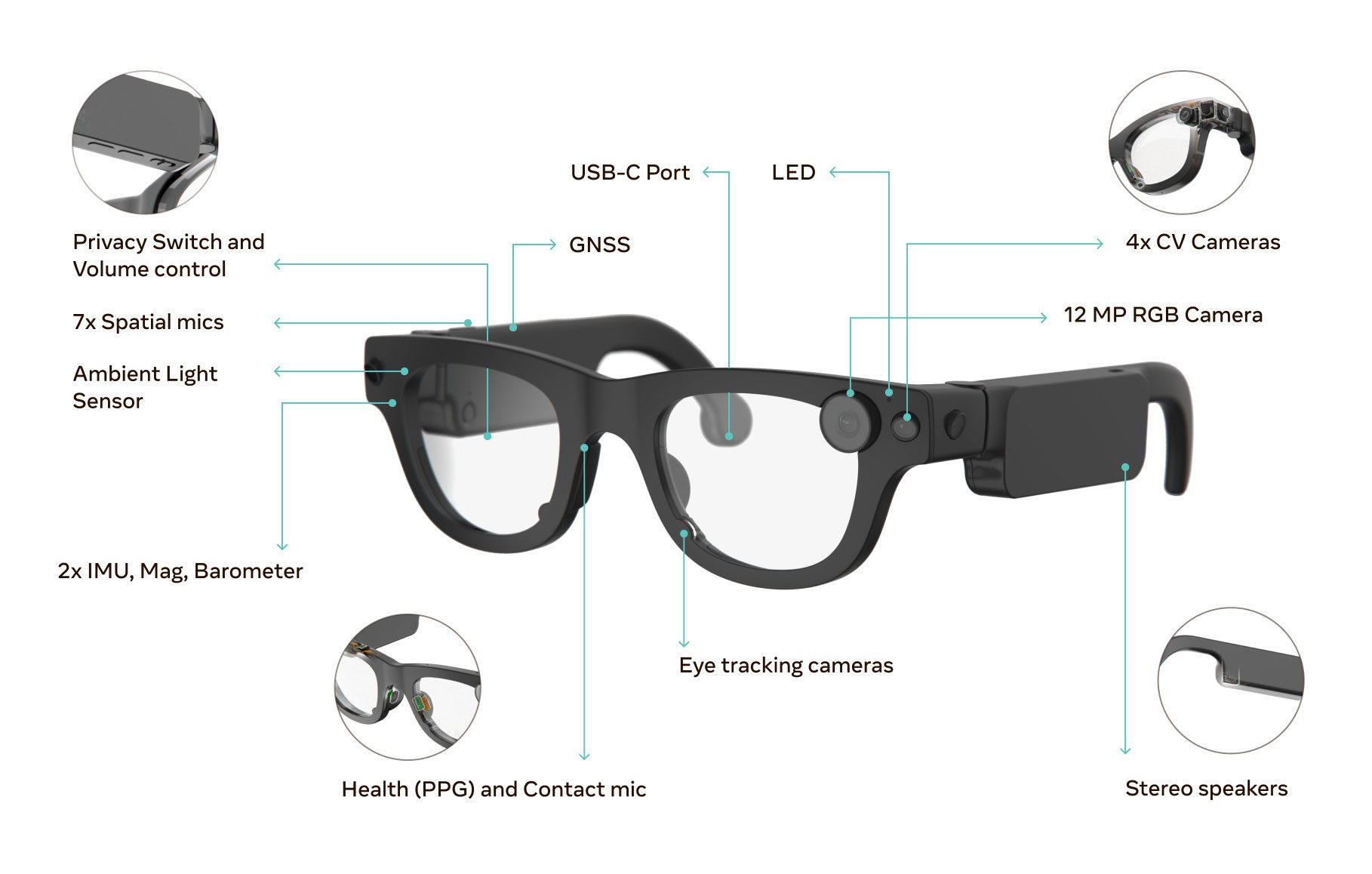
Meta announced it’s shipping out Project Aria Gen 2 to third-party researchers next year, which the company hopes will accelerate development of machine perception and AI technologies needed for future AR glasses and personal AI assistants.
The News
Meta debuted Project Aria Gen 1 back in 2020, the company’s sensor-packed research glasses which it used internally to train various AR-focused perception systems, in addition to releasing it in 2024 to third-party researchers across 300 labs in 27 countries.
Then, in February, the company announced Aria Gen 2, which Meta says includes improvements in sensing, comfort, interactivity, and on-device computation. Notably, neither generation contains a display of any type, like the company’s recently launch Meta Ray-Ban Display smart glasses.
Now the company is taking applications for researchers looking to use the device, which is said to ship to qualified applicants sometime in Q2 2026. That also means applications for Aria Gen 1 are now closed, with remaining requests still to be processed.
The whitepaper details the device’s ergonomic design, expanded sensor suite, Meta’s custom low-power co-processor for real-time perception, and compares Gen 1 and Gen 2’s abilities.
Meanwhile, the pilot dataset provides examples of data captured by Aria Gen 2, showing its capabilities in hand and eye-tracking, sensor fusion, and environmental mapping. The dataset also includes example outputs from Meta’s own algorithms, such as hand-object interaction and 3D bounding box detection, as well as NVIDIA’s FoundationStereo for depth estimation.
Meta is accepting applications from both academic and corporate researchers for Aria Gen 2.
My Take
Meta doesn’t call Project Aria ‘AI glasses’ like it does with its various generations of Ray-Ban Meta or Meta Ray-Ban Display, or even ‘smart glasses’ like you might expect—even if they’re substantively similar on the face of things. They’re squarely considered ‘research glasses’ by the company.
Cool, but why? Why does the company that already makes smart glasses with and without displays, and cool prototype AR glasses need to put out what’s substantively the skeleton of a future device?
What Meta is attempting to do with Project Aria is actually pretty smart for a few reasons: sure, it’s putting out a framework that research teams will build on, but it’s also doing it at a comparatively lower cost than outright hiring teams to directly build out future use cases, whatever those might be.
Aria Gen 2 | Image courtesy Meta
While the company characterizes its future Aria Gen 2 rollout as “broad”, Meta is still filtering for projects based on merit, i.e. getting a chance to guide research without really having to interface with what will likely be substantially more than 300 teams, all of whom will use the glasses to solve problems in how humans can more fluidly interact with an AI system that can see, hear, and know a heck of a lot more about your surroundings than you might at any given moment.
AI is also growing faster than supply chains can keep up, which I think more than necessitates an artisanal pair of smart glasses so teams can get to grips with what will drive the future of AR glasses—the real crux of Meta’s next big move.
Building out an AR platform that may one day supplant the smartphone is no small task, and its iterative steps have the potential to give Meta the sort of market share the company dreamt of way back in 2013 when it co-released the HTC First, which at the time was colloquially called the ‘Facebook phone’.
The device was a flop, partly because the hardware was lackluster, and I think I’m not alone in saying so, mostly because people didn’t want a Facebook phone in their pockets at any price when the ecosystem had some many other (clearly better) choices.
Looking back at the early smartphones, Apple teaches us that you don’t have to be first to be best, but it does help to have so many patents and underlying research projects that your position in the market is mostly assured. And Meta has that in spades.
The rise of artificial intelligence is driving a surge of data center construction across the United States, and rural communities are feeling the impact.
I really like Surfshark VPN. Like I said in my full Surfshark review, it’s the fastest VPN on the market, with download speeds that beat all the other best VPNs. It also gives you universal split tunneling, multi-hop with customizable endpoints and unlimited simultaneous connections.
Surfshark does have its flaws, though. The apps hang up on error messages a bit too often and features sometimes turn on when you don’t need them. If anything about Surfshark is annoying you enough that you’re ready to switch, here’s how you can cancel your subscription, get a refund and (if you want) delete your account altogether.
How to cancel auto-renewal on Surfshark
To cancel Surfshark, all you need to do is stop your subscription from automatically renewing. After you cancel auto-renewal, you can keep using Surfshark for the rest of the period you paid for (unless you get the refund or delete your account entirely). Assuming you bought your subscription through the Surfshark website, follow these steps to cancel.
Go to Surfshark.com. At the top-right of the screen, click My account.
Enter your username and password, then log in. You’ll be taken to your account dashboard at my.surfshark.com.
At the top-right of the screen, click your account email address. Click on Subscription in the drop-down menu.
Click the Payments tab under the words “Your subscription.”
Scroll down to the “Subscription details” section. Next to your Surfshark subscription, click on Cancel auto-renewal.
Sam Chapman for Engadget
That’s all there is to it. Remember that unless it’s been 30 days or less since you subscribed, you won’t be able to get a refund, and Surfshark doesn’t offer prorating for unused time. Additionally, you can always cancel Surfshark by simply opening a live-chat window and asking the support team to do it for you — just be warned that you’ll probably be asked to reconsider several times first.
How to cancel Surfshark if you subscribed through an app store
If you subscribed through an app store, the cancellation process is different. You’ll have to stop your auto-renewal through the platform where you first bought the subscription. In this section, I’ll cover how to cancel through the desktop versions of each app store, since requests submitted there are more likely to work. Just note that you can do the same thing by going to the subscriptions section of your profile on the appropriate mobile app store.
If you bought Surfshark through the Google Play Store, open play.google.com on a desktop computer. Click the circle at the top-right that contains your account’s first initial, then click Payments & subscriptions in the menu that appears. On the new page, click the Subscriptions tab, then scroll down until you find Surfshark. Click Manage, click Cancel Subscription and follow the instructions.
If you went through the Apple App store, a desktop computer is also the easiest way to cancel. Open the App Store in macOS, click Sign In at the bottom-left, then enter your email and Apple ID password. After signing in, check the bottom-left again and click your name, then click Account Settings at the top-right. Click Subscriptions, find Surfshark, then click Edit and Cancel Subscription.
How to cancel Surfshark if you subscribed through Amazon
You can buy Surfshark through Amazon, but if you do, you’ll also have to cancel through Amazon. Go to Amazon and log in to your account. At the top-right, click Account & Lists, then Membership & Subscriptions. Scroll until you find Surfshark and click Cancel Subscription. After that, follow the onscreen prompts.
How to delete your Surfshark account
It’s possible to delete your Surfshark account and immediately end your association with every Surfshark app, but there’s no direct method — your only option is to start a live chat conversation. To do that, go to support.surfshark.com, scroll to the bottom and click Chat with us. In the conversation window, tell the bot you want to delete your Surfshark account. Be prepared to fend off several requests for you to reconsider.
How to get a refund from Surfshark
Surfshark offers a full refund within 30 days of purchase. Live chat is the only way to request a refund. Go to support.surfshark.com and click Chat with us at the bottom of the page, then tell the live chat bot you want a full refund. It’ll guide you from there.
Sam Chapman for Engadget
If you subscribed through Amazon or an app store, you’ll need to request the refund through there instead. The typical refund policy for each platform applies, superseding Surfshark.
Surfshark alternatives
After you’ve cancelled Surfshark, I strongly recommend considering another VPN — it’s not only a vital privacy precaution, but opens up worlds of streaming fun as well. My favorite for both price and performance is Proton VPN, but NordVPN is also a good choice, providing a similar experience to Surfshark but with apps that function a bit better. If you’re prepared to pay a bit more for a service that works seamlessly, ExpressVPN may be for you.
This article originally appeared on Engadget at https://www.engadget.com/cybersecurity/vpn/how-to-cancel-your-surfshark-subscription-110005758.html?src=rss
Discover Tails 7.1, featuring enhanced Tor integration and a new offline start page for improved privacy and user experience. Upgrade your security today!
Earlier, I wrote about yt-dlp, the powerful command-line tool for downloading videos from hundreds of websites, which is an incredible tool that many Linux users have come to rely on, but let’s be honest, not everyone loves working exclusively in the terminal, and sometimes you just want a quick, visual way to download videos without typing commands.
Enter ytDownloader: a modern graphical interface that brings the power of yt-dlp to your desktop with a user-friendly design.
Longtime Slashdot reader zuki writes: According to a recent report over at Tom’s Hardware, a number of those among early buyers who have been able to put the highly-coveted $4,000.00 DGX Spark mini-AI workstation through its paces are reporting throttling at 100W (rather than the advertised 240W capacity), spontaneous reboots, and thermal issues under sustained load. The workstation came under fire after John Carmack, the former CTO of Oculus VR, began raising questions about its real-world performance and power draw. “His comments were enough to draw tech support from Framework and even AMD, with the offer of an AMD-driven Strix Halo-powered alternative,” reports Tom’s Hardware.
“What’s causing this suboptimal performance, such as a firmware-level cap or thermal throttling, is not clear,” the report adds. “Nvidia hasn’t commented publicly on Carmack’s post or user-reported instability. Meanwhile, several threads on Nvidia’s developer forums now include reports of GPU crashes and unexpected shutdowns under sustained load.”
China is accelerating its biotech ambitions by pushing the limits of animal testing and gene editing (source paywalled; alternative source) while Western countries tighten ethical restrictions. “Editing the genes of large animals such as pigs, monkeys and dogs faces scant regulation in China,” reports Bloomberg. “Meanwhile, regulators in the US and Europe demand layers of ethical reviews, rendering similar research involving large animals almost impossible.” From the report: Backing the work of China’s scientists is not only permissiveness but state money. In 2023 alone, the Chinese government funneled an estimated $3 billion into biotech. Its sales of cell and gene therapies are projected to reach $2 billion by 2033 from $300 million last year. On the Chinese researchers’ side are government-supported breeding and research centers for gene-edited animals and a public largely in approval of pushing the boundaries of animal testing.
The country should become “a global scientific and technology power,” Xi said, declaring biotechnology and gene editing a strategic priority. For decades, the country’s pharmaceutical companies specialized in generics, reproducing drugs already pioneered elsewhere. Delving head first into gene editing research may be key to China’s plan to develop innovative drugs as well as reduce its dependence on foreign pharmaceutical companies.
The result is a country that now dominates headlines with stories of large, genetically modified animals being produced for science — and the catalog is startling. Its scientists have created monkeys with schizophrenia, autism and sleep disorders. They were the first to clone primates. They’ve engineered dogs with metabolic and neurological diseases, and even cloned a gene-edited beagle with a blood-clotting disorder.
California-based AI and robotics company 1X is now accepting pre-orders for its humanoid robot NEO, which was designed to automate everyday chores and to offer personalized assistance. Users will be able to control NEO and have it accomplish tasks around the house with the click of a button or a verbal command. It will come with the ability to do basic tasks autonomously when it starts shipping next year, including opening doors, fetching items and turning the lights on or off. However, if early adopters want NEO to be capable of more specific or complex tasks, they’d have to be comfortable with the idea of a human teleoperator controlling the robot remotely and seeing inside their homes.
In an interview with The Wall Street Journal’s Joanna Stern, 1X CEO Bernt Børnich explained that the AI neural network running the machine still needs to learn from more real-world experiences. Børnich said that anybody who buys NEO for delivery next year will have to agree that a human operator will be seeing inside their houses through the robot’s camera. It’s necessary to be able to teach the machines and gather training data so it can eventually perform tasks autonomously. “If we don’t have your data, we can’t make the product better,” he said.
Børnich admitted that much of the work will be done by teleoperators in the beginning. Owners will have access to an app where they can schedule when the teleoperator can take over NEO and where they can specify the task they want the machine to do. He said 1X is putting control in the hands of the owner to respect people’s privacy as much as possible. The company can blur people so that the remote operator doesn’t see them, and owners can designate no-go zones in their homes that the operator cannot go to. Teleoperators also cannot take control of NEO without the owner’s approval. Of course, there’s always potential security breaches to think of — Børnich at least assured that NEO has several layers of security to prevent it from hurting people.
1X NEO is available in tan, gray and dark brown. It’s now available for pre-order from the company’s website with a deposit of $200. Those who want early access to it can get it for $20,000, but it will also be available as a subscription service of $499 a month.
This article originally appeared on Engadget at https://www.engadget.com/ai/1x-neo-is-a-20000-home-robot-that-will-learn-chores-via-teleoperation-040252200.html?src=rss
It’s been nearly three years since Withings first showed off U-Scan to a bemused world, and now it’s finally on sale. U-Scan is the company’s at-home urinalysis gizmo which sits in your toilet bowl and tests your first splash of the day. The device runs a tiny sample through a microfluidic to test, depending on what cartridge you use, either your nutritional or kidney health. These results are then sent to the Withings app, letting you track the quality of your urine over time. Your humble narrator holds the dubious honor of being the first reporter to test the U-Scan during its debut, and found the results pretty interesting.
There are two cartridges available at launch, the first dubbed Nutrio, which looks at your body’s response to nutrition. It will look at your urine’s pH, specific gravity, ketones and the presence of vitamin C over time. Those factors can help you understand if your diet is too acidic, how much fluid you’re drinking on a regular basis, if you’re burning fat, and your anti oxidant intake. The company says that Nutri will be of special interest to people taking GLP-1 medication for weight loss to help them monitor changes to their nutrition levels. Calci, meanwhile, will track your urine’s pH, specific gravity and calcium levels, to keep an eye on your risk of developing kidney stones.
Naturally, such a tool will not be the most affordable in the world, and you can expect to pay a hefty price to own one. Pay $379.95 and you’ll be able to get a U-Scan, a single cartridge that will last for three months, and access to Withings+. The options are then split across “Proactive” and “Intensive” Plans, with the former giving you 2-4 analyses per week, while the latter runs near-daily. If you want the closer monitoring, then $449.96 will get you two cartridges and Withings+ access, which will last you the same three month window. As for replacement cartridges, those on the Proactive tier will spend $99.95 every quarter, while those in team Intensive will pay $179.95. As part of signing up for Withings+, you’ll get a free coaching session with a registered dietician available in all 50 states.
This article originally appeared on Engadget at https://www.engadget.com/home/withings-380-toilet-mounted-urine-analyzer-is-finally-ready-to-buy-040146049.html?src=rss
Below are a few noteworthy changes in the latest release of Fedora Workstation that we think you will love. Upgrade today from the official website, or upgrade your existing install using GNOME Software or through the terminal with dnf system-upgrade. GNOME 49 Fedora Linux 43 Workstation also ships with the brand-new GNOME 49 release, bringing […]
The Japan Mobility Show kicks off in Tokyo this week, and Mazda is using the occasion to show off a couple of concepts it says embody a theme called “the joy of driving fuels a sustainable tomorrow.” One of these is the Vision X-Coupe, which Mazda says shows off the evolution of its KODO design language—something we first saw at the Tokyo show a decade ago.
You can see a clear visual link between the renderings of the Vision X-Coupe and some of Mazda’s current models like the 3 hatchback or the CX-30 crossover, but translated through the long, low form factor of a four-door coupe. The design language is perhaps less interesting than some of the sustainability ideas that Mazda is exploring here, though.
There’s definitely hints of the Mazda RX-Vision in this shape.
Credit:
Mazda
It’s a four-seat, four-door coupe.
Credit:
Mazda
Fun to drive AND sustainable? Sign us up.
Credit:
Mazda
The powertrain is a 503 hp (375 kW) plug-in hybrid that uses a two-rotor turbocharged rotary engine as the internal combustion part of the equation. Mazda says it should have a total range of 500 miles (800 km), with a range of 100 miles (160 km) on battery power alone.
An anonymous reader quotes a report from Ars Technica: On Tuesday, Westinghouse announced that it had reached an agreement with the Trump administration that would purportedly see $80 billion of new nuclear reactors built in the US. And the government indicated that it had finalized plans for a collaboration of GE Vernova and Hitachi to build additional reactors. Unfortunately, there are roughly zero details about the deal at the moment. The agreements were apparently negotiated during President Trump’s trip to Japan. An announcement of those agreements indicates that “Japan and various Japanese companies” would invest “up to” $332 billion for energy infrastructure. This specifically mentioned Westinghouse, GE Vernova, and Hitachi. This promises the construction of both large AP1000 reactors and small modular nuclear reactors. The announcement then goes on to indicate that many other companies would also get a slice of that “up to $332 billion,” many for basic grid infrastructure. The report notes that no reactors are currently under construction and Westinghouse’s last two projects ended in bankruptcy. According to the Financial Times, the government may share in profits and ownership if the deal proceeds.
At TechCrunch Disrupt 2025, Waymo co-CEO Tekedra Mawakana said society will ultimately accept a fatal robotaxi crash as part of the broader tradeoff for safer roads overall. TechCrunch reports: The topic of a fatal robotaxi crash came up during Mawakana’s interview with Kristen Korosec, TechCrunch’s transportation editor, during the first day of the outlet’s annual Disrupt conference in San Francisco. Korosec asked Mawakana about Waymo’s ambitions and got answer after answer about the company’s all-consuming focus on safety. The most interesting part of the interview arrived when Korosec brought on a thought experiment. What if self-driving vehicles like Waymo and others reduce the number of traffic fatalities in the United States, but a self-driving vehicle does eventually cause a fatal crash, Korosec pondered. Or as she put it to the executive: “Will society accept that? Will society accept a death potentially caused by a robot?”
“I think that society will,” Mawakana answered, slowly, before positioning the question as an industrywide issue. “I think the challenge for us is making sure that society has a high enough bar on safety that companies are held to.” She said that companies should be transparent about their records by publishing data about how many crashes they’re involved in, and she pointed to the “hub” of safety information on Waymo’s website. Self-driving cars will dramatically reduce crashes, Mawakana said, but not by 100%: “We have to be in this open and honest dialogue about the fact that we know it’s not perfection.”
Circling back to the idea of a fatal crash, she said, “We really worry as a company about those days. You know, we don’t say ‘whether.’ We say ‘when.’ And we plan for them.” Korosec followed up, asking if there had been safety issues that prompted Waymo to “pump the breaks” on its expansion plans throughout the years. The co-CEO said the company pulls back and retests “all the time,” pointing to challenges with blocking emergency vehicles as an example. “We need to make sure that the performance is backing what we’re saying we’re doing,” she said. […] “If you are not being transparent, then it is my view that you are not doing what is necessary in order to actually earn the right to make the roads safer,” Mawakana said.
NVIDIA has introduced NVQLink, an open system architecture that directly connects quantum processors with GPU-based supercomputers. The Quantum Insider reports: The new platform connects the high-speed, high-throughput performance of NVIDIA’s GPU computing with quantum processing units (QPUs), allowing researchers to manage the intricate control and error-correction workloads required by quantum devices. According to a NVIDIA statement, the system was developed with guidance from researchers at major U.S. national laboratories including Brookhaven, Fermi, Lawrence Berkeley, Los Alamos, MIT Lincoln, Oak Ridge, Pacific Northwest, and Sandia.
Qubits, the basic units of quantum information, are extremely sensitive to noise and decoherence, making them prone to errors. Correcting and stabilizing these systems requires near-instantaneous feedback and coordination with classical processors. NVQLink is meant to meet that demand by providing an open, low-latency interconnect between quantum processors, control systems, and supercomputers — effectively creating a unified environment for hybrid quantum applications.
The architecture offers a standardized, open approach to quantum integration, aligning with the company’s CUDA-Q software platform to enable researchers to develop, test, and scale hybrid algorithms that draw simultaneously on CPUs, GPUs, and QPUs. The U.S. Department of Energy (DOE) — which oversees several of the participating laboratories — framed NVQLink as part of a broader national effort to sustain leadership in high-performance computing, according to NVIDIA.