Ads prominently displayed on search engines are impersonating a wide range of online services in a bid to infect Macs with a potent credential stealer, security companies have warned. The latest reported target is users of the LastPass password manager.
Late last week, LastPass said it detected a widespread campaign that used search engine optimization to display ads for LastPass macOS apps at the top of search results returned by search engines, including Google and Bing. The ads led to one of two fraudulent GitHub sites targeting LastPass, both of which have been taken down. The pages provided links promising to install LastPass on MacBooks. In fact, they installed a macOS credential stealer known as Atomic Stealer, or alternatively, Amos Stealer.
Dozens targeted
“We are writing this blog post to raise awareness of the campaign and protect our customers while we continue to actively pursue takedown and disruption efforts, and to also share indicators of compromise (IoCs) to help other security teams detect cyber threats,” LastPass said in the post.
NVIDIA will invest up to $100 billion in OpenAI as the ChatGPT maker sets out to build at least 10 gigawatts of AI data centers using NVIDIA chips and systems. The strategic partnership announced today is gargantuan in scale. The 10-gigawatt buildout will require millions of NVIDIA GPUs to run OpenAI’s next-generation models. NVIDIA’s investment will be doled out progressively as each gigawatt comes online.
The first phase of this plan is expected to come online in the second half of 2026, and will be built on NVIDIA’s Vera Rubin platform, which NVIDIA CEO Jensen Huang promised will be a “big, big, huge step up,” over the current-gen Blackwell chips.
“NVIDIA and OpenAI have pushed each other for a decade, from the first DGX supercomputer to the breakthrough of ChatGPT,” said Jensen Huang in a press release announcing the letter of the intent for the partnership. “Compute infrastructure will be the basis for the economy of the future, and we will utilize what we’re building with NVIDIA to both create new AI breakthroughs and empower people and businesses with them at scale,” said Sam Altman, CEO of OpenAI.
NVIDIA has made a number of strategic investments lately, including making a $5 billion investment in Intel, shortly after the United States government took a 10 percent stake in the American chipmaker. The company also recently spent more than $900 million to license AI technology from startup Enfabrica and hire its CEO and other key employees.
OpenAI has also formed other strategic partnerships over the last few years, including a somewhat complicated arrangement with Microsoft. This summer it struck a deal with Oracle to build out 4.5 gigawatts of data center capacity using more than 2 million Oracle chips. That deal was part of The Stargate Project, the strategic partnership between SoftBank, OpenAI, NVIDIA, Oracle, Arm and Microsoft with a promise to spend $500 billion in the US on AI infrastructure.
This article originally appeared on Engadget at https://www.engadget.com/ai/nvidia-is-investing-up-to-100-billion-in-openai-to-build-10-gigawatts-of-ai-data-centers-175159134.html?src=rss
Apple bolstered this year’s iPhone lineup with the debut of the iPhone Air, a phone that measures up well against the Samsung Galaxy S25 Edge. It’s an impressive device that manages to pack some serious specs into its thin frame, and a design that harkens back to the thinner phones Apple used to make. This time around, though, the company
While some would like to see themselves as Robin Hood-type well-intentioned opportunists, it has long been known that there is no honor among thieves. Case in point: today’s story, where a man named Raivo Plavnieks was trying to raise money for treatment to survive his stage 4 high-grade sarcoma, and became the target of a malicious crypo
Target is no stranger to competition with Amazon sales. They’ve overlapped their Circle Week sales with Prime Day many times before. Since October Prime Day is around the corner, Target has just announced its own sale for October. Here are all the details you need to know.
What is Target’s Circle Week?
Circle Week is Target’s name for its biggest sale. As the name suggests, it lasts a whole week, and while it used to happen just once a year but, it now occurs multiple times a year. The most recent sale was this summer, and before that, in the spring, overlapping with Amazon’s Prime Day and Big Spring Sale, respectively.
When is Circle Week?
The next Circle Week will take place from Oct. 5 to Oct. 11. That means it begins two days before October Prime Day, which runs from Oct. 7 through Oct. 8.
Do you need to be a member to shop the sales during Target Circle Week?
Like Amazon’s Prime Day sale, you will need to be a Circle member to take part in the sale, but unlike a Prime membership, Target Circle is free. You can sign up for an account on the Target app or Target.com.
You can also pay for a Target Circle 360 membership, which grants you early access to the sale as well as other perks, like same-day delivery. If you’re a teacher or student, you can save 50% on the one-year Circle 360 subscription through Sept. 13; otherwise, it starts at $10.99 per month. But again, a paid membership isn’t necessary to get all the best Circle Week deals.
What deals can I find during Target Circle Week?
Circle week will focus on apparel; home products like kitchen appliances, storage, floor care, and bedding; fun and entertainment; and Halloween costumes and treats. You’ll also find tech products on sale, which we’ll be covering as usual. You can shop in person or online, and there will be a “Deal of the Day” for every day of the event that will start at 40% off.
While Target hasn’t released a list of deals you can expect, you can get a pretty good idea from past Circle Week sales. Here are some of the deals they had at the tail end of the Circle Week last fall.
What competitors are also offering sales?
Amazon’s October Prime Day will take place from Oct. 7 through Oct. 8, so all the other sales tend to revolve around these dates. Walmart will likely have its Walmart Deals sale, like they’ve done in the past, and Best Buy will likely have its own sale as well. I’ll cover the details of those sales as they are released.
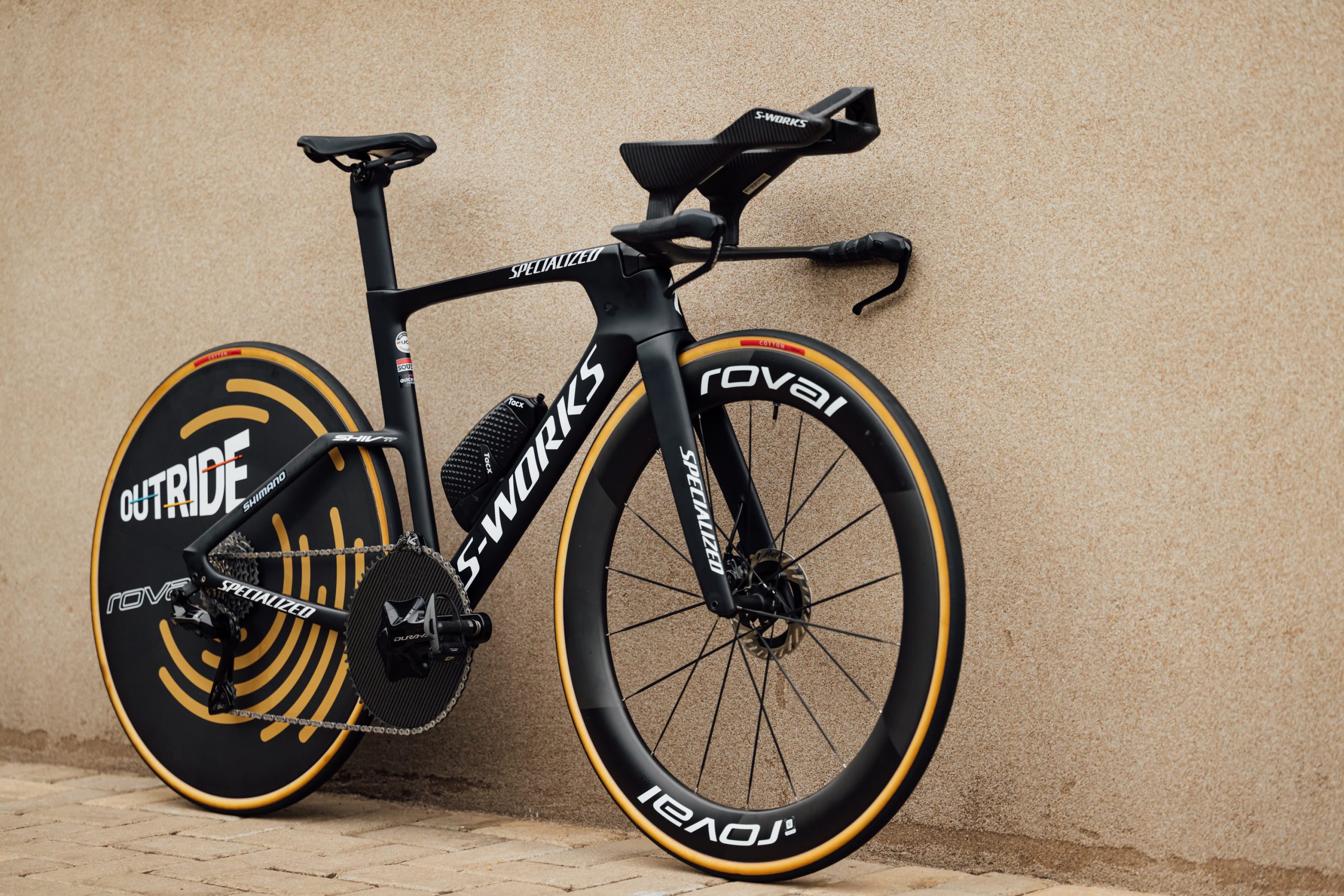
Remco Evenepoel romped to a third consecutive victory in the men’s elite time trial at the UCI Road World Championships on Sunday, and here’s his weapon of choice.
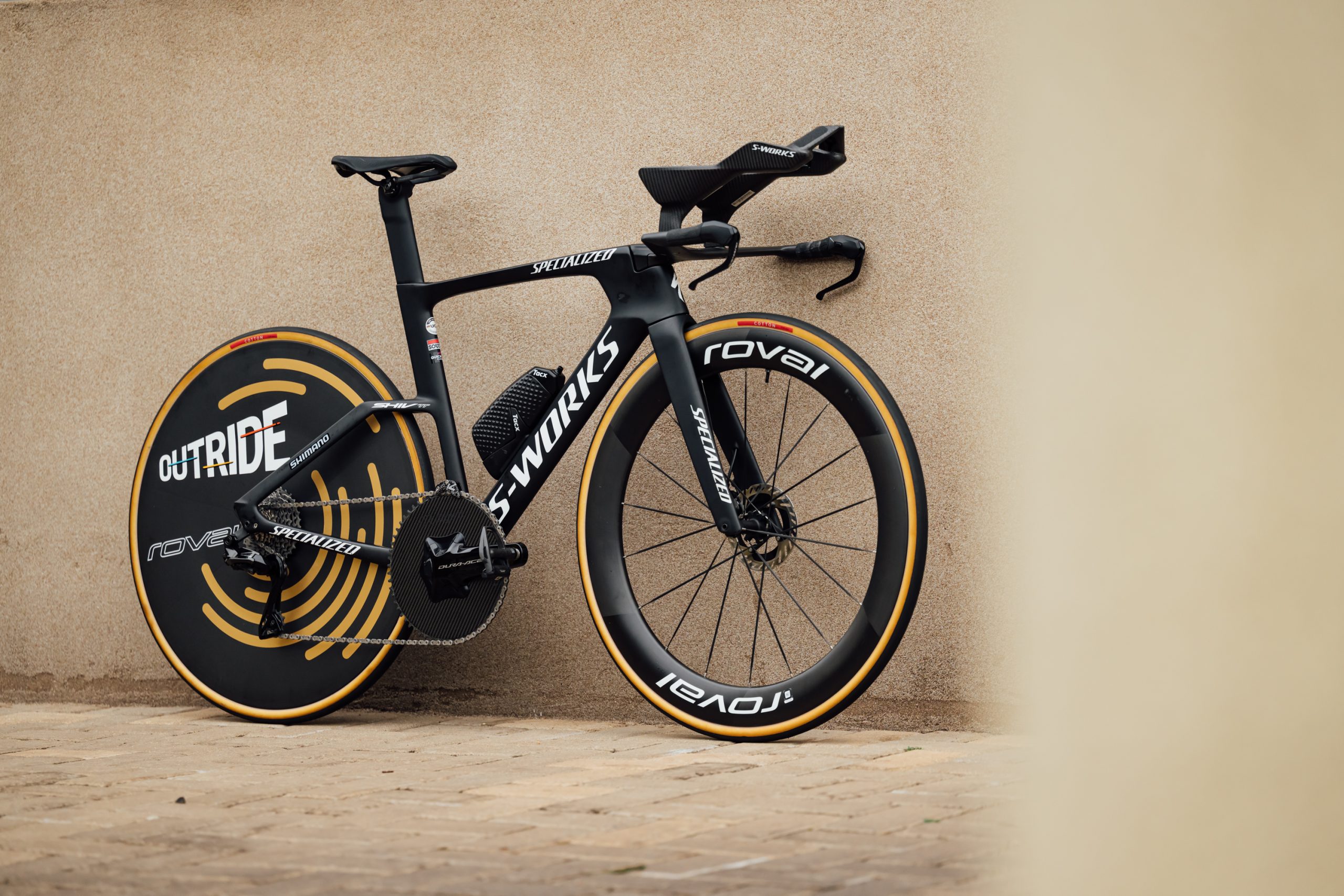
As you’d expect, Evenepoel’s Specialized Shiv TT Disc time trial bike is fully kitted out with all of the latest kit, including a custom carbon fibre cockpit, a monster 1x carbon chainring and Roval’s latest aero wheels.
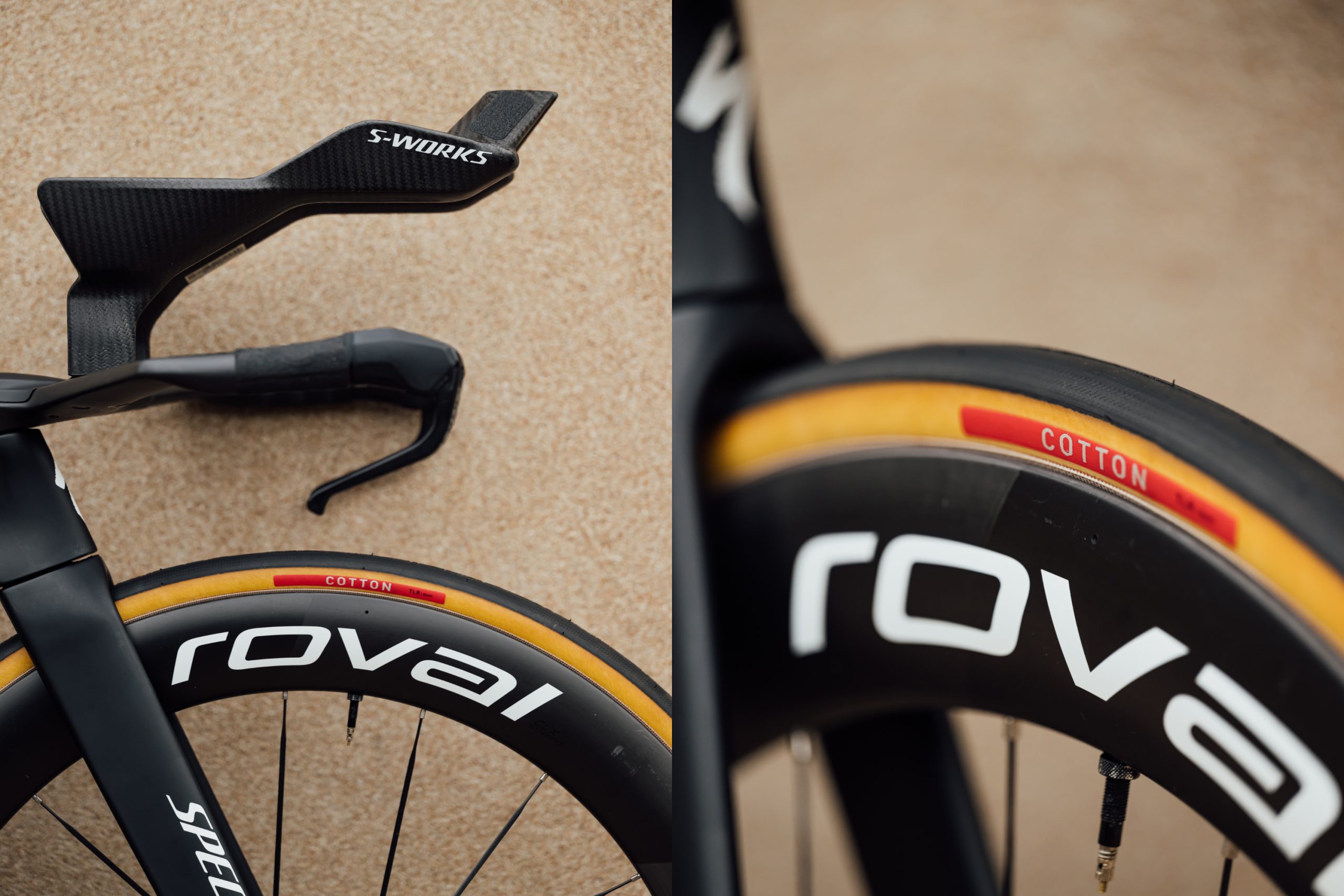
This year also appears to be the first time Evenepoel has won the event using tubeless tyres, rather than clinchers.
Let’s dig into why that might be and take a closer look at the rest of the Belgian’s tech picks for riding against the clock.
3, 2, 1, go…
Evenepoel’s Specialized Shiv TT Disc looks to have been stripped of paint to shave off a few grams. Chris Auld / Specialized
Evenepoel is one of cycling’s most dominant riders against the clock, and he proved this by catching none other than Tadej Pogačar around 2km from the finish line – despite the Slovenian star starting 02:30 minutes ahead of him.
Launched in 2019, the Specialized S-Works Shiv TT Disc is getting somewhat long in the tooth now, but Evenepoel keeps proving that it remains a competitive frameset.
This year’s hilly parcours in Rwanda saw Evenepoel on an all-black version of the bike, with excess paint presumably stripped away, in order to save weight.
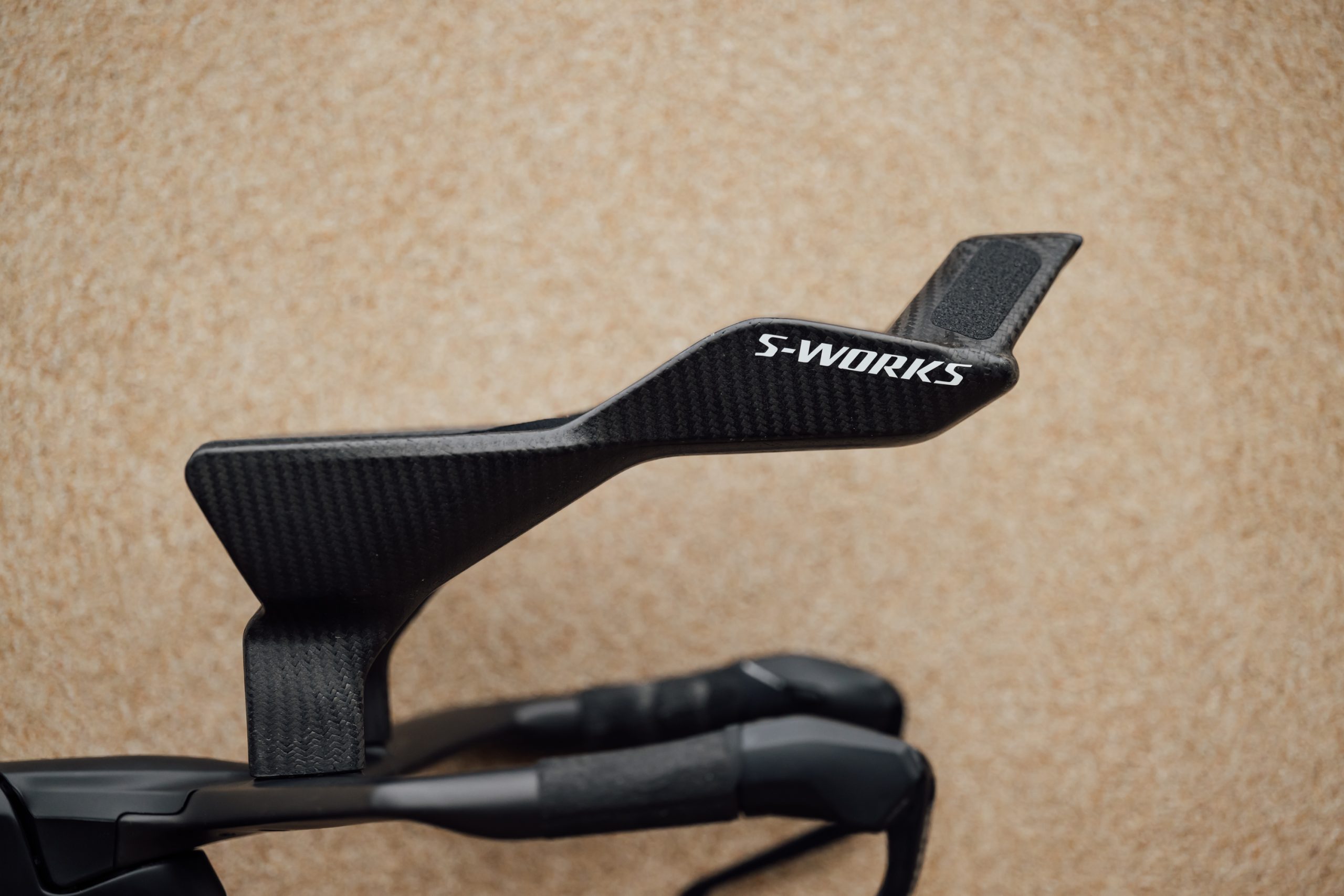
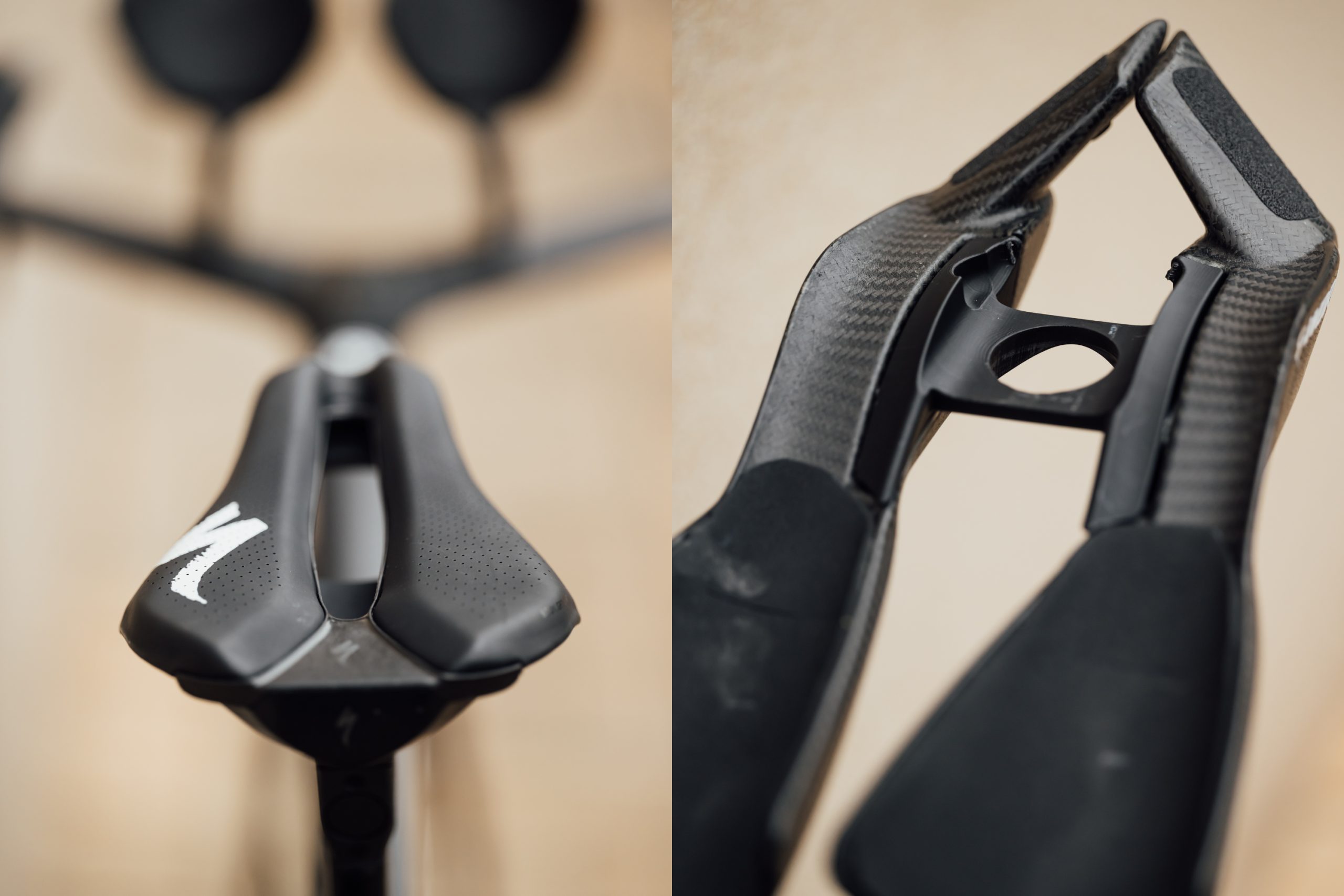
Evenepoel’s custom carbon fibre extensions are angular and aggressive. Chris Auld / Specialized
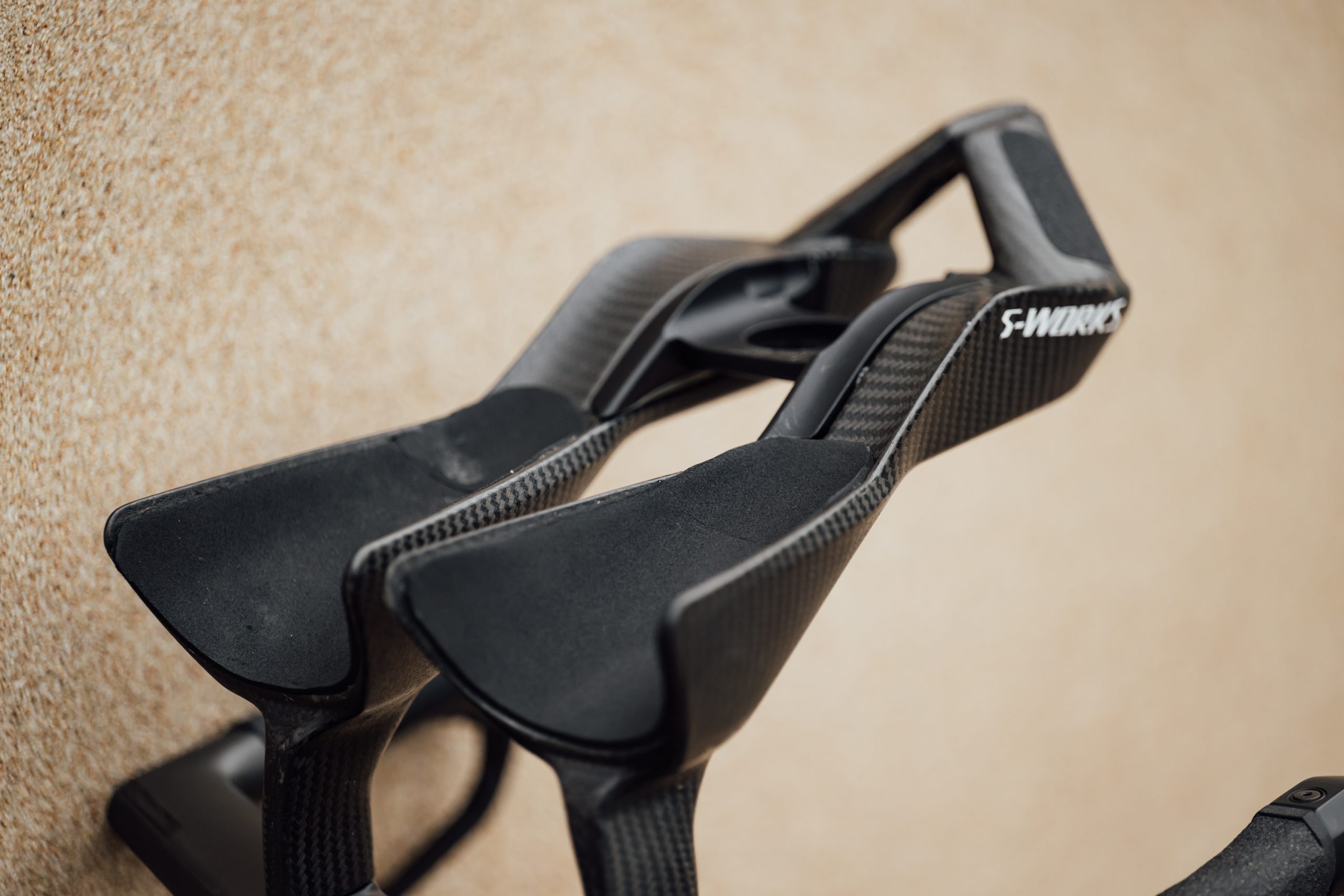
As is de rigueur for top TT riders, Evenepoel has a set of custom aero extensions, which are moulded to fit his forearms and keep him locked into an aerodynamic position.
A touch of grip tape on the tips of the extensions and bull horns is all he needs – there’s no bulky handlebar tape causing extra drag here.
The extensions feature minimalist padding for a close fit, while a bridge between the two extensions acts as a bike computer mount for Evenepoel to monitor and record his efforts.
Evenepoel’s hand grips are tilted in to be almost touching, and there look to be shift buttons underneath so he can change gear while in his compact aero tuck.
The custom extensions feature high-sided armrests to keep Evenepoel locked into his position. Chris Auld / Specialized A bridge between the extensions creates space for his bike computer. Chris Auld / Specialized
In terms of wheels, Evenepoel was rolling on options from Specialized’s in-house brand, Roval – with what looks like a carbon-spoked Rapide Sprint CLX up and a 321 full carbon disc out back.
The Rapide Sprint CLX wheel features a 63mm-deep rim, and is said to be the most aerodynamic front wheel the brand makes.
This represents a significant change for Evenepoel, who has used Specialized’s Turbo Cotton clincher tyres for each of his previous TT victories at the UCI Road World Championships.
A full carbon rear disc plus a deep-section front was a very popular combination at this year’s TT world champs. Chris Auld / Specialized Specialized still hasn’t revealed any official details about its new Turbo Cotton TLR tyres. Chris Auld / Specialized
We’re yet to receive detailed information on the new Turbo Cotton TLR tyres, but we can only assume they represent a decent improvement on the clincher model in terms of performance.
Zooming in shows Evenepoel was running an unusually wide 30mm tyre up front, though from our experience at the Tour, these tyres generally measure up slightly narrower than the printed width on Roval rims.
Regardless of how wide they are, given that both the tyres and wheels were developed in-house, it’s likely Specialized will have optimised them to work together in harmony.
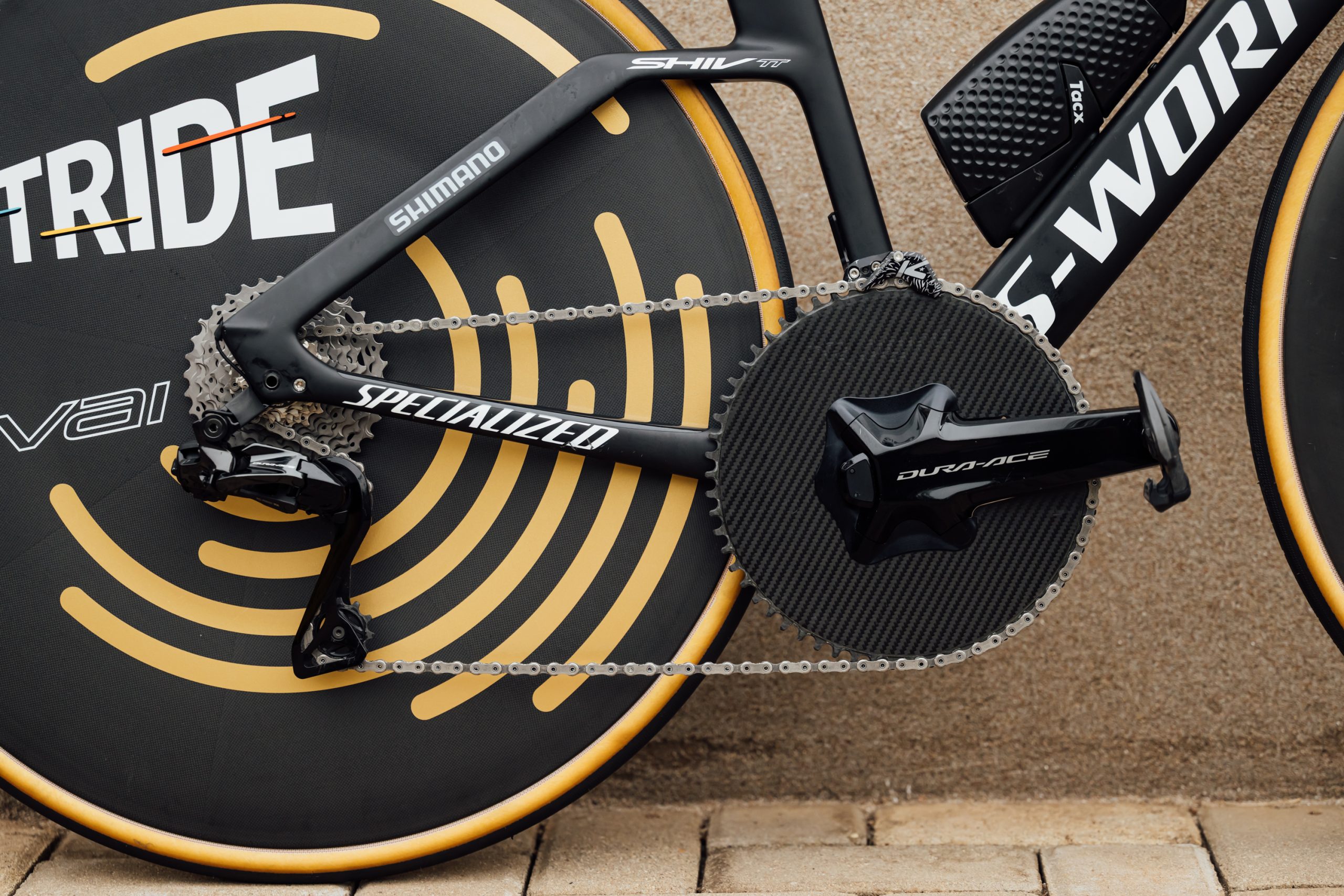
Per his trade team, Evenepoel uses a Shimano Dura-Ace Di2 R9200 groupset. Chris Auld / Specialized
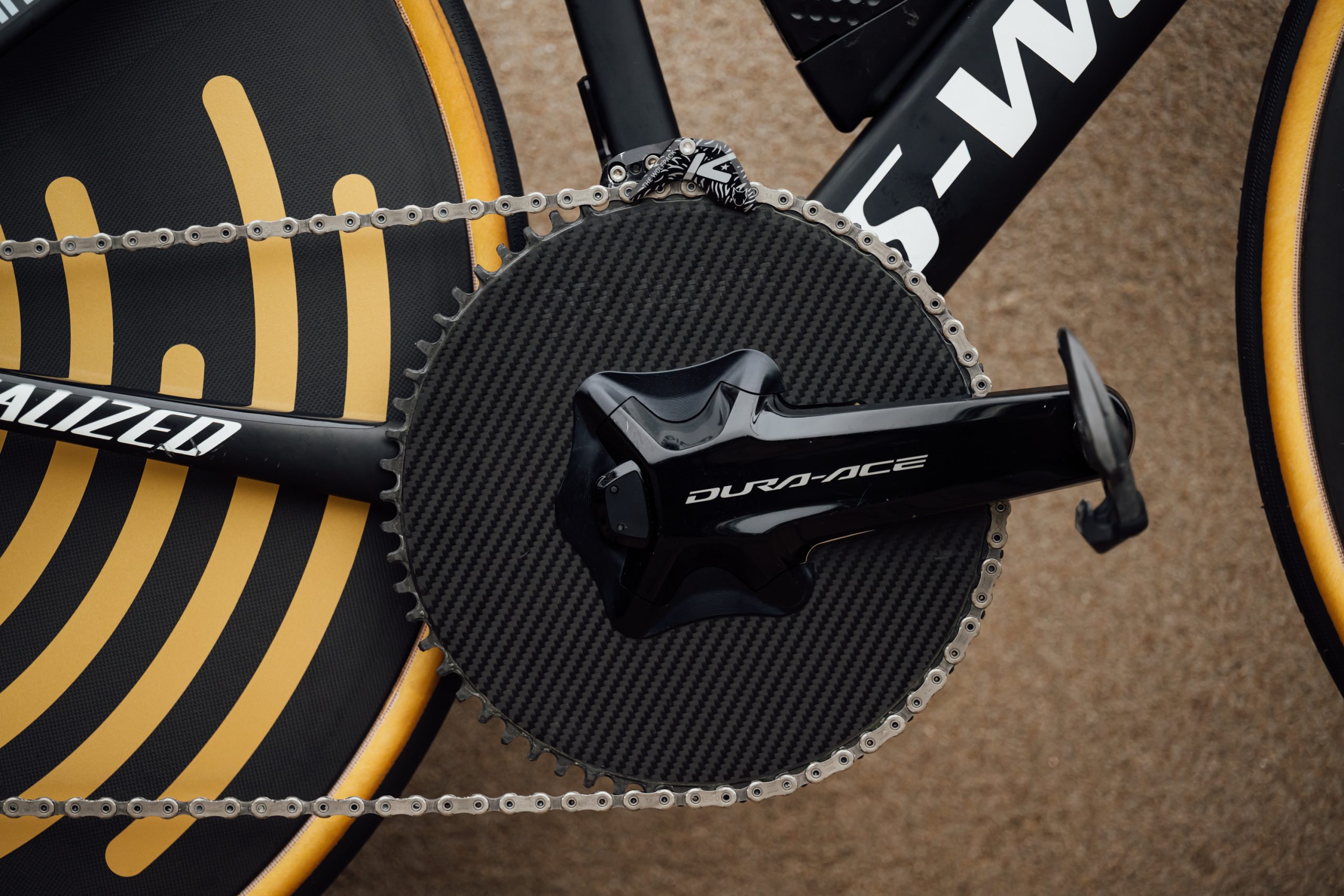
Finishing off the build is a Shimano Dura-Ace Di2 R9200 groupset, with a single Digirit carbon chainring up front and what looks like a wide-ranging 11-34t cassette out back.
Evenepoel also has what looks like an Alugear bolt cover, which smooths the interface between the third-party chainring and his Shimano power meter crankset. As on his road bike, we expect Evenepoel was running relatively short, 165mm cranks.
A K-Edge chain guide replaces the front derailleur to ensure there are no untimely chain drops, and Evenepoel opted for a Tacx aero water bottle, instead of a classic round one, for a final aero gain.
Remco only needed one chainring and he opted for a whopper. The profiled bolt cover is made by Alugear. Chris Auld / Specialized
Remco Evenepoel’s custom Specialized S-Works Shiv TT Disc for the 2025 UCI Road World Championships individual time trial
Frameset: Specialized S-Works Shiv TT Disc
Groupset: Shimano Dura-Ace Di2 R9200 with 1x Digirit carbon chainring
Wheelset: Roval Rapide Sprint CLX front, Roval 321 Disc rear
Microsoft is working on bringing support for setting a video as your desktop wallpaper on Windows 11. From a report: Hidden in the latest Windows 11 preview builds, the feature lets you set an MP4, MOV, AVI, WMV, M4V, or MKV file as your wallpaper, which will play the video whenever you view the desktop.
For many years, users have wanted the ability to set a video as a desktop background. It’s a feature that many Linux distributions support, and macOS also supports the ability to set a moving background as your lock screen. Windows Vista did support setting videos as your wallpaper, but only as part of the Ultimate SKU via a feature called DreamScene.
It’s not just glitches at the launch of the Meta Ray-Ban Display smart glasses… The New York Times remains skeptical of its market share:
[Meta’s] smart glasses remain a niche. As of February, Meta had sold about two million of its $300 Ray-Ban Meta camera glasses since their 2023 debut, and it hopes to sell 10 million annually by the end of 2026, which is a tiny amount for a company this size. In the last decade, Meta has spent over $100 billion on its virtual and augmented reality division, which includes its smart glasses and is not profitable. Last quarter, the division reported a $4.5 billion loss, nearly the same as a year ago.
“Meta’s Smart Glasses Might Make You Smarter. They’ll Certainly Make You More Awkward,” joked a recent Wired headline.
But the Wall Street Journal does report there’s “a growing group of blind users… finding the devices to be more of a life-enhancing tool than a cool accessory.” Jonathan Mosen, executive director at the nonprofit National Federation of the Blind said he’d like to see Meta continue to invest in the glasses. “It’s giving significant accessibility benefits at a price point people can afford.”
He has used them a few times to record video of ride-share drivers refusing to give him and his wife a ride because she travels with a guide dog. Denying rides to people with service animals is illegal in many countries, including the U.S.
Another concern for blind users is that AI assistants in general are prone to making errors, or so-called hallucinations, which may not be apparent. Aaron Preece, who is blind and editor in chief of American Foundation for the Blind’s AccessWorld magazine, said Meta’s glasses recently failed to correctly read the number on the door to his home. “I just can’t trust it,” he said. “It’s more of a novelty than something I’d use on a day-to-day basis.”
When it comes to innovative technology, CNET seems more excited about Meta’s display-controlling “neural wristband” accessory. Instead of camera-based hand tracking, these muscle-sensing bands “can register gestural moves like pinches, taps, thumb swipes, and maybe even typing over time…”
Reddit’s content became AI training data last year when Google signed a $60 million-per-year licensing agreement. But now Reddit is “in early talks” about a new deal seeking “deeper integration with Google’s AI products,” reports Bloomberg (citing executives familiar with the discussions).
And Reddit also wants “a deal structure that could allow for dynamic pricing, where the social platform can be paid more” — with both Google and OpenAI — to “adequately reflect how valuable their data has been to these platforms…”
Such licensing agreements are becoming more common as AI companies seek legal ways to train their models. OpenAI has also struck a series of partnership agreements with major media publishers such as Axel Springer SE, Time and Conde Nast to use their content in ChatGPT…
Reddit remains among the most cited sources across AI platforms, according to analytics company Profound AI. However, Reddit executives have noticed that traffic coming from Google has limited value, as users seeking answers to a specific question often don’t convert into becoming active Redditors, the people said. Now, Reddit is engaging with product teams at Google in hopes of finding ways to send more of its users deeper into its ecosystem of community forums, according to the executives. In return, Reddit is looking for ways to provide more high-quality data to its AI partners. Discussions between Reddit and Google have been productive, the people said. “We’re midflight in our data licensing deals and still learning, but what we have seen is that Reddit data is highly cited and valued,” Reddit Chief Operating Officer Jen Wong said on July 31 during a call with investors. “We’ll continue to evaluate as we go.”
“New research suggests ash and soot from burning wildlands has caused more than 41,000 excess deaths annually from 2011 to 2020,” reports the Los Angeles Times:
By 2050, as global warming makes large swaths of North America hotter and drier, the annual death toll from smoke could reach between 68,000 and 71,000, without stronger preventive and public health measures…
In the span studied, millions of people were exposed to unhealthful levels of air pollution. When inhaled, this microscopic pollution not only aggravates people’s lungs, it also enters the bloodstream, provoking inflammation that can induce heart attacks and stroke. For years, researchers have struggled to quantify the danger the smoke poses. In the paper published in Nature, they report it’s far greater than public health officials may have recognized. Yet most climate assessments “don’t often include wildfire smoke as a part of the climate-related damages. And it turns out, by our calculation, this is one of the most important climate impacts in the U.S.”
The study also estimates a higher number of deaths than previous work in part because it projected mortality up to three years after a person has been exposed to wildfire smoke. It also illustrates the dangers of smoke drifting from fire-prone regions into wetter parts of the country, a recent phenomenon that has garnered more attention with large Canadian wildfires contributing to hazy skies in the Midwest and East Coast in the last several years. “Everybody is impacted across the U.S.,” said Minghoa Qiu [lead author and assistant professor at Stony Brook University]. “Certainly the Western U.S. is more impacted. But the Eastern U.S. is by no means isolated from this problem.”
Nvidia will invest up to $100 billion in OpenAI as the AI lab builds data centers requiring 10 gigawatts of power capacity. The 10-gigawatt deployment equals 4 to 5 million GPUs — the same number Nvidia will ship globally this year. Building one gigawatt of data center capacity costs $50 to $60 billion, including approximately $35 billion for Nvidia chips and systems. The first phase begins in the second half of 2026 using Nvidia’s next-generation Vera Rubin systems.
The investment adds Nvidia to OpenAI’s investor roster alongside Microsoft, SoftBank, and Thrive Capital at a $500 billion valuation. Nvidia CEO Jensen Huang described the investment as “additive to everything that’s been announced and contracted.”
Since the AMD FSR 4 INT8 DLL leak, we’ve known that it’s possible to use FSR 4 on older GPU architectures than RDNA 4. Recently, we’ve actually seen successful use of FSR 4 on AMD’s RDNA 2 architecture, after early efforts resulted in bugged visuals. Per a Reddit guide posted yesterday by user u/NaM_777, users of AMD RDNA 2 GPUs like the RX
After years of wincing through aggressive massage gun sessions, I just assumed muscle relief required enduring a little bit of pain. There’s a reason for the saying, “hurts so good,” right? But it turns out you don’t need to suffer to see results: The Rally orbital massager, which I have previously reviewed, has completely changed my hard-ass approach to recovery.
Don’t get me wrong—percussive massage guns have their place. They’re powerful and effective at working out the deepest knots. But after months of inconsistent use, I realized something: I was avoiding my own recovery tool. The aggressive pounding felt like punishment rather than self-care, turning what should’ve been a daily wellness ritual into something I’d postpone until I was in serious pain.
I’d skip sessions when I needed them most, only reaching for my massage gun when my muscles were screaming for attention. By then, I’d need that aggressive percussion just to make a dent in the tension I’d allowed to build up. During marathon training especially, I simply can’t let this happen. That’s where orbital massages come in.
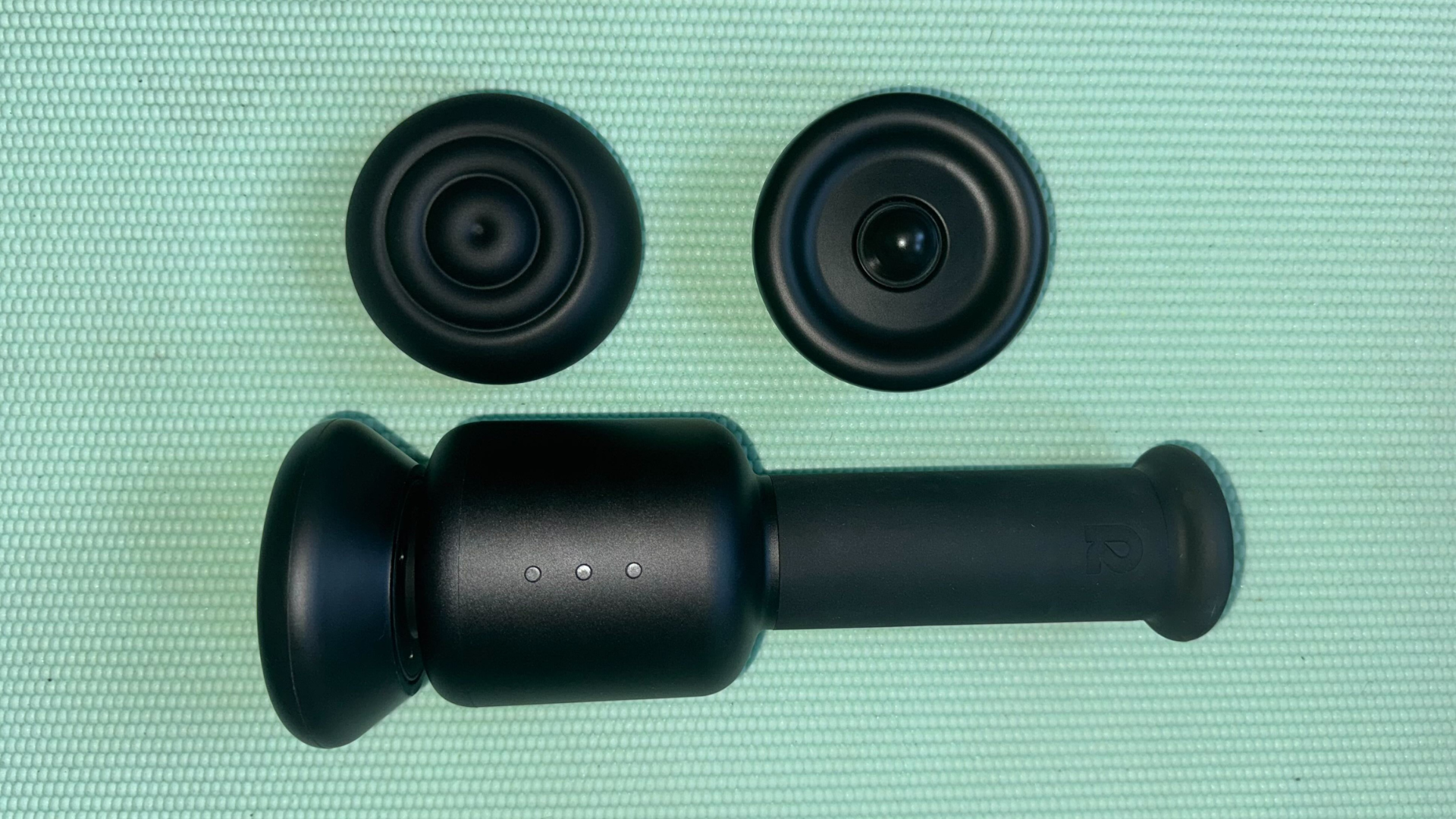
The Rally’s orbital massage technology works differently than traditional percussive guns—instead of hammering muscles with rapid-fire pulses, picture the circular motion of a car buffer. Luckily, the motion is gentle enough that it feels more like a human touch, as opposed to turning me into a car getting buffed.
The Rally has taught me something crucial about sustainable self-care: I’m infinitely more likely to reach for a device that feels good to use, rather than one that hurts. It’s a game-changer for consistency. With my old massage gun, I’d psyche myself out before sessions: “Do I really need this? Can I handle the intensity right now?” With the Rally, there’s no mental barrier. I can use it while watching TV, during work breaks, or as part of my bedtime routine, without dreading the experience.
Building up when you need to
Here’s the best thing about the Rally: It can double as a percussive massager when you need more intensity. But now, instead of starting with the nuclear option, I work my way up to it. It’s more comfortable and, I find, more effective: My muscles respond better to massage when they’re already relaxed and have good blood flow.
I’ll begin with the gentle orbital motion to warm up tissues and increase circulation, then switch to percussion mode if I encounter stubborn knots. I am far from anti-percussion massage—there are times when you need that deeper, more aggressive treatment, like after a particularly intense workout, when dealing with chronic knots, or for trigger point therapy. But now, those hurt-so-good instances are the exception, rather than the rule.
The Rally’s ability to switch between modes means I’m not locked into one approach. I have the gentleness for daily maintenance and the power for when things get serious.
The best recovery tool is the one you actually use
By embracing the gentler, orbital massage as my daily default, I’ve created a sustainable self-care routine that prevents problems rather than just treating them. Proactive care beats reactive treatment every time.
Maybe my muscles are thanking me not because I’m punishing them less, but because I’m caring for them more consistently. Sometimes the revolutionary approach is simply being kinder to yourself, and having the tools that make that kindness effective.
If you’ve been avoiding your massage gun or find yourself using it only when you’re already in pain, consider making the switch to orbital massage as your primary recovery method. Your future self (and your muscles) will thank you for choosing consistency over intensity.
An anonymous reader shares a report: Venture capitalists in clean tech are starting to say out loud what they’ve suspected for a while: China’s dominance has left key sectors in the West uninvestable. A group of eight VCs from Western firms agreed to share with Bloomberg the details of a July road trip across China during which they visited factories, spoke with startup investors, and interviewed founders of companies.
They knew China had raced ahead in sectors like batteries and “everything around energy,” but seeing how big the gap was firsthand left them wondering how European and North American competitors can even survive, says Talia Rafaeli, a former investment banker at both Goldman Sachs and Barclays who’s now a partner at Kompas VC. “Everyone needs to take this kind of trip,” she said.
These days, Austin, Texas feels like ground zero for autonomous cars. Although California was the early test bed for autonomous driving tech, the much more permissive regulatory environment in the Lone Star State, plus lots of wide, straight roads and mostly good weather, ticked enough boxes to see companies like Waymo and Zoox set up shop there. And earlier this summer, Tesla added itself to the list. Except things haven’t exactly gone well.
According to Tesla’s crash reports, spotted by Brad Templeton over at Forbes, the automaker experienced not one but three crashes, all apparently on its first day of testing on July 1. And as we learned from Tesla CEO Elon Musk later in July during the (not-great) quarterly earnings call, by that time, Tesla had logged a mere 7,000 miles in testing.
By contrast, Waymo’s crash rate is more than two orders of magnitude lower, with 60 crashes logged over 50 million miles of driving. (Waymo has now logged more than 96 million miles.)