
Out today is the Qt 6.10 release candidate for this forthcoming toolkit release…
Monthly Archives: September 2025
Jackson Goldstone’s world champion striped Santa Cruz V10 sports prototype Fox 40 fork and Shimano stoppers
After winning the MTB World Championships in Champéry, the UCI Mountain Bike World Series in Lenzerheide was the first time we’d seen the world champion stripes on Jackson Goldstone’s bike.
Some interesting tech points were hiding on his Santa Cruz V10, including a prototype Fox 40 fork and new Shimano brake calipers that we believe are prototypes for an upcoming Saint groupset.
While Goldstone showed good speed for the whole weekend, qualifying fourth on Saturday, an unfortunate crash in his race run cost him 8 seconds and resulted in a 22nd place.
We checked out the new world champion’s bike in the pits to get a close-up look at the rainbow details.
- New SRAM XC drivetrain spotted on Nino Schurter’s retiring race bike
- Prototype SRAM DH AXS and RockShox Boxxer spotted on Troy Brosnan’s Canyon Sender
Fox 40 prototype
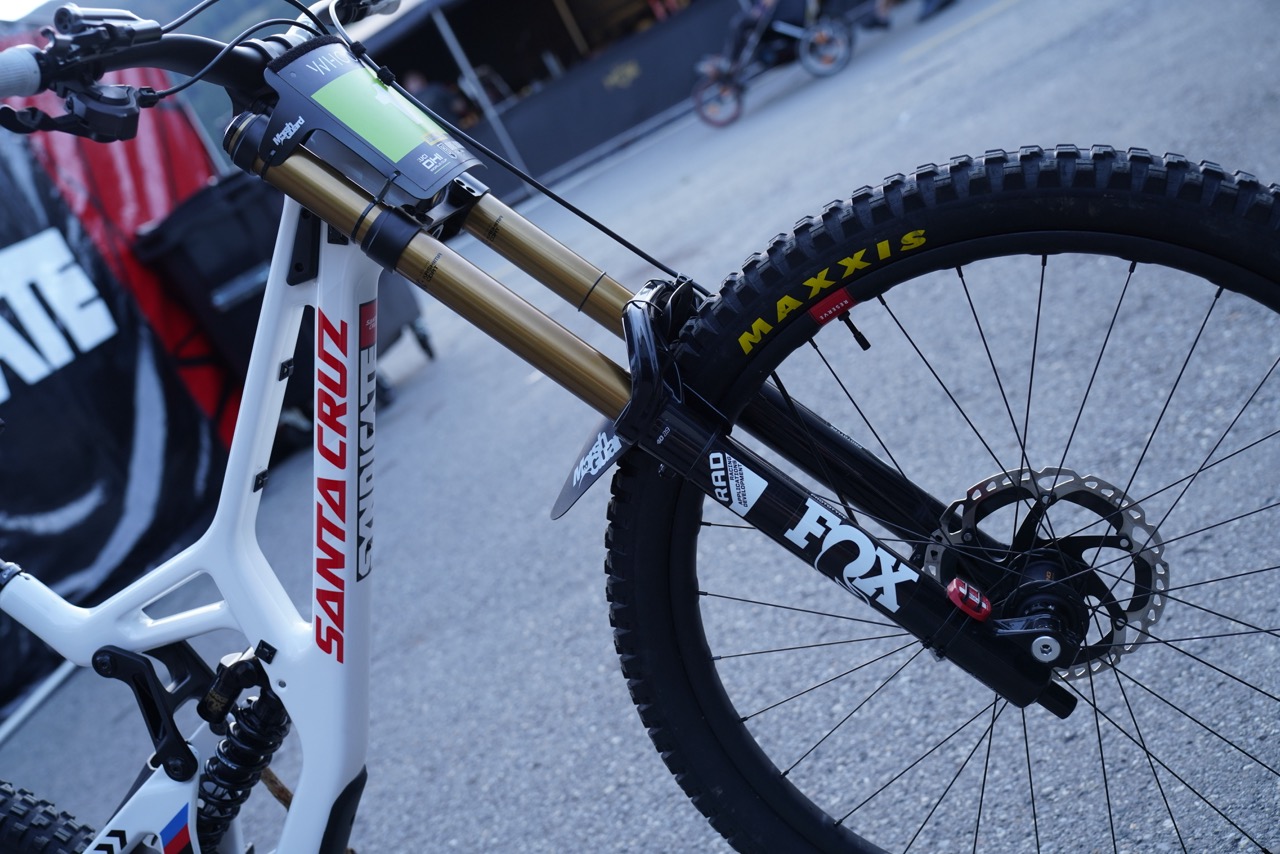
At the front of Goldstone’s bike is a new Fox Factory 40 fork, which features stickers from the brand’s RAD (Racing Application Development) programme.
Unlike the Podium fork, Fox has kept a traditional design for downhill racing.
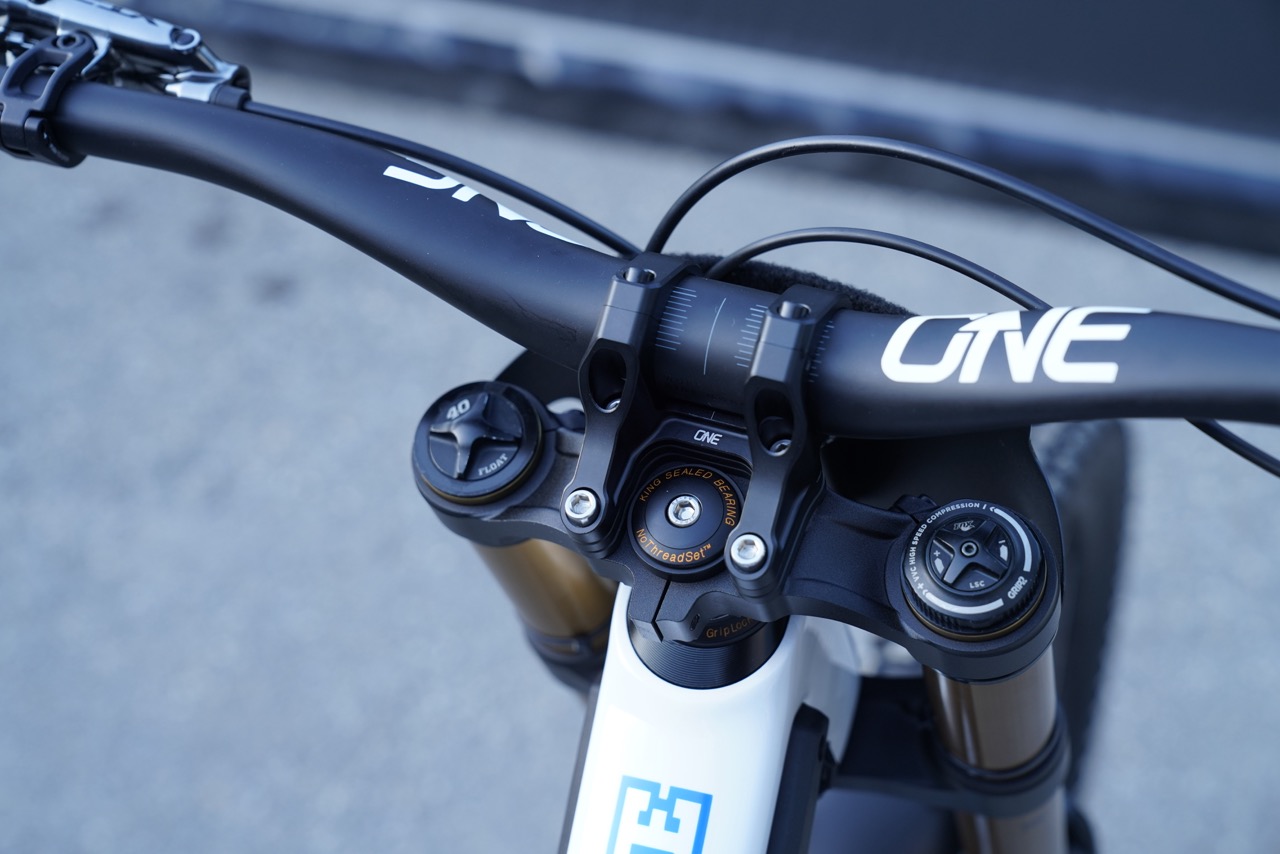
The crown looks to feature the generative architecture we’ve seen on Fox’s latest forks, including the new 36, where the brand says it increased torsional stiffness by 20 per cent.
At the top of the stanchion, it appears the fork is using a GRIP X2 damper, the same as that found on the current 40. However, we’d expect the insides to be different from how it’s labelled.
New Shimano Saint brakes
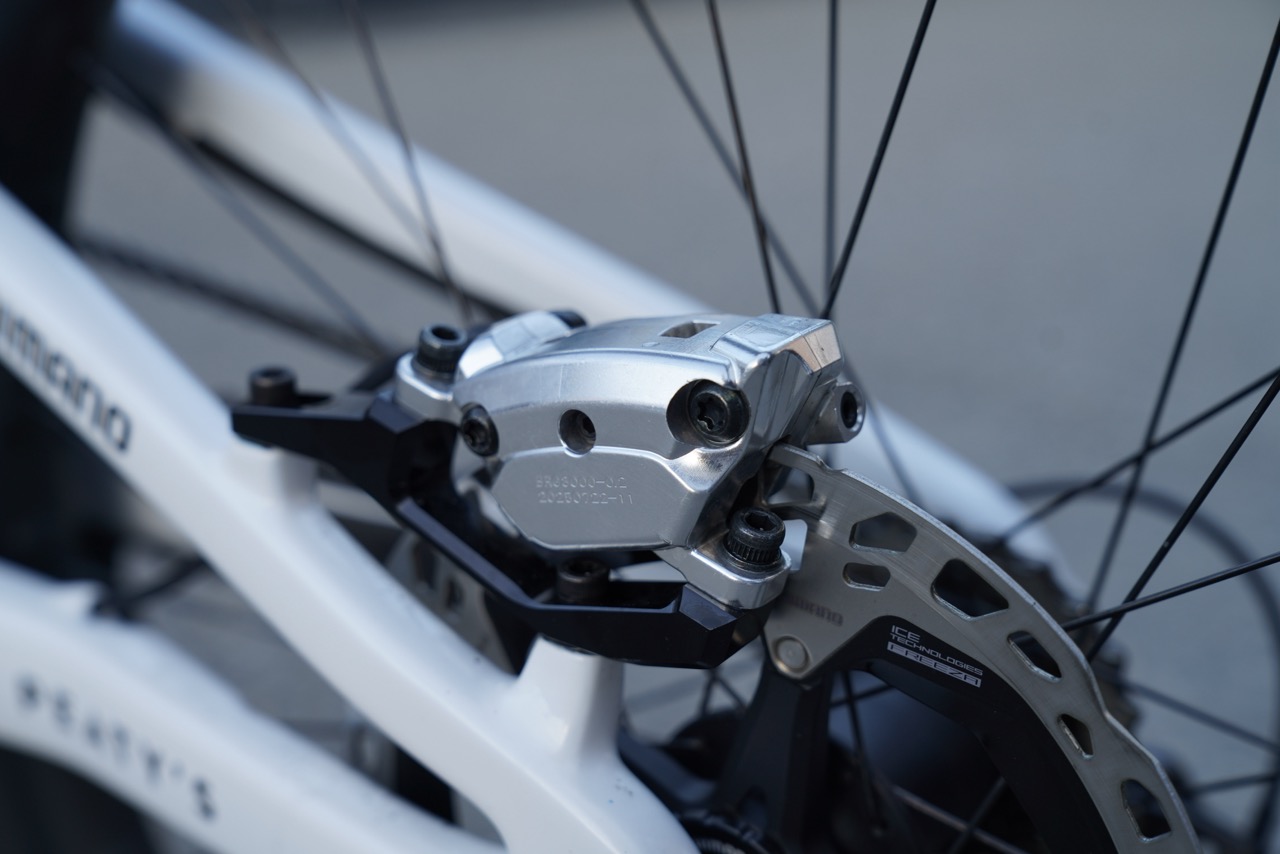
It’s been nearly 13 years since Shimano last updated its Saint groupset, with many fearing the Japanese brand had forgotten its gravity-inspired riders.
While we’ve seen nothing of a new drivetrain, these chunky stoppers suggest Shimano has something in the works.
The calipers are much larger than the recently released XTR 9220 brakes, closer to SRAM’s Mavens, hinting that these may be the big-power brakes many fans have been waiting for.
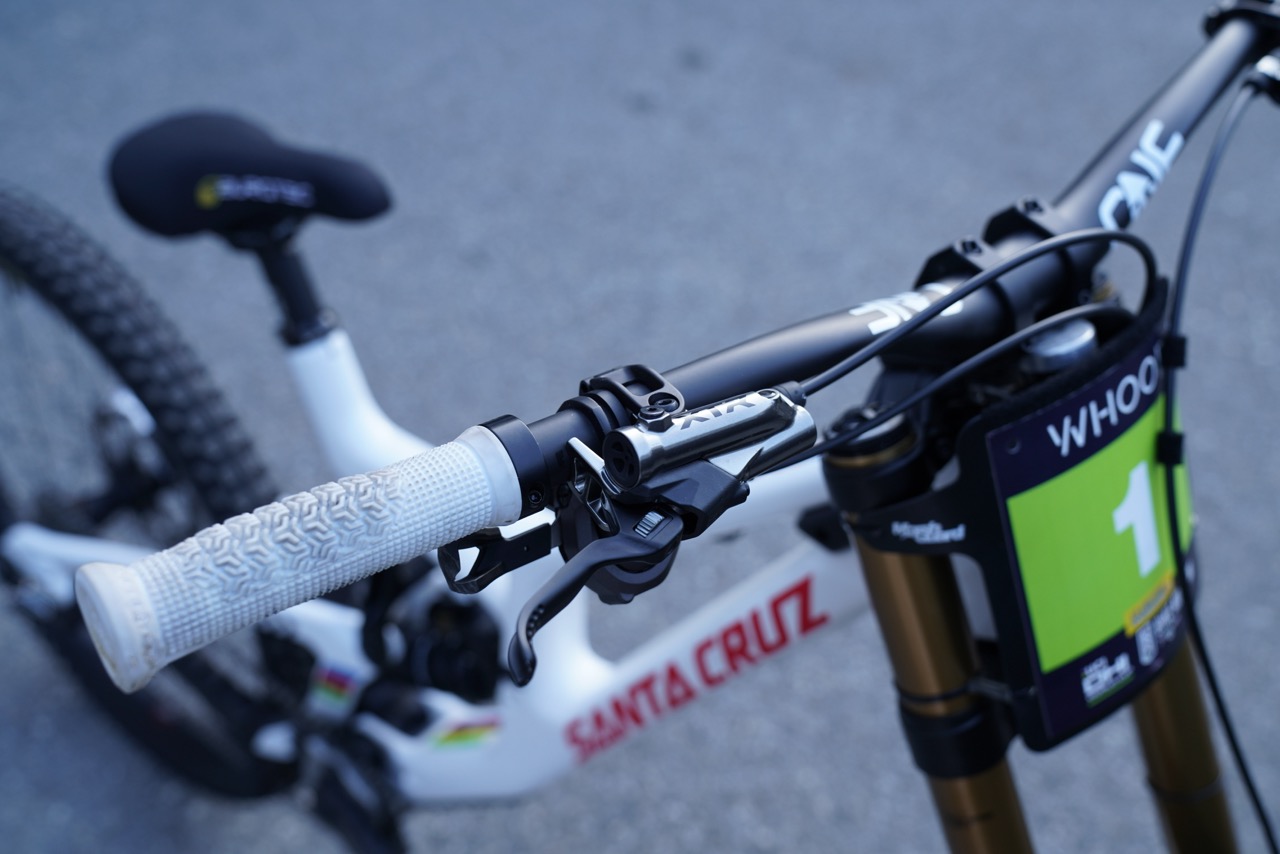
An XTR lever is used in conjunction with the caliper on Goldstone’s bike, which we assume means the lever on upcoming Saint brakes may be the same.
With SRAM showing a prototype DH AXS at the weekend, could we see the big brands bringing updates to their downhill bikes next year?
Rainbow delight
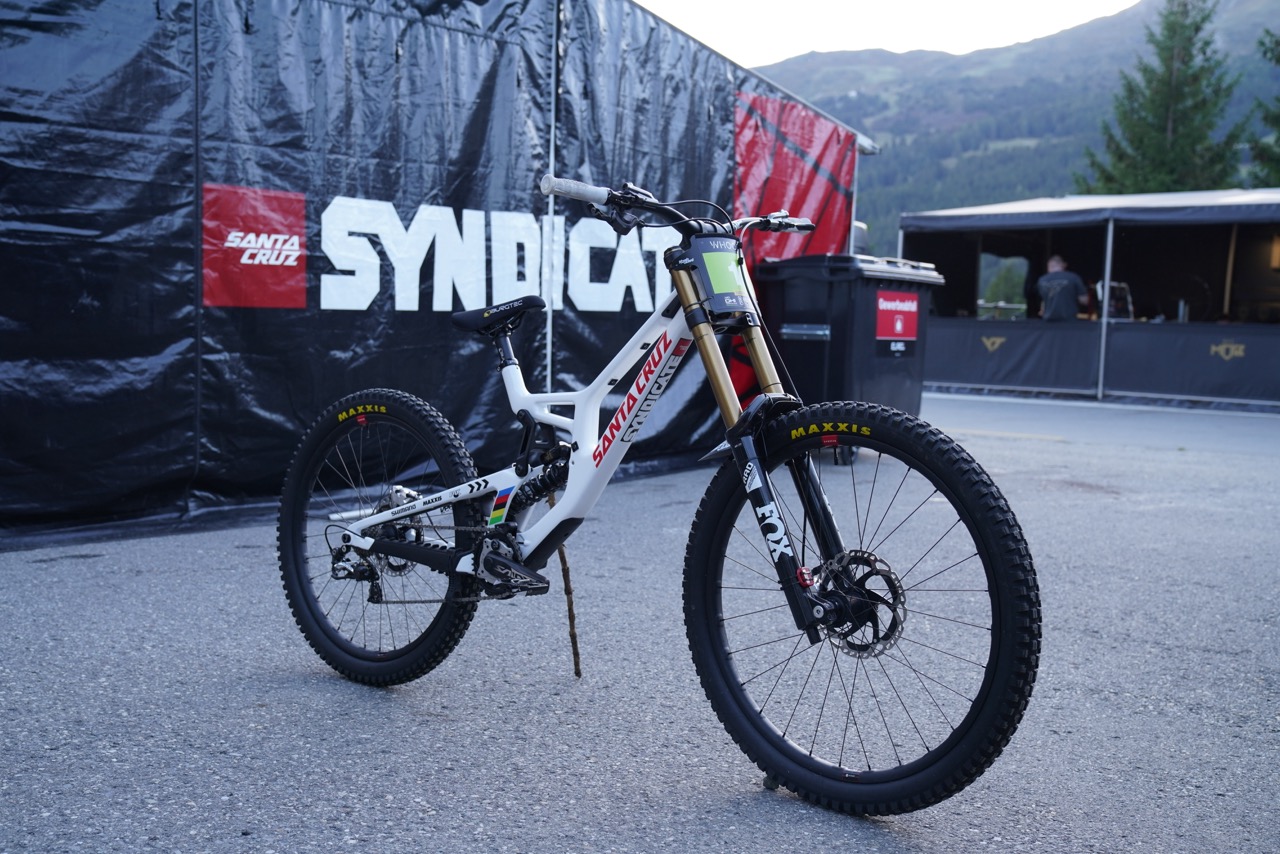
Goldstone took the stripes two weeks ago in Champéry, but we’ve had to wait until now to see them.
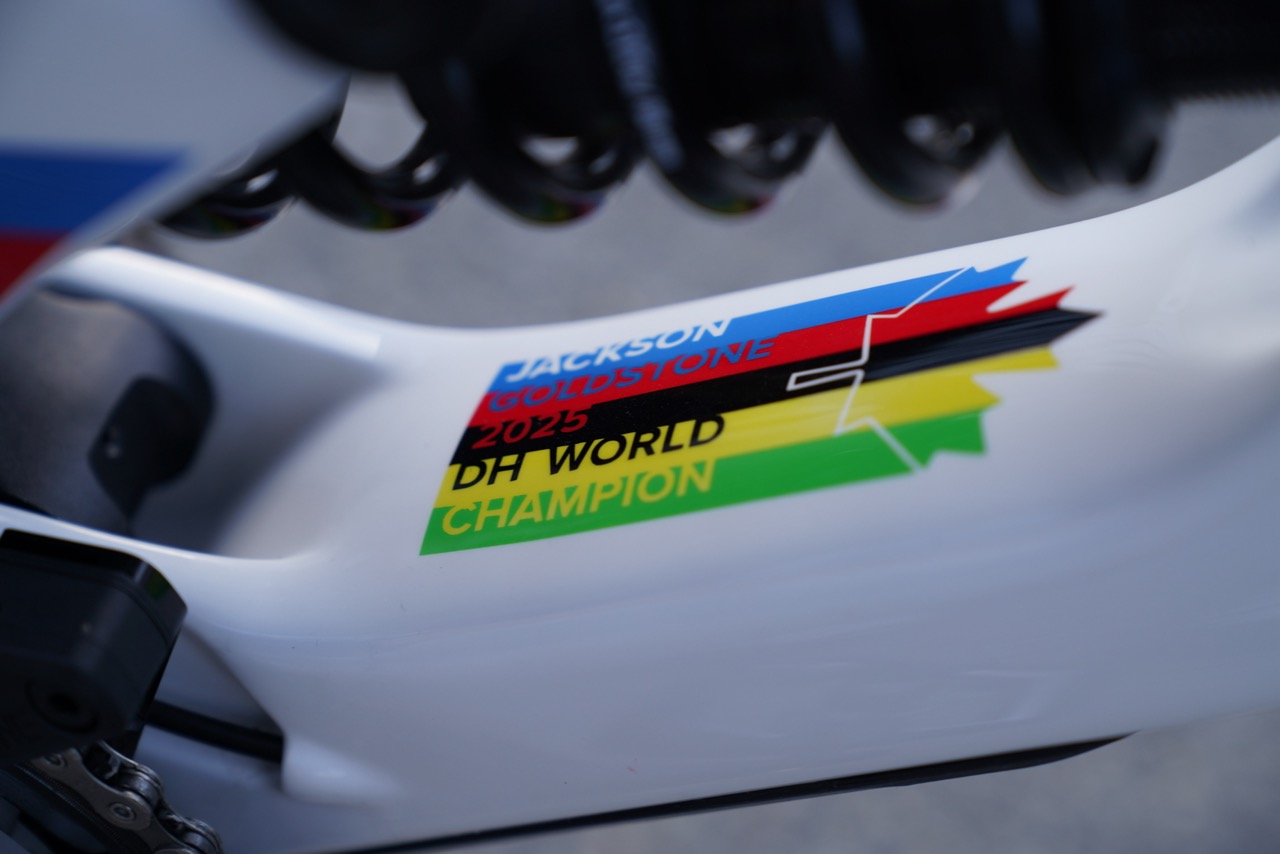
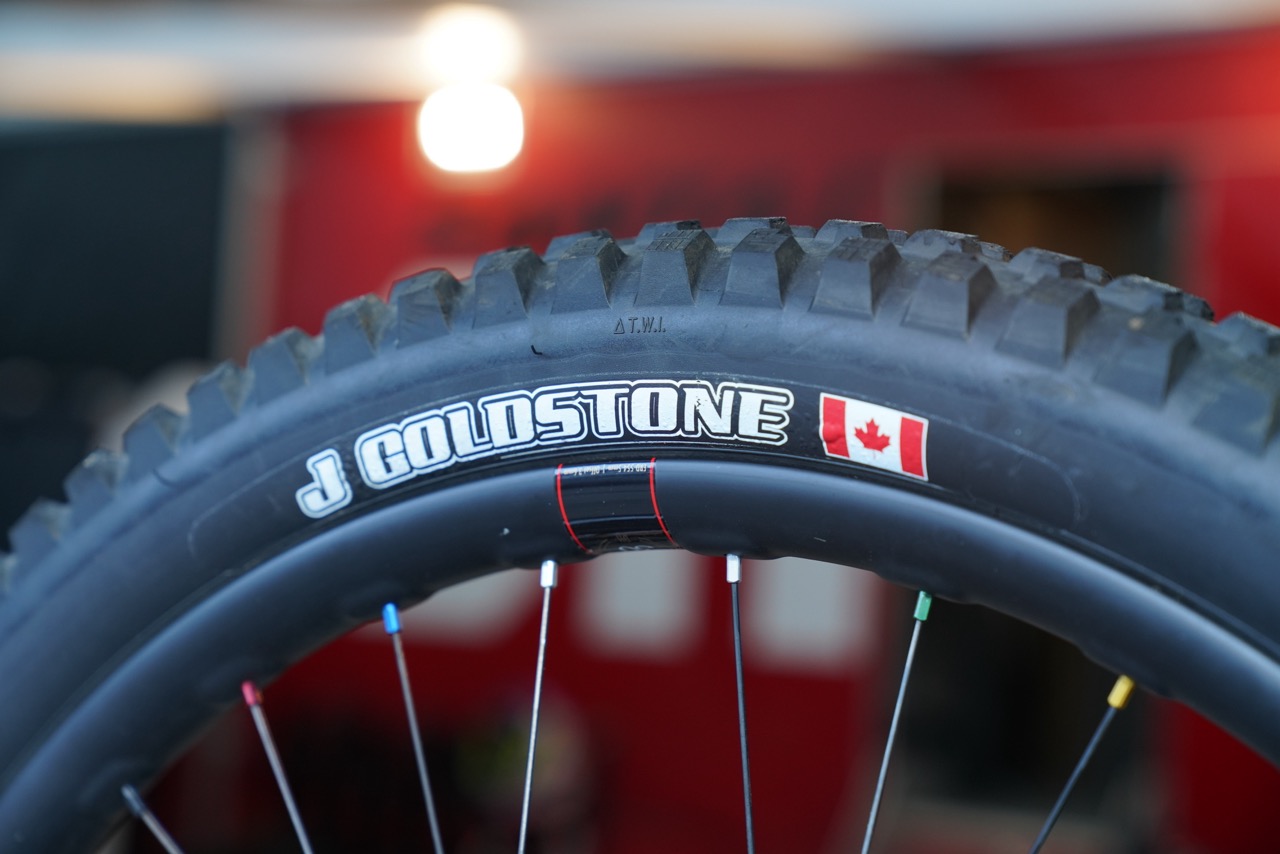
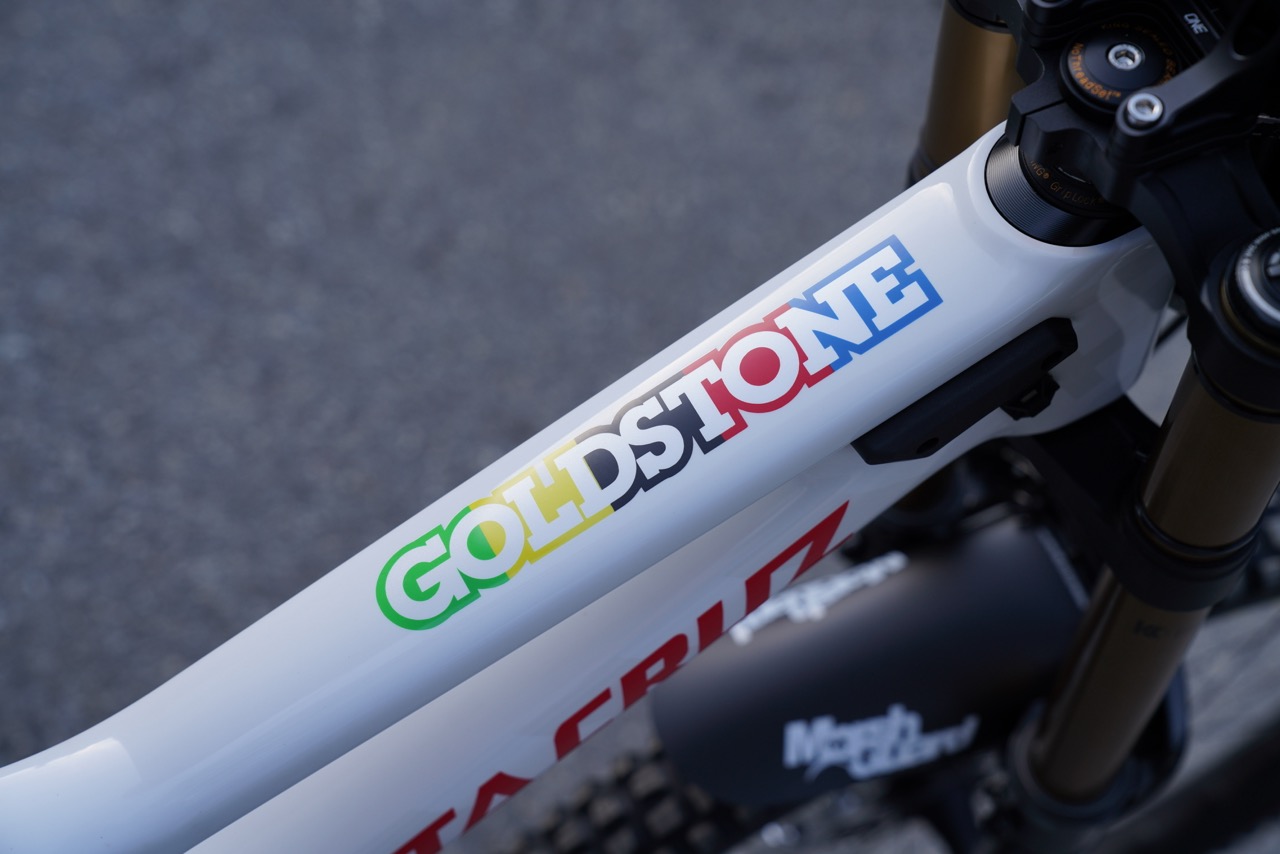
The 21-year-old American’s team have gone to great lengths to make sure his victory is well celebrated across the bike, with the stripes featuring on various components.
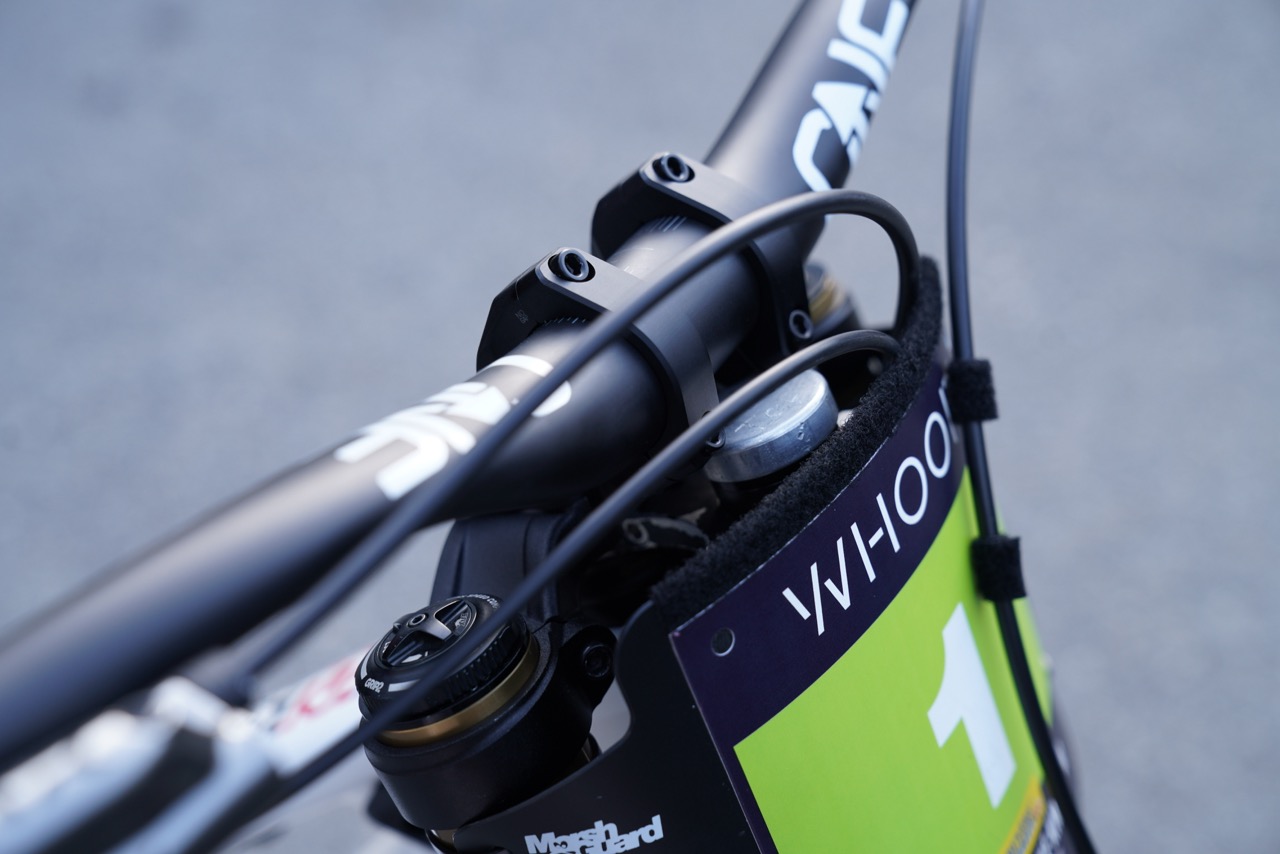
Goldstone’s bike features other techy details, with his raceplate hiding a tuned mass damper.
We’ve seen a few riders experimenting with this, with the component said to reduce the amplitude and duration of vibrations down the trail.
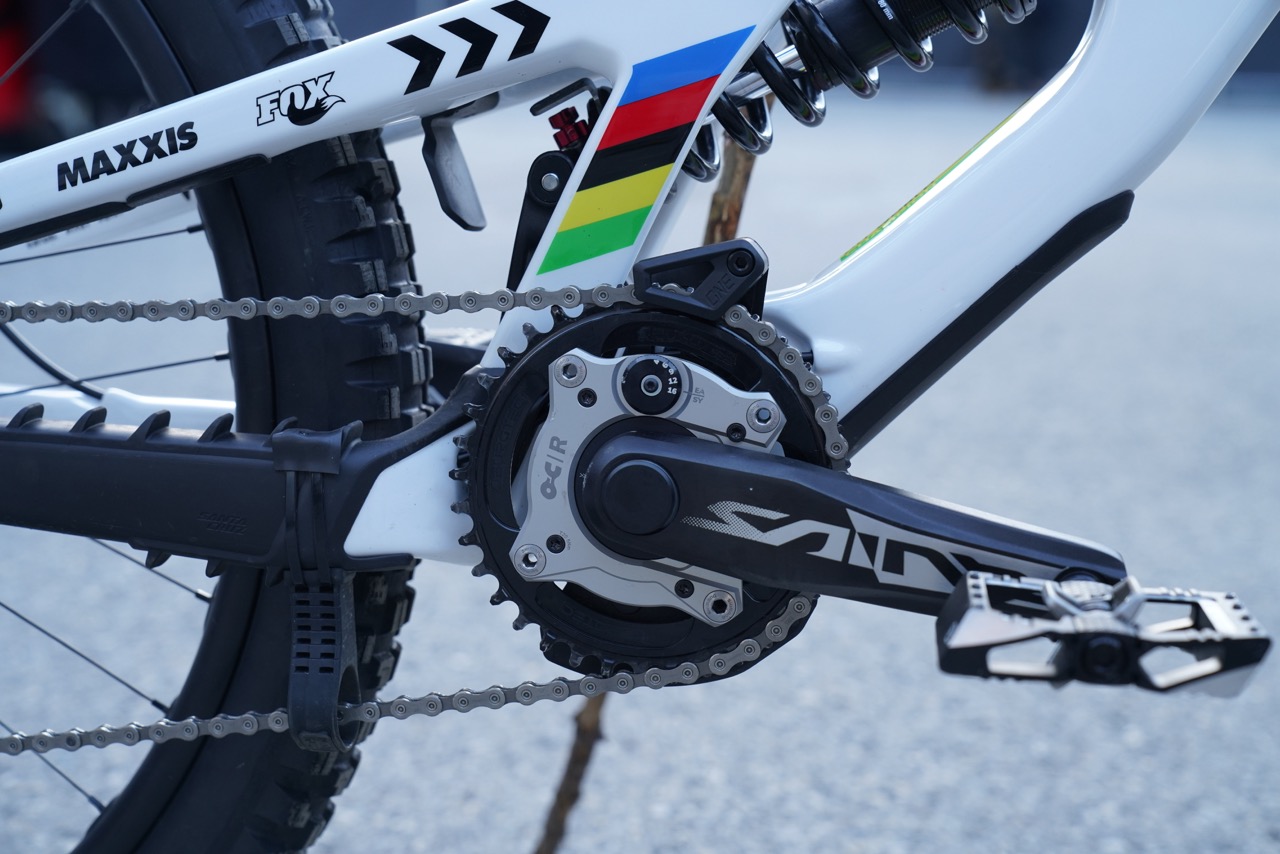
At the centre of the bike, an Ochain device is used to reduce pedal kickback, while a STFU Trail chain damper is used to silence the chain.
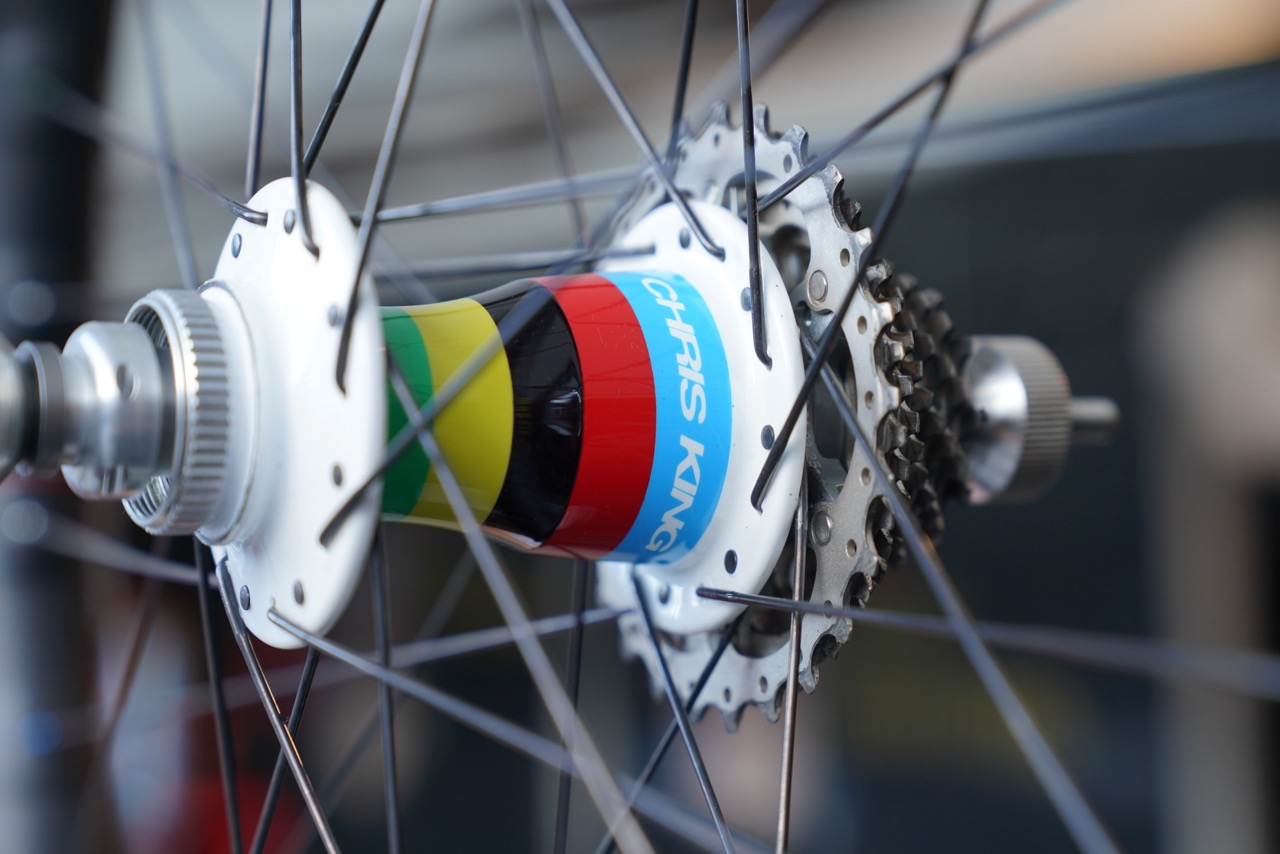
Keeping the rainbow scheme together were these hand-painted Chris King hubs, which Goldstone’s mechanic, Woody, has laced into Reserve DH rims with rainbow nipples.
Lezyne’s new Radar React light alerts you to approaching traffic without a bike computer
Lezyne has released its Radar React front and rear lights, which use radar tech to alert you to cars approaching from behind.
The system is available as a Radar Drive single rear light or can be linked to the React Drive front light.
With the combined setup, the system doesn’t need to be used in conjunction with a GPS bike computer, with LEDs on the rear of the front-mounted React Drive light signalling when a vehicle is behind you.
The price for the single Radar Drive rear light is £100 / $179.99 / €169.95, with the React Drive front light priced at £170 / $124.99 / €119.99.
Both lights can be bought as a system for £250 / $279.99 / €259.99.
The rearview radar-equipped Radar Drive light can be used on its own or with Lezyne’s Radar Ally app to use the radar feature, removing the need for a bike computer or the React Drive light.
- What are rearview radar bike lights and should you use one?
- Best bike lights 2025 – our pick of the best front and rear lights to keep you visible out on the roads
Safer rear light
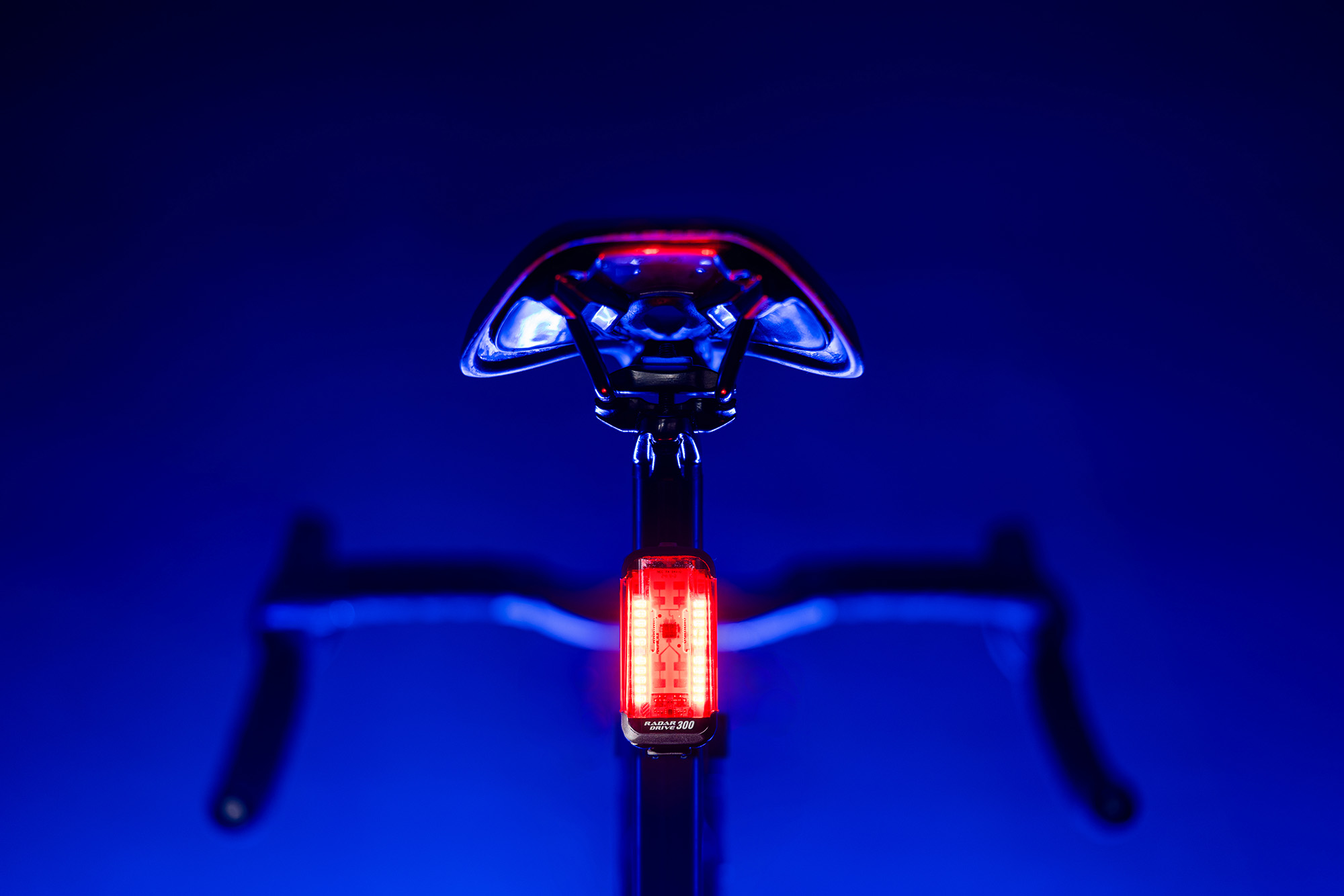
Lezyne says the Radar Drive provides increased safety even when not connected to the system, with the rear light using a special flash pattern when it detects a rear-approaching vehicle to improve visibility.
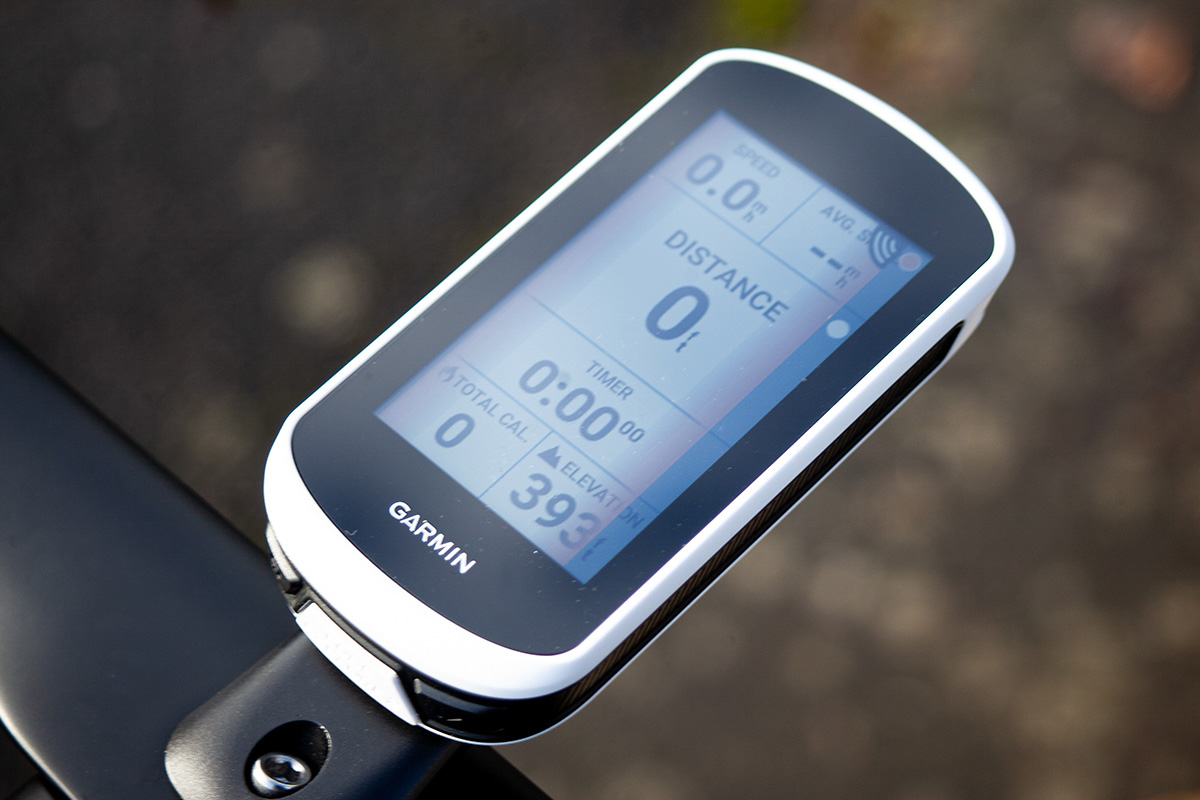
But as with Garmin’s Varia radar, it can be connected to a head unit to alert you to vehicles behind.
Lezyne says it can spot vehicles up to 150 metres away, and the device is able to detect how fast they are approaching.
If the vehicle is coming fast, the head unit or React Drive light will show a different set of visual cues to indicate that it may be dangerous.
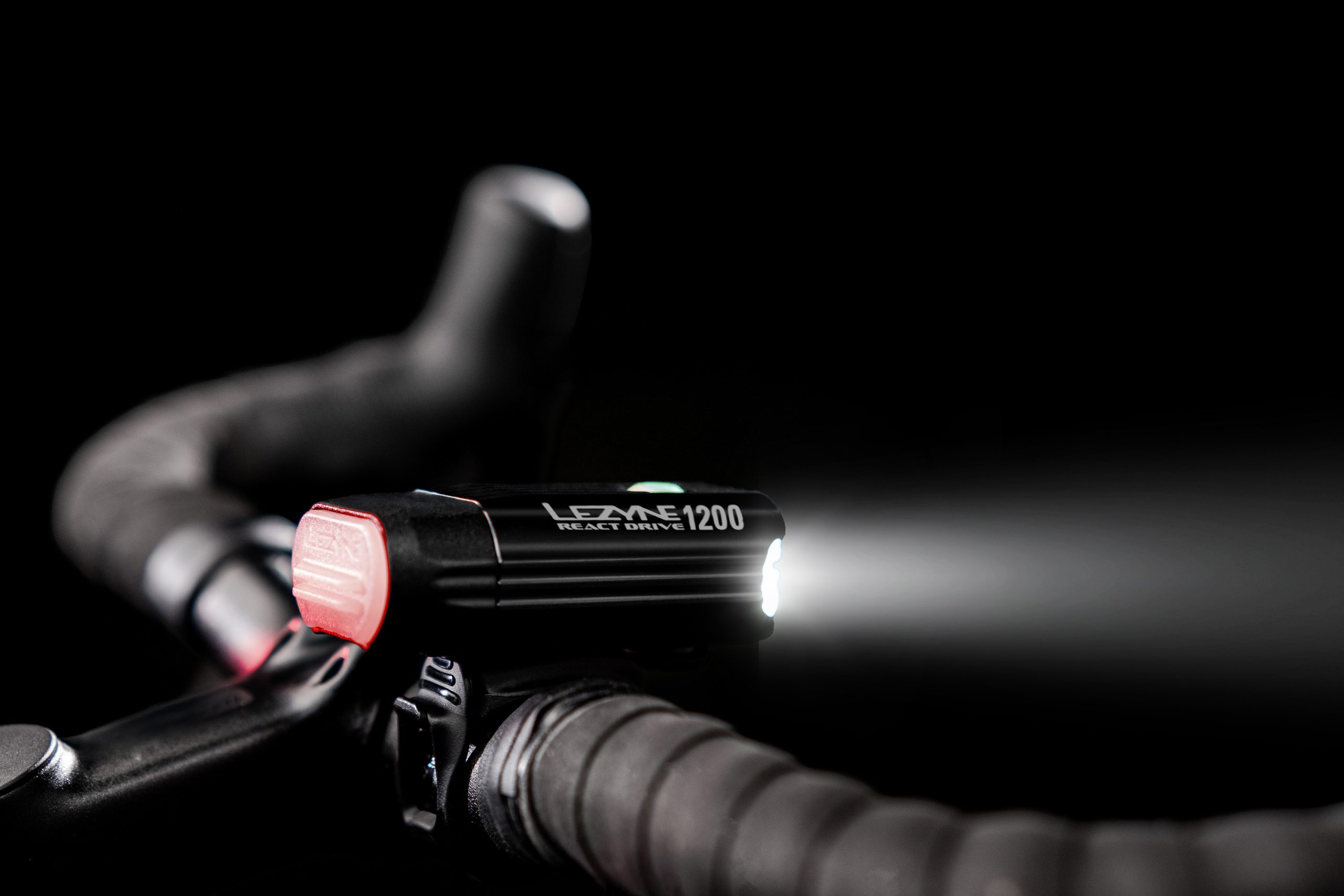
The visual cues are shown via the translucent rear portion of the unit, lighting up when a car is behind you.
Changing lighting patterns indicate the distance to the approaching vehicle, with faster flashing indicating greater danger.
The React Drive front light doesn’t only show visual cues, with a built-in speaker giving audible alerts to vehicles passing.
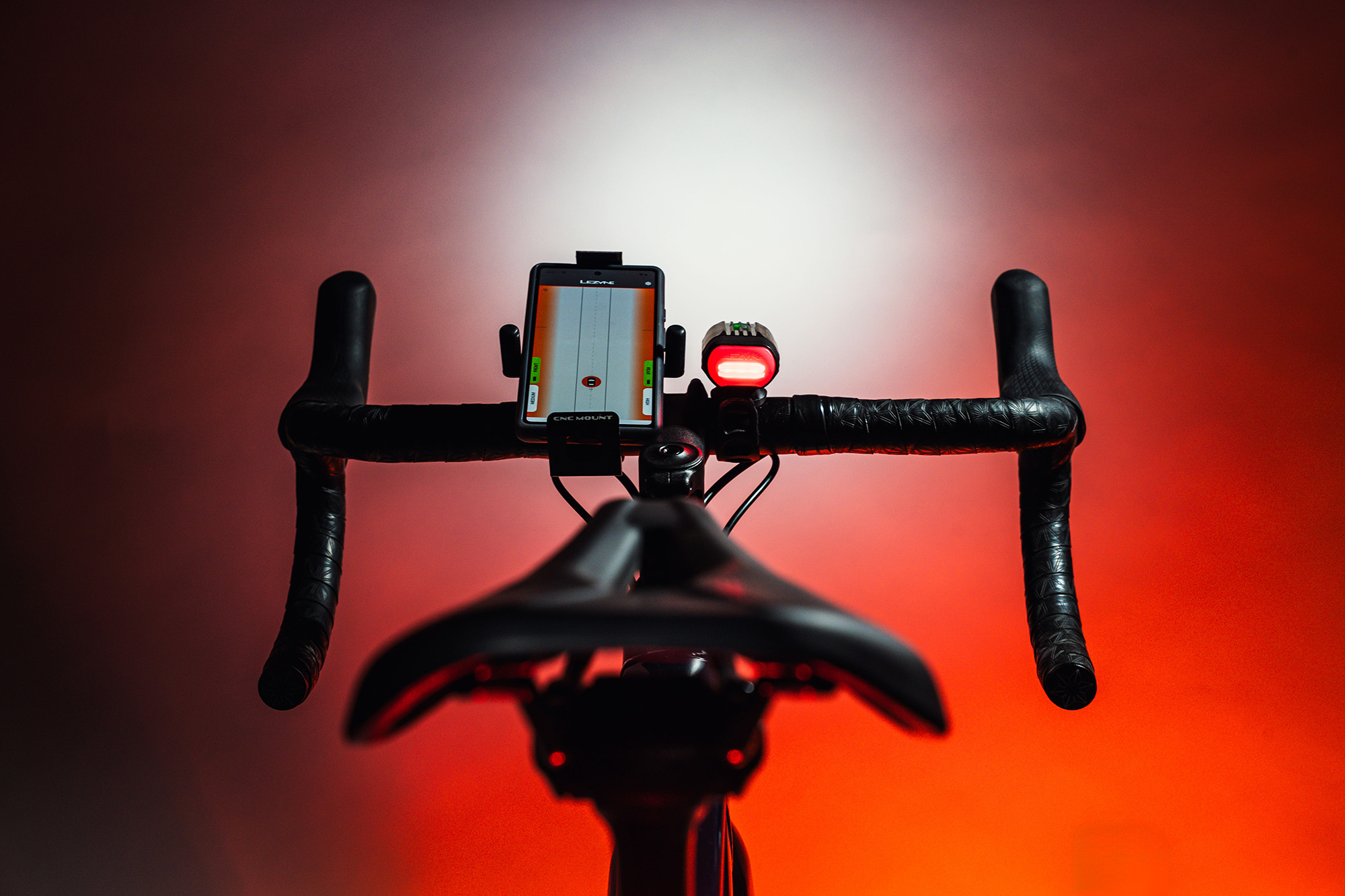
Lezyne says the Radar Drive light is compatible with most GPS bike computers that support radar, or it can be used with the Radar Ally app.
The Radar Ally app also enables you to customise system alerts, control the front and rear lights, and check for system firmware updates.
The lights connect via ANT+ and Bluetooth, meaning they should work with a range of cycling computers.
Bright enough for the road
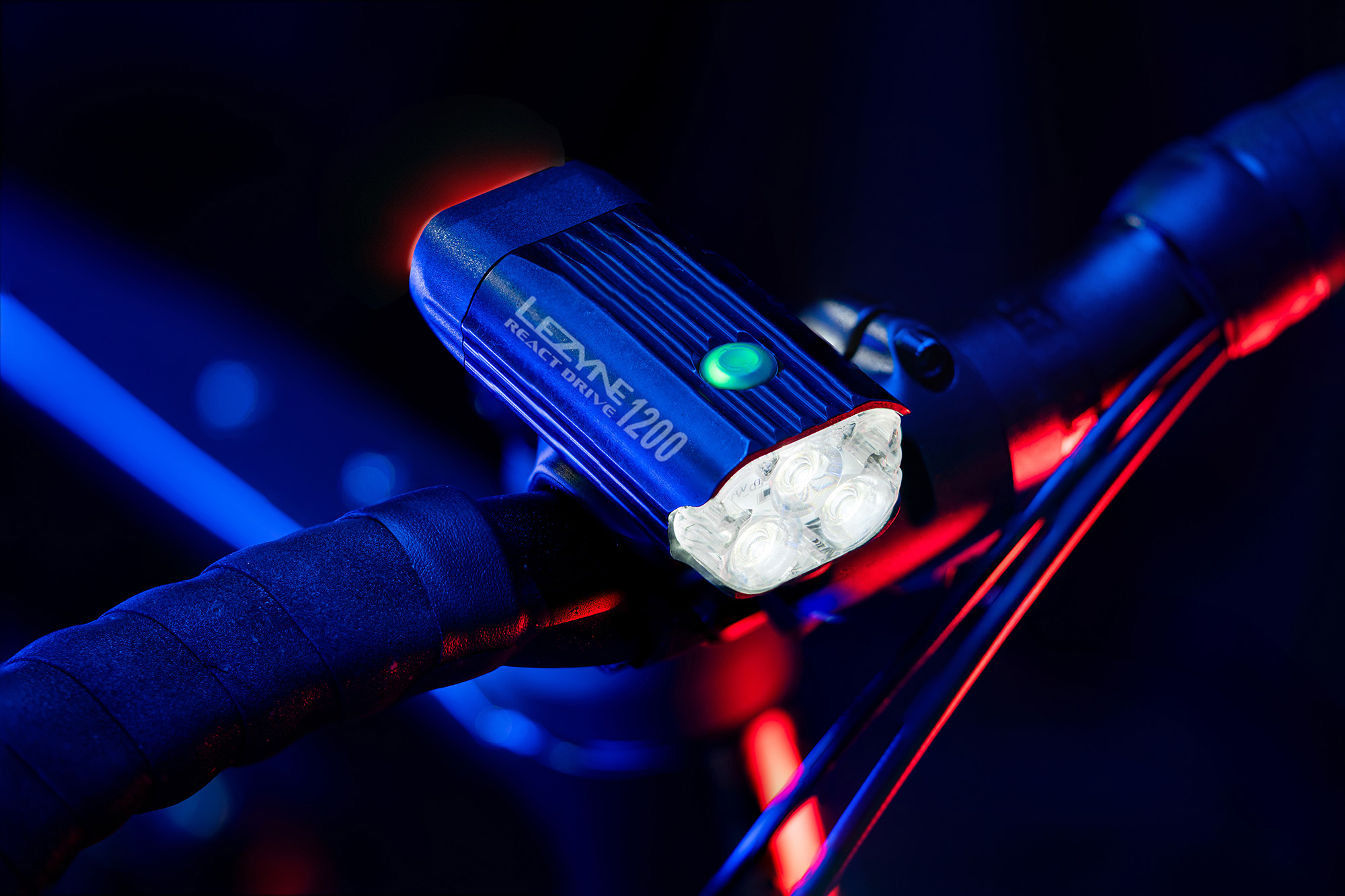
Both lights are IPX7-rated, so they should be able to keep you visible even on the wettest days.
Charging is via USB-C, with the front light having a claimed 70-hour max runtime and the rear 20 hours.
Lezyne says the React Drive front light has an output of 1,200 lumens on the maximum setting, which should be enough to navigate by on the road.
The rear light has a 300-lumen maximum output, which should ensure you’re seen from far away down the road.
Olimex RP2350-PICO2-BB48 Open Source Development Board
Olimex has announced the RP2350-PICO2-BB48, an enhanced Raspberry Pi Pico 2 with open hardware design. It exposes all 48x GPIOs in a 0.6-inch dual-inline layout for breadboard use and integrates improvements that expand flexibility for prototyping and development. The hardware configuration is based on the RP2350B processor, which integrates dual Cortex-M33 or dual RISC-V cores […]
Science’s Reproducibility Crisis: How FOSS Hackers Can Help
Most scientists agree: many published results are hard to reproduce. Can open source practices help fix the problem?
The post Science’s Reproducibility Crisis: How FOSS Hackers Can Help appeared first on FOSS Force.
You can now test drive Fedora 43 and Ubuntu 25.10
Spooky season is nearly here. Want to be scared? There are fresh betas to tryTwo of the biggest names in fixed-release distros are nearly finished and ready to drop. You can taste them now, but they’re not fully baked yet.…
Easy KDE Plasma 6 Customization | Monochrome Paws
This is a KDE Plasma 6 theme customization with clean, minimalist monochrome vibes: Global Theme Graphite, Icons Gruvbox Plus, Kvantum Theme Graphite, Wallpaper of your choice, with optional widgets.
Replace the Terminal with These Useful GUI-Based Alternatives
Tired of typing long commands in a terminal? Here are some GUI alternatives you can swap in for classic Linux terminal tools.
New Apple Immersive Video Coming From Red Bull, Audi, BBC Proms, CNN & More
A swathe of new Apple Immersive Video content is coming to Apple Vision Pro.
Earlier today, the first third-party Apple Immersive Video was released, the MotoGP documentary Tour De Force. It was filmed with Blackmagic’s URSA Cine Immersive, and edited in its DaVinci Resolve.
MotoGP Tour De Force Places You Trackside With Apple Immersive Blackmagic Cameras
Tour De Force places you trackside at the start of a MotoGP race in Apple Immersive.
 UploadVRIan Hamilton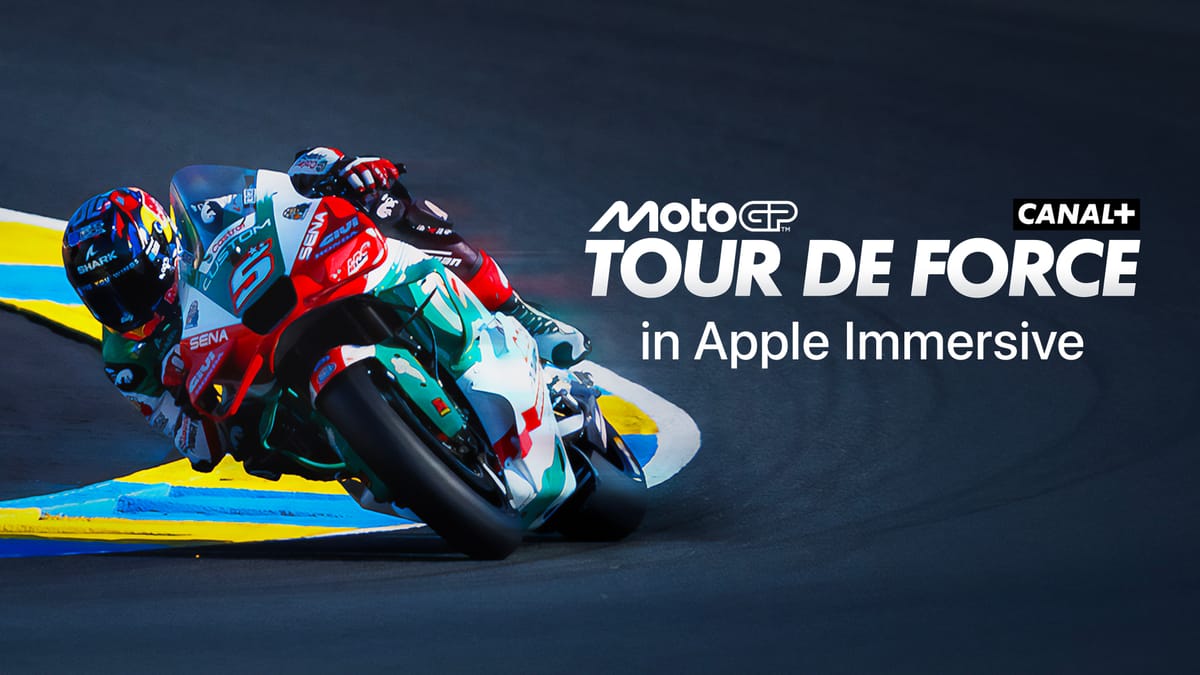
As we noted when they were announced, Blackmagic’s immersive camera and editing software update are set to enable a vastly greater library of Apple Immersive Video than would be possible if the only source remained Apple-contracted projects using Apple’s own cameras.
Alongside the release of Tour De Force, Apple announced 7 other third-party Apple Immersive Video titles coming soon, as well as 2 new episodes of Apple’s first-party series.
Third-Party
World of Red Bull
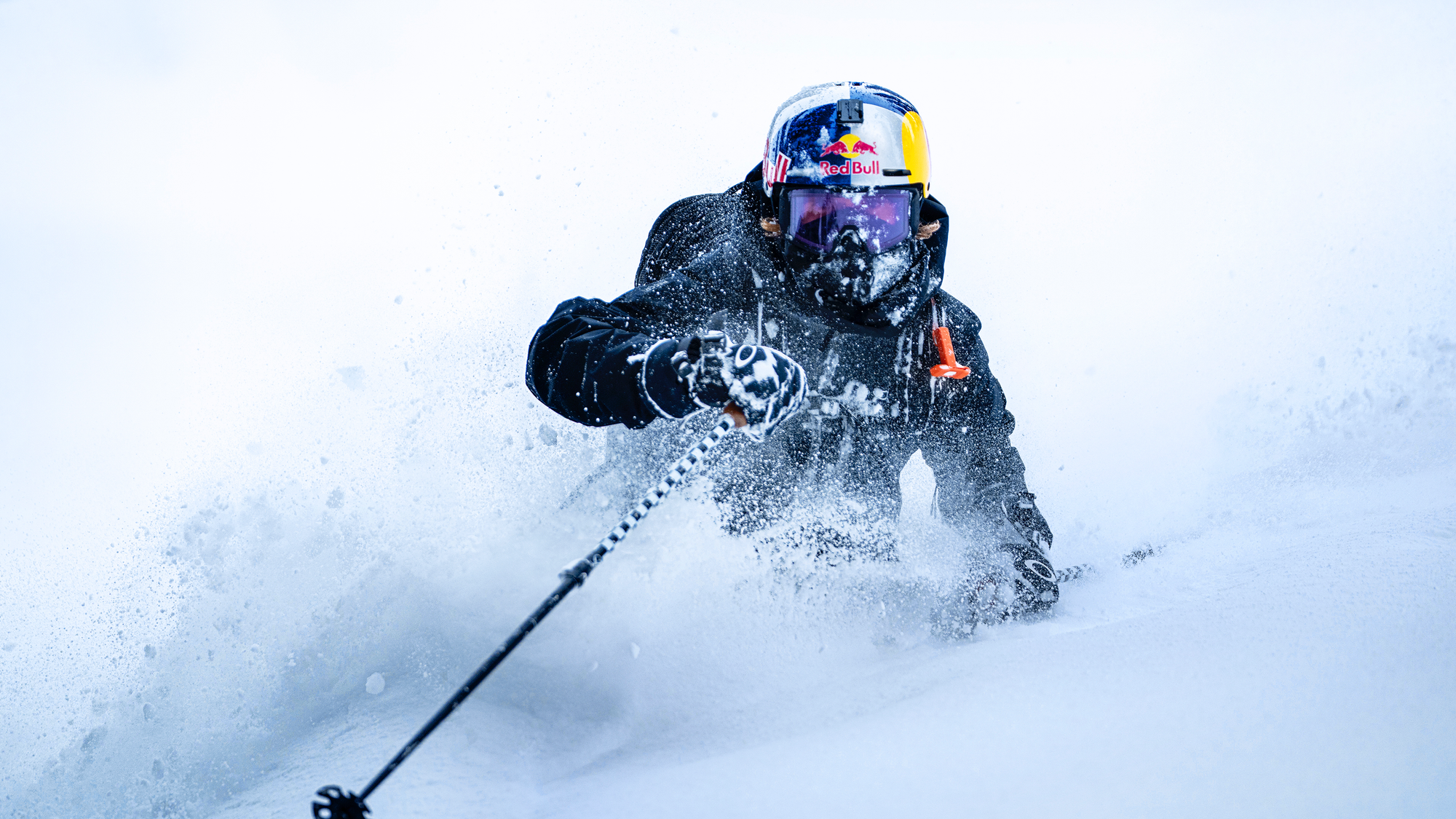
World of Red Bull is a new series of immersive experiences for Apple Vision Pro that bring Red Bull’s signature energy and storytelling to this groundbreaking format.
In the debut episode, “Backcountry Skiing,” audiences are transported into the wilderness of Revelstoke, British Columbia, where the world’s top freeskiers push their limits on remote, untouched slopes. Blending breathtaking action with intimate athlete moments, the episode captures both the intensity and beauty of backcountry freeskiing, while showcasing the passion, preparation, and dedication it takes to reach the peak.
In the next episode, “Big-Wave Surfing,” viewers will feel the power of the ocean like never before as elite surfers attempt to ride the barrel of the heaviest wave in the world off the remote coast of Teahupoʻo, Tahiti.
The first episode, Backcountry Skiing, will be available in December, and Big-Wave Surfing will release in 2026.
A Night at the BBC Proms

This fall, classical music fans can enjoy BBC Proms, the world’s greatest classical music festival, like never before. Pianist Lukas Sternath makes his BBC Proms debut performing Edvard Grieg’s Piano Concerto in A minor with the BBC Symphony Orchestra and their chief conductor, Sakari Oramo. With this special experience — the first classical music concert available in Apple Immersive — viewers will enjoy the performance inches from the pianist’s hands, while being surrounded by the power of the orchestra in Spatial Audio, and enveloped by the historic architecture of one of the world’s most iconic music venues, the Royal Albert Hall.
Journey to Antarctica to Find Emperor Penguins (CNN)
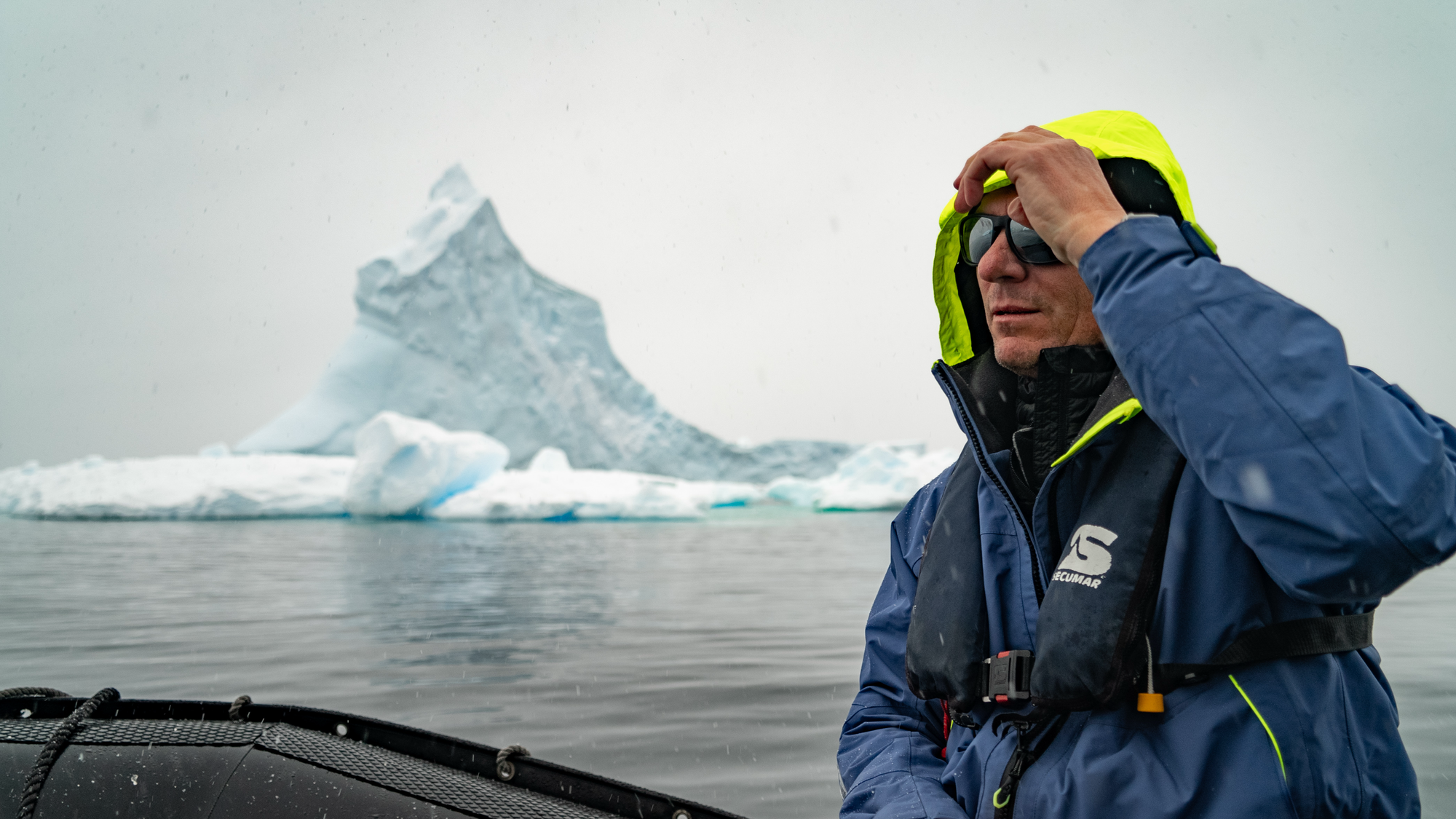
CNN’s chief climate correspondent, Bill Weir, joins a scientific expedition to Antarctica, bringing audiences into unbelievable proximity with emperor penguins emerging from winter with newborn chicks on Snow Hill Island. He’ll discuss the impact a warming climate and receding sea ice are having on penguin populations with the researchers that know them best, and talk about the challenges of conducting vital work like this at one of the hardest-to-reach places on Earth.
Journey to Antarctica to Find Emperor Penguins will release in 2026.
Julaymba
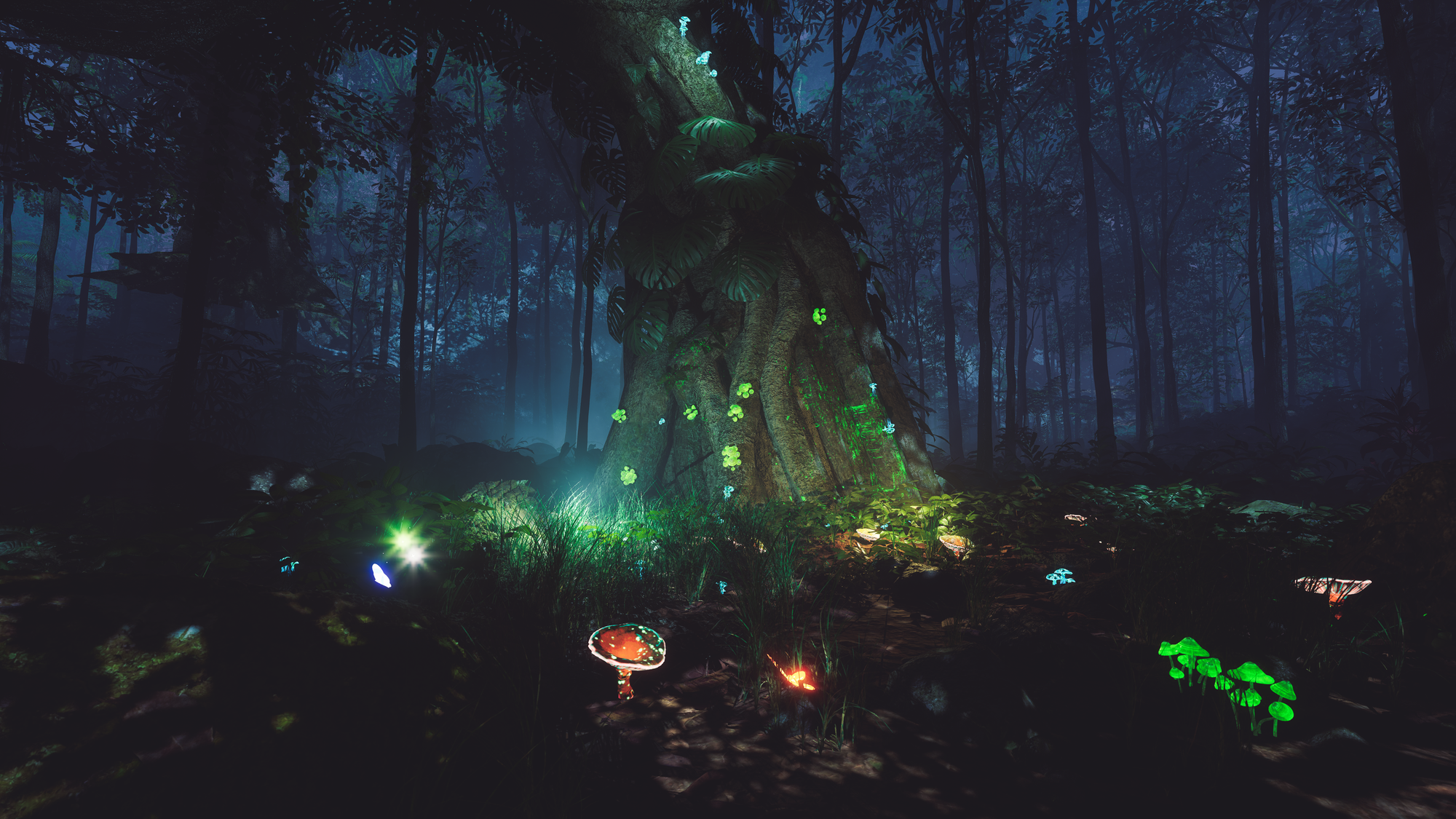
Apple Vision Pro users can step into the heart of the world’s oldest rainforest with Julaymba, an award-winning immersive documentary launching this October. In the lush Daintree Rainforest of North Tropical Queensland, Australia, viewers will journey with the Eastern Kuku Yalanji people — the Indigenous Traditional Custodians of the region — where an Elder welcomes them through stories, ceremony, and a profound connection to country. Alive with waterfalls, glowing fungi, and the calls of cassowaries, this UNESCO World Heritage Site will completely immerse viewers, offering an intimate encounter with culture and nature.
Julaymba was originally released on Meta Quest last year, but it has now been “recaptured” for Apple Vision Pro, and will be available in October.
Experience Paris

Experience Paris in an immersive film from The Explorers that celebrates French heritage. Viewers will discover the quiet precision of a three-Michelin-star kitchen, ascend to breathtaking heights atop the city’s most iconic tower, and experience the timeless charm of Montmartre’s historic streets.
Experience Paris will release “this fall”.
CORTIS (Color Outside The Lines)

Step inside the world of CORTIS, the newest K-pop boy band from BIGHIT MUSIC, the label behind iconic global groups BTS and TOMORROW X TOGETHER. Viewers will experience raw, unseen moments with unprecedented access to the practice room, where the choreography for their introductory track, “GO!”, comes to life.
CORTIS will release “this fall”.
Audi F1 Project
Audi is set to enter Formula One in 2026, and the company is also working on an Apple Immersive Video related to this.
No specific details are available about the video yet, though, nor a teaser image.
New Apple Episodes
Apple also announced two new episodes of its own Apple Immersive Video series, Wild Life and Elevated.
Orangutans (Wild Life)

Viewers can bond with young orangutans at an extraordinary rehabilitation center in Borneo as they grow, play, and learn the ropes of jungle life.
Orangutans is the fourth episode of Wild Life. The first three were Rhinos, Elephants, and Sharks.
Maine (Elevated)

Tim Robbins guides viewers above Maine, sweeping over rugged coastlines, pristine lakes, and forests bursting with fall’s fiery palette of orange, crimson, and gold.
Maine is the second episode of Elevated. The first was Hawaii.
China Launches Stealth Jet From Electromagnetic Catapult Aircraft Carrier
Longtime Slashdot reader hackingbear writes: The Chinese People’s Liberation Army Navy (PLAN) has demonstrated its ability to launch and recover aircraft from its first electromagnetic catapult-equipped aircraft carrier, the CNS Fujian. Official imagery released by the PLAN today confirms that the new J-35 naval stealth fighters, KJ-600 airborne early warning and control aircraft, and J-15T fighter jet are carrying out carrier trials. Ben Lewis, a co-founder of PLATracker, told USNI News that the test was a “significant milestone” for the Chinese military’s carrier program. “Once operational, the PLAN will have the capacity to field fifth-generation stealth carrier aircraft, supported by fixed-wing carrier-based airborne early warning and command aircraft, across the first island chain and Western Pacific Ocean,” Lewis said.
Electromagnetic catapults offer several advantages, not least the fact that they can be more finely tuned to very different aircraft types, including ones that are larger and slower (like the KJ-600), or which are smaller and lighter, such as smaller drones. In contrast to the U.S. Navy, which gathered decades of experience with steam-powered catapults, China opted for electromagnetic ones for its first catapult-equipped carrier. It’s worth noting that the U.S. Navy’s USS Gerald R. Ford was the first carrier ever to get an aircraft into the air using what is also referred to as an electromagnetic aircraft launch system (EMALS). However, it has not launched an F-35C so far, making the J-35 the first stealth jet to achieve this feat. Based on earlier predictions, the F-35C may not do the same for some years.


Read more of this story at Slashdot.
Carving A Wooden Skull In 5 Minutes, 5 Hours, And 5 Days
This is a video of artist Blake McFarland carving three wooden skulls: one in five minutes, one in five hours, and one in five days. That five minute skull — even that one looks better than I could make in a lifetime. And while the uncensored five day skull is certainly impressive, if you’re paying for a skull by the hour I’d definitely opt for a five hour version for the best value.
OBS Studio 32.0 Released With Plugin Manager, NVIDIA RTX Improvements
OBS Studio 32.0 stable is now available for this popular cross-platform desktop recording and screencasting software popular with game streamers and for a variety of other recording/casting purposes…
Supreme Court Allows Trump to Fire Remaining Democrat On FTC
The Supreme Court has temporarily allowed President Trump to fire Rebecca Slaughter, the last Democrat on the FTC. “The court’s action is technically temporary, since the justices said they will hear arguments in the case in December, but every indication is that the conservative court majority will use the case to reverse a major Supreme Court precedent that dates back almost a century,” reports NPR. From the report: Congress created the FTC and lots of other agencies to be multi-member, bipartisan regulatory agencies. And the Supreme Court in 1935 upheld those statutes ruling ruled against then-President Franklin D. Roosevelt’s claim that he could fire FTC commissioners at will. In a unanimous opinion at the time, the court said Congress acted within its powers in declaring that a commissioner could only be fired for misconduct — not for a policy disagreement. But now, prodded by President Trump, the court’s six-member conservative majority seems poised to remake the way independent agencies operate. And if the handwriting on the wall is as clear as it seems to be, the independent agencies won’t be independent. Their membership will be subject to the will of the president.
The court’s action Monday was hardly subtle. While the lower courts had ruled that the president could not fire Slaughter, under the court’s 1935 precedent, the conservative Supreme Court majority allowed the president to fire her. Indeed, her name isn’t even on the FTC website anymore. And the court so far has allowed Trump to fire other agency board members. In short, the justices are not playing hide-the-ball. And it’s a good bet that the court will reverse the 1935 precedent, which until now had been reaffirmed multiple times. The result will be that whereas in the past, these agencies had to be bipartisan, with a minority of opposition party members, now there will be no such requirement. In short, Trump can name all the agency members. And if his successor is a Democrat, he or she can fire all the Republicans.


Read more of this story at Slashdot.
The Only Birds Known To Use Tools To Make Music
This is a video highlighting the endangered Palm Cockatoo, the only non-cartoon bird known to make and play instruments, crafting drumsticks and using them to beat out a rhythm to attract a mate. Mates love good rhythm. Me? I have no rhythm. One time I tried to impress a date with my own drumming at Rock Band but by the time I’d finished my solo she was gone and raccoons were going through the garbage in my kitchen.
The Moon is Rusting – Thanks To ‘Wind’ Blown All the Way From Earth
The Moon is rusting — and it’s Earth’s fault. Nature: Scientists have found that oxygen particles blown from Earth to the Moon can turn lunar minerals into hematite, also known as rust. The discovery adds to researchers’ growing understanding of the deep interconnection between Earth and the Moon — and shows how the Moon keeps a geological record of those interactions, says Ziliang Jin, a planetary scientist at Macau University of Science and Technology in China. He and his colleagues reported their findings earlier this month in Geophysical Research Letters.
Most of the time, both Earth and the Moon are bathed in a stream of charged particles emanating from the Sun. But for around five days each month, Earth passes between the Sun and the Moon, blocking most of the flood of solar particles. During that time, the Moon is exposed mainly to particles that had been part of Earth’s atmosphere before blowing into space — a phenomenon known as Earth wind. That wind contains ions of various elements, including hydrogen, oxygen and nitrogen. When those charged particles hit the Moon, they can implant themselves into the upper layers of lunar soil and trigger chemical reactions.


Read more of this story at Slashdot.
RPM 6.0 Package Manager Released with New Package Format
RPM 6.0 package manager debuts with the new v6 package format, modern crypto, OpenPGP v6, and drops legacy v3 installs.
Google’s Gemini AI Is Coming To Your TV
Google is rolling out its Gemini AI assistant to Google TV, bringing conversational AI to over 300 million devices. Users will be able to ask Gemini for help with TV recommendations, show recaps, reviews, or even general tasks like homework help, vacation planning, or learning new skills. TechCrunch reports: The company stresses that Gemini’s addition doesn’t mean that you won’t be able to do the same things you used to be able to do through the (non-AI) Google Assistant integration. Those commands will still work, says Google. The Gemini rollout to Google TV begins on the TCL QM9K series starting today. Later in the year, Gemini will arrive on the Google TV Streamer, Walmart onn 4K Pro, 2025 Hisense U7, U8, and UX models, and 2025 TCL QM7K, QM8K, and X11K models. More functionality will be added over time.


Read more of this story at Slashdot.
US intel officials “concerned” China will soon master reusable launch
SpaceX scored its 500th landing of a Falcon 9 first stage booster on an otherwise routine flight earlier this month, sending 28 Starlink communications satellites into orbit. Barring any unforeseen problems, SpaceX will mark the 500th re-flight of a Falcon first stage later this year.
A handful of other US companies, including Blue Origin, Rocket Lab, Relativity Space, and Stoke Space, are on the way to replicating or building on SpaceX’s achievements in recycling rocket parts. These launch providers are racing a medley of Chinese rocket builders to become the second company to land and reuse a first stage booster.
But it will be many years—perhaps a decade or longer—until anyone else matches the kinds of numbers SpaceX is racking up in the realm of reusable rockets. SpaceX’s dominance in this field is one of the most important advantages the United States has over China as competition between the two nations extends into space, US Space Force officials said Monday.
iFixit Tears Down the iPhone Air, Finds That It’s Mostly Battery
iFixit’s teardown of Apple’s iPhone Air reveals a device dominated by its battery, which occupies approximately two-thirds of the internal space while critical components including the logic board cluster at the top. The battery matches the component used in Apple’s iPhone Air MagSafe battery pack and can be swapped between devices.
The top-heavy component layout addresses the bendgate vulnerability that damaged logic boards in previous thin iPhone models when pressure was applied to the device’s middle section. Despite the iPhone Air’s thinner profile, iFixit awarded it a 7 out of 10 repairability score, citing reduced component layering that provides more direct access to the USB-C connector, battery, and other serviceable parts compared to standard iPhone models. The dual-entry system further contributes to the device’s serviceability.


Read more of this story at Slashdot.
Facebook adds an AI assistant to its dating app
Facebook Dating has added two new AI tools, because clearly a large language model is what the search for love and companionship has been missing all this time. The social media platform introduced a chatbot called dating assistant that can help find prospective dates based on a user’s interests. In the blog post announcing the features, the example Meta provided was “Find me a Brooklyn girl in tech.” The chatbot can also “provide dating ideas or help you level up your profile.” Dating assistant will start a gradual rollout to the Matches tab for users in the US and Canada. And surely everyone will use it in a mature, responsible, not-at-all-creepy fashion.
The other AI addition is Meet Cute, which uses a “personalized matching algorithm” to deliver a surprise candidate that it determines you might like. There’s no explanation in the blog post about how Meta’s algorithm will be assessing potential dates. If you don’t want to see who Meta’s AI thinks would be a compatible match each week, you can opt out of Meet Cute at any time. Both these features are aimed at combatting “swipe fatigue,” so if you’re 1) using Facebook, 2) using Facebook Dating, and 3) are really that tired of swiping, maybe this is the solution you need.
This article originally appeared on Engadget at https://www.engadget.com/social-media/facebook-adds-an-ai-assistant-to-its-dating-app-225754544.html?src=rss