The Fedora project has posted a
proposal for a policy regarding the use of AI tools when developing for
the distribution.
You are responsible for your contributions. AI-generated
content must be treated as a suggestion, not as final code or
text. It is your responsibility to review, test, and understand
everything you submit. Submitting unverified or low-quality
machine-generated content (sometimes called “AI slop”) creates an
unfair review burden on the community and is not an acceptable
contribution.
Circle, the world’s second-biggest issuer of stablecoins, is examining ways to make it possible to reverse transactions involving its tokens [non-paywalled source], in a rare admission by a major crypto firm that it needs to take lessons from the traditional financial sector. Financial Times: Circle president Heath Tarbert said a mechanism that allowed money to be refunded in cases of fraud or disputes would help the stablecoin industry’s push to become part of the financial mainstream. “We are thinking through…whether or not there’s the possibility of reversibility of transactions, right, but at the same time, we want settlement finality,” Tarbert told the Financial Times.
“So there’s an inherent tension there between being able to transfer something immediately, but having it be irrevocable,” he added. Such measures could be seen as a major departure from the crypto industry’s previous emphasis on the “immutability” of the blockchain, a digital ledger that is public and records transactions that cannot be unwound.
Despite Elon Musk and Donald Trump’s very public spats and seemingly still ongoing feud, the White House has remained committed to supporting the former’s AI ambitions. And today, the General Services Administration (GSA) announced that it has reached an agreement with xAI that will allow it to buy Musk’s Grok AI models for $0.42 per organization.
As part of the Trump administration’s OneGov procurement initiative, the deal with xAI will allow federal agencies access to the Grok 4 and Grok 4 Fast advanced reasoning models. The 18-month contract is the longest OneGov AI procurement agreement to date. xAI announced its Grok for Government strategy earlier in the summer, which signalled its intention to provide the government with a suite of AI products, including custom models for national security, science and healthcare purposes.
As well as opening its models for government use, xAI is also providing dedicated engineers to speed up the implementation of its AI tools for participating agencies, and will offer an “upgrade path” for expanded features and higher rate limits. Such access is a crucial part of Trump’s AI Action Plan, designed to position the US as the global leader in AI. And his administration doesn’t appear to have been put off by Grok’s bizarre behavior in recent months, such as its preoccupation with far-right conspiracy theories regarding “white genocide” in South Africa, or its brief but enthusiastic turn towards antisemitism.
xAI is the latest in a line of AI companies to strike deals with the GSA. Back in August, Anthropic began offering its Claude AI model to three branches of the US government for $1, following Gemini and xAI’s arch rival OpenAI joining a list of approved vendors.
This article originally appeared on Engadget at https://www.engadget.com/ai/elon-musks-grok-is-cleared-for-federal-government-use-162407911.html?src=rss
Apple seems determined to leave a persistent gap between the cameras of its Pro iPhones and the regular ones, but most other features—the edge-to-edge-screen design with FaceID, the Dynamic Island, OLED display panels, Apple Intelligence compatibility—eventually trickle down to the regular-old iPhone after a generation or two of timed exclusivity.
One feature that Apple has been particularly slow to move down the chain is ProMotion, the branding the company uses to refer to a screen that can refresh up to 120 times per second rather than the more typical 60 times per second. ProMotion isn’t a necessary feature, but since Apple added it to the iPhone 13 Pro in 2021, the extra fluidity and smoothness, plus the always-on display feature, have been big selling points for the Pro phones.
This year, ProMotion finally comes to the regular-old iPhone 17, years after midrange and even lower-end Android phones made the swap to 90 or 120 Hz display panels. And it sounds like a small thing, but the screen upgrade—together with a doubling of base storage from 128GB to 256GB—makes the gap between this year’s iPhone and iPhone Pro feel narrower than it’s been in a long time. If you jumped on the Pro train a few years back and don’t want to spend that much again, this might be a good year to switch back. If you’ve ever been tempted by the Pro but never made the upgrade, you can continue not doing that and miss out on relatively little.
Thief VR: Legacy of Shadow will receive an official gameplay premiere next week.
Announced earlier today, publisher Vertigo Games confirmed that Thief VR: Legacy of Shadow is getting an “in-depth look” at the upcoming stealth game next week through its YouTube channel. Going live on September 30 at 10am Pacific Time, little else was shared about what to expect. This follows a previous behind-the-scenes look in June that confirmed Stephen Russell’s return as Thief’s original protagonist, Garrett.
Developed by Maze Theory, this upcoming entry sees you play as a thief called Magpie who’s been orphaned by the tyrannical Baron Northcrest. Forced to survive on the streets by stealing, this journey sees you uncover “a legendary artifact holding a legacy from the past” as you carefully navigate these environments across The City.
Magpie comes equipped with various tools to carry out this job, using various arrows to take down or distract your foes while sticking to the darkness. Thief VR: Legacy of Shadow also promises tactile interactions that allow you to directly pickpocket guards, open hidden compartments, and more, while each mission promises multiple paths to take.
Amazon will pay a record civil penalty to settle a case with the Federal Trade Commission. The agency accused Amazon of tricking consumers into signing up for a Prime membership without their consent (and making it hard for customers to cancel) in a lawsuit filed in 2023.
To settle the charges, Amazon has agreed to pay a $1 billion civil penalty and $1.5 billion to refund customers. The company also agreed to “ease unlawful enrollment and cancellation practices for Prime,” per the FTC.
The agency says the civil penalty is the largest ever for a case involving a breach of its rules — it had accused Amazon of violating the FTC Act and the Restore Online Shoppers’ Confidence Act. The $1.5 billion in consumer redress will provide “full relief for the estimated 35 million consumers impacted by unwanted Prime enrollment or deferred cancellation,” the FTC said. It added that this is the second-highest restitution award it has ever obtained.
Moreover, Amazon will have to stop using some of the dark patterns (i.e. deceptive design practices) that prevented customers from easily canceling Prime memberships.. For instance, it will no longer display a button that reads, “No, I don’t want Free Shipping” during the cancellation flow. Instead, it will have to show a “a clear and conspicuous button for customers to decline Prime,” per the terms of the settlement.
Amazon will also have to provide clearer information about a Prime subscription to consumers during the sign-up process. This will include details about the price, whether the subscription auto-renews and how to cancel.
Engadget has contacted Amazon for comment.
This article originally appeared on Engadget at https://www.engadget.com/big-tech/amazon-is-paying-25-billion-to-settle-ftc-claims-it-duped-customers-into-signing-up-for-prime-160641347.html?src=rss
Amazon has agreed to settle a Federal Trade Commission lawsuit accusing the e-commerce giants of tricking customers into signing up for Prime and then making it frustratingly hard to cancel.
In a press release Thursday, the FTC confirmed that, pending court approval, Amazon will pay a $1 billion civil penalty and provide $1.5 billion in refunds to an estimated 35 million customers “harmed by their deceptive Prime enrollment practices.” Former FTC chair Lina Khan initiated the lawsuit, accusing customers of trapping customers in a “labyrinthine” Prime cancellation process the company named after Homer’s Iliad.
The civil penalty, the FTC noted, is “the largest ever in a case involving an FTC rule violation,” and the refunds to customers are “the second-highest restitution award ever obtained by FTC action.”
Generative AI systems that create text, images, audio, and even video are becoming commonplace. In the same way AI models output those data types, they can also be used to output robot actions. That’s the foundation of Google DeepMind’s Gemini Robotics project, which has announced a pair of new models that work together to create the first robots that “think” before acting. Traditional LLMs have their own set of problems, but the introduction of simulated reasoning did significantly upgrade their capabilities, and now the same could be happening with AI robotics.
The team at DeepMind contends that generative AI is a uniquely important technology for robotics because it unlocks general functionality. Current robots have to be trained intensively on specific tasks, and they are typically bad at doing anything else. “Robots today are highly bespoke and difficult to deploy, often taking many months in order to install a single cell that can do a single task,” said Carolina Parada, head of robotics at Google DeepMind.
The fundamentals of generative systems make AI-powered robots more general. They can be presented with entirely new situations and workspaces without needing to be reprogrammed. DeepMind’s current approach to robotics relies on two models: one that thinks and one that does.
Building off the work in months prior around Device Mapper atomic write support and related infrastructure, the md-linear target for linear software RAID support will enable atomic write support with the upcoming Linux 6.18 merge window…
Trek has launched the CheckOUT, its first full-suspension gravel bike, claiming it offers greater comfort and control on rough terrain without sacrificing speed.
Trek says its lab testing shows its suspension reduces rider fatigue by cutting vibration and steering input, while a new geometry, wider bar, and extensive mounting options further underline its adventure focus.
Trek claims the CheckOUT is its most capable gravel option for tough terrain. Dylan Remis / Trek bikes
According to Trek, the CheckOUT’s suspension is primarily intended to enhance rider comfort and reduce fatigue.
Trek says it paid particular attention to the relationship between conventional chassis bounce and bike-rider decoupling, where you’re thrown out of the saddle on rough terrain.
Trek found that when a rider moves out of the saddle, they naturally put in more effort to maintain control and stability.
For a bike that’s aimed at tackling singletrack and the toughest gravel endurance events, Trek says reducing this fatigue-inducing element was the priority.
Trek tested the bike extensiely on its bike treadmill. Trek Bikes
Trek says its lab treadmill, which mimics rough gravel surfaces, proved essential in the development and testing of the bike.
Trek tested the new bike against a rigid gravel bike, plus a CheckOUT with a 55mm tyre.
The engineers then monitored the rider’s motion and tracked the movement of the rider’s tailbone (sacrum).
Trek says this shows how well the rider stays coupled to the bike, especially on rougher terrain
Trek’s vibration testing showed the CheckOUT reduced fatigue by a significant margin. Trek Bikes
The CheckOUT suspension design provided a 27 per cent reduction in rider position variability with 50mm tyres, reducing a further 32 per cent when a larger 55mm tyre was used.
The suspension design also reduced vibrational forces reaching the rider by 41.5 per cent compared to a rigid gravel bike.
The reduction in steering input was also tested in Trek’s lab. Trek Bikes
Trek’s testing also showed that rough surfaces have a significant impact on a bike’s steering, with the constant corrections required when riding a fully rigid gravel bike causing fatigue.
Under testing, it showed that with the CheckOUT setup, steering saw a 23 per cent reduction in variability with a 50mm tyre. This was further reduced to 16 per cent with a 55mm tyre fitted.
New design and new suspension
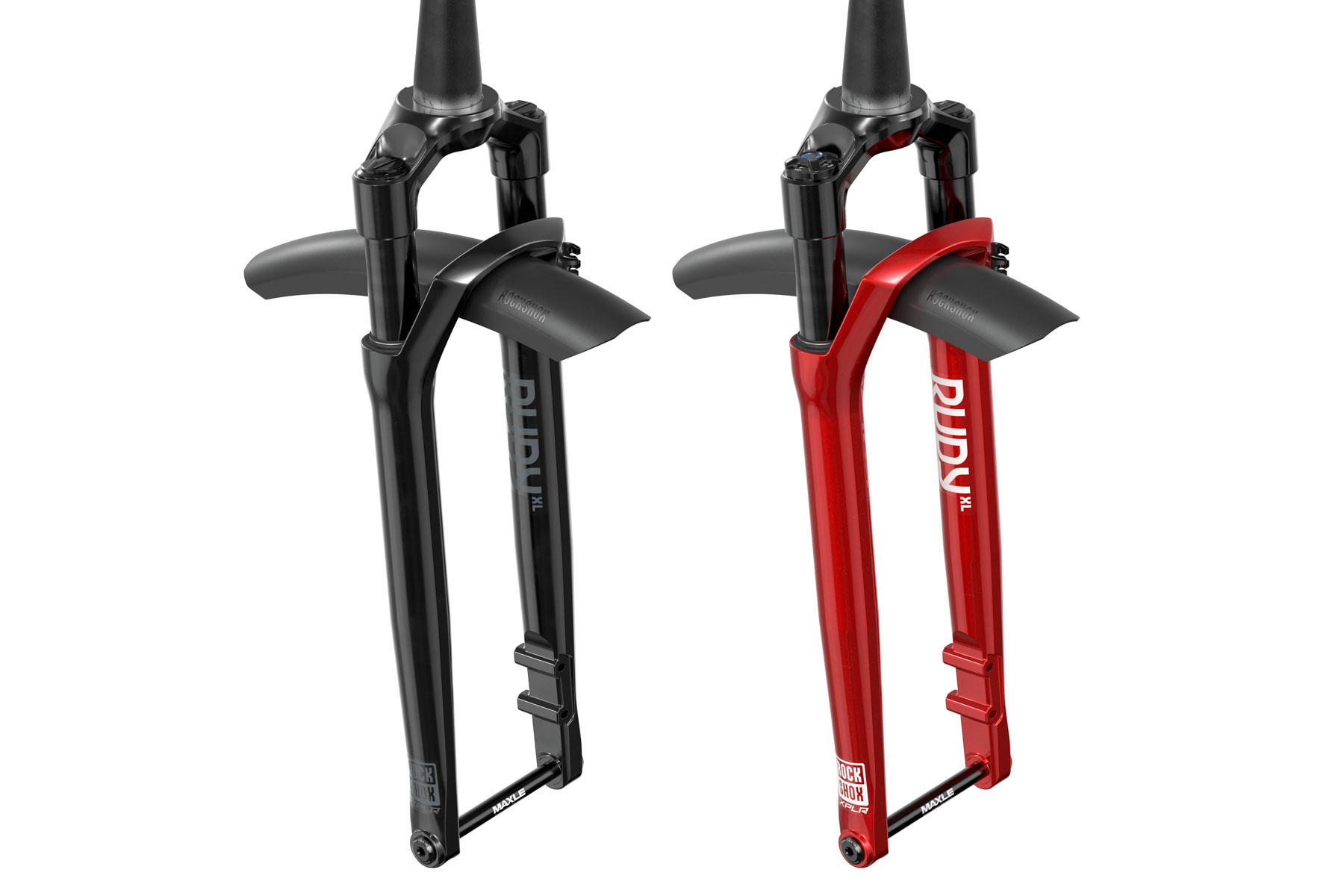
The new RockShox Rudy XL brings 60mm of travel and 56mm tyre clearance. Trek Bikes
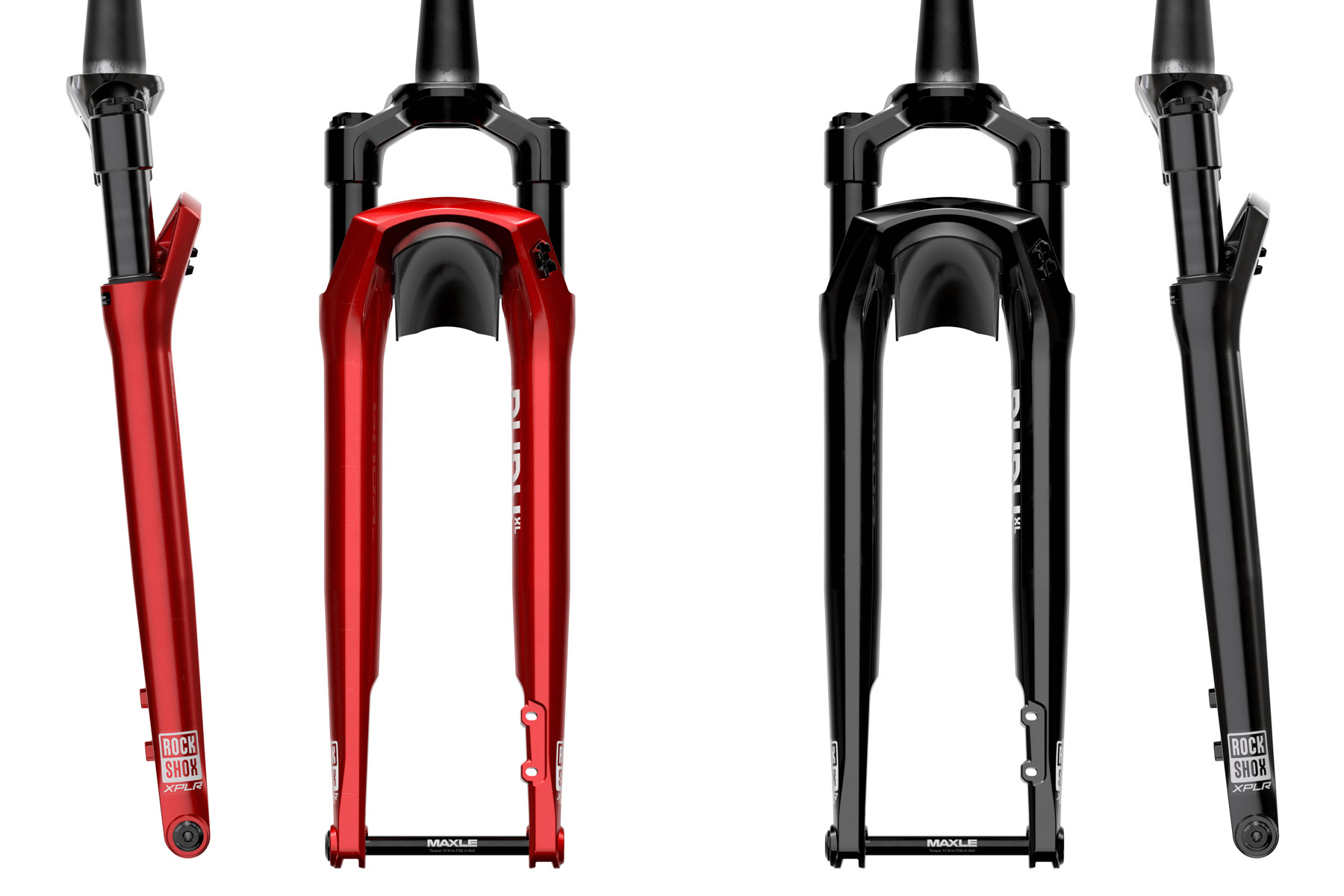
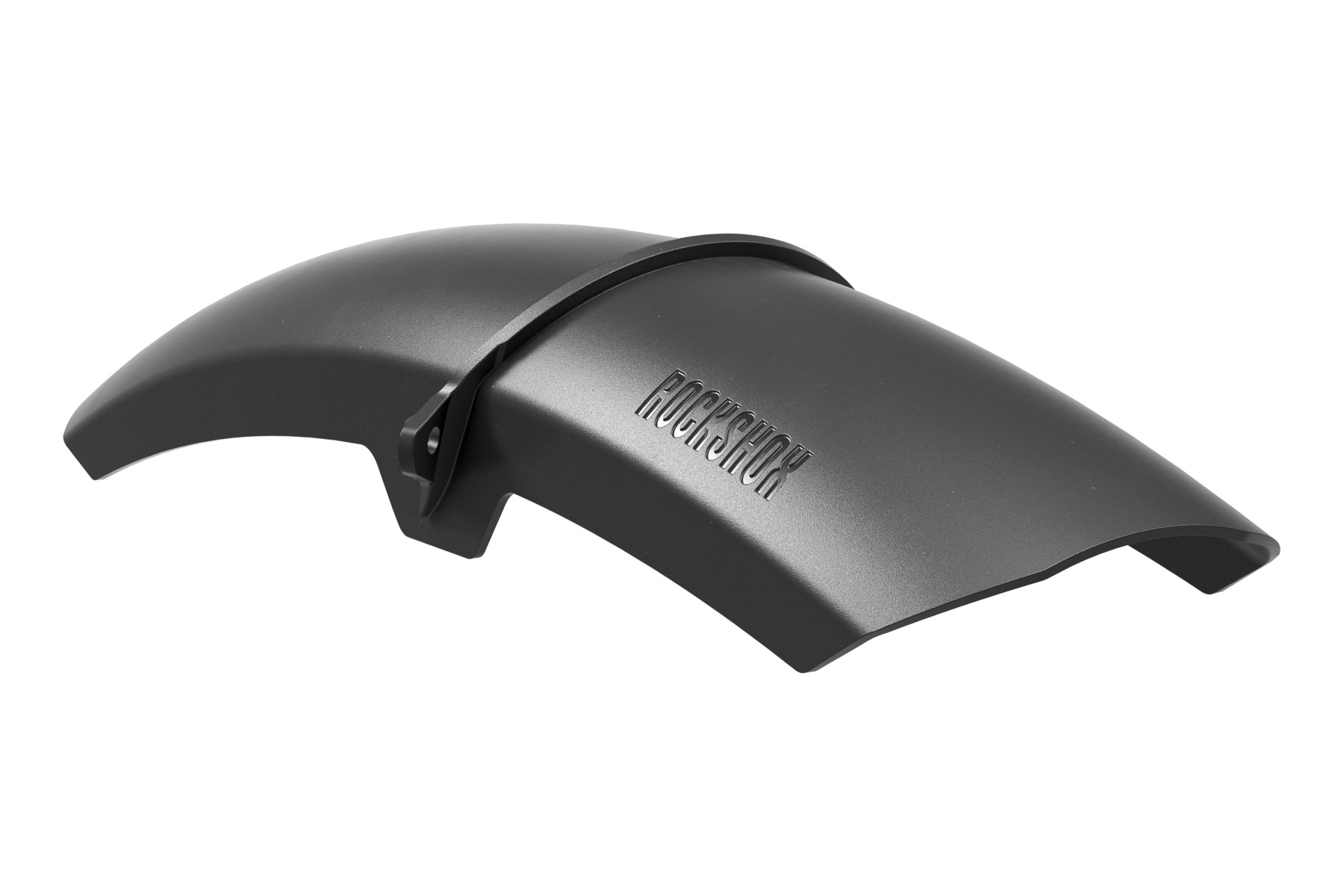
Trek didn’t want to use a mountain bike fork on the CheckOUT, so it worked with RockShox to create the Rudy XL – a burlier version of its existing gravel fork, which ups travel to 60mm and tyre clearance to 56mm, while maintaining a gravel-friendly 45mm offset.
The Rudy XL will be available separately in 50 and 60mm travel options and priced at $929, €1,010, £900.
The CheckOUT SL7 in Era white is our favourite finish. Trek Bikes
RockShox provides a SIDLuxe 170 x 27.5mm shock. This gives 55mm of travel at the rear wheel.
All models come equipped with a dropper post.
TransX is providing a cable-operated dropper on the SL5 model and RockShox’s wireless Reverb AXS on the SL7.
New wider bar
The CheckOUT SL bar features a wide flare and gentle backsweep. Trek Bikes
Trek bucks the trend towards narrow bars with the new GR Checkout bar.
The bar is designed to be more aero on the hoods, with a narrower position, pushing out 12cm wider in the drops. Trek claim this gives more confident handling over burlier terrain without sacrificing aero performance.
The top section of the bar is designed to add all-day comfort. The rounded top’s larger radius on the rear gives you somewhere for your palms to rest. Trek’s longstanding Carbon IsoCore construction is used to further absorb vibrations.
New gravel geometry
Trek claims the new bike is faster on the road than a mountain bike. Dylan Remis / Trek bikes
The CheckOUT features Trek’s new adventure geometry.
Compared to the rigid adventure-focused Checkpoint, the CheckOUT gets both a longer reach and a higher stack.
Up against Trek’s lightweight XC race bike, the Supercaliber, the CheeckOUT has a more upright position that also places the rider further back.
A full range of luggage is available for the CheckOUT SL. Trek Bikes
The CheckOUT doesn’t have any in-frame storage, but Trek has collaborated with Topo on a frame bag that fits within the front triangle in colour-matched finishes.
At the rear, a proprietary rack with a built-in linkage matches the rear suspension movement, so your bikepacking load won’t get shaken.
The frame features a huge number of mounts, with 18 in total on size M/L and above bikes.
There are two on the top of the top tube, seven on the downtube, three on the seat tube, and three on the underside of the downtube.
Trek CheckOUT range overview
Both models of the CheckOUT are built from Trek’s OCLV 500 series carbon and tested to mountain bike standards.
The SL5 and SL7 AXS complete builds are joined by a frameset option.
The SL5 comes with Shimano’s 1 x 12 mechanical GRX groupset. Trek Bikes The SL7 is built around SRAM’s Force AXS XPLR and X0 AXS. Trek Bikes The CheckOUT SL is available as a frame-only option. Trek bikes
Amazon will pay $2.5 billion to settle Federal Trade Commission allegations that it duped users into paying for Prime memberships, the regulatory agency announced Thursday. CNBC: The surprise settlement comes as Amazon and the FTC were just three days into the trial in a Seattle federal court. Opening arguments took place on Tuesday. The lawsuit, filed by the FTC in June 2023 under the Biden administration, claimed that Amazon deceived tens of millions of customers into signing up for its Prime subscription program and sabotaged their attempts to cancel it.
Three senior Amazon executives were at risk of being held individually liable if the jury sided with the FTC. Amazon will pay a $1 billion civil penalty to the FTC and will refund $1.5 billion to an estimated 35 million customers who were impacted by “unwanted Prime enrollment or deferred cancellation,” the agency said.
Plus: MGS Delta’s multiplayer mode is launching soon, news about the Black Ops 7 beta, a new trailer for Avatar 3, and a bad Fire Emblem game is out now on phones
When the president of the United States enflames tensions in this way, it’s no surprise our discourse enflames as well. Here’s one such example: You may have seen posts on social media this week claiming that Threads is now attaching warnings to posts from users who are suspected members of Antifa, or posts with the label attached itself. One viral post discussing the subject comes from the account “Balleralert,” who shared the following screenshot on Wednesday:
The label, affixed to a innocuous post by the account benballer, reads: “This user is suspected of being part of a terrorist organization called Antifa. Please report any suspicious behavior.” Taken at face value, one might assume Threads, owned by Meta, is trying to get on the Trump administration’s good side by identifying seemingly “leftist” accounts as members of Antifa.
It’s all a bit
The thing is, the label is not real: A Meta spokesperson confirmed this to me via email, saying that the label is just a meme, and not something created by Meta. That’s not to say the label hasn’t appeared in any Threads posts. They absolutely have, and you may have seen them. But if some Threads posts appear to have the label attached, it’s because it’s actually part of the original text of the post, formatted to look like an addition by Meta.
Some users appear to be adding the text to their posts in jest, such as in this example, which puts the label in context with a popular meme from the film Inglourious Basterds. This post, which places the label on an innocent declaration about how pumpkin pie is good. These are solid jokes, but they’re also fueling confusion: Some commenters are concerned about the label, while others are sharing their own versions of the meme, which are quite obvious compared to the “Antifa label.”
A good reminder to think before you share
Official labels on posts are increasingly a standard across social media posts, which is likely why this meme is something a handful of users are falling for, especially given recent controversies over the relationships between the U.S. government, the media, and tech companies. If you’re used to seeing community notes or warning from companies like Meta, you assume this Antifa label is legitimate. Learning that it isn’t should serve as a good reminder that the internet is a treasure trove of disinformation. You should never take a random post on Instagram as the unvarnished truth, especially if that post seems particularly controversial, or particularly aligned to your own worldview.
Before you believe something you see on your feeds, take a moment to think it through. Do some research to see if any trusted sources have confirmed the claims. If they haven’t, remain skeptical, and refrain from spreading it around.
Elon Musk’s xAI is suing OpenAI, alleging that the ChatGPT maker has stolen its trade secrets. The lawsuit comes after the company recently sued a former employee, Xuechen Li, for allegedly stealing confidential information from the company before taking a job at OpenAI.
In its latest lawsuit, which was reported bySherwood, xAI says that Li’s alleged actions are part of “a broader and deeply troubling pattern of trade secret misappropriation, unfair competition, and intentional interference with economic relationships by OpenAI.” According to xAI’s lawyers, OpenAI also hired two other xAI employees who stole proprietary information from Musk’s company.
“Another early xAI engineer—Jimmy Fraiture—was also harvesting xAI’s source code and airdropping it to his personal devices to take to OpenAI, where he now works,” the lawsuit states. “Meanwhile, a senior finance executive brought another piece of the puzzle to OpenAI—xAI’s ‘secret sauce’ of rapid data center deployment—with no intention to abide by his legal obligations to xAI.”
OpenAI didn’t immediately respond to a request for comment on the lawsuit. Musk, of course, has a complicated history with the ChatGPT maker, and this isn’t the first time his rival AI company has sued OpenAI. Last month, xAI filed lawsuits against OpenAI and Apple over Grok’s placement on App Store charts. Musk alleged that ChatGPT rank in the top spot represented an “unequivocal antitrust violation.” Musk has also filed numerous lawsuits against OpenAI over its relationship with Microsoft and its move to become a for-profit company.
This article originally appeared on Engadget at https://www.engadget.com/ai/xai-accuses-openai-of-stealing-its-trade-secrets-in-new-lawsuit-152926944.html?src=rss
Today, Giant has responded to US Customs and Border Protection’s “Withhold Release Order”, issued on 24 September and suspending imports on products manufactured in Taiwan. The ban included bikes, bike parts and components.
Giant says it plans to engage with US CBP and will seek the revocation of the order, although it’s unclear what the timeline might be for any resolution and whether this might involve formal arbitration.
Giant says in its response that it is “firmly committed to upholding human rights and labor protections” and since the start of 2025 has implemented a zero recruitment fee policy, as well as upgrading its employee housing.
In addition, Giant states that it has “established internal supervision mechanisms and third-party audits, and continues to conduct due diligence to ensure compliance with international standards”.
Giant points out that the order applies to US imports of its Taiwan-made products only. Giant Bicycles
Giant’s response continues: “Giant Group remains dedicated to protecting labor rights through concrete actions and ensuring a transparent, fair, and sustainable development. The Group will continually provide timely updates and maintain open communication with global stakeholders to foster a responsible and resilient industry environment.”
Giant points out that supply and sale in other markets of its products manufactured in Taiwan are unaffected – the Withhold Release Order only applies to imports into the US. It says that some shipments to the US may be subject to delays and inspections, but it’s activated contingency measures and is working closely with business partners to minimise the impact.
Nothing is spinning off its budget brand CMF into an independent subsidiary, according to a report by TechCrunch. India will serve as the newly-formed company’s headquarters for manufacturing and R&D, thanks to a partnership with one of the country’s telecom operators. Nothing says this venture will create over 1,800 jobs in the country.
India is actually a good choice for the HQ. The country is Nothing’s strongest market overall, with over a 2 percent market share in smartphones. It’s the fastest-growing brand in the region, with an 85 percent growth in shipments year over year. CMF also specializes in budget-friendly handsets under $200 and this is the dominant category in India, according to the IDC.
“India will play a key role in shaping the future of the global smartphone industry. CMF has been well-received by the market since we launched it two years ago,” Nothing CEO Carl Pei said in a statement. “With our end-to-end capabilities, we are uniquely positioned to now build it into India’s first truly global smartphone brand.”
Nothing hasn’t said how much money it would take to set up this new subsidiary, but the company did just raise $200 million in a funding round. Maybe some of that cash will be funneled to this project.
The company first launched CMF back in 2023. It started with the release of a pair of earbuds and a smartwatch but has since moved on to smartphones.
This article originally appeared on Engadget at https://www.engadget.com/mobile/smartphones/nothing-is-spinning-off-its-budget-cmf-brand-152505010.html?src=rss
Accenture has reduced its global workforce by more than 11,000 in the past three months and warned staff that more would be asked to leave if they cannot be retrained for the age of AI. From a report: The IT consulting group on Thursday detailed an $865 million restructuring programme and an outlook for the year ahead that reflects continuing sluggish corporate demand for consulting projects and a clampdown on spending within the US federal government.
“We are exiting on a compressed timeline people where reskilling, based on our experience, is not a viable path for the skills we need,” chief executive Julie Sweet told analysts on a conference call. The company employed 779,000 people at the end of August, it said, down from 791,000 three months earlier, after beginning a round of lay-offs that will continue until the end of November. It did not say how many jobs had gone directly as a result of the restructuring, but said severance payments and other costs totalled $615 million in the quarter just ended and would be $250 million more in the current three-month period.