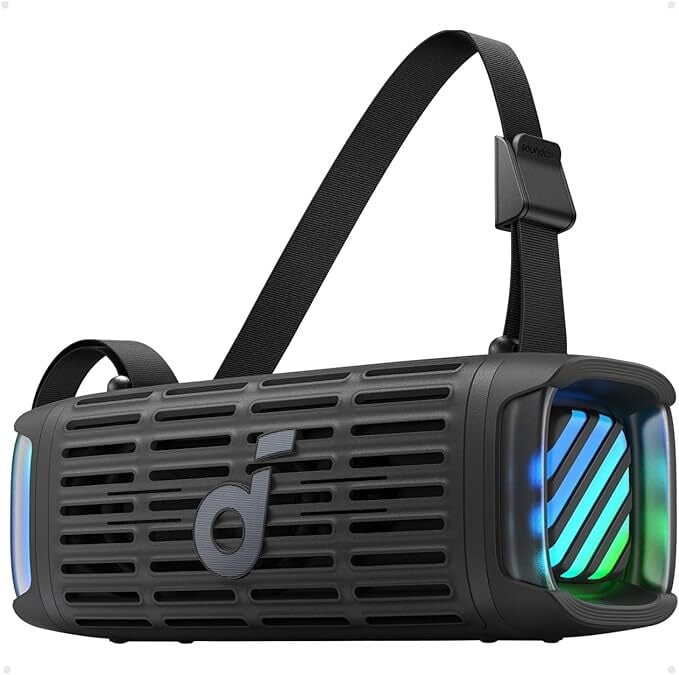
A lot of outdoor speakers will float on water or be rated IP68 waterproof, but the only one that will also float facing up and be resistant against salt water is the Soundcore Boom 3i, making it the best portable speaker for water activities. It also has plenty of useful features that make it a great outdoor speaker. Right now, you can get it for $99.99 (originally $139.99).
I’ve been using Soundcore speakers and headphones for a while, and I’ve been impressed by their material, sound quality, and well-designed companion app, especially when taking into account their price. The Soundcore Boom 3i is no different, considering you need to spend around $180 these days to break into portable speakers with similar features.
Being corrosion-proof means you can get it to the beach without worrying that the salt will mess up the speaker. In case it does, there’s a “Buzz Clean” feature that plays low-frequency sounds to shake and clear debris out of the drivers. Floating facing up was a great addition, so the speakers won’t be underwater. It’s small enough to carry around and comes with a shoulder strap. The 50W power outage is great for its size, and can be loud enough to host a gathering of around eight people with no issues.
The app has a 9-band custom EQ so you can tweak the sound to your liking. There’s also a bass boost button along with volume, play, pause, and other useful media controls on top of the speaker. The battery will last about 16 hours, and you can listen to music while charging it.
You’d be forgiven for thinking Titan Isles was some sort of prequel to the Windlands series. While it does have a lot in common with Psytec’s combat-flavored adventure platformer Windlands 2 (2018), Titan Isles is an entirely new game that marks a clear departure from the series’ focus on exploration by amping up combat and stripping down levels to a mostly straight ‘A to B’ pathway, making for a pretty good (if not basic) bullet hell-style shooter that dispels more of the the Windlands magic than I was hoping to part with.
Titan Isles Details:
Developer: Psytec Games Available On:Quest, SteamVR, coming to PSVR 2 in 2026 Reviewed On: Quest 3 Release Date: September 25th, 2025 Price: $30
Gameplay
There’s a lot to like about Titan Isles: sweeping landscapes with impressive vertical drops, massive bosses that can really force you to rethink your plan of attack, and a variety of new locomotion schemes that just feel right. For some, this is the game.
There’s also a lot to dislike too: shooter mechanics seemingly lifted from flatscreen games, straight-shot level design with no real opportunity for exploration, and predictable enemy types that never seem to evolve beyond basic attack patterns. It all feels a little too predictable, and a little less intriguing than it ought to be. But, I’ve been tainted by the large-scale allure of Windlands.
Image courtesy Psytec Games
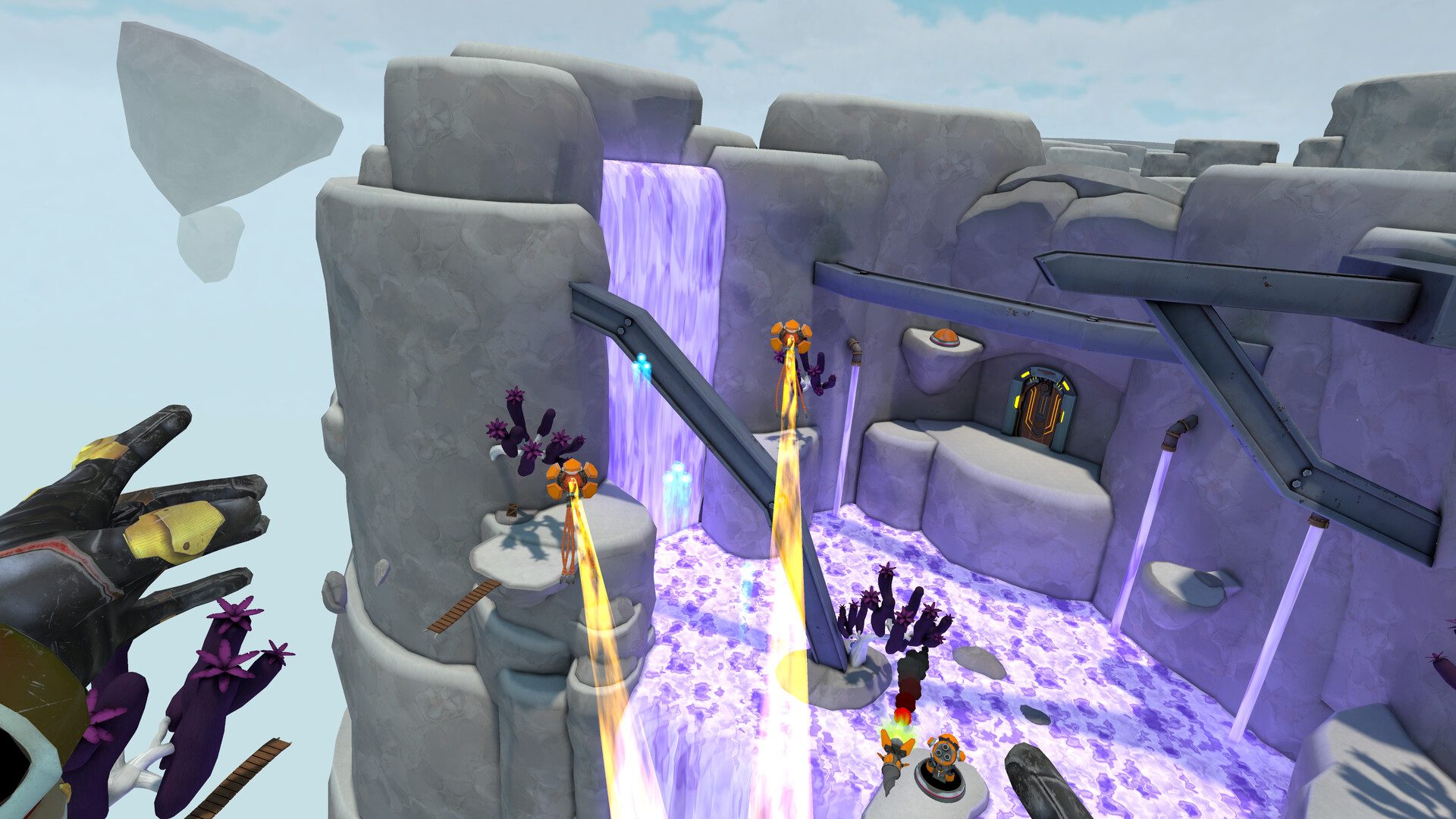
Don’t get me wrong. Titan Isles does what many bullet hell-style games often do, i.e. striping down the “need” for immersive shooting mechanics while putting the lasers on full blast, as three of the four ‘Exo Suits’ focus on some type of infinite ammo weapon. Still, on the flipside, each suit type comes with its own unique traversal style, which feels as mature and (mostly) well balanced as its Windlands forerunner.
Here’s a quick look at the Exo Suits and abilities available, each of which is upgradeable back at base:
Storm – Hand-mounted jet packs, pistols and a more powerful rifle
Hunter – Grappling Hooks, bow and arrow
Goliath – A lesser version of Storm’s jet pack, shield and hand canon
All of the weapons above come with floating reticles by default, making it feel like you’re essentially pointing and clicking at baddies ad infinitum. But hey, this is essentially an arcade bullet hell, which seems to be par for the course. Anyway, more on that in the Immersion section below.
Titan Isles isn’t solely a single-player game, although you can play start to finish on your own. Supporting up to four co-op players, the game automatically scales to add in more baddies to each arena, which also means more lasers and homing missiles to dodge. The clip below is slightly slowed down for full effect.
Still, having a good set of buds by your side doesn’t entirely distract from the fact that Titan Isles is basically just about clearing enemies across its long, successive arenas, which are periodically gated until you kill everything inside before meeting the end-level boss and eventually completing the mission.
Of course, if you are looking for more of a challenge, you can always turn up the difficulty level before you strap in, which makes enemies both better shots and more powerful. Still, there’s a notable lack of organic exploration, save the random collectibles you may (or may not) ever really care about.
That said, a definite highlight for me was the game’s level bosses, which even on normal mode can be challenging if you haven’t upgraded your kit wisely, or haven’t figured out which Exo Suit is the best for you.
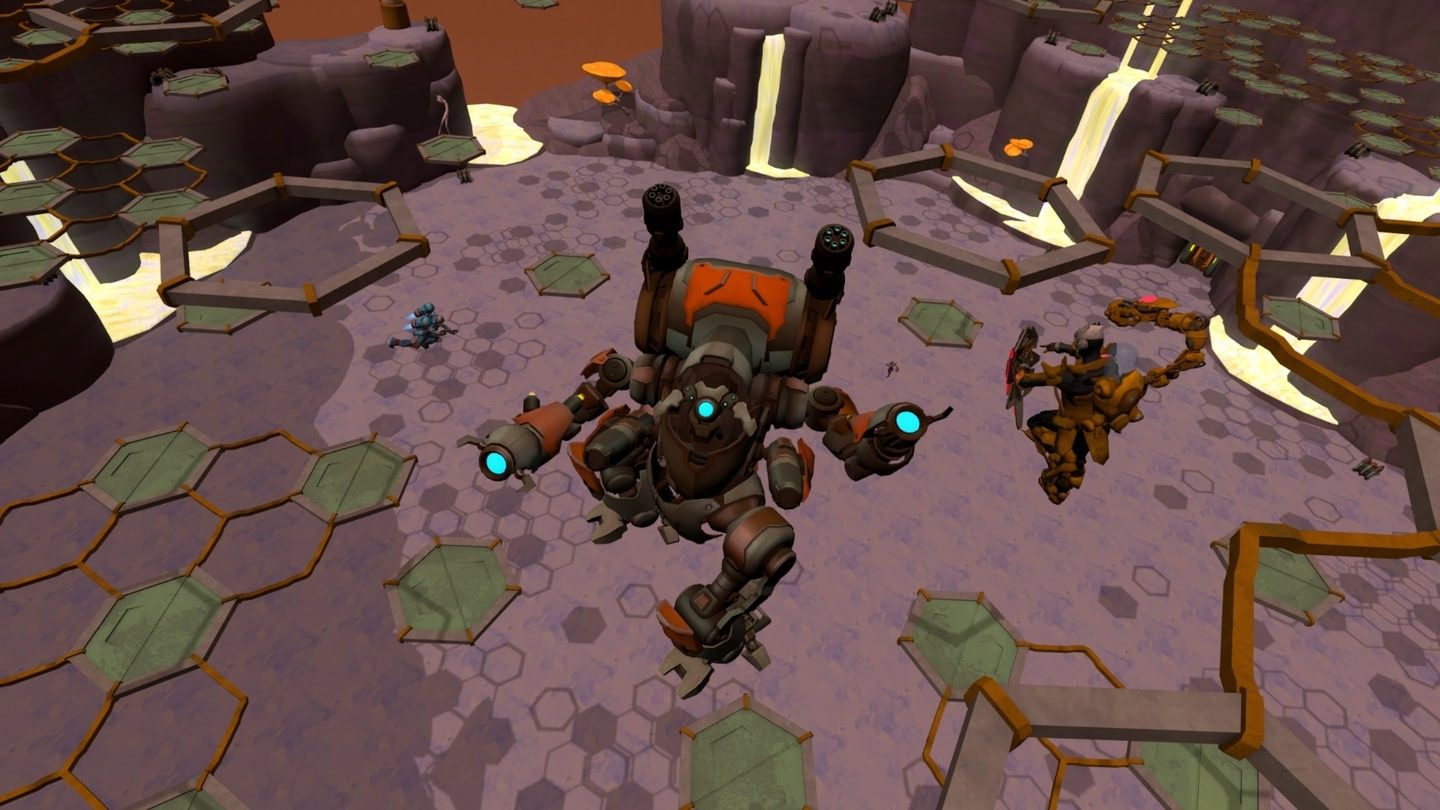
Bosses are massive, and well varied, putting together all of your locomotion and shooting skills at once. They just so happen to require virtually the same tactics as the arena-based boss battles in Windlands 2, i.e. break frangible armor points and avoid successively intense attacks as a single remaining armor point becomes with most challenging to shoot. It’s a simple formula, but one that interplays with the arena design to good effect.
And please, don’t ask me about the story behind Titan Isles—something, something, something, evil robots—which the game’s end boss really takes to an extreme by tossing every minion and shooting style at you in quick succession. He took me around five hours of solo play to get to.
There are found notes throughout that follow a marooned scientist who witnessed the world tragedy to bring the Titans to power, massive robots who are (I repeat) evil, although sitting there listening to long-winded audio logs between arenas feels a bit antithetical to the entire “go go go” experience.
Once the credits role, replay value is actually fairly high. It doesn’t just throw you at the same levels you beat before, but offers up a randomly mixed level that you can choose on any difficult mode. You can also do extra bits (more fun in co-op, no doubt) including ‘Racing’, a collectible ‘Collection Sprint’ mode, and a shooting-focused ‘Target Rush’ mode.
Immersion
Okay, I’ll admit I’ve been pining for Windlands 3 here a little too hard in this review, but with something clearly imbued with Windlands’ DNA as Titan Isles, there’s really no other apt comparison. It leaves me thinking about how much more I loved Windlands 2, and its ability to weave that core bullet hell combat into a richer narrative and larger world that really felt lived in—something worth taking the time to explore with friends.
That said, my favorite part of Titan Isles is its various locomotion schemes, which actually depart from the grappling hook-swinging parkour seen in the series.
While the Hunter Exo Suit does have grappling hooks that work almost like they do in Windlands, the exception is you can actually hook onto anything in Titan Isles and not just greenery. The focus here is less on how you get around, and more on how fast you can get the hell out of Dodge: exactly why I never played as Hunter.
Image courtesy Psytec Games
Hunter’s powerful arrows never seemed to outweigh the movement penalty that comes with having to accurately aim your next grappling hook hold, making me gravitate to the jetpack-equipped Storm most of the time. Effortlessly blasting around the map, expertly threading baddies and zipping around homing missiles and oncoming laser barrages is one of those “I can’t believe I’m actually good at this” sort of skills that I know comes from years of research in VR locomotion design. I invested all of my points, gained by beating levels into Storm’s jetpack and weapons.
That’s me though. You may gravitate towards Goliath for its heavy cannon and shield that efficiently blocks sustained laser fire, which also has a more limited version of Storm’s jetpack. Or Blink, which can triple jump and wall-surf around bosses with ease—a close second for me to Storm. Still, there’s nothing better than a fully upgraded jet pack to take you to the highest (and often safest) point of any given arena.
Which leads me to the shooting experience. On the spectrum of ‘built-for-VR shooting mechanics’, Titan Isles is closer to a flatscreen arcade game than many. Basic floating reticles follow you around, which felt alright when it came to grappling hooks, but less so when it comes to continuously blasting away at anything that moves. You can turn off reticles in settings, as well as change colors of both left and right reticles, although it doesn’t make shooting any more immersive.
I know. This is a conventional feature of most bullet hells, VR or otherwise, although I can’t help but feel like Titan Isles gave up VR-centric design in service of putting more enemies and lasers in the arena when it probably didn’t have to.
That said, many of the game’s finer immersive touches are genuine highlights. Voice acting is top notch, although the game’s soundtrack offers up a sweeping musical score that I would probably listen to out of VR. Spatial audio is also on point when it comes to enemies and friends too. In co-op, you’ll also be able to hear your companions naturally when they’re close to you.
Once out of range, they become voices on a radio, indicating you’ve strayed too far from you team mate. Any way you take on Titan Isles, you’ll need to keep an ear out for beeping homing missiles and turrets of all types, which often times start their barrage before you can see them.
Visually, the game looked and worked pretty great on Quest 3, as arenas can easily fill with tons of enemies, each of which blasts away with its own lasers and missiles. It’s a cartoony art style that (sigh, I’m saying the thing again) Windlands fans will easily recognize as both suitably cartoony and super performant.
Comfort
For a fast-paced game with enough parkour and jetpacking to shake a stick at, Titan Isles isn’t as intense as the opening warning label suggests. Flying, swinging and triple jumping around is done in sweeping, predictable arcs, letting you control the trajectory in basically every instance.
There’s also smooth and variable snap-turning available, as well as both head and controller relative forward movement. A variable vignette can also help you tune down some of the motion-related wear. I’m particularly sensitive to uncontrolled, forced locomotion, and only found a few brief moments in the transport ship on my way to missions as a little iffy. Otherwise, I played multiple hours at a time without issue.
‘Titan Isles’ Comfort Settings – September 25th, 2025
Your Quest Link PC VR games now show up in the Horizon OS library on v81 PTC, and launching them bypasses the old Rift Dash interface entirely.
If you’re unfamiliar, Quest Link is the built-in feature of Meta’s headsets that lets them act as PC VR headsets, either over a USB cable or your home Wi-Fi network.
Normally, you launch Link from the Quick Controls menu of your headset, and it brings you into the legacy Rift Dash interface that hasn’t been meaningfully updated in over five years. From here, you’d use the Rift Dash Library to launch PC VR titles and change settings.
What Is the Public Test Channel (PTC)?
The Public Test Channel (PTC) is the beta release channel of Quest’s Horizon OS. If you opt in, your headset receives a pre-release build of each upcoming version.
Note that there are often features in the eventual stable version not present in the PTC, and occasionally (but very rarely) features or changes in the PTC don’t make it to the stable version.
Now, in Horizon OS v81 PTC, if your headset has already been set up with the Quest Link app on a PC on the same Wi-Fi network, you’ll see your installed Link PC VR Store apps in your Horizon OS library, marked ‘PCVR’, alongside your standalone Quest apps.
Clicking a PC VR game will launch directly into it, bypassing the old Rift Dash interface entirely. Pressing the Meta button on your right Touch controller will open the Horizon OS interface, not the Rift Dash anymore, and exiting the game will bring you back to your standalone home.
0:00
/0:41
Footage captured by UploadVR.
It’s a significantly lower-friction experience than the previous Quest Link behavior, making launching into a PC VR game faster than even Valve’s Steam Link or Guy Godin’s Virtual Desktop, and it makes PC VR feel like a far more integrated part of the Quest experience.
Given Meta’s withdrawal from PC VR content and rare updates to Quest Link, this is a surprise, to be sure, but a welcome one.
The file_operations
structure in the kernel is a set of function pointers implementing, as the
name would suggest, operations on files. A subsystem that manages objects
which can be represented by a file descriptor will provide a file_operations structure providing implementations of the various
operations that a user of the file descriptor may want to carry out. The mmap() method, in particular, is invoked when user space calls the mmap()
system call to map the object behind a file descriptor into its address
space. That method, though, is currently on its way out in a multi-release
process that started in 6.17.
Nintendo will open an official pop-up store in London this fall, its first-ever in the UK. The store will be open from October 22 to November 16 on the ground floor of the Westfield London shopping mall in Shepherd’s Bush.
The Japanese gaming giant operates official stores in Tokyo and Kyoto, as well as permanent locations in New York and (20 years later) San Francisco. The pop-up store in London will feature an extensive collection of Nintendo merchandise across the brand’s most iconic titles including Super Mario, Donkey Kong, The Legend of Zelda, Animal Crossing and more. Fans can pick up all sorts of apparel and collectible accessories like keyrings, pins and bags.
Entry to the pop-up during its first week will be by reservation only, with tickets going live on October 7. Guests will be able to reserve a date and time slot to enter between October 22 and 26. From October 27, store entry will operate via a first-come, first-served system, though don’t be surprised to see a line out the door.
This article originally appeared on Engadget at https://www.engadget.com/gaming/nintendo/nintendo-is-opening-a-pop-up-store-in-london-this-fall-164549021.html?src=rss
Score another win for EU consumers. On Wednesday, Microsoft backtracked on the strings it had attached to Windows 10’s Extended Security Updates (ESU) program. However, it only did so in the European Economic Area (EEA) following complaints from an advocacy group. The elephant in the room? The EU’s Digital Markets Act (DMA) safeguards against unlawful bundling and restricting consumer choice. Had the company not relented, those regulations could have spawned investigations and hefty fines.
“In the European Economic Area, we’re making updates to the enrollment process to ensure it meets local expectations and delivers a secure, streamlined experience,” a Microsoft spokesperson told Windows Central. “Our goal is to support customers and provide them with options as they transition to Windows 11, with uninterrupted access to critical security updates.”
The move stems from Microsoft’s decisions regarding the future of Windows 10. In early 2023, the company said it would only support crucial security updates for the operating system until October 2025.
Microsoft
Since then, the company launched the ESU program. It allows consumers to pay $30 to add a one-year extension on security updates. The Windows maker also added a couple of “free” options. The first one is to enable Windows cloud backup using a Microsoft account. However, that uses OneDrive. And once you surpass 5GB of free storage, you’ll need to pay for more. (If you have a lot of big files to back up, that would likely apply.) The other option is to spend 1,000 Microsoft Rewards points, which not everyone has lying around.
The advocacy org Euroconsumers called out Microsoft in June. “Limiting security means limiting product life,” the nonprofit wrote. It described Microsoft’s Windows 10 requirements as “planned obsolescence.” That’s the practice of deliberately designing products with limited lifespans. Conveniently for Big Tech, that tends to boost sales. Inconveniently for consumers, it’s an added cost.
Planned obsolescence is also a term that could have drawn the ire of EU regulators. Tech titans like Microsoft found to violate the DMA can be forced to pay up to 10 percent of their global annual turnover.
Euroconsumers said Microsoft was steering consumers toward two options. “Buy a new device before you’re ready or stick with your current one and face increased security risks,” it wrote. The group noted that 22 percent of EU PC owners still run a Windows device from 2017 or earlier. 2018 is often considered a rough baseline for Windows 11 eligibility, given the software’s technical requirements.
While PC users in the EEA now have an extra year, the rest of the world isn’t so lucky. If you’re still running Windows 10, you only have until October 14 to do one of three things: upgrade to Windows 11 (Microsoft’s preferred choice), pay $30, turn on Windows backup, or fork over reward points. Choose wisely.
This article originally appeared on Engadget at https://www.engadget.com/computing/microsoft-pressured-to-extend-free-windows-10-security-updates-in-most-of-europe-164533056.html?src=rss
The Fedora project has posted a
proposal for a policy regarding the use of AI tools when developing for
the distribution.
You are responsible for your contributions. AI-generated
content must be treated as a suggestion, not as final code or
text. It is your responsibility to review, test, and understand
everything you submit. Submitting unverified or low-quality
machine-generated content (sometimes called “AI slop”) creates an
unfair review burden on the community and is not an acceptable
contribution.
Circle, the world’s second-biggest issuer of stablecoins, is examining ways to make it possible to reverse transactions involving its tokens [non-paywalled source], in a rare admission by a major crypto firm that it needs to take lessons from the traditional financial sector. Financial Times: Circle president Heath Tarbert said a mechanism that allowed money to be refunded in cases of fraud or disputes would help the stablecoin industry’s push to become part of the financial mainstream. “We are thinking through…whether or not there’s the possibility of reversibility of transactions, right, but at the same time, we want settlement finality,” Tarbert told the Financial Times.
“So there’s an inherent tension there between being able to transfer something immediately, but having it be irrevocable,” he added. Such measures could be seen as a major departure from the crypto industry’s previous emphasis on the “immutability” of the blockchain, a digital ledger that is public and records transactions that cannot be unwound.
Despite Elon Musk and Donald Trump’s very public spats and seemingly still ongoing feud, the White House has remained committed to supporting the former’s AI ambitions. And today, the General Services Administration (GSA) announced that it has reached an agreement with xAI that will allow it to buy Musk’s Grok AI models for $0.42 per organization.
As part of the Trump administration’s OneGov procurement initiative, the deal with xAI will allow federal agencies access to the Grok 4 and Grok 4 Fast advanced reasoning models. The 18-month contract is the longest OneGov AI procurement agreement to date. xAI announced its Grok for Government strategy earlier in the summer, which signalled its intention to provide the government with a suite of AI products, including custom models for national security, science and healthcare purposes.
As well as opening its models for government use, xAI is also providing dedicated engineers to speed up the implementation of its AI tools for participating agencies, and will offer an “upgrade path” for expanded features and higher rate limits. Such access is a crucial part of Trump’s AI Action Plan, designed to position the US as the global leader in AI. And his administration doesn’t appear to have been put off by Grok’s bizarre behavior in recent months, such as its preoccupation with far-right conspiracy theories regarding “white genocide” in South Africa, or its brief but enthusiastic turn towards antisemitism.
xAI is the latest in a line of AI companies to strike deals with the GSA. Back in August, Anthropic began offering its Claude AI model to three branches of the US government for $1, following Gemini and xAI’s arch rival OpenAI joining a list of approved vendors.
This article originally appeared on Engadget at https://www.engadget.com/ai/elon-musks-grok-is-cleared-for-federal-government-use-162407911.html?src=rss
Apple seems determined to leave a persistent gap between the cameras of its Pro iPhones and the regular ones, but most other features—the edge-to-edge-screen design with FaceID, the Dynamic Island, OLED display panels, Apple Intelligence compatibility—eventually trickle down to the regular-old iPhone after a generation or two of timed exclusivity.
One feature that Apple has been particularly slow to move down the chain is ProMotion, the branding the company uses to refer to a screen that can refresh up to 120 times per second rather than the more typical 60 times per second. ProMotion isn’t a necessary feature, but since Apple added it to the iPhone 13 Pro in 2021, the extra fluidity and smoothness, plus the always-on display feature, have been big selling points for the Pro phones.
This year, ProMotion finally comes to the regular-old iPhone 17, years after midrange and even lower-end Android phones made the swap to 90 or 120 Hz display panels. And it sounds like a small thing, but the screen upgrade—together with a doubling of base storage from 128GB to 256GB—makes the gap between this year’s iPhone and iPhone Pro feel narrower than it’s been in a long time. If you jumped on the Pro train a few years back and don’t want to spend that much again, this might be a good year to switch back. If you’ve ever been tempted by the Pro but never made the upgrade, you can continue not doing that and miss out on relatively little.
Thief VR: Legacy of Shadow will receive an official gameplay premiere next week.
Announced earlier today, publisher Vertigo Games confirmed that Thief VR: Legacy of Shadow is getting an “in-depth look” at the upcoming stealth game next week through its YouTube channel. Going live on September 30 at 10am Pacific Time, little else was shared about what to expect. This follows a previous behind-the-scenes look in June that confirmed Stephen Russell’s return as Thief’s original protagonist, Garrett.
Developed by Maze Theory, this upcoming entry sees you play as a thief called Magpie who’s been orphaned by the tyrannical Baron Northcrest. Forced to survive on the streets by stealing, this journey sees you uncover “a legendary artifact holding a legacy from the past” as you carefully navigate these environments across The City.
Magpie comes equipped with various tools to carry out this job, using various arrows to take down or distract your foes while sticking to the darkness. Thief VR: Legacy of Shadow also promises tactile interactions that allow you to directly pickpocket guards, open hidden compartments, and more, while each mission promises multiple paths to take.
Amazon will pay a record civil penalty to settle a case with the Federal Trade Commission. The agency accused Amazon of tricking consumers into signing up for a Prime membership without their consent (and making it hard for customers to cancel) in a lawsuit filed in 2023.
To settle the charges, Amazon has agreed to pay a $1 billion civil penalty and $1.5 billion to refund customers. The company also agreed to “ease unlawful enrollment and cancellation practices for Prime,” per the FTC.
The agency says the civil penalty is the largest ever for a case involving a breach of its rules — it had accused Amazon of violating the FTC Act and the Restore Online Shoppers’ Confidence Act. The $1.5 billion in consumer redress will provide “full relief for the estimated 35 million consumers impacted by unwanted Prime enrollment or deferred cancellation,” the FTC said. It added that this is the second-highest restitution award it has ever obtained.
Moreover, Amazon will have to stop using some of the dark patterns (i.e. deceptive design practices) that prevented customers from easily canceling Prime memberships.. For instance, it will no longer display a button that reads, “No, I don’t want Free Shipping” during the cancellation flow. Instead, it will have to show a “a clear and conspicuous button for customers to decline Prime,” per the terms of the settlement.
Amazon will also have to provide clearer information about a Prime subscription to consumers during the sign-up process. This will include details about the price, whether the subscription auto-renews and how to cancel.
Engadget has contacted Amazon for comment.
This article originally appeared on Engadget at https://www.engadget.com/big-tech/amazon-is-paying-25-billion-to-settle-ftc-claims-it-duped-customers-into-signing-up-for-prime-160641347.html?src=rss
Amazon has agreed to settle a Federal Trade Commission lawsuit accusing the e-commerce giants of tricking customers into signing up for Prime and then making it frustratingly hard to cancel.
In a press release Thursday, the FTC confirmed that, pending court approval, Amazon will pay a $1 billion civil penalty and provide $1.5 billion in refunds to an estimated 35 million customers “harmed by their deceptive Prime enrollment practices.” Former FTC chair Lina Khan initiated the lawsuit, accusing customers of trapping customers in a “labyrinthine” Prime cancellation process the company named after Homer’s Iliad.
The civil penalty, the FTC noted, is “the largest ever in a case involving an FTC rule violation,” and the refunds to customers are “the second-highest restitution award ever obtained by FTC action.”
Generative AI systems that create text, images, audio, and even video are becoming commonplace. In the same way AI models output those data types, they can also be used to output robot actions. That’s the foundation of Google DeepMind’s Gemini Robotics project, which has announced a pair of new models that work together to create the first robots that “think” before acting. Traditional LLMs have their own set of problems, but the introduction of simulated reasoning did significantly upgrade their capabilities, and now the same could be happening with AI robotics.
The team at DeepMind contends that generative AI is a uniquely important technology for robotics because it unlocks general functionality. Current robots have to be trained intensively on specific tasks, and they are typically bad at doing anything else. “Robots today are highly bespoke and difficult to deploy, often taking many months in order to install a single cell that can do a single task,” said Carolina Parada, head of robotics at Google DeepMind.
The fundamentals of generative systems make AI-powered robots more general. They can be presented with entirely new situations and workspaces without needing to be reprogrammed. DeepMind’s current approach to robotics relies on two models: one that thinks and one that does.
Building off the work in months prior around Device Mapper atomic write support and related infrastructure, the md-linear target for linear software RAID support will enable atomic write support with the upcoming Linux 6.18 merge window…
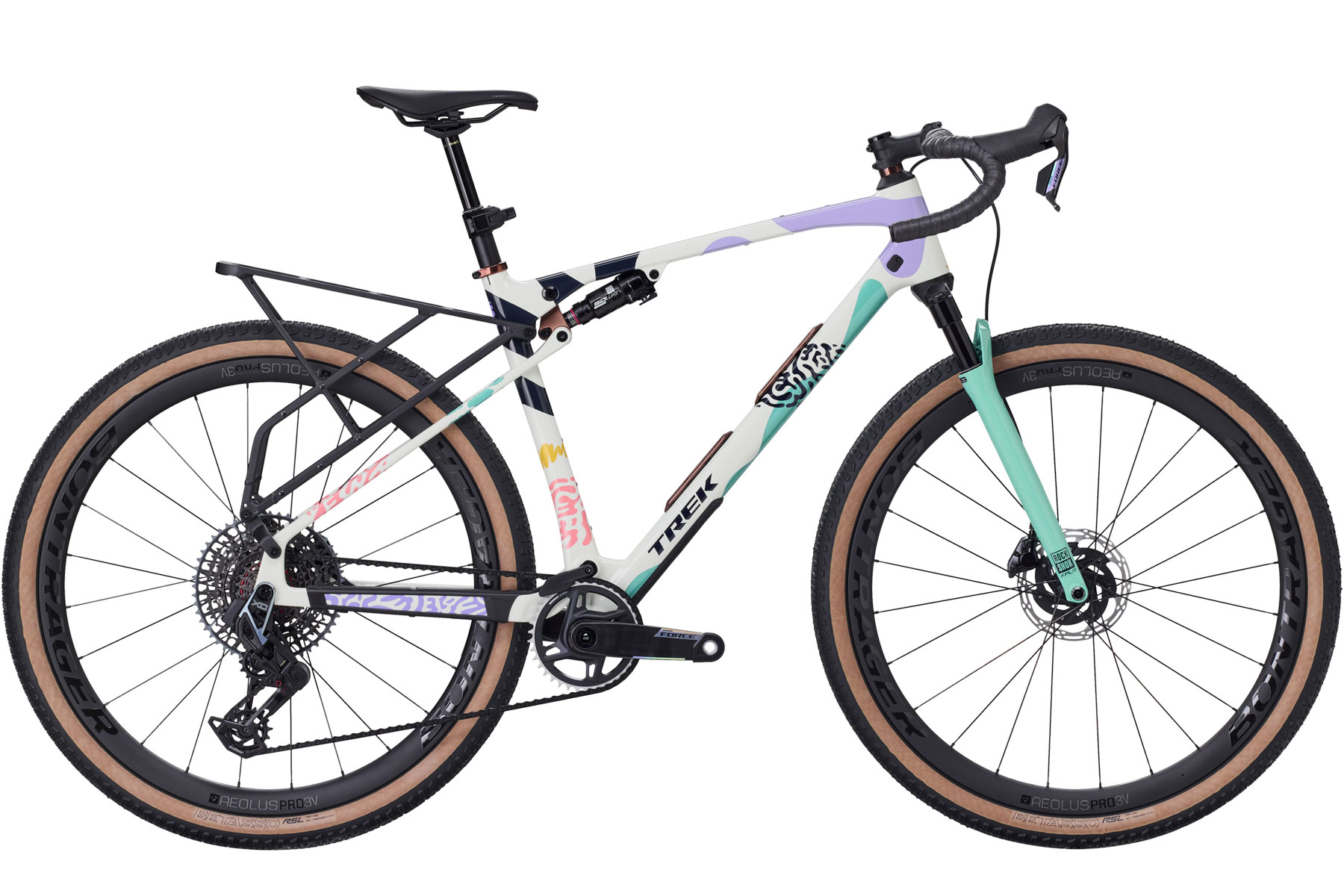
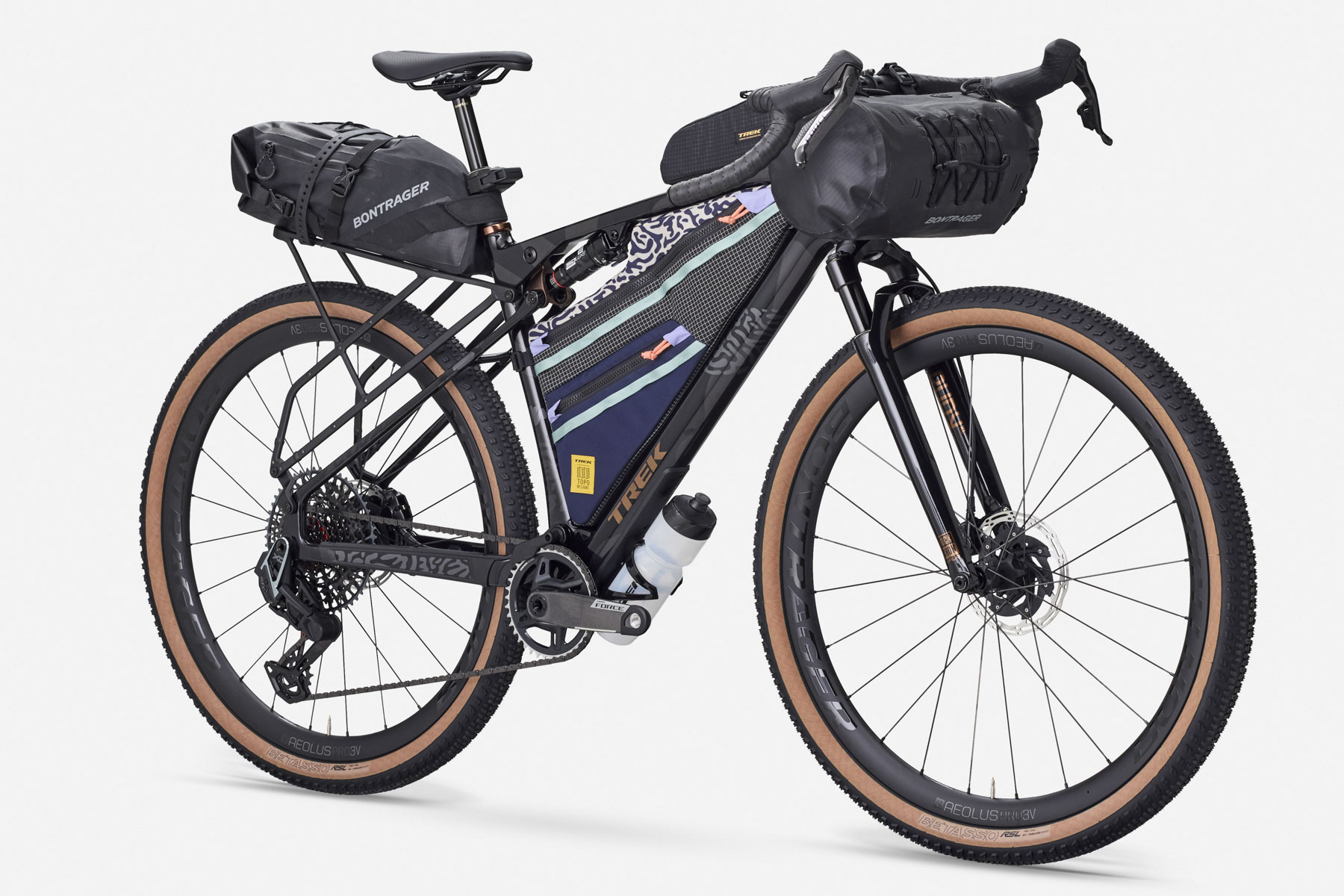
Trek has launched the CheckOUT, its first full-suspension gravel bike, claiming it offers greater comfort and control on rough terrain without sacrificing speed.
Trek says its lab testing shows its suspension reduces rider fatigue by cutting vibration and steering input, while a new geometry, wider bar, and extensive mounting options further underline its adventure focus.
Trek claims the CheckOUT is its most capable gravel option for tough terrain. Dylan Remis / Trek bikes
According to Trek, the CheckOUT’s suspension is primarily intended to enhance rider comfort and reduce fatigue.
Trek says it paid particular attention to the relationship between conventional chassis bounce and bike-rider decoupling, where you’re thrown out of the saddle on rough terrain.
Trek found that when a rider moves out of the saddle, they naturally put in more effort to maintain control and stability.
For a bike that’s aimed at tackling singletrack and the toughest gravel endurance events, Trek says reducing this fatigue-inducing element was the priority.
Trek tested the bike extensiely on its bike treadmill. Trek Bikes
Trek says its lab treadmill, which mimics rough gravel surfaces, proved essential in the development and testing of the bike.
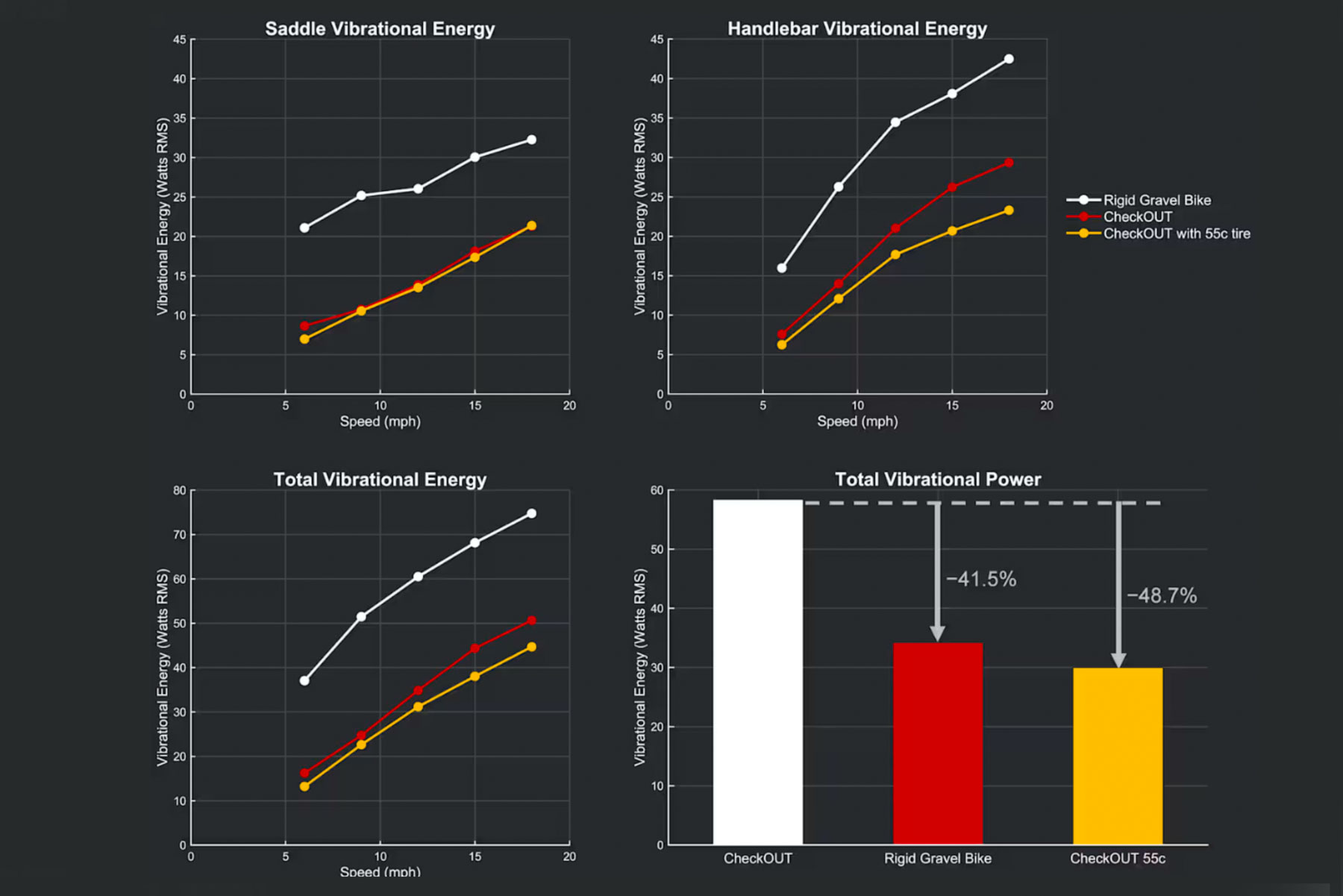
Trek tested the new bike against a rigid gravel bike, plus a CheckOUT with a 55mm tyre.
The engineers then monitored the rider’s motion and tracked the movement of the rider’s tailbone (sacrum).
Trek says this shows how well the rider stays coupled to the bike, especially on rougher terrain
Trek’s vibration testing showed the CheckOUT reduced fatigue by a significant margin. Trek Bikes
The CheckOUT suspension design provided a 27 per cent reduction in rider position variability with 50mm tyres, reducing a further 32 per cent when a larger 55mm tyre was used.
The suspension design also reduced vibrational forces reaching the rider by 41.5 per cent compared to a rigid gravel bike.
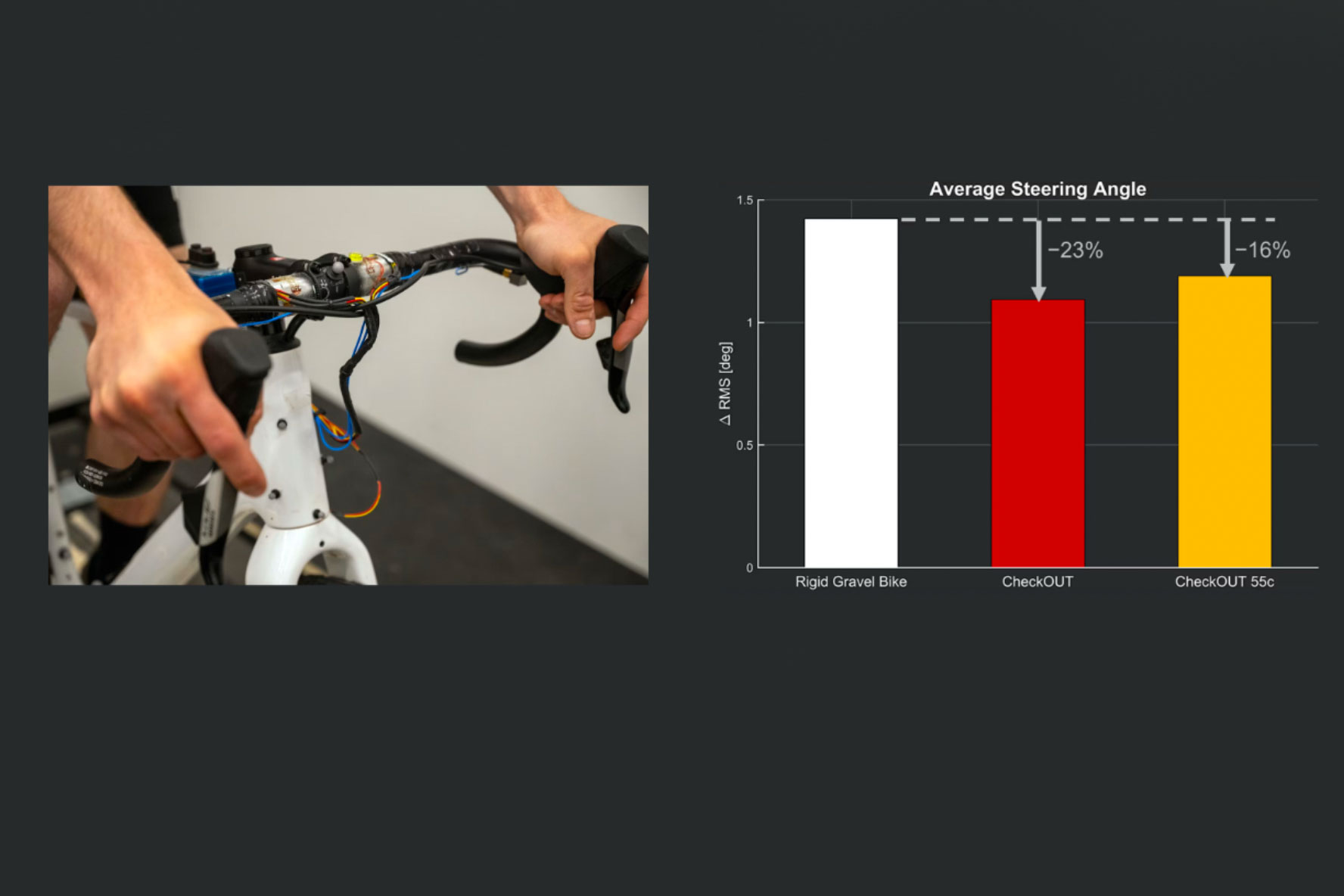
The reduction in steering input was also tested in Trek’s lab. Trek Bikes
Trek’s testing also showed that rough surfaces have a significant impact on a bike’s steering, with the constant corrections required when riding a fully rigid gravel bike causing fatigue.
Under testing, it showed that with the CheckOUT setup, steering saw a 23 per cent reduction in variability with a 50mm tyre. This was further reduced to 16 per cent with a 55mm tyre fitted.
New design and new suspension
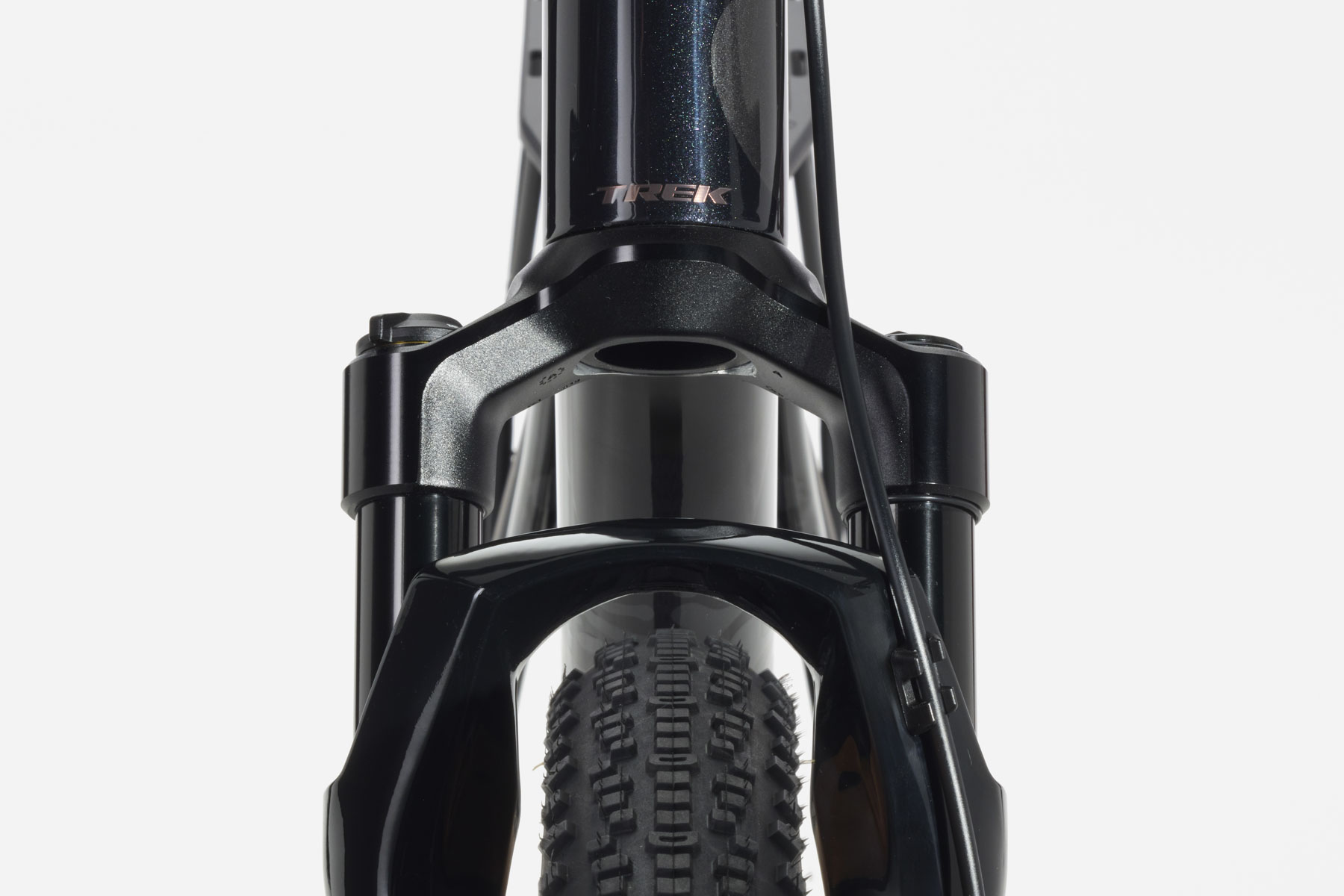
The new RockShox Rudy XL brings 60mm of travel and 56mm tyre clearance. Trek Bikes
Trek didn’t want to use a mountain bike fork on the CheckOUT, so it worked with RockShox to create the Rudy XL – a burlier version of its existing gravel fork, which ups travel to 60mm and tyre clearance to 56mm, while maintaining a gravel-friendly 45mm offset.
The Rudy XL will be available separately in 50 and 60mm travel options and priced at $929, €1,010, £900.
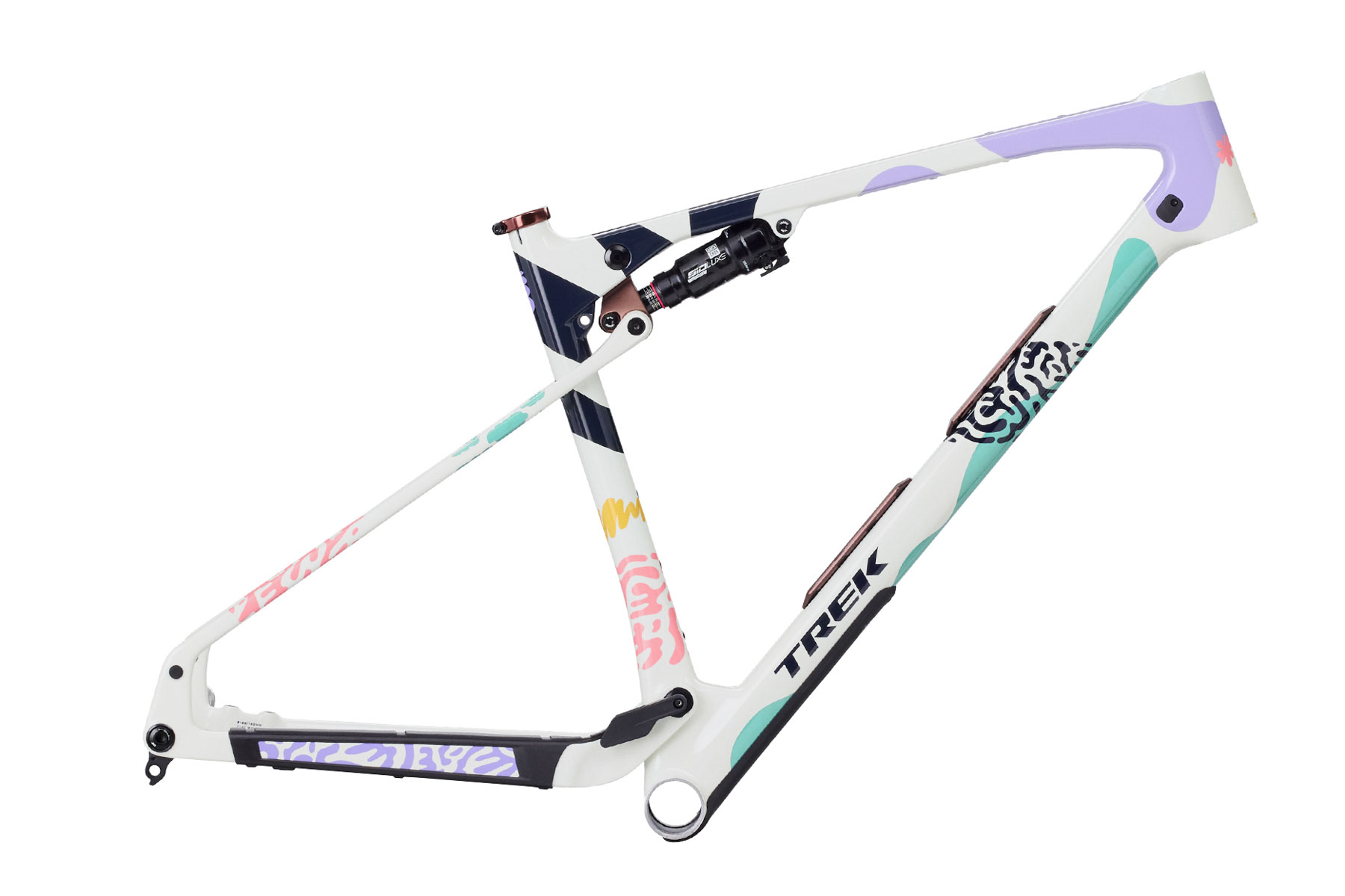
The CheckOUT SL7 in Era white is our favourite finish. Trek Bikes
RockShox provides a SIDLuxe 170 x 27.5mm shock. This gives 55mm of travel at the rear wheel.
All models come equipped with a dropper post.
TransX is providing a cable-operated dropper on the SL5 model and RockShox’s wireless Reverb AXS on the SL7.
New wider bar
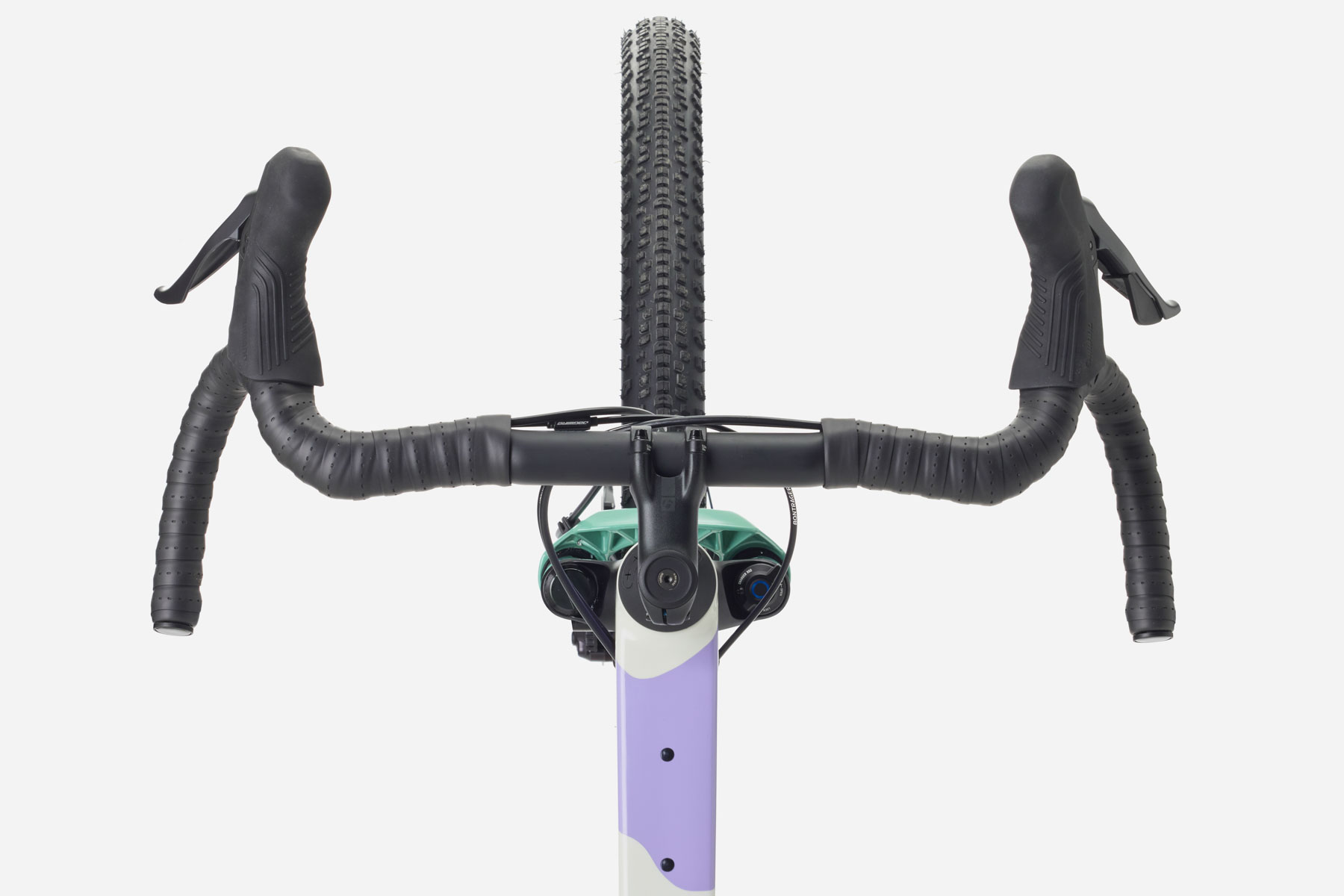
The CheckOUT SL bar features a wide flare and gentle backsweep. Trek Bikes
Trek bucks the trend towards narrow bars with the new GR Checkout bar.
The bar is designed to be more aero on the hoods, with a narrower position, pushing out 12cm wider in the drops. Trek claim this gives more confident handling over burlier terrain without sacrificing aero performance.
The top section of the bar is designed to add all-day comfort. The rounded top’s larger radius on the rear gives you somewhere for your palms to rest. Trek’s longstanding Carbon IsoCore construction is used to further absorb vibrations.
New gravel geometry
Trek claims the new bike is faster on the road than a mountain bike. Dylan Remis / Trek bikes
The CheckOUT features Trek’s new adventure geometry.
Compared to the rigid adventure-focused Checkpoint, the CheckOUT gets both a longer reach and a higher stack.
Up against Trek’s lightweight XC race bike, the Supercaliber, the CheeckOUT has a more upright position that also places the rider further back.
A full range of luggage is available for the CheckOUT SL. Trek Bikes
The CheckOUT doesn’t have any in-frame storage, but Trek has collaborated with Topo on a frame bag that fits within the front triangle in colour-matched finishes.
At the rear, a proprietary rack with a built-in linkage matches the rear suspension movement, so your bikepacking load won’t get shaken.
The frame features a huge number of mounts, with 18 in total on size M/L and above bikes.
There are two on the top of the top tube, seven on the downtube, three on the seat tube, and three on the underside of the downtube.
Trek CheckOUT range overview
Both models of the CheckOUT are built from Trek’s OCLV 500 series carbon and tested to mountain bike standards.
The SL5 and SL7 AXS complete builds are joined by a frameset option.
The SL5 comes with Shimano’s 1 x 12 mechanical GRX groupset. Trek Bikes The SL7 is built around SRAM’s Force AXS XPLR and X0 AXS. Trek Bikes The CheckOUT SL is available as a frame-only option. Trek bikes
Amazon will pay $2.5 billion to settle Federal Trade Commission allegations that it duped users into paying for Prime memberships, the regulatory agency announced Thursday. CNBC: The surprise settlement comes as Amazon and the FTC were just three days into the trial in a Seattle federal court. Opening arguments took place on Tuesday. The lawsuit, filed by the FTC in June 2023 under the Biden administration, claimed that Amazon deceived tens of millions of customers into signing up for its Prime subscription program and sabotaged their attempts to cancel it.
Three senior Amazon executives were at risk of being held individually liable if the jury sided with the FTC. Amazon will pay a $1 billion civil penalty to the FTC and will refund $1.5 billion to an estimated 35 million customers who were impacted by “unwanted Prime enrollment or deferred cancellation,” the agency said.