
A new feature merged this week for the Intel Mesa compiler code for their ANV Vulkan and Iris Gallium3D drivers is support for Stochastic Rounding…
Monthly Archives: September 2025
Journalist warns of widespread debt bondage risks in Taiwan’s bicycle industry following forced labour allegations
On Wednesday, American customs officials revealed that they will block the import of bicycles manufactured in Taiwan by Giant Bicycles after a US Customs and Border Protection (CBP) investigation “that reasonably indicates forced labour use”.
The CBP alleges that it has identified five ‘forced labour indications’ during an investigation of Giant, including debt bondage, where a person is forced to work to pay off a debt.
For investigative journalist Peter Bengtsen, this is not a surprise. “The risk of debt bondage,” he told BikeRadar, “is the rule, not the exception, for migrants employed in Taiwan’s bicycle and other industries.”
Bengtsen has led investigations into the labour conditions of Taiwan’s bicycle, car, electronic and other industries. Between 2022 and 2025, Bengtsen and his team conducted 200 interviews with migrant workers, gathering testimonies that covered debt bondage and other forced labour indicators.
Bengtsen’s work investigating labour conditions in the Taiwanese cycling industry was published in Le Monde diplomatique in June 2024 and February 2025.
His piece from 2024 asked whether major cycling brands were overlooking forced labour risks. Around a dozen of Giant’s migrant employees were interviewed for the story, with Bergtsen reporting that Vietnamese employees said they paid $5,700 to home-country recruiters, while Thai employees said they paid up to $3,200.

Bengtsen reported in his story from earlier this year, ‘The Bicycle industry’s dirty secret’, that one Vietnamese employee had paid $5,500. “I had to pay up front. I borrowed everything from the bank and mortgaged the house,” they said.
“Migrant workers in Taiwan are vulnerable to forced labour due to several factors, of which high recruitment fees and limited freedom to change employers are key,” Bengtsen told BikeRadar.
“For decades, workers hired from abroad have paid exorbitant fees to home-country recruiters and Taiwanese labour brokers for jobs and services. As a result, workers borrow significantly from banks and money lenders, often at excessive interest rates, and thereby risk debt bondage while working in Taiwan to pay off loans.
“Other migrant vulnerabilities include language barriers, lack of knowledge of laws and rights, lack of support measures or knowledge thereof, and lack of organisation and representation. Fear of repatriation for speaking up adds to the vulnerabilities,” he went on.
Following Bengtsen’s second report in Le Monde diplomatique, the publication received a statement from the Taiwanese Bicycle Association (TBA), an industry trade association that represents companies engaged in exporting bicycles, components and accessories.
The TBA said: “Taiwanese companies have strictly abided by the labour regulations in Taiwan, which nonetheless, may in one way or another, differ from the international method and reference for betterment. We would always obey Taiwan’s labour law and try our very best when there’s room for improvement.”
Giant said it will file a petition to seek the revocation of the import ban, and that it is “firmly committed to upholding human rights and labour protections”.
It said it has taken “concrete actions” in the last year, including the implementation of a Zero Recruitment Fee Policy and upgrading employee housing to provide a “safer and more comfortable living environment.”
Many of the world’s biggest bicycle brands have had bikes or components made in Taiwan. The country is the biggest exporter of bikes to Europe, and trade data shows 28 per cent of bikes imported to the US in 2022 came from Taiwan.
The US can ban imports of goods if they are suspected of being made as a result of forced labour. The country has imposed regulations on imports from China’s Xinjiang region, because members of the minority Uyghur community have been detained and forced to work, according to US officials.
The CBP’s statement says Giant has “profited by imposing such abuse… resulting in goods produced below market value and undercutting American businesses by millions of dollars in unjustly earned profits”.
CBP’s statement echoes the logic behind Donald Trump’s tariff trade war earlier this year, which aimed to make it harder for foreign companies to compete in the US. One trade organisation called the tariffs “devastating” for the US bicycle industry.
Disastrous Oracle Implementation At Europe’s Largest City Council.
Longtime Slashdot reader whoever57 writes: Birmingham City Council, the largest such entity in Europe, has been declared effectively bankrupt. There are a couple of reasons for this, but one of them is a disastrous project to replace the city’s income management system using Oracle. The cost of this has risen to $230 million, while the initial estimate was $24 million. There was a failed rollout of the new system earlier this year. “Original plans for the replacement of SAP with Oracle Fusion set aside a 19.965 million-euro budget for three years implementation until the end of the 2021 financial year,” reports The Register. “Go-live date was later put back until April 2022 and the budget increased to 40 million euros. After the council realized it would need to reimplement all of Oracle, the budget for running the old system and introducing the new one increased to 131 million euros.”
“In a hastily convened Audit Committee meeting this week, councilor heard how that date has now been put back until November, expressing their anger that the news hit the media before they were told.” Testing failed with only a 73.3% pass rate and 10 severe deficits, “below the acceptance criteria of a 95 percent pass rate and zero severe deficits.


Read more of this story at Slashdot.
System76 Releases Pop!_OS 24.04 LTS Beta Alongside COSMIC Desktop Beta
Overnight the Linux PC vendor System76 released their long-awaited Pop!_OS 24.04 LTS Beta operating system along with the beta milestone of their COSMIC desktop environment…
Raspberry Pi Updates Keyboard PC with New 500+ Model
Raspberry Pi 500+ is the newest all-in-one personal computer in the Raspberry Pi family. It combines the Raspberry Pi 5 platform with a mechanical keyboard, upgraded memory, and integrated storage. The design builds on the earlier Raspberry Pi 400 and 500 models while adding higher specifications and new input features. The Raspberry Pi 500+ is […]
Fostering creativity through open-ended projects with Code Editor for Education
Tom Mason is Head of Mathematics and Head of ICT at St Joseph’s College, an all-boys secondary school in South East London. He is passionate about teaching and learning, and has a keen interest in digital education practices.
Mr Mason recently set his Year 10 students a creative coding challenge, which they completed using our Code Editor for Education. The challenge not only boosted student engagement, but also showcased the effectiveness of open-ended, student-led learning in computer science education.

Challenges in the classroom
Teaching coding in a classroom setting presents a unique set of challenges, with one of the most significant being the rise of artificial intelligence (AI). Instead of engaging deeply with concepts like loops, conditions, and sorting algorithms, students now increasingly rely on AI tools to generate entire blocks of code for them, without understanding their functions.
Meanwhile, traditional teacher-led instruction methods that focus on isolated coding concepts like inputs and outputs often leave students disconnected from the practical and creative aspects of programming.
Against this backdrop, Mr Mason wanted to give his students the opportunity to:
- Apply their Python knowledge in meaningful ways
- Collaborate and problem-solve independently
- Explore unfamiliar programming concepts in a guided but open-ended fashion
The project
Mr Mason set a simple but powerful brief:
“Over three lessons, build a quiz that asks 10 questions about what you’ve learnt on the course.”
With this simple instruction, Mr Mason gave students a clear idea about what to do, while giving them the freedom to design their quiz however they liked. Students were also told that:
- Their 10 quiz questions had to relate to Python
- After creating their quiz, their classmates would give feedback based on key criteria (how well the code worked, the level of creativity, the user experience, etc.)
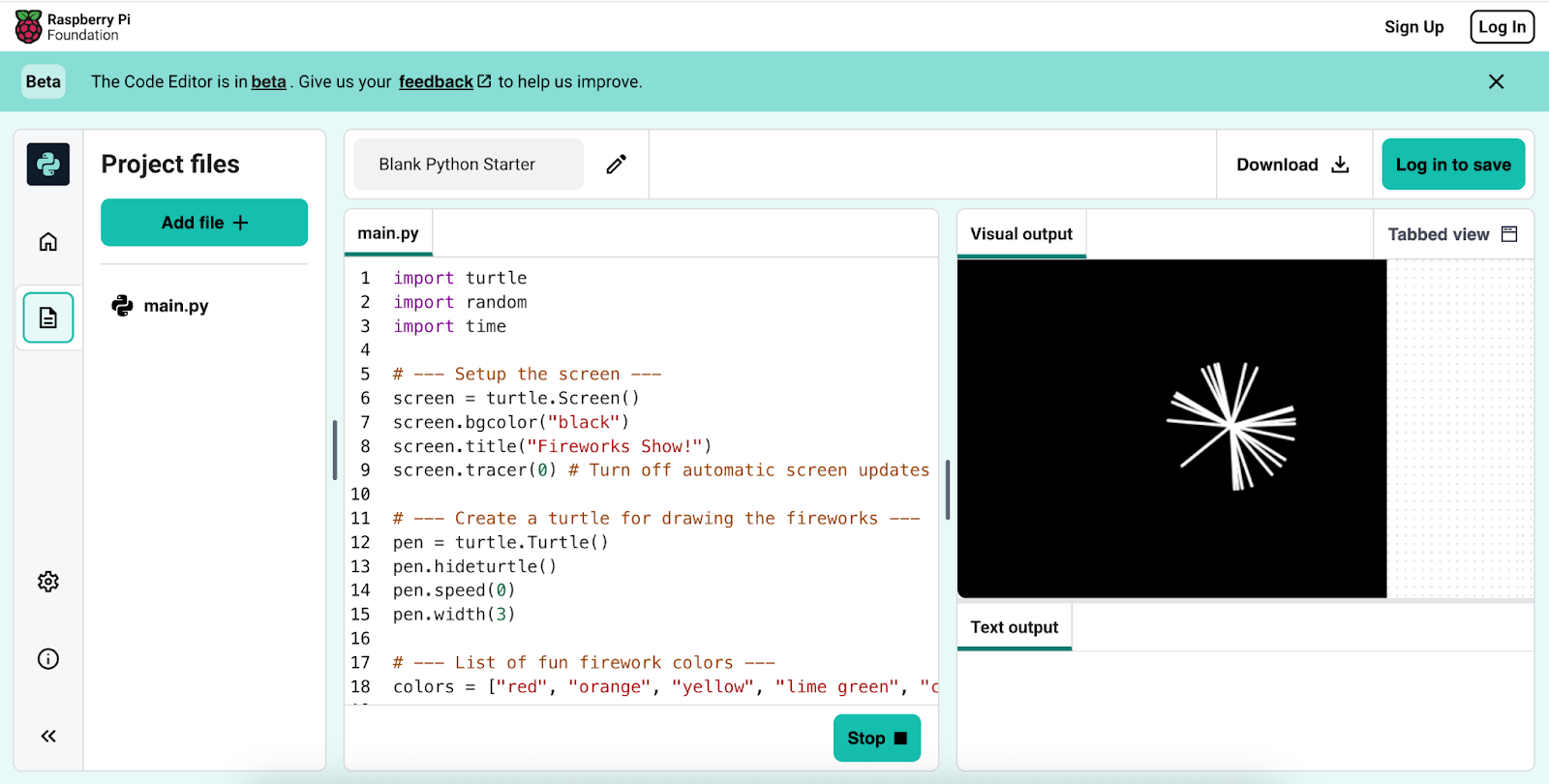
To complete the project, students used the Code Editor for Education. Created in collaboration with educators and built purposefully for the classroom, the Code Editor supports a range of teaching styles and learning abilities. Its simple interface encourages students to engage with the logic behind their code — they can’t rely on autocomplete.
Results
The open-ended structure led to an explosion of creativity and problem-solving.
Without step-by-step instructions, students had to independently explore solutions to questions like:
- “How do I randomise questions?”
- “How can I hide quiz answers in a separate file?”
Some students created multi-file Python projects, separating the logic controlling how the quiz worked from the content, or static information. For example, some students created one file to store the player’s answers and another file to manage the quiz interface and score logic. Students also created other advanced features:
- Score tracking based on speed of response
- Use of external Python libraries
- Custom input and output formatting
- Algorithms to randomly order quiz questions
All students met the base requirements, but the open-ended nature of the project allowed more advanced students to push the boundaries, without the need for additional scaffolding.
Educator reflection
“They couldn’t just Google the answer; they had to think critically and test ideas. That’s what made it powerful.”
Mr Mason noted that the project’s success was due in large part to the flexibility and responsiveness of the Code Editor. Students could iterate quickly, test their ideas, and collaborate, all within a platform built for classroom coding.
“It was the most successful thing I’ve done. I’ll definitely be doing it again every year.”
Key takeaways
- Project-based learning fosters deeper engagement and knowledge, and creative application of programming concepts.
- Open-ended prompts empower students to explore and develop their own solutions.
- Code Editor for Education encourages thoughtful questions and experimentation rather than reliance on autocomplete solutions. With built-in class management and project tools, it offers a safe, browser-based environment ideal for coding in the classroom.
Join St Joseph’s College and the 1300+ other schools helping their students build a strong foundation in text-based programming with the Code Editor for Education.
The post Fostering creativity through open-ended projects with Code Editor for Education appeared first on Raspberry Pi Foundation.
German Remote-Driving Firm Hopes To Make Private Car Ownership Redundant
votsalo writes: A German company, Vay, offers a rental car service where the cars are driven by a remote driver to the customer, who then takes over driving the car. At the end of the rental, a remote driver takes over again to take the car away. The trained remote drivers sit in a driving station, with a steering wheel, foot pedals, screens, headphones, and even tactile feedback for things like bumps on the road.
Vay says the rental rate cost would be “about half of what a current car-sharing service costs.” If he is talking about car-rental services that deliver cars to customers by on-site drivers, like this defunct San Francisco car rental company, then the claim about half the cost seems right.
Vay’s founder used Las Vegas as a testing ground for the service and expects to launch in Germany soon. Las Vegas “had the necessary legal framework already in place,” said von der Ohe, a graduate of computer science and entrepreneurship from Stanford. “It fitted on to three pages. Germany’s ran to many more, but we’ve worked closely with the authorities here to make sure we can fulfil everything that’s required of us, from technical to safety concerns. Now that the legislative landscape is in place, we’re raring to go.”


Read more of this story at Slashdot.
IXI’s autofocus glasses are one step closer to reality
Forget smart glasses, autofocus lenses have the potential to help far more people by offering a high-tech alternative to clunky bifocal and varifocal eyewear. Those traditional solutions involve looking at specific portions of glasses for near and far objects. While that’s more convenient than swapping frames constantly, it requires retraining your eyes a bit and can also lead to eye strain.
Finnish startup IXI’s autofocus glasses aim to go one step further: It has developed eyewear with built-in eye tracking and LCDs that can automatically focus on whatever you’re looking at, just like fixed frame glasses. Even better, they look just like regular eyewear, even more-so than Meta’s thick-framed Ray-Ban smart glasses. While IXI isn’t yet ready to start shipping its hardware yet, the company announced today that it’s one step closer to production by acquiring the lens manufacturing company Finnsusp and entering into a “long-term strategic partnership” with OptiSwiss.

IXI
While IXI isn’t the only company working on autofocus frames — we covered ViXion01’s Star Trek-esque glasses at CES last year — it’s the closest to bringing the technology to normal-looking spectacles. Sure, they’re not as flashy as Meta’s Ray-Ban lineup, and they don’t exactly scream high-tech, but IXI’s reserved approach could make its glasses more compelling to older audiences. Not everyone wants to look like a trendy supergeek, after all, but the idea of having glasses that could make your eyes feel decades younger practically is a huge draw.
IXI has developed “the world’s lowest power eye-tracking” to make its glasses possible, CEO and co-founder Niko Eiden told Engadget in an interview. The company stuffed tiny batteries into the thin frames of its glasses, which Eiden claims can last for a day of usage. The assumption is that you’ll charge them overnight by connecting a cable to their temple area (unfortunately, that also makes them too unwieldy to power up while you’re wearing them). If they do completely lose power, they’ll function purely as far-sighted spectacles.
With the Finnsusp acquisition, IXI will be able to begin low-volume production of its glasses for in-house testing, while the OptiSwiss partnership will eventually help it to scale for the mass market. Eiden says the company isn’t announcing pricing or availability yet, but he expects it to be in the “high end of existing glasses.” More so than Meta’s hyped-up smart glasses, IXI’s products are targeted at people who are already wearing glasses and who could quickly see the value of in autofocus lenses. Eye degradation comes for us all eventually.
This article originally appeared on Engadget at https://www.engadget.com/wearables/ixis-autofocus-glasses-are-one-step-closer-to-reality-060000152.html?src=rss
Pop!_OS 24.04 and COSMIC Betas Have Arrived — We’ve Got Screenshots
Cosmic’s Rust-powered debut is here! Dive into the revamped Pop!_OS 24.04 beta and get your first look at the modern desktop that’s rewriting Linux history.
The post Pop!_OS 24.04 and COSMIC Betas Have Arrived — We’ve Got Screenshots appeared first on FOSS Force.
Slopwatch: linuxconfig.org, linuxsecurity.com, and Google’s Promotion of the Worst and Most Prolific Slopfarms
Slopwatch will be relatively long for the simple reason that we found a lot of new LLM slop about “Linux”.
Valve Expands ‘Steam Link’ PC VR Streaming to More Headsets and Opens the Door to Android XR

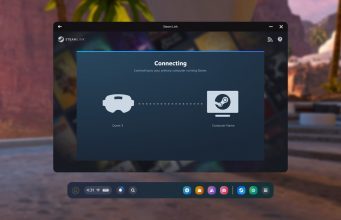
Valve today announced that it’s bringing its wireless PC VR streaming software, Steam Link, to five more headsets from PICO and HTC. The company also plans to make it easier for headset makers to bring Steam Link to even more headsets in the future.
The News
Valve has released Steam Link on the PICO Store and HTC’s Viveport store.
Supported Pico headsets include the Pico 4 Ultra, Pico 4 (and 4 Pro), Pico Neo3 (and Neo3 Link). The first supported HTC headset is the Vive Focus Vision, and Valve says support will be added for the Vive XR Elite “later this year.”
Steam Link makes it easy to play PC VR games by allowing supported headsets to connect wirelessly to a PC on the same network. Users can then access their library of PC VR content through the SteamVR interface, and delve deep into the largest library of PC VR games, many of which aren’t available on standalone headsets, like Half-Life: Alyx (2020).
As part of the announcement of Steam Link launching on new headsets, Valve said it also plans to release a Steam Link APK so that “other hardware manufacturers [can] validate Steam Link support on their headsets.” That should mean that future headsets will be able to more easily add support for Steam Link with little to no involvement with Valve.
Valve also said the APK will “allow users of unsupported headsets to explore compatibility and available features,” which means modders and tinkerers might be able to tap into Steam Link’s capabilities even on technically unsupported headsets.
My Take
Steam Link was first launched on Quest 2 and Quest 3 back in 2023. It was an unexpected move, but reaffirmed Valve’s commitment to make SteamVR accessible to as many headsets as possible. Adding support for a new wave of headsets shows that the company, despite its often glacial pace, still wants to make SteamVR a great platform for developers, users, and headset makers.
Compared to typical corporate behavior, Valve’s focus on making SteamVR as widely accessible as possible is shown to be a priority even higher than selling its own VR headset. In fact, Steam Link is the reason that Quest 3 became my main PC VR headset over Valve’s own Index headset.
While Pico headset support had been rumored for some time, the announcement of the forthcoming Steam Link APK release wasn’t something I saw coming.
This should make it much easier for headset makers to enable Steam Link support on their headsets, perhaps without even needing a thumbs up from Valve. This move appears to be in anticipation of future Android XR headsets, the first of which are expected to launch before the end of the year.
And it sounds like users will also be able to get access to the Steam Link APK, which means people will be able to experiment with sideloading and modding onto other headsets.
It’s unlikely (since the APK is for Android OS), but there’s at least a chance that someone could reverse-engineer it and make a derivative version that works on something like Vision Pro. That remains to be seen and will depend heavily on how open Valve is with the Steam Link APK and associated developer documentation.
If you want an idea of where Valve’s broader VR strategy is likely headed—including future VR hardware—I wrote an extensive analysis of the company’s recent and rumored VR developments earlier this year.
The post Valve Expands ‘Steam Link’ PC VR Streaming to More Headsets and Opens the Door to Android XR appeared first on Road to VR.
Shoplifters Could Soon Be Chased Down By Drones
An anonymous reader quotes a report from MIT Technology Review: Flock Safety, whose drones were once reserved for police departments, is now offering them for private-sector security, the company announced today, with potential customers including including businesses intent on curbing shoplifting.Companies in the US can now place Flock’s drone docking stations on their premises. If the company has a waiver from the Federal Aviation Administration to fly beyond visual line of sight (these are becoming easier to get), its security team can fly the drones within a certain radius, often a few miles.
“Instead of a 911 call [that triggers the drone], it’s an alarm call,” says Keith Kauffman, a former police chief who now directs Flock’s drone program. “It’s still the same type of response.” Kauffman walked through how the drone program might work in the case of retail theft: If the security team at a store like Home Depot, for example, saw shoplifters leave the store, then the drone, equipped with cameras, could be activated from its docking station on the roof. “The drone follows the people. The people get in a car. You click a button,” he says, “and you track the vehicle with the drone, and the drone just follows the car.” The video feed of that drone might go to the company’s security team, but it could also be automatically transmitted directly to police departments.
The defense tech startup Epirus has developed a cutting-edge, cost-efficient drone zapper that’s sparking the interest of the US military. Now the company has to deliver. The company says it’s in talks with large retailers but doesn’t yet have any signed contracts. The only private-sector company Kauffman named as a customer is Morning Star, a California tomato processor that uses drones to secure its distribution facilities. Flock will also pitch the drones to hospital campuses, warehouse sites, and oil and gas facilities. It’s worth noting that the FAA is currently drafting new rules for how it grants approval to pilots flying drones out of sight, and it’s not clear if Flock’s use case would be allowed under the currently proposed guidance.


Read more of this story at Slashdot.
System76 Releases COSMIC Beta Desktop Environment and Pop!_OS 24.04 LTS Beta
Linux hardware vendor System76 announced today the general availability of the beta version of their up-and-coming COSMIC desktop environment written in Rust, along with the beta version of Pop!_OS 24.04 LTS.
European Banks To Launch Euro Stablecoin In Bid To Counter US Dominance
Nine major European banks are creating a Netherlands-based company to launch a euro-backed stablecoin in 2026, aiming to counter U.S. dominance in the digital token market. Reuters reports: While global stablecoin issuance stands at nearly $300 billion, euro-denominated stablecoins totalled just $620 million, according to figures released last week by the Bank of Italy, with dollar-pegged tokens overwhelmingly dominant. “The initiative will provide a real European alternative to the U.S.-dominated stablecoin market, contributing to Europe’s strategic autonomy in payments,” the banks said. They launched the effort, which they said will create a token that can be used for quick, low-cost payments and settlements, even as the European Central Bank voices scepticism over stablecoins.
ECB President Christine Lagarde in June told European policymakers that privately issued stablecoins posed risks for monetary policy and financial stability. As a safer alternative, she has urged European lawmakers to introduce legislation backing the launch of a digital version of the EU’s single currency. Some commercial banks, however, have pushed back against the introduction of a digital euro, fearing that it would empty their coffers as customers transfer cash out of banks and into the safety of an ECB-guaranteed wallet. In addition to ING and UniCredit, the other banks participating in the new company include Banca Sella, KBC, DekaBank, Danske Bank, SEB, Caixabank, and Raiffeisen Bank International. They said that others could join the initiative, and a CEO for the company would be appointed soon. According to a recent report by Deutsche Bank, emerging market economies are adopting dollar-based stablecoins to replace local deposits and cash. “This has created a global monetary dilemma: countries should adopt stablecoins or risk being left behind. Europe is under particular pressure.”


Read more of this story at Slashdot.
Spotify Announces New AI Safeguards, Says It’s Removed 75 Million ‘Spammy’ Tracks
Spotify says it has has removed over 75 million fraudulent tracks in the past year as it works to combat “AI slop,” deepfake impersonations, and spam uploads. Variety reports: Its new protections include a policy to police unauthorized vocal impersonation (“deepfakes”) and fraudulent music uploaded to artists’ official profiles; an enhanced spam filter to prevent mass uploads, duplicates, SEO hacks, artificially short tracks designed to fraudulently boost streaming numbers and payments. The company also says it’s collaborating with industry partners to devise an industry standard in a song’s credits to “clearly indicate where and how AI played a role in the creation of a track.”
“The pace of recent advances in generative AI technology has felt quick and at times unsettling, especially for creatives,” the company writes in a just-published post on its official blog. “At its best, AI is unlocking incredible new ways for artists to create music and for listeners to discover it. At its worst, AI can be used by bad actors and content farms to confuse or deceive listeners, push ‘slop’ into the ecosystem, and interfere with authentic artists working to build their careers. The future of the music industry is being written, and we believe that aggressively protecting against the worst parts of Gen AI is essential to enabling its potential for artists and producers.”
In a press briefing on Wednesday, Spotify VP and Global Head of Music Product Charlie Hellman said, “I want to be clear about one thing: We’re not here to punish artists for using AI authentically and responsibly. We hope that they will enable them to be more creative than ever. But we are here to stop the bad actors who are gaming the system. And we can only benefit from all that good side if we aggressively protect against the bad side.”


Read more of this story at Slashdot.
AMD’s GAIA For GenAI Adds Linux Support: Using Vulkan For GPUs, No NPUs Yet
Back in March AMD announced the open-source GAIA software for GenAI but as noted in that former article, at launch it was limited to Windows-only support. AMD recently released a new version of GAIA with Linux support albeit in a rather interesting twist is limited to Vulkan acceleration…
Nintendo of America Boss Doug Bowser Is Retiring
Doug Bowser, president of Nintendo of America since 2019, will retire at the end of 2025 after overseeing major expansions including theme parks, films, and the launch of the Switch 2. He will be succeeded by Devon Pritchard, while Satoru Shibata will also take on a CEO role at Nintendo of America.
“One of my earliest video game experiences was playing the arcade version of Donkey Kong,” Bowser said in a statement. “Since that time, all things Nintendo have continued to be a passion for both me and my family. Leading Nintendo of America has been the honor of a lifetime, and I am proud of what our team has accomplished in both business results and the experiences we’ve created for consumers.” Pritchard said that “Doug has been a fantastic mentor” and that he looks forward to “building on the incredible foundation he has helped establish.”


Read more of this story at Slashdot.
New Altias Fusion track bike promises Olympic-level performance without the astronomical price tag
Premium track bikes are expensive. As per the UCI rules, equipment used in competition needs to be available to purchase.
So you can buy a Hope HB.T track bike frameset, as used by Matthew Richardson to break the 200m world record, from Hope, but it will cost you £30,000. The V-IZU TCM2 frameset ridden by the Japanese team at the Paris 2024 Olympics has a price listed at €126,000.
New Zealand-based Velobike Innovation is looking to offer a more affordable alternative, with its new Altias Fusion track bike frameset. It says it’s designed for Olympic-level performance, but in a frameset that’s competitively priced and accessible to the wider cycling community.
Starting at £5,300, the frameset’s price is comparable to many premium road bike framesets.
According to Glenn Catchpole, the founder of Velobike Innovation: “The Altias Fusion is the bike I’ve always wanted for myself. It combines all the best features of a traditional track bike while leaving room to embrace more progressive ideas in the future.”

Velobike Innovation describes track cycling as the Formula 1 of cycling, where countries spend millions on frames with cutting-edge features and ”if you don’t turn up with competitive equipment, you will be disadvantaged”.
At the 2024 Paris Olympics, the track bike arms race featured an array of exotic and very pricey equipment. However, just yesterday, the UCI revealed price caps for track cycling equipment for the 2028 Los Angeles Olympics, although the proposed values haven’t yet been made public.
Velobike points out that track bike design typically revolves around interchangeable components such as wheels and cranksets, while it says that its approach with the new Altias bike is to develop components designed to work together for maximum performance.
So the new bike system will, in the future, offer interchangeable forks, cockpits and aero components to suit the needs of specific track events.
Velobike says its approach also aims to futureproof its design, so that it can adapt to future developments and rule changes.

Specific design features of the Altias frame include a geometry that positions the rider as aggressively as possible, without contravening the UCI’s regulations. That’s paired with front-end components that can be swapped out, for example to reduce drag in a time trial or increase power delivery in the Keirin, and which can be custom designed for individual riders.
The Altias Fusion track frame will be available in size L from October, with three other frame sizes, S, M and XL, to follow in early 2026. Prices for the track frame start at £5,300 / $7,200 / €7,700, with the frameset available exclusively via www.altias.co.
Ubuntu Touch 20.04 OTA-10 Released, Adds Upgrader for 24.04 Migration
UBports releases Ubuntu Touch OTA-10 with a new upgrade tool, Rabbit R1 support, and minor fixes. 24.04-1.0 postponed over boot issues.
Neon Goes Dark After Exposing Users’ Phone Numbers, Call Recordings, Transcripts
An anonymous reader quotes a report from TechCrunch: A viral app called Neon, which offers to record your phone calls and pay you for the audio so it can sell that data to AI companies, has rapidly risen to the ranks of the top-five free iPhone apps since its launch last week. The app already has thousands of users and was downloaded 75,000 times yesterday alone, according to app intelligence provider Appfigures. Neon pitches itself as a way for users to make by providing call recordings that help train, improve, and test AI models. But now Neon has gone offline, at least for now, after a security flaw allowed anyone to access the phone numbers, call recordings, and transcripts of any other user, TechCrunch can now report.
TechCrunch discovered the security flaw during a short test of the app on Thursday. We alerted the app’s founder, Alex Kiam (who previously did not respond to a request for comment about the app), to the flaw soon after our discovery. Kiam told TechCrunch later Thursday that he took down the app’s servers and began notifying users about pausing the app, but fell short of informing his users about the security lapse. The Neon app stopped functioning soon after we contacted Kiam. TechCrunch found that the app’s backend services didn’t properly restrict access, allowing any logged-in user to request and receive data belong to other users. This included call transcripts, raw call recordings, and sensitive metadata, including phone numbers, the date/time of calls, and their durations.


Read more of this story at Slashdot.