
GraalVM has been an interesting and performant Java JDK that over time added support for additional programming languages and execution models. Following their 2022 announcement that GraalVM CE Java code would be donated to OpenJDK, Oracle recently announced that moving forward GraalVM will focus on non-Java languages…
Monthly Archives: September 2025
Researchers (Including Google) are Betting on Virtual ‘World Models’ for Better AI
“Today’s AIs are book smart,” reports the Wall Street Journal. “Everything they know they learned from available language, images and videos. To evolve further, they have to get street smart.”
And that requires “world models,” which are “gaining momentum in frontier research and could allow technology to take on new roles in our lives.”
The key is enabling AI to learn from their environments and faithfully represent an abstract version of them in their “heads,” the way humans and animals do. To do it, developers need to train AIs by using simulations of the world. Think of it like learning to drive by playing “Gran Turismo” or learning to fly from “Microsoft Flight Simulator.” These world models include all the things required to plan, take actions and make predictions about the future, including physics and time… There’s an almost unanimous belief among AI pioneers that world models are crucial to creating next-generation AI. And many say they will be critical to someday creating better-than-human “artificial general intelligence,” or AGI. Stanford University professor and AI “godmother” Fei-Fei Li has raised $230 million to launch world-model startup World Labs…
Google DeepMind researchers set out to create a system that could generate real-world simulations with an unprecedented level of fidelity. The result, Genie 3 — which is still in research preview and not publicly available — can generate photo-realistic, open-world virtual landscapes from nothing more than a text prompt. You can think of Genie 3 as a way to quickly generate what’s essentially an open-world videogame that can be as faithful to the real world as you like. It’s a virtual space in which a baby AI can endlessly play, make mistakes and learn what it needs to do to achieve its goals, just as a baby animal or human does in the real world. That experimentation process is called reinforcement learning. Genie 3 is part of a system that could help train the AI that someday pilots robots, self-driving cars and other “embodied” AIs, says project co-lead Jack Parker-Holder. And the environments could be filled with people and obstacles: An AI could learn how to interact with humans by observing them moving around in that virtual space, he adds.
“It isn’t clear whether all these bets will lead to the superintelligence that corporate leaders predict,” the article concedes.
“But in the short term, world models could make AIs better at tasks at which they currently falter, especially in spatial reasoning.”


Read more of this story at Slashdot.
Apple is reportedly nearing production for its latest M5-powered MacBooks
The latest Apple silicon is about to hit the assembly lines, according to Bloomberg‘s Mark Gurman. In the latest Power On newsletter, Gurman said that Apple “is nearing mass production of its next MacBook Pros, MacBook Airs and two new Mac monitors.” Gurman added that these upgraded products are scheduled for release sometime between the end of this year and the first quarter of next year.
Earlier this year, Gurman noted that Apple was expected to start production on the M5 MacBook Pro during the second half of 2025. All signs seem to point toward Apple following its typical release schedule, where the latest MacBook Pro makes its fall debut, followed by the reveal of the upgraded MacBook Air in the spring. However, Gurman previously mentioned in a July edition of his newsletter that “Apple is now internally targeting a launch early next year” for the MacBook Pro instead.
Beyond the upcoming MacBooks, we’re expecting one of the two Mac monitors to be the upgraded Studio Display. First released in March 2022, Apple’s Studio Display could use a refresh, which some rumors say will include a mini-LED display, along with overall improvements to brightness and color quality.
This article originally appeared on Engadget at https://www.engadget.com/computing/laptops/apple-is-reportedly-nearing-production-for-its-latest-m5-powered-macbooks-154148070.html?src=rss
Independent Distro KaOS Linux 2025.09 Arrives with Linux 6.16, KDE Gear 25.08
KaOS Linux 2025.09 has been released as the latest ISO snapshot for this independent Linux distribution built on top of the latest KDE software and using Arch Linux’s pacman package manager.
Million-Year-Old Skull Rewrites Human Evolution, Scientists Claim
The BBC reports that a million-year-old human skull found in China suggests that the human species “began to emerge at least half a million years earlier than we thought, researchers are claiming in a new study.”
It also shows that we co-existed with other sister species, including Neanderthals, for much longer than we’ve come to believe, they say.
The scientists claim their analysis “totally changes” our understanding of human evolution and, if correct, it would certainly rewrite a key early chapter in our history. But other experts in a field where disagreement over our emergence on the planet is rife, say that the new study’s conclusions are plausible but far from certain.
The discovery, published in the leading scientific journal Science, shocked the research team, which included scientists from a university in China and the UK’s Natural History Museum. “From the very beginning, when we got the result, we thought it was unbelievable. How could that be so deep into the past?” said Prof Xijun Ni of Fudan University, who co-led the analysis. “But we tested it again and again to test all the models, use all the methods, and we are now confident about the result, and we’re actually very excited.”
Thanks to long-time Slashdot reader sinij for sharing the article.


Read more of this story at Slashdot.
This Huge Box of 1,600 LEGO Bricks Is Selling at a Record Low Price, Black Friday Has Come Early

You’re getting two big LEGO brick boxes for nearly the price of one.
The post This Huge Box of 1,600 LEGO Bricks Is Selling at a Record Low Price, Black Friday Has Come Early appeared first on Kotaku.
Best Buy’s Weekend Flash Sale Brings Great Deals On Tech But It Ends Today

We still have a few weeks to go before the Black Friday and Cyber Monday sale events begin in earnest, but no worries, there are plenty of deals available right now. Major retailers are getting a jump on the holiday shopping season—Walmart is hosting a GeForce sales event with big discounts on graphics cards and gaming PCs, and Best Buy is
LEGO Just Released the 2025 City Advent Calendar, Selling for Pennies on Amazon at Launch

As we near the advent season, this deal will quickly disappear.
The post LEGO Just Released the 2025 City Advent Calendar, Selling for Pennies on Amazon at Launch appeared first on Kotaku.
California Now Has 68% More EV Chargers Than Gas Nozzles, Continues Green Energy Push
Six months ago California had 48% more public and “shared” private EV chargers than gasoline nozzles. (In March California had 178,000 public and shared private EV chargers, versus about 120,000 gas nozzles.)
Since then they’ve added 23,000 more public/shared charging ports — and announced this week that there’s now 68% more EV charger ports than the number of gasoline nozzles statewide. “Thanks to the state’s ever-expanding charger network, 94% of Californians live within 10 minutes of an EV charger,” according to the announcement from the state’s energy policy agency. And the California Energy Commission staff told CleanTechnica they expect more chargers in the future. “We are watching increased private investment by consortiums like IONNA and OEMs like Rivian, Ford, and others that are actively installing EV charging stations throughout the state.”
Clean Technica notes in 2019, the state had roughly 42,000 charging ports and now there are a little over 200,000. (And today there’s about 800,000 home EV chargers.)
This week California announced another milestone: that in 2024 nearly 23% of all the state’s new truck sales — that’s trucks, buses, and vans — were zero-emission vehicles. (The state subsidizes electric trucks — $200 million was requested on the program’s first day.)
Greenhouse gas emissions in California are down 20% since 2000 — even as the state’s GDP increased 78% in that same time period all while becoming the world’s fourth largest economy.
The state also continues to set clean energy records. California was powered by two-thirds clean energy in 2023, the latest year for which data is available — the largest economy in the world to achieve this level of clean energy. The state has run on 100% clean electricity for some part of the day almost every day this year.
“Last year, California ran on 100% clean electricity for the equivalent of 51 days,” notes another announcement, which points out California has 15,763 MW of battery storage capacity — roughly a third of the amount projected to be needed by 2045.


Read more of this story at Slashdot.
CachyOS: A Derivative Different from the Others
An analysis of CachyOS, the performance-focused Arch derivative that delivers real optimizations through x86-64-v3/v4 packages, the BORE scheduler, and specialized kernels. With 5-20% performance gains and strong gaming support, it proves derivatives can offer genuine innovation beyond simple installers.
Linux 6.18 To Deliver Many Notable Features For AMD CPUs
There is a lot coming for AMD processors with the Linux 6.18 kernel. Of the early pull requests submitted in advance of the planned Linux 6.17 kernel release later today, there are a number of changes already lined up with some exciting AMD CPU feature additions for the next kernel version. These AMD changes for Linux 6.18 are all the more important with that kernel expected to become this year’s Long Term Support (LTS) kernel version…
How to record a phone call on an iPhone
With iOS 26, Apple has expanded its native call recording feature with transcripts, Live Translation, summaries and tighter integration with Notes. It’s a more polished and useful tool than before, especially if you rely on your iPhone for interviews, meetings or important conversations.
Call recording itself first arrived with iOS 18.1 in October 2024. The feature has always been region- and language-dependent, and that hasn’t changed. If it’s available where you live, you can capture calls directly from the Phone app without third-party apps or hardware. If it’s not, there are still alternative methods worth knowing about. Here’s how it works, plus what to do if the option isn’t available in your country.
How to check if call recording is available
First, confirm that the feature is supported in your region. Apple maintains a feature availability page that lists countries where call recording isn’t offered, including the European Union, Saudi Arabia and South Africa. If your country is on that list, you won’t see the option in the Phone app.
Before recording your phone call, you’ll need the consent of the person on the other end of the line. When you start recording, both parties hear an audio notice stating that the call is being recorded.
How to record a call on iPhone
Recording a call is straightforward:
-
Open the Phone app.
-
Start or answer a call.
-
During the call, tap the More button.
-
Select Call Recording.
The call continues as normal, but the iPhone automatically saves the audio once you hang up or tap Stop. You’ll find all recordings in iOS’ native Notes app, inside a folder called Call Recordings.
How to play back, manage and delete recordings
To listen back, open Notes, go to the Call Recordings folder, and tap the file you want. Tap Play to hear it.
From here, you can:
-
Search: Tap the More button and select Find in Transcript.
-
Copy: Tap the More button and select Add Transcript to Note or Copy Transcript.
-
Save: Tap the More button and select Save Audio Files, then select where you want to save recording (another folder or app).
-
Share: Tap the More button and select Share Audio, then select how you want to share the recording
-
Delete: Tap the More button and select Delete. This deletes the recording and any related transcript.
How to transcribe your calls
If your region and language are supported, iOS 26 also transcribes calls. Open a recording in Notes, then tap Show Transcript and Summary. Processing might take a few moments, but once it’s ready, you’ll see the conversation broken down by speaker. From there, you can search the text, copy it into another note or tap a line to jump to that part of the audio. Apple warns transcripts may not be flawless, so double check to make sure important details are correct.
Apple Intelligence summaries
With Apple Intelligence switched on, you’ll also get a generated summary of the call. This is handy if you only need the highlights — for example, the action items from a meeting or the main points of an interview. Summaries appear alongside the transcript in Notes.
How to turn off call recording
By default, call recording is enabled on supported devices. If you don’t want the option at all, navigate to Settings, select Apps, then Phone, tap Call Recording and toggle it off.
Alternatives if call recording isn’t available
If you’re in a region where the built-in feature doesn’t appear, or you’re running a previous version of iOS, there are still other ways to record calls.
In the US, federal law dictates one-party consent. This means you can record a phone call as long as you are actively participating in the conversation. However, it is important that you check state laws (in the US) or relevant laws in your country before recording a phone call. Note that these options don’t integrate with Apple Notes or Apple Intelligence, but they give you a backup if the official method isn’t supported where you live.
-
Rev Call Recorder (US only) is free to use on your iPhone. There are no in-app ads or time constraints, allowing you to record high-quality audio via the app.
-
Google Voice (US only) lets you record incoming calls via the app by pressing “4” on the keypad. The audio file appears in your Google Voice inbox afterward. The function is restricted to incoming calls, and features will depend on the account you have.
-
External recorders: You can connect a small recorder to your iPhone through USB-C or Lightning, or place a digital recorder next to your phone on speaker mode. This keeps everything offline, but audio quality can vary.
-
Speakerphone: If you have access to multiple devices, you can place your call on speakerphone and simultaneously use a separate device with the Voice Memos app open to record your call. While the sound quality is unlikely to be on par with other alternatives, it is a feasible option.
This article originally appeared on Engadget at https://www.engadget.com/mobile/smartphones/how-to-record-a-phone-call-on-an-iphone-120058707.html?src=rss
Mistral’s New Plan for Improving Its AI Models: Training Data from Enterprises
Paris-based AI giant Mistral “is pushing to improve its models,” reports the Wall Street Journal, “by looking inside legacy enterprises that hold some of the world’s last untapped data reserves….”
Mistral’s approach will be to form partnerships with enterprises to further train existing models on their own proprietary data, a phenomenon known as post-training… [At Dutch chip-equipment company ASML], Mistral embeds its own solutions architects, applied AI engineers and applied scientists into the enterprise to work on improving models with the company’s data. [While Mistral sells some models under a commercial license], this co-creation strategy allows Mistral to make money off the services side of its business and afford to give away its open source AI free of charge, while improving model performance for the customer with more industry context…
This kind of hand-holding approach is necessary for most companies to tackle AI successfully, said Arthur Mensch [co-founder and chief executive of Mistral]. “The very high-tech companies [and] a couple of banks are able to do it on their own. But when it comes to getting some [return on investment] from use cases, in general, they fail,” he said. Mensch attributes that in part to a mismatch between expectations and reality. “The curse of AI is that it looks like magic. So you can very quickly make something that looks amazing to your boss,” but it doesn’t scale or work more broadly, he said. In other cases, enterprises simply might not know what to focus on. For example, it is a mistake to think equipping all employees with a chatbot will create meaningful gains on the bottom line, he said. Mensch said to fully take advantage of AI, companies will have to rethink organizational structures. With information flowing more easily, they could require fewer middle managers, for example.
There is a lot of work yet to do, Mensch said, but in a large sense, the future of AI development now lies inside the enterprise itself. “This is a pattern that we’ve seen with many of our customers: At some point, the capabilities of the frontier model can only be increased if we partner,” he said.


Read more of this story at Slashdot.
30 years later, I’m still obliterating planets in Master of Orion II—and you can, too
I love 4X games. I’ve tried other strategy game genres, but frankly, they don’t stick if they’re not first and foremost 4X games—at the heart of it, it must be about exploring, expanding, exploiting, and yes, exterminating.
I suspect that the first 4X game most people played was some entry in the Civilization franchise—though certainly, a select few played precursors dating back to text-based games in the 1970s.
But for me, the title that kicked off my obsession was Master of Orion II (MOO2)—a game that has you develop and build up planets across a simple galaxy map, researching speculative future technologies, and ultimately wiping out your opponents and claiming dominion over the known universe. (There are other victory conditions too, but that one is the most fun.)
Tiny RISC-V Development Board with WCH CH32V317WCU6 Available from $6.80
The nanoCH32V317 is a compact development board created by MuseLab to simplify prototyping and embedded system development. It integrates USB connectivity, Ethernet support, and a straightforward programming interface through USB Type-C, providing an accessible platform for engineers and hobbyists working with RISC-V microcontrollers. The board is powered by the WCH CH32V317WCU6, a RISC-V microcontroller capable […]
150 million-year-old pterosaur cold case has finally been solved
One hundred and fifty million years ago, the Solnhofen Limestones of Germany were covered in small islands and warm saltwater lagoons. Coral reefs flourished with crinoids, sponges, jellyfish, and crustaceans; Dragonflies buzzed above the water as small reptiles sunned themselves at the water’s edge. Pterosaurs and Archaeopteryx took to the skies, but there was trouble in this Jurassic paradise: Tropical storms would turn it into a pterosaur graveyard.
What paleontologist Rab Smyth found in this graveyard finally revealed why so many fledgling pterosaurs had succumbed to the storm. Smyth, a researcher at the Center for Paleobiology and Biosphere Evolution at the University of Leicester, unearthed two Pterodactylus antiquus hatchlings, and their bones showed exactly how they had succumbed to storm winds. The wings of both specimens (ironically named Lucky I and Lucky II) revealed clean, slanted humerus fractures that suggested they had been twisted in the storm. Unable to fly, they drowned and were rapidly buried in the lagoon depths.
“Our results show that most pterosaurs are preserved predominantly through catastrophic events, often reflecting mass mortality episodes,” Smyth and his research team said in a study he led, recently published in Current Biology.
These are the best budget cycling shoes under £120 for beginner cyclists
If you’re looking for a decent pair of cheap cycling shoes due to a limited budget, then look no further.
We’ve rounded up a selection of cheap road and mountain cycling shoes priced under £120 to help you find the right pair for your performance requirements and budget.
£120 might sound like a lot of money, and for many riders it is. However, it’s around the point at which upgrades begin to become more marginal. And, in any case, most of the options listed below are regularly available for substantially less than their RRP.
If you’re not limited by budget, check out our guides to the best cycling shoes and mountain biking shoes, as rated by our expert testers.
We have separated this list into road bike and mountain bike shoes, though bear in mind that the SPD design found on mountain bike shoes may be a better choice for those starting out with clipless pedals.
Editor’s note: This list was updated on 26 September 2025, with all new entries from our best road and mountain bike buyer’s guides.
Best cheap road cycling shoes in 2025
Bontrager Solstice
SQUIRREL_TEXT_13111489
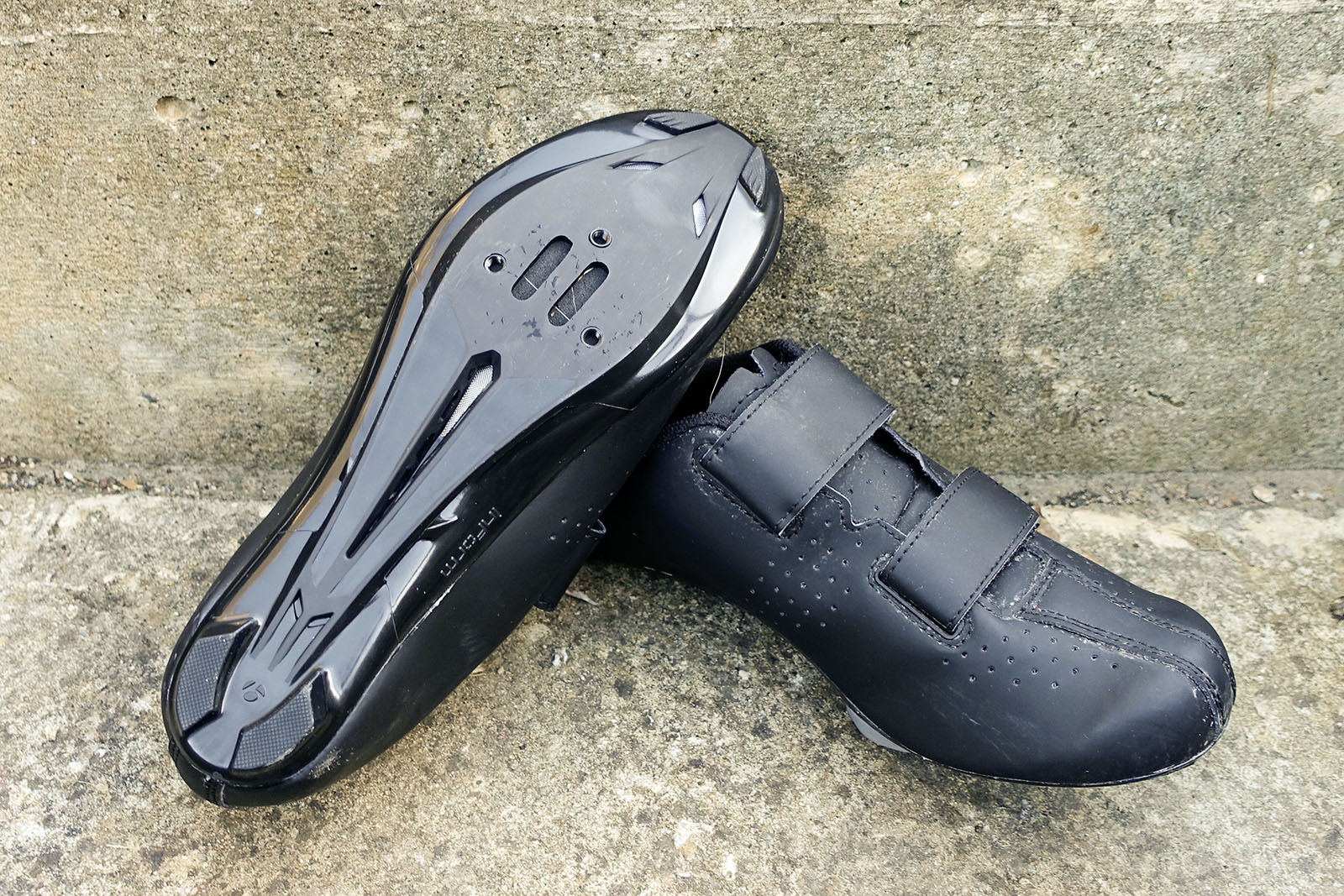
- £100 / $85 / €105 / AU$105 as tested
- Pros: Compatible with SPD-SL and SPD cleats; light for the price; good value for money
- Cons: Not the best ventilation
Bontrager’s Solstice is well-priced and offers great comfort in a simplistic form factor.
The shoes feature velcro closure straps and a moderately stiff nylon sole that make for an adjustable and wide-ranging fit.
Compatible with SPD-SL and SPD cleats, the Solstice give options for riders who are new to clipless pedals. Although keep in mind, the two-bolt cleat adaptor is not included.
The weight per shoe of 227g in EU42 is competitive.
Our tester found the shoes to be comfortable on long rides, but felt the ventilation was lacking on warmer days.
- Read more: Bontrager Solstice road cycling shoe review
SQUIRREL_13111489
Triban GRVL 500
SQUIRREL_TEXT_13112279
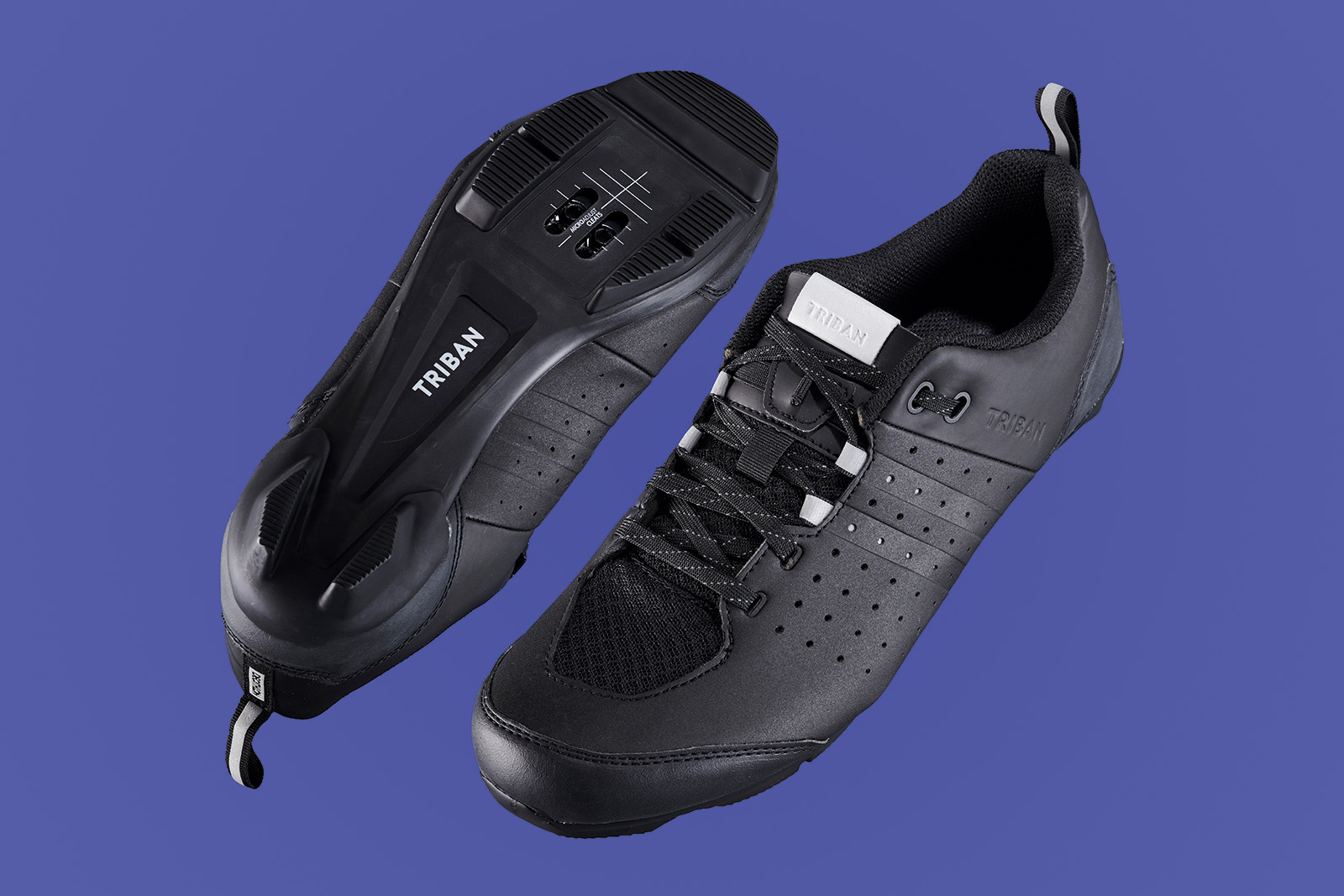
- £50 as tested
- Pros: Well-priced; good adjustability from laces; SPD-compatible
- Cons: Heel raise limits performance
The Triban GRVL 500 offers incredible value, with a variety of features seen on shoes twice its price.
While the shoe is stiff, it doesn’t feel punishing and makes it a great option for road cycling, gravel riding and commuting.
The fibreglass reinforced sole is compatible with two-bolt SPD cleats and has grippy sections for walking.
We did the heel raise when walking or riding out of the saddle was a setback.
- Read more: Triban GRVL 500 shoe review
SQUIRREL_13112279
Best cheap mountain biking shoes in 2025
FLR F-57
SQUIRREL_TEXT_13148407
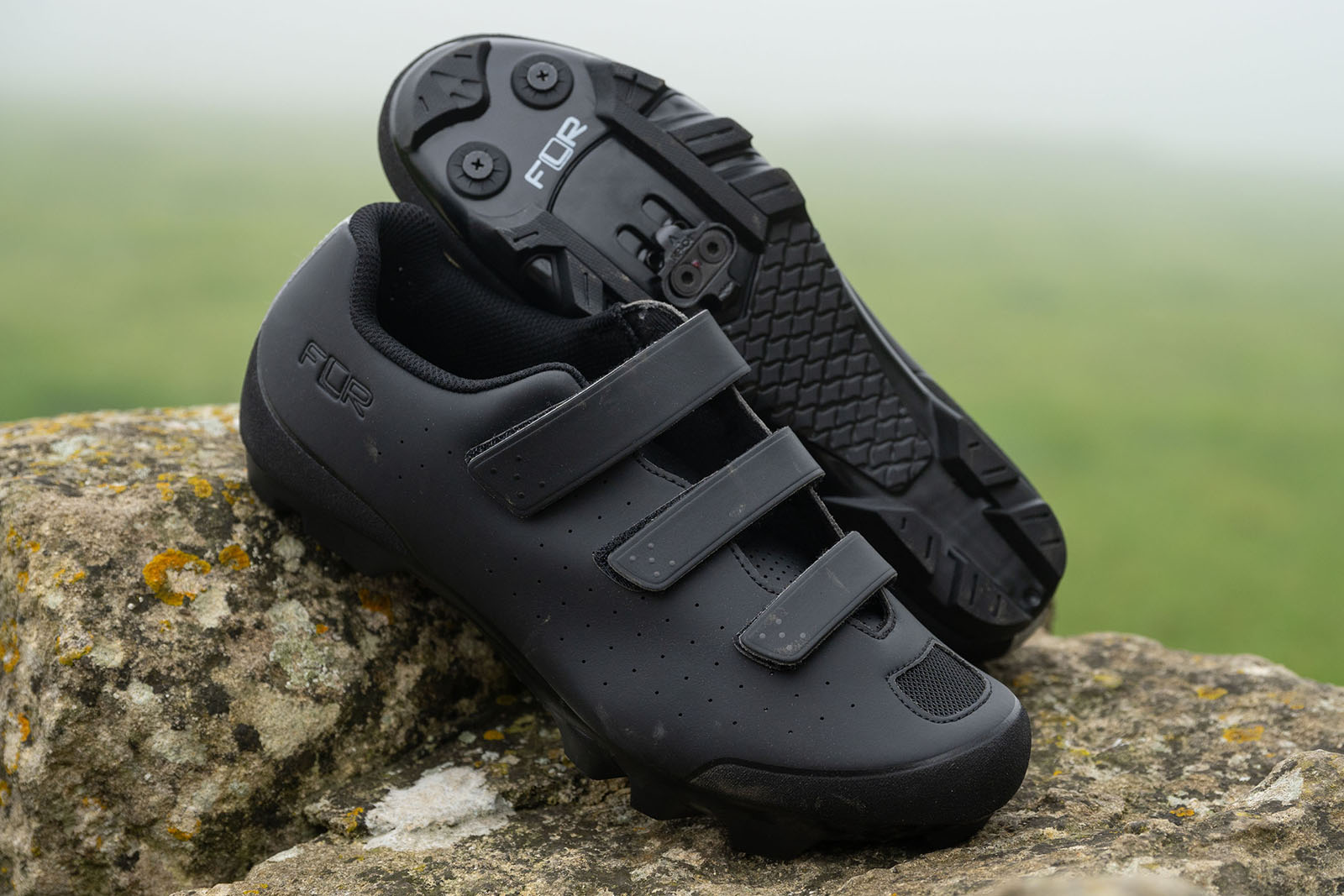
- £70 / $70 as tested
- Pros: Good fit; great value; good off the bike
- Cons: Velcro fasteners need to be kept clean
FLR’s F-57s are a well-designed XC shoe, with impressive comfort and great pedalling characteristics that make for an excellent all-rounder.
We found the aggressive tread lugs offered great traction for off-the-bike walking, especially on slick shoots.
We weren’t a fan of the velcro closure, which lost its adhesion in muddy conditions.
- Read more: FLR F-57 review
SQUIRREL_13148407
Shimano GF400
SQUIRREL_TEXT_13148411
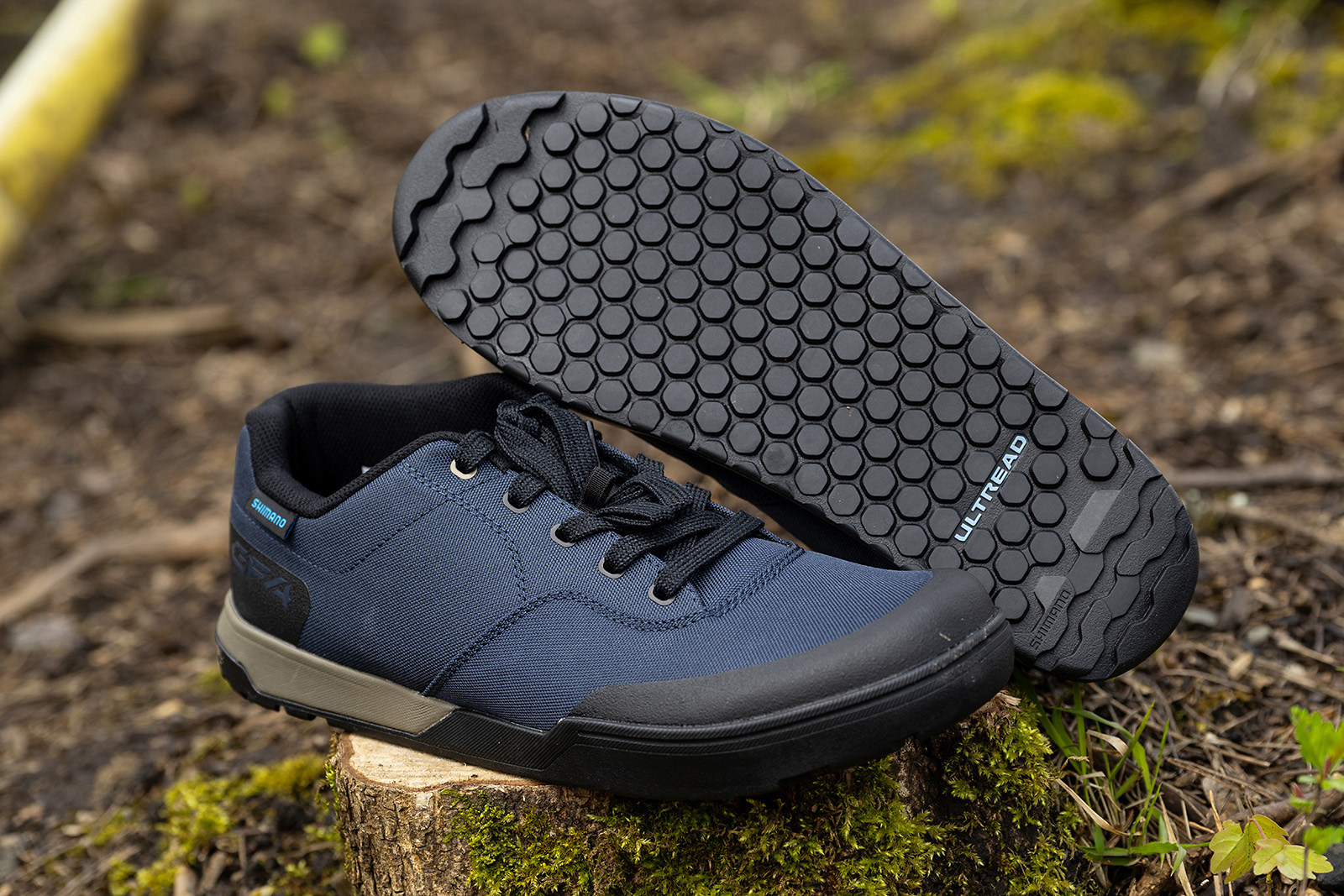
- £120 / $120 / AU$150 as tested
- Pros: Great traction, secure feel; well-priced
- Cons: Could have ankle support
The GF400 has grip levels that keep your feet secure on even the choppiest section of trail.
They have a snug fit, which limits movement inside the shoe, making them feel confident on the pedals when going through rough terrain.
There isn’t a lot of ankle protection, with the inside cuff not quite high enough to keep the cranks from hitting your ankle.
Despite this, they make a good gravity-inspired option for those looking for flat shoes.
- Read more: Shimano GR400 review
SQUIRREL_13148411
Shimano GE5
SQUIRREL_TEXT_13215148
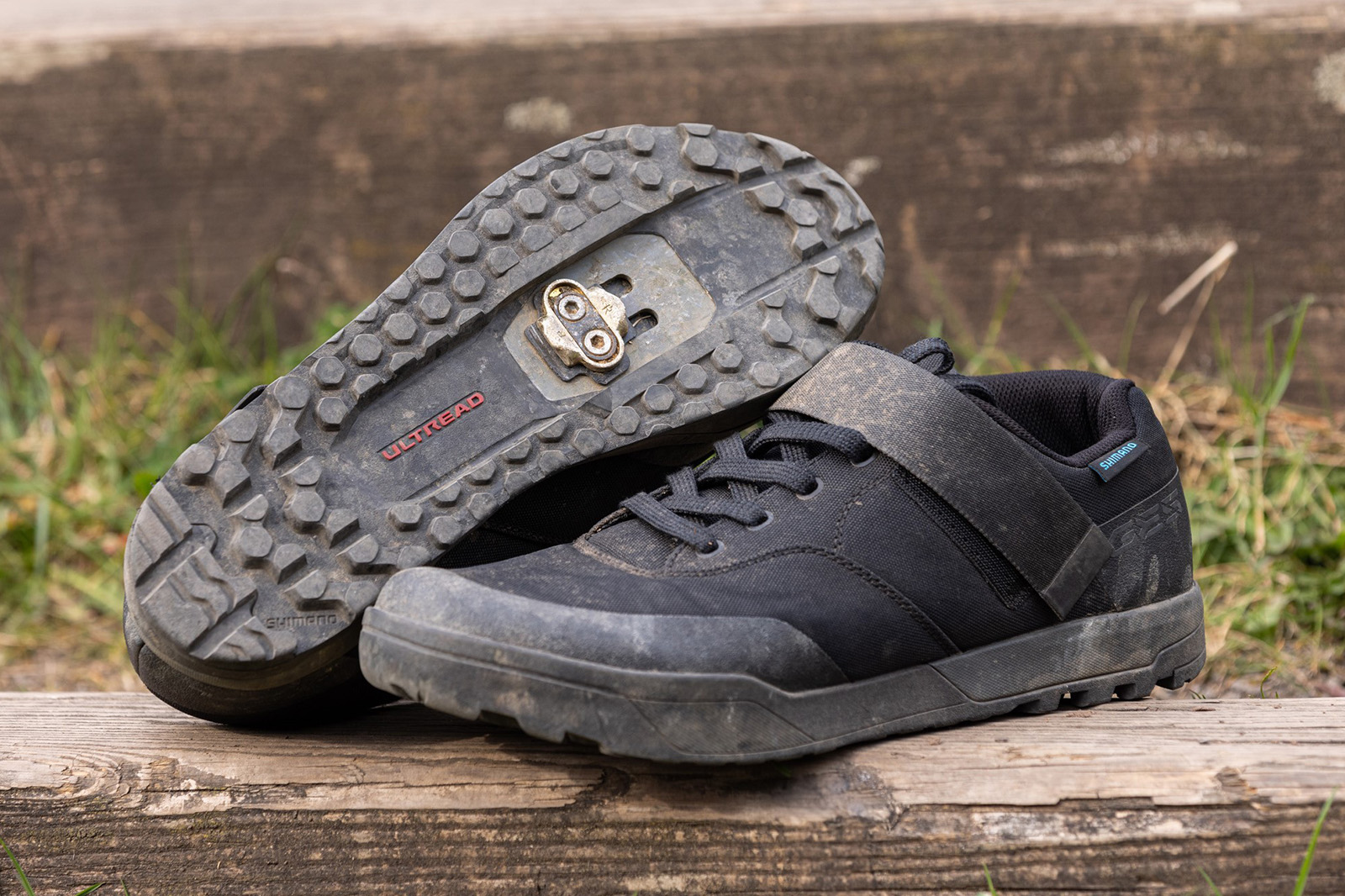
- £120 as tested
- Pros: Great feel; well-thought-out fit; simple design; good value for money
- Cons: Broad toe box requires careful cleat positioning; sole could be stiffer.
The GE5s are incredibly comfortable on the bike, with the flexible upper and broad toe box letting your feet move freely.
The Torbal 2.0 technology adds flex where you need it most while riding, although we found that the sole could be slightly stiffer.
Both sides of the ankle receive extra padding thanks to the asymmetric design, keeping your feet safe from loose rocks and crank strikes.
We were impressed with the shoes’ off-bike performance, with the tread lugs helping to find traction when pushing up steep shoots.
SQUIRREL_13215148
Cryptography Performance Improvements Coming For Linux 6.18
Adding to the list of pull requests submitted early in advance of the Linux 6.18 merge window opening are several cryptography-related improvements. In particular, some nice performance optimizations once again for the Linux kernel…
The oneAPI Construction Kit Drops Support For Vulkan
Introduced two years ago was the Intel/Codeplay oneAPI Construction Kit for helping to bring SYCL support to new hardware. As part of that the oneAPI Construction Kit was brought to RISC-V and other platforms. Out this week is now oneAPI Construction Kit 5.0 and sadly it drops Vulkan API support…
Debian 13 Nvidia Driver Installation
The NVIDIA GPU drivers are essential for utilizing the full capabilities of NVIDIA graphics cards on Linux systems. Whether you’re setting up a bare metal Debian installation or configuring GPU passthrough in a virtualized environment, the driver installation process remains consistent. This guide will walk you through installing the proprietary NVIDIA drivers on Debian 13 (Trixie), ensuring your graphics card is properly recognized and functional for gaming, CUDA computing, or professional workloads.